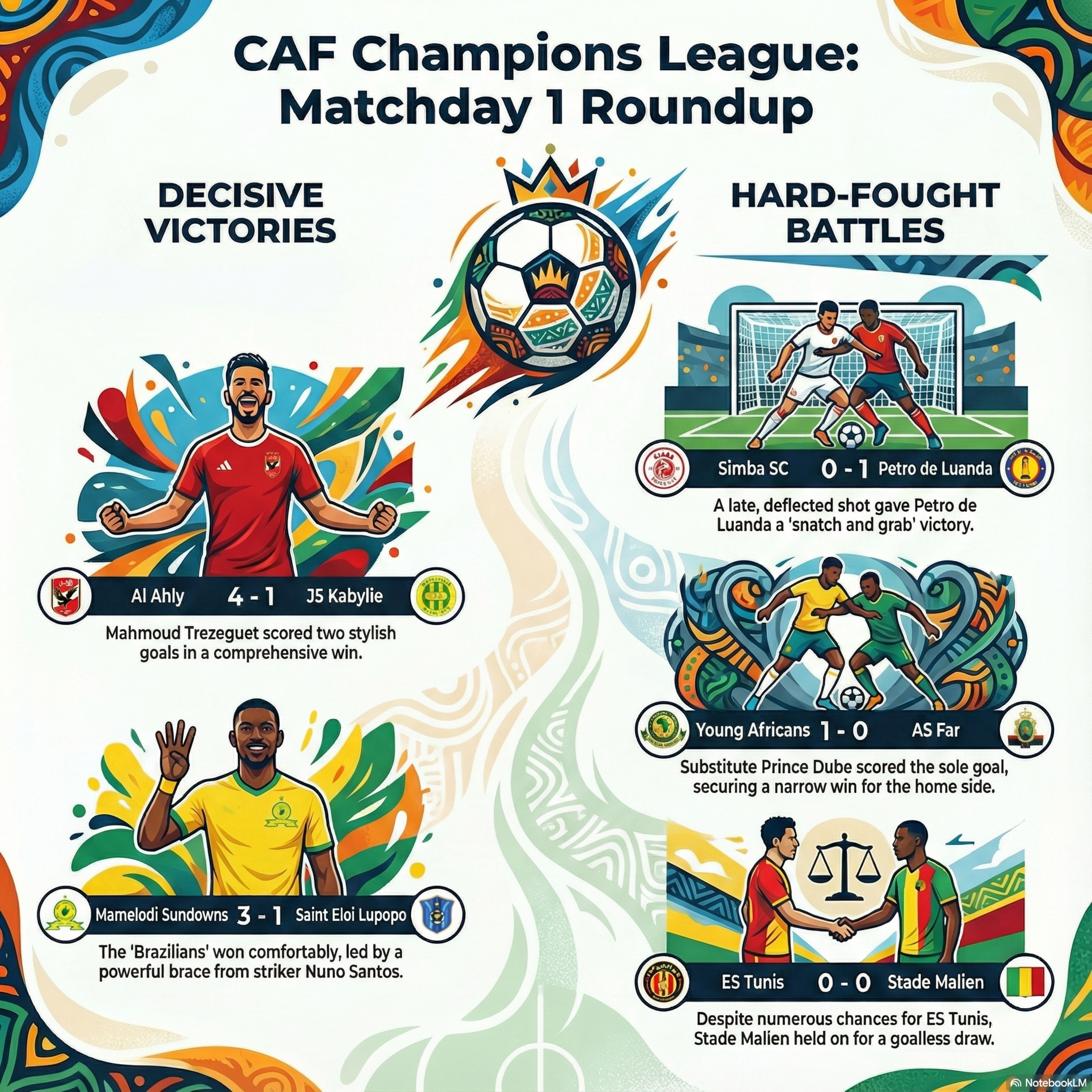
CAF Champions League Matchday 1 Roundup
About this episode
CAF Champions League Matchday 1 Roundup
Listen now on Spotify, Apple Podcasts, Amazon and other streaming services! Don’t forget to subscribe, share, and leave a ⭐⭐⭐⭐⭐ review to help more players and coaches discover the power of Techne Futbol and Data Technology in the beautiful game.
#TechneAfricaFutbol #TechneFutbol #TrainWithTechne #Playermaker #TraceFutbol #Hudl #FootballTech #FootballInnovation #PlayerDevelopment #CoachTools #SmartFootballTraining #AfricanFootball #CAFOnline #FIFA #FIFAYouth #CAFDevelopment #YouthFootballAfrica #NextGenFootball #FootballScouting #TalentIdentification #DigitalScouting #EliteYouthDevelopment #FootballJourney #FootballAnalytics #FIFAForward #FutebolAfricano #TrainTrackCompete #FootballExcellence #FootballAfrica #TheFutureOfFootball
Welcome, welcome, welcome. You can absolutely feel the electricity, can't you? This is the deep dive, and today, forget the highlights reel where you're going deep. Very deep. We're talking about the tactical DNA of African club football. We are slicing right through the noise, you know, looking past the final score lines for a moment to uncover those hard won secrets. This obsesses and, just as importantly, the failures. That's it. We're trying to figure out what really defines continental excellence.
And the material we're looking at, it's phenomenal for that. It's not just a review of who won, it's a real steady and contrast. How so? Well, you see the systematic, almost suffocating dominance of the giants on one side, and then on the other you have these stunning, surgically precise performances from teams who just refuse to be broken down. I love that. So our mission today really is a master class in coaching. We're dissecting the tactical triumphs, the goal scoring glory and yeah, the defensive drama.
To understand what we can actually extract, what are the lessons here that can elevate the game across the entire continent? Exactly. We're going to systematically breakdown these recent clashes. We're focusing on technical skill under pressure, on managerial discipline, and this is the big one for me, how the mental game really dictates success. We're looking for concrete, repeatable lessons. I mean, how do you really maintain control when the stakes are at their highest? What are the actual mechanics of a successful high press?
Or how do you hold a low block for 90 minutes without, you know, just fracturing under the pressure? Precisely so. We'll structure this in three parts, 1st dominance, then resilience, and finally decisive game management. I think we should just jump right in. Let's do it. I love that structure. So let's start at the top. Section 1, the blueprint of dominance. And here we're looking at 2 powerhouses, Al Lily and Mamaliti Sundowns. They both control games, but, well, they do it in really different ways.
Fundamentally different and that offers vital lessons in structure and, I think, persistence. Let's start with Al Lily, then a four one victory over JS Kabili. On paper, that sounds like an effortless afternoon. Yeah, but the analysis shows something completely different. It was a pure pressure cooker environment. The result wasn't easy. It had to be violently forced. That's the key distinction, isn't it? Al Ali's blueprint is all about volume and velocity. Absolutely. Their whole approach is designed to overwhelm you almost by statistical inevitability.
We saw just a sheer volume of attacks and a real commitment to having multiple men constantly flooding the box. So they're not prioritizing patients. No, not at all. They're prioritizing acceleration. Chaos. Almost. And what's so fascinating is that this relentless approach, it actually creates tactical inefficiency, especially early on. You know, we saw them looking threatening, but a lot of that threat came from these ambitious long shots when maybe a better, cleaner option was available inside.
Well, it's a strategic calculation. They're trading those high percentage shots for sustained momentum, That overwhelming attack. It's intended to compress Kaboli space and just accelerate their defensive exhaustion. You force quick decisions, you force mistakes, and you accept that some of your own chances will be rushed. So the defense never gets a chance to breathe. Never. They can't reset their shape, they can't organize a clean exit. The pressure is just constant. But this leads us directly to a crucial lesson, even for the elite teams.
Let's call it the wasted opportunities lesson. For all that power, Al Ali really struggled with their clinical finishing in those opening stages. They absolutely did. When the pressure was highest, the composure just seemed to vanish. We have to highlight Mahmoud Trezegate. He swung and completely missed what was described as a glorious opportunity. And this wasn't a half chance, was it? Not at all. The structural work was done. The pass was perfect. That failure wasn't tactical, it was purely a matter of technical execution under maximum duress.
And you see that so often. You do. For anyone watching that specific miss, it just underscores A continuous hurdle for teams across the continent. The ability to create the chance is world class. The ability to convert it, that's often the limiting factor. OK, but I have to push back a little on that. If the whole tactical approach is to flood the box and rush the play, doesn't that inherently increase the chance of a technical failure Like that Is Al Ali's system, you know, this chaos system partially to blame for that early wastefulness?
That's a brilliant point, and yes, it's a paradox of dominance. By creating mental chaos for the defense, you absolutely risk creating it for your own attackers too. They're all operating the same high stress environment. Exactly. But, and this is key, Trezegate being a star player show the required resilience. When the intended blueprint stalled, he adapted. And that is the key adaptation. Trezegat gets the breakthrough, but through completely unexpected means. This is a player who is not known for his aerial ability.
He thrives on the ground with flair. And yet he scores a crucial headed goal. He took it absolutely superbly and, as the notes say, knew exactly where to place it. That gave Ali the lead. Let's break that moment down because it's a huge lesson. It is. It's a failure of Kabailey's marking for sure, but it's a triumph of Trezegage positional intelligence against the run of expectation. He drifts into the middle. He's exploiting A momentary lapse. Probably one of the center backs got dragged wide by that persistent threat on the flank.
And he just reads the play better than anyone else. He reads the cross, gets his head over the ball and directs it with purpose to the far post away from the keeper. That's pure game intelligence. The defender expects you to cut in size. You attack the space they aren't even looking at. And that opportunistic yet highly technical moment broke the deadlock. It did, and once that lock was broken, you saw the intended synergy finally start to flow. Yeah, the second goal was pure textbook. It was described as absolutely spot on from open play.
Ben Sharkey, who was hungry and focused all game, finds Sheriff with perfect timing. And that is the reward for persistent wide play. Ben Sharkey didn't let the earlier struggles, you know, the missed chances and the frustration diminishes effort. He held his with, waited for the perfect moment and delivered a ball that split the collapsing defense. It's a systematic lesson, really. It is sustained pressure forces exhaustion. When the defense gets tired, there's spatial awareness degrades and that's when you see those clean cut channels open up for the through ball.
And that's when the dominant team has to be ruthless. You have to strike quickly and to close the game. Trezegat gets his second, the 4th of the night, securing that comprehensive win. It wasn't just momentum by then, it was pure composure. He gets his head over the ball after a touch from tar, sweeping it into the far corner. And that's the difference between a good team and a great one. The game is already one, but they maintain that technical detail, that assurance goal. It reinforces the standard.
It's a statement. It is getting your head over the ball like that ensures it stays down, accelerates into the corner, unsavable. And in a group stage competition, that goal difference is tactically invaluable. It gives you more flexibility down the line. So Ollie's blueprint is high risk, high reward. It demands almost unsustainable technical excellence. But when it clicks. They are unstoppable. OK, so now let's contrast that high velocity, overwhelming style with Memelodi Sundowns. They got a three one win against Santa Loda Gupo, but their dominance looked, well, methodical, almost surgical.
Sundowns are the Brazilians for a reason. They are, and I quote, happy to play possession football. The material really highlights that methodical approach. You have the Chilean playmaker AND spreading the ball wide to mood out. It's control first. It's control first, spatial manipulation second, and penetration third. They use possession not just to keep the ball, but to move the opposition structure. They force defenders to constantly shift, and that's what creates those little micro gaps. And that patient, structural play, It paid off early.
Nuno Santos scored a brilliant stretch. A clinical goal, yes, but the notes say the defense was caught napping. Completely unmarked. How does that happen at this level? This is the danger of facing a true possession team. Lopopo likely got fatigue or maybe just mesmerized by the lateral passing and for a split second they switched off. Thinking they were safe. Exactly. They thought they were safe in a period of controlled passing, but Sundowns can instantly transition from lateral control to vertical incision.
Santos's positional awareness was key. He wasn't just waiting, he was anticipating that defensive lapse. So by the time the pass came, the work was already done. Pretty much the awareness coupled with the precision of the pass meant that even though he still had work to do, it was a high percentage chance derive from meticulous control. The artistry of their midfield was so clear. We have to talk about Rosino, described as an artist with that left boot. He delivered a delightful ball that hit the bar, setting up a free header for Matthews.
And Rosino is the perfect example of that methodical playmaker. The weight on the ball, the spin, the delivery. That's what unlocks even the tightest, deepest low blocks. He sees the geometry that others just don't. But we have to pause there because the subsequent free header. Missed by Matthews. Missed. And that brings us right back to our Wasted Opportunities theme. Bizeno executes the perfect technical delivery, creates an uncontested chance, and yet the execution fails. It just shows that even in the most organized systems that individual technical refinement in front of goal is still the bottleneck.
That specific missed header was a huge tactical escape for Lupopo, a massive let off. And yet Sundowns adapted when patients wasn't leading to conversion, they just ramped up the intensity. The notes say the high press was pinning Sailor Defense back in the defensive third. Let's stop there. What does that high ress actually look like for Sundowns? Good question. When we talk about Sundowns high ress, it's not some chaotic chase, it's a structure. They use what are called cover shadows, essentially positioning their forwards and midfielders to block the immediate passing lanes into the center, forcing Lupopo to go wide or long.
So they're dictating the play even without the ball. Precisely. They were often man oriented in that final third, specifically targeting Lipopo's holding midfielders and center backs, denying them any time or space. And that constant pressure, it leads to psychological strain. And that strain paid off Marcelo Andy restored the lead on the hour mark and it was noted as a non powerful but perfectly placed shot. And that goal is the perfect counterpoint to Al Ali's volume approach. AND wasn't relying on raw power.
He was relying on precision. He was capitalizing on the mental exhaustion caused by having to defend in your own 3rd for so long. The. Defense was scrambling. Scrambling out of position and likely tired from dealing with that press for an hour. In that moment of fatigue, placement beats power every time. High intensity and structured pressure restore their momentum. That's a master class and exploiting an opponent's degradation. And finally Nuno Santos with the assurance goal, a bullet header for the three one win, capitalizing on a burst of speed from Matthews and a lovely ball in.
And this goal is the final punctuation mark. It shows a blend of all their attributes. Matthews of speed bottom the space on the wing, the lovely ball man was perfectly weighted and Santos delivered a bullet header. Notice the difference? Pure focused power. Unlike Trezagate styled header, this was about securing the result with authority. That blend of control from the midfield, intensity from the press and power in the final finish, that's the complete blueprint of dominance. So 2 paths to the same end.
Sundowns show that methodical control can be just as effective as overwhelming volume, but only if you have the technical quality in that final action. Wow. OK, so the lesson from Section 1 is clear. Multiple routes to dominance, but both require relentless application and, crucially, a way to overcome that psychological barrier of wasted chances. And that sets us up perfectly for Section 2. The resilience equation. If the first section was about how giants win, this is about how the determined underdog survives.
We're talking defensive discipline, goalkeeping, heroics and the critical role of fine margins. This is the section for any club looking to climb the ranks because dominance is a luxury. But resilience, Resilience is a necessity. We're looking at tactical rigidity as a weapon. We have to start with ES Tunis. The Tunisian giants four time champions against Stayed Marion, a 00 draw. Tunis was dominant in every single statistic, but they just couldn't convert. Why did the wall hold? The wall held because it was a low block executed with almost perfect discipline.
Marion likely set up in a compact 541 or 451. Their strategy was simple. Deny any central penetration. Force Tunis to either shoot from outside the box or rely on difficult crosses into a crowded area. And when you look at the chances they missed, it shows that strategy worked. It absolutely does. I mean, the missed chances were high quality. Yasin Marriott was unmarked at the far post and missed a volley. Florrie and Daniel missed an open shot that should have been buried. But those misses are the direct result of mental and spatial pressure.
Think about Marriott's volley. Yes, he was unmarked, but the time he thought he had was an illusion. What do you mean? The defense, by forcing the cross to come from a deep or difficult angle, ensures the ball arrives at an awkward height, maybe with an awkward spin. The concentration required to execute a perfect volley when the goal is insight after maybe 85 minutes of chasing shadows is immense. And Daniel's miss. That was likely from visual clutter. When you have 9 layers behind the ball, your perception of the target, the goal begins cluttered.
It can lead to rushed, poor decisions. In a way, the defense won that battle before the shot was even taken. But the real hero of this resistance was the goalkeeper. Absolutely. Triore's performance for Staid Marion was immense, particularly that fantastic save from a point blank effort by the 19 year old Connotay. Triary wasn't just physical, he was psychologically decisive. That point blank save on Konichi was a massive statement. In a low block, the goalkeeper is your essential shock absorber and that save it wasn't just a reaction, it was proactive positioning.
He read the play. He anticipated Conez's body shape and made sure he was occupying the maximum amount of goal space. That single moment completely stalled the Tunisian giants and psychologically reinforced the belief in the Marion defensive line. It told them we can hold this. And every subsequent attack from Tunis is now laced with a little bit of doubt. Exactly. So the lesson in resistance is clear. Tactical rigidity and a strong decisive goalkeeper are non negotiable for mid tier teams aiming for these kinds of upsets.
They forced the four time champions to settle for a draw. Resistance is an active pursuit. That's a great way to put it. They didn't just sit back, they consistently dictated where Tunis could attack from and then neutralize the final shot through discipline and a world class keeper. ES Tunis failure was tactical. They couldn't find a way to draw Marian out of their shell. They just kept increasing the volume volume of ineffective attacks. OK, so let's look at moments where that resilience turned into a genuine offensive opportunity.
The puncher's chance. Let's go back to Lupopo's equalizer against Sundowns, right? Sundowns were completely dominant, but Lupopo scored completely against the run of play the striker Ghashala just before halftime. This is the critical moment where dominance can cost you. Sundown's high press requires massive energy and Lupopo exploited that one split second lapse. Kashala delivered a classic goal. Poachers goal. He wasn't even involved in the build up, no. He was just anticipating, anticipating the transition, anticipating the single mistake that high pressure can eventually force the pressing team to make.
It's the ultimate psychological disruptor. You dominate for 40 minutes, concede right before the break, and suddenly your rhythm is broken. Your halftime team talk is completely different. Absolutely. The tactical lesson here is about managing that transition phase when you lose possession. Sundowns being so high up the pitch, we're vulnerable to that immediate vertical ball. Kashala's goal highlighted that even a few seconds of disorganization at the back can undo 40 minutes of sustained pressure.
So for teams looking to survive, that puncher's chance relies on one striker being permanently box savvy. And ready to seize that one moment of opportunity. We saw a similar thing, a brief psychological revival for JS Kabali against a law. Their goal, which have the deficit, came from a deflection off the keeper, standing foot and own goal. And that deflection, it created a different game on our hands, even if it was only for a short while. It shifted the score from 30 to 3/1. It was pure luck. It was luck, but it was luck created by persistence, A ball that should have been dealt with cleanly but the deflection off the keeper's foot.
A tragic individual error suddenly shifted the psychological scale. It just proves that even against the Giants, capitalizing on small errors can give your team a critical shot of adrenaline. The collective gasp you hear in the stadium when that happens, it's palpable. It is. It confirms that the greatest weapon a resilient team has is the opponent's individual mistake under pressure. Pressure doesn't just force team errors, it forces individual technical errors in players you rely on, like your goalkeeper.
OK, finally in the section, let's turn to the ultimate game of fine margins, Simba SC versus Athletico A1 or result. This match was a defensive mirror image. Both sides just cancelled each other out. The parody was total. Simba probably came closer. Kabambi hit the post. Abraham's run found the side netting. Both defenses were organized, disciplined and risks very little. So when 2 tactically balanced teams meet like this, it's almost always decided by either individual genius or. Pure, agonizing luck.
The cruel twist of fate. And it was the cruel twist. Petro de Luanda scored the only goal, a late bolt from the blue, a deflected strike off the opposition player Roy, who buried his face in his shirt after diverting it past his own keeper. And this is the profound lesson in late game persistence and the fragility of concentration. Rice, the player who took the shot, was described as having a very optimistic strike from range. A low percentage. Shot a very low percentage shot, but it was that very optimism, that willingness to just pull the trigger from distance that forced the defensive error.
Roy, likely fatigued, may be slightly out of position. Trying to block what he thinks is a harmless shot, ends up diverting it into his own net. So the goal proves you don't need tactical perfection, you need persistent audacity. Precisely. Petrol's win was a classic snatch and grab. They won the match not through a superior structure, but through a willingness to test the concentration of the opponent. In the 85th minute, Simba failed to close the shot down fast enough and Roy, under fatigue, made that critical split second error.
Fine margins are not decided by chance alone. No, they're decided by persistent action that forces the defensive block eventually to crack. So the resilience equation is really about tactical patience, backing your goalkeeper and relentlessly seeking out that single moment of psychological fragility in your opponent. That's it in a nutshell. Which transitions us perfectly to Section 3 game management. We've seen dominance. We've seen resilience. Now we analyze the moments where managers really earn their salaries, timely substitutions, mental toughness, and technical execution that swing these tightly contested matches.
This is where we gauge managerial effectiveness in football. If your tactical plan works perfectly for 60 minutes, but you have no result to show for it, the manager has to be brave enough to disrupt the status quo. You have to be willing to change something that isn't broken but isn't working either. Exactly. The ability to read the moment and implement the necessary change, whether it's personnel or tactical, is often the difference between one point and three. Let's analyze young Africans versus AS as far A1 nil result decided by exactly that kind of moment.
Yanga started with a siege mentality, putting the AS far keeper Tenuti under siege in these early minutes. Yeah, early headers from Zinkelly, clever free kicks. The tactical approach was clearly high pressure from the start. Similar to Ollie, they were aiming to test keepers. Nerves exploit any early lack of organization. But maintaining that kind of pressure takes a mental toll not just on the attackers, but on the defense and especially the goalkeeper. And we saw that toll on Tenuti. He made some excellent saves, but he also made a terrible clearance that created a problem entirely of his own making.
And that terrible clearance is the physical manifestation of that mental test, isn't it? It is a great keeper save shots. A truly elite keeper maintains composure even when the ball is pinging around the box. For 15 straight minutes, Knuties lapse rushing a clearance St. to the opposition. It shows how that sustained high intensity stress degrades decision making. He felt rushed even when he wasn't immediately threatened. And that lapse, it sets the stage for the management intervention. The decisive moment arrives, Yanga makes a substitution, John replaces Akua, and moments later they take the lead.
Prince New Bay rifled home superbly after a long ball caught the AS far defense completely out. The timing is incredible. It just validates the manager's decision. It does. John comes on, and the dynamic immediately changes. It doesn't mean John did everything but a new pair of legs, a new perspective, a new attacking pattern. It forces the AS far defense to recalculate its positioning. The defenders who had been marking Akua suddenly have to deal with John, and that momentary mental recalculation was fatal.
So that's the lesson. Managerial bravery. Changing personnel when the structure seems fine but the results aren't coming. Substitution was the catalyst. Yes, and Dubai's goal was a supreme finish, beating a goalkeeper who had been unbeatable just moments before. And it came from a long ball, a sudden shift in verticality that a Is weren't prepared. For a timely substitution, a simple tactical adjustment and sudden penetration, the coach secured the three points by being proactive. Couldn't have said it better myself.
OK, let's step back for a moment and look at the technical details that cropped up across all these results. A quick technical deep dive on set pieces and individual skill. Well, set pieces as a tactical weapon showed, let's say, general inconsistency. We saw quality deliveries, Zezo's outswinger for Ollie, repeated corners for Simba, but goals were far from guaranteed. The conversion rate continentally seems to suggest this is still an underutilized and underdeveloped tactical resource. I think so, but the Trezicate headed goal, which we talked about earlier, stands out as a supreme example of execution.
It proved that set pieces aren't just about the delivery, they're about the ability of the attacker to direct the ball expertly. It's the exception that proves the rule. It really is. Effective set pieces require highly rehearsed, minute technical execution. The run, the jump timing, the specific angle of the head. Trezeget's goal was a moment of technical excellence that overcame that general inconsistency we see so often. So many teams seem happy with just good service. They do, but they fail to ensure the attackers have specialized training in finishing from those situations.
If your delivery is good, your finishing execution must be flawless. And beyond set pieces, we saw flashes of individual skill that reminded us of the really high ceiling of technical ability on the continent. We mentioned Trezeguet's lovely footwork and Rosinho's delightful ball. And let's not overlook the younger generation cunnow, The 19 year old for ES Tunis showed his ability to protect the ball and perform a lovely churn to get away from his marker. These individual flashes of mastery, the quick feat, the perfect weight of Pass there would unlock tight defenses when the macro tactical plan hits a brick wall.
Managers need to find a way to integrate that flair into consistent team outputs. Rather than just relying on it as a random Hail Mary, OK. But if the raw talent is there, the lovely churn, the delightful ball, why does it so often stall right at the end? This brings us to the biggest recurring theme of our entire deep dive. The elephant in the room. The final third conundrum. This is the ultimate tactical and psychological challenge for African football. We saw it in every single match we analyzed.
Al Ali wasted multiple chances. Kavali lacked any real power in the final third ES2 and has failed to convert absolute high quality open opportunities. The process of getting the ball into the final third through midfield control, high pressing, structured passing is often exquisite. The technical work to reach the penalty box is often world class. But the moment the goal is insight. The composure seems to evaporate for so many teams. And this isn't a problem of fitness or basic training. This is a specialized failure of technical decision making under maximal psychological pressure.
So why does this happen? Is it a confidence thing? Is it a historical lack of specialized finishing coaching compared to, say, European academies? It's multi layered. Firstly, it's pressure. When you play in these highly competitive continental tournaments where goals are so scarce, the moment the goal opens up becomes this overwhelming moment of panic, and that leads to a rushed execution. And secondly. There is a clear need for greater investment in specialized finishing and composure training.
We need coaches who run highly specialized drills that mimic the chaotic environment of the penalty box, forcing players to make the right decision to place or to power when they are physically and mentally fatigued. Because the difference between a dominant side scoring four goals from 15 attempts and a truly world class side scoring 8 from 15, that completely changes the game. Absolutely. If a team like ES Tunis converts just one of those high quality misses against Dade Marion, the entire structure of the resistance fractures.
When you struggle to finish, you have to sustain that energy sapping pressure for 90 minutes. When you're clinical, you can score early, sit back, conserve energy, and manage the game effectively. So improving this clinical composure is the single most important investment for the African game. I believe so tactically and financially. The goal scoring moments like Nuno Santos's bullheader and Marcelo Andy's play shot, Those are the technical benchmarks all clubs must strive to emulate through specialized, consistent coaching.
It's the highest barrier to entry. We have the athletes, we have the strategic minds. But the ability to execute that final decisive moment, it remains the great unsolved puzzle. Well said. OK, this has been an incredibly rigorous deep dive into the tactical engine room of the continent's football. Let's try and synthesize the major themes we've unlocked for you, the listener. We've really seen three major pillars of success emerge. First, the necessity of a structured approach to pressure, whether that's Sundown's methodical control or Al Ali's overwhelming volume.
Right second, the power of calculated resistance. That defensive structure coupled with world class goalkeeping which acts as the essential psychological shock absorber, just like we saw with staid Marion. And 3rd, the critical role of managing managerial intervention. That bravery and making tactical and personal changes like the substitution that immediately paid off for Yonga, is absolutely key to securing those tight 3 points. We also acknowledge that the technical ceiling is incredibly high, with those flashes of flair from players like Rosinho and Konada.
But all of these themes, they all converge on the final third conundrum. It is the tactical and psychological failure that, if it can be solved, unlocks a whole new level of continental excellence and international competitiveness. So we've seen incredible resilience, flashes of world class artistry and strategic discipline from teams across the board. If the primary criticism that's often levied against the continent's game is wasted opportunities, the Marriott miss, the Daniel Blaze over the bar, that continuous lack of power replacement under duress, what is the single most fundamental change?
Is it in player development, coaching philosophy or league structure that can guarantee the level of clinical finishing we saw in those successful moments like Nuno Santos's bullet header or Treza gets composed sweep? That is the ultimate question for everyone involved in developing the game on the continent. How do we ensure that technical composure becomes a baseline expectation and not just a rare event? Is it purely about specialized academies teaching shot selection profiles, or does it require a change in the competitive environment itself to accelerate that learning curve?
Something for you to Mull over as you watch the next crucial round of continental matches. Thank you for joining us for this deep dive into the beautiful yet strategic, physically complex game. We'll catch you next time.
 Apple Podcasts
 Castbox
 Castro
 Goodpods
 Moon FM
 Overcast
 Pocket Casts
 Podbean
 Podcast Addict
 Podcast Republic
 Spotify