Doctor Khumalo South African Football Icon
About this episode
Doctor Khumalo South African Football Icon
Listen now on Spotify, Apple Podcasts, Amazon and other streaming services! Don’t forget to subscribe, share, and leave a ⭐⭐⭐⭐⭐ review to help more players and coaches discover the power of Techne Futbol and Data Technology in the beautiful game.
#TechneAfricaFutbol #TechneFutbol #TrainWithTechne #Playermaker #TraceFutbol #Hudl #FootballTech #FootballInnovation #PlayerDevelopment #CoachTools #SmartFootballTraining #AfricanFootball #CAFOnline #FIFA #FIFAYouth #CAFDevelopment #YouthFootballAfrica #NextGenFootball #FootballScouting #TalentIdentification #DigitalScouting #EliteYouthDevelopment #FootballJourney #FootballAnalytics #FIFAForward #FutebolAfricano #TrainTrackCompete #FootballExcellence #FootballAfrica #TheFutureOfFootball
Welcome to the deep dive. Today we are. We're cutting through all the noise to celebrate a figure whose influence, I mean, it goes so far beyond just the 90 minutes on the field. It really does. We're doing a deep dive into the life, the truly iconic career and the, well, the enduring legacy of South African football royalty Theophilus Dr. Kumalo, And that's KU M Hilo. And this is going to be such a vibrant exploration because, you know, we're not just looking at a successful athlete here, we're actually examining A cultural phenomenon.
Exactly. We've got tributes. We have systematic analysis of his career and some incredible, really personal anecdotes that paint this full picture of his identity, his unparalleled skill, what they called his football wizardry, and of course, that lifelong, almost systematic relationship he's had with the Kaiser Chiefs. That relationship is so key. I mean, it's why his name still rings so loudly, you know, years after you retired, when you mention a living legend in South African sport, Kumalo's name is right there, front and center.
The respect he commands, the sheer longevity of the brand. Doctor Kumalo, it's just electric. And that staying power is exactly what we need to get into today. Well, just listen to the words people use. Fans, peers, everyone. The vocabulary is almost poetic poetry in motion, a player with a unmatched vision, class, charisma. He wasn't just a midfielder, he was the primary engine. He was the undisputed heartbeat of what everyone, and I mean everyone, recognizes as a very, very golden era. For the chiefs and for the whole country.
For both, absolutely. The whole National Football landscape. And here's a detail from our sources that honestly, genuinely stunned me. It's about his global recognition. Oh, this is a great one. We learned that when these massive international football legends with the true royalty of the game visit the Kaiser Chiefs village, they often don't know anything else about the club. Right. The history, The current team? Nothing. But they know him. They often just assume he owns the village. All they want to see is Doctor Kumalo.
Can you imagine that specific persistent recognition? It just crosses every geographical and linguistic barrier. It's extraordinary. It is. And you know, that level of individual brand equity is incredibly rare. It really speaks to a charisma that translates universally, and that brand power has well, it's now been formally recognized institutionally. That's a great point. We have to start by acknowledging his recent and very, very deserved achievement, his induction into the South African Sports Hall of Fame in 2023.
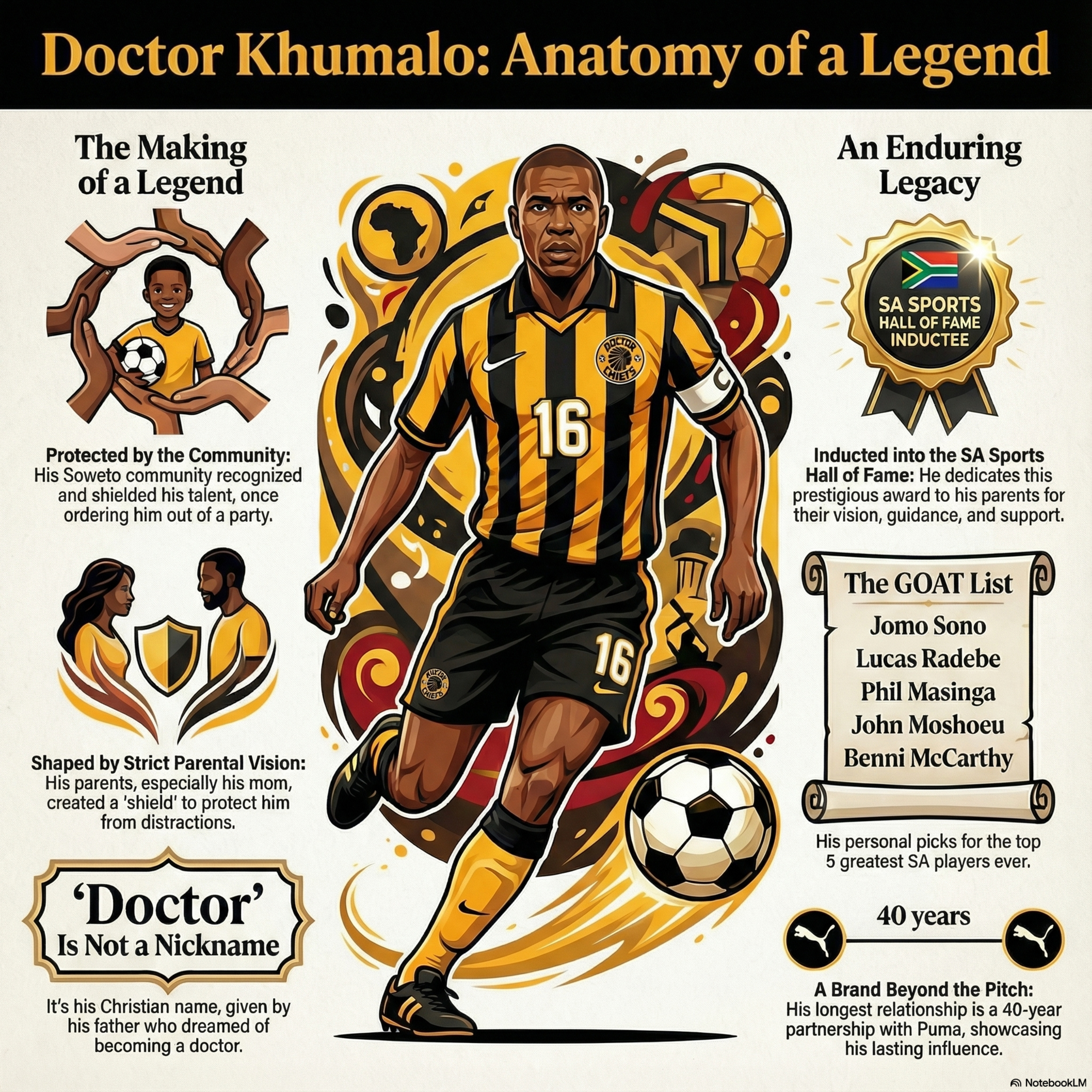
Yes, that puts him permanently alongside figures like Doctor Kaiser, Motong, Neil Tovey. It just confirms his place in history, even as he's still actively contributing to the sport as an analyst. OK, so before we dive into the football itself, we have to tackle the core of his identity because there's this massive and actually beautiful misconception we need to set straight right now. The name. The name everyone says Doctor Kumalo and just assumes Doctor's a nickname he earned on the field, right?
For a surgical precision or something? It's the ultimate linguistic trap, isn't it? His full given name is Theophilus Dr. Kumalo. Doctor is his Christian name. It is. It was not a title earned on the pitch, even though you're right, his play often felt surgical. It was a name given to him at birth. And the family story behind it, it just provides such rich context for his ambition, for his drive. It explains so much. His late father Prokumalo, who was the chief superstar himself, had this lifelong ambition to become a medical doctor, but he couldn't pursue it.
Financial constraints. So he did the next best thing. He named his son Doctor. It was an aspiration, the dedication. It was this massive family hope just imprinted on a child from the very beginning. And that's not even the only piece of deep meaning in his name. His first name, Theophilus, is just as profound. I didn't know this part. It's a Greek and biblical name, and it means friend of God. So when you look in his full name, Theophilus, Dr. Kumalo, you see this fusion of, you know, deep spiritual faith and this intense professional aspiration.
It's like a family prophecy laid out for him. Wow, Friend of God and Doctor, That just transforms how you see the whole cult of Kamala, doesn't it? It moves it beyond just fandom into this deeper respect for a destiny that he consciously pursued and well fulfilled. He absolutely did. No. OK, so while Doctor is the given name, we can't ignore the nicknames he did earn through his performance. There's the affectionate doggies and of course, the globally recognized one. 16 V 16 V, yes. So for you listening, if you're not up on your car engineering metaphors, we should probably give a little context here.
16V stands for 16 valves. It refers to a high performance engine. Having more valves lets the engine breathe better, which means more speed, more power, more efficiency. And that nickname just perfectly encapsulated his role. Perfectly. He wasn't just the engine, he was the high performance engine. He was thinking faster, he was more efficient and he delivered that power exactly when the team needed it most, right in the heart of the midfield. He was the difference maker, the high octane part of the machine.
Exactly. But to really get how that powerful, high performance engine was built, we have to go back. We have to look at his formative years and examine the discipline, the sacrifice and that deep, systematic connection to the Kaiser Chiefs. OK, so let's unpack the environment that shaped him. Kumalo grew up in Soweto. Place like Rockville, Mofolo, Deep Clouf. Right. And this was a time when Township football was described as very ripe. It was this rich, competitive grassroots culture that was his first and probably his most unforgiving training ground.
But what's so crucial, and what our sources highlight, is that this environment didn't just facilitate his talent in a really unique way. The community actively protected it. Yes, there's this extraordinary anecdote that just perfectly illustrates the kind of social oversight that surrounded him, Kumalo recalls one Sunday. He was a rising young player, and he briefly went to a stock, you know, a community social gathering, music, food. He was there for maybe less than an hour. And what happened next is just it's like something out of a movie.
It is the community elders, people who saw his potential. They noticed him. They marched right into that tent, switched off the music and basically read him the riot act. Unbelievable. They pointed to the atmosphere, you know, the alcohol, the socializing, all the distractions. And they gave him a clear command. This is no place where you belong to Wow. They saw his destiny, and they actively intervened. They recognized that this environment was a direct threat to the massive potential he carried.
That is so profound. It just underscores that success isn't just about internal talent. It requires this external vigilance. They didn't just tell him to play well, they demanded he protect his future brand by choosing his surroundings wisely. And this, this crystallizes the most critical theme of his youth decision making. Komalo himself reflected on this. The choice was so stark. Listen to these respected community leaders and his parents or stay with friends who had, in his words, alcohol and women without any vision and he.
Chose to listen. He chose to listen. He walked out slowly, realizing in that very moment that this was the vital decision. This was what would safeguard his potential and protect his entire future. He internalized the need to eliminate distractions right from the start. And that protective shield was, of course, reinforced most powerfully at home. Oh, absolutely. His late mother was incredibly strict and she had this unique insight right because his dad, Prokumelo, had also been a Kaiser Chief superstar.
So she knew the pressures, she understood the guidance and sacrifice it required. And the anecdote about his childhood sacrifice, I mean, it's just formative. It's deeply moving and it really shows you the foundation of his work ethic. It really does. At the tender age of seven, he committed to walking his mother to the train station every single morning at 4:00 AM in the dark. And the detail here is just heartbreaking. He wasn't just walking with her, he was protecting her. He carried 2 bricks with him, Two bricks for self-defense against any potential threats in that pre dawn darkness.
Just think about that responsibility, that sense of duty embedded in the seven-year old, that daily commitment. It just defined his character. And that sacrifice, it laid the groundwork for his ultimate act of gratitude. Our sources tell this powerful story of his first professional paycheck in 1987 from Kaiser Chiefs. What did he do? He immediately went to find his mother. She was working at the LRO hotel and he gave her a simple life changing instruction. Quit your job. It's. Just like that. Just like that, he didn't just offer to help out, he provided unwavering financial security.
He became her debit order, a guaranteed monthly income from that day until she passed away in 2020. That's decades. Decades of absolute non negotiable financial commitment. It just shows the profound depth of his character. He used his success to honor his family sacrifices. It really, really demonstrates that the price of his success wasn't just measured in trophies, but in this extreme personal commitment and this enduring gratitude and this commitment, it naturally led him to the Kaiser Chiefs Football club.
It was a connection that was basically woven into his DNA. The timeline confirms it. He signed with Chiefs while he was still in high school in his final year metric. Which is amazing in itself. And while the lineage was clear, you know, his father being pro Kumalo, a chief superstar, that actually meant the expectations, the bar he had to surpass were exceptionally high, maybe even intimidating. For sure. But he was fortunate. He had these early figures within the club who really nurtured him beyond just the standard team structure.
We learn about a man named Stain, his very first coach at the Kaiser Chiefs Academy in Rockford. Stain treated him like a son. He offered personal mentorship, not just, you know, tactical. And Kamala's appreciation for that was immediate and tangible. The source notes this really rare moment of gratitude among young players. Kumalo bought Stain a leather jacket with money from his very first paycheck. That's class. It just shows he understood the value of mentorship and never ever forgot where he started.
And the numbers, they just cement this systematic bond. The source explicitly confirms that Kumala's longest professional relationship in his entire life? A staggering 45 years is with the Kaiser Chiefs. 45 years. That is almost unheard of in professional sports globally. It's a systemic relationship, isn't it? The club provided the structure, his family provided the discipline, and the talent just flourished in that ecosystem. The perfect ecosystem for creating a maestro. Which brings us to the centerpiece of our deep dive, the actual football wizardry.
We need to move beyond just praise here and really understand the technical mechanics of his dominance. And how do you define a player who is so dominant yet avoided all the flashy cliches of his peers? Well, he was consistently described with those really high adjectives, you know, poetry in motion, the maestro making the midfield canvas, pure art form. But the function was always more important than the flair. He was the conductor, the orchestrator. He didn't chase the game. Who directed it? He directed it.
And this is where his technical genius really was his vision. He didn't just see the immediate pass. He had a football vision so advanced he could see the entire play, the pass, the movement, the finish three steps ahead of everyone else on the field. He was basically operating in predictive mode. That's incredible. So nothing happened without him. He was the brainstem of the entire team, but as you said, we have to contrast his style with other legends of that era like Joe Mosono or Caesar. Who are all about the flashy dribbling?
Exactly show stopping stuff. Kamala wasn't a showboat. But, and this is the paradox, he could still manage to get past four or five opponents whenever he needed to. So if he wasn't relying on complex stepovers or elaborate faints, what was his signature move? How did the maestro dance past defenders? His signature wasn't complicated, but it was devastatingly efficient and fast. It was pure, sharp control married to mental quickness. The source describes his dribbling as moving the ball quickly and abruptly to the left, to the right, to the left, to the right, essentially weaving past defenders using rapid close control and instant changes of direction.
So it's the acceleration and deceleration. That's it. His ability to speed up or slow down with the ball, just allude to his foot, made him impossible to predict or tackle cleanly. That blend of mental acuity and lightning footwork, it suggests a real killer. Instinct was necessary. And our sources, they confirm this ruthless professional edge. We have his direct quote about his mentality towards opponents and it's, well, it's truly uncompromising. Oh, it speaks volumes about his psychological preparation.
If there was an opponent on the other side of the fence, his view was he's dead, his name is no longer existing, DADRIP. It's a declaration of total dominance, psychological warfare. Once that whistle blew, friendships were over, pleasantries were done, and only victory mattered. And that aggressive mental preparation is what cemented his legendary status, especially in those high pressure games. Fan observations about the Derby matches, the monumental clashes against Orlando Pirates, they were all the same.
Whenever was the Derby, you knew Kumalo was going to elevate his game and challenge the Pirates, often delivering those match winning moments. Yet Despite that, on field ferocity, there was this deep mutual respect off the pitch. The sources highlight that the late Zola Mahobi, who was a very prominent, passionate figure with Orlando Pirates, once admitted that Kumala was the only legend they truly regretted not getting for their club. That is the highest order of tribute, isn't it, coming from your fiercest rival.
It is, and Kumala honors that respect. He keeps a pirate's jersey she gifted him proudly displayed on his wall. It shows that beneath that competitive fire, there was a shared appreciation for greatness in that era. But let's get back to the systematic nature of his talent. That's the key to his wizardry. The sources give us this incredible anecdote. We're calling it the replicated Magic. Yes, this goes back to his high school football days during the Milk Cup tournament. He was playing for Delonga High School against a team called Raw.
The game was tied 22. It goes into extra time and Kumalo just took over. Completely. He described how he dribbled the entire opposing back line, including the keeper leading directly to a 52V. It was the stuff of teenage legend now. Here is the crucial connection for you listening an adult fan who was 17 at the time and saw that schoolboy heroics later saw Kumalo duplicate that exact precise corner flag to goal move during a Kaiser Chiefs versus Sundowns professional league game at Ellis Park. He duplicated it.
The sequence, the specific dribbling style, the path through the defense. It was the same piece of systematic football wizardry, just replicated perfectly years later on a massive professional stage. That's incredible. It tells us two things. First, his technique was perfected very early on. Right And 2nd, his moves weren't just random flashes of brilliance, they were stored tactical maneuvers he could just deploy reliably under pressure. That level of consistency bringing high school mastery to the big leagues.
That's what defines him as a systematic genius, an artist whose art was reproducible. And that systematic genius made him essential on the biggest stage of all, the national team, Bufana Bufana. Indeed, his talent became utterly indispensable on the international stage, especially during that high stakes push for the 1998 World Cup qualification, A monumental moment for the New South African national team. We have to set the scene for the pressure here. That qualifying campaign, particularly the deciding game against Togo, the weights of an entire nation's hope, was just resting on the shoulders of that squad.
And the source material pinpoints this absolutely crucial defining moment. It just showcases the confidence his coaches had in him before that Togo game, the coach, Doctor Evan Cao, he pulled Kumalo aside. He didn't give him complex tactical instructions. What did he say? He delivered a massive emotional and professional challenge. He just said boy, take South Africa to the World Cup. Wow, talk about pressure. Right and Kumalo delivered. He rose to that occasion, played a pivotal role, either scoring or assisting Phil Missinga, which directly led to that historic qualification, that singular act of faith from his coach and his delivery on it that cemented his national hero status permanently.
And that status? It got its ultimate validation with the 2023 induction into the South African Hall of Fam. It puts him right alongside the giants of the game. It's the highest cultural and professional recognition you can get. It is. And when he accepted that award, he immediately linked it back to his foundation, to his parents, dedicated it to his parents for their vision, their guidance, their support. He used this powerful metaphor about overcoming criticism, noting that people might have thought they were burying him alive in the past, but in fact they were burying a seed.
And that seed grew into the legend being honored today. Exactly the narrative of endurance and the global impact of that was visible in the tributes that poured in from places like Zambia and Sweden. We heard from a Zambian fan, Toombo, who had this beautiful, insightful interpretation of Kumala's name. What was that? He initially thought Kumala was a medical doctor because his skill brings healing to the fans heartaches through his performance on the pitch. That might be the highest compliment a player can receive that your performance is restorative.
I think so. And this healing, this positive energy, it connects directly to his current role and his unique legacy of non jealousy. So many former greats, they struggle to transition into punditry without bitterness towards the new generation. Kumalo is the remarkable exception. He is consistently praised in the sources for being a beautiful and good human being. He shows this genuine, unreserved excitement and happiness for young talent coming up today. He does. He actively calls out specific names Mundo, Villa, Kazi and Lemo, praising their maturity and their technical ability with just real enthusiasm.
And this isn't just passive observation, right? It's active mentorship, his engagement with current Bufana players like them, Bizwan, Mushishi and Saudi. It's always focused on upward aspiration. He tells them to be strong, but the crucial instruction is always to take their game to Europe, not to settle for local success. He's using his platform to push the boundaries for the next generation, encouraging them to achieve that sustained international visibility he himself enjoyed. He's the ultimate role model for not settling, for making sure the next wave doesn't get complacent with just domestic fame.
That commitment to longevity and brand excellence, it's something we really need to analyze further, especially when we pivot to his post playing career and his commercial partnerships. Right. Speaking of longevity and brand protection, the sources uncovered a fact about Kumalo's commercial life that really stands out. And it validates that sentiment that his staying power needs to be studied, you know, academically. Let's talk about his second longest relationship in life. It's not with a person, it's with a brand.
An astonishing 40 years with Puma. 40 years, I mean, that's not a typical endorsement deal. That is a deep, decades long partnership. It's incredible. And this longevity is precisely why the source material suggests Kumalo's staying power needs to be studied at Harvard and Oxford. And you have to ask why. It's not just about wearing the gear. It's about character consistency. It's about minimizing public scandals and maintaining relevance across shifting cultural landscapes. His brand has never been compromised which makes him a reliable 4 decade investment.
That's a powerful insight in a world where endorsement deals might last, what, three to five years? A 40 year relationship implies trust, stability, mutual strategic vision. It suggests Kumalo always presented himself as a low risk, high return asset. He focused on professionalism over controversy. And this reputation for integrity, it brings us right to the inevitable Dwight discussion. The greatest of all time, when Kumalo is if he considers himself in that conversation, His response is defined by this remarkable humility.
He just says, I don't recall what I've done on the field. He actively minimizes his own achievements, which just reinforces his reputation for not blowing his own horn, not relying on past glories. It's a perfect expression of the quiet confidence of a true icon. Exactly. But when he was pressed, he did offer his highly objective and analytical view of the game's greatest. He tried to limit the list at first, but then, you know, Acknowledging the depth of South African talent, he applied extra time to the request and settled on a top 6.
And what a list. It includes Joe Masono, Lucas Redebi, Phil Masinga, John Shoes, Mishu, Benny McCarthy, who he added in extra time for his achievements and, you know, implied by his inclusion in the whole discussion. The awful list, Doctor Kumalo himself. That list is just a master class and objective selection. Different positions, different eras, no ego. His objective wisdom and that natural storytelling ability have created this overwhelming demand for his life to be documented. The sources mention these persistent calls from fans, including in Sweden and even producers like Shabala, all demanding he write a book or have a movie made about his journey.
And he was initially reluctant about a book project, right? He cited that classic kind of humorous old saying about the reading culture in South Africa. Yeah, that the safest place to statue money is in a book because supposedly nobody touches it. A great line, but the persistent demand and I think the desire to share his intellectual legacy overcame that reluctance. He's now committed to working on not one, but two distinct books. Which is fantastic news for anyone interested in his story. The first is the one everyone's demanding.
Straightforward autobiography about his life as a legend. The second book. That's where his intellectual capacity, I think, is really going to shine. I agree. The second is a motivational book. It's directed specifically a young aspiring athletes and professionals trying to make it, and the goal is to share the untold stories, the deeper, more challenging truth about what success actually is. So it includes the difficult negative moments that came before the positive outcomes. Exactly. So you have to ask, right?
What kind of negative moments is a legend going to share? He's committed to sharing the painful realities, the early sacrifice, the two bricks he carried, the constant pressure to choose discipline over instant gratification, the moments of profound personal difficulty. He wants to show the full, gritty picture of what it took to sustain that greatness. He shared that powerful, defining story about the 1987 paycheck and telling his mother to quit her job, becoming her decades long financial support.
These are the stories that go beyond football. They are about character, commitment and paying your debts. People need to understand the sacrifices required to build that kind of life and legacy. Absolutely. So finally, let's just clarify his current roles because we should address the speculation around his coaching and ambassador work. These roles always invite scrutiny. It's important to remember he has significant coaching experience. He was an assistant and a caretaker coach at Chiefs, and he even won a prestigious Coach of the Month award with Donald Koos.
The fan desire to see him back in the dugout is still very strong. But his current very visible ambassadorial work, like handing out man of the match checks for a betting company, that's led to some speculation. Which he explicitly and humorously dismissed the idea that this is some kind of guise to steal players for the Kaiser Chiefs. He shot that down pretty quickly. His stated purpose is purely to cheer and encourage the young athletes to make sure they feel supported by the older generation no matter which team they play for.
His interactions with current stars like Saudi and Mashishi confirm this mentorship focus. He's actively telling them be strong, don't come back home too quickly, try probably to take your game to Europe and make a living out of it. He is promoting high professional aspiration and ambition, not just club rivalry or local comfort. So if we synthesize everything we've learned about Theophilus Dr. Kumalo, the disciplined, family oriented icon who ruthlessly protected his talent and achieved success through this profound decision making.
What is the intellectual legacy he leaves us with? I think his legacy is so far beyond statistics. It's in the intellectual capacity and the wisdom he now shares with the world. We analyze those maxims he embraced from his mentors. Courage kills fear and focus kills strength. Kumal is the ultimate embodiment of applying fundamental knowledge and wisdom to sustain a massive professional career and brand. It's the ultimate lesson in brand protection and professional longevity. We mentioned the suggestion that his success needs to be studied at Harvard and Oxford, and that's because his trajectory mirrors global superstars.
You think of how David Beckham strategically expanded his brand into lifestyle and the US market, or how Cristiano Ronaldo meticulously managed his health and profile to keep playing and dominating well into his 40s. Kumalo achieved that same level of strategic decades long influence within the South African context and beyond. He built a brand of stability, loyalty and high performance, which has made him an enduring commercial and cultural force. Which brings us to our final provocative thought for you, the listener.
If Doctor Kumalo's longevity is a case study and discipline commitment, what core principle from his life is the most transferable lesson for your own professional journey? Is it that decision to listen to community leaders over distracting friends? Or is it his absolute commitment to giving back with his very first paycheck? Or maybe it's that psychological conviction that when you're facing a challenge challenge, the opponent must be DADRIP. Which necessary personal sacrifice are you committing to today?
That will be the defining detail of your professional legacy 30 years from now. Theophilus Dr. Kamalo, Friend of God, the 16B Maestro and the ultimate champion of his own meticulously defined path. What a profoundly detailed and insightful look at a true legend. Absolutely legendary. We hope this deep dive into the Maestro Systematic Genius helps you see the broader context of what it really takes to be truly great, both on and off the field. Until next time, keep digging deeper into the sources of greatness.
 Apple Podcasts
 Castbox
 Castro
 Goodpods
 Moon FM
 Overcast
 Pocket Casts
 Podbean
 Podcast Addict
 Podcast Republic
 Spotify