Benfica Academy: The Seixal Development and Monetization Model
About this episode
Benfica Academy: The Seixal Development and Monetization Model
Listen now on Spotify, Apple Podcasts, Amazon and other streaming services! Don’t forget to subscribe, share, and leave a ⭐⭐⭐⭐⭐ review to help more players and coaches discover the power of Techne Futbol and Data Technology in the beautiful game.
#TechneAfricaFutbol #TechneFutbol #TrainWithTechne #Playermaker #TraceFutbol #Hudl #FootballTech #FootballInnovation #PlayerDevelopment #CoachTools #SmartFootballTraining #AfricanFootball #CAFOnline #FIFA #FIFAYouth #CAFDevelopment #YouthFootballAfrica #NextGenFootball #FootballScouting #TalentIdentification #DigitalScouting #EliteYouthDevelopment #FootballJourney #FootballAnalytics #FIFAForward #FutebolAfricano #TrainTrackCompete #FootballExcellence #FootballAfrica #TheFutureOfFootball
Welcome to the Deep Dive. We're here to crack open the formulas for global success, examine the internal machinery, and really extract the parts that are genuinely transferable. And today we are absolutely on the turf. We are. We're talking about football, but this is so far beyond just a game. It's an engineering marvel really. We're dissecting the blueprint of what you could call the ultimate self-sustaining, high volume world class talent factory. And when we say high volume and world class, we really mean it.
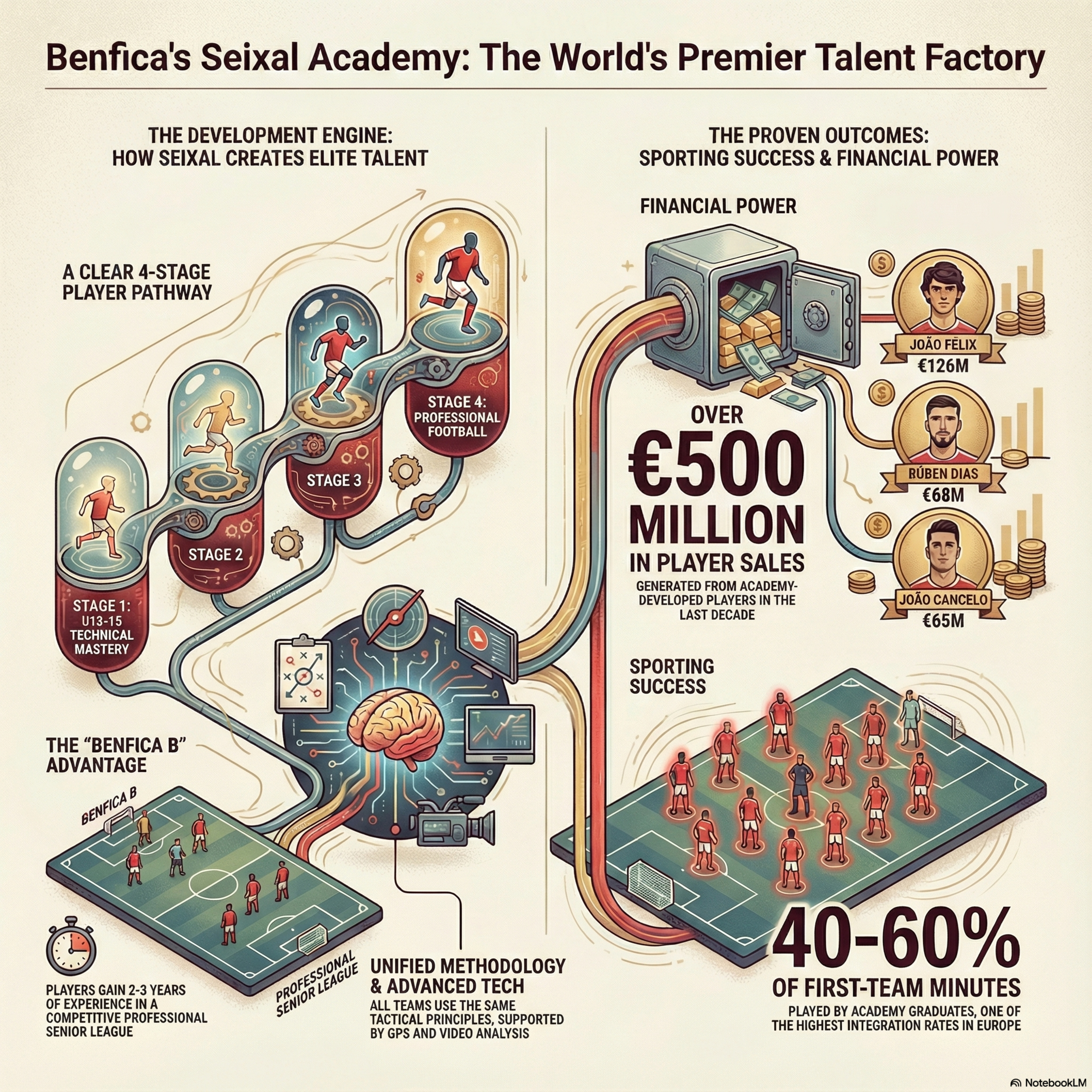
The figures, I mean, figures associated with the single Academy model, are just breathtaking. They really are. The last decade alone, this one institution has generated over €500 million. Half a billion euros. In transfer revenue, and this is purely from players they developed themselves. Think about the scale of that for a second. We're not talking about, you know, winning a big trophy and getting a huge sponsorship deal. We are talking about talent generation as a primary number one revenue stream.
It's the core of the business. I mean, they sold Jean Felix for €126 million, Ruben Diaz 68,000,000, Bernardo Silva 50 million and that output is just, it's sustained year after year after year. And here's a brilliant part. While they are selling these global superstars, they are simultaneously stocking their own first team. With graduates. You often see 40 to 60% of their first team minutes in any given season being played by Academy kids. That is definitive proof this club does not just go out and buy talent, it manufacturers it.
Exactly, Development doesn't decide projects for them, but you know if a passion project it is the fundamental strategic pillar and the financial engine of the entire club. So our mission today is really focused and I think it's critical, especially for anyone listening who's invested in the future of the African game. We're taking this globally proven blueprint, this whole ecosystem built on, you know, world class technical skill, tactical intelligence, and this almost ruthless financial efficiency.
And we're systematically breaking it down. We have to. We need to see what the core components are, everything from the coaching philosophy to the data integration. And see what can be adopted, what can be adapted to dramatically strengthen player development right across the African continent. Precisely. This is all about about recognizing Africa's, I mean unparalleled, raw, athletic and technical potential. Which is undeniable. Undeniable and giving it a world class structure to actually thrive within.
We're studying what the sources call a fully integrated high performance development ecosystem, and that's so much more than just football drills. It is. It's academic education, character formation, and a totally seamless integration path from, you know, a 13 year old kid all the way to the senior professional team. And here is the immediate sort of insight for any club administrator, any investor, any federation listening right now this. Is the key take away? Long term player development and financial sustainability are not mutually exclusive goals.
Not at all. They are mutually reinforcing. When you execute this correctly, your Academy stops being a line item, a cost center. And it becomes your most reliable profit center. So let's dive deep into how they built this engine and how African football can adapt its principles. OK, let's unpack this blueprint. And we have to start, I mean literally from the ground up, the infrastructure. Yes, the model is centered entirely on physical integration. And we're talking about a single massive campus, 19 hectares.
This isn't just, you know, a nice to have. It feels like a core strategic decision. It is the core strategic decision. The physical infrastructure dictates the environment and ultimately the culture. You need that scale, that 19 hectares, because it centralizes the entire operation. So you have the little guys, the U13. All the way up, the Academy teams, the B team and the first team are all housed in one single location. Yeah. That proximity, that physical closeness is fundamentally strategic. I get the convenience of it, you know, not having to bust players around, but what are the sort of the non obvious psychological benefits of having everyone in one place?
Is it just about seeing the stars in the cafeteria? It's so much more profound than just spotting a star player. It completely eliminates the psychological barriers to entry. OK, think about it. A promising U15 player, they step onto the training ground and they are sharing locker rooms, medical facilities, sometimes even the same pitches as the first team professionals every single day. So that elite standard is no longer some abstract concept, some goal you read about. It's visible, it's tangible, it's a daily reality.
This constant exposure just normalizes the high demands of professional football. It becomes a water they swim in. Normalizing elite standards. That's a powerful phrase. And for the African context, this idea of vertical alignment seems absolutely crucial for accelerating learning. It's. Vital We often see that while top African talent has this incredible raw ability, they can sometimes struggle with that final tactical and psychological leap when they move to Europe. Right, the adaptation period can be tough.
Exactly. A unified environment helps solve this. It allows AU 17 coach to easily walk over and talk to the BT manager. It lets that U-17 player train with the B team for a week to get a taste of senior intensity and then slot right back into his age group for continuity. All without any logistical friction or, you know, travel time. None and that early calculated exposure dramatically and I mean dramatically accelerates their readiness curve. And I'm guessing the quality of the infrastructure itself is non negotiable.
It's not just, you know, a few well kept fields. Oh no, it's state-of-the-art. We're talking dedicated high tech residence halls, medical and rehab units built for performance optimization, centralized performance hormones, analytics facilities, and crucially, a mix of hybrid and natural grass pitches. Why is that so important? Because they need to exactly replicate the surface conditions, the pace of the ball, the density of the turf, the wear and tear that players will find in elite competition in the top European leagues later in their careers.
So the infrastructure is designed to leave absolutely no physical adaptation to chance. Nothing. It supports the philosophy, and that philosophy, as we mentioned, is called Formasan Benfica. This is the intellectual blueprint, then the software that runs on the hardware. Perfectly put, it guides every single decision from U13 all the way up and it is fundamentally player centric. It prioritizes the long term potential and the complete development of a thinking player. Over what? Over the short term goal of just winning youth trophies.
OK, let's dig into that thinking player concept. Where does the emphasis begin for a, say, a 13 year old? It begins with an absolute, non negotiable dedication to technical excellence. Ball Mastery. Ball mastery first and foremost in the younger age groups, especially U13 to U15 and overwhelming percentage of training time is just pure ball work. We're talking first cutch and body orientation, controlling the ball in incredibly tight spaces. Like a phone booth. Exactly, and fostering genuine creativity in one V1 and 2V1 situations.
The belief is unwavering. A superior technical base is the prerequisite for all future tactical adaptability. It makes sense. If you can't execute under pressure, the best tactical plan in the world is completely useless. You've got it. So you build this technically robust machine 1st and then you install the complex problem solving software. And that software is the intelligence and versatility piece. Precisely once that technical platform is solid, they start layering on the intelligence. Players are drilled relentlessly on spatial and situational awareness.
They have to achieve rapid decision making speed under increasingly high pressure. And this is where the versatility comes in. They actively discourage early specialization. They. Do it's a core tenet U13 to U15 players are constantly rotating roles specialization, you know committed to just one position that only starts much, much later between U-16 and U-19 and they have a. Rule right? A mandate Players must be capable of playing at least two different positions effectively, even if they have a primary role.
The logic there must be about creating deeper tactical maturity. It's all about that if you spend time playing it right back, you inherently internalize the pressure points, the demands and the decision making timing of the central midfielder who supports you and the winger you have to defend against. So you're not just learning your role, you're learning the whole system. That holistic understanding makes you a far more intelligent player in your own specialist role later on. You know, this versatility is a huge actionable take away for African clubs.
We know how important it is for African talent to be adaptable when they move abroad. Oh, absolutely. If a player can credibly occupy two or three positions, their market value skyrockets immediately and their chance of actually succeeding in a foreign league where systems and coaches are constantly changing is dramatically increased. It just reduces the risk profile for the club that's buying them. And just as importantly, it prevents early burnout and improves long term career longevity. If one position isn't quite working out for a player, they have a developed Plan B right there on the field.
OK, let's move off the pitch because the support system is just as deep. Character and holistic support are seen as non negotiable. They were foundational for professional success. The source material is very clear on this. The objective is to form balanced, resilient professionals, not just athletes but also students and citizens. It's a true human development model. The investment in personal growth is immense. This includes dedicated psychological coaching, structured mentorship programs pairing younger players with established pros, and intensive leadership workshops.
And behavior is monitored. Constantly, behavioral standards both on and off the field are monitored and consistently reinforced. They understand that a high value asset, which is what these players are, must be mentally resilient and disciplined. What about the academic support? I feel like that's so often gets overlooked in systems that are just obsessed with winning. It's fully integrated. The whole ECOS system ensures that academic tutoring is aligned with training schedules. Players get meticulous nutrition planning, monitored meals, you know, ensuring they're fueling their bodies correctly for elite performance.
And you mentioned injury prevention. Crucial there is critical data-driven injury prevention and recovery support. You know, that injury prevention detail is fascinating. It's really a mechanism of value retention, isn't it? Absolutely. When you're dealing with young, rapidly developing athletes, managing their mechanical load and preventing soft tissue injuries is paramount. Every single day a high value asset spends on the sidelines due to a preventable injury is a day of last value appreciation.
This whole whole sick model, the character, the education, the nutrition, is the essential component that so many African academies need to adopt. Because it ensures the player has the mental resilience to handle professional pressures. And it provides the foundational Plan B if for whatever reason that professional career path changes. OK. So moving from that foundation, let's look at the system for actually identifying, acquiring and then refining the talent, the pipeline, the pipeline, the recruitment strategy is this really interesting blend of deep local roots and a broad targeted global net.
So they have an intensive focus on their local area, Lisbon, and wider Portugal that ensures a stable base of domestic talent. But then their international scouting is highly intentional. They seek specific profiles in specific regions, South America for technical flair and significantly for our discussion. They actively scout in Africa through historic networks. And that point is so critical. It's a validation of the inherent quality of African football. It absolutely is. The model explicitly seeks out profiles from the continent with and.
I'm quoting physical potential, raw talent, and high ceilings. So the recognition is there. Africa provides the necessary raw material. The raw material is there in abundance. The fundamental challenge for African football then is having the refining structure, this robust systematic process we're talking about, to take that raw potential and convert it into a world ready, tactically intelligent professional. OK, And this is where the methodology really diverges from traditional scouting norms. I think this is where the blueprint truly stands out globally.
Their anti physical bias in early recruitment. Can you walk me through that? Because it's counterintuitive. If a 15 year old is physically dominant, he scores 30 goals, wins every physical duel. How does this blueprint ensure he might be overlooked in favor of a smaller, late developer? That is the crucial critical challenge that separates elite development from just simple talent identification. They understand the danger of what's called physical maturation bias. That early maturing physically dominant kid often peaks in his mid teens and then he struggles when his peers finally catch up physically.
They actively avoid chasing those temporary peaks. So instead, they prioritize cognitive attributes. All day long. What specific cognitive attributes are they looking for over that brute force? Number one is technical intelligence. Can the player solve complex problems with the ball at high speed? Second, decision making speed. Yeah. How fast do they think and process the game, not just how fast they can run? The processing. The processing speed. Thirdly, they assess scanning frequency and efficiency.
How often does the player check their shoulders and process the space around them before they even receive the ball? Which indicates high situational awareness. Exactly. And finally, they look for a demonstrable learning mindset and high coach ability. So they are essentially betting on the brain over the body in the short term, with the full knowledge that the body can be developed later. Precisely, they are intentionally seeking out those late developers, those agile, technically gifted profiles who might be physically underdeveloped right now.
And this yields vastly higher long term performance outcomes. Because the market, the top level game, is always demanding technical intelligence and cognitive speed, not just raw power. By prioritizing the brain early, they identify the true high ceiling talent. OK, so once they've identified these intelligent, technically gifted players, they need a pathway. And this brings us to what might be the most crucial bridge the B team advantage. This is, and I'd argue that strongly, the single most important structural feature that gives them a competitive edge over their global peers.
You know, AX Barcelona's reserve setups. All of them. The existence of the B team competing in League of Portugal 2 is the accelerator that guarantees senior readiness. And League of Portugal 2 is a genuinely tough, physical and highly competitive professional environment. It's not a Youth League. Not at all. It's cited as one of Europe's strongest second divisions. The issue you see is that U-19 football, even the high level UEFA Youth League, is simply insufficient preparation for the physical, mental and tactical intensity of the top senior game.
So the B team provides what, 2-3 years of highly competitive professional senior football for those 18 to 20 year old? Yes, we are talking about 60 to 100 senior matches played against fully developed adults who are often fighting for their careers for their mortgages. Wow, that volume of high quality senior competitive minutes is immense. It allows the whole adaptation process, tactical, physical, psychological, to happen outside the crushing pressure cooker of the first team. Where trophies are on the line every single week.
It's a pressure cooker, but with a safety valve. It is the perfect bridge and if we recap the pathway stages, you can really appreciate the vertical flow, OK. Let's do it. U13 to U15, That's your dedicated technical mastery phase. The focus is almost exclusively on one V1's creativity, spatial awareness. Then U-16 to U-17. That's the introduction to tactical complexity. Players start specializing in positional roles, but they're drilled in positional play. Principles required defensive and offensive behaviors.
U18 to U-19. Competitive adaptation, they get exposure to high performance environments, the real weight of the club's principles and they're benchmarked in the UEFA Youth League and. Then comes the bridge. The bridge Benvika B in League of Portugal too. This is the professional transition. This is where the product is hardened. They learn to handle the physicality, the travel, the tactical variations, the mental grind. Kind of a full senior professional season. And only then after all that is first team promotion even on the table.
And it's based purely on objective performance benchmarks and genuine readiness to contribute immediately. There's no sentimentality. The lesson for the African game here, particularly for domestic leagues, is glaring. It's huge. That gap between U-19 football and the senior professional game is an enormous impediment to development. African leagues or national structures have to find a way to institutionally mandate this high intensity, physical and consistent match environment. Whether that means mandating D teams in the top domestic leagues, creating structured regional hubs for Academy graduates, or investing in rigorous high level reserve leagues.
That bridge is where the raw potential hardens into professional excellence before the transfer market comes call. In That's the Danger. The danger is that African players arrive in Europe having completely skipped that critical 60 to 100 game senior development phase, and that dramatically increases their risk of failure and of course, lowers their initial transfer value. So the model is essentially doing all the essential finishing work at home, guaranteeing a polished professional commodity when they eventually enter the global market.
So the structure is set, the talent is flowing in, but the entire operation relies on the software and that's the coaching methodology. And what defines the system from what I can see is it's absolute unwavering vertical alignment. That's the term. It means every single coach from EU thirteens all the way to the first team manager is speaking the exact same football language. So they're using the same methodological manual, adhering to the same conceptual framework, correct? That consistency is paramount.
It builds these long term learning pathways and makes the transition for a player who gets promoted feel intuitive, not disruptive. And philosophy itself, we mentioned, is deeply rooted in positional play. Yes, focusing on optimal space occupation, structured build up from the back and creating superiority whether numerical or positional all across the pitch. Which requires intelligent, adaptable players. It ties perfectly back to their recruitment strategy. A perfect circle. So how is this framework actually taught on the training pitch?
Are they just running repetitive drills over and over? Absolutely not. The primary teaching tool is something called Constraints Based Learning. OK, what's that? It's a methodological pillar designed specifically to force problem solving. Training sessions are not fixed repetitive drills. They are small sided games designed to put players into complex scenarios. Can you give us a concrete example? What might a coach do to, you know, constrain the players? OK, so a coach might run a 6V6 game, but he'll constrain the playing area, maybe make it very long and narrow.
Then he'll mandate a three touch limit for every player. OK, getting harder. And then he'll add a time constraint. The ball has to move from the defensive 3rd to the attacking third in under 10 seconds. So what did that force? It forces immediate, rapid decision making, it requires technical precision under intense pressure, and it demands constant scanning to find the optimal solution within those imposed rules. So the players are learning by adapting and I suppose failing forward, it fosters creativity.
And it maximizes that decision making speed they scout for in the first place. The training environment itself is teaching them the cognitive skills required for the elite level. It's training the brain to operate faster than the opponent. 'S you've got it. Now let's talk about how the coaching is supported and informed because this system moves beyond just intuition and embraces evidence based development. Through systematic data and technology integration. And this starts from U13. That seems intense.
It is a professional operation from day one. Data acts as a crucial support tool for expert evaluation. It doesn't replace the coach's eye, but it informs it. So what are we talking about? Take GPS monitoring, for instance. It's used across every single team. And this isn't just about counting steps. It measures total distance, high intensity running volume, and crucially, mechanical load and fatigue indicators. Why is tracking the mechanical load so important for a, say, AU 15 player? It's. Absolutely vital for injury prevention.
By understanding the acute and chronic load ratios on a player's body, the staff can tailor training loads daily for each individual. So if a young athlete is going through a growth spurt. Their mechanical load might be disproportionately high. The GPS data helps the coaching staff manage return to play protocols with precision and more importantly, anticipate and prevent common soft tissue injuries. Again, it's about protecting the asset and maximizing its value appreciation. Every decision is an investment decision.
Beyond the physical metrics, how are they tracking cognitive development with data? Through systematic video analysis, fluency OK From U13 onward, players are trained to review their own individual clips. They're analyzing their positional behavior, their tactical errors, their successful decision making moments, all using professional tools like Weiss, Scout and Huddle. So they're not just watching the video, they're becoming active learners who are fluent in the language of modern tactical analysis.
That is next level professionalism. Yeah, by the time they reach the B team, they're already proficient in self-assessment and a high level tactical discussion. It's incredible. And underpinning all of this is the longitudinal digital development profile. Yeah, every single player has a long term digital profile. It's tracking their technical metrics, their physical data, their tactical understanding scores, and even psychological assessments from the moment they arrive until the day they leave or integrate.
That has to be an enormous amount of data. What is the key strategic benefit of tracking all those metrics over say 5 or 6 years? It provides multi year objective evidence for every single developmental decision. It ensures that the system doesn't accidentally overlook a late developer or a player who's just struggling with a temporary dip in form. So the data helps combat the natural human bias toward immediate results or, you know, physical maturity. Perfectly said, if the data shows a player's technical fluency score is steadily increasing, even though his current lack of pace is an issue, the system knows to hold on to him and invest further.
It's a safety net for high potential talent. That's a powerful application of David, using it to protect long term potential. And finally, we have to talk about how they evaluate the coaches themselves. This is maybe the hardest philosophical shift for most football environments. They're not just judged on wins and losses. They're evaluated based on player progression and adherence to the methodology, not on match results. And that immediately changes the entire incentive structure, doesn't it? Completely, The coach is rewarded for producing AU17 player who is ready for the next step, not for winning the U15 league title.
Winning that title often encourages coaches to prioritize the physically dominant kids who might not be technically sound enough for the long term. So it reinforces that long term player centric focus. And since staff turnover is a high risk, a successful methodology makes your staff desirable globally, which is a major concern for the African football brain drain. A huge concern. The club mitigates this risk by investing heavily in internal coach education and crystal clear, documented tactical playbooks.
The methodology must be institutional, not dependent on any single star coach. So if a coach leaves, the system remains intact. The philosophy continues seamlessly. OK. Let's pivot to the commercial side of this. The return on investment is what validates the entire effort. And that figure we started with over half a billion euros in transfer revenue in a decade is just staggering proof that development is profitable. I mean, we're talking about massive sales. Chiron Felix, Ruben Diaz, Bernardo Silva, it goes on and on.
It establishes the Academy as a true financial engine, and it operates on a self-sustaining cycle. And this is the ultimate aspiration for any African clubs seeking financial stability, you know, outside of just relying on date revenue or infrequent sponsorship deals. Describe that closed loop talent cycle. It's simple really. High quality development leads to competitive Benfica B exposure that guarantees a smooth first team integration which culminates in strategic transfer sales for huge fees.
And that revenue is then immediately and strategically reinvested right back into the Academy infrastructure, the staffing and reinforcing the first team. The Academy Is literally funding the entire senior operation and its own continuous improvement. And the ROI is maximized because as we already established, the acquisition costs are incredibly low. They're identified so early through local recruitment and targeted international scouting. Low acquisition cost combined with a high development value from the methodology and that crucial B team senior exposure, it just results in an extremely high market value at the point of sale.
This model is really the gold standard for how structured, sustained investment development can offset the huge financial disparity you see with leagues like the Premier League or La Liga. It's a blueprint for African clubs and federations to generate stable, high value revenue streams. And beyond just the money, the sporting success reinforces the credibility of the entire pipeline. If the players weren't actually good enough, the senior team wouldn't be successful. Exactly. That's the credibility metric.
40 to 60% of first team minutes are played by Academy graduates and the club remains competitive at the highest level domestically. And they do well in youth competitions, too. They're consistent. Deep runs in the UEFA Youth League prove that their U-19 talent is benchmarked effectively against the absolute best youth setups in the world. Real Madrid, Chelsea, Juventus, they belong in that company. So when we compared this specific model to other elite global youth academies, you know a Axis de Tocumst, Sporting's Alka, Shady, even Lamezia, what are the structural elements that truly set this blueprint apart?
The sources really highlight three key structural advantages 1. The Stronger B Team Competitive Environment League of Portugal 2 provides a physical, intense professional transition phase that is just superior to the reserve leagues or U21 competitions used by many of their peers. It accelerates that senior readiness. Massively 2 More flexible tactical development. Unlike some academies, they have a really rigid, one-size-fits-all tactical dogma. This model emphasizes positional play principles while simultaneously training players for that positional versatility we talked about.
So it prepares them better for the diverse tactical requirements they'll find in other top European leagues when they eventually get transferred out. Exactly. And three, superior monetization efficiency. It's simple. Because the pathway is so credible and because the B team guarantees that senior exposure, they just extract higher financial value and have better success rates from their graduates compared to their competitors. So if we take all of this, this entire structure and we direct it back to the African game, what are the clear opportunities cited in the report that Africa can leverage or, you know, become a partner in?
Well, the blueprint itself suggests opportunities for expansion into emerging markets. It explicitly targets deeper partnerships in Africa for scouting footholds, coaching exchanges and collaborative development projects. So African football can and should enter these partnerships demanding structured knowledge transfer, not just as a source of talent and let's. Focus on that post formation development for ages 18 to 21. This is such a crucial point as so many African players struggle to integrate immediately when they move abroad.
The model advocates for a strategic loan partnerships and, critically, remote analytics monitoring for players who need that structure during the transition phase. So the Academy could monitor their fitness, their mechanical load, their performance data remotely, providing that continuity and guidance even when they're at another. Club precisely and furthermore, African centers must embrace A deeper integration of objective data tracking, extending GPS and technical metrics down to the U12U15 level to refine their own talent identification to move away from relying only on intuition.
But implementing such a rigorous structure in the African context, it comes with unique hazards. We have to be pragmatic about the risks we need to guard against. The most immediate and difficult risk is losing talent too early. The struggle Portugal faces, where 15 and 16 year olds are poached by aggressive foreign recruitment, is magnified exponentially in Africa, and it's often driven by poverty and financial desperation. It is the mitigation strategy has to be built on trust and relationships.
I mean, you're competing against aggressive European scouts who are offering immediate life changing lump sum payments. How does a local structured pathway compete against that immediate financial incentive, especially when a player's family poverty is such a huge driver? You compete with credibility and with long term relationships. You have to have strong family engagement. You have to operate a relationship first recruitment strategy. You can't match the immediate cash. You can't, but you have to clearly communicate and more importantly prove that your structured local pathway, which includes the B team bridge, academic support and injury prevention, is a demonstrably safer and more valuable long term bet than an immediate high risk move abroad.
So the focus has to shift from one large, risky payment to ensuring the player has a better, longer career that generates generational wealth. Exactly. And the second major risk we discussed the brain drain of the coaching staff. Right. Maintaining coaching consistency is paramount when you're successful. Methodology makes your staff highly desirable all over the world. So African institutions must invest massively in their own internal coach training programs and ensure their methodology is meticulously documented.
The system has to be stronger than any individual coach. Because without that institutional commitment to staff development and documentation, the whole system will just collapse every time a successful coach receives A lucrative international offer. Hashtag check Outro. This deep dive really clarifies that scaling up development in African football. It requires adopting a systems mindset. We have to move beyond just the hope of discovering the next raw superstar. It's about building the factory, not just finding the diamond.
Exactly. The three core transferable pillars are clear. First, the unified methodology which focuses on technical and cognitive skills over premature physical dominance. Second, that competitive B team bridge which is just non negotiable for hardwiring professional readiness. And 3rd and 3rd, the implementation of a self-sustaining financial loop where high value development fuels the clubs of the Federation's entire economic model. And we have to internalize the specific conclusion that was cited in the blueprint itself.
Africa offers raw talent and high ceiling potential in abundance. That part of the equation is already solved. Clearly, the adaptation challenge is converting that incredible raw potential, both physical and technical, into professional grade intelligence, tactical adaptability and resilience all through the kind of structured data supported development we've just dissected today. So what does this all mean for you? Whether you're a coach, an administrator, or an investor, this is not about magically building a 19 hectare campus tomorrow.
It's about adopting the philosophy. First. Prioritize consistency in your coaching. Base your decisions on evidence and long term player progression, not short term wins, And enforce absolute vertical alignment from your grassroots all the way to your senior level. To start by documenting your methodology and then invest in the technology and the people that start with that long term vision. That's the path. If we leave you with one final provocative thought, let it be this. If the B team operating in the harsh physical environment of the Portuguese second division is the single greatest competitive differentiator for this world class money generating model, what is the mandatory institutional league or competition structure that African football needs to structurally create for its top Academy graduates?
What specific high intensity environment must be mandated to accelerate their professional readiness before the transfer market takes them so that you can maximize their success rate and their financial value? Something for you to Mull or explore on your own.
 Apple Podcasts
 Castbox
 Castro
 Goodpods
 Moon FM
 Overcast
 Pocket Casts
 Podbean
 Podcast Addict
 Podcast Republic
 Spotify