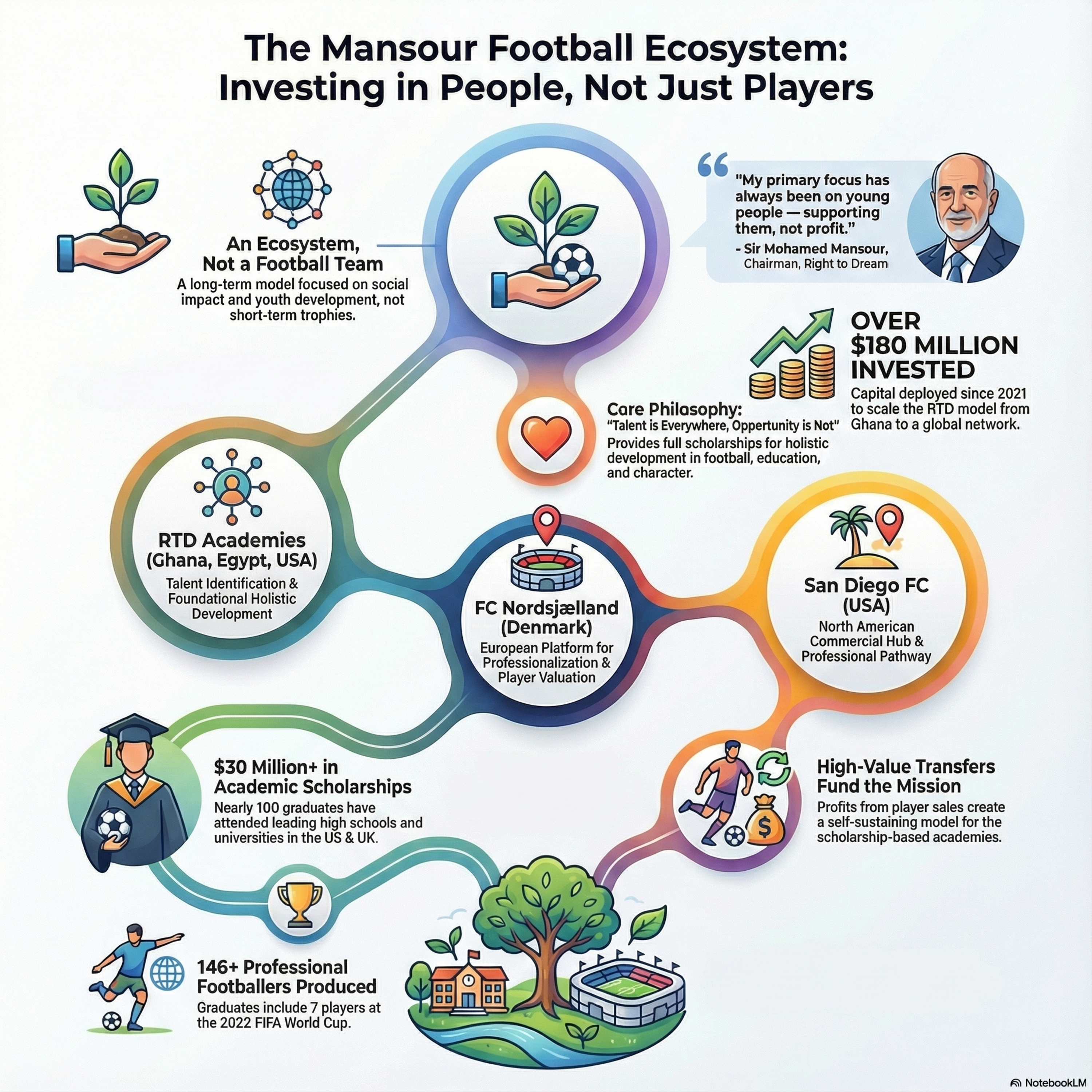
The Mansour Football Ecosystem and Vision
About this episode
The Mansour Football Ecosystem and Vision
Listen now on Spotify, Apple Podcasts, Amazon and other streaming services! Don’t forget to subscribe, share, and leave a ⭐⭐⭐⭐⭐ review to help more players and coaches discover the power of Techne Futbol and Data Technology in the beautiful game.
#TechneAfricaFutbol #TechneFutbol #TrainWithTechne #Playermaker #TraceFutbol #Hudl #FootballTech #FootballInnovation #PlayerDevelopment #CoachTools #SmartFootballTraining #AfricanFootball #CAFOnline #FIFA #FIFAYouth #CAFDevelopment #YouthFootballAfrica #NextGenFootball #FootballScouting #TalentIdentification #DigitalScouting #EliteYouthDevelopment #FootballJourney #FootballAnalytics #FIFAForward #FutebolAfricano #TrainTrackCompete #FootballExcellence #FootballAfrica #TheFutureOfFootball
Welcome to the deep dive. Today we are cracking open a blueprint, not just for a football club, but for something much, much bigger. Much bigger. We're talking about a full stack, purpose built model for social and economic change across an entire continent. And it's all using football, the world's game, as its engine. Exactly. So what we're going to uncover today is this master class in how a vertically integrated system can stop talent development from being, you know, extractive. And instead turn it into a self-sustaining regenerative loop.
It's a really remarkable case study. It is, and the commitment behind it is just staggering. Well, you have to understand the entity driving it to really get the scale. We're looking at a model that's being driven by the Mansur Group and. That's a name you really need to know to grasp the weight of this. Absolutely. This isn't some new venture capital firm looking for a quick flip. This is a multi generational family owned conglomerate. I mean, they were founded way back in 1952. Wow, so this is old established capital.
Old, established and incredibly global. They're operating in more than 100 countries. 100 countries. They've got a workforce of over 60,000 people and revenues are north of seven and a half billion dollars. So when we say giant, we really mean it. We do, and they have the accolades to back it up. Forbes named them the leading Arab family business in 2023. So the point is, this is not a short term gamble, this is long term strategic thinking applied to a whole new area. OK. So that's the foundation, the massive corporation, but the actual sports investment that flows through a more specialized arm, right?
One with a very specific mission. Correct. The venture itself is spearheaded by Man Capital, which is their global investment arm set up in 2010. And this is where it gets really interesting because their stated mission isn't just about profit. What is it the official mandate is, and I'm quoting here, driving economic development, contributing to communities and forging a better future? OK. So that's what you call purpose driven investment PDI. Exactly. And that phrase PDI changes everything. It shifts the entire conversation.
It moves it away from how fast can we get a return on investment to how can we sustainably fund a social mission. Right. And when you look at the history of, say, African talent going to Europe, it has so often been about that fast return. It's been extractive. A quick extraction of talent with very little of the value, financial or otherwise, going back into the community that actually produced that talent in the first place. And that's the problem this blueprint is designed to fix. That's the core of it.
So our mission for this deep dive is to really pull apart the strategy to extract the actionable lessons from this massive investment, especially for what it means for the African game. And the central insight for you listening is to see this not as just a few different clubs or academies. No, you have to see it as one complete self-sustaining loop. A vertically integrated talent chain. Let's stick with that term for a second. A vertically integrated talent chain. In practice, what does that really look like?
How does it actually work? Well, in simple terms it means the philanthropic part of the engine. Which would be the academies giving scholarships to kids. Exactly. Those academies are financially supported. They're sustained by the commercial success of the professional clubs that are also in the network. So the big money player transfers aren't just profit for some far off shareholder. Not at all. They become perpetual funding streams. They're the lifeblood that pays for the next generation of scholarships.
It's an engine that runs on its own success. It really does sound like the antidote to those old extractive models, a closed loop system designed to put the value right back where it came from the youth. That's the idea. OK, this is fascinating. Let's unpack the system piece by piece. We have to start where it all began, the cornerstone in Ghana. The foundational nucleus? Yes, It all starts with the Right to Dream Academy, or RTD, founded in Ghana all the way back in 1999. And its origins were, from what I understand, incredibly humble.
Profoundly so. The founder, Tom Vernon, started it all independently. The first group of boys? He literally housed them in his own home near Accra. In his own home. Yes. So this wasn't some top down corporate initiative. This was development driven by a deep personal commitment. You just can't fake that kind of authenticity, can you? That ground level buy in is so important for building trust in grassroots development. It is, and it established A philosophy that is still at the core of everything they do to today, which is talent is universal but opportunity is not.
And crucially, the system was designed from day one with this holistic vision. The goal was never just to find great footballers. It was about using football for something else. Using football as a vehicle to produce leaders, to produce scholars, people who were equipped for a successful life, whether that was on the pitch or far, far away from it. And this commitment is kind of famously summed up in their books and Boots philosophy. It is. I think a lot of people have heard that phrase, but we need to understand the rigor behind it.
This isn't just like an hour of tutoring in the afternoon. Not at all. It's a mandatory 3 part approach that defines the life of every single student athlete. OK, so what's pillar one? Pillar one is the elite football training and this is backed by a huge scouting network. They assess over 100,000 children a year. 100,000. They cast an incredibly wide net across communities to make sure they're finding that truly untapped raw potential. The scale of the scouting alone is just immense. Wow. OK, so that's the boots.
What about the books? Well, the second pillar is the defining 1 rigorous world class academics. This is 100% scholarship program and it's fully residential. So they live there full time. They live there and the schools are accredited for the Cambridge International Examination, which is incredibly demanding and. Because it's residential, they can control the whole schedule. Exactly. The intellectual and academic demands are given the exact same weight as the athletic demands. Think of it like a high performance boarding school where the main sport just happens to be elite football.
And the third pillar you mentioned character development. How do you, you know, teach that? It's woven into the very fabric of the place. It's about accountability. It's about community service. It's about understanding that you are a role. Model and this all leads to that dual pathway idea you mentioned. It does. It means if a student doesn't make it as a professional footballer, they have this incredible academic foundation to build on and the numbers here, they really speak for themselves. RTD has raised over $50 million in educational scholarships for its graduates.
$50 million just for higher education, that's a real safety net. That's something that most traditional academies just they can't even dream of offering that and you. See the result? They have over 56 graduates right now attending top high schools and universities in the US and the UK. They are actively building future doctors, lawyers, engineers, leaders, the. Football is the hook, but the education is the real transformation. That's the model and the ultimate role model they hold up for. This is George Way.
Of course, the ultimate example. The way story has it all, doesn't it? He reached the absolute pinnacle of football, winning the blonde ore, but then goes back to university later in life and eventually becomes the president of his country. Combining athletic greatness with the highest level of social and political leadership. And that narrative is purposefully built into the culture at RTD. It sends a powerful message to the students. Your potential is only limited by your character and your drive.
OK, so this amazing purpose driven philosophy has been working since 1999. Now let's get to the major turning point, the arrival of the Man Sewer Group's capital in 2021. Right. The MAN sewer investment was what allowed this model to scale globally. MAN Capital came in, acquired the majority state through their MAN Sports vehicle and they started with an initial commitment of €100 million. About 120 million U.S. dollars. And since then, the total global investment from the Man Sewer Group into this ecosystem is over $180 million.
But why was that outside capital so critical? I mean if the the model was already successful. Because the model itself, the full scholarship, fully residential model, is incredibly expensive to run. I can imagine you're covering food, housing, top tier coaching, medical care, internationally accredited teachers. Everything all under one roof all year round. It is extremely difficult to sustain that level of quality on your own through just, you know, the occasional player sale. So the Mansoor investment provided the patient long term capital.
Exactly. The sustained capital needed to replicate that expensive model in other countries without cutting corners or compromising on the quality. It was the moment the model truly became scalable. And they're not just moving on from Africa, they're actually doubling down on the origins. Absolutely. The plan is to cement Ghana's role as the foundational bedrock of the whole system. They're planning at the brand new, multi $1,000,000 state-of-the-art campus near Accra. A new campus. Construction is set to begin in early 2026.
This is a Mesa statement of intent. It replaces the original base and really solidifies Ghana's position as the sort of intellectual and spiritual heart of the entire global network. And this is where we have to bring in the wider context of the Mansur Group's business in Ghana. It's not just football, is it? No, and that's a key synergy that a smaller pure play football Academy would never have. The Mensur Group has invested something like 600 million U.S. dollars in Ghana over the last decade in non football businesses.
Like what? They're huge. Caterpillar dealership Mantrac is a big one, and they're extensive automotive businesses. And how does having a Caterpillar dealership help a football Academy? It creates real tangible career paths outside of football. I see for an RTD graduate who decides to pursue say engineering or logistics instead of a pro contract, Well man track or the car businesses can offer internships, maybe even jobs right there in Ghana. So they're not just offering scholarships to universities overseas, they're offering actual domestic career opportunities.
They're offering domestic career anchors, proving their commitment to developing Ghanian talent for Ghanian economic growth. It gives the whole sports venture this incredibly deep, long term local credibility. That is the definition of holistic development, a safety net that goes beyond just academics and into the actual workforce. And the government's reaction really confirmed this. The Ghanaian Ministry of Sports saw the investment not just as money, but as a vote of confidence in the country itself as a top tier talent hub.
I saw a quote from Michael Essien, the former Chelsea star who's now a coach in the system. Yes, and he called it a gift to the youth and future of Ghana because it guarantees that mandatory education alongside the football which just multiplies the life opportunities for the next generation. So we have the philosophical cornerstone and the financial backing firmly in place. Now we need to see how they channel this incredible talent through a global infrastructure. This is where the Multi Club model comes in.
Right. And this is really the architectural masterpiece of the whole blueprint. The strategy is to build out a comprehensive multi club ownership network and MCO. We hear that term MCO all the time time now in football. But let's be clear. What makes this one different? How does that purpose driven investment focus change the game? Well, the contrast with other models is pretty stark. You look at something like the City Football Group. Manchester City ownership. Right. That's a model that is incredibly capital intensive.
It's focused on brand visibility, on winning trophies right now, and they do that through massive spending on player acquisitions. Man City has spent over €2 billion since 2009 buying talent. Which requires a very different kind of funding. Completely different revenue stream, yes. Then you have a model like Red Bull's which is a bit closer. That's more about developing talent for profit and brand integration. Exactly. The RTD model is structurally similar to Red Bull's focus on talent development, but it layers that explicit social mission right on top.
The goal isn't global domination by buying up everything. The goal is sustainability. The goal is long term sustainability through the profitable export of the academy's own products. With that profit, then ring fence to keep funding the social mission. So it's an inversion of the normal model. In this system, the professional clubs exist to serve the needs of the Academy. That is the structural insight of the entire system. The Academy Is the priority. OK, let's trace the path of a player. The talent is identified in the hubs in Ghana and Egypt.
Where's the first stop on the professional ladder? The first stop is the professional proving ground, the crucial link into the high value European leagues Denmark. FC Nordschaland. Why Denmark? Why is that club the indispensable sort of university of football for them? FCN was acquired by RTD back in 2016. It's in the Danish Super Liga, which is a stable, technical, well respected European league. It serves as the perfect bridge. The bridge from what to what? It's the place where a young Ghanaian or Egyptian graduate, maybe 18 or 19 years old, can go to learn the rhythms of professional football, the European lifestyle, the technical demands of a top flight league, but without the intense, immediate pressure you'd face in the Premier League or La Liga.
It's a stepping stone. A very carefully chosen 1 and the performance metrics coming out of there are just phenomenal. They really validate the whole concept. They do. The most staggering statistic is that around 80% of FC Nord's Jalen's men's first team consists of Right to Dream Academy graduates. 80% wait 80. 80% That number is almost unheard of in modern European football. It proves the works. They don't have to go out and spend millions on external players. They don't have to because they're producing their own high quality tailor made talent internally.
It massively reduces their acquisition costs. So FCN is less of a traditional club and more like the professional wing of the Right to Dream Academy. That's a great way to put it. It creates the seamless transition. The players arrive already knowing the system, the philosophy, the coach and style. And that smoother integration must lead to faster success. It leads directly to high value success stories. You look at graduates like Muhammad Kudus who moved on to the Premier League or Kambaldine Suleimana.
Their transfers generate that huge revenue that is then critically funneled right back to Ghana to fund the next round of scholarships. Of course, there's a big cultural jump for a young player moving from West Africa to Scandinavia. How does the model support them with that? Well, that's where the holistic development really pays off because these students have gone through that rigorous Cambridge International curriculum. They usually arrive with a higher level of English fluency and sort of intellectual adaptability.
They're more prepared for the change. More prepared and the residential community focused nature of the Academy in Ghana prepares them for living independently and adapting to a new culture. It's a calculated cultural bridge designed to minimize the risk of a player failing for off pitch reasons. And we have to mention the commitment to gender equity here as well. That's a non negotiable part of the PDI mission. FCN doesn't just have a boys Academy, they have a girls Academy and a professional women's team.
Which follows the template they already set in Africa. It does. Right to Dream founded the first ever residential girls football Academy in Africa back in 2013. The commitment is systemic. It's about equitable opportunity for male and female athletes at every single stage of the pipeline. OK, so we've covered West Africa and the European Bridge. Let's pivot now to the expansion into North Africa. What was the thinking behind setting up an Academy in Cairo and buying the club FC Mazar? North Africa opens up a whole new talent pool, a different cultural and scouting demographic, and of course it gives them a foothold in the massive Egyptian market.
So the RTD Academy in Cairo opened in 2023. That's just a carbon copy of the Ghanaian model. It's the exact same books and boots residential model, Yes, and the acquisition of FC Mazar in 2022 gives them the professional platform they need in that region and the. Goals for FC Mazar seem very specific, very ambitious. They are for the men's team. The goal is to quickly climb the ladder into the top tier Egyptian league, but the really big strategic play is on the women's side. What are they doing there?
FC Mazar is establishing Egypt's first ever fully professional women's football team and they have a very public, very explicit goal to win the African Champions League. The. CF Women's Champions League. That is a huge statement socially and commercially. It is they are targeting a high growth, globally underserved part of African football. So it's about the social mission of empowerment, but it's also a smart business move. It's both. They're tapping into to a market that's growing rapidly in value and visibility.
It shows they're committed to developing the entire African game, not just the historically dominant men's side. So this move into Egypt really creates a Pan African scouting network. OK. So we have identification in West and North Africa, the European validation in Denmark, and now for the final massive piece of the puzzle, the move into the world's biggest consumer market, the USA. This brings us to the biggest acquisition of all, the 30th MLS expansion team, San Diego FC. For a reported fee of $500 million.
A record $500 million expansion fee, this was a major statement purchase. It signaled their intent to secure a vital foothold in the very lucrative North American market. Now obviously the US platform diversifies their options away from just Europe, but what makes it so valuable in this specific system? The MLS provides a really unique high value non European exit route for their African talent. How so? Well, unlike the top European leagues, the MLS has a salary cap and it's driven by a more structured, stable growth model.
For an RTD graduate, playing in the US offers a different cultural experience, a strong commercial platform, and it also opens up potential pathways to US higher education. It just diversifies the risk away from being 100% reliant on the European towards the market. But the key here isn't just that they bought an MLS team, it's how deeply The Academy Is integrated into it. It's the Ghanaian model replicated exactly on American soil. The RTD Academy in San Diego is residential. Full scholarship for around 120 student athletes following the exact same holistic curriculum.
And it's designed to be the main pipeline into the pro team, bypassing the, let's say, fragmented US youth system. That's the idea and the physical location just emphasizes that integration. How's that? The Academy Is Co located right alongside the first team's facilities on Sikwan tribal land. So the young players are literally training next to the professionals every day. Every day it creates that constant high quality talent stream and it's location. Being so close to the Mexican border means they can also leverage bridge talent from both the US and Mexico, maximizing the reach of their scholarship model.
The ownership group in San Diego is also pretty unique, isn't it? It's a master class in local engagement. It includes the Sikwon Band of the Kumei Nation, which makes it the first Native American ownership group in global football. And some other big names too. Yes, people like baseball star Manny Machado and former World Cup winner Juan Mata. This ensures that social impact and community focus are baked into the commercial structure from day one. It's that marriage of profitability and purpose again.
So we have this incredibly sophisticated fully vertical network identification in Africa, a proving ground in Europe and commercial anchors in the US and Egypt. It all sounds amazing, but I have to ask the big question. What happens if the transfer market cools down? The whole system is funded by these massive player sales. The cost of running hundreds of full residential scholarships across 3 continents must be astronomical. How does this financial engine actually guarantee sustainability? And that takes us right into the most critical part of the whole blueprint, the sustainability engine itself.
OK, so how does it work? The economic logic behind the entire structure is something you could call social impact arbitrage. Social impact arbitrage. Break that down. For us, arbitrage usually means profiting from a price difference. And that's what's happening here. The arbitrage is between the enormous cost of providing this world class holistic development, the scholarships, the facilities, everything, and the enormous value that's generated when that talent is eventually monetized on the global transfer market.
So the system is designed to capture that value. To internalize and secure the maximum possible transfer value. And then here's the key. It immediately recycles that value back into the nonprofit part of the infrastructure. So when a player like Muhammad Kudus is sold for, say, £55 million, or Ernest New Alma for €25 million, that money doesn't just go into a generic corporate pot. No, it's a closed loop. That money goes directly back to fund the next 100 scholarships in Ghana or to build a new classroom in Cairo.
The profitability of the pro clubs, FCN and eventually San Diego is specifically structured to be the perpetual income stream for the academies. The Academy Is a financial model, The clubs are the vehicle to fund it. But I have to ask about the governance. How do you legally guarantee that money isn't siphoned off, especially when it's moving between different corporate entities in different countries? And that is where the corporate architecture of the Mansoor Group provides the institutional backbone that a smaller organization would lack.
The RTD academies operate with nonprofit mandates, often supported by specific trust funds set up by Man Capital. And the clubs are for profit. The clubs are commercial, yes, but the internal accounting structure recognizes that the capital flows upstream. The transfer revenue is earmarked to cover the operational costs of the academies first and foremost. Their PDI mandate means they prioritize the long term mission over short term dividends. That fiduciary commitment is what keeps the loop closed.
It is that makes sense internally. But relying on development revenue, especially from African players, means dealing with the complicated world of FIFA solidarity payments. And that's where the legal strength of the structure becomes. It's just absolutely critical. And this brings us to what is probably the most important legal precedent this blueprint has set for all of African football, the landmark victory at the Court of Arbitration for Sport CAS in 2024. The Ernest Newama case. Exactly. We need to slow down and really unpack this, because this one technical legal point has huge implications for every single grassroots club on the continent.
First, what is solidarity payments? So solidarity payments are a FIFA rule. When a professional player is transferred for a fee, 5% of that fee has to be distributed to the clubs that trained him between the ages of 12 and 23. So it's supposed to reward the small grassroots clubs that did the early development work precisely. It's vital revenue for them now. In the case of Ernest Naama's €25 million transfer, RTD had trained him from age 10 to 18. They were clearly the primary developer. So a big chunk of that 5% should have gone straight back to RTD to fund more scholarships.
It should have, but initially something went wrong. What happened? FIFA's automated system misallocated the bulk of the compensation. It went to a defunct grassroots club that had only trained him until he was 8. And this is a common problem, isn't it? Bad paperwork? Clubs that no longer exist. It's a huge problem that vital development revenue often gets misdirected or just completely lost in the system. For a small independent Academy in Africa, losing that money could mean having to shut its doors.
And this is where having the man sewer group in your corner all the difference. All the difference. Right to Dream fought the ruling. They leveraged the massive corporate and legal resources they now had access to. They didn't just accept it, they took the fight to CAS. And they won. They won. CAS recognized RTD as the undisputed primary trainer during those key formative years and ordered FIFA to recalculate and reallocate the funds correctly. The money went back into the purpose driven system where it belonged.
O what's the big lesson here for the African game as a whole? The lesson is about the institutionalized rotection of development revenue, the ability to fight a massive legal battle against an entity like FIFA that's completely out of reach for a small independent Academy. They just don't have the legal budget or the time to fight that battle. Not at all. So without that corporate backing, that 5%, which is hundreds of thousands of dollars, would have been lost to the development system forever.
The corporate structure acts as a legal shield. A sophisticated legal shield, it turns what are often unpredictable, easily lost solidarity payments into a dependable, sustainable source for the philanthropic mission. That structural integrity is what guarantees the books and Boots mission can survive. It's an investment in financial integrity. Wow. It shows sustainability isn't just a business plan, it's also about institutional defense. Let's finish this section by looking at the actual return on human capital.
Is it really working on both sides, the football and the academics? Well, the success metrics have to be dual. On the sporting side, the elite level is undeniable. So far, 67 RTD graduates, male and female, have been called up to their national teams. It shows high level recognition across the board. It does, and the Ultimate Proof 7 graduates from the Right to Dream system played in the 2022 Men's FIFA World Cup 7 and in total, the combined system of RTD Ghana and FCN has produced 146 professional players to date.
It's a verifiable, consistent production line of elite talent. But the academics have to be just as strong to fulfill that leadership mission. And they are. That $50 million raised in educational scholarships tells its own story. The focus is always on producing these well-rounded leaders who can contribute to their home countries in many different ways. So whether they're scoring a goal in the Champions League or coming home with an engineering degree. They are positioned to lead, and that really is the true strength of this blueprint.
It fundamentally maximizes the potential of every single young person who enters the system. It's not a business that happens to do some good on the side. It's a social transformation model that is made financially sustainable by a very clever multi club ownership structure. It's systematic, it's rigorous and it inverts the whole thing. The commercial clubs exist to serve the philanthropic heart. That is the single biggest take away for African Development. This has been an incredibly detailed look at this blueprint.
Let's try to bring it all together now and summarize the essential lessons that could be replicated for the African game. Right. I think you can boil it down to three essential actionable lessons for any group, corporate, government, private that wants to invest ethically and successfully in African football. OK, lesson #1 has to be the curriculum, right? The holistic curriculum is non negotiable. Books and booths has to be mandatory. You cannot just measure your success by player transfer. Fees.
It has to be a dual metric. A dual metric, always. The education is mandatory because, frankly, it produces better, more resilient athletes and it equips every single graduate for leadership. Off the pitch, it just maximizes is the total return on human capital. OK, lesson 2. The pathways have to be integrated. You have to build the vertically integrated talent chain. You can't just rely on sporadic sales to random clubs. The system needs its own guaranteed high level professional platforms. Like FCN and Europe and San Diego and the US.
Exactly. To validate and monetize the talent you've developed. This integration reduces your reliance on outside parties, it speeds up professional development, and it captures the maximum value internally to fund the next cycle. Lesson 3 which is maybe the most crucial for long term survival. It's the robust corporate structure needed to secure and reinvest that development revenue. The legal Muggle. The legal and financial muscle that we saw in that CAS victory, that is paramount. Smaller independent academies cannot afford to lose a single dollar of those solidarity payments.
Corporate backing ensures the wealth generated by African talent flows back to fund the next generation in Africa. It makes the whole model durable. It's so clear that this ecosystem offers a powerful, replicable blueprint, but it does require that massive capital and just as important, a long term mindset that a lot of investors just don't have. They don't. And that leads to the final provocative thought We want to leave you with if this model, this linking of long term corporate capital with a nonprofit development mission is the proven sustainable future for African football.
Then who's next? Who's next? What local investment groups? What governments? What successful diaspora networks across the continent can now step up to replicate the purpose and the structure, the structure of this model, even if they can't match the sheer scale of it? The blueprint proves that elite football and social transformation are not mutually exclusive. In fact, they are structurally and financially dependent on each other. The challenge now is finding that patient capital and the leadership to make it happen elsewhere.
And we should add, this vision is not static. It's still expanding. The next confirmed phase of this continental plan is the future expansion of the RTD Academy model into East Africa. So this signifies a deep, sustained Pan African vision. It proves this framework is designed to grow into a truly continental force. That commitment to continuous expansion and reinvestment is really the ultimate proof of the plan's integrity. Thank you for joining us on this deep dive. We hope it's challenged you, our listener, to see football development not just as a sport, but as a genuine, verifiable tool for national and social transformation across the African continent.
We hope you feel thoroughly well informed.
 Apple Podcasts
 Castbox
 Castro
 Goodpods
 Moon FM
 Overcast
 Pocket Casts
 Podbean
 Podcast Addict
 Podcast Republic
 Spotify