Kenya's 8-0 Collapse To Sane Mane's Senegal An Analog Coaching Failure
About this episode
Kenya's 8-0 Collapse To Sane Mane's Senegal An Analog Coaching Failure
Listen now on Spotify, Apple Podcasts, Amazon and other streaming services! Don’t forget to subscribe, share, and leave a ⭐⭐⭐⭐⭐ review to help more players and coaches discover the power of Techne Futbol and Data Technology in the beautiful game.
#TechneAfricaFutbol #TechneFutbol #TrainWithTechne #Playermaker #TraceFutbol #Hudl #FootballTech #FootballInnovation #PlayerDevelopment #CoachTools #SmartFootballTraining #AfricanFootball #CAFOnline #FIFA #FIFAYouth #CAFDevelopment #YouthFootballAfrica #NextGenFootball #FootballScouting #TalentIdentification #DigitalScouting #EliteYouthDevelopment #FootballJourney #FootballAnalytics #FIFAForward #FutebolAfricano #TrainTrackCompete #FootballExcellence #FootballAfrica #TheFutureOfFootball
Welcome back to the deep dive. Today we are undertaking well. It's an intensive, almost forensic analysis of a sporting defeat. 1 so shocking it triggered A mandatory high level organizational audit. We're talking about international football, specifically the absolute catastrophic dismantling of the Harambee Stars of Kenya. At the hands of the Lions of Taranga, Senegal. And the final score was not just bad, it was staggering. Kenya 0, Senegal 88 nil, 8 nil. And this wasn't merely a poor performance on November 18th, 2025.
It was. And this is a quote from the internal audit that followed A definitive indictment. An indictment of the entire national high performance infrastructure. And that is precisely why this deep dive is so crucial. Our here isn't to, you know, wallow in that score line. It's to extract the fundamental lessons that this audit lays bare. Because this loss, it comes at such a pivotal high stakes moment for Kenya. A huge moment. They're preparing to Co host the 2027 Africa Cup of Nations. Alongside Uganda and Tanzania, Plus, they're gearing up for the big push toward World Cup 2030 qualification.
The stakes couldn't be higher. So for you, the listener, this is the absolute shortcut to understanding the technological and I think cognitive chasm that separates, let's call it analog ambition from digital execution in elite modern sports. That's a great way to put it. This is a story about the failure of obsolete infrastructure in the face of modern data-driven excellence. Let's get right into it then, the executive summary of this audit. OK. So the audit frames this result, that devastating atenism margin as exposing a critical systemic failure.
Not just a bad day. Not at all. The core conflict it identifies. Well, it's unavoidable. It says. Kenya brought an obsolete high performance infrastructure to the match and it was completely unprepared to face an opponent that was, in their words, digitally evolved. That framing, analog versus digital, that feels like everything. This wasn't just, you know, one team was stronger than the. Other it was a fundamental mismatch, a technological gap made painfully, painfully obvious. And Senegal really represented that digital evolution.
Absolutely. I mean, they're led by their head coach, Pape Thea, who, and this is significant, has actively served on the prestigious FIFA Technical Study Group. So he's at the cutting edge of tactical analysis. He is He came equipped with precision metrics, a modern, almost architectural approach to the game. And Kenya, well, Kenya collapsed under failures that were rooted in something far more basic than just raw fitness. Which brings us to the root cause the audit identifies. It's a term I never heard before.
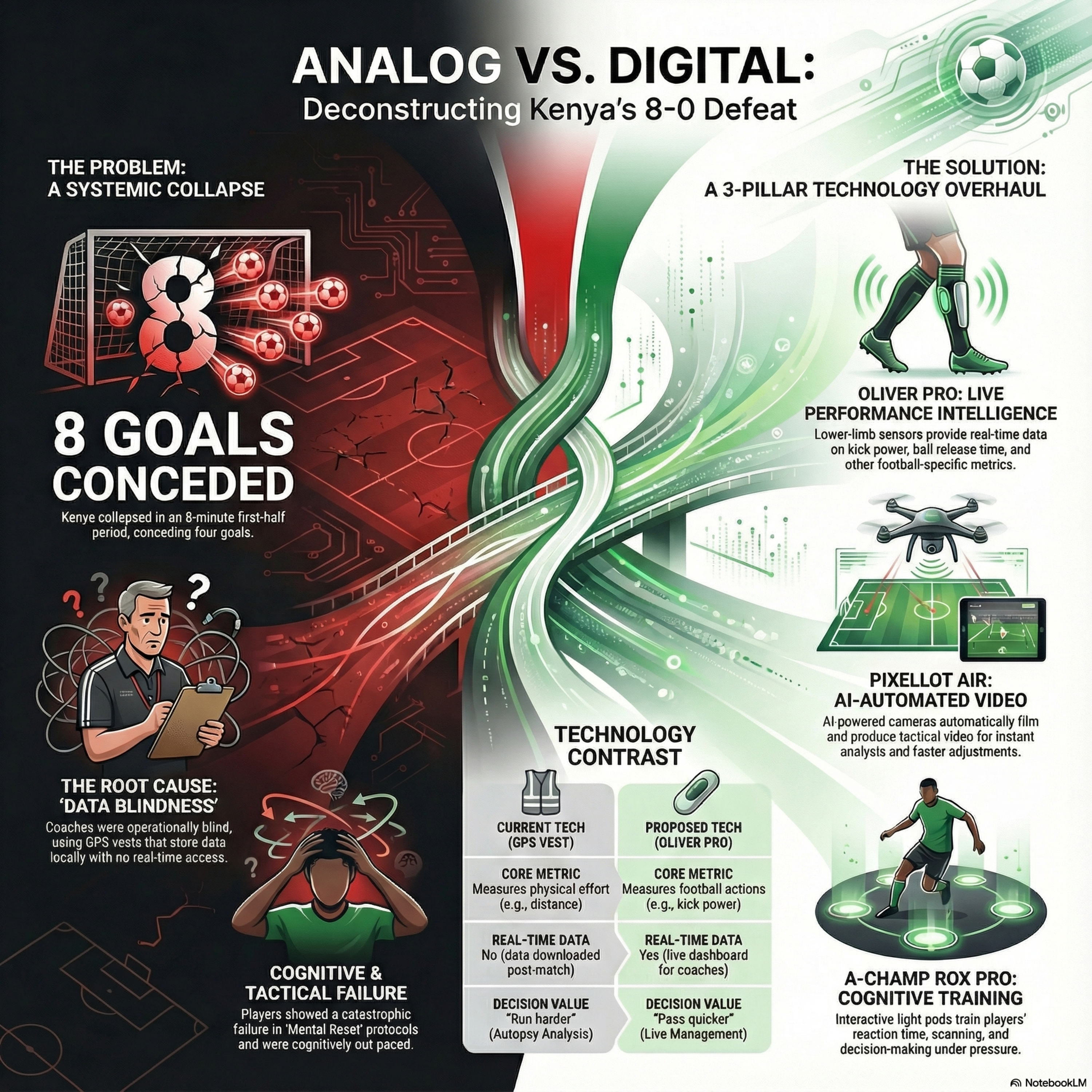
Data blindness. Data blindness. Yes, it. Sounds like a technical affliction, something terminal in modern football. What did that actually mean for head coach Benny McCarthy and his staff during those 90 minutes? It meant they were rendered operationally blind, dying completely and during the most critical high leverage phases of the match. The core issue was their tech, their reliance on outdated electronic performance and tracking systems. The GPS vests we see players wearing. Exactly. Standard vest based tech like player data or Catapult 1.
The problem is the data recorded on those vests. Total distance, top speed, that kind of thing. It's physically stored on the device itself. So you can't see it live. It is entirely inaccessible to the coaching staff, the analysts, the medical team during the actual live action. So when disaster struck and we're going to get to that timeline, McCarthy had 0 objective real time intelligence. Zero. He had no way of knowing which players were actually deteriorating, not just physically, but maybe more importantly, technically and cognitively.
Wow. He was forced to manage based purely on what he could see with his eyes, on intuition, on emotional perception alone. Meanwhile, what's happening on the Senegal bench? Well, you have to assume they have the opposite instant objective data that enables surgical intervention alerts on say midfield shaped deviating or fatigue thresholds being crossed or technical efficiency dropping off a Cliff. So that tech gap wasn't just a minor disadvantage. The audit concludes it was a decisive competitive advantage.
It amplified every other disparity in skill or tactical prep. And this data gap, it led to what the audit calls autopsy analysis. I want to stop on that phrase because it just sums up the futility of their whole system. It really does. Autopsy analysis means you find out why the patient died after the operation is over, right? The data they collected during that 80 loss only became accessible hours later, after the vests were plugged in and downloaded. So at 04 down in the 17th minute when McCarthy desperately needed to know which midfielder had dropped 20% in kick power or which defender had just stopped scanning the field.
The only information he had was the score line and the visible panic on his players faces. That is brutal. So the primary mandate going forward, the audit says is an aggressive non negotiable pivot. They have to move toward real time technology to close the specific data blindness gap and they have to do it immediately. To really understand the depth of this failure, we have to talk about the collapse itself. It wasn't a slow erosion over 90 minutes. This wasn't a gradual thing. The match was effectively over in just an 8 minute window.
Between the 9th and the 17th minute. Four goals conceded, 4 That's relentless, it's punishing and frankly, it's historically shocking at this level of football. It is, and this specific period is where the audits emphasis shifts. It moves definitively from, you know, simple physical failure, though fitness was a factor, to cognitive and systemic failure. So it's not about the legs, it's about the brain. Precisely the core breakdown proven by how fast those goals came was the complete absence of effective, trained mental reset protocols.
OK, let's unpack that. What is a proper mental reset actually look like in an elite team, The kind of thing Senegal would have drilled into them? It's the conditioned ability to instantly process conceding a goal, to suppress that natural spike of panic and emotion, and to immediately reorganize your defensive structure and control the tempo of the game. It sounds like a circuit breaker. It is a circuit breaker, it involves leadership, communication and often a pre planned deliberate tactical foul to just stop the play or maybe a short calming period of just keeping the ball and Kenya.
'S players had none of that. A complete and total failure of this elite psychological resilience, which led to what the audit vividly describes as emotional contagion. Emotional contagion like a virus. Exactly. Panic visibly spreading like wildfire through the entire team, accelerating the disintegration with every single goal that went in. Let's walk through that devastating timeline. This feels like visualizing the failure of, as we said, the analog brain under digital level pressure. It all starts at the 9th minute.
Goal 19.0 on the clock. Nicholas Jackson scores The systemic issue identified here was basic a complete lack of pressure on the ball carrier. El Haji Malik DIAF. So he just had all the time in the world. He was able to measure and deliver the assist without any physical impedance at all. The right back Barono Xiang was caught way too high up the pitch. A coordination failure? A total coordination failure and the center back failed to shift across to cover that crossing channel. They were disorganized from the first whistle and that first goal just confirmed how fragile their structure was.
And then just three minutes later, the audit points to the real turning point. It labels this 1A catastrohic error in ALL caps. Yeah. Goal 212th minute. Do you have scores this time after the goalkeeper Brian Bwyer committed a handling error? And Bruyor wasn't even the regular starter. He wasn't. He was rotated into the starting lineup, which against a tier one African champion like Senegal, was a highly, highly questionable decision from McCarthy. But the audit goes deeper than just a simple mistake.
Right. Oh yeah, this wasn't just a technical mistake. Like a wet ball slipping through his hands. The audit calls this a psychological collapse, reflecting a severe deficit in cognitive training under stress. So he just panicked. He panicked. That air gifted possession. It destabilized the structure even more, and, crucially, it just destroyed the team's morale. That's when the failure went from tactical to pure emotional panic. So the panic sets in. The contagion starts and goals three and four follow, almost immediately confirming it.
Goal 315th minute. This one was a failure of the midfield pivot Anthony Akumu and Alfa Onyango. The defensive shield. What was supposed to be the defensive shield, they were completely bypassed by a single sharp vertical pass from Pete Matar SAR. Just cut right through them. Like a knife through butter, it exposed this enormous, exploitable gap between the defense and midfield lines. It just showed an absolute lack of defensive coordination. Senegal knew exactly where that space was, and Kenya offered zero resistance.
And then goal 4. This one involved a world class player exploiting A fundamental flaw. Goal 417th minute Saudi Monet scores. This was a classic, classic demonstration of a failure and defensive awareness. You can't give him an inch. And they gave him a mile the left back. Breton Otieno completely lost track of Money on his blind side. Now Money's movement is world class, we know that. But the audit points to Kenya's inability to properly scan and track high speed runners coming from deep. Why does that happen?
When you're cognitively exhausted, you get tunnel vision, you only focus on the ball and you completely forget the movement around you. This lapse meant the match, psychologically and structurally, was completely over before the 20 minute mark. And during this 8 minute firestorm, the technical bench is blind and the players have no game management strategies to fall back on. Absolutely none. There was no attempt at a tactical foul to break the momentum, no effort to cool the tempo by holding possession even for a few seconds.
And no leadership. Critically, no on field leadership from senior players to grab everyone and enforce A structural reset. The audit is scathing about this passive acceptance of a total collapse. OK, let's pivot now. We need to contrast Kenya's internal chaos with what the Audit calls the structural dominance of their opponent. What made Senegal underpaid Thea so superior that they could inflict this level of punishment? Senegal's strategy was systematic, it was highly fluid and you could tell it was meticulously rehearsed.
They weren't just making it up as they went along. Not at all. They operated in a standard 433 formation on paper but it transition seamlessly and instantly into a devastating 235 when they had the ball in Kenya's half. So they overload the attack. Massively and Thias coaching philosophy is explicitly offensive, he says. We play offensively and after every loss of possession we must immediately recover the ball. This translates directly into lethal mechanisms that just preyed on Kenya's analog weaknesses.
Let's breakdown those mechanisms, starting with their positional strategy, the exploitation of half spaces. This is a hallmark of modern elite coaching. The half spaces are those vertical channels, you know, between the central defender and the fullback. That awkward zone. It's incredibly difficult to defend because it falls into this no man's land of defensive responsibility. So who's supposed to pick up the runner? Exactly. Monet and Idlman and DI consistently operated in these zones and it forced a catastrophic dilemma on Kenya's defenders.
Either the center back follows the attacker wide, creating a massive hole in the middle. Or the fullback lets the attacker run freely inside. And Senegal used this all game to just drag the Kenyan center backs out of position. It created perfect insertion points for late runners from midfield like Pep Matar SAR Kenya's defensive structure. It just couldn't handle that rotation and. The speed of their attack. It was described as suffocating. Their vertical transition speed was phenomenal When Kenya lost the ball, which was often because of their slow decision making, right Senegal's counter pressing, their gagging pressing immediately activated.
They didn't pass sideways or backward. They played vertically the second they won possession, never allowing Kenya to get back into a defensive shape. So a turnover in midfield was basically an immediate scoring chance. Instantly this high speed verticality that meant that any mistake was punished within seconds. You also mentioned that Theo specifically used his FIFA Technical Study group experience to develop their fullbacks. Yes, he studied the effectiveness of high and wide fullbacks during his analysis work, particularly at the U-17 World Cup and he.
Brought that to the senior team. He did. Ismael, Jacobs and foremost Mendi operated essentially as auxiliary wingers. They provided extreme with high up the pitch. This pinned Kenya's defensive 4 deep and narrow, which just made the space in the half spaces even bigger. So it was all connected. It was a perfectly integrated system of attack. This structural aggression was simply too much for a team that was trained in, you know, traditional, more passive defensive patterns. OK, let's go through the key positional mismatches the audit identified.
Let's tie them directly to this structural dominance. Starting with goalkeeping, the contrast between Brian Breyer's panic and Edward Mendy's Pro Active Control was, well, it was night and day. Amendi is world class, of course. Of course, but Brewer lacked the necessary footwork and confidence to play out from the back, which just invited immediate high intensity pressure from Senegal. His psychological fragility, triggered by that poor selection decision, became the team's single biggest liability.
So he kept giving the ball away. A very low distribution success rate which frequently handed possession straight back to Senegal in dangerous areas. In the central defense, Alphonse Amnesia and Sylvester Owino, the audit says they were overwhelmed. The term they used was cognitively outpaced, and the audit strongly, strongly stresses this was not just about a lack of raw physical speed. Right, it's that mental piece again. It was a catastrophic failure of the perception action coupling loop. OK, let's stop there for you listening.
Can we define that concept? Paint a picture of what that failure actually looks like on a football pitch. Certainly perception action coupling is the brains ability to seamlessly link visual information. What you see like Monet starting a run from deep with the required physical response. What you do like adjusting your position or making a tackle? So it's the speed of thought to action. It's the speed of that connection. A failure in this loop means a delay. Visually it looks like a defender moving half a second too late or stopping their run entirely, because the input, the image of the danger and the output the physical movement are disconnected.
And that's what happened with Men A. Multiple goals because Omija and Owino failed to scan, failed to anticipate, or failed to react in time. Their failure was rooted in delayed decision making, not just slow legs. And the midfield trio, the lynchpin that just completely crumbled. Total utter dominance by Senegal's trio of Idrisiglai, Cape Guy and Pete Matarsar. They ran the show. They did Kenya's pivot, Akumu and Onyango. They failed on every metric. They didn't protect the back four. They lost second balls consistently.
They had no coordination in their press, but critically, Dukabua, the creative player, Yeah, his average ball release time was recorded at over 1.5 seconds. 1 1/2 seconds? That sounds like an eternity against a pressing team. It is lethal against an elite pressing team like Senegal. That delay is a guaranteed turnover. It means the Senegalese midfield could close the passing lane or initiate A tackle before the ball even left a booyah's boot. So. Constant turnover. Constant turnovers and a crippling inability to transition from defense to offense.
The forwards, as a result, were completely starved of service. So they'd no chance to even score. The audit estimates their expected goals. Their XG was just .80 for the entire match, meaning they barely created one genuine scoring opportunity over 90 minutes. We've established that head coach Benny McCarthy was managing blind during that collapse. Let's zero in now on why that blindness was systemic. Let's look at the tech they relied on. OK, the standard vest based electronic performance and tracking systems are EPTS.
They are standard and professional football, sure, but they have a fundamental limitation when it comes to diagnosing what went wrong here. And what's that? These vests placed on the upper back. They only measure basic physical outputs. Total distance covered, top speed, player load, you know, basic heat maps. And as we said, all this data is just stored on the device during the match. And here is the paradox the audit identifies that I think is so important for you to grasp. Why are those basic metrics useless or even misleading when you're trying to figure out AN-80 defeat?
Because the physical data is a distraction from the real failure. The audit points out that in matches where a team is dominated, where they're chasing the game, constantly trying to press, constantly tracking runners, the players often run more than the opposition. So it looks like they're working hard. Exactly. A Kenyan midfielder might log 12 kilometers and hit his maximum pop speed. If McCarthy reviews that data after the game, he might think, well, the effort was there, we just got unlucky.
But the vests, they failed to capture the truth of that effort. The vest confirms exhaustion, but it cannot diagnose why they lost. It failed to record that the midfielder lost possession 15 times, that he failed to scan his blind side, or that his crucial ball release time was agonizingly slow, directly leading to four of the goals. So it measures the engines effort but not the precision of the steering. That's a perfect analogy. And that gap, that's what results in autopsy analysis, a post mortem diagnosis that is absolutely useless for prevention.
This fatal flaw, this reliance on after the fact physical data, it completely handicapped the entire bench staff, even the highly qualified ones. It did. Let's talk about lead data analysis Nick Comanthe. According to his background, he has multiple master's degrees, EPTS certification. His technical expertise was rendered completely useless by the hardware. He had the knowledge, but not the tools. Exactly. During that entire 8 minute collapse, he had zero live objective data to feed to McCarthy.
He couldn't provide an alert that, for instance, midfielder Antonia Coomer was experiencing a technical decline, something you could measure by a drop in his average kick power. Not just that he looked tired. Right, or that defender barone ocean Sprint frequency had dropped dangerously below his personal baseline, which is a huge red flag for a cognitive inability to track high speed movements. And the video analysis was just as slow, creating this massive bottleneck. The performance analyst Pallela Maposa was basically trapped using manual video coding systems like Huddle Sports code.
These rely on a human operator tagging events. It's just too slow. It's inherently too slow for elite football. By the time a Posa had manually tagged, coded and prepared a visual clip of a defensive error for review, Senegal had often scored two more goals. So halftime analysis becomes a scramble. A complete scramble based on incomplete subjective observations, not on objective tagged data. When you are being run ragged by a team like Senegal, you need answers in seconds, not in the 15 minute halftime window.
In this contrast with the Senegal benchmark is just so striking. Their coach, Paid Thio, was analyzing the opponents with what the audit calls surgical precision. Theo's data-driven coaching philosophy is the benchmark. His staff would have had real time access to detailed data on player positioning, pressing efficiency and immediate alerts whenever a player deviated from the tactical plan. Which allowed for those surgical. Exactly like bringing on fresh legs not just because someone looked tired, but because their key technical metrics, like successful pass completion under pressure, had dropped below a preset threshold.
Kenya was simply playing a different, decades older game. This brings us to the most crucial forward-looking part of the audit, the strategic road map for recovery. The prescription. Yes, the mandate is clear. Abandoned the philosophy of training harder and commit entirely to training smarter. This requires immediate targeted investment in a three pillar technology solution. Let's start with Pillar One, which is a revolutionary approach to tracking Oliver Pro. Oliver Pro is the recommended immediate transition for all their teams, senior and youth, and the audit identifies the critical differentiator.
It's the placement. The inertial measurement unit is housed in a calf sleeve on the leg, worn directly on the lower limb that actually interacts with the ball. This biomechanical positioning allows for the accurate direct measurement of football specific metrics that the upper back vests just cannot capture. Wait, why the calf sleeve? Why is measuring the leg rather than the core so important for unlocking these new metrics? Because football is played with the lower limbs, the upper back vest measures displacement.
How far the player moves the calf sleeve measures mechanical interaction with the ball and the ground. It's about the action, not just the motion. Exactly. It uses advanced micro accelerometers to calculate force, power and frequency directly related to kicking and running dynamics. This shifts the whole focus from just running to actual technical execution under pressure. So what are the key football specific metrics that McCarthy's staff desperately needed during that Senegal game? There are four critical game changing ones.
First, kick power, which is measured in G force OK. This is objective data that can identify defenders whose clearance power is just insufficient. The target minimum is 4.0 G In the 80, loss data would have shown multiple clearances failing to even bypass the first line of the Senegalese press, leading to immediate counterattacks. 2nd is ball interactions. This one is vital for psychological profiling. It objectively counts every single touch, pass, dribble or tackle. The audit suggests using this to identify players who mentally hide or avoid responsibility when the pressure mounts.
If a central midfielders ball interaction count drops by 50% in that 9th to 17th minute window, that is immediate objective evidence of a mental and tactical withdrawal. And the third, which we touched on before, seems absolutely vital against high pressing teams. Ball release time. Absolutely vital, it measures the interval between a player receiving the ball and releasing it. The audit establishes this as a critical, nonnegotiable selection criterion. Players must show a ball release time of less than .8 seconds in high intensity training to even qualify for matches against elite opposition.
And Abuya was at 1.5 seconds. Which is definitive proof of why this objective metric is so necessary for selection. But the real game changer here isn't just what they measure, it's when they measure it. The real time intelligence capability through the coach's dashboard. This is the operational leap forward. During that 9th to 17th minute collapse, Nick Comanthy would have received live objective alerts on his screen. Akumu's kick power decreased 15% below baseline. Oshiyang's Sprint frequency dropped 20% or Abuya has had only 8 ball interactions in the last 10 minutes.
This live data enables McCarthy to make surgical evidence based substitutions and adjustments at the precise moment things start to go wrong. Instead of waiting until the score is 06 and the damage is done. And the emotional damage is irreparable. And the audit also notes the cost benefit calculation here is overwhelmingly positive. Yeah, the hardware cost is moderate, around $262 per unit. This is significantly lower than the highest and professional vests, which allows for crucial wider deployment.
They can immediately equip EU 20 and U-17 pathways, standardizing performance analytics early. Which maximizes the long term return on investment. Massively. OK, moving to pillar 2. This addresses that slow manual video coding bottleneck. Pixelot AIR. Pixelot Air is all about AI automated video analysis. Instead of relying on a human analyst trying to manually tag events, the system uses machine vision technology to track the ball and all the players automatically. So it does the coding for them.
Instantly it generates multi angle tactical views of formations, pressing traps, gaps. It completely eliminates that manual bottleneck and allows for rapid, comprehensive halftime adjustments based on objective visual evidence. So instead of Paposa, the analyst, manually tagging an error 20 minutes too late, the head coach can pull up a clear visual clip during the 15 minute break. And show the entire defensive unit precisely. They stop relying on subjective verbal instruction like hey everyone needs to work harder.
Instead they show clear objective, evidence based feedback. Omija look at this clip. The distance between you and Owino is 8 meters. The tactical brief demands 4 meters. Why? And the audit points to another federation already doing this. It does. It specifically highlights the Royal Moroccan Football Federations extensive use of pixel lot to standardize elite development across all age groups as the non negotiable benchmark Kenya must immediately emulate. Finally, Pillar 3, this directly addresses the fundamental cognitive failure of the 8 new loss, the HMP ROX PRO Interactive Cognitive Motor Training Systems, or ICMT.
This is the neuroscience solution. This pillar directly tackles that core issue we identified in the central defense being cognitively outpaced. We established the failure of that perception action coupling loop. Right, see and did it. ICMT uses these networked, randomized, light sensitive pods that flash different colors and sequences. The player has to respond physically to the visual stimulus under pressure, forcing them to process multiple visual stimuli at once, which rapidly improves neural efficiency.
How does this training physically achieve that goal? Are we training the eyes, the neural pathways or the muscles? It's primarily the neural pathways, specifically the efficiency of the connection between the visual cortex, which sees the stimulus, and the motor cortex, which executes the action. It's like upgrading the wiring. That's a great way to think of it. By forcing the brain to make decisions at high speed repeatedly, the ICMT system creates and reinforces stronger, faster neural pathways.
It's like upgrading an old Internet cable to fiber optic. It just speeds up the entire decision making loop. So what are the specific applications that would have helped against Senegal? First, defensive scanning drills. You place the pods in a 360° circle around the defender. They have to detach their eyes from the ball and scan their environment, continuously lighting up pods based on verbal commands while simultaneously tracking a ball. Which directly addresses the failure to track Sadio Mana's blind side runs.
Exactly. It trains that 360° awareness. And what about the goalkeeper B Wire's psychological collapse? Goalkeeper reaction training. You use randomized light sequences to simulate shot directions and heights. The goalkeeping coach, Monib Josephs would implement this, increasing the speed and the complexity as the keeper adapts. This builds cognitive resilience under pressure. So his brain is less prone to panic. It ensures that the neural pathways for rapid decision making are robust and less likely to short circuit.
And the final application which defines the entire game management crisis fatigue based decision making. This is the solution to that 8 minute collapse. It involves subjecting players to high intensity physical drills to induce exhaustion and then immediately followed by complex cognitive tasks using the ROX Pro systems. So you're recreating the end of a match. You're simulating the 80th minute mental collapse. You're training the brain to maintain high cognitive quality and structural discipline despite physical exhaustion.
It fundamentally counters the mental reset failure we saw. It trains mental toughness when the legs are gone. This brings us to the formal aggressive plan to move from modernization to full transformation. The road map is dubbed Project 2027. Yes, and it outlines the immediate steps required to transform the Harambee Stars from, let's be honest, perennial participants into genuine AFCON 2027 contenders. So quarter 1, January to March 2026, this is audit, acquisition and certification. This is where the commitment is tested right away.
The initial capital investment target is about $50,000 USD. This covers 50 Oliver Pro units, some for the senior team, some for the youth pathways, a couple of pixel lot air systems and two HM ROX Pro sets. That sounds like a lot, but the audit defends it. It provides A forceful defense. It states the ROI on this is exponentially higher than the cost of a single non data-driven international training camp or friendly match. This has to be the priority. And there's a non negotiable requirement for the staff.
This feels like a big statement of intent. It is mandatory Oliver Pro Coach's dashboard certification for Benny McCarthy and his entire coaching staff and all the analysts. The mandate is clear and uncompromising, which is no certification, no sitting on the bench during matches. Wow. It ensures immediate and proper use of the new real time data workflow and forces a culture shift away from pure intuition toward objective data. OK. Moving it to quarter 2 April to June 2026. Implementation of benchmarking.
This is where they define the new Harambee DNA. And this new DNA is defined purely by evidence based selection. The subjective eye test call ups are gone. The metrics are specific, objective and non negotiable. Like we said, midfielders must achieve a ball release time under .8 seconds. Defenders must maintain kick power drops of less than 10% in the second-half. Goalkeepers need over 80% distribution completion under high pressed drills. You have to meet these benchmarks to get a call up. And the cognitive training becomes a mandatory part of the routine here.
Mandatory 15 minute H AMP ROX Pro cognitive activation sessions before every single field session. It's not optional. It ensures the players brains are primed for high speed decision making before the physical work even begins. What about the matches in that quarter? The focus for the Test matches is strictly on process over results. The team has to show improved discipline, ensuring the score differential doesn't exceed two goals in any 10 minute period. A direct response to the 8 minute collapse.
An objective measure to counter that failure. Quarter three, July to September 2026, focuses on optimization and scouting, linking the national team to the domestic league for the first time in this way. It calls for aggressive, data-driven domestic scouting. The Oliver Pro units are to be deployed within the FKF Premier League. This is a huge shift. So scouts will be looking at data, not just players. They'll be asking which domestic player has the required kick power, the lowest ball release time, the highest scanning frequency.
This objective measure is designed to expand the player pool based purely on performance data. Which would effectively mitigate some of those historical selection issues. Bias favoritism, yes, and furthermore, players who fail a benchmarks get targeted intervention like a mandatory 4 week remedial cognitive training program rather than just being dropped from the squad. And finally, quarter 4 October to December 2026, this is AFCON readiness in the final selection process. The year end review is critical.
They have to compare their Q4 data against the Q1 baselines to demonstrate measurable improvement to all the stakeholders and sponsors. So they can prove it's working. And they will benchmark Kenyan player data against Oliver Pro's anonymous global database to objectively measure the remaining competitive gap. For example, AFCON semifinalists average .65 seconds release time. We are currently at .85 seconds, demonstrating A200 millisecond deficit remaining. And the final squad selection. It will identify the preliminary 35 man squad based entirely on 12 months of longitudinal objective data, removing subjectivity and bias completely from that final high stakes selection.
Now this whole technical diagnosis, this road map, it stems from a profound institutional failure that the FKF President Hussein Muhammad immediately acknowledged he had to What was the public reaction to that 80 humiliation? And what did Muhammad pledge? Following the loss, Muhammad issued a rapid and sweeping public apology. He called the result a wake up call that could not be ignored. He didn't make excuses. No, he pledged urgent and painful reforms, stating the Federation would review all policies, operational procedures and the performance of every staff member, starting from grassroots.
He committed to building a serious professional technical team. The political will seems to be there, driven by the sheer national embarrassment. And the scrutiny was immediate for head coach Benny McCarthy, despite his pedigree. I mean UEFA Champions League winner as a player, former Manchester United striker, coach, but he faced huge criticism, not just for that goalkeeper rotation. Which was deemed catastrophically poor judgement. And LED directly to the mental collapse, but also for his tactical passivity.
His failure to intervene decisively during that 8 minute collapse showed a lack of real time management capability, which, as the audit says, comes right back to his data blindness. And his assistant coach made things even worse. Assistant coach Vasila Manasakis actions were labeled unprofessional. He got a red card for aggressive dissent towards the referee. A complete loss of emotional control at the moment of maximum crisis. Which sends a terrible signal to the players on the field. A devastating signal about bench composure and leadership when the players were already drowning in panic.
It left McCarthy physically isolated out there, just compounding the sense of total organizational failure. It's vital to put this defeat into historical perspective, to understand the emotional weight here. The 80 loss to Senegal on November 18th, 2025. It now ranks as the fourth worst defeat in the Harambee Stars entire history. The fourth worst ever. An infamous moment carved into their record, sitting just behind a catastrophic 90 loss to Zambia way back in 1970. 78 So this result has become a real marker of structural decay.
Now we have to address the serious systemic, non-technical issues raised internally regarding selection. The audit implicitly suggests that technology is the only way to overcome human bias. It does. The audit sources highlighted a serious internal concern regarding historical tribalism dominating team selection at the expense of merit. That's a serious accusation. It is accusations were made that recent poor results, including the 8 neural thrashing and the U-17 team struggling to draw with some Amalia, coincided with selections perceived as being dominated by players from the Luo community.
And the sources contrasted that with other results. Yes. They noted that better results, like qualifying for the AFCON U20 tournament, occurred only when there was, and this is a quote, a proper mix of players from different tribes. Which underscores why that mandate in Quarter 3 for data-driven domestic scouting isn't just about performance. It's about organizational integrity. It's the cure for subjectivity. By establishing non negotiable metrics like kick power and ball release time, the FKF aims to create a selection environment where bias, tribal or otherwise, simply cannot flourish.
Because the performance metrics are transparent, they're objective, and they're longitudinal. It takes the opinion out of it. It does, and that structural change is perhaps the single most significant challenge of the whole project 2027. And finally, the federation's commitment is tied to securing future funding. They have to demonstrate ROI to the government and to sponsors like Safaricom. Absolutely. The audit gives them the narrative structure to do that. They can now approach sponsors with objective metrics.
It's not just a plea for money. No, they can say we are not asking for money for hope. We are asking for money to achieve a 30% faster decision making time in our midfield unit by Q3 or our defensive unit is maintaining structural integrity 40% longer under pressure compared to January 2026. So they're framing this as an innovation project. Exactly justifying continued technological investment through measurable objective, performance based success. So to conclude, the audit paints this picture of a federation facing a fundamental, unavoidable binary choice.
That 80 defeat offered a painful clarity, but now the institutional courage is required to actually execute the plan. And that choice is simple and stark. Option A Maintain the current analog infrastructure you know, hope for improvement through motivational speeches or swapping out a few players, and accept continued mediocrity. And eventual embarrassment. And eventual embarrassment or Option B invest the necessary capital now in that three pillar technology solution, Oliver Pro, Pixel Lot Air and HMP ROX Pro and commit fully to data-driven selection and training to build a systematic competitive advantage.
And the stakes could not be higher given the dual mandates of hosting AFCON 2027 and the World Cup 2030 qualification push. The stakes are the credibility of the entire national program. The audit concludes with absolute certainty. Without this immediate technological modernization, Kenya faces continued defeats, failure to progress and the guarantee of embarrassment at their own AFCON tournament in 2020. 7 It's a damning conclusion. The final undeniable conclusion is that the gap between Kenya and elite African football nations will not close their passion, effort or traditional training methods alone.
It requires the systematic adoption of technology and a data-driven philosophy that the elite nations deployed years ago. Which brings us to our final provocative thought for you to the listener. If this kind of forensic audit can now provide real time, objective clarity on everything from a player's kick power to their cognitive failure rate under fatigue data that can be delivered instantly to a coach's dashboard, what does this detailed analysis suggest about the future of coaching across all major sports?
Does traditional intuition still have a valid critical place in game management when objective high frequency data can guide every single substitution and every single tactical adjustment? That's something for you to Mull over as we conclude this deep dive.
 Apple Podcasts
 Castbox
 Castro
 Goodpods
 Moon FM
 Overcast
 Pocket Casts
 Podbean
 Podcast Addict
 Podcast Republic
 Spotify