PSG Crowned Intercontinental Cup Champions
About this episode
PSG Crowned Intercontinental Cup Champions
Listen now on Spotify, Apple Podcasts, Amazon and other streaming services! Don’t forget to subscribe, share, and leave a ⭐⭐⭐⭐⭐ review to help more players and coaches discover the power of Techne Futbol and Data Technology in the beautiful game.
#TechneAfricaFutbol #TechneFutbol #TrainWithTechne #Playermaker #TraceFutbol #Hudl #FootballTech #FootballInnovation #PlayerDevelopment #CoachTools #SmartFootballTraining #AfricanFootball #CAFOnline #FIFA #FIFAYouth #CAFDevelopment #YouthFootballAfrica #NextGenFootball #FootballScouting #TalentIdentification #DigitalScouting #EliteYouthDevelopment #FootballJourney #FootballAnalytics #FIFAForward #FutebolAfricano #TrainTrackCompete #FootballExcellence #FootballAfrica #TheFutureOfFootball
OK, let's unpack this. Welcome back to the deep dive. Today we're taking you straight to the heart of Qatar, specifically the 2025 FIFA Intercontinental Cup Final. That's right, it pitted the European powerhouse Paris injuremen against the South American champions Flamingo. Now, on the surface, this was a clash of Titans, a single match to crown a global winner. But our mission today is to, you know, look at this as a dual story. It was far more than 120 minute football match that ultimately ended in penalties.
For PSG, it was this quest for a historic 6 trophy haul. That's acceptable, yeah. But for Flamingo, and this is the really interesting part, this was a crucial business final. It was a proof of concept. A proof of concept designed to show what exactly? To demonstrate the global commercial viability and I'd say the financial maturity of Brazilian football on the world stage. Really appreciate that framing when you dig into it. The clash of the balance sheets here is, well, it's arguably more important than the clash on the pitch.
The initial take away that really sets the table for everything we're about to discuss is just the astonishing financial stakes involved. And those stakes, you know, they primarily benefited the non European challenger. Exactly what we saw in Doha was this perfect moment where competitive excellence aligned with really aggressive financial ambition. A synthesis that's historically been almost impossible for clubs outside of Europe. The impossible dream, really. PSG came into this game chasing a historical landmark, a record, but Flamingo was pursuing a specific, almost unbelievable monetary goal off the field.
And a goal that had monumental implications for the entire South American game. Absolutely. So let's jump right into that financial dimension, because the numbers coming out of Rio are genuinely staggering and they really define the success of Flamingo's management, regardless of the final penalty shootout. Yeah, we have to talk about the R $2 billion benchmark. That's the North Star for the club right now. This number is the core of their whole commercial revolution. Flamingo is on track, projected to be the very first Brazilian club in history to surpass 2 billion Rays in annual revenue in a single fiscal year.
OK, so for our listeners, let's put that into perspective. 2 billion rays, What are we talking in U.S. dollars? Roughly $370 million USD. And this isn't just a record, it's a paradigm shift. $370 million. I mean when you compare that to an ambitious MLS club or even a mid table Premier League club. A different stratosphere. It puts Flamingo in a completely different financial conversation. Yeah, it elevates them from just being a regional giant in South America to a, well, a bona fide global financial entity.
It signals a huge shift from organizational chaos to a real corporate structure, right? Precisely. They are moving away from the historical Brazilian model, which, you know, was often characterized by operating on a campaign by campaign basis. Hoping for a trophy, selling a star player to balance the books that whole cycle. That's the one relying heavily on selling one star player annually just to stay afloat. This 2 billion Reyes benchmark means they can stop planning like a short term campaign and start planning like a long term, stable, diversified company.
Which allows for a sustained investment right in things like infrastructure, youth development. Instead of just constant reactive spending. Exactly, that structural change is so powerful and their recent on pitch success, I mean culminating in this Intercontinental Cup final run, yeah, that was crucial in accelerating that whole commercial ambition. It was the catalyst. Let's look at the tournament cash injection, specifically the cash infusion from their successful 2025 campaign. Even before the final whistle, Blue in Doha was immense.
How immense are we talking? Flamingo had already secured our $422.3 million which is about 78,000,000 USD in prize money. Wow. From the combined competitions, just their run to the Intercontinental Cup final, that's just pure competitive revenue. Wait, hold on. If the journey to the final was worth $78 million, what was the marginal difference for actually winning it against PSG? And that's the critical point. The marginal financial difference from winning the final was reported as relatively modest.
How modest? An additional R $27 million, which is only about $5,000,000 USD. So let me get this straight. The trophy itself was worth $5 million, but the global platform, just the journey there, was worth 78 million. Yes, this completely inverts the importance of the event for a South American club, doesn't it? It totally does. The attention, the global stage, that proof of concept you mentioned, that was the real financial prize they were chasing. Absolutely. The $78 million secures the immediate financial health, sure.
But the global platform being on that stage against PSG, that's what allows them to execute their long term growth strategy. Which is monetizing global attention. And becoming in new international markets, I mean, think about how hard it is to introduce a brand like Flamingo to a potential sponsor in the Middle East or a broadcaster in Asia. Right. It's not a household name there like a Real Madrid or Manchester United. Not yet. And their answer to that problem was strategic player acquisition, basically buying international familiarity to shortcut the process.
It was crucial they intentionally built their squad around players who already had recent European visibility. So guys who have played in major leagues, 4 major national teams. Exactly so that the casual global fan or a potential international sponsor recognizes at least some names on the roster and then hiring a coach like Felipe Luis. Who has a huge playing history in Europe? Adds an extra layer of instant marketable legitimacy. But international familiarity is their golden ticket. It instantly helps global sponsors, broadcaster, social platforms.
It helps them sell the club story easily. They're exporting A recognizable package, not just a badge that needs a 10 minute explanation. Right. But even with all that international ambition, you need a stable foundation at home. Let's look at their existing revenue machine using the 2024 numbers we have. Their ambition is built on a remarkably stable and robust domestic streams. In 2024, the cornerstone was broadcasting revenue. How much was that? It brought in our $453 million or about $84,000,000 USD.
Then advertising and sponsorship followed pretty closely, generating our $417.7 million, around $77 million USD. Those are foundational domestic figures that very few non European clubs globally could even dream of. Very few, but. To get to that 2 billion Reese target, you need a substantial new lever and the reporting points directly to the explosion of the betting and gambling sponsorship market in Brazil. And specifically the massive Batano deal. Tell me about that. That Batano master sponsorship is the single biggest engine driving them toward that 3, $370 million target.
It's reported at our $268.5 million per season. Which translates to. A gigantic $50 million USD and stable recurring cash flow just from the primary shirt sponsor. I mean when you can guarantee half $100 million annually from a single commercial partner, it fundamentally changes your ability to make long term investment decisions. On player contracts, transfer fees, infrastructure. All of it. It gives you financial breathing room. They are effectively competing with the budgets of established European leagues for players, all thanks to this massive domestic commercial growth.
It's incredible. But here's the critical question for me, this level of ambition, it always comes with risk. You mentioned the R $2 billion target, but we also have to talk about the flip side, the rising debt. Of course. Given that they reported a deficit in 2024 despite record gross revenue, is that ambition reckless or is it strategically necessary? That is the essential friction in the story, isn't it? In 2024, despite generating that record gross revenue are $1.3 billion or $241 million USD, the club still reported a small deficit.
So it's not just about what you make, it's about what you spend. Financial success in modern football is never purely about gross revenue. It's about efficient spending and managing these huge fixed costs, primarily player wages. And the net operating debt was rising, too. What was driving that number up? It was indeed rising to around our $327 million or $61 million USD. Now this wasn't due to say reckless spending on consumables. It was really two very specific high cost investment areas. OK, what were they?
First, high player costs. Signing and maintaining a world class squad requires massive guaranteed salaries. That's standard. And the second? Second, and this is crucial, they are pursuing an ambitious, expensive stadium land acquisition project. A modern, privately owned stadium. That's the final frontier of revenue optimization, right? It lets them control match day revenue, commercial space, hospitality. It's what the European giants have done for decades. Exactly. They're taking on short term debt to secure generational revenue streams.
It's a calculated risk. Which brings us back to the impact of these new FIFA tournaments, the Intercontinental Cup, the expanded Club World Cup. How does that global competition fundamentally change that risk calculation for the board? It completely alters the risk reward ratio. I mean, before this new structure, if you invested say our $500 million in your squad, the financial reward was capped by domestic leagues and the Copa Libertados, which have much smaller prize pools right now. One good deep run into these new FIFA structures, which carry massive, often 7 to 8 figure prize funds and incomparable exposure, can provide enough cash and commercial lift to justify years of ambitious investment.
So Flamingos campaign basically validates that new model. It's the perfect case study that $78,000,000 in prize money is their emergency brake, their growth engine, and their insurance policy all rolled into one. They're using the pitch to finance the balance sheet. So while Flamingo was fighting a business final, PSG was fighting for a different kind of history, a historic statistical dominance. Let's shift our focus to the pregame environment in Doha. Yeah, the contextual stakes were steeped in historical oddity.
And the setting was perfect for that global contrast. The Ahmad Ben Ali Stadium in Qatar, a 2022 World Cup venue A. Magnificent venue capacity of over 45,000. It really underscored the global importance of the event. And the key thing here is that both teams were chasing their first title in the current newly restructured FIFA Intercontinental Cup format. That distinction is so crucial because the history of this specific trophy is frankly confusing, even to informed fans. Right. FIFA did that sweeping competition overhaul, splitting the global club championship into two parts.
Exactly. You have the massive expanded FIFA Club World Cup, which is held less frequently now and then you have this, the single match FIFA Intercontinental Cup, which is a direct clash between the European and South American champions. And that leads to the necessary caveat for Flamingo fans. They could proudly remember their 1981 Intercontinental Cup win. But that was a completely different format. That was the traditional single match format between the winners of the European Cup and the Copa Libertodortis.
This new FIFA version is an official modern trophy. So for both clubs, this was a chance to definitively put their name on the modern restructured version. Which led to that aha moment for the listener about the trophy hierarchy. Confusion. OK. Help us unpack that confusion. PSG could still claim a form of world champion status even if, say, another club had recently won the expanded Club World Cup. How does that work? The issue really stems from FIFA's attempt to create multiple global champion touch points every year.
Since the new Club World Cup is less frequent, the Intercontinental Cup, played annually, effectively serves as the definitive annual clash between the world's two strongest confederations. So the winner? The winner, in this case, PSG, could legitimately claim the title of the most dominant team of the calendar year, even if the slightly larger, more encompassing Club World Cup title rested somewhere else at that moment. So it's the highest expression of annual dominance, not necessarily the winner of the single largest tournament.
You've got it. FIFA's overhaul created a semantic yet intense debate about global supremacy. Which brings us to the managers mindsets and the contrast between Luis Enrique and Felipe. Luis was almost cartoonish in its difference. On one side you had Luis Enrique, the PSG manager, pursuing A statistical historic achievement, the sex double. He'd already won everything else that year. Everything League One, the trophy de champion, the Coup de Crons, the Champions League, the UEFA supercut. He came into Doha with the expectation of victory, not the hope.
That is a staggering level of dominance. He wasn't just aiming to win a cup, he was aiming to cement PSG as the undisputed most dominant collective unit in world football for the entire 2025 calendar year. His mentality was purely aggressive. Keep making history. He wanted to prove his system was perfect. And then the Felipe Luis. He approached the game with extreme caution and realism, maybe door during unnecessary humility. He openly said that Flamengo was the underdog, didn't he? He did. He acknowledged PSG as the best team in the world with the best coach, and he said unequivocally that his team needed to play a perfect game to even stand a chance.
So this wasn't false modest to use as the pragmatic assessment. Absolutely. His strategy wasn't about trying to outplay PSG in a possession battle. It was a surgical approach focused on defense and neutralization. How so? Luis knew they couldn't let PS GS midfield control the tempo. His entire focus was on defending as a team, maintaining high physical intensity, and specifically neutralizing those key midfield players who fuel PS GS attack. Deny them time and space. Exactly, contain them and then hope to exploit limited counter attacking opportunities.
Now, before we get into the match itself, let's quickly touch on Flamingo's road to the final because unlike PSG, who got a direct route, Flamingo had to earn their spot in Qatar. They did. They earned their initial slot by winning the Copa Libertadores and the Brazilian Syria. Then, once in Qatar, they first had to face Cruz Azul from Mexico. The FIFA Derby of the Americas. Right, that was a gritty 21V. It really tested their resolve early. And after that they had to face Pyramids FC, the African representative.
Correct. They defeated Egypt's Pyramids FC two nil in the FIFA Challenger Cup. That win guaranteed their spot in the final showdown against PSG. They were battle tested coming into Doha. And crucially, key personnel. Both teams have their stars available despite some pre match injury worries. Indeed, Luis Enrique got good news with Uzmani Dimbele. He'd been sick but managed 2 full training sessions and was available on the bench. A huge impact sub to have. For sure, and for Flamengo, their star striker Pedro was returning from injury and was also available for selection.
OK, the stage is set, the financial structure is in place, the history is complex. The managers have their battle plans. Let's dive into the 120 minute showdown itself. The match kicked off with an immediate and intense physical exchange. The first half was a perfect illustration of those two contrasting tactics. Flamingos started with an incredible high pressing intensity. Trying to disrupt PSG's rhythm. Exactly recovered the ball quickly launched dangerous vertical counters. Use speed and physicality.
And PSG responded how they always do. Maintain possession, control the tempo, try to wear them down. Luis Enrique's system is built on that. Patient control forced the opposition to chase and eventually they make mistakes. And the biggest piece of early drama came just 12 minutes in a huge VAR intervention that saved Flamingo. It really did. I remember the sequence being debated for days afterwards. Flamingo's goalkeeper Augustin Rossi made a significant error on a clearance. Just gifted the ball to PSG in a dangerous.
Spot he did. Fabian Ruiz recovered it, slotted it home, thought he'd scored the opener. But the goal was immediately disallowed. And VAR VR spent several minutes reviewing it from all angles. The final ruling was that during Rossi's initial I'll fated clearance, the ball had completely crossed the touchline. It had gone out of play. Before Reeves recovered possession, that decision kept the score at 00 and was a major, major reprieve for Flamingo's shaky start. That VAR call kept Felipe Lisa's plan alive, but eventually PSG's quality was just too much to contain, though first there was an unfortunate set back for them around the 33rd minute.
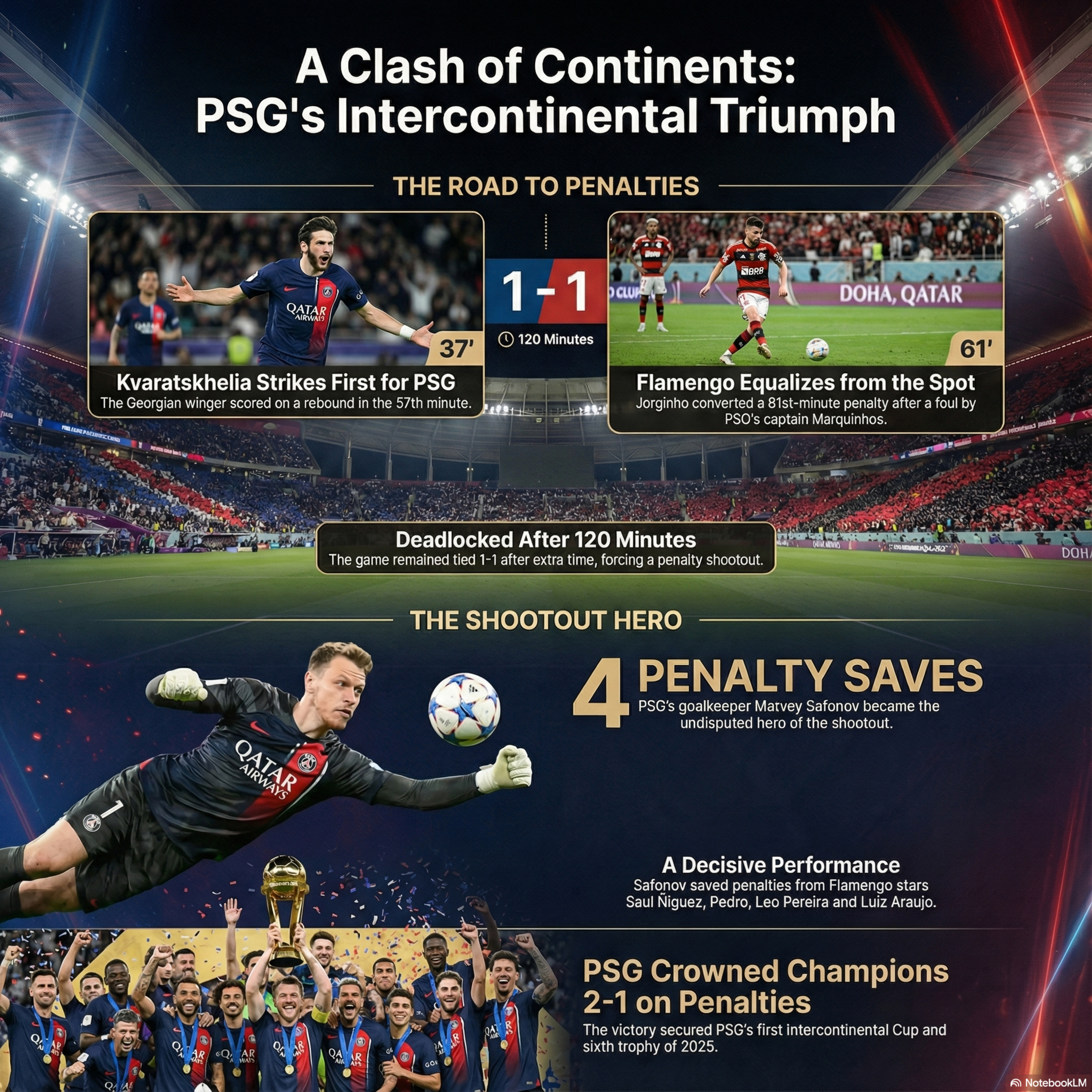
Yes, Kang and Lee suffered an injury in midfield, forcing an early substitution. He was replaced by Seni Mayulu. And losing Lee, a key cog in that possession structure, that had to be a disruption for PSG's flow. It was, but despite the injury, they found the crucial breakthrough just 4 minutes later. In the 37th minute, Kovichik Ferrat Scalia scored the official first goal. Walk us through that goal. It was a perfect example of PSG capitalizing as that initial physical intensity from Flamingo started to wane.
It began with a quick ball recovery and Flamingos 3rd. Desire do. Right on the right flank, he drove toward the penalty area, took a powerful shot, Rossi managed to save it, but he pushed the rebound right back into the danger zone. And Ferrat Scalia was right there. He had tracked the play perfectly from the left, reacted quicker than the defenders and scored with a decisive is a first time shot 1 Nero PSG a huge psychological blow right before halftime. So PSG held the partial victory. Felipe Luis's men returned for the second-half knowing they had to seize the protagonist role again or the sextuple was sealed.
And they did exactly that. Flamingo came out with renewed intensity, pushing higher up the pitch. They managed to regain some of that momentum they'd lost. And it paid off just after the hour mark. The penalty. Around the 59th minute, Captain Marquinos, who was having a surprisingly difficult night, committed a foul on the Araskaita inside the box. A clumsy challenge. It was a clear penalty and the immense pressure of that moment then fell on the experienced shoulders of Giorgino. Giorgino, known globally for his composed penalty technique, stepping up against Saffanoff.
And he delivered a perfect penalty, converted it coolly, sent Saffanoff the wrong way and levelled the game one one in the 61st minute. A massive moment of composure for Flamingo, it proved they could hang with the Champions League winner. It completely neutralized the goal they conceded just before the break. So as the clock wound down towards 90 minutes, we saw the coaches start to deploy their contingency plans right bringing in the Subs. The substitution pattern told a story. Felipe Luis brought in guys like De La Cruz and Saul Niguez.
He was reinforcing the midfield, trying to hold the ball, slow the game down, basically prepare for extra time. While Luis Enrique did the. Opposite, he brought in his attacking impact Subs Bradley Barcola and of course, the recently recovered Usman Nidimbele. And Dimbele immediately injected that velocity and danger into PSG's attack. And he led directly to the most crucial heart stopping moment of the entire 90 minutes. The Marquinos Miss. This sequence, right in stoppage time, was the absolute definition of Marquinos's strangely jittery performance.
Dembele smashed a powerful low cross right across the face of the goal. And Martinos was perfectly positioned. A golden chance. A tap in really in the six yard box, A chance to win the game in the final seconds of regulation. But he completely scuffed it. Redirected the ball right into the grateful hands of Augustin Rossi, a horror miss. Agonizing for PSG fans, A miracle escape for Flamingo that sent the game into extra time. And after 90 frantic high intensity minutes, the 30 minute, the extra time period saw a noticeable shift in strategy.
That high level aggression just couldn't be sustained. Did it lead to any clear chances or did it just become a defensive slog? It became much more conservative, a clear tactical shift toward defensive control, minimizing risk. The game became dominated by set pieces, fewer clear cut chances from open play. It was a war of attrition. But the Flamingo keeper Agustin Rossi, who had that early mistake saved by VAR, he became a hero late in extra time. He absolutely did. In 118th minute right before the whistle, Rossi made one final solid save on a strong low chance from John Nevis.
Forcing the shootout. It was a decisive stop that held Flamingo in the game and forced the Ultimate Conclusion penalties. OK. Let's pivot now to the crucial controversy segment, because the penalty shootout delivered a high stakes climax with incredible heroism but also a massive point of contention that almost spoiled the victory. The final score of the shootout was 2/1 to PSG, but that doesn't tell the whole story. The undisputed star, the man who delivered the sextuple, was Matt VE Saffenov. The Russian goalkeeper.
PS GS understudy He was only playing because of a last minute injury to the starting keeper and he proved the unbelievably clutch. How many saves did he make? Because saving 4 penalties in a global final is historic. Saffenov was phenomenal. He saved four of the five penalty shots he faced. The Flamingo Stars who failed to convert were Salnigas Pedro, Leo Pereira and Luis Araujo. Just incredible. His performance was the singular, decisive reason PSG lifted that trophy. Without him, the story of the sextuple simply does not happen.
But the elation of his performance then quickly collided with the rules, turning the narrative toward the controversy around 1 specific kick. Pedro's penalty which Saffenov save. OK, this is what we need to get into to the technicalities of the rules. IFAB Law 14. Exactly. The controversy erupted because during Pedro's kick, the allegation and the visual evidence suggested that Safanov was positioned entirely off the goal line with both feet before the ball was struck. Let's clarify that rule for the listener.
The goalkeeper's position during a penalty kick. Law 14 is very specific. Until the ball is kicked, the keeper has to stay on the goal line facing the kicker, but crucially, the keeper must have at least part of 1 foot touching or in line with the goal line. Stepping completely off the line before the ball is struck is a technical violation. It is, and if a goal is saved and a violation occurred, the penalty must be retaken. And VAR did intervene here. They reviewed Saffanov's foot placement on Pedro's kick for several agonizing minutes.
They did. The official spent what felt like an eternity listening to the VAR room. The visual evidence was strong enough to warrant a very close. Look, but the final decision was. To ultimately confirm the referee's initial outcome, they allowed the safe to stand despite the strong suggestion of a technical violation. It's immensely weighty, isn't it? You have this spectacular match winning heroism from Safinov on one hand, but on the other a potential technical violation that by the book should have meant a retake.
It raises an important question about the practical application of VAR in penalty shootouts. Officials often face pressure to let marginal technical violations slide in favor of momentum, especially when the infringement is just milliseconds from the kick. So the decision not to order a retake was basically a tacit acknowledgement that Saffanov's spectacular performance was being prioritized over the absolute letter of the law. In that high stakes moment, yes, that controversial save proved to be the pivotal moment.
It's the difference between human drama and pure regulatory adherence. And while Safanov was the hero, it's impossible to discuss this final without naming the big loser figure. And that title, unfortunately, goes to PSG captain Marquinos. He had an incredibly rough night, a strangely jittery performance which is so unusual for a player known for his calm authority. He was directly involved in two defining negative moments for PSG. First conceding the equalizer, the clumsy foul that led to Flamingos penalty.
And then, most painfully. He was the man who had that goal, golden open chance, the sitter to win the game in the 90th minute from Dembele's cross, only to scuff it directly to the keeper. A penalty conceded and a sitter missed. He was fortunate that the collective efforts of his team and Savanov sheer brilliance ultimately bailed him out. Absolutely. The final result obscures his performance, but the details show he was lucky. Which provides a perfect bridge to our conclusion, PSG's historic legacy and what this victory meant.
This win secured the final piece of their jigsaw puzzle. The 2025 Intercontinental Cup victory confirmed the 6th trophy of their calendar year, the historic sextuple. And it's secured Luis Enrique's second sextuple as a manager, crowning PSG is the most dominant team in the world in 2025. And it fundamentally proves that collective play prevails over individual performance. In a team stacked with stars, that's a huge managerial achievement. And on top of all that, PSG became the first French team in the history of the current format to win the title.
The ultimate clean sweep. A historic defining win for PSG, but we have to circle back to Flamingo because regardless of the loss, the business narrative suggests an enduring triumph for them. Their success was achieving their main objective, becoming a globally legible product. Flamingo proved under the most intense scrutiny that they are one of the best teams in the world. They showed imposing physical intensity, resilience and competitiveness. They pushed the Champions League winner to the absolute limit.
Didn't just participate, they performed. And most importantly, reinforcing that crucial financial context, the journey itself secured that R $422.3 million in prize money, which underpins their future growth toward that R $2 billion revenue projection. That intense visibility, forcing a penalty shootout against the world's most dominant team, is the ultimate proof of concept for investors, for sponsors, for broadcasters. They showed the world that their product is high quality, competitive and highly marketable.
They may have lost the trophy, but they emphatically won the business argument. So what does this all mean for the future of Global football? We have a confusing trophy system, a historic European achievement and this groundbreaking financial result from the South American champion. It changes how every non European board views spending, risk and ambition. And it raises A fascinating question for you to consider long after this deep dive ends. What's that? Given that one deep high profile run can now fund years of commercial growth for clubs like Flamingo, and given the confusing nature of FIFA's world champion titles, does the financial proof of concept now outweigh the symbolic importance of the trophy itself?
So is the business model, not the cup in the Cabinet, the real measure of global football success? It's a question worth asking. The ultimate measure of dominance might have moved from the turf to the trading floor, a thought absolutely worth mulling over. Thank you for joining us for this deep dive.
 Apple Podcasts
 Castbox
 Castro
 Goodpods
 Moon FM
 Overcast
 Pocket Casts
 Podbean
 Podcast Addict
 Podcast Republic
 Spotify