Predicting Player Injury The African Bio-Analytics Blueprint
About this episode
Predicting Player Injury The African Bio-Analytics Blueprint
Listen now on Spotify, Apple Podcasts, Amazon and other streaming services! Don’t forget to subscribe, share, and leave a ⭐⭐⭐⭐⭐ review to help more players and coaches discover the power of Techne Futbol and Data Technology in the beautiful game.
#TechneAfricaFutbol #TechneFutbol #TrainWithTechne #Playermaker #TraceFutbol #Hudl #FootballTech #FootballInnovation #PlayerDevelopment #CoachTools #SmartFootballTraining #AfricanFootball #CAFOnline #FIFA #FIFAYouth #CAFDevelopment #YouthFootballAfrica #NextGenFootball #FootballScouting #TalentIdentification #DigitalScouting #EliteYouthDevelopment #FootballJourney #FootballAnalytics #FIFAForward #FutebolAfricano #TrainTrackCompete #FootballExcellence #FootballAfrica #TheFutureOfFootball
Welcome to the Deep Dive. Today we are just ripping the cover off the world's most advanced performance research. We've got a stack of intense scientific and financial documents, and we are boiling it all down to the pure insight just for you. And this is really a shortcut, isn't it? It's cutting edge knowledge and we're tailoring it specifically for everyone invested in the future of African high performance sport. Exactly because this is so crucial, what we're diving into today, it's not just some shiny new piece of tech.
No, not at all. It's a systematic blueprint. It's a whole new way of gaining a competitive advantage. I mean, for decades sports science was obsessed with external metrics. Right. How fast did they run? What was the total distance on the GPS tracker? High height? Did they jump all of that and look that data is useful? It's useful, but it's fundamentally reactive. It feels like an engineer looking at a car just by its speedometer. You know you can see the car went fast, but you have absolutely no idea if the engine is about to seize up.
That is the perfect analogy. The huge shift that we're unpacking is moving completely inward. It's a move from output to actual insight. And the what's the why? Precisely, it's about quantifying the the biological cost of that training, the damage that was done, and more importantly, the body's innate ability to adapt to it. We're looking at a system that has basically productized the science using hematology, immunology and and some very advanced. OK, so let's set the mission for today. Right out of the gate, we are investigating a platform, a proprietary bioanalytic system that claims to have cracked the code on player availability.
Which is the Holy Grail? It is. The idea is if you can quantify the body's Physiology right down to the cellular level, you stop just managing injury risk. And you start predicting it, sometimes weeks in advance. The premises, well, it's simple but incredibly powerful. The biological cost is the one true predictor of success, not just the miles on the clock. And this is where it gets really interesting for our audience. This is not some foreign science being parachuted in. The actual scientific lineage of these algorithms is deeply, deeply rooted right here on the continent.
It is. It was born out of foundational research into East African endurance Physiology and it's anchored today by some of the most sophisticated medical infrastructure in South Africa. So the knowledge that we gained from studying the world's greatest natural endurance athletes is now coming back. It's returning as a systematic, commercially viable blueprint. That's the goal for you listening today, to identify those orderly steps to professionalize player welfare and gain that sustainable edge, whether you're running a franchise in the the Basketball Africa League or a major rugby union.
Let's get straight into it then the architecture of this prediction, because you really have to understand the science first. Part 1, how the body breaks down and adapts. And we have to start with the core concept, oxidative stress. What is this and why is it the body's ultimate damage sensor? Right, so oxidative stress is basically the biological byproduct of doing hard work. When an athlete pushes themselves, their metabolism produces these things called reactive oxygen species or Ros. You might know them as free radicals.
And free radicals. We always hear that term and just assume it's bad bad for you. And that's a common misconception. Initially, in controlled amounts, they are not bad at all. In fact, they're essential. We call them functional Ros. Functional. How so? They're signaling molecules. Think of them as tiny chemical sparks that tell the body's repair systems, the muscles, the immune system. Hey, work was done here. You need to adapt, repair and come back stronger. They are the trigger for positive adaptation.
So the body is actually using a little bit of controlled chemical damage to signal that it needs to get fitter. The problem I I'm guessing is keeping it controlled. That is the entire challenge. The process goes wrong. It becomes a problem when the training volume or the intensity just completely overwhelms the body's natural antioxidant capacity. That's when you slip into a state of chronic oxidative stress. And then the signals get crossed. The signal stop saying adapts and they just start causing systemic damage.
You get suppressed immunity, you get profound inflammation. And this is the critical part. It is the direct biological precursor to soft tissue failure. A hamstring tear doesn't just happen, it starts here. This is a massive departure from traditional sports medicine then, because for years what did we rely on? Markers like creatine kinase CK. And CK is, to be frank, a very crude marker in this context. When you see a spike in CK, it's telling you that muscle cell membranes have already been torn apart.
The damage has already happened. You're reacting to the breakdown. You're reacting. It's like measuring the smoke after the fire has already taken hold. You're managing the rehab process. You're not preventing the injury in the first place. So if CK is the smoke, what is this platform measuring? It's measuring the fire hazard. It uses what's called point of care or POC testing for something called redox status. Redox status, it's the instantaneous balance between the pro oxidants that's the damage, and the antioxidants, which is the body's defense system.
By watching the tiny little shifts in this redox balance, the system acts as a true early warning system. So the medical staff can see the balance tipping. They can see it tipping days, maybe even a week before that hamstring is stressed enough to actually tear. They can intervene, modify the training load, all while the athlete is still technically healthy. And that is the difference between maybe a four day modified training block and a six week lost asset. A huge difference, but for that warning system to be reliable it has to overcome a huge flaw in standard medical testing which is using these generic population based averages.
Ah. The normal problem? It's the Achilles heel of traditional sports testing. A clinical lab tests an elite athlete, right? And they compare that result. Let's say it's a ferritin level for iron against a reference range that's derived from the general public. Most of whom are sitting at a desk all day. Exactly. They're largely sedentary, So what is normal for the general population could be catastrophically deficient for, say, an NBA player who has a completely different metabolic baseline. So that slight drop in ferritin, which the lab report says is normal, could actually be putting that athlete at massive injury risk because they're in a prefix antique state.
Precisely. The system gets around this by using something called the adaptive reference range, and that this is where the machine learning really becomes essential. It uses Bayesian statistical methods to build an incredibly precise biological profile for each individual athlete. OK. Stop there. Bayesian statistics. That's a high level term. Can you break that down? Why is that method so much better for this than standard statistics? I'll try so think of it like this. Traditional stats, they ask what's the probability of this result given what we know about the whole population.
It's static. It relies on a fixed average. Bayesian statistics is different. It's dynamic. It constantly updates its assessment based on new evidence. Every single weekly blood test refines the model. So it's a personalized, accumulating body of evidence. It's not comparing an athlete to a generic cookbook, it's comparing them to a lifetime of notes they've taken on their own personal optimal recipes. That's a great way to put it. The system is constantly learning what normal means for that specific person, and it validates this with something they call a leave one player out approach.
It basically runs its models over and over, taking out one data point to make sure the model is robust. So the threshold for what's abnormal becomes incredibly tailored. And that is the nuance, the ability to spot a pre fatigue state that a standard clinical lab would totally miss. That's what saves millions of dollars and, frankly, wins championships. That nuance proves the predictive power is real. But the true Holy Grail of sports science, as people call it, is when you fuse that internal biological data with the external movement data.
That's when this becomes more than a tool. It becomes an intelligent system. This integration is what took them from being a diagnostic company to a prediction machine. The platform does this with its AI vision layer, which is called Motion Signal. For decades we had the GPS data, the internal heart rate, and we just have to kind of guess at the cost. Motion Signal closes that loop. How does that actually work? I mean, it sounds like something from a movie. It uses advanced markerless motion capture and the key is the athlete doesn't have to wear any special sensors or dots.
The AI just ingests standard video footage. From broadcast cameras or the tactical cameras coach has already used. Exactly. From those cameras, it constructs a highly accurate skeletal wireframe in real time, a digital skeleton essentially overlaid on the video. And from that digital skeleton, what is it measuring? It's measuring biomechanical signature that the human eye just can't reliably see. Things like tiny fluctuations and joint angles, subtle changes in speed, and the most critical variable of all, gait symmetries.
OK, so let's walk through the power of triangulating all this data. The blood is whispering, the movement is shifting. What is the system actually predicting? Let's run a real world scenario. The blood test from the Zone platform shows elevated pro oxidants at the same time the athletes cortisol to testosterone ratio is off, which means they're they're breaking down tissue. So that's a big biological risk flag. Flag #1 right? Then simultaneously, the motion signal AI looks at yesterday's training footage and it shows that in the last 15 minutes that athletes left hamstring swing velocity was say, 7% slower than their personal baseline.
7% that's the body subconsciously protecting something. It's guarding the breakdown. Exactly. The athlete might say they feel fine, but the system sees the internal biology failing and the external mechanics starting to compensate. When you fuse that high biological risk with that detectable mechanical change, boom, the platform issues a high confidence non contact soft tissue injury alert. And the claims on accuracy are pretty incredible. They are, they claim, 86% specificity and 85% sensitivity in their predictions.
It's that integrated intelligence that makes it so powerful. So we've got the science down, but here is the kicker for me. The entire biological model that this is built on, it didn't start in some lab in Europe or the US. It started right here, Part 2. Africa as the laboratory of human potential. This is such a powerful strategic point for everyone listening. The platform score research legacy begins in the Rift Valley of Kenya. The elder at Genesis, the founder, Doctor Brian Moore, spent his doctoral years in the late 90s, early 2000s profiling distance runners.
He was trying to figure out the hematological basis for East African dominance. He was trying to find the scientific why? Why are these athletes just on another level in terms of endurance? His work was absolutely foundational. He was tracking iron kinetics, red blood cell production, and hemoglobin mass. All of it. And the key finding was that the Physiology of these high output athletes was so unique, so optimized, that standard Western markers for things like iron deficiency were completely useless for.
Them they were playing a different game biologically. Totally. He realized that the very definition of peak human adaptation had to be rewritten, and the Kenyan runner was the new baseline. So the East African runner becomes the global gold standard, the benchmark against which all the other endurance algorithms are calibrated. Absolutely. And this led to the huge philosophical breakthrough that became the company's mission. He proved that biology whispers before it shouts. He could see the biological fatigue, what he called unexplained underperformance syndrome, weeks before the athlete actually slowed down.
Wow. That predictive philosophy, honed in Eldoret, is what they now sell to the biggest teams in the world. That is the ultimate strategic narrative, isn't it? Yeah, the science was born from studying Africa's peak human potential and now returns as a systematic tool to help professionalize African sport. Precisely. But there's another piece to this If Kenya provided the biological blueprint, South Africa provides the sophisticated medical and clinical leadership, the South African clinical Nexus.
And you're talking about real institutional integration here, not just a few testing labs. That's a vital point. We have to highlight the role of Doctor Georgie Bruinvals, a lead scientist on the female athlete side of things. She served as president-elect of the South African Sports Medicine Association, SASMA. So that places the platform's actual methodologies at the highest levels of regional sports medicine policy and education. It embeds it within the establishment and that rigor is backed up by deep academic ties, including collaborations with the University of Cape Town's exercise science and sports medicine unit, ESSM.
This ensures the science is constantly being validated against a world class standard. And you can see the practical application immediately in collision sports. South African rugby is the perfect lab for this, with its intense physical and inflammatory load. Yes, the platform has high level engagement with SARU, the Spring Bucks, but they've also engaged with major franchises, specifically mentioning the Blue Bulls, rugby union, and that's significant. Why the Bulls specifically? Because the Blue Bulls are one of the most commercially robust rugby franchises on the planet, this shows it's not just a vanity project for a national team, it's a deliberate business to business strategy targeting the biggest, most professional unions in the region.
And that leads us to the next logical step, which is the opportunity for the future African market transformation. I mean, why is this market so ready for this technology right now? It all comes down to the capital influx. We're seeing huge institutional money finally dedicated to building sports infrastructure. Here you have the International Finance Corporation, part of the World Bank Group, partnering with Helios Sports and Entertainment. Their stated goal is to professionalize leagues. So the money is there to build the foundation.
And that capital infusion is rapidly increasing the demand for elite player welfare tech. Let's look at the growth of the Basketball Africa League, the Bal and NBA partner. As that league's profile grows, the value of the players the assets grows, and the need to protect those assets with assurance technology just skyrockets. There's also a really exciting commercial synergy here with the big fast moving consumer goods companies, the FMCG giants that are such huge players in the African economy.
This is a brilliant strategic opportunity. Let's take the example of Bidco Africa sponsoring the Kenya national rugby sevens team Shuja. With a focus on diet and nutrition, the Bioanalytics platform generates what it calls actionable insights. It might recommend a specific nutritional intervention like increasing vitamin C or curcumin intake to fight off high oxidative stress. I see the loop. The platform provides the hard scientific data that proves the FMCG sponsorship is actually working. It moves the conversation from just brand awareness to measurable performance enhancement.
It proves that the nutritional products are having a real positive biological impact on the athletes. It's a self reinforcing ecosystem. OK. We've established the science, the African transaction, the market opportunity. Now we have to talk money. Part 3 is the economics of availability for leagues that are often operating on tighter budgets. How on earth do you justify this kind of premium investment? The conversation has to shift. It has to move beyond cost and into asset assurance. We have to frame professional athletes as exactly what they are.
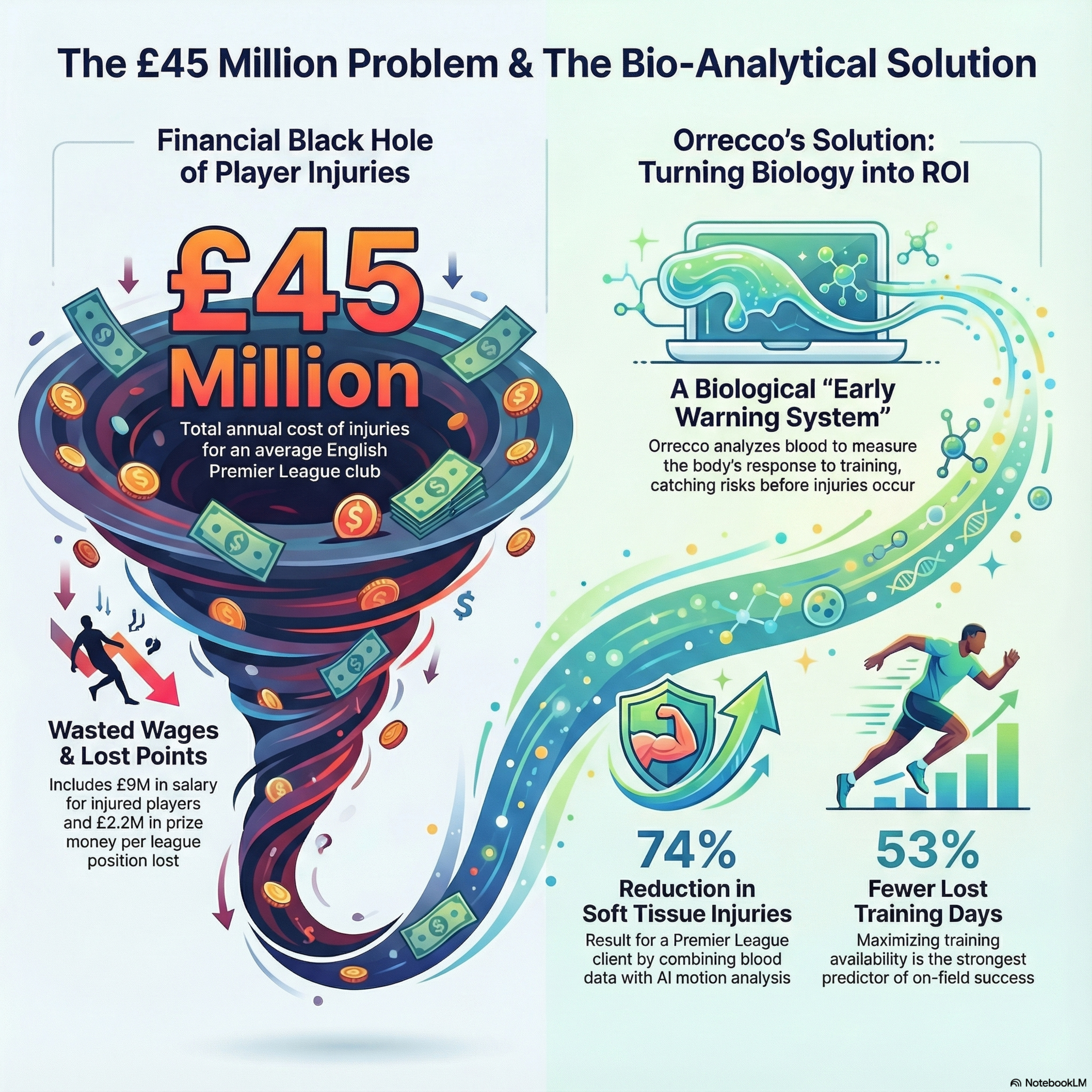
They are depreciating multi $1,000,000 assets and the primary economic function of a performance department is to protect the availability of that asset. Because every day an athlete is injured is just pure unmitigated depreciation. It's money down the drain. To put this in perspective, you have to look at the financial hemorrhage happening in the big established leagues. Let's use the English Premier League as our baseline. The numbers are pretty shocking. They're staggering. The average EPL club loses around £9 million per season in direct wages paid to unavailable players.
£9 million just salary being paid to players who are generating 0 returns. Zero just being burned on the sidelines, but that's just the start. The indirect performance cost is where it gets really painful. Losing your key players directly impacts your lead position. And every league position is worth millions. Exactly. Dropping just one spot in the EPL table costs about 2.2 million in prize money. When you factor in the points loss because your star striker was out for six weeks, the total annual economic liability of injury is estimated to be around 45,000,000.
£45 million per club, per season. That is the financial black hole we're talking about. And it applies to every sport. Look at the NBA, the whole load management debate we hear about all the time. It's fundamentally a financial hedging strategy. Teams are deliberately sitting healthy multi $1,000,000 assets to protect them from breaking down late in the season. So that enormous cost of doing nothing justifies the premium price. But let's play devil's advocate. For a lot of African leagues, that half $1,000,000 Tier 1 price tag is a massive ask.
You have to prove the ROI is real, not just a theory within their budget. Absolutely, and that's why the tiered pricing model is so important for adoption. Tier 1, the Enterprise Elite package. That's the full service option, weekly blood tests, the AI vision platform, and critically dedicated PhD scientific staff on site. The full works for an EPL club or an NBA franchise. That's the target. The cost is estimated between 250,000 and $500,000 a year. It's a consultancy model because you're getting hyper specific, actionable advice every single day.
So let's nail that ROI calculation for that top tier. A club spends say 300,000 lbs. How many injuries do they need to prevent for that to make sense? The ROI is exponential. If you prevent just one significant hamstring injury to a starting sliger, you save roughly 200,000 lbs in direct wages over a six week recovery. So you're already 2/3 of the way there. But that's not the real value. If that strikers availability helps you win two or three critical games, the value of those preserved league points is in the millions.
The system can pay for itself 15, even 20 times over the moment it prevents that one critical injury. It's not an expense, it's catastrophic risk mitigation. OK, what about Tier 2, the model that's probably most relevant for emerging pro leagues and national federations? Tier 2 is the platform license. It's a software as a service model or sauce. This targets teams with smaller budgets. So the second pier of European football or a league like the Bal, and what do they get? The team gets full access to all the proprietary algorithms, the apps, the coaching dashboard, but the club's own medical staff collects the data.
They do the finger prick POC test themselves. So you get the powerful analysis engine, but you don't have the expense of a full time PhD scientist on your payroll. Exactly, and the cost drops significantly. It's estimated at 50,000 to $100,000 per year. That's a much more accessible price point, and honestly it's logistically smarter for leagues with a lot of travel. And quickly tier 3 the prosumer model. That's a paper test model for individual high worth athletes. Think golfers, tennis players.
They pay somewhere between 300 to $1000 for a detailed panel. It gives them the same science without the team structure to convince. Stakeholders. You need more than a spreadsheet, you need hard data. What are the proven success metrics this platform claims that would justify this investment? These metrics are the whole argument. First, a claim 74% reduction in soft tissue injuries for a Premier League client. 74%. That's going from, say, 8 hamstring strains a season down to two. That is the ultimate asset protection stat.
That alone should be enough. What about less obvious things like illness? An NBA client reported 100% availability from an illness perspective. Think about that. In an environment with constant travel, varied facilities, having immune armor is a massive competitive advantage. Avoiding 1 viral outbreak that takes out half your team is priceless. And the last one, which connects everything back to daily performance training availability. A 53% reduction in lost training days and we all know training availability is the single strongest predictor of success on match day.
If your players are on the pitch training while your rivals are in the treatment room, you are gaining a huge systematic advantage over the course of a season. If the ROI is the why, the tools are the how, let's look inside the toolbox that coaches and staff are using everyday. We start with Zone, the biomarker engine. Zone is the tool that transforms a medical checkup into a daily performance metric. This isn't your annual physical, this is a pre practice readiness report. And the logistical advantage of that point of care system is just critical, isn't it?
Especially for developing leagues. You can't wait three days for a lab report to come back from a city 500 kilometers away. The speed is the whole game. The diagnostic devices analyze a simple finger prick of blood in just 4 to 6 minutes. It allows for immediate intervention. You know before the 10 AM practice starts if a player is in a highly inflamed state and needs their session modified. So what are the critical markers they're looking at in that 6 minute window that gives them these actionable insights?
They track a powerful combination of things. First, antioxidant status, which tells you their capacity to handle the planned workload. Second, inflammation markers like CRP and IL 6 which detects systemic stress. Third, key micronutrients like vitamin D and magnesium. And 4th, the really critical one, hormonal status, specifically the cortisol to testosterone ratio. The CT ratio, that's the ultimate measure of the body's stress state, right? Absolutely. A high cortisol to testosterone ratio means the body is catabolic.
It's breaking down tissue faster than it's building it. The actionable insight is immediate. Pull them from the heavyweight session. Get them on mobility work. Focus on protein and recovery. You don't guess, you act on biological truth. Now let's talk about fit woman and fit coach. This feels revolutionary because it addresses a massive historical gap in sports science, and it's so important as African women's sports leagues professionalize. It's astounding when you think about it. For decades, 50% of the population of female athletes were being trained using research and protocols derived almost entirely from the other 50% from men.
It's just profound inefficiency. It's suboptimal performance guaranteed. The science recognizes the four distinct phases of the menstrual cycle, menstruation, follicular ovulation, and luteal, and each one dramatically alters the body's chemistry. For instance, in the luteal phase, core body temperature rises, which impacts metabolism, hydration, everything So. If you're training a female athlete the exact same way every single day, you are absolutely leaving performance on the table. And worse, you're probably putting them at unnecessary risk.
And the risk mitigation is is huge. Hormonal fluctuations can increase limit laxity, the looseness in the joints. There's strong research suggesting that the risk of catastrophic injuries like ACL tears is higher during specific phases of the cycle. So Fit Coach takes all this complex biology and turns it into a simple organizational tool for the staff. Exactly. The coaching staff can see a dashboard that visualizes the cycle phase of the entire squad. If a few key players are entering a high risk phase, the coach knows to adjust that day's training.
Maybe focus on stability and strength work instead of high impact drills. It's proactive, personalized management. And this product isn't just an add on strategically, it's a very powerful wedge. It absolutely is. A-Team will often adopt Fit Coach for their women's squad first. They see immediate, measurable gains in availability and performance, and that scientific rigor and success makes it a very easy decision to then upgrade to the full platform for all their athletes, male and female. OK, Finally, let's revisit the external measurement tool Motion Signal.
We mentioned the AI vision, but that markerless advantage is so important for developing environments. It really bears repeating. The advantage is minimal new hardware it uses, the cameras you already have, broadcast feeds, tactical cameras. That saves a huge amount of money and logistical friction for a professionalizing league. And it's detecting those tiny warning signs that even the most experienced coach or physio would probably miss. It's capturing what they call movement signatures. The athlete might report feeling 100%, you know, maybe subconsciously hiding a little fatigue, but the AI comparing them to their own unique baseline might detect a 5% loss of hip extension symmetry when they're sprinting.
And that 5% deviation, that's the mechanical precursor to failure. It is. It's a subconscious guarding pattern, a tiny change in gait that puts extra stress somewhere else. By triangulating that objective mechanical deviation with the high oxidative stress warning from the blood test, the intervention moves from maybe we should rest him to we must rest him or a high confidence injury is coming in the next three days. We've covered the data, the science, the tools. The final systematic lesson is about strategy.
Part 5 Lessons in strategic positioning and growth What can African federations and leagues learn from this about adopting this kind of professionalism? The key lesson is that adoption isn't just about buying the tech. It's about smart partnerships and clever sales strategy. You have to leverage what's already there and you have to target the ultimate decision makers. Let's look at their partnership with Sportradar, the NBA's data provider that feels like a master class in frictionless integration.
It really is. Sportradar already has optical tracking cameras in every NBA arena. So instead of asking teams to buy and install a whole new camera system, this platform just taps into the existing data pipeline, the API, and ingest that raw tracking data. It completely solves the data silo problem. And the lesson for African leagues is clear. Look for partners that can use the infrastructure you already have, Your stadium cameras, your broadcast feeds. The speed of adoption is more important than proprietary hardware.
The second big lesson is the LMA model. Using education as a sales strategy. They partnered with the League Managers Association in the UK. Which represents the top coaches and managers. This bypasses all the typical organizational resistance you might find further down the chain. You go straight to the person who has to answer for the results. And who signs the checks? Exactly. They sponsor technical webinars. They provide professional development sessions on recovery science. They're educating the budget holders on why this science is necessary to win championships.
When the manager turns to the performance director and asks why aren't we using this, the sale is already made. That top down demand is essential. Let's talk about their competitive position. The market is flooded with wearables, whoop, aura, all these things. Why does this system command such a premium? What's its Moat? The Moat is built on clinical accuracy. It's blood truth versus wearable convenience. Wearables are great. They're convenient, but they rely on otical sensors that can have margins of error, especially at high intensity.
This platform chose blood, which is the gold standard. They've positioned themselves as a medical grade intervention, not a consumer gadget. So the listener needs to understand where this fits in the sports tech ecosystem. It's not a generalist. It's a specialist. It's the doctor. Let's use the sources on metaphors to break it down. Compared to an AI prediction system like Zone 7 which predicts injury based only on workload patterns. How much they ran? Right. A RECO predicts based on the biological capability to handle that workload.
AI without biology is, as they say, blind. It's measuring the stress you applied, while this measures the structural integrity left in the beam. OK, what about against athlete management systems like Kitman Labs? An AMS, like Kitman is a database. It's the file cabinet where you store all the data. This platform is the Doctor Who analyzes the files. It gives you actionable scientific advice. It doesn't just display the data, it tells you what it means. And finally, versus the most common tool out there, external load monitors like Catapult GPS.
Catapult measures the work done or RECO measures the cost of the work. They're complementary, but this platform is higher up the value chain. It answers the one question every manager has Is my player ready to train today, and if so, how much can they safely handle? To wrap up the strategy part, we have to mention the investors. What does it signal to African federations when someone like Mark Cuban is backing this? It signals absolute elite level product market fit. Mark Cuban isn't just a VC, he's the owner of the Dallas Mavericks.
He is a user deploying this technology on his own billion dollar assets. His investment is the ultimate validation. And the athlete investors, guys like Padre Harrington, there's super users who've staked their careers on it. That collective backing tells any potential investor of federation in Africa that this is a proven de risked technology. It's not a gamble. This has been an incredibly systematic look at how performance science is changing, and more importantly, how the African game can use this shift to its advantage.
Let's just synthesize the whole system one last time. It's a comprehensive bioanalytical intelligence platform and it's built on three fully integrated layers, the internal, the external, and the hormonal. You have zone, which is the blood. That's your physiological truth, your readiness. Score in minutes. Then you have motion signal, which is the eyes. That's the external biomechanical analysis that spots those subtle movement changes caused by fatigue. And you have Fit Woman and Fit Coach which manages the hormones ensuring that half of your athlete population is finally being trained optimally and safely.
It is the most complete picture of an athlete available today. And the conclusion for the African game is just so powerful. The platform's research started here in the Wrist Valley, and it's clinically anchored in South Africa. This provides a clear, definitive pathway for immediate professionalization. The opportunity is to move from being the source of historical research to being the leader in delivering systematic, measurable value. The African game doesn't have to spend 20 years making tiny improvements.
It can leapfrog straight to the predictive edge. By adopting A Tier 2 system now, an emerging African league could immediately set a global standard for player welfare that many established European leagues haven't even achieved yet. And that brings us to the final provocative thought we want to leave you all with today. Something to really think about. If the absolute financial cost of injury in a big western league is 45,000,000 per club per season, what is the relative impact of injury in an emerging African league?
The absolute wages might be lower, but the competitive impact, the difference between winning the Bal and getting that global exposure versus finishing mid table is arguably exponentially higher. So the question isn't whether you can afford this system. The real question is, can you afford the competitive cost of not having it? What is the advantage gained by the very first African league or federation to fully commit to this systematic approach, and how quickly will everyone else be forced to follow?
The technology is here, the blueprint is clear and the genesis is African. The time to implement is now. That is the complete picture. Thank you for joining us for this deep dive. We'll see you next time.
 Apple Podcasts
 Castbox
 Castro
 Goodpods
 Moon FM
 Overcast
 Pocket Casts
 Podbean
 Podcast Addict
 Podcast Republic
 Spotify