Why Sekhukhune United Fired Coach Eric Tinkler
About this episode
Why Sekhukhune United Fired Coach Eric Tinkler
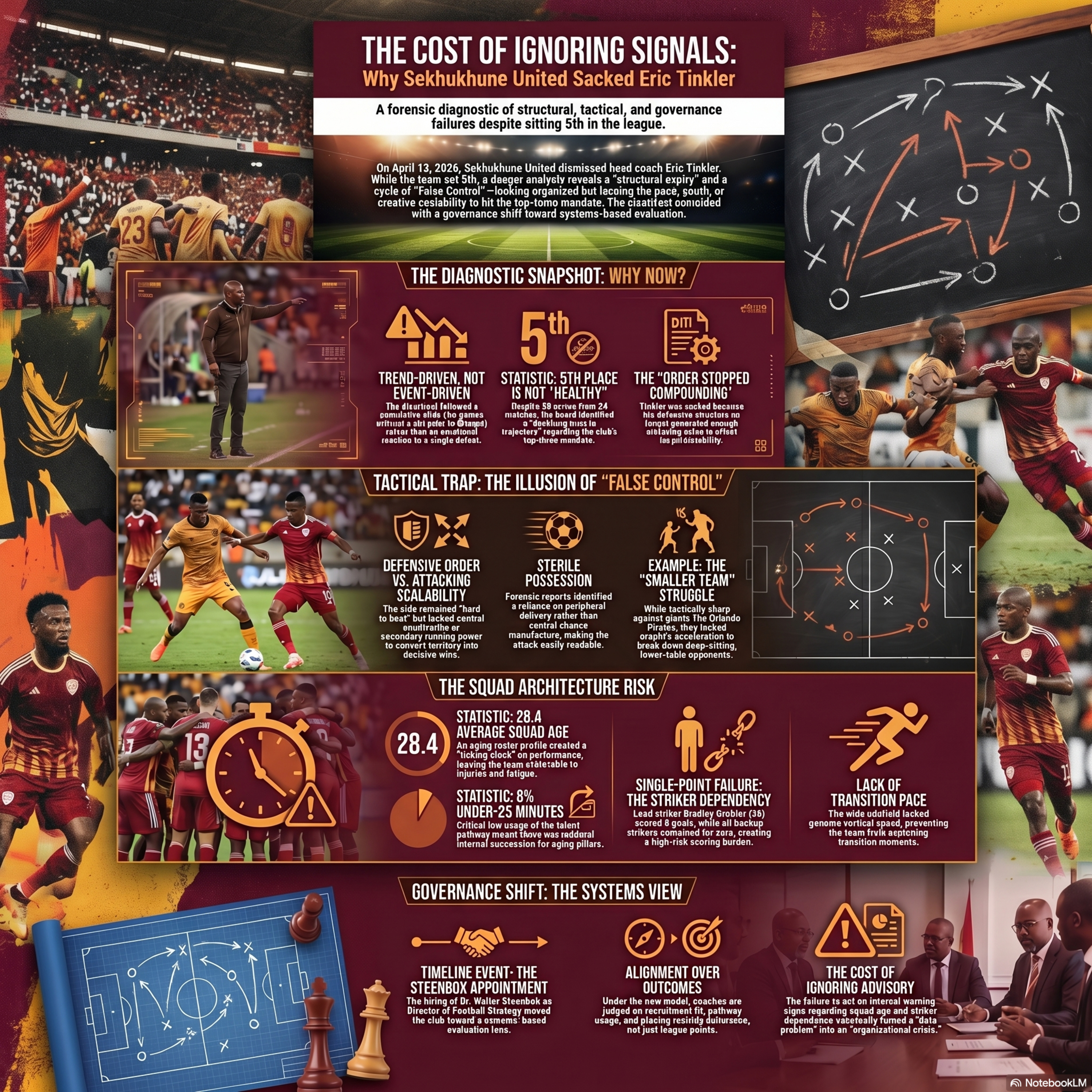
So picture this. It's April 13th, 2026. You are a top flight South African football coach. OK, I'm with you. And you just walked off the pitch having won a crucial match. One nil. A vital win. Exactly. A1 NIL win against me Jesse. Your team is sitting comfortably in 5th place, you've got 38 points on the board and you are absolutely still in the fight for continental qualification. Sounds like a pretty good day at the office. Right, so naturally the club management does the only logical thing, they fire you immediately.
Yeah, it's just, I mean, it sounds completely backwards to anyone outside of football. It's insane. In literally any other industry, if you hit your targets and keep the company in the top five, you get a bonus. Oh absolutely. You definitely don't get handed your walking papers in the tunnel right after a victory. And that is exactly why we are pulling this whole thing apart today. I want you, the listener, to imagine that we are sitting quietly in the back of a room, just totally unseen, surrounded by the greatest football strategist on the continent.
I love that visual, just absorbing all that unfiltered wisdom. It's exactly taking in how the modern game is truly run behind closed doors, and our goal today is to take all that knowledge regarding Eric Tinkler's sudden dismissal from Sakakuna United and just, you know, map it all out for you. Because we really need to explore why being good enough is suddenly a fatal flaw in football. And how understanding these underlying mechanisms can actually elevate the broader freaking game. So where do we even start with this?
Well, to understand the firing, we have to completely ignore that final one nil win against Majesi. Ignore it completely. Yeah, that game is a total distraction. If you want to comprehend why a manager gets removed when everything seems fine on the surface, you have to rewind. OK, so we're going back. Right, you have to look at the entire arc of his tenure because the justification for his exit, it was actually being built during his periods of peak success. That is wild. OK, so take us back to the beginning of that arc, Park.
How did his time at the club actually unfold before that final day? So we can wrap his time there across three very distinct phases. The strategists in that room we were talking about, they probably call the first phase the surge. The surge, OK like that? Yeah, so this is August 2025. He arrives and instantly he wins Coach of the Month. Oh wow, so right out of the gate. Exactly. He secures 13 points in five games. The team is sitting at the top of the table and they get this massive victory over Orlando Pirates.
I remember that period, they looked just entirely reinvigorated. They did, and you know, it is crucial to give credit where it's due. He he brought this immediate, highly credible defensive order to the team, which is huge. It is because in football it's always faster to teach destruction than it is to teach creation. Oh, that's a great way to put it. Right, you can drill two banks of four, close down the midfield spaces and make a team incredibly difficult to break down in like a matter of weeks.
And that defensive solidity, it earns tremendous emotional buy in from the dressing room, I imagine. Absolutely the players feel secure, but. But I'm guessing A-Team can only run on that initial adrenaline in structure for so long, right? Like a new relationships honeymoon phase. That is the perfect analogy, which brings us to phase two, stagnation. The honeymoon is over. Exactly. The team plateaus. They are still physically robust, they still keep clean sheets, but the point accumulation just slows down dramatically.
So the initial edge they gained from simply being organized, it just stopped compounding. But what actually happens on the pitch to 'cause that stagnation? I mean, why does a defense that works beautifully in August suddenly stop generating winds in November? Opponents adapt. It's really that simple. They. Figure them out. Right, in the search phase, teams attacked Sakakuni, which left space behind them, and Sakakuni just exploited that space on the counter. But by Phase 2, the rest of the league had the blueprint.
Opponents started deploying low blocks. So they just parked the bus. Basically they sat back and said we won't attack you here. You take the ball and suddenly Sekukun has 60% possession with absolutely no idea how to unlock a packed penalty area. So they're staying in games, but they can't force a victory. Exactly, which naturally accelerates them into phase three. Regression. Yes, regression. The frustration of holding the ball without scoring leads to mistakes. The plateau turns into a slide. And that slide was pretty steep, right?
Very they had a six game winless streak in the league, which was compounded by a shocking early exit from the Ned Bank Cup. To Milford, right? Yeah, at the hands of Milford. So looking at it through that three phase lens, that one nil win against Mejosi really was just a statistical blip on a downward graph. A total blip. Because the club had a clear mandate, right? They wanted the top three finish and silverware. The Milford loss killed the Cup dream entirely. And the six game slide widened the gap to the league leader.
But if I can just pull on the thread here for a second, if that defensive structure was so rock solid, why couldn't they transition into an attacking team? At what point does being hard to beat stop being a compliment and start becoming a limitation? That right there, that is the dividing line between an average coach and an elite tactician. Really. Yeah. If you cannot translate defensive stability into attacking superiority, you eventually suffocate your own team. Wow. And Seikukun's attack just became incredibly blunt.
They relied almost entirely on one mechanism which was hopeful long service into the penalty box. They were just waiting for their 38 year old veteran striker Bradley Gerbler to win a header or hold up the ball. 38 years old, so they were basically just playing the percentages and hoping for a fortunate bounce. Exactly, and there is a specific term for what was happening to them. Among analysts, it's known as false control. False control. Yeah, and this is a concept that goes far beyond sports. It applies to business negotiations, really anything competitive.
How does it work? False control means you keep your shape, you dominate the territory, and you hold all the possession. To a casual observer, you look like you are dominating the game. But you're actually not. Right. You cannot penetrate the center. You lack any dynamic pace out wide. You are never actually stressing the opponent's defensive structure. OK, you know what it sounds like? It sounds like an army surrounding a castle. OK, I like where this is going. Yeah, like they secure the perimeter, they dig the trenches, but then they realized they forgot to bring any battering Rams or siege ladders.
Yes. So they hold all the territory. They look incredibly intimidating from the outside, but the forces inside the castle aren't actually under any real threat. They can just sit behind the walls and wait. That is the perfect visualization. You are expending massive amounts of energy maintaining the siege, but zero energy is being transferred into structural damage against the opponent. Wow. So what's the alternative? Elite teams aim for threatening control. Threatening control. OK. Right. Threatening control forces the opponent into impossible split second decisions.
You pull their center backs out of position. You overload the wings. You create absolute chaos inside the penalty area. And sick who could just couldn't generate that chaos. Not at all. They were entirely predictable. Well, wait. If I'm listening to this, I'm thinking back to the press conferences around that time. Oh, the press conferences, yeah. Tinkler went to the media and openly complained that his players just didn't show up against the small, smaller teams. He framed it as a motivation problem.
He did. So why should we blame his tactical setup if the players are just being lazy and not executing? Isn't that a mentality issue? Well, it's incredibly common to label systemic failure as a mentality issue. It's a convenient way to shift the blame. So you don't buy it? Not at all. Mentality is very often just a mask for poor structural fit. Interesting. Think about it, when you're only attacking plan is to hit long diagonals to a static 38 year old target man and you don't have dynamic runners sprinting into the spaces around him, the players are naturally going to look sluggish.
Because they literally have no viable options when they get the ball. Exactly. They get the ball, look up and what do they see? 10 defenders camped in the box and 1 veteran striker marked by three center backs. So they freeze. They hesitate. They pass sideways, and to a fan sitting in the stands, that hesitation looks like laziness or a lack of care. But it's actually cognitive overload. Spot on. The players are being asked to solve a complex puzzle without the necessary tools. OK, so if the tactics lacked variety, we have to ask was that a failure of imagination from the coach or were the players simply incapable of playing a high tempo, expansive game?
And that brings us directly to the roster construction. Because limitations don't happen in a vacuum, right? No, of course not. They are completely dictated by the physical reality of the squad and the data from Seiko Kuna's squad architecture. It was showing massive systemic vulnerabilities. Yeah, let's look at those numbers because they are genuinely jarring. Lay them out. So the average age of the squad was creeping up to 28.4 years old. Which is very high for an energetic, pressing team. Exactly.
And furthermore, here is a staggering metric for you. Only 8% of the total minutes played across the season went to under 23 players. 8%. Just 8% and we mentioned they were relying heavily on Grobbler for goals. When you look at the bench, the backup strikers had combined for zero goals 0. Which means the coach had constructed an incredibly fragile ecosystem. I mean, he placed the entire burden of goal scoring on an aging pillar with absolutely no succession plan behind him. Oh wait, Tinkler lost key players to injuries in the second-half of the season, right?
Grobler included. He did, yeah. So isn't it a bit harsh for the board to sack a manager when his medical room is just full of his most important pieces? I mean, you can't control muscle tears. OK, this is perhaps the most vital lesson for the administration of the African game. Are you ready? I'm ready, lay it on me. Injuries did not 'cause the fragility of that team, they exposed it. Oh wow, so the structural flaw was there all along, just waiting for a catalyst like a game of Jenga. A game of Jenga, yes.
If your entire attacking ecosystem relies on a 38 year old striker, pulling out just one or two blocks means the whole tower collapses. Exactly. If your tactical model is so rigid that losing 1 veteran completely neuters your attack, then the system itself is fundamentally flawed. That makes so much sense. Relying on aging players while giving basically 0 developmental minutes to youth. That's not a strategy. It's deferred panic. Deferred panic. Yeah, succession planning is often treated like, you know, APR exercise, a way to make fans feel good about local Academy kids getting a run out.
Right, like look at our home grown talent. But in modern football, integrating youth is literal first team risk management. And you could see that deferred panic finally cash out in April. The club went out and made a desperate short term signing. Oh, rivaldo Coetzi, yes. Bringing him right at the end of the season just to patch holes in the midfield. And short term, late season signings almost universally fail to deliver value. Because they have no time to integrate. Exactly. The player has no preseason, no chemistry with the squad, and they're just being dropped into this high pressure environment to fix a systemic leak.
It's a Band-Aid on a bullet. Wound right, And that kind of reactive squad building is the direct consequence of a coach telling his board I only trust the veterans. Because when the veterans inevitably breakdown, the Cliff the team falls off is incredibly steep. Extremely. Steep. So we have this team hitting a tactical ceiling and a squad physically degrading due to age and injury. But while all of this is happening on the grass, the ground is shifting in the boardroom. This is the turning point.
The parameters for what actually constituted success were being completely rewritten behind the scenes. Yeah, this is where the narrative shifts from a purely footballing problem to a massive evolution in sporting governance. Let's get into it. So on March 30th 2026, the club appointed Dr. Walter Steenbach. As the Director of Football Strategy, and just for anyone listening who might be unfamiliar with how these corporate structures work, Director of Football Strategy isn't just a chief scout who buys players, right?
No, no, no. His mandate covers the entire operational philosophy of the club. It's everything. It's everything he overseas the talent pathways from the youth Academy to the first team, the integration of data analytics, the scouting networks and the high performance medical programs. So the second that appointment was finalized, the entire evaluation metric for the head coach changed overnight. Overnight, Tinkler was no longer being judged solely on whether he secured 3 points on a Saturday afternoon.
He was suddenly being judged on systemic alignment. Systemic alignment. So meaning the board is asking, is he playing the youth? Yes. Does his style of play actually increase the market value of the squad? Exactly. Does his tactical setup match the club's 10 year vision? Spot on. And this, this right here, is the friction point between a coach LED model and a club LED model. OK, breakdown the mechanics of those two models for us because this feels huge. It is huge, it's a distinction sweeping through global football and it's really taking root in Africa now.
So what's a coach LED model? In a traditional coach LED model, the manager acts almost like a king, OK the board, hands in the keys and says keep us in the top division, win games however you see fit. So if the manager wants to play 1135 year olds, sit in a low block and win every game one nil, the board is happy because they are surviving. Exactly, but a club LED model completely flips that hierarchy. Entirely. Entirely in a club LED model, the institution dictates the identity. The board decides we are going to be a club that presses high, plays expansive attacking football and develops Academy talent to sell at a premium.
Oh wow, so the coach's role shrinks. Right. The head coach is then hired simply as a highly specialized middle manager to execute that predetermined corporate strategy. But wait, isn't it completely unfair to change the rules mid season? Like Tinkler was hired as a tactician to stabilize the ship and suddenly he's being fired for not being a developmental philosopher. It feels unfair to the coach, sure, but this is the evolution of modern football governance. So when Tinkler is giving those press conferences after defeat, praising the depth and financial power of Mamelodi Sundowns and essentially saying, look, we're doing the best we can with what we have, he thinks he is just managing expectations.
He thinks he's being a realist. He absolutely does, but to a board that has just hired a director of football strategy to revolutionize the club's infrastructure? It sounds like lowered ambition. It is toxic. It sounds like a manager accepting a permanent ceiling. He was trying to defend his Kingdom while the board had already transitioned into a corporate structure. He was solving yesterday's problem of defensive stabilization, while the board was demanding solutions for tomorrow's problem of scalable growth and asset creation.
That makes the firing crystal clear. It wasn't about the one nil win against Magessa yet at all. Not even a little bit. It was about the fact that his philosophy was fundamentally incompatible with the new architectural blueprint of the club. So once the trigger is pulled, what happens the next morning the club brings in Paulus must say hey, as the interim coach. What is the actual mechanical function of an interim manager in a situation that volatile? Well, the primary function of an interim is definitely not tactical reinvention and.
You can't install a complex system in a few weeks anyway. Exactly. You cannot install a complex asymmetric pressing system in three weeks. The interim's job is emotional decompression. Emotional decompression. What does that actually look like on the training pitch? So when a manager is sacked, the training facility is incredibly tense. I can imagine. Players who are favored by the old manager are terrified they will be sold. Players who are frozen out or overly aggressive trying to prove themselves.
There's massive anxiety everywhere. The cognitive load is immense. An effective interim strips all of that away. He cancels the grueling 2 hour video analysis sessions. He simplifies the passing drills. He organizes small sided games and tells the attackers to just play freely without worrying about a rigid shape. So he just lets them breathe. Yes, he lowers the temperature in the building. He keeps the players physically sharp while letting their minds recover from the stress of a failing regime.
It's essentially acting as a bridge, just keeping the foundation intact while the board searches for the permanent architect. And that search must be incredibly difficult. They need someone who won't dismantle the solid defensive floor Tinkler built, but who possesses the tactical imagination to raise the attacking ceiling and, you know, integrate that 8% of youth players. Right, it requires an evolver, not a revolutionary. I like that distinction. You don't want a coach who comes in and says we're throwing away the defensive playbook.
You want someone who understands that defensive organization is the prerequisite for possession, and possession is the prerequisite for threatening control. OK, if we pull back and look at this entire saga, the false control on the pitch, the aging squad, the massive strategic shift in the boardroom, there are universal lessons here. Absolutely massive ones. If you were listening to this and running a club, a business or any organization really, the lesson here is that competitive enough is a trap.
Let's synthesize the absolute core takeaways for clubs across the African continent who are watching this unfold. Well, there are three definitive blueprints we can extract from this. OK, what's the 1st? First, humility is a tangible performance edge. Humility. Yes, if your attack is completely blunt and opponents have figured out your transition game, you cannot stubbornly insist that your system is flawless. You must have the humility to adapt your tactics before the board adapts its coaching staff.
Evolve on your own terms or be replaced by someone who will. I love that. What is the second blueprint? Second, data and strategic advisory are not insults to a manager's intuition. They're not threats. Right. They are safeguards against his blind spots. When a director of football points out that a squad's age profile is a looming disaster, the coach shouldn't view that as an insult. He should view it as an early warning system. Exactly. Embracing long term strategy actually protects short term results.
That shifts the whole dynamic from a power struggle to a partnership. And the final lesson? The third lesson is the unbreakable link between tactics and physical reality. Meaning you have to work with what you actually have. Right. You cannot divorce your theoretical game model from the actual physiological profile of your players. Give me an example of that. If your vision requires high intensity pressing and rapid wide combinations, but your roster is built around a static aging core, the system will collapse the pieces.
Just don't fit. The vision in the manager's head must match the legs on the pitch. If there is a mismatch, you either change the tactic immediately or you change the personnel. Attempting to force a square peg into a round hole will only result in false control and eventual termination. It is so profound. We started today by looking at a headline that seemed entirely irrational. You know a manager fired after a win with his team in 5th place. It sounded nuts at the start. Totally nuts, but by unpacking the mechanisms beneath that headline, the irrationality completely vandalist.
It makes total sense now. The one nil win was just a thin layer of paint over a foundation that was actively cracking. We moved from the illusion of defensive success through the trap of false control where the team held territory without threat, down into the deferred panic of an aging squad. And finally, up to the boardroom. Exactly where the definition of success evolved from mere survival to structural asset growth. It really is the ultimate case study and recognizing when a methodology has run its course.
Because the tools required to dig a club out of the basement, they are rarely the same tools required to build the penthouse. Wow. Which brings us to a final thought for you, the listener to carry forward. We talked extensively today about this shift toward these highly structured, data-driven club LED models, right? Yeah, where identity is dictated by executives. Exactly where tactical identity and player recruitment are dictated by executives and algorithms rather than a charismatic manager. So think about the teams you support, or even the organization's you work for.
Are they celebrating false control Right now? It's. A great question. And if the warning signs were flashing, would leadership have the courage to fix the roof while the sun is still shining, or would they wait for the storm? Furthermore, if a club can now map every single performance metric, recruit talent entirely via data profiling, and mandate the exact tactical shape from a boardroom until the traditional role of the head coach disappears entirely. Mind blowing to think about. Are we only a few years away from a director of football simply relaying algorithmic adjustments to an operative on the touchline, rendering the era of the visionary sideline manager completely obsolete?
Thank you so much for sitting in the room with us for this incredible exploration. It's been fantastic. Keep looking past the final score and we will see you next time on the deep dive.
 Apple Podcasts
 Castbox
 Castro
 Goodpods
 Moon FM
 Overcast
 Pocket Casts
 Podbean
 Podcast Addict
 Podcast Republic
 Spotify