Why Raw Data Traps Football Scouts
About this episode
Why Raw Data Traps Football Scouts
So I want you to picture this. You're standing on the sidelines of a university football pitch, right? This is in Nairobi, Kenya and you're watching a 19 year old kid play just. Raw, unpolished energy. Exactly. I mean, on the surface it looks like a standard game, but underneath the jersey of this specific player, his name is Francis Ozueno, there is a soccer BGPS tracker and it is quietly collecting thousands of data points. Thousands. Every single step. Every sudden stop. Right. He hits 26 kilometers an hour.
He registers 32 high speed accelerations in on a single hour. I mean, he's generating a physical footprint that rivals a European professional. Which is incredible for a 19 year old in the University league. It's massive. But here is the crazy part. The elite sports scout looking at this data, they decide to well to penalize him. Yeah, they act suppress his score. Right. They lowered his metrics and flag him with a medium risk rating. And today on the Deep Dive, we are looking at the highly confidential Afrotech sports technology dossier on Francis.
And it is a fascinating read because what we discover is why, in the modern era of elite sports science, having incredibly impressive raw data is, you know, actually the single biggest trap in the industry. It really is. I mean this deep dive today, it's all about the architecture of talent. We are looking at the exact moment where elite Formula One level sports science intelligence transitions all the way down to the grassroots. It's the nuts and bolts of how talent is engineered. Today, exactly.
So whether you're an aspiring athlete, maybe a coach on a budget, or just someone who loves the hidden systems behind world class talent, we are going to look under the hood. We're going to see how the pros separate the actual signal from the noise. And to do that, you know, we really have to look at the structural philosophy of the AFRITEC TSA integrated scouting model. Right, because their philosophy completely rejects the old romanticized idea of scouting. Right. Oh, completely. I mean, for decades the narrative around African football, or really any developing sports ecosystem, was all about raw talent.
The grizzled scout on the touchline, trusting his gut. Exactly, claiming he can spot a generation layer just by the way they run. But the Afrotech model violently rejects that premise. They argue that the gap between the local pitch and an international stadium isn't closed by natural gifts, It's closed by systems, by data architecture. Which brings us to the dossier itself. Because when I opened this report, the very first thing I saw was this decision first structure. And I have to admit I kind of hated it.
A. Lot of people do it first. Well, yeah, because it feels completely backwards, right? On Page 1, before I've seen a single speed metric. The executive decision dashboard brands Francis with a verdict. It's a scholarship recommendation plus monitor. It gives you the answer before the evidence. Exactly. I mean, isn't that just grading the test before you read the essay? You're anchoring the reader's bias before they even evaluate the raw data. You could definitely see it as anchoring bias, but consider the alternative reality of the professional football market.
Attention is the single most scarce resource in elite scouting. I mean, they're looking at hundreds of players, right? Hundreds, sometimes thousands, every single month. A sporting director doesn't have the luxury of going on a 30 page journey of discovery. If you bury the conclusion at the end of the report, it just goes in the shredder. So it's basically a survival mechanism for the data. Exactly. The decision first matrix forces the scout to clearly define why they are looking at the data before they get lost in it.
Because Afrotech breaks this down into four specific signals, right club acquisition, agent representation, federation selection, and the scholarship signal. Right. And by stating upfront that Francis is a monitor for a pro club but a scholarship recommendation, they're framing the lens. They're telling the reader, you know, don't expect a Finnish Champions League starter here. Expect a highly malleable university prospect. OK, that makes sense from an efficiency standpoint, but let's actually look at the date of this kid generated, because it's.
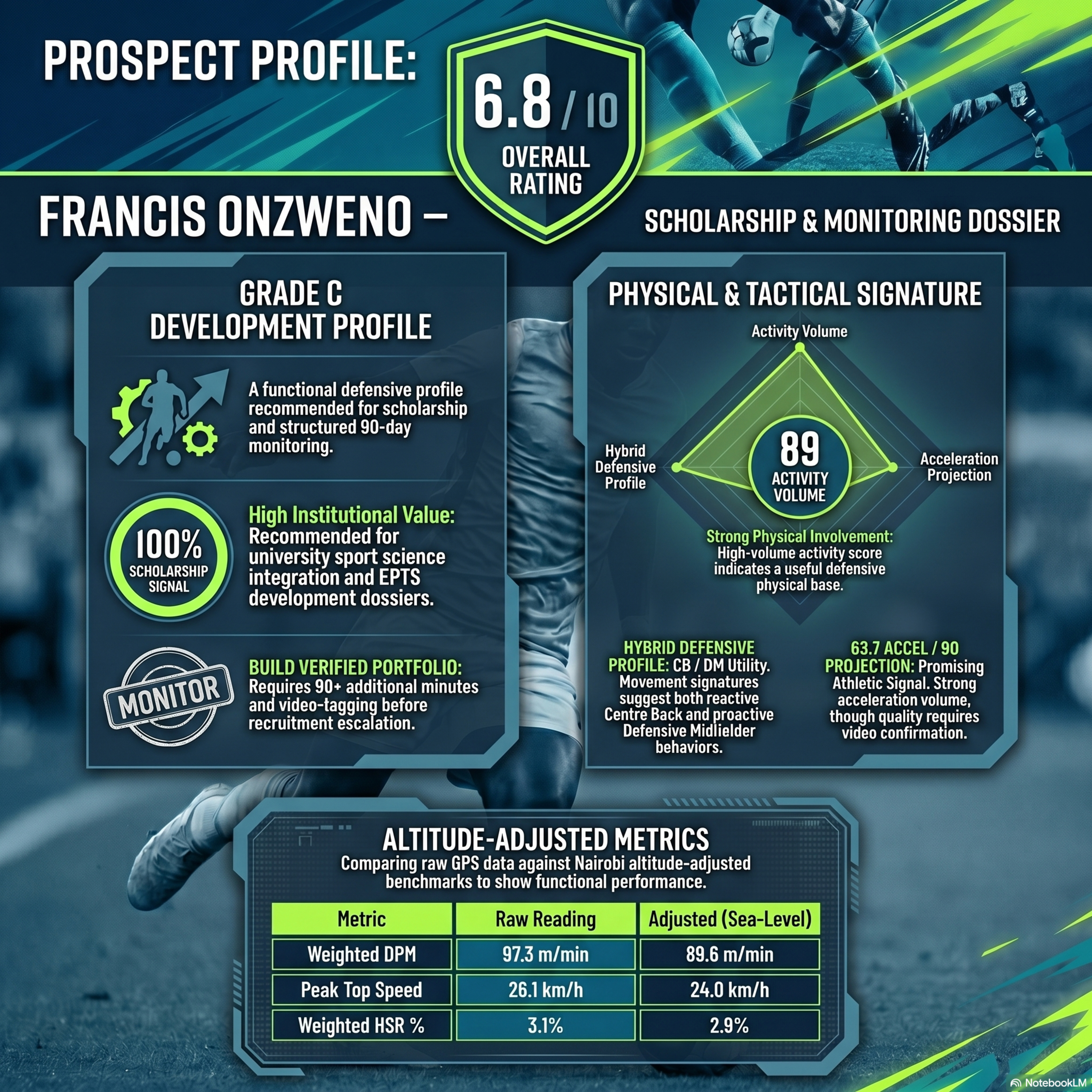
It really is, especially given the sample size. Right, it's just 45.2 minutes total, spread across 2 entirely separate sessions. So let's breakdown session one first. Session 1 is on April 29th. It's short, just 12.8 minutes to play. But he is explosive. In those 12 minutes, his distance per minute, his DPM hits 117.8 meters per minute and he hits a top speed of 26.1 kilometers per hour. But the key here is the movement signature. It's heavily deceleration dominant. He have 8 accelerations but 11 high intensity decelerations.
Right, so he's stopping constantly and this hit me when I was reading it. Session 1 looks exactly like a firefighter desperately putting out spot fires. That is a great analogy. Right, because he's reacting to emergencies, sprinting backwards, slamming on the brakes. That is the classic behavior of a center back. Holding the line and reacting when the ball breaches the zone. Exactly. But then you look at Session 2 just a few days later on May 2nd, and it flips completely upside down. Completely different profile.
Session 2 is 32.4 minutes long, but his DPM drops sharply to 88.6 meters per minute. And his top speed is lower too, right down to 24 kilometers per hour. Right. But the crucial part is his movement signature reverses. He goes from being deceleration dominant to hyperacceleration dominant. A staggering 24 accelerations compared to only 8 decelerations. Exactly. So if session 1 is a firefighter, session 2 looks like a guard dog actively pushing the perimeter. He's proactive, accelerating into open space to initiate defense, which is the classic signature of a defensive midfielder.
It's a highly accurate visualization. And this is where a lazy scout might look at the drop in top speed and distance from session one to session 2 and just say, oh, his fitness is poor, right? They'd say he can't sustain his intensity over 30 minutes. Exactly. Yeah, but the dossier introduces this critical context variable called fixture density. The chronological gap between April 29th and May 2nd is less than four days. Which for a 19 year old without elite recovery protocols like ice baths or advanced nutrition, that is a massive physiological load.
Right. So the physical drop off isn't necessarily a low fitness ceiling. It's highly likely to be residual muscle fatigue and more importantly, it's a roll context shift. A center back slamming on the brakes generates completely different stress than a defensive midfielder accelerating to screen the pitch. You cannot compare the two data sets without defining the tactical role first. OK, so the data is telling us a story of a young player adapting to different roles while tired. But there is another layer.
The dossier applies here and this is where I really need to push back. The African ecosystem modifier. Yes, because Afrotech literally deflates his numbers. Nairobi is at high altitude right? Roughly 1800 meters. So they apply an 8% manual deflation to his metrics. Which is the most vital piece of sport science translation in the whole document? But wait, hear me out. Marathon runners train in Kenya specifically because the thinner air gives them a cardiovascular superpower. It forces the body to make more red blood cells.
That's true for steady state aerobic endurance, yes. Right. So if Francis is generating 97 meters a minute at altitude, if you bring him to sea level in London, his engine should be limitless. Why would Afrotech deflate his output? Shouldn't they artificially inflate his numbers to show his sea level potential? It's a very common assumption, but you are conflating steady state aerobic endurance with anaerobic maximal velocity output. OK, explain the difference in this context. Football is not a marathon.
It's an alactic and anaerobic sport. It's a chaotic series of explosive sprints with incomplete recovery. When Francis sprints at 1800 meters, the thinner air doesn't help him. It limits his ability to clear metabolic waste. So he's building up lactic acid way faster. Exactly. He recovers from oxygen debt much slower, However, and this is the crucial biomechanical factor. Air resistance is lower at altitude. It is physically easier to move your body mass through the air. Oh. Wow, I didn't even think about that.
Right, so players can hit artificially High Peak speeds in short bursts because there is literally less air pushing against them. So the 8% deflation isn't punishing his aerobic fitness. No, it's a mathematical recalibration of his peak velocity. If you don't suppress that top speed metric, a European club buys an expected 26 kilometers an hour in the thick, humid sea level air of an English winter. And you just won't be able to hit it. OK. That completely reorients my understanding. You're protecting the data from environmental inflation.
And it's not just altitude. The dossier adjusts for pitch surface, too. A dry, uneven pitch causes more chaotic ball movement than a pristine hybrid grass pitch in the Premier League. Which forces players to run more just to deal with the disorganization. Exactly. Afrotex modifier accounts for that chaos. So if you're a coach listening, the ultimate take away here is that raw GPS readings are not universal truths. They're deeply contextual. If you don't adjust for altitude, pitch friction, and tactical chaos, you artificially inflate the players market value.
Which leads us to the biggest problem with this wearable tech. Because even with this adjusted data, Francis's overall rating is only a 6.8. He's flagged as medium risk. Why? Because of what the dossier calls OBS Hold Observation hold. Right, it's the ultimate reality check for sports analytics, the dossier states bluntly. GPS activity does not equal ball of uncertainty. I mean we get so seduced by the dots moving on the screen the top speeds, we forget the trackers just measuring a mass moving through space it.
Doesn't tell you what that mass did when a leather ball actually arrived at its feet. Exactly. Francis's technical domain is rated a Brutal 5.8 out of 10, and not because he's technically bad, but strictly because of missing evidence. The black holes in the data are staggering. We have no verified passing data, no data on receiving under pressure, weak foot competency or ball security. The scout doesn't even know his physical height, weight or dominant foot just from the GPS. The tracker proves he has an elite engine, but it offers 0 proof that he can effectively participate in a game of football.
Let's use those 32 accelerations from session 2 on a spreadsheet that looks phenomenal. But you're saying those accelerations could actually be a sign of terrible footballing ability? Absolutely. The scout has to ask, were those accelerations proactive, intelligent, pressing triggers? Did he read the opponent and accelerate to win the ball? If so, he's a genius, right? Or, conversely, were those 32 accelerations panicked, desperate sprints because his initial positioning was completely wrong? Because a panic Sprint looks exactly the same on AGPS tracker as a brilliant pressing run.
Exactly the same. A line on a graph pointing sharply upwards. This is why sports science integration is so critical. You have to pair the wearable tech with synchronized video tagging. So you take the timestamp of the acceleration and overlay it onto the video to see the tactical trigger. Without video to confirm passing clips, first touch under pressure and aerial dual win rates, Francis's true tactical value is purely A mathematical projection. OK, so we've mapped out the physical machine perfectly.
We know we're missing the technical manual, but what fuels the machine? Because you can have the engine, but if the player breaks under pressure it doesn't matter. Which brings us to the DPI framework. Yes, I was looking at this and it blew my mind that Afratec is actively trying to quantify what is inside a 19 year old's head. It's arguably the most forward thinking element of their methodology. DPI stands for desire, ability, positioning, intelligence, and Exit power. And they anchor these in academic theory, right?
It's not just buzzword. Exactly. They are profiling his psychological architecture. So let's dissect these His desire scores A7 point O out of 10. The dossier roots this in self determination theory. Now, I know a bit about SDT from organizational psychology about competence, autonomy and relatedness. But how does a scout apply that to a dusty pitch in Nairobi? Well, they use it to separate intrinsic motivation from extrinsic motivation. If a player only plays hard because an agent is watching, their effort plummets when things get difficult.
Right, that's extrinsic. But Francis demonstrates high intrinsic motivation. The very act of voluntarily putting on this tracking device, knowing it will ruthlessly expose his flaws, shows a desire for objective self improvement. He wants that competence and autonomy. OK, that makes sense. For the seven point O. Then we have ability which scores a 6.8, and they anchor this in Anders Erickson's concept of deliberate practice. Yes, and deliberate practice isn't just about putting in 10,000 hours, it's about the quality of those hours.
It requires measurable outputs and continuous adjustment. Because he adapts his physical output between the center back role and the defensive midfielder role. Exactly. He isn't just mindlessly running. He demonstrates A cognitive ability to absorb instructions and alter his behavior based on tactical requirements. But then we hit the final metric, and this is wild exit power. This gets the lowest score in his entire profile, a 5.7 out of 10, and the dossier links this to agency theory. This is where the business of modern scouting is absolutely cutthroat.
Great, because Exit power isn't measuring his psychology or his speed, it's actively measuring his commercial leverage in the global market. Why does he have practically 0 leverage? In economic terms, agency theory deals with the relationship between a principal, like a club, and an agent. The player leverage is dictated by verified information and market demand. And Francis doesn't have verified info. Exactly. He doesn't possess A commercially packaged video portfolio of his technical ball events, his biometric data isn't publicly confirmed by a federation, and he lacks formal, legally binding contract representation.
He is commercially invisible. He's like a high performance engine sitting in a garage with No title, no registration and no license plates. That is the tragedy of developing ecosystems. He has the mental architecture. He embraces the sport science, but until it's paired with technical video and packaged commercially, his exit power remains a 5.7. He cannot force a transfer to a bigger club. He can't demand a massive salary. He has zero agency in the open market. So if you're handed this specific profile, you have a kid who is highly trainable, has massive physical potential, huge data gaps regarding technical skills, and absolutely 0 market leverage.
What is his monetizable value today? This leads directly to the scholarship signal verdict on Page 1. He is not ready for a professional club acquisition. Hence the monitor status. Exactly. But the dossier explicitly stays He holds immense institutional value for a university sports science program. OK, walk me through that business case. Because if I'm the athletic director at Strathmore University and my budget is super tight, why am I giving a full academic scholarship to a kid whose technical skills are a giant question mark?
Because for the university, Francis represents a live biological case study. Funding talent here isn't about paying for a star striker to guarantee a trophy. It's a strategic investment. You're investing in a player who has the mental architecture to act as a catalyst for your entire performance intelligence system. It's an institutional hack. A university in Nairobi likely cannot afford $100,000 stadium wide optical tracking system. So you fund the kid who is willing to wear the wearable tech, you fund the Guinea pig.
Exactly. By bringing Francis into the program on a scholarship, Strathmore University fundamentally transitions its entire football operation. They move away from the subjective era of a coach. Just saying. Oh, Francis looks sharp today. Right. And they transition to the era of measurable development evidence. It creates this beautiful symbiotic relationship. Francis this gets a free higher education, which is a massive safety net, and he gets a structured environment to fill in his technical black holes.
And the university gets to build an internal EPTS database from scratch. They establish physical benchmarks for their region. They elevate their coaching staff, their sports science department, their physiotherapy students. Francis. Becomes the living, breathing anchor point for the university's data literacy program, which is just incredible. But it brings us to the execution. The most critical part? The scholarship is offered. Francis signs the paperwork. He has the tracker strapped to his chest.
What exactly do the coaches do with him on Monday morning at 80 AM? This is where the dossier provides a hyperactionable 90 day EPTS road map. And if you are a coach listening right now at any level, this blueprint is something you can replicate tomorrow. Let's look at phase one, stabilization days, one through 30. The directive is blunt. Stop guessing the. Stabilization phase is entirely about data integrity. For the 1st 30 days, every single match or training session that Francis participates in must be meticulously recorded both with GPS and video.
And they have to use exact role tags right? The analyst has to input whether he is playing center back or defensive midfielder before the whistle blows. If you do not tag the positional role, your benchmarks are utterly useless. If you compare his physiological output on a Tuesday playing center back against the Saturday playing defensive midfielder, you misinterpret the data. Like the firefighter and guard dog analogy. Exactly. Phase one creates a clean, pristine baseline of his true physical outputs in a singular defined role.
Then we move to phase two, repeatability days 31 through 60, and this phase attacks those physiological red flags like the severe high speed running drop off we saw. The road map prescribes introducing 2 to 4 controlled recovery sprints per half into his weekly training regimen. So sports science moves from observation to intervention. They are actively trying to improve his body's ability to clear hydrogen ions at altitude. But crucially, Phase 2 is also where they begin solving the OBS hold. The coaching staff must start pairing the raw GPS data with the video footage they need to visually code his acceleration clusters.
So the coach literally sits down, pulls up the timestamp of those 32 accelerations, looks at the video and asks Francis at minute 14. Were you pressing intelligently or panicking because you were out of position? You marry the objective spatial data with the subjective tactical context. Wow. And once you identify the behavioral flaws in phase two, you move into phase three, the development dossier days 61 to 90. Now the training becomes hyper specific to his tactical deficiencies. The road map mandates training, 2 specific behaviors for him, pressing trigger timing and his first pass completion after regaining possession.
Because if his job is to be the proactive defensive midfielder, he has to aggressively win the ball back and immediately secure possession with a safe first pass. OK, but reading through this highly regimented 90 day biological and tactical programming, I have to ask about the human element. How does a 19 year old process being treated like a science experiment? It is incredibly taxing. I mean, he's being probed, measured, video tagged and adjusted daily. That has to be exhausting. Which is why the road map includes the single most important action item in the entire dossier, the implementation of the data literacy habit.
What does that look like in practice? The blueprint legally mandates a 15 minute weekly player review session. The player is not allowed to just hand over the vest and go home. Francis must sit down in a room and actively look at his own metrics. Because if he doesn't understand his DPM or his high speed running ratio, the tracker is just a piece of plastic. The data is just noise on a spreadsheet. It's just a report card, he gets yelled. At for precisely. But if the coaching staff educates him, it triggers A profound psychological shift.
He stops viewing the data as a weapon used to criticize him and he starts viewing his own body and decision making as controllable variables. It shifts him from being a passive passenger to the active pilot of his own career. He knows exactly what the European market demands and where he falls short. Education is the ultimate mechanism for building that exit power we discussed. Once a player understands their data, they can intentionally generate the exact metrics the professional market wants to buy.
I mean, let's just take a step back and look at the scale of this journey. We started on a dusty university pitch with a microscopic 45 minute sample of GPS data. Just a handful of raw numbers. 117.8 distance per minute, 32 accelerations, A medium risk score of 6.8. Right. And from that tiny sliver of telemetry, we unpacked the entire philosophy of elite sports scouting. We navigated the harsh economic realities of the decision First matrix. We. Explore the African ecosystem modifier, understanding why thinner air demands a support.
Depression of top speed metrics. We stared into the OBS hold black holes of missing technical evidence, realizing that running fast means nothing if you can't control the ball. We saw how psychological resilience and market leverage are quantified through the DAPI framework. And finally, we saw how this tech doesn't just judge a player, it provides A meticulously structured 90 day scholarship blueprint designed to actively forge international caliber intelligence from the ground up. It fundamentally changes talent identification.
The future of a sports recruitment isn't about having a better eye for the game, It is entirely about possessing a superior architectural system for processing data. Which leaves us with a massive concept to consider. Think about the trajectory of this tech right now. A Soccer B tracker and an Afritech analysis is highly specialized, but what happens in five years? When wearable biometric technology becomes universally affordable. Exactly. Imagine a world where every single high school, university, and Academy player on the planet is wearing one of these devices under their jersey.
When high fidelity spatial data is absolutely everywhere, the competitive advantage will no longer belong to whoever simply possesses the data, because everyone will have it. The advantage will belong exclusively to whichever institution has the rigorous discipline to organize that data manually, adjust it for their specific ecosystem, and build a relentless 90 day development system around it. Are we entering an era where the very concept of raw talent is practically obsolete? Think about it.
 Apple Podcasts
 Castbox
 Castro
 Goodpods
 Moon FM
 Overcast
 Pocket Casts
 Podbean
 Podcast Addict
 Podcast Republic
 Spotify