Why Math Beats Hope in African Football
About this episode
Why Math Beats Hope in African Football
Hello everyone and welcome back. It is Sunday February 15th 2026 and if you were listening to this, you have probably maybe just about recovered from what was quite frankly, one of the most intense weekends of football we have seen in a very long time. It was absolutely breathless. The group stages of the 202526 Total Energies C Gap Champions League are officially done. The dust has settled, the noise from the stadiums has finally died down a little and we are staring at the final bracket, the final eight.
It feels like a really significant morning, doesn't it? I mean, usually the day after the group stages wrap up, there's so much debate. It's all about luck, about a dodgy refereeing decision. You know about who deserved to go through. Oh yeah, the narrative machine goes into OverDrive. It does, but looking at the final eight teams this morning, there's a a very different feeling in the air. It feels inevitable. That is the perfect word for it. Inevitable. We spent months, literally months, hyping up the group of death, talking at all the potential upsets, the dark horses that might make a run.
We love the narrative in African football, don't we? We just get swept up in the emotion, the history, the sheer spirit of the game. You look at a badge, you think of the club's history and you think they have to go through. It's their destiny. But looking at the table today, Destiny had absolutely nothing to do with. It no, Destiny took a backseat, a very distant backseat to data. That is the headline for me, really. If you look at the qualifiers, the Pretenders, and let's be honest, there were a few teams we all thought might just sneak in.
They've been sent home. Packing their bags. We are left with a very specific, very elite group and what we are going to do today is we're going to strip away all that emotion. We are going to talk about heart or passion or spirit. We're going to look at the cold, hard reality of the numbers. We are going forensic today. This is a proper deep dive. We are looking at why certain teams survive this grueling, absolutely punishing calendar and why others just collapsed. They really did. And it turns out the hierarchy of continental football has, well, it's crystallized.
It is no longer just about who has the best dribblers or the most expensive striker. It seems like there is a severe stratification happening, a real split between clubs using advanced sports science and those you know still relying on gut feeling. It's the difference between playing checkers and playing 3D chess, isn't it? We have a massive stack of data here, GPS, load monitoring, tactical heat maps, financial breakdowns, you name it and the picture it paints is just it's stark. So the teams that went through, it's not just better football.
Not at all. They didn't just play better football, they managed the game in a completely different dimension. I want to get into that, that concept of game management, because you hear pundits throw that phrase around all the time. It usually just means wasting time, right? Taking it to the corner flag. Exactly. But you're talking about something much, much deeper here. We're going to discuss game management in totality, the net profit illusion, and this idea of a hybrid model of elite physicality.
Right, the mission today is simple to understand why the table looks the way it does, because trust me, it is not random. So let's start with that hierarchy itself, the haves and the have nots who is actually left standing in the ring? And let's just list them out, because the list itself tells a huge story. OK, We have Pyramids, FCS, Rs Perkin, Al Lee AS Arfar Al Hilal, Mammalodi, Sundowns Stayed, Melian and Esperance de Tunis OK. Let me just stop you right there, just listening to that list. My brain is doing the math.
Five of those eight teams are from North Africa. Five out of eight. Then you have Mammalodi, Sundowns and Al Halal who are, let's be fair, financial giants in their own right. And then and then there's State Malian, who feel like the only true outsider in that whole group. It's a widening chasm, it really is. We used to see a lot more parity in the group stages, didn't we? Maybe a team from West Africa or a surprise from Central Africa making a deep run. Yeah, bit more variety, but. This year, the split is undeniable, and it's not just about geography.
It's about organizational structure. That's the real dividing line. So when we say organizational structure, what does that actually look like on the pitch? Because you know, for the fans watching on TV, it's just 11 guys running around. How does a better structure change the result of a 90 minute match? It it comes down to that concept. You mentioned game management in totality. Let's break that down because it's so important. Most people think game management is what happens in the 90th minute when you're winning one Zil and the fullback takes the ball to the corner flag.
The Dark. Arts The dark arts Exactly. But game management in totality is physiological. It's about the ability to perform high intensity actions, sprinting, jumping, recovering in the most decisive moments of the game. And that window is specifically minutes 75 to 90. The championship minutes, the dying minutes. That's where games are won or lost. Exactly. But here's the science of it. When you get to the 80th minute of an elite football match, your glycogen stores are almost completely depleted.
Your brain is actually getting less oxygen. Your decision making naturally degrades. You start making tired decisions. A bad pass, A lazy tackle. A lazy tackle. You don't track a runner. The data shows unequivocally that the teams who qualify the haves were able to maintain their physical metrics right until the final whistle. They were still hitting Sprint speeds of 95% of their Max capacity in the 88th minute. Wow, where's the eliminated teams? The eliminated teams like MC Alger or Young Africans, they fell off a physical Cliff.
Their physical drop off after minute 75 LED directly to mental errors. They couldn't generate high probability, expected goals or XG in those crucial away fixtures because they simply didn't have the legs to get into the box. So that is the digital divide right there. It's not that their players aren't talented, it's that they physically couldn't execute that talent because their engines ran out of fuel while the other team the other team was still running on high octane. Precisely. Success in this competition is now highly, highly correlated with two things, effective playing time and managing high intensity distance.
If you can't run hard in minute 85, you go home. Simple as that. Let's zoom in then. We need to see this in action because talking about it is one thing. Match Day 6 was this weekend and we had some absolute thrillers that perfectly, I mean perfectly, illustrate this divide. I want to start with the big one, Group C Loftus Versfeld, Mamelodi Sundowns versus MC Alger. This was the marquee matchup of the whole weekend. It was genuinely win or go home for both sides. The stakes were sky high. The tension was unbelievable.
And you had that whole narrative layer on top of it too. Rouhani Moquena facing his old club. The atmosphere must have been electric. But looking at the data, Sundowns won this game in a way that felt surgical. It was a master class in what we can call chaos management. Sundowns 1-2 nil. But let's look at how they scored that first goal. It's the 6th minute. Bran Leon Muniz gets the goal. To the naked eye, watching on TV, it looked like a terrible, terrible mistake by the MC Alger goalkeeper Alexa Conduce.
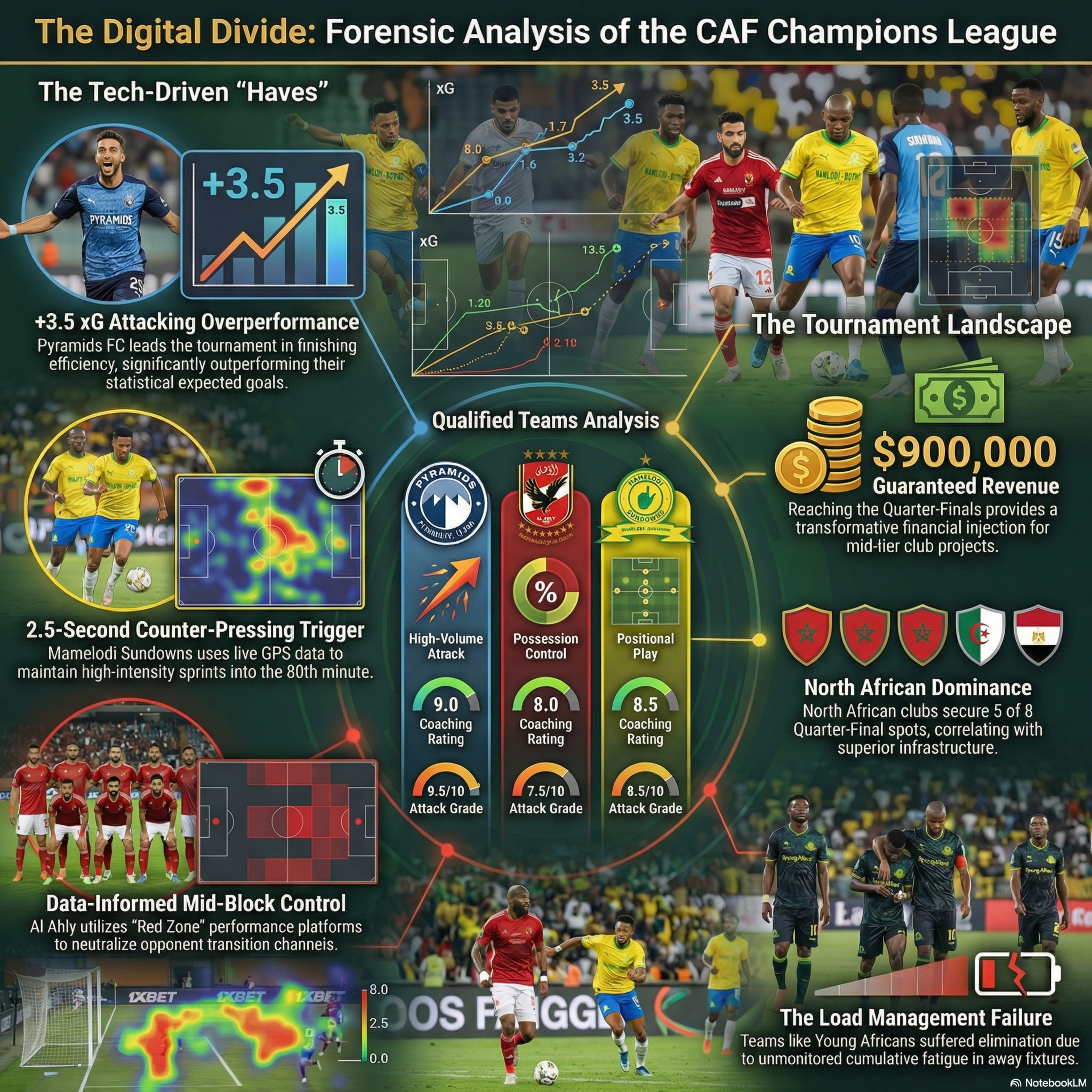
Oh, it looked like a howler, a complete shocker. You're screaming at the TV. Just clear it, Get rid of it. Of course. But if you freeze frame that moment, it wasn't an unforced error. It was a forced error. We have the tracking data here. The moment MC Alger recovered the ball near their own penalty box, look at what the Sundown's forward line did. Specifically, you have to look at the clock. OK, how fast was the reaction? 2.5 seconds. That's the counter pressing trigger. Within 2.5 seconds of losing possession, or in this case the opponent gaining the ball in a dangerous area, the Sundown's front 3 initiated a full Sprint coordinated press.
2 1/2 seconds is nothing. That's barely enough time to take a breath, let alone pick out a pass. That's the entire point. It's a trained behavior. It's not just enthusiasm or hard work. It's an algorithm. They practice relentlessly in training. If X happens, you do Y immediately. No thinking involved. So Gundu's never had a chance. He didn't have time to scan the field because the press was already on top of him. And here is the wildest stat. From that moment, Bran Leone's reaction time to the loose ball was statistically faster than any of the MC Alger defenders.
What does that even mean? He moved before they did. It means he started his movement to the interception zone before the goalkeeper even made the mistake. He was anticipating the error based on the intensity of the pressure. The defenders were reacting to the ball. Leon was reacting to the probability of the situation. That is the fundamental difference. That is incredible. It's almost like he was seeing the future and it wasn't just the pressing, was it? Some downs had 66% possession. Usually we see teams have that much of the ball and do absolutely nothing with it.
Sterile possession, right? The classic sterile possession, but Sundowns focused on quality over volume. This is a huge theme for all the elite teams. They don't just shoot from anywhere. They wait, they construct. Look at the second goal, Bran Leon again, but the assist came from Aubrey and Mudiba. That cross was absolute perfection, a thing of beauty. It was, but look at where he aimed it. It wasn't just a hopeful ball into the box. He put the ball into what analysts call the corridor of uncertainty.
I love that term, but let's visualize it for the listener. Where exactly is this corridor? OK, so imagine a strip of grass running parallel to the goal line, right between the goalkeeper and his defensive line. It's about 3 to 5 meters wide. If you put a low hard cross in there, it's a nightmare. Why? Because the goalkeeper can't come out to claim it, he's afraid he'll miss it and leave an open goal. And the defenders can't deal with it easily because they're running back towards their own goal, facing away from the attacker.
It is the highest assist conversion zone in all of football. Modiba didn't just cross it into the box, he hit a specific GPS coordinate. And Leon was there to meet it. Because his movement was also calculated, he positioned himself on the blind side of the central defender. He knew that if the ball went into that corridor, the defender wouldn't be able to see both him and the ball at the same time. It's pure geometry. So MC Alger's out there playing football and Sundowns is playing against them with geometry and algorithms.
That's a tough day at the office. It's an unfair fight. Defensively, though, Sundowns were just as solid. Ronwyn Williams kept a clean sheet. He did, but it's interesting he wasn't making highlight reel saves every two minutes, was he? His clean sheet was all about positioning and organization. The only real scare was that shot from Zeigrana. A total rocket by the way. But the XG on that shot was only .35. A one in three chance basically. So low probability. Exactly. Aside from that one moment, MC Alger had what we call failed entries.
They had plenty of the ball in the middle third of the pitch, but every time they tried to enter the final third, Sundowns had all the angles covered. It was possession without any penetration, a dead end. We have to talk about the touchline though, the drama, Miguel Cardoso versus Rolani Moquina. It got pretty heated over there. It was pure theater. Loved it. But even that has a data angle. If you look at the in game management metrics, Cardoso won that battle hands down. Look at his substitutions.
He brought on Marcelo Allende in the 61st minute and then Peter Sholili in the 84th. Those weren't just random like for like changes. No, they were timed perfectly to manage the energy levels of the entire team by bringing on a fresh L end. When he did, he refreshed the midfield press just as MC Alder was starting to get tired and find a bit of space. He kept the intensity. High and MC Alder's changes. They were reactive. They were chasing the game, trying to fix problems that had already appeared.
Sundown's changes were proactive, They were preventing future problems. It's a completely different mindset. OK, so let's flip the script entirely. That was a high energy, high pressing, chaotic game. But then you look at the other big one, Al Ali versus Ace firing Cairo, a 00 draw. On paper most people would see that score line and say boring, but you're telling me this was actually a tactical masterpiece? It was a master class in risk aversion analytics. Both teams did the math before kickoff.
They knew a draw likely got them both through to the quarterfinals, so the entire game became about minimizing variables, eliminating chaos. But Al Olli at home, I mean, usually the Khyber International Stadium demands blood. They want goals, they expect a three, no win. But Al Olli played differently, very cautiously. They refused to press high. If you look at the heat maps from the game, it's fascinating. Usually Al Olli's midfielders, your Deings, your Adias are swarming all over the opponent's penalty box.
In this game, Atia Deing and Ben Romdain were sitting in a dense compact cluster right in the center circle, a solid mid block. Why? Why would they give asfar all that space at the back? Seems counterintuitive for Al Ali. Because they respected Asfar's transition speed, their pregame analysis would have shown that ASFAR wanted Al Ali to push up to leave space behind so they could hit long direct balls into the channels for their quick wingers. Ali Ali simply said no, we're not playing that game.
They nullified the transition channels by clogging the midfield. It was frustrating to watch, I'm sure for the fans, but statistically it was the safest, most efficient way to ensure qualification. But there was a problem for them upfront, wasn't there? Muhammad Ali bin Rahm dating? The stats on him from this game are just they're confusing. It's a complete statistical paradox. If you look at his creativity numbers, his chance creation, he was elite, genuinely world class. He generated 3 clear high quality scoring chances.
He was finding the space, making the right runs, but his finishing nonexistent. Utterly nonexistent. Al Ali as a team generated about 1.2 expected goals in that match. And scored zero. That is a negative variance of Manic 1.2. It means the system was working, they were creating the chances, but the individuals in front of goal were not executing the final touch. They lacked that clinical attacking edge. It's a worry for them. Azhar, on the other hand, they seem to be playing a different sport entirely.
At times, the dark arts were on full display. Oh, they weaponized game interruptions. It was brilliant in a cynical way. 4 yellow cards, the goalkeeper taking 30 seconds, sometimes 40 to take a simple goal kick. They completely broke the effect of playing time. And Al Olli is a team that thrives on rhythm, right? Exactly. They need the ball moving fast. Quick interchanges as far made sure the ball was stopped more often than it was moving. It disrupts the physiological and mental flow of the opponent.
You can't get into a rhythm if the game stops every 90 seconds. It's ugly football, but it's smart tournament football. In a knockout setting, it's absolute genius. Let's move on to a team that has zero interest in 00 draws. The defending champions Pyramids FC. The absolutely dismantled Power Dynamos 31. This is the offensive machine in full flow. Pyramids are genuinely terrifying right now because the threat is so distributed. It doesn't come from one superstar striker. You had goals from Mustafa Zico, from Obama, from Ewarton.
Anyone can score at any time. And the assist maps for them are really interesting. It looks like they have a favorite spot a go to play. The cutback from the byline. It's a very high percentage strategy that the best European teams use. They overload the wings with their fullbacks and wingers, get one of them to the byline and then play a sharp lowball back towards the penalty spot. And why is that so effective? It is artistically very, very hard to defend because the defenders are all running back towards their own goal and they can't see the attackers making runs behind them by the time they turn the balls in the back of the net.
But the stat from that game that just blew my mind was the passing accuracy. 90% with 62% possession. That is just absurd in the context of African football. Usually the pitch conditions, the travel fatigue, the pressure from the opposition, it brings that number down into the low 80s at best. But pyramids were completing 9 out of every 10 passes. What does that do to the opponent? I mean physically, what is the effect of that? It suffocates them anaerobically. Power Dynamos spent the entire game chasing shadows.
You run so much more when you don't have the ball. By the 60th minute, you could see it. Power Dynamos pressing intensity just dropped off a Cliff because they were completely exhausted. And what happened in the 59th minute? Hiriton scored. Of course he did. They basically ran them into the ground without even breaking a sweat themselves. They use the ball as a weapon of fatigue. Just one last match I want to touch on quickly from the weekend. Simba SC versus staid Malian. Simba 11 nil. The stadium and Dar es Salaam was rocking, but they went home.
The report calls this a Pyrrhic victory. It was the definition of too little, too late. Anna Sedora scored an early goal and for a moment you thought here we go. Maybe the comeback is on. But they just lacked the ruthlessness to compound that lead, to overturn the goal difference or the head to head records. They needed a blowout win, a three nil or 4 nil. They just didn't have it in them. And stayed million and we we have to give them a huge amount of credit. They lost the game, but they topped the group.
How on earth does a team with a fraction of the budget of Simba or Al Ali atop a Champions League group? It's resilience, pure tactical resilience, and they excel at a metric called expected points. Away from home, they know they can't go to Tanzania and dominate possession, so they don't even try. They focus on limiting high quality chances against them. They clog the middle of the pitch, force the opposition to take shots from wide, difficult angles and they just survive. Even in defeat, they manage the goal difference perfectly.
They are the surprise package for sure, but the data says they absolutely deserve to be here. So we've talked a lot about what happened on the pitch, but I want to peel back the curtain a little bit more. I want to know why these top teams are so dominant. Let's do a tech stack audit because the report implies the haves aren't just winning because they have better players, they're winning because they have better computers. This is the invisible layer of the game that decides so much. Let's look at the tier one teams, Sundowns a Lily, Pyramids.
They are operating with what you'd call integrated tech stacks. OK, so let's go back to Sundowns. You mentioned the GPS vests the players wear. What are they actually tracking with those? So they are likely using systems like Catapult or Stat Sports. But it's not just about simple metrics like how far did you run? That's old news. It's about load management. Ecifically, they're tracking something called the Acute Chronic Workload Ratio, or ACWR. Right, that sounds like a mouthful. Break that down for us in simle terms.
OK, imagine your body's fitness level is a bank account. The chronic load is how much money you've saved up over the last month. That's your fitness base, your resilience. The acute note is how much you're spending this week, the intensity of training in matches. If you spend way, way more than you've saved, if that ACWR ratio gets too high, you go bankrupt. In football terms, you get injured. That is a billion analogy. So when they subbed off Marcelo Allende in the 61st minute against MC Alger.
Exactly. He was playing well. The fans were probably annoyed thinking why are you taking him off? But the data analyst on the bench looking at the iPad likely saw his ACWR number flashing red. It was hitting the danger zone. If he stayed on for another 10 or 15 minutes, his risk of a hamstring care might go up by 50%. So they took him off. The decision wasn't tactical, it was preventative. It meant he is healthy and available for the quarterfinals. So they are literally preserving their most valuable assets based on live data.
And because they manage this so precisely across the whole squad, the players who do stay on the pitch for 90 minutes can still Sprint at over 25 kilometers per hour deep into the 80th minute. Because they haven't been overdrawn in the previous weeks, their bank accounts are full. Incredible. What about Al Ottley? You mentioned data scouting. What does that involve? They use sophisticated software to analyze things like pack line breaking passes. OK, we hear this term pack line more and more in modern football analysis.
Help us visualize what that is. Right. So imagine you're watching the game from a high camera angle. The opposing team's formation can be seen as a series of horizontal lines drawn across your TV screen. The forwards are aligned. The midfielders are aligned. The defenders are aligned. Every time you pass the ball forward past an opponent, you are breaking a line. You are effectively taking that player or Packer out of the game with a single pass. So a simple sideways pass breaks 0 lines. Exactly.
A sideways pass is safe, but it's useless for the pack metric. Al Ali's analysts use data to identify which of their players make the most line breaking passes and, crucially, which passing lanes their opponents use most often to break their lines. So they're defending against Al R. It was preemptive. Their data told them that Alsar likes to play long, straight passes into the channels, so Al Lolly just positioned their midfielders in those exact lanes to cut off the supply lines before the pass was even made.
It's defending the idea of a pass, not the pass itself. That's next level stuff. And pyramids. What's their tech secret? For them, it's about positional play drills derived from data. They're 90%. Passing accuracy isn't magic, it's muscle memory forged by algorithms. They train in small sided games where the drills are designed around statistical probabilities. For instance. Their players know that if the left back has the ball under pressure, the Freeman is statistically most likely to be in the right half space, A specific zone between the oppositions winger and central midfielder.
So they don't even have to look up and scan the whole field. They pass to the spot because the math says a teammate will be there. That is frightening efficiency. Now let's contrast all of that with the Tier 2 teams, the have Nots you mentioned, Rivers United, Young Africans, Santa Leo, Lopopo. What is missing from their setup? It's what you could call the scouting void. Take Rivers United. They finish with a -8 goal difference, which is telling. The report suggests a lack of comprehensive video analysis on their opponents.
They were reportedly showing up to games unprepared for the specific set piece routines and transition patterns of a team like Rs Burkane. That's like showing up to a final exam without ever opening the textbook. It really is. They were playing a purely reactive game, trying to figure out the opponent during the match, whereas Rs Berkane came into that game knowing Rivers United's defensive weaknesses before they even got on the plane. And young Africans, what was their downfall? They fell into the fatigue trap.
They were eliminated despite winning their final game. Why? Because they dropped crucial points earlier in the group, particularly in away games due to poor load management. They tried to play an expansive, high energy pressing style of football in tough away environments. Which it burns way more if you. Way more a data backed approach would have told them hey we are playing at high altitude this week or in extreme humidity, let's not press like Mad Men, let's play a compact low block, conserve our energy and try to steal a 00 or A10 win on the counter.
Instead, they ran themselves into the ground, accumulated fatigue over several weeks, and drop points they shouldn't have. And then there's St. Alois Lupopo, 2 red cards in their final decisive match. That's just a discipline collapse. It seems that way, but it points to a lack of what we call referee analytics. I didn't know that was a category. Yeah, you can analyze the referee. Oh, it's huge. Now the top teams have databases on referees. They know that referee A gives a yellow card for every 3.2 fouls on average, while referee B only gives a card for every 5 fouls but is very strict on dissent.
Absolutely. If you know you have a strict referee before the game, you tell your players to adjust their aggression levels. Don't make that borderline tackle. Lupopo clearly didn't adjust. They played their normal aggressive game and the referee punished them for it. They failed to read the data on the most important man on the pitch, the one with the whistle. It seems like CAF is trying to help bridge this gap though. I saw something in the report about a red zone platform. Yes, to their credit, CAF is trying to democratize the data.
They provide the raw tracking and event data to all the clubs in the competition. But here is the massive catch. Data is useless if you don't have anyone who can interpret it. It's like CAF is giving every club the keys to a Ferrari, but only a few clubs have actually hired A qualified driver. Al Alley has a team of analysts to drive that Ferrari at 200 miles an hour. The smaller clubs have the keys, but they don't even know how to start the engine. So the gap remains not because of access to data, but because of human capital.
That leads us perfectly into the other massive gap. We need to talk about money. Section 4. The financial forensics of this competition. The economics of the CF Champions League are absolutely brutal and people need to understand this. We have to start with the prize money ladder. Just for reaching the quarterfinals, these eight teams are now guaranteed $900,000. Which sounds like a lot of money. Nearly a million U.S. dollars. It sounds huge, and for a team like Stayed Malian, it is what you'd call a Black Swan event.
It's transformative. That $900,000 can fund their entire Academy infrastructure. It can secure player wages for three years, maybe even upgrade their training facilities. It genuinely changes their entire projectory as a club. But then you look at a team from a bigger economy like Rivers United, they earned roughly $750,000 for their participation in Nigerian IRA. That's over a billion. The fans read the headlines and think we are rich. Go out and sign 3 new strikers. And that is what we have to call the net profit illusion.
OK, walk us through the math. Why isn't that money just sitting in the bank? Let's just look at the invoice for a typical group stage campaign. You have three away games to compete at this level. You cannot fly on commercial airlines if you want to win. The connections across Africa are too difficult, the layovers are too long. It absolutely kills your players recovery time so you have to charter a private plane. OK. What does that cost? Ballpark? Conservatively, for a round trip from say, West Africa to North Africa, you're looking at $150,000 per trip.
So for three away games, that's $450,000, Yeah, half $1,000,000 gone just on jet fuel and pilots. Gone right now. Add accommodation. You're not travelling with 20 people, you're bringing a delegation of 40 players, technical staff, medical team, club officials. You aren't staying at A roadside motel, you need a five star hotel with elite nutrition, proper gym facilities, top level security that bill racks up incredibly fast. Then you add local transport visas for everyone, bonuses for the players for each point they get.
So that billion naira. It's gone. It's spent before the prize money even arrives in the bank account. In fact, for many clubs that don't make it out of the group, the group stage is a loss leader. They might break even if they're lucky, but many actually lose money. So why on earth do they do it? Two reasons brand exposure and player transfer value. If you make it to the quarterfinals, your players on the biggest stage in African football, scouts from Europe and the golfer watching you can sell a talented striker who scores in a quarterfinal for $2,000,000.
That's where the real profit is. But if you exit early. You lose that entire showcase window. Exactly. The Rivers United players didn't get to show their stuff in the high stakes knockout rounds. Their potential transfer value stays low. That is the real devastating financial loss. And for the big boys who failed to qualify, like Simba and Yonga. For them, it's the rebuild cost. They have high wage bills. They pay big salaries to attract top foreign imports from across the continent. They absolutely need that knockout stage revenue to sustain that payroll.
Failing to get out of the group means they might have to sell one or two of their best players just to balance the books. It sets the entire project back 12 to 24 months. That is such a harsh reality. One bad group stage campaign and you were effectively relegated to a rebuilding phase for the next two years. It's the razor's edge of elite African football. There is very little margin for error. OK, let's try and shake off the gloom of the economics and look forward to what's coming. Section 5 we have our lead 8 we have all this data.
Let's try and project what is going to happen next. The report has some really cool visualizations for us. Yeah, let's look at attacking Edge. This is a metric that basically measures how clinical a team is in front of goal compared to the quality of chances they create. And pyramids are at plus 3.5 over performing their XG. Translate that for us. What does that mean in simple terms? It means they are scoring goals that on average they shouldn't be scoring. Their finishing is absolutely elite. If you give them a half chance, a 20% probability shot, they are burying it.
And on the other end of that scale, Al Ollie. Navisure 2.1 underperforming their XG. That is a massive red flag for a team with their ambitions. It means they are incredibly wasteful. In a tight, tense knockout game. You might only get 2 good chances. If you miss both of them, you are out. What about creativity? Who are the players we absolutely need to be watching in the quarterfinals? Aubrey Madiba at Sundowns. The data shows he completely dominates the half space, that little pocket of space between the opposition full back and center back.
He is the architect of everything they do and you have to keep an eye on Mustafa Zico at pyramids. He's a dual threat, the data shows. He is elite at creating chances and elite at finishing them. A nightmare to defend. And defensively, who is the team to beat the defense of Iron? It's Al Halal of Sudan, they have statistically the most compact defensive block in the entire tournament. Their goalkeeper faces the lowest post shot XG in the competition. What does that mean? It basically means that the defense in front of him is so organized, so good at blocking shots and forcing attackers into bad angles that the keeper rarely has to face a difficult shot.
He has the easiest job in the world because the 10 guys in front of him are doing their jobs perfectly. And the age profile of these teams. This is fascinating. Staidmelion has an average age of 24.6 years old. They are babies. They rely on youthful energy on their ability to recover quickly. Compare that to Al Ekley and Sundowns, who squads both average around 29. The old heads. Right. They can't run as much, maybe, but they rely on tactical intelligence and game experience. They run smarter, not harder.
It's going to be a classic battle in the knockouts of legs versus. Brains. The report even gives positional ratings out of 10. Pyramids Attack gets the 9.5 out of 10. That is just terrifying for whoever draws them. It is, but on the flip side, Al Ali's defense gets a nine point O and Sundown's midfield control also gets a nine point O. So we have these very clear, very distinct strengths for each of the main contenders. It's a bit like rock, paper or scissors. So let's put our next on the line. No more hiding.
What are the probabilities saying who's the favorite? OK, the undisputed favorite according to the model is Pyramids FC. The model gives them a 75% probability to advance past the quarterfinals regardless of who they draw. They are just too efficient, too balanced right now. And what's the nightmare scenario in the draw? The matchup nobody wants to see. Well, from a neutrals perspective, it's the one we all want to see. Al Olli versus Sundowns. But from their perspective, ideally they want to avoid each other.
The styles clash in a very specific way. Sundowns parent possession game often frustrates Al Olli's desire for a more transitional game. If they draw each other, it's a genuine 5050 coin flip. And the underdog? What chances it gives, Staid Malian. The model gives Staid Malian about a 40% chance of getting through. The data suggests they will struggle over A2 legged tie against one of the experienced dark arts teams. They might get a big win at home in Bemco, but can they survive a hostile away leg in Tunis or Cairo when the pressure is really on?
That is the billion dollar question. Before we wrap this all up, let's talk about lessons. The take away, section 6. If you could sit in the boardroom with these clubs right now, based on everything in this report, what is the one piece of advice you're giving each of them? OK, for the quarter finalists who are still in it for Al Ali, you have to fix the finishing. It's not a tactical problem. It might even be psychological. You need psychological conditioning for your forwards. You cannot survive the quarters in missing open goals.
Tighten up the set piece defense. The data shows you are vulnerable from corners and wide free kicks away. Goals are currency in this competition and you cannot afford to give up cheap ones. And for ACR discipline. Simple as that. You cannot win a quarter final with 10 men. You need to channel that aggression and keep your heads cool when it matters most. And for the teams that were eliminated, what's the blueprint for them to get back to this stage and compete? For teams like Rivers United and Power Dynamos, the message is clear.
Stop spending all your money on expensive players you can't support with infrastructure. Take 10% of your prize money, just 10% and build a basic analytics department. Hire 2 smart graduates with laptops. Let them start building your data capabilities because data reveals the edge. You simply cannot compete with the North African giants by playing hopeful football anymore. You need to be smarter. And for a team like MC Elder. Possession without penetration is utterly futile. You need to recruit vertical threats.
Go find players with genuine game breaking speed. The general lesson from this whole group stage seems to be crystal clear. The future belongs to the hybrid model. Exactly. You cannot compete at the highest level by just being strong or just being skilled or just being passionate. You need elite physicality supported and guided by forensic data. If you don't have both of those components, you are frankly becoming obsolete in the modern African game. So your final verdict on the story of the 2026 group stage?
Efficiency over exuberance. The teams that advanced treated this competition as a logistical and mathematical exercise. The teams that failed played with emotion and hope. And in 2026, math beats hope every single time. And the Afrotech verdict? Who is lifting the trophy? Pyramids FC are the clear data backed favorites to retain their title. Memelod Sundowns are the most likely team to cause an upset if, and it's a very big IF, they can conquer their own demons in a potential semifinal. I want to leave everyone listening with a closing thought.
Data doesn't play the match, the players do. We all know that. But in 2026, data dictates how the match is played and if your club isn't reading the numbers, they're not just playing at a disadvantage, they're playing a different sport entirely. They are bringing a knife to a drone fight. That's the reality now. It's an invisible game of structure, of management, of numbers, and it's happening right in front of our eyes. So when you tune in to watch the quarterfinals in a few weeks, don't just watch the ball, Watch the structure.
Watch the pressing triggers, watch the substitutions and when they happen, watch the invisible game that we just spent an hour discussing. I promise you it will change how you see the sport forever. It really, really will. Thank you so much for joining us on this deep dive into the 2026 CF Champions League. It's been a fascinating look under the hood of where African football is and where it is going. Keep analyzing, keep watching, and we'll catch you for the knockout. Goodbye.
 Apple Podcasts
 Castbox
 Castro
 Goodpods
 Moon FM
 Overcast
 Pocket Casts
 Podbean
 Podcast Addict
 Podcast Republic
 Spotify