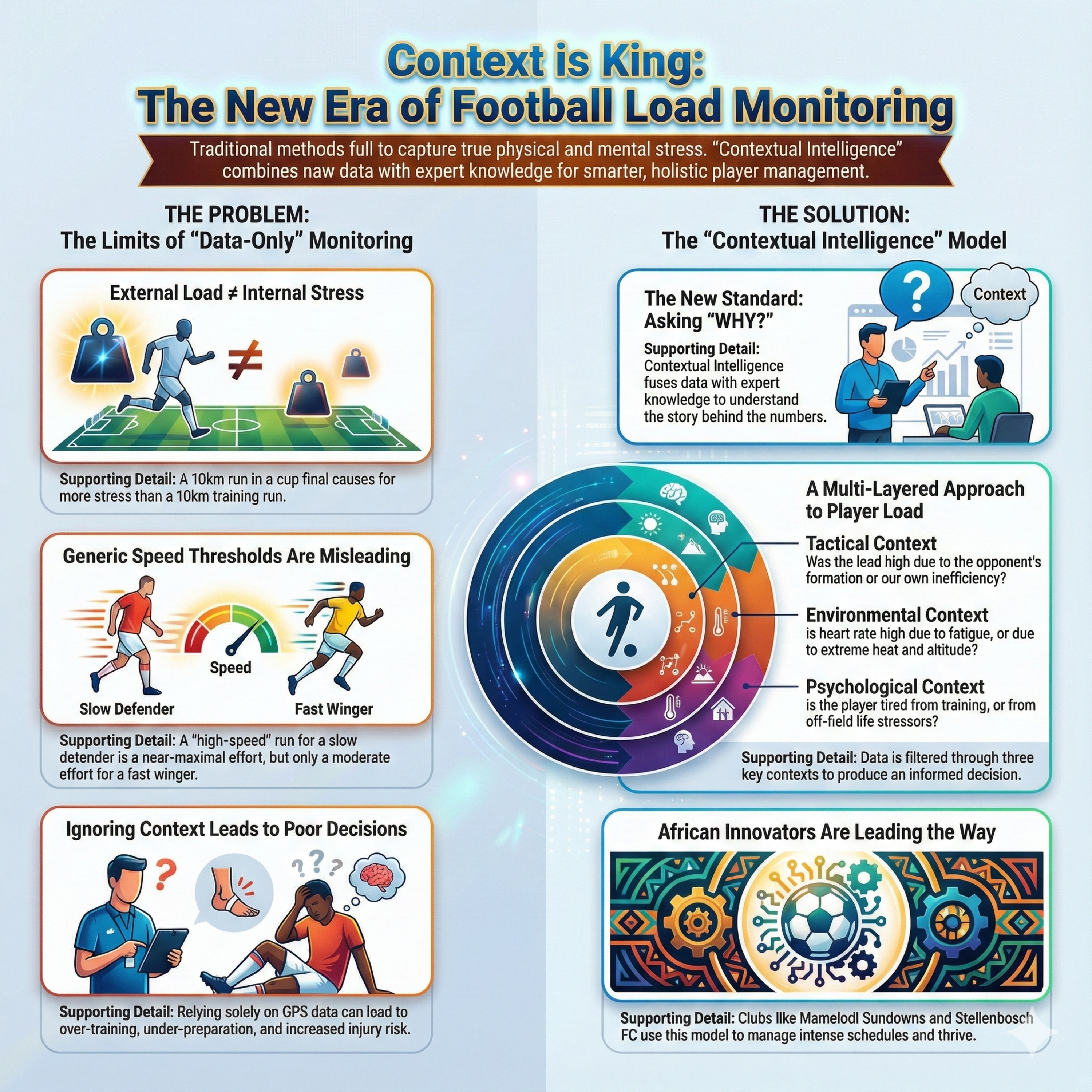
Why Football's Raw Data Is Failing Coaches
About this episode
Why Football's Raw Data Is Failing Coaches
Listen now on Spotify, Apple Podcasts, Amazon and other streaming services! Don’t forget to subscribe, share, and leave a ⭐⭐⭐⭐⭐ review to help more players and coaches discover the power of Techne Futbol and Data Technology in the beautiful game.
#TechneAfricaFutbol #TechneFutbol #TrainWithTechne #Playermaker #TraceFutbol #Hudl #FootballTech #FootballInnovation #PlayerDevelopment #CoachTools #SmartFootballTraining #AfricanFootball #CAFOnline #FIFA #FIFAYouth #CAFDevelopment #YouthFootballAfrica #NextGenFootball #FootballScouting #TalentIdentification #DigitalScouting #EliteYouthDevelopment #FootballJourney #FootballAnalytics #FIFAForward #FutebolAfricano #TrainTrackCompete #FootballExcellence #FootballAfrica #TheFutureOfFootball
Welcome back to the deep dive if you've ever looked at a post match report that says you know player X ran 11 kilometers and your first thought is So what then this is absolutely the deep dive for you it's. The $1,000,000 question, isn't it it? Is we are so far past just counting what athletes do, we're now in an era where we have to understand what it all means. We are basically ripping up the old playbooks because modern football, and I mean especially here on the African continent, is just, it's logistically punishing, it's hyper physical and the old ways of measuring things are completely failing us.
They really are. It's become a necessity, you know, not a luxury. For years, I think performance staff have been operating with blinders on. They've been handing coaches these reports that that basically just confirmed that yes, running did occur. Right, activity confirmed. Exactly. But those numbers, 10 kilometers, 11 kilometers, they're just empty calories without that crucial layer of context. They tell you absolutely nothing about the recovery debt that player just incurred or the tactical reason behind that effort.
Exactly. We've hit the ceiling on just measuring volume. So our mission today is very clear. We are going to breakdown this groundbreaking science, this philosophy really known as contextual intelligence or CI. And this isn't just about getting shinier, more expensive technology. This is a complete philosophical revolution in how elite coaches manage player stress, adaptation and so critically, injury risk across these brutally demanding seasons. And that focus is just so relevant for the African game, often hear about, you know, the resource constraints.
But the clubs that are actually succeeding, they're turning that need for efficiency into a mandate for extreme intellectual rigor. That's a great way to put it. They simply have to be smarter than everyone else because the demands they face, crazy travel, the massive environmental shifts are often far greater than anywhere else in the world. That's the core of it. This is what we call an epistemological shift. It's moving away from what was, let's be honest, a black box approach. You just trusted the raw data coming out of the GPS unit.
Download the file and hope for the best. Exactly. But the new standard, it requires the practitioner, the sports scientist, to integrate that hard, objective data with the incredibly experienced, almost tacit judgement of the coaching staff. The role changes completely. It does. You're no longer just the person who downloads the file. You become the chief context interpreter for the entire organization. Precisely. And if we're going to get our heads around the complexity of contextual intelligence, we have to start with the single most foundational idea in all of athletic training, and that's the relationship between the dose and the response.
OK, let's unpack that the dose response idea. On the surface, it sounds simple. You apply a stimulus, you get an adaptation. But in elite team sport, that relationship is anything but simple. It's fundamentally complex. I'd even say it's chaotic. In a very controlled environment, like say in pharmacology, the dose response relationship can be beautifully linear and predictable. You give X amount of a drug, you expect Y amount of effect. But in professional football, the training stimulus, that's the dose, which leads to a physiological change.
The response, it's moderated by so many different factors. We're talking sleep, nutrition, psychological stress, tactical pressure, the list goes on and on, and the relationship becomes highly nonlinear and incredibly unpredictable. So Player A and Player B could run the exact same drill, the exact same external load, but because Player A slept for four hours or is, you know, worried about a contract negotiation, their body's response to that same drill is totally, totally different. Completely different.
The stimulus is identical, but the adaptation outcome is miles apart. And that nonlinearity is exactly why we have to break the training stimulus down into two very distinct, non negotiable concepts, external load and internal load. If you don't get this split, you can't practice CI. OK, so let's define the terms. What exactly separates the two? Let's start with external load. OK. So external load is the objective physical work that's performed by the player. It's completely independent of their psychological or physiological state at that moment.
So it's what the gadgets measure. It's exactly what you measure with your high tech hardware, your GPS units, your inertial sensors. We're talking about metrics like total distance, high speed running, the number of accelerations and decelerations, often those really high force movements over 3 meters per second squared, and even energy metrics like metabolic power. That's the input, then the physical work being put into the system. That's the perfect way to think of it. Now internal load is the crucial counterpart.
This is the athletes subjective and objective physiological and psychological stress response to that external work. And how do we measure that? This is measured through things like heart rate monitoring, the athletes own subjective rating of perceived exertion or RPE, and more objective lab measures like blood lactate concentrations. And now on the real cutting edge, we have newer biochemical biomarkers like sweat metabolites. And this is where we hit that critical failure point of the old way of doing things.
Why is only monitoring external load, even with the best, most expensive GPS vests, so dangerous for player health? Because it makes a catastrophic assumption. It assumes machine 80 where none exists. It assumes the body is a simple predictable engine. But the research that validates the CI philosophy shows time and time again that identical external loads do not elicit identical internal responses. OK, if I tell player A and Player B to run 10 kilometers at the same pace, their GPS data will be identical.
But a Player A is, say, recovering from a fever. His heart rate response, his hormonal response, the whole neuroendocrine system will be catastrophically higher than Player B's. That's the physiological side of it, but what about the context of the game itself? That must play a huge role. Oh, that's the most compelling example of all. Let's take that 10 kilometer run again. If it's performed at a high stakes knockout championship match where adrenaline is surging, the cognitive load is immense, the pressure is maximal, the internal load will be dramatically higher, Your stress hormone cortisol will just spike through the roof.
And you compare that to the exact same 10 kilometer run, same GPS data, but done in a low pressure midweek training session. Exactly. The external load is identical, but the recovery requirement for that match scenario could easily be double, maybe more, because the neuroendocrine system has been taxed so heavily by stress and anxiety. So the context, the environment of the game, it acts as a multiplier of internal stress. It's the ultimate moderation, creator of adaptation, and if you're a coach who only looks at the distance covered, you are completely missing the most important signal of fatigue, of recovery, debt and a potential injury.
This is why contextual intelligence is non negotiable. So if our simple linear models have failed because the system is just too complex, how are the smart clubs using data science to get a handle on this? Let's talk about how machine learning has stepped in to bridge that gap. Well, ML is perfectly suited for this kind of problem because it excels at recognizing these complex nonlinear patterns that just defy simple equations. Traditional methods like linear regression failed because they couldn't account for all those interacting modulating variables we just talked about.
Now we can deploy these advanced algorithms, things like random forest models, convolutional neural networks, or CNNS, to actually and successfully predict match performance based on the specific patterns we see in the training load leading up to the game. So these algorithms aren't just taking an average of the week's work, they're looking for a specific fingerprint in the preparation phase. That's a great way of putting it, a fingerprint, and the research here provides a really beautiful validation of the whole CI concept.
The models discovered that the most decisive factors in predicting how explosive a player would be in a match were specific variables related to their movement quality. Not just distance run. No, not at all. It was things like angular velocity and angular jerk measured in the training sessions three to four days before the match. So on what we call MD 3 and MD 4. OK, hold on, angular velocity and angular jerk for those of us listening. Why are those specific variables so much more important than just total distance or total high speed running?
It's because they capture the quality of movement and the neuromuscular demand far better than simple speed thresholds. Angular velocity measures rotation and change of direction, and angular jerk in simple terms measures how explosively the player changes their acceleration. It's about the quality and force of their movements. The sharp, powerful actions. Exactly. These high quality, high force demands are the stimulus that primes the neuromuscular system, getting it ready for match day explosiveness.
And the fact that the algorithm pinpointed MD 3 and MD 4 is the most critical window that seems to validate what good coaches have known through intuition for decades about periodization. The context of the schedule is what matters. It confirms that CI isn't just about accumulating volume, it's about the timing and the intensity distribution. The algorithm works because it recognizes the necessary pattern of loading, the context of pre match preparedness that dictates the outcome. It confirms that the total work you do all month matters far less than the specific pattern of quality work you deliver in that immediate lead up to a match.
That's a really powerful transition because it forces us to move beyond just aggregated data and start thinking about what's shaping the environment the players are in. So let's move into our next section and breakdown the three core pillars of contextual interpretation, starting with Pillar, A, Tactical Context and Game state. Right. The tactical plan is essentially the blueprint for all physical output. A coach who just looks at a player's total distance in a post match report is missing the most critical piece of the puzzle, the tactical nuance that drove that effort in the first place.
You can't separate the two you. Absolutely cannot separate the physical output from the tactical instruction. And we see this play out in real time, especially in these massive high level African competitions like the C Cave Champions League. So give me an example of how the score line itself fundamentally changes the physical output in a way that AGPS unit alone could never explain. We call it the score line effect, and it's been proven consistently in the research. Think about a really tight, decisive knockout match in the final 15 minutes.
If the score is level, or maybe the margin is just one goal, the players will produce maximum explosive efforts. They're motivated by that strategic necessity to secure the result. The internal load, the adrenaline, the fight or flight hormones is absolutely massive. And you contrast that with a player on a team that's leading, say, 4 nil in a league game with 10 minutes left to play. Exactly. That player will and should naturally conserve energy. They might drop their high speed running metrics way down.
A coach looking only at the data might see a low intensity finish. But contextually, that was the most appropriate and intelligent strategic choice. CI recognizes that the physiological demand is always relative to the strategic consequence. And what about possession status? We have to contrast the load profile of a possession dominant team like Mamelodi Sundowns or one of the big Egyptian clubs versus A-Team that's built to defend in a low block and hit on the counterattack. The work they do looks completely different.
Oh, the demands are polar opposites. A player on a team that's out of possession generates significantly greater high intensity efforts because they are constantly closing down space, shifting, pressing, trying to recover the ball. A defensive midfielder in a low block system will log a massive volume of the short burst accelerations and decelerations. Meanwhile, the midfielder for the possession dominant team might post what looks like a low distance game, which if you're using the old metrics might suggest they weren't putting in a full effort.
And that would be a catastrophic misinterpretation. That low distance game for the possession player might actually be incredibly taxing internally. It's because of the high density of accelerations, decelerations and changes of direction that are required in really tight spaces to circulate the ball. So the external load looks low, but the internal load is through the roof. Exactly. The cognitive strain and the muscular strain of all those repeated dense high force actions is extremely high. CI demands that we stop looking at total distance and start looking at the density of specific tactical actions.
That sets the stage perfectly for Pillar B, which is psychological and cognitive load, what you might call the invisible stressors. This feels like where the coach's ability to read the room becomes the ultimate CI filter. This is absolutely crucial because mental fatigue creates the most devastating disconnect in that dose response relationship. We can look at some proxy studies, for example, with youth athletes, water polo players in one case, who face these really heavy schedules, their physical metrics like distance and volume, they stayed pretty stable across the week, but their perceived recovery status and their well-being scores fluctuated wildly based on the importance of the match and the density of their other commitments like media or schoolwork.
So their muscles and their lungs were capable of doing the work, but their brains were exhausted. And we know that the brain is the ultimate limiter of all performance. It absolutely is when cognitive load is high, and that could be from trying to learn complex new tactical instructions or dealing with media scrutiny or personal issues or even contract insecurity. For a senior professional, it drastically increases their rating of perceived exertion, their RPE. So a coach who is only relying on Agps report sees standard speeds and volumes, but if the players RPE for that session is disproportionately high, that's a massive red flag.
It's a clear signal that mental fatigue is driving this low disconnect. So the athlete is having to work harder internally just to produce the same standard external output. That's it exactly. And this psychological pressure, it doesn't just make them feel tired, it translates directly into physical risk, doesn't it? It's a direct pathway to injury. We have longitudinal studies that demonstrate players who are exposed to chronic negative media scrutiny or organizational problems or instability, like a constant change of coaches or administrative chaos.
They report higher stress and anxiety. And that leads to injury. That physiological stress manifests itself as suppressed immune function, poor sleep quality, and ultimately A significantly increased injury rate, particularly those non contact soft tissue injuries. So ACI practitioner doesn't see a drop in training intensity as a sign of laziness, They see it as a potential coping mechanism for stress. They pivot from punishment to a contextual intervention. Precisely. The data is simply an indicator that the athlete is failing to cope with their total stress load, and that includes what we call life load.
The intervention isn't more physical training. It might be a conversation, a scheduled rest day, or a referral to a psychological resource. Now this brings us to the contextual pillar that is arguably the most demanding and unique for African football, Pillar C, the environmental context. This is a complete non negotiable that defines performance management on this continent. The environment acts as an additional and often unmonitored external dose of stress. European models for the most part assume a relative climatic standardization and pretty easy logistics.
African clubs operate across geographical extremes that place an immense and often unmeasured strain on the players. We're talking about massive geographical volatility in something like the Sea CAF Champions League, which means you have to plan around altitude, humidity and just sheer travel strain. Think about a typical schedule for a top club. You could be training and playing in a high altitude city like Johannesburg, where the air is thinner and that requires specific metabolic adjustments.
Then just a few days later, you're flying across the continent to Cairo or Casablanca, which are at sea level and potentially much hotter and more humid. And then on to somewhere like Kinshasa. And then on to Kinshasa in a tropical Equatorial climate that is a colossal physiological stressor. The combined effect of altitude changes, time zone shifts and thermal shock. That GPS vest tells you 0 about any of that. Absolutely nothing. And the travel load itself, the jet lag, the circadian rhythm disruption, the poor sleep and transit, all of that has to be factored into the total internal load.
It must be, and This is why some of the more cutting edge monitoring methods are becoming so essential, specifically this emerging field of sweat omics. Sweat omics. OK, tell us more about this. This is a frontier technology. How does it help us quantify that environmental stress? It's really the next evolution of internal load monitoring. We're now using these wearable, noninvasive patches that can analyze biomarkers directly from a player's sweat. We're talking about monitoring levels of electrolytes like sodium, metabolic markers like lactate, and even stress hormones like cortisol, all in real time.
So this gives us a direct window into a kind of multimodal fatigue that heart rate and RPE can't quite capture with the same precision. That's it exactly. When a player runs 5 kilometers in 35°C heat, the standard GPS report just shows 5 kilometer distance. But sweat Omix, it reveals the massive thermoregulatory dose that was imposed by that environment. The body is diverting huge metabolic resources just to cool itself down, and that impacts hydration status and cardiovascular strain. This thermal strain is a dose unto itself and.
CI demands that the recovery protocol be adjusted based on that thermal strain, the sodium loss, the dehydration, not just on the distance the player covered and this need for precision. It's just magnified in Africa because the climatic extremes are the biggest logistical challenge of all. It's survival science, really. If you mismanage recovery after a match in high humidity, the risk of injury in the next session just skyrockets. CI mandates A holistic view. You have to integrate the geographical stress of travel, the thermal stress of the climate and the mechanical stress of the playing surfaces into one comprehensive risk assessment.
We've really established the theoretical need for context, so let's pivot now to Section 3, practical insights. How do we turn all this complex theory into actionable, individualized prescriptions on the training ground? Let's start with the failure of generic thresholds. This is arguably the most common and damaging mistake in professional football globally. The error is relying on these one-size-fits-all speed thresholds. For instance, universally defining high speed running or HSR as anything above 5.5 meters per second, which is about 19.8 kilometers for every single player.
Regardless of their position or their physical capability. Exactly. And that is just inaccurate data about effort. If I'm a lightning fast winger, 19.8 kilometers might be a submaximal jog for me. But if I'm a big heavy central defender, 19.8 kilometers could be a maximal debilitating effort. We are comparing apples and oranges with a single number. It's meaningless. It's almost meaningless to individualize the prescription and make the data scientifically valid. We must anchor these thresholds to the players unique physiological ceiling.
We need to know their maximal aerobic speed or MAS. That's the lowest speed required to reach their maximum oxygen consumption. Their WO2 Max and we need to know their maximal Sprint speed, their MSS which is their absolute top end speed. And the space between those two numbers that tells us everything we need to know about their efficiency, their adaptation potential, and their fatigue tolerance. Correct. That difference between their top speed and their aerobic limit is their anaerobic speed reserve for ASR and the ASR, you can think of it as the pool of energy they have available for all those high intensity and aerobic efforts, OK.
And the key inside of CI is that the metabolic cost of running at a specific speed is entirely relative to the percentage of that players own ASR that that speed represents. So let's breakdown what that means for a coach. Let's take our central defender and our winger again, OK? So for our slower central defender, hitting 19.8 kilometers might consume 90% of his maximal Sprint speed. He's working deep into his anaerobic zone, he's incurring severe fatigue and he's going to require a lengthy recovery.
For the fast winger, that same 19.8 kilometers might only be 60% of his top speed. It's an almost purely aerobic effort for air, low fatigue, and he'll be recovered within hours. So prescribing the same recovery or training stimulus based on that generic metric is just negligent. But calculating those individual ceilings, the MAS and the MSS for every player in a big squad, that takes time, it takes resources, and it often requires field or lab testing. Isn't this exactly the barrier for some of the more resource constrained African clubs?
How do they solve that logistical issue? And that is the essential challenge. The answer, though, is efficiency and intellectual investment. The most successful clubs recognize that the time and cost they invest in establishing a reliable MAS and MSS baseline is recovered tenfold by reducing non contact injuries and maximizing the efficiency of every single minute of training. So it's an investment, not a cost. Absolutely, and furthermore, MAS can often be estimated very reliably with simple validated field tests like the 3015 intermittent fitness test.
You don't necessarily need an expensive lab to do VO2 Max tests. It's really about being smart, not just about being rich. And what's specific valid metric? Does the research suggest we should be tracking instead of just generic high speed running distance? The evidence on this is very compelling. Studies with high level youth players have shown that the distance covered about 30% of a player's individual ASR show the highest and most consistent correlation with improvements in their aerobic fitness tests.
And generic HSR distance. It should much much weaker correlations. So the goal for a coach who is shifting to CI isn't just increased total running volume, it's to increase the volume of time spent running above 30% of that players specific anaerobic speed reserve that provides a far more precise and effective dose. Right. It individualizes the metric and ensures that the stimulus you're applying is actually driving the adaptation you want, rather than just producing generalized nonspecific. Fatigue.
That's it in a nutshell. And this individualization, it's absolutely critical when you're managing the reality of modern football. Congested fixtures 2 sometimes three games a week, often coupled with significant travel. How do you see I aware clubs maintain fitness while minimizing that debilitating fatigue? This is where this idea of micro dosing comes in. Micro dosing is the art of maintaining neuromuscular performance even in the face of metabolic fatigue. The very first step is the rigorous identification of the most demanding passages of play, the MDPS from your match video and your GPS data.
So the toughest moments. The toughest moments, those most intense one to five minute windows of match action, measured by intensity metrics like meters per minute or the density of high force accelerations. If we know that the most challenging period for our defensive midfielder is say a 2 minute window where they cover 40 meters per minute and execute 8 high force decelerations, that becomes our target. That is your target dose. So instead of a punishing generalized high volume session on a Tuesday designed to just build fitness, the strategy is to use these targeted priming or maintenance drills.
The coach designs a specific maybe 3 minutes small sided game that replicates that exact meters per minute intensity, focusing specifically on those high force changes of direction. So you deliver the high quality, high intensity neuromuscular stimulus that you need to keep the player tuned. But because the duration is so short, it's just three minutes, you minimize the fatiguing metabolic response that would just impair the recovery for the next game. It is peak efficiency. You get the necessary neuromuscular dose, but you avoid the systemic fatigue that comes with just doing high volume generalized running.
This is absolutely non negotiable for clubs facing those continental schedules with heavy travel. It forces them to find quality over quantity. Let's look at another specific application of this priming idea, neuromuscular priming. Using sled training. We've seen this method used to try and increase explosive power just before a match. Yes, this is a fascinating study because it really highlights the difference between looking at acute data points versus understanding chronic context. Researchers investigated using these very heavy sled resistant sprints around 80% of the players body mass and they performed them 24 hours pre match on MD one as a way to potentiate the muscles for explosiveness in the game.
So a coach might be hoping this gives their players an immediate competitive edge for the match the next day. What did the acute data actually show? Well, the acute effect, so the immediate statistical jump in power or Sprint metrics 24 hours later was not significant. So a coach who is only focused on that immediate data point might discard the method right away. Thinking this just fatigued the player yesterday and gave me no measurable benefit today. But contextual intelligence requires that long term periodization view it.
Absolutely does. The study showed that the chronic application of the method, so implementing it consistently over a 10 week period led to significant tangible improvements in long term performance metrics. We're talking increased relative force production and improved Sprint mechanics. That is profound. It tells us that CI requires the practitioner to understand that some acute training methods, even if they induce a bit of short term fatigue, are absolutely necessary to drive long term structural adaptation.
Yes, the coach must understand the long game, the context of the entire season, not just the acute fatigue that the player reports the next day. It demands trust in the process and a shift from managing individual days to managing adaptation across weeks and months. And that concept, managing fatigue across weeks and months, it brings us perfectly to Section 4, the African implementation landscape. We have to acknowledge that the sheer logistical reality here means these advanced CI strategies aren't just helpful, they are essential for survival.
Absolutely. The unique constraints faced by African clubs make the standardized European load models almost completely irrelevant. We already talked about the climatic volatility, but the travel load is perhaps the single biggest external stressor that has to be factored into any CI monitoring system. Right, The journey to ACF Champions League match is not like taking a quick flight from London to Paris. It's often multi stop across multiple time zones. It involves significant waiting times and constantly changing environmental conditions.
Just take the Mammalodi Sundowns example again, which is typical for any top competitor. They might fly from Preteria on the high veld high altitude dry climate to Cairo or Casablanca at sea level with potentially high humidity, and then from there maybe on to Lubumbashi or Kinshasa, which is a whole different tropical humidity and logistical challenge. So the physiological cost of the jet lag, the massive shift in thermal regulation, the sleep disruption, it's a compounding dose of stress that GPS distance can never, ever capture.
Which is why the CI practitioner has to integrate things like travel hours, time zones crossed, and estimated sleep quality right into the total load equation. They need unique recovery protocols for these scenarios. And we absolutely have to mention pitch quality, which is a major injury risk factor that differs dramatically across the continent. This is all about mechanical load context. The stiffness of the pitch surface dictates the impact forces that are transmitted up through the players kinetic chain.
You might have pristine hybrid turfs in South Africa, but then you travel to play on older, harder, uneven natural surfaces somewhere else. So monitoring total distance without factoring in surface context is just negligent, especially for players who are returning from injury. Exactly. A player who is recovering from an ankle injury might tolerate 60 minutes of running on a soft, forgiving pitch, but if the coach blindly prescribes 60 minutes on a hard, unforgiving surface and then away fixture, that high mechanical load might translate into an immediate re injury.
CI requires the performance staff to have pitch stiffness metrics, even if they're subjective like a coach's observation, as a central part of the daily risk assessment. Despite all these extreme constraints, we are seeing these incredible innovation hubs emerge. So let's start with the benchmark for professionalism in sub-Saharan Africa, Memelodi Sundowns. How are they leveraging CI to maintain their dominance? Sundowns obviously backed by significant investment. They operate with a methodology and sophistication of a top European club.
Their innovation strategy is corporate driven and is really built on the foundation that was laid by former coach Pizza Mozamani, who deeply understood that scientific optimization was the only way to bridge the gap with global standards. The culture there is so critical. It's not just about buying the GPS vest, it's about ensuring that all the staff work in lockstep. Precisely the data team, the doctors, the tactical analysts, they are all unified and their CI application is specifically tailored to manage a 60 plus game season across that Extreme C CAF Champions League calendar.
They use real time load visualization to manage travel fatigue, they prioritize specific competitions for player freshness through rotation, and they ensure individualized recovery protocols are non negotiable for success. They treat recovery as a performance variable. They absolutely do. OK, moving to a different model, let's talk about Stellenbosch FC. They're often seen as a Moneyball success story built on intellectual capital rather than massive financial outweigh. Stellenbosch is a fantastic example of efficiency that's driven by pure rigor.
Under their former head of performance, they implemented this systematic, robust data workflow. They just couldn't afford to waste money or effort, so every metric they tracked had answer a specific contextual question. And how did they use data visualization to inform that CI process? Well, they moved beyond just static reports. They use advanced visualization tools to map seasonal trends of high speed running and Sprint distance against their match outcomes, and this allowed them to ask these critical contextual questions of the coaching staff.
Like what? For example, OK team, we see a dip in high speed running volume. Is this because the players are satie from last week's travel? Or is it because we have achieved tactical mastery, we're controlling the game in the opponent's half, and we actually require less running to achieve victory? That is the absolute essence of CI, using data not just to confirm what happened, but to filter the. Y Exactly. And their head coach Steve Parker. He exemplifies the CI aware coach. He openly discusses that necessary balance between the science and the grid.
While the data is used rigorously for load management and week to week selection. He acknowledges that in those crucial moments, like a cup final, psychological resilience and human determination might just override the calculated data risk. And that balancing act? Data informs, but human judgement dictates. That's the definition of contextual intelligence it. Really is. Next up, let's look at Orlando Pirates, who have systematically institutionalized sports science as a formal decision driver in their high performance structure.
Yeah, Pirates have gone all in. They've established A dedicated, highly formalized scientific department under the guidance of coach Jose Rivera, and this department is explicitly credited as a real time component of their decision making. Their focus is using data to evaluate current player load and predict injury risk during the training week so they can adjust drills on a Tuesday or a Wednesday before a potential injury manifests on a Friday. And they also use a very smart partnership model to gain access to advanced testing without that massive capital expense.
Correct. Their collaboration with institutions like the Prime Human Performance Institute in Durban, it gives them access to world class facilities, VO2 Max labs, Isokinetics, testing machines that they just couldn't afford to build in house. And this allows them to seamlessly correlate their internal physiological data from the lab with their external field data from GPS. Which lets them create that crucial athlete passport. What goes into that passport? The Athlete Passport is the comprehensive living document for each individual player.
It contains their physiological ceilings, their MASMSSASR, their full injury history, their preferred recovery methods, and crucially, their psychological baseline, their typical response to stress, their normal RPE patterns. This ensures that every periodization plan is truly individualized, built on the detailed needs analysis rather than some generic team standard. And beyond South Africa, we're seeing other pioneers integrating CI principles, often because of the immense pressures of continental competition.
What can you tell us about Yramids FC in Egypt? Yramids FC is a case where significant financial resources are being leveraged for really strategic long term CI planning. They've structured their entire high performance department to mirror European elite standards and their strategy is highly contextual. They use their load data to meticulously Dr. rotation and selection strategies, and they're very competitive domestic league specifically to prioritize player freshness and metabolic recovery so they can maximize their success in the grueling C cap Champions League campaign.
So they're thinking about load distribution across a whole season. Across the entire season, not just week to week. And Morocco's Raja Club Athletic is taking a fascinating developmental approach within their famous account. Yes, Raja CA demonstrates that CI is crucial even at the youth level. They use monitoring to manage the difference between a player's biological age and their chronological age. Because youth players mature at such different rates, if a coach only uses their date of birth, they risk overtraining A biologically younger, less robust player or under training a biologically advanced player.
By using CI to gauge maturation status, they ensure that the training load is perfectly appropriate for that individual's current stage of development. Preventing burnout and injury. Exactly. They minimize injury risk during those critical growth phases. Finally, we have challengers like Simba SC in Tanzania representing the ambition of East African football. Simba SC really highlights the transition from just ambition to institutionalized science. They're actively investing in foreign expertise, recruiting sports scientists and performance specialists to professionalize their environment rapidly.
They're moving from what they describe as a training club mentality, which is focused on volume, to a performance club mentality, which is focused on specific, contextualized output. This whole panoramic view, it just concerns that the old ways are obsolete. So let's move to our final section, Section 5, our synthesis, bringing together all this theoretical and practical bedrock into one definitive context aware model. We have to anchor ourselves one last time to the theoretical truth. External load is just the vehicle adaptation.
Fatigue, recovery, and injury risk are all driven entirely by internal load. How the engine of the body actually responded right. Any system that treats GPS distance as more important than heart rate or RPE is fundamentally flawed because it's measuring the output without ever assessing the cost. And this focus on the internal response, it brings a warranted skepticism toward metrics that are maybe a little too simple, doesn't it? Yeah. Absolutely. We have to address the over reliance on metrics like the popular Acute Chronic Workload ratio, or ACWR.
While it can be useful contextually, experts strongly caution against using it as some kind of standalone crystal ball for injury prediction. It's not magic. It is not magic, they argue. It often lacks a clear individual causal link to injury and can lead to these overly conservative decisions that unnecessarily reduce training intensity. The T take away is that expert knowledge is necessary to interpret the variations and anomalies within ACWR. Monitoring should never rely solely on automated data collection.
The coach's eye is still paramount. So if that's the physiological bedrock, let's look at the tactical framework which is provided by the ecological approach. How does this redefine fitness within the CI framework? The ecological approach which is championed by tactical analysts, It reframes fitness entirely. Fitness in football is not the ability to run 10 kilometers, it is the ability to repeatedly execute specific tactical actions, ressing, transitioning, counterattacking in the appropriate context.
It insists that load monitoring has to differentiate between generic running and football running. That's a really powerful distinction. So give me the contextual value difference between those two types of running. OK, A50 meter Sprint that's performed during a pre match warm up. It has physical volume, sure, but it has 0 tactical value and 0 cognitive demand. OK Conversely, A50 meter Sprint performed in the 88th minute to track back and prevent a goal has massive contextual value. It places a higher cognitive load, a higher psychological stress, and it contributes directly to the strategic outcome of the match.
CI demands that monitoring systems be seamlessly integrated with tactical video analysis to capture and weight this contextual value. Otherwise, the data is meaningless to the coaching staff. So we've covered the entire spectrum here, the physiological necessity, the tactical integration, the practical individualization, and the severe constraints of the African landscape. How do we synthesize all of this into one unified decision making tool? What are the five layers of questions the practitioner has to ask within this context aware model?
This final framework is really the operating manual for the CI practitioner. It moves sequentially from the raw input to the final strategic decision, and it always prioritizes the contextual question that filters the data. OK, start us off with layer one input which is the external load. What is the critical filter here? The practitioner has to 1st ask the tactical context question. Is the external load high because of the opponent's strategy which is forcing us into more defensive high intensity running?
Or is it high because of our own tactical inefficiency meaning our players are covering redundant ground due to poor structure? The data must be filtered by the game plan. Layer 2 process or internal load. This is the physiological response to that work. The question here is the environmental context. Is the players heart rate or their RPE disproportionately elevated due to a fundamental fitness problem? Or is that elevation primarily caused by external environmental stressors like massive heat stress, humidity, or unacclimatized altitude?
We have to filter the data through the climate. Layer 3 filter the psychological part, the human element that bridges the external work and the internal response. This is the crucial life context question. Is the player reporting high levels of fatigue on their Wellness surveys because of the physical load from training? Or is it due to life load, organizational instability, personal media scrutiny, or critical family issues? We have to understand the total stress landscape the players navigating.
Layer four decision or expert judgement. This is the strategic pivot point for the coaching staff. Right here the coach has to apply strategic context based on the synthesis of all those previous filters. Do we make the calculated risk to push through this accumulated fatigue because we have a crucial must win cup final tomorrow? Or do we prioritize immediate rest and rotation for the long term league campaign? The data informs the risk, but strategic necessity dictates the decision. And finally layer 5.
Output the dose response. This is the result that closes the feedback loop. This is the individual context question. Did this specific training dose, factoring in all the environmental, psychological, and tactical filters, actually improve this specific player's physiological ceiling? Did it successfully move their MAS or their ASR in the direction we wanted? This final check ensures the whole system is adaptable and truly individualized. The era of just buying GPS vests and staring at the total distance column is completely, utterly dead.
The future is synthesis and the informed judgement of the expert practitioner, supported but never replaced by the data remains the most powerful algorithm available. And what's truly fascinating about all this, and why it's so important for a context, is that African clubs are not just catching up. They are uniquely positioned to become global leaders in this contextual intelligence revolution. Because they are forced to be efficient, they simply cannot afford the waste of resources or the risk of injury.
Exactly. The extreme environmental and logistical demands, the multi stop flights, the altitude changes, the pitch variance. They force clubs like Sundowns and Stellenbosch to be more context aware, more precise and more efficient than their European counterparts who are operating in these standardized environments. CI isn't a luxury for them, it is a fundamental survival mechanism for achieving smart performance. That is the powerful synthesis right there. The goal of monitoring is this unified concept, performance enhancement and Health Protection.
And if African clubs continue to excel at integrating this high tech monitoring with a necessary nuanced understanding of their specific extreme constraints. They might not just catch up to global standards, they might actually drive the next wave of innovation in load management, forced by the sheer necessity of their demanding operating environment to become the most intellectually efficient organizations in the global game. So the question for you, the listener, as you look at the future of the beautiful game, is this.
If the key to sustained elite performance lies in maximizing efficiency under constraint, where will the next great Moneyball success story emerge? I'm betting the answer is right here on the African continent, driven by necessity and contextual intelligence. A powerful thought to end on, one that puts the science exactly where it belongs, in the service of ambition. Thank you for joining us for this deep dive into the contextual intelligence paradigm. We'll see you next time.
 Apple Podcasts
 Castbox
 Castro
 Goodpods
 Moon FM
 Overcast
 Pocket Casts
 Podbean
 Podcast Addict
 Podcast Republic
 Spotify