Why Fake Jerseys Rule African Football
About this episode
Why Fake Jerseys Rule African Football
Picture this. You are standing dead center in the middle of a roaring, vibrating just absolute cauldron of a stadium. Oh yeah. Just close your eyes for a second and put yourself there. Maybe you are in Legos and everywhere you look you are completely surrounded by this unulating sea of neon green and white, right? Or maybe you're down in Johannesburg and the noise of the vuvuzelas is literally shaking the concrete beneath your boots, like you can actually feel the vibration traveling up your legs.
It's an unparalleled sensory experience. It really is. Or perhaps you're in Cairo, right under the glow of those red flares, completely enveloped in the Crimson of the home team, with chance echoing so loud you can't even hear yourself think. The sheer scale of it is just staggering when you're in it. Exactly. Just feel that human energy, the colors, the drums, the sheer unadulterated passion of the African football fan. It's a sensory explosion. And frankly, it's without a doubt one of the most powerful cultural forces on the planet.
Absolutely. And as you stand there, as you are part of this silent audience, just absorbing the profound weight of this moment, looking around at 10s of thousands of people proudly wearing the badge of their favorite club on their chests, you are witnessing the absolute lifeblood of football culture. And yet there is a massive contradiction staring us right in the face. Right, because today, in this deep dive, we are going to ask you, the listener, to look a little closer at that massive sea of jerseys.
Yeah, look really closely. Because hidden in plain sight, right there in the synthetic fabric covering the chests of millions of devoted fans across the continent, is one of the most mind bending economic paradoxes in the modern sporting world. It is a paradox that completely defines the modern game on the continent. And the paradox is simply this. Africa possesses some of the most deeply entrenched, wildly passionate and heavily populated football consumer bases anywhere on Earth. Without question.
The cultural devotion is absolute, yet the domestic clubs themselves, the very institutions that are generating this incredible loyalty, the teams whose badges are being kissed by fans in the stands, they are absolutely starving for commercial revenue. It makes zero sense when you just look at it on the surface. No, no, you have millions of people wearing the gear, screaming the names, living and breathing the club from the moment they wake up to the moment they go to sleep, and yet you look at the club's actual bank accounts and they are empty.
Completely empty in many cases. Which brings us to our mission. For today's Deep Dive, we are talking directly to you. We know you are an avid learner, someone who wants to know how the Gears of the world actually turn beneath the surface. We are going to figure out where exactly is all that money going. If the fans are visibly spending their hard earned cash to wear the colors, why aren't the clubs actually earning anything? What's fascinating here is that the answer isn't simple, and it certainly isn't local.
It is a systematic journey that spans the entire globe. Today, we are going to track the evolution of the global merchandise machine. We are going to dissect the terrifyingly perfect technology behind modern counterfeit jerseys. And trust me, the science behind these garments is going to shock. You. Oh, absolutely. We will map out the underground transnational supply chains that move these shirts across oceans and borders. But most importantly, we are going to decode exactly what African football institutions must learn from this sprawling shadow economy if they ever hope to reclaim their game and secure their own financial future.
I am so incredibly ready for this. It is such a massive puzzle. So let's set the stage by looking at the global Goliath of football merchandise. Because to truly understand the commercial vacuum in Africa, we have to look at how this machine is actually supposed to work when it's firing on all cylinders. When we look at elite European football institutions. And we were talking about teams like Real Madrid, Barcelona, Manchester United, Bayern Munich. They aren't just local sports teams playing on a weekend anymore.
No, they operate as massive transnational lifestyle brands. Exactly. They are global entertainment conglomerates and a huge, massive piece of that pie is merchandise. Over 25% of their total club revenue comes directly from merchandising and licensing agreements. 25%. 25% that is a foundational commercial pillar. We are talking about a global sports merchandise market that is barreling toward $50 billion by the year 2030. It's massive. Just the football apparel segment alone is forecast to jump by over $3.6 billion between 2024 and 2029, and that is entirely driven by fans wanting player jerseys, training kits and branded lifestyle gear.
And that 25% figure, that is the critical baseline we have to keep in mind throughout this entire conversation. For European clubs, merchandise isn't an afterthought. It is an aggressively optimized, highly lucrative asset. They have entire dedicated departments analyzing global supply chains, consumer trends and retail placement. But if we contrast this with the systemic reality across sub-Saharan Africa, the picture flips entirely. Despite having these massive, dedicated fan bases that rival or even exceed European clubs in terms of raw passion, African sports organizations continually struggle to convert that cultural fandom into sustainable revenue.
It's like they have the water, but they just don't have the plumbing to catch it. That is the perfect analogy. For the vast majority of football teams across the continent, official merchandise is not viewed as a revenue generator at all. It is viewed systemically as a burdensome operational expense. Wait, really? They see selling shirts to their own fans as a burden. They do. They see it as a cost of doing business, something they have to provide to the players and maybe a small VIP section, not a way to actually sustain the business itself.
That's wild. The data on retail revenue across the continent is notoriously opaque, but we know that only a very small handful of clubs in places like South Africa, Tanzania, Kenya and Ethiopia maintain anything remotely resembling a structured retail ecosystem. For everyone else it's practically non existent. OK let's in fact this if they aren't making that foundational 25% from selling shirts to their millions of adoring fans, how are these African clubs even keeping the lights on? Running a professional football team is incredibly expensive.
You have player wages, stadium maintenance, travel costs across massive distances. How are they surviving without retail? They survive on what are essentially highly volatile, incredibly precarious financial life. Lines. Like what? Well, they depend heavily on direct government allocations, which as we know, can vanish instantly if political winds change. They rely on the unpredictable prize money from regional tournaments. If you get knocked out in the first round, your budget for the entire year is ruined.
They lean on the deep pockets of private owner subsidies, essentially hoping a wealthy benefactor just keeps writing checks. And perhaps most crucially and damaging to the long term quality of the game, they rely on the continuous exportation of their best playing talent to wealthier European leagues. So they have to sell their best players just to maintain baseline financial solvency. Nicely, they are strip mining their own on field product because they are completely missing out on the retail revenue that should be sustaining them.
They sell a generational talent to a club in Belgium or France just to make payroll for the next 6 months. And here is the brutal truth about economics. Right when domestic clubs failed to capitalize on their own culture, a massive commercial vacuum forms. And nature, especially economic nature, absolutely abhors a vacuum. It does. There is demand and we know there was millions of fans worth of demand. Someone is going to supply it because the club's left this void wide open. It has been seized by highly sophisticated, incredibly efficient globalized counterfeit networks.
Exactly. These networks essentially looked at the roaring passion of the African fan, looked at the structural failure of the African club and said thank you very much, we will take it from here. They saw an open goal and they took the shot. And the reality that African clubs must confront is profound. Recognizing this lost 25% revenue pillar isn't just an accounting exercise, it is the absolute first step toward true financial independence. Until African football institutions understand that they have effectively surrendered their own visual iconography to a sprawling shadow market, they will remain forever dependent on those external life lines.
They have to wake up to the reality that their brand is being monetized every single day. The money is flowing, it's just not flowing to them. Which brings us to the actual shirts themselves. And I have to stop you right here, listener, because whatever image you have in your head right now of a fake football shirt, I need you to take that image and completely throw it out the window. Oh, entirely. If you're picturing the old days, you know the misspelled names on the back, The heavy, itchy, incredibly non breathable polyester that felt like a plastic bag.
The ones where the colors would bleed into each other the moment you started sweating. Yes, exactly. The team Crest that looks like it was drawn from memory by someone who had only heard the team described over the phone. The sponsor logo that completely cracks and peels off after exactly one trip through the washing machine? That era is completely, 100% dead. You're not talking about cheap knockoffs anymore. We're dealing with something else entirely. We have officially entered the era of the 1.1 reproduction.
1:00 to 1:00. Yes, and how globalization inadvertently armed counterfeiters is just incredible. The primary driver behind the indistinguishable nature of modern counterfeit jerseys is that illicit manufacturers predominantly operating out of massive industrial hubs in China, specifically places like Guangxi province and Guangzhou, have successfully reverse engineered the exact proprietary sizing templates and athletic cuts of the major global equipment manufacturers. Wait, reverse engineered? You mean they aren't just looking at a picture and guessing the shape?
Not at all. They have acquired or deduced the exact technical specifications used by the biggest brands on the planet, Nike, Adidas, Puma, Kapa. They know the exact millimeter measurements of the collar, the specific tapering of the waist, the precise Raglan cut of the sleeves. They didn't just copy the look, they copy the actual engine of the garment. Exactly. And it goes even deeper, blurring the line between authentic and counterfeit through a phenomenon known as factory overruns. OK, I've heard rumors about this.
What exactly is a factory overrun? Well, the major global brands don't own all their factories, right? They contract out massive orders to huge textile facilities in Asia. In some instances, high tier counterfeits are being produced inside the exact same manufacturing facilities that produce the officially licensed merchandise. So it's basically the night shift going rogue. Nike or Adidas clocks out at 5:00 PM and the Shadow Factory clocks in at 5.01 using the exact same blueprints. That's a very accurate way to visualize it.
They are using the exact same industrial machinery, the same cutting tools, the same sewing setups, and occasionally the exact same baseline textiles. The garments are practically identical. They just entered the global market through illicit supply channels outside of the authorized brand distribution networks. That is wild. Because of this, trying to identify them as counterfeit through visual inspection alone is nearly impossible for the average consumer. The counterfeiters actually take immense pride in this.
Yes, matching the specific aesthetic parameters of the genuine article has become a competitive badge of honor within the illicit market. They are competing with each other to see who can make the most perfect unauthorized replica. The fakes are literally being born on the same tables as the real ones. But it's the material science that really blows my mind. Because football shirts have changed dramatically over the last 20 years, right? We used to have those heavy, thickly embroidered club crests sewn directly into the fabric.
You could feel the weight of it on your chest. But modern professional gear is all about lightweight athletic performance. The players don't want anything weighing them down. It's all heat pressed applications so there's no chafing from heavy stitching on the inside of the shirt. And the counterfeiters scaled that advanced material science incredibly fast. They aren't using needle and thread anymore either. These illicit manufacturers now routinely use high frequency thermoplastic polyurethane or TPU and 3D silicone heat transfers to replicate the authentic badges.
Wait, I thought they were just putting a flat sticker and slapping it on there. How are they getting the logos to look so perfectly textured? By mastering the exact same application technology as the global brands, this TPU and silicone technology allows them to recreate incredibly fine lines, intricate intercrest details, and varied visual finishes. They can seamlessly mirror the exact specifications of professional grade player version kits, moving Florida State from matte finishes to high gloss metallic Sheens within the exact same bad.
The granularity of this is just staggering. I mean these counterfeit factories are basically operating like high tech laboratories. They employ highly specialized industrial heat presses. And to give you an idea of how precise this is, they apply these silicone and TPU patches at incredibly specific temperatures. We are talking about precisely between 140 and 160°C. And it's not just the heat, it's the pressure. They apply 4 to 6 kilograms of pressure for exactly 5 to 15 seconds. Which is the exact mathematical formula required to ensure the badge adheres immaculately to the synthetic fabric without warping the material or melting the edges.
Right. They even use TPU films that feature microscopic metallic textures to give the Crest a highly 3 dimensional embossed appearance. They have totally eliminated all the old red flags we used to look for. There are no loose threads anymore. Exactly. There's no poorly aligned embroidery. There are no loose threads hanging off the sponsor logo. The tactile feedback when you run your fingers over it, the visual shine when the stadium lights hit it. It perfectly mimics the proprietary tech of the global sports brands.
However, there is a very, very dark side to this technological marvel, because while the exterior successfully creates an incredible illusion of premium quality, even mimicking the complex moisture licking properties of branded tech, the underlying material composition presents severe, entirely undisclosed risks to the consumer. This is the toxic truth of the shadow economy, because while the badge looks perfect, the fabric itself is hiding some pretty terrifying secrets. These factories are operating entirely outside of global regulatory framework.
Completely outside. They bypass all health inspections, all safety standards, all environmental evaluations, so the baseline textiles they use are often incredibly low grade, untreated synthetic polymers. And exhaustive testing by organizations like the American Apparel and Footwear Association has revealed horrific chemical findings within these counterfeit garments. They have found highly toxic substances used in the illicit dyeing and manufacturing processes. We are talking about unacceptable levels of PFAS per and polyfluoroalkyl substances, which are known as forever chemicals, as well as BPA and Aquaphenol ethoxylates.
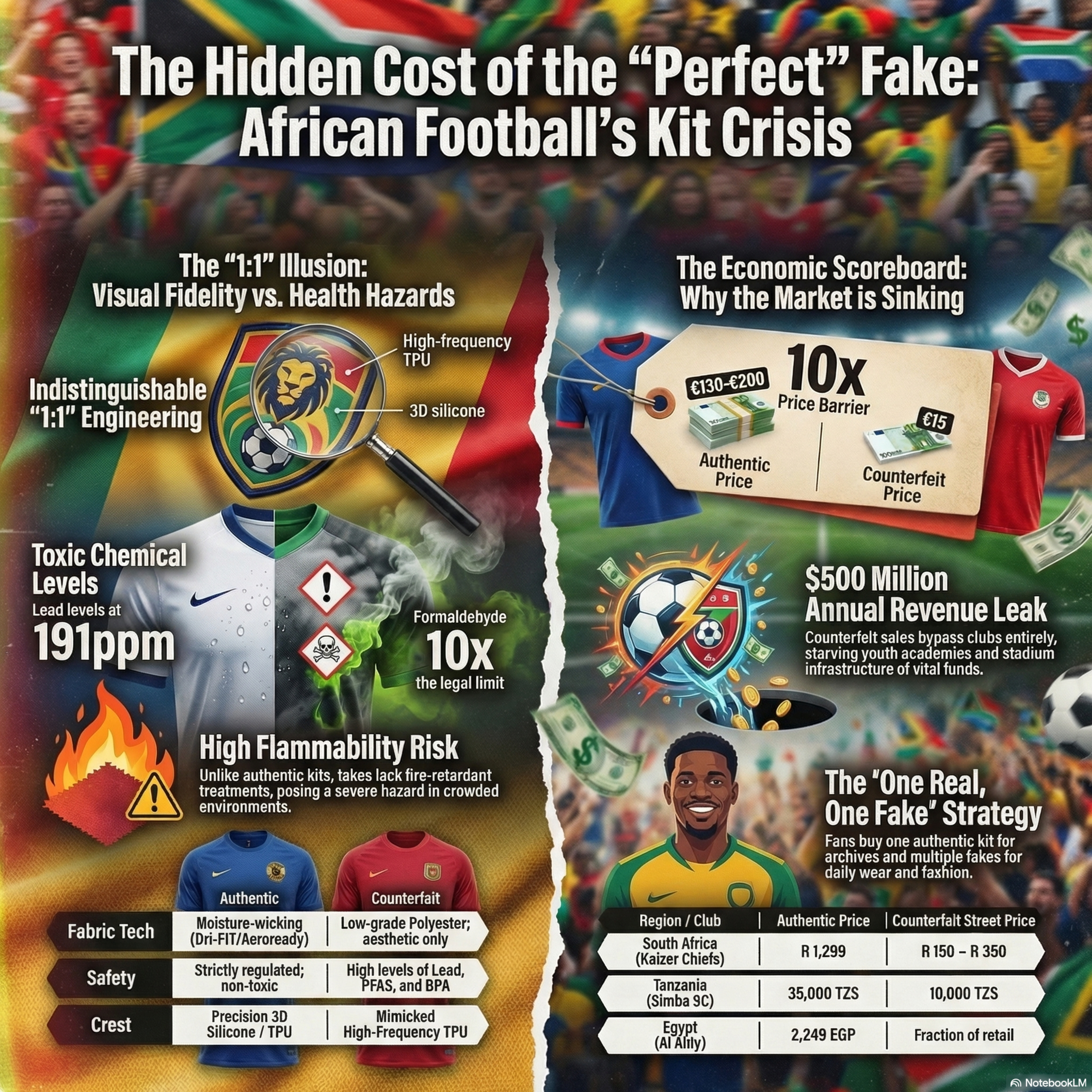
OK, those sound like heavy industrial chemicals. What does that actually mean for the person wearing the shirt? It means they are wearing a hazardous material. In some specific instances, these counterfeit products were found to contain lead levels reaching 191 parts per million alongside formaldehyde concentrations, nearly 10 times the legal regulatory limit allowed in apparel. Hold on lead and formaldehyde. Just think about the reality of how these shirts are used. You are putting a synthetic shirt on your body to go play a highly physical, exhaustive game of 5A side football.
You are sweating heavily in the high temperature climates typical of the African continent. Your pores are wide open and you're wearing a garment loaded with formaldehyde and 191 parts per million of lead. Are there no border checks catching this? The sheer volume of the shipments overwhelms customs officials. The health impacts of this are very real and largely undocumented in these informal markets. We are looking at acute contact dermatitis, severe and unexplained skin rashes, and potentially chronic self poisoning through the dermal absorption of these heavy metals directly into the bloodstream via sweat.
And it gets worse because it's not just a chemical hazard, it's a physical one. Exactly unlike authentic jerseys, which are strictly mandated by consumer protection laws to undergo fire reportant chemical treatments, these counterfeit synthetic shirts are highly, highly flammable. Wow. This poses a massive fire hazard, which is particularly terrifying when you consider how often these shirts are worn as everyday clothing by children in crowded domestic environments or near open flames, commonly used for cooking or heating in many parts of the continent.
You brush up against a cooking stove and a shirt made of untreated synthetic polymers essentially melts directly onto the skin. It is a horrifying thought. So if we look at what this means for the African Gay African club, directors need to wake up and realize what they're actually up against. They are no longer competing against a guy selling cheap misspelled cotton knockoffs out of the trunk of his car. Not at all. They're competing against highly engineered, incredibly accurate, albeit highly toxic, technological marvels.
The counterfeiters have elevated forgery to an industrial science. Which naturally, raises an incredibly important question. Even with this incredible leap in aesthetic quality and considering the potential hidden dangers, why are so many millions of fans actively choosing the counterfeit route over the authentic year? And the answer to that lies in the staggering macroeconomic realities of modern fandom. It's what we call the Price Elasticity Chasm. Let's just break down the raw, staggering map of what it actually costs to be a dedicated football fan today.
Over the past decade, the retail cost of authentic football apparel has surged exponentially. Skyrocketed. You have global inflation, massive licensing fees demanded by the brands, aggressive retail markups at every step of the supply chain, and it all gets passed directly to the fan at the register. Right now if you want an authentic player version jersey, the exact same high tech cut and material the pros wear on the pitch from a top tier global team or a prominent African club, you are paying between 130 and €200.
That is an astronomical sum for a single piece of athletic wear. It really is. Even if you step down to the standard replica or fan version, which has a looser fit and slightly less advanced materials, you are still looking at a price tag between 75 and €100. But those highly accurate 1.1 counterfeit versions we've spent all this time talking about? You could buy those directly from street vendors or online illicit platforms for as little as 15 to 30 euros. That extreme price disparity creates highly elastic demand.
When the price difference is that massive, consumer loyalty to the concept of authenticity completely shatters, and this was fascinatingly highlighted during the beta testing of a mobile authentication app called Kit Legit. Oh I love this story. Explain what Kit legit was trying to do and what they accidentally discovered instead. Kill Legit was originally designed as a high tech tool to help users verify the legitimacy of their football shirts. The idea was that fans would use the app to scan tags and crests to make sure they weren't being scammed into buying a fake.
But during their user interviews and beta testing phases, the developers uncovered A profound psychological paradigm shift in the market. They realized that the vast majority of modern football fans simply do not care if a shirt is fake. They built an app to catch fakes and the fans basically said we already know it's fake and we don't. Care. Exactly. The intrinsic desire for absolute, verifiable authenticity has been completely overshadowed by extreme price sensitivity. If the fake looks 95% identical to the real thing but cost 80% less, the modern consumer views the fake as the rational economic choice people.
Just want to wear the badge. They want to show their allegiance. They do not care if the brand hologram on the bottom hem is officially licensed by a corporate boardroom thousands of miles away, which has led to this really interesting bifurcated consumer strategy that we call the one real, one fake rationale. It's a highly pragmatic approach to fandom. It really is. Basically, a dedicated fan will bite the bullet, save up their money, and buy exactly 1 highly expensive €150 authentic jersey. But here's the kicker.
They don't actually wear it. They keep it pristine. They hang it up in their closet, Maybe they frame it, or they preserve it in their personal collection as an archive piece. Then they go out and buy multiple cheap €15 counterfeit variants of that exact same shirt to actually live their life in. Because living life in a football shirt is inherently risky to the garment. Exactly. You wear the fakes to go play local football matches on dusty pitches where it might get ripped. You wear it to crowded, highly physical pub viewings where someone is almost guaranteed to spill a drink on you when a goal is scored.
It's a completely logical partitioning of your wardrobe. You support your team visually every single day without risking the absolute destruction of €150 investment. And this behavior is further amplified by a massive, widespread cultural fashion trend known as bloke core. I see this everywhere now. It's totally taken over social media. It has Bloke Core centers around integrating vintage and modern football jerseys into everyday St. wear. It completely strips the jersey of its purely athletic context.
You aren't wearing it just to play sports anymore and embeds it into daily lifestyle fashion. You wear it with jeans, with stylish sneakers to go get coffee, to go to a club. But if you want to actively participate in this trend, you need a wardrobe rotation. You can't wear the same shirt every day. You need to own multiple kits from different eras, different colors, different away variants. And doing that legally is basically impossible for a normal person. Purchasing 5 authentic kits at €100 each just to satisfy a seasonal fashion trend is financially ruinous for the average consumer.
So they are financially be forced into the counterfeit market just to participate in modern St. wear culture. And what is truly fascinating is how the consumer community has adapted to this reality. There is no institutional trust anymore, and nobody cares about the official authenticity tags, the QR codes, or the multimillion dollar brand marketing campaigns telling them to buy. Real trust is completely decentralized. It's entirely peer-to-peer now. Fans are using digital networks, massive subreddits, private Facebook groups, specialized Instagram and TikTok communities to Crowdsource their trust.
They act as critical clearing houses, reviewing and verifying the quality of specific counterfeit vendors. It has become a collaborative, almost gamified consumer experience in these online communities. The goal isn't to buy an authentic shirt. The goal is to collectively discover, review and share the links to the most highly engineered fake. Someone will post macro photos of the stitching on a counterfeit crust and the community will critique it. It's like a specialized detective agency. Exactly, they bypass the global sports brands entirely, relying instead on pure validation to find the vendor selling the absolute best 1.1 quality.
So. What does this all mean? If I'm the commercial director of an African club, what am I supposed to do with this information? How does this apply to me? It means you must realize that intense brand loyalty no longer guarantees A willingness to pay exclusionary prices. Your fans might love your club with all their heart, they might bleed your colors, but they will not bankrupt themselves to wear your official, holographically verified shirt. No they won't. Merchandising strategies have to adapt to the wardrobe rotation reality of the modern fan.
If you price them out of the official market, they have an incredibly organized, highly gamified shadow network waiting with open arms to give them exactly what they want. They will just route around you and to truly understand how devastating this dynamic is on the ground, we need to map the regional battlegrounds across the continent. Because while global European clubs dominate the massive international sales volumes, the domestic market for African premier clubs is a unique, highly specific micro economy.
Very specific. It's characterized by immense hyper localized fan passion that intersects with profound systemic inefficiencies, and this chronic failure to establish accessible retail networks has resulted in the near total capitulation of local markets. Let's start at Ground Zero. Let's look at South Africa, right in the heart of the Johannesburg central business district. The South African Premier Division is arguably one of the most commercially developed leagues on the entire continent. You have massive historic heritage clubs like Kaiser Chiefs and Orlando Pirates.
These institutions possess fanatical bases numbering in the millions. When there is a Soweto Derby, the entire country stops to watch. The demand for their club iconography is absolutely off the charts. But the dichotomy of this market, the split screen between the formal retail sector and the informal St. economy is starkly visible during their kit launch cycles. Take the Kaiser Chiefs highly anticipated launch for their 20252026 season kits which were produced in partnership with CAPA. It was a massive media event.
The authentic home and away jerseys retailed at R1299 at official club stores and high end authorized sporting goods retailers. R1299 for context, for a massive portion of the working class supporter base that is a wildly prohibitive sum of money for a single T-shirt. And almost immediately the counterfeit underworld reacted. They fled the market. If you go down into the Johannesburg CBD, specifically into notorious high density retail corridors like Small St. you could suddenly find massive volumes of what locals affectionately call Fong Kong fake goods.
But these fakes weren't R1299. They range from R-150 to R350 depending on the tier of replication quality. And the speed of this illicit distribution network is what truly staggers law enforcement. These fakes arrive within days, sometimes even hours of the official kit launches. Wait. Hours. How is that even logistically possible? Because the counterfeit networks often have access to the designs before the official launch, thanks to leaks in the Asian manufacturing supply chain, they are manufacturing the fake simultaneously with the authentic marketing campaigns.
Unbelievable. This incredible speed completely overpowers any reactive measures by the authorities, local law enforcement, and the South African Revenue Service. SARS will occasionally execute massive, highly publicized multi million Rand busts. They raid the CBD, they seize massive shipping containers of illicit apparel, they burn the goods. But it ultimately doesn't matter. It's like trying to empty the ocean with a teacup. Exactly. The overwhelming demand for affordable expressions of team loyalty ensures that the informal vendors on Small St. remain the absolute primary point of access for the majority of the working class supporter base.
As soon as one shipment is seized, 3 more take its place. So South Africa is bleeding out commercially right in the middle of the CBD. Let's move our map N let's look at East Africa, specifically Tanzania. We have to talk about the Kariaku Hub. If you know anything about East African football, you know that the rivalry between Simba Sports Club and Young African Sports Club, Kamaleno and Isyanga dictates the entire commercial football landscape there. It dictates everything. These two clubs command massive, deeply passionate followings, and their respective red and green colors are ubiquitous across the city of Dar es Salaam.
But their ability to commercially exploit that massive fandom is being severely undermined by staggering volumes of imported counterfeits flowing straight through the highly porous port of Dar Aslam. And the epicenter of this trade is the Kariaku market, right? Yes, Kariaku is widely recognized as the largest informal trading hub in East Africa. It is a labyrinth of commerce and the price discrepancy here is absolutely devastating to the official clubs. An authentic Simba SC jersey retails for approximately 35,000 Tanzanian shillings.
OK, but deep within the crowded alleys of Karayaku, a highly convincing, beautifully replicated counterfeit costs just 10,000 TCS. Less than 1/3 of the price. If you are a fan trying to support your family, the math makes the decision for you. Exactly, And the economic bleeding from this is so severe that it frequently forces direct government intervention. It's not just a club problem anymore, it's a national trade issue. In recent years, the Tanzanian Minister for Industry and Trade has had to issue strict 7 day ultimatums to the Tanzania Bureau of Standards, the TBS demanding the impounded massive shipments of counterfeit Simba Yanga and national team jerseys.
Just imagine being a customs official at that port. You are staring at massive shipping containers filled with thousands of shirts and you're trying to figure out if they are the real deal or highly engineered fakes, all while the government is breathing down your neck. The government is locked in an ongoing struggle just trying to ascertain whether complex massive shipments are legitimate or counterfeit before they clear customs and vanish into carry a coup. It just highlights the incredibly sophisticated nature of modern forgery and East African import logistics.
It is an absolute state of siege for official merchandise, and it is the exact same story up in North Africa, but with an added deeply fascinating psychological layer. Let's look at Egypt. The Egyptian Premier League. This is totally dominated by the massive Cairo giants Al Ali and Zemalek. This is the absolute pinnacle of North African football prestige. The Cairo Derby is one of the most intense fixtures in global football, but authentic merchandise for these clubs is subjected to incredibly steep pricing hierarchies.
An authentic Al Olli jersey can hit exorbitant prices upward of 2249 Egyptian pounds. Even the standard replicas range from 899 to 1579 EGP. And we absolutely must view this through the lens of the local macro economy. Egypt has been experiencing severe inflationary pressures, currency devaluation, and widespread economic hardship. Those official price points are entirely prohibitive for the vast majority of the populace, so to cope with this, the fans employ A psychological mechanism known in consumer behavior studies as neutralization.
OK, I find this concept so fascinating. Neutralization. Walk us through how this actually works for the average fan walking the streets of Cairo on match day. Essentially, academic studies on consumer behavior in Egypt show that susceptibility to social influence and strict value consciousness strongly Dr. The intention to purchase fake apparel. Imagine a fan whose entire social circle revolves around Al Ali. It is part of their core identity. They feel immense pressure to visibly support the team, but they cannot afford 2249 EGP, so the fan neutralizes any ethical guilt about buying a counterfeit.
They basically tell themselves it's not stealing, it's survival. Precisely the social validation derived from wearing that iconic club Crest, from visibly participating in the vibrant communal culture of the Cairo Derby, far outweighs any abstract ethical concerns regarding intellectual property infringement. Wow. The fan justifies it because they feel they must wear the colors to belong, and the club has priced them out of doing it legally. Therefore, the informal St. markets of Cairo remain perpetually saturated with illicit replicas, allowing the working class to actively participate in the culture without enduring financial hardship.
So if we look at the big picture across the continent, whether we're talking about small St. in the CBD of Johannesburg, the labyrinth of Kariyaku and Dar es Salaam, or the bustling St. markets of Cairo, exclusionary pricing creates the exact same result everywhere. A total capitulation of the local market to informal street vendors. You price out your fans and the shadow economy welcomes them in with open arms. But to truly understand the sheer scale of this shadow economy, we have to trace the logistics backwards.
We have to look at what academics call globalization from below and map the West African supply chain right. Because the massive networks funneling literally millions of counterfeit jerseys into sprawling commercial hubs like Blog and Market and the trade fair complex in Lagos do not originate locally. They're heavily rooted in the industrial zones of China. The Guangzhou Lagos Nexus This is a crucial point. We aren't talking about local artisans making knockoffs in a small workshop. This is a highly organized international trade route.
Correct, This is a massive logistical undertaking. Thousands of African traders routinely travel to Guangdong province in China, which is often referred to as the world's factory, specifically to procure massive bulk shipments of counterfeit apparel. They operate primarily out of commercial districts like Xiaobei and San Yuanli, which are so heavily populated by African merchants they are frequently referred to locally as Little Africa. So how do they actually move the money and the goods? Because surely international banks and customs agencies flag this stuff, right?
They avoid the formal systems entirely. These traders leverage vast informal networks. They use underground banking systems to move massive amounts of capital across borders without triggering financial oversight. They utilize highly specialized logistics and customs clearance operations that are specifically designed to bypass international intellectual property laws. They mislabel shipping manifests. They break bulk shipments down into smaller, less conspicuous parcels. The goods are then shipped via sea freight or air cargo directly to Nigerian ports where they are distributed with astonishing rapidity through chaotic, hyper competitive informal markets.
And this brings us to what I think is the most tragic, heartbreaking part of this entire deep dive. It's the total decimation of local industry because we used to have indigenous manufacturing. In the 1990s, Nigeria's local textile industry, centered around massive industrial hubs like ABBA, Kaduna and Kano, sustained hundreds of thousands of local jobs that made clothes for the continent. But that local capability has been completely bypassed and functionally destroyed by this pipeline. The stark inability to compete with the aggressively low prices of these fully integrated, massive Chinese supply chains has reduced the local Nigerian textile industry to a mere fraction of its former capacity.
It's an uneven playing field. When demand surges for a local or national team, Jersey indigenous entrepreneurs in historic hubs like ABBA find themselves entirely unequipped to meet it. Because they didn't know the tools anymore. Exactly. They lack the chemical inputs for modern synthetic fibers. They lack the advanced heat press machinery required for the 1.1 replica quality we discussed earlier. And critically, they lack the continuous, reliable electrical infrastructure necessary to rapidly mass produce affordable, high quality kits.
So the immense millions of dollars worth of capital generated by African football passion money that is spent by African fans in African markets flows straight out of the continent and directly into Asian manufacturing hubs. It's an economic tragedy, and if you want the ultimate case study of how this all collides the hype, the artificial scarcity, the cultural passion and the ruthless efficiency of the counterfeit network, we absolutely have to talk about the 2018 Nigeria World Cup kit. Oh, this is the perfect example.
The phenomenon of that specific jersey perfectly encapsulates everything we've discussed. Listener, do you remember this? The Nike neon green and white zigzag jersey naija? It was a cultural explosion. It completely transcended football and became an unprecedented global St. wear artifact. The Nigeria Football Federation reported up to 3,000,000 pre-orders globally 3 million. Incredible numbers when it. Officially released at a retail price of $90.00, it sold out on Nikes International e-commerce platforms.
Within 3 minutes. There were massive queues wrapping around the block outside Nike flagship stores in London with people camping out. Overnight. People were reselling it online for double, triple the price. Within hours, it was the hottest clothing item on the planet. And that combination massive, unprecedented global hype paired with artificial scarcity and a high retail price point, created the absolute perfect vacuum for the counterfeit market. The illicit supply chain didn't just exploit the demand, they mobilized with terrifying, almost unbelievable speed.
They really did. Illegal factories in China and Thailand immediately shifted their entire production lines to replicate that incredibly complex zigzag pattern. And they didn't wait for the official launch. A full week before the official Nike release, Nigerian fans and stadiums were already wearing highly accurate counterfeit versions during pre World Cup friendly matches. Think about that. Let that sink in. A week before they beat Nike to their own massive global launch party, I want to give you the granular details of what happened on the ground in Lagos.
LEGO's based counterfeit distributors operating in the sprawling Bull Logan market reported the demand for the 2018 fake kit surged by an estimated 1000% compared to previous tournaments. It was a gold rush. The counterfeit versions flooded the market stalls and they were beautifully strategically categorized into strict quality tears to maximize market penetration across every single income level. It was a master class in market segmentation. Exactly. If you just wanted to look for watch party, the lower grade fakes were sold for as little as $5 if you wanted the performance.
If you wanted the premium feel, you could buy the high tier tie grade replicas. These featured advanced moisture wicking synthetic fabrics and hyper accurate badge placements, and they retail between 20 and $40. And the cultural acceptance of these fakes was absolute. It was completely normalized across all strata of society. It wasn't something to hide. It was even immortalized in Nigerian popular culture. We had major musicians releasing viral tracks, singing lyrics, proudly defending the wearing of fake jerseys.
They were actively mocking the exclusionary $90.00 pricing of the authentic Nike product, basically saying we love our country, we wear the colors, but we aren't paying $90.00 for a shirt. The application for the African game is incredibly stark here. What global brands fail to realize is that. Which brings us to a critical sociological distinction. Because to fix this, African clothes must recognize that they are not dealing with a monolith. The African fan is not one single demographic. They actually have two distinctly different customer bases requiring 2 completely different retail strategies.
The domestic consumer living on the continent and the diaspora consumer living abroad. Let's look at the domestic fan 1st, through what sociologists call the utility lens. For the fan living in Lagos or Dar es Salaam or Cairo, buying a jersey isn't about solving an identity crisis. It is about functioning within a survivalist economy. Right? Exactly. Domestic fans navigating these informal markets are acutely restricted by incredibly low purchasing power parity. This is not a moral or ethical dilemma for them.
Between an authentic $90.00 jersey and a $15 fake, the authentic $90.00 jersey simply does not exist within their realm of economic possibility. It might as well cost $1,000,000, right? The counterfeit jersey is therefore embraced as a democratizing garment. It allows lower income populations to access global fashion trends and visibly participate in global sporting culture without facing financial ruin. And we have to look at the vendor reality to the real people selling these shirts on the street corners.
We have comprehensive economic reports from Nigeria indicating that nearly 44% of informal businesses generate less than 20,000 naira day in total revenue. That's gross revenue, not profit. It's tiny. Their median daily profits hover at a meager 10,000 to 20,000 naira. When you factor in sky high inflation, severe currency depreciation and surging transportation costs, selling cheap, high turnover counterfeit football jerseys is literally a matter of strict economic survival. For these families, the trade is deeply.
Deeply embedded into the socio economic fabric of the city. You can't just wish it away. Conversely, if we shift our focus across the ocean to the expansive African diaspora residing in places like the United States, the consumption of merchandise is driven almost exclusively by a powerful identity lens. In a transnational context, the football shirt transforms completely. It is no longer just a piece of affordable athletic utility. It becomes a highly potent sartorial signifier of heritage, of cultural pride, and of a nostalgic, tangible connection to the homeland.
You see this vividly during major continental fixtures when North and East African nations play each other in the Africa Cup of Nations. The diaspora mobilizes. We're talking about these incredible mini World Cups at massive watch parties in places like Houston, Atlanta, Minneapolis and Washington DC Beautiful events. You see a massive surge in demand for jerseys, flags, traditional foods. For first generation immigrants and younger generations born in the diaspora, wearing the jersey of an African club or national team is a psychological bridge.
It's a visible badge allowing them to reclaim a piece of their identity in a foreign demographic landscape. But here is the massive commercial tragedy logistical failures. Because prominent African clubs lack robust international ecommerce platforms and they lack global distribution licensing agreements, the American diaspora is frequently forced to utilize illicit or alternative supply chains to acquire this merchandise. They literally want to give the clubs their money but the plumbing just doesn't exist.
There's no website they can go to put in their credit card and get a shirt shipped to Atlanta. Precisely so they use digital workarounds. The diaspora frequently turns to Chinese e-commerce platforms, most notably DH Gate. DH Gate serves as this highly efficient direct to consumer digital pipeline linking the illicit manufacturing hubs of Guangzhou directly to Western buyers. And it's fascinating how organized they are about this. Fans use community forums on Reddit to extensively review specific DH gate sellers.
They're sharing links to specific vendors with names like FPTS, Port Z or G Jersey Store. They're doing deep dive reviews, dissecting the stitching quality, noting the tightness of the athletic cuts, comparing shipping times from China to the US. And the consensus within these communities is that they can secure 70% to 90% of the authentic quality at a fraction of the price, effectively bypassing both the high prices and the total lack of official availability from the clubs themselves. But the diaspora also engages heavily in physical, community based commerce.
Consumers actively seek out local African immigrant markets and specialty brick and mortar stores located in demographic hubs like New Jersey, Atlanta, and Houston. Purchasing from these locations serves a dual purpose. It allows the diaspora to acquire culturally significant apparel while simultaneously supporting local immigrant entrepreneurs, keeping the capital circulating within the transnational community ecosystem. So if I'm a club director, what's the big take away here? It's that you have to recognize these two entirely different faces of fandom.
You have domestic fans requiring affordable utility and you have diaspora fans requiring accessible identity. You need 2 entirely different retail strategies to serve them. You can't just have one high-priced shirt and expect it to work for both the fan of Legos and the fan in Houston. If they fail to do this, the destructive feedback loop on the African sports ecosystem will only accelerate. And the global cost of this is absolutely staggering. It is estimated that counterfeit football merchandise costs legitimate clubs, national federations and licensed manufacturers approximately $500 million annually in lost direct sales.
$500 million that's just evaporating from the game every single year, and locally on the continent, that toll is devastating. This isn't just about some corporate CEO losing a fraction of a percent on their profit margin. For African premier clubs, this is the loss of a strategic commercial lifeline. Think about what that money could do. It could change everything. That $500 million could fund vital world class youth academies across the continent. You could upgrade dilapidated stadium infrastructure, improving safety and the fan experience.
It could ensure the retention of top tier playing talent so these clubs don't have to constantly export their best players to Europe just to survive the season. It creates A perpetual vicious cycle of commercial underdevelopment. When a fan in Dar es Salaam or Lagos purchases a fake jersey from a street vendor that capital stipulates entirely within the informal underground economy, it completely bypasses the club whose badge is being worn. Because the clubs do not earn this merchandising revenue, they cannot afford to invest in formalized retail infrastructure, advanced brands, storytelling, or sophisticated anti counterfeiting measures.
This chronic lack of investment practically guarantees that the counterfeiters continue to hold an absolute monopoly, creating an inescapable feedback loop of financial stagnation. And it also highlights the complete futility of reactive policing. We see this all the time, these massive, highly publicized police raids by groups like the SAPS and SARS in South Africa. They raid the markets. They seize millions of rans worth of illicit apparel. They hold a press conference. But it doesn't work. Why?
Because seizing goods from low level St. vendors doesn't disrupt the primary Asian manufacturing hubs in Guangzhou or the bulk smuggling routes run by massive syndicates. It only impoverishes local micro entrepreneurs who are just trying to feed their families. It is treating a symptom with a sledgehammer while completely ignoring the underlying disease. Which brings us to the ultimate question. Yes, here's where it gets really interesting. We've mapped the disease. We've seen the billion dollar shadow economy.
We know how the fakes are made, how they are shipped, and why people buy them. So how do we fix this? What most African clubs actually do. Let's lay out that blueprint for reclaiming the African game. To reclaim their commercial sovereignty and harness the profound passion of their supporters, African sports organizations must enact A fundamental paradigm shift strategy. One is implementing formalized tiered pricing. Break that down. What does that actually look like? Clubs must recognize and respect the economic realities of their domestic supporters.
They cannot sell €130 shirt in a market where the median daily income is a fraction of that. They need to proactively produce official club verified replica merchandise that is specifically engineered for cost efficiency. It should be locally manufactured wherever possible to avoid import tariffs and priced appropriately for local affordability. You have to undercut the illicit market by offering a legitimate ethical alternative that actually competes with the price of high tier fakes. I love this.
Give the fan a real shirt for the price of a fake one and they will buy the real 1. It removes the need for neutralization. It seems so incredibly simple and strategy 2 flows right out of that. The structural integration of the informal economy. Exactly. Instead of engaging in futile, resource intensive attempts to eradicate street vendors through aggressive law enforcement raids, clubs should seek to partner with them. Identify trusted, informal market distributors. Transform these illicit sellers into official localized retail agents for your new lower tier authentic merchandise.
By doing this, clubs instantly acquire a massive preexisting hyper efficient distribution network. It's genius. You Co opt the network that is already beating you. You don't fight the street vendors, you make them your sales force. You give them a legitimate product with a solid margin and they will push it for you. And finally, Strategy 3, global e-commerce for the diaspora. African clubs must actively invest in international logistics and global licensing agreements. You have to establish official, reliable digital storefronts capable of shipping globally.
Capture that immense purchasing power and cultural yearning of the US and European diaspora. Eliminate their need to rely on illicit platforms like DH Gate to express their cultural identity. Build the formal plumbing so they can easily and legally give you their money. The ultimate take away here is inescapable. Until these systemic vulnerabilities are addressed, and until these innovative commercial strategies are adopted, the sophisticated networks of globalization from below will continue to siphon the immense commercial potential of African football.
They will continue to leave the club's structurally impoverished amidst a massive warring sea of their own stolen iconography. We have covered a massive amount of ground today, from the 140° heat presses operating in the shadows of Guangzhou, to the bustling hyper competitive alleys of Karaaku, to the massive diaspora watch parties in Atlanta. And I really want to thank you, the listener, for sitting in on this master class with us today. Because while the numbers we discussed can seem grim and the challenge is monumental, the energy here remains incredibly high.
This isn't a tragic story of inevitable defeat, it's a solvable puzzle. The passion of the African football fan is an unparalleled natural resource. It just needs the right commercial plumbing. The fans are ready, the money is clearly there. The clubs just need to step up, adapt and reclaim their game. If we connect this all to the bigger picture, it leaves us with a truly lingering, provocative question. We've spent this entire deep dive analyzing how an underground network of informal St. vendors and illicit manufacturers can efficiently distribute millions of complex garments across a massive continent in a matter of hours, entirely bypassing massive infrastructural and governmental hurdles.
What could the African continent achieve if it applied that exact same hyper efficient, decentralized logistical genius to formal industries like medicine, agriculture or tech infrastructure? Wow, now that is something to seriously chew on. Next time you're watching a match, take a look at the crowd, look a little closer at the sea of jerseys in the stadium, and think about the incredible, unseen global journey woven into every single thread. Thank you so much for joining us on this deep dive. Keep learning, keep questioning, and we will see you next time.
 Apple Podcasts
 Castbox
 Castro
 Goodpods
 Moon FM
 Overcast
 Pocket Casts
 Podbean
 Podcast Addict
 Podcast Republic
 Spotify