Why Culture Beats Capital In African Football
About this episode
Why Culture Beats Capital In African Football
I want you to imagine a massive like scrawling factory, and this factory produces literally the most valuable, highly sought after resource on the entire planet. We're talking 10s of billions of dollars in revenue here. Exactly. 10s of billions for the companies that take this resource and sell it around the globe. But now imagine that the town immediately surrounding this factory, the actual place where the resources being pulled from the earth, is just, well, almost entirely bankrupt. It's a completely broken dynamic.
Right. The workers are struggling, the infrastructure is crumbling to pieces, and all that immense wealth is just being boxed up and shipped overseas. Extracted. Extracted and that jarring contrast, you know it isn't some hypothetical thought experiment. That is the exact literal reality of African football today. It is. It's a profound structural imbalance. I mean, we are looking at a landscape that generates roughly $625,000,000 in economic value annually right now. Which sounds like a lot. It does sound like a lot, but the projection by 20-30, we're looking at an $80 billion investment opportunity.
Right, 80 billion with AB. With AB 80 billion. But the issue is that the current model, like you said, is almost purely extractive. The raw talent is born, it's bred and it's developed right there on the continent. But the immense financial value, the commercial rights, the broadcasting windfall. All the generational wealth, basically. Exactly all of that is realized in European markets. And that brings us to exactly why we are here today. I want you listening right now to imagine that we are standing in the back of a closed door master class.
The silent audience. Yes, you are part of the silent audience today. This is the room where the most closely guarded, like high level strategic intelligence about this multi billion dollar industry is finally being shared. And our mission here isn't just a passively listen. No, not at all. Our mission is to absorb this strategic intelligence so we can understand how to truly break in, operate and ultimately our African game. We have to figure out how to shift this from that extractive model we just talked about into a sustainable, you know, hyper valuable ecosystem, one that actually rewards the continent.
So to do that, I'm guessing we can't just rely on the standard global playbook. Right. Oh, absolutely not. If you bring the standard playbook, you fail. We have to embark on a really systematic journey today. OK, lay it out for us. Where do we start? So we are going to start by decoding the invisible language of the game, because operating blindly is literally what ruins most foreign investments. Makes sense. Then we'll break down the geographical reality. You know this massive distinct regional ecosystems.
Right? From there, we need to map out the mobile first operational reality on the background. Then we'll identify the massive blue ocean opportunities in sports, technology and the women's game. OK, love that. And finally, we have to actively dismantle those dangerous Western assumptions that just blind ambitious professionals and hold the entire game back. OK, let's unpack this, because if you've ever wondered why brilliant football minds, people with incredible resumes from top global clubs, just arrive on the continent and completely fail?
While others with seemingly way fewer credentials just absolutely thrive. Exactly. We need to start at the front door. We need to talk about the baseline entry ticket to this whole world. Right. And that entry ticket fundamentally is cultural fluency. And I want to be really, really clear about the stakes here. Entering the African football space without cultural fluency is not just like a minor faux pas. It's not just a slap on the wrist. No, it is an asymmetric risk. If you walk into a boardroom in Lagos or a club office in Cairo and you reveal this profound lack of cultural literacy, you do not just lose that specific deal.
What happens? You permanently damage your reputation across the entire continent. Hang on, across the entire continent? That sounds like a bit of an exaggeration, doesn't it? I mean, if I mess up a pitch in Nairobi, why would someone in Johannesburg even care? I know it sounds wild, but it's true because the formal structures might be fragmented. Sure, but the informal network, it is incredibly tight. Oh, interesting. And it operates at lightning speed. In this ecosystem, news travels at the speed of a WhatsApp voice note.
Wow. Yeah, a bad first impression, maybe a display of arrogance or just a failure to respect local customs in Kenya that will precede you to South Africa, to Nigeria and even to the diaspora communities in London. Long before your return flight even lands. Exactly. You are dealing with a highly connected web of stakeholders who are just constantly communicating outside of official channels. So what does this fluency actually look like in practice? Because I imagine it's a lot more than just, you know, learning how to say hello in a local dialect.
Oh, it is vastly more complex than that. Fluency means mastering 4 very specific, distinct dialects. OK, let's go through them. What's the first one? The first is tactical. Meaning like what happens on the actual pitch? Yes, but strictly contextualized to the environment. OK, give me an example. So for example, if you are an analyst advising a club in the CF Champions League right, you need to know why setting up a low defensive block might be tactical suicide against a team like Al Ali. Wait, really?
Why? Because it isn't just about the geometry of the pitch, it's about understanding the immense psychological pressure of playing in front of 70,000 screaming fans in Cairo, right? And you have to know how North African teams manipulate match tempo to exploit passive defending. OK, so tactical fluency is dialect one. What is the second dialect? The commercial dialect. You have to really understand the nuanced difference between sponsorships and naming rights in these specific markets. How does that differ from, say, Europe?
Well, a European consultant might push a club to accept this heavily incentivized performance based sponsorship deal because, well, that's standard practice in the Premier League. Sure, Hit your targets, get paid. Exactly. But in an African domestic league where broadcast revenues are incredibly uncertain and gate receipts just constantly fluctuate, clubs desperately prioritize guaranteed upfront liquidity. Oh, I see. If you pitch performance clauses, you are speaking the entirely wrong commercial language.
That makes total sense. It's like you're offering them a stock option when they literally just need cash to keep the lights on today. Precisely. Which brings us to the third dialect, which is emotional. Emotional fluency meaning what? Empathy. Essentially, it's the ability to read a dressing room or a fan base. You have to be able to recognize the difference between a supporter base that is genuinely furious and actively planning a protest. Versus a fan base that is just what venting. Yeah, a fan base that's simply performing anger for social media clout and banter.
If you misread that, you might advise a club president to fire a manager totally unnecessarily. Wow, and I'm guessing the 4th dialect is the one that get people into the absolute most trouble. Without a doubt, it is the political dialect. OK, the politics. You have to be able to decode federation power structures. You really need to understand the subtext. So reading between. Exactly. When a federation president makes this highly public, impassioned statement about fully supporting a national team coach, the political dialect often tells you that this means the exact opposite.
So it means the coach is getting fired. Very often, yes. It signals that the board has already decided to sack the coach and they are just carefully managing the public optics before they drop the hammer man. So if fluency is the foundation, what actually protects you long term? Because honestly, it sounds exhausting to just constantly decode everything all the time. It is exhausting, but fluency just gets you in the door. Authenticity is your ultimate competitive Moat. Authenticity. Yes, authenticity cannot be bought with venture capital, and it definitely cannot be fast tracked with some intensive weekend seminar.
Right. Spending two years deeply engaged in one specific market, truly embedding yourself will be a surface level generic engagement across 10 different African markets every single time. You know this sounds a lot like that concept from sociology peer Bordeaux's idea of habitus, right? Exactly. And what's really fascinating here is how perfectly Bordeaux's framework applies directly to football. Unpack that a bit for the listener. So habitus refers to the deeply ingrained tastes, dispositions, and perceptual frameworks that an individual acquires through prolonged, sustained exposure to a specific to fix social environment.
Basically the unwritten rules of how to exist in a space. Exactly, the vibe, the rhythm and you cannot fake the habitus of the African game. Let's translate that out of sociology jargon for a second. Yeah, What does faking the habitus actually look like on the ground? Give me a scenario. OK, imagine a foreign sports marketing executive flying into Accra, right? I'm picturing it. They've read like a few Wikipedia articles. Maybe they watched a 30 minute documentary on Ghanaian football on the flight over.
So they think they're an expert. Right. They walk into a meeting with a local Academy director wearing a traditional Kente cloth scarf over their expensive Italian suit. Yeah, and they immediately start using local slang that they literally learned on the Internet that morning, trying to act like they are one of the boys. Yikes, how does that go over? Horribly, the Academy director will spot the performance in three seconds. Because it's performative, right? The executive lacks the habitus. They lack the natural rhythm of conversation, the genuine understanding of the local struggle, the authentic cadence of respect.
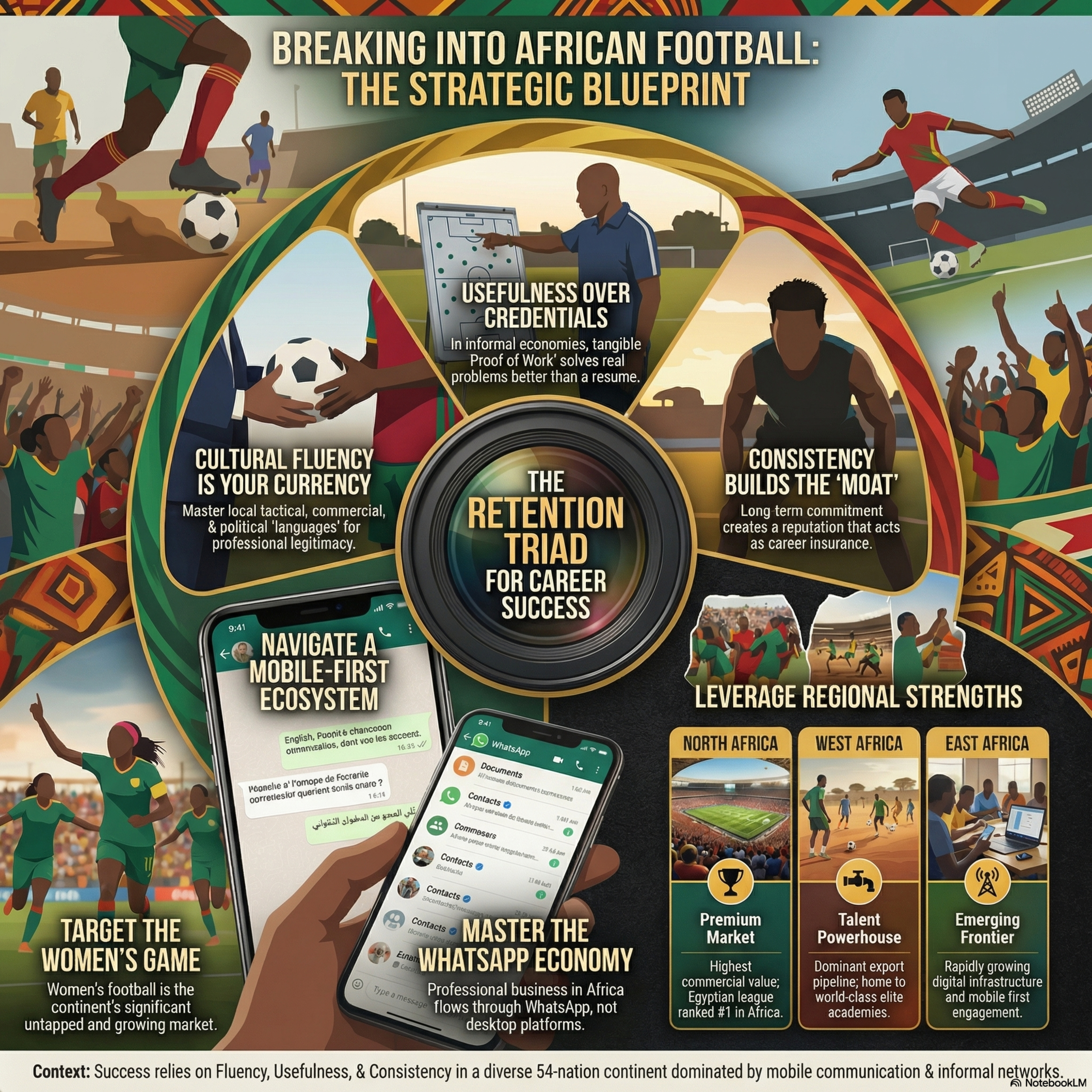
The performance actually creates deep distrust. It's like trying to order a highly customized, super complex coffee in a foreign country where you literally don't speak a language. Like, the ingredients might be perfect, the breeze might be world class, but because you can't articulate the order authentically, you're just never going to get the drink. That is a perfect way to look at it, and this leads to what we call the retention triad. The retention triad. What's that? If you want a sustainable career in this space, you need 3 specific things, fluency, usefulness and consistency.
Fluency, Usefulness, consistency. Right connections and capital might open a door for you, but this triad keeps you in the room. You must speak the language fluently. You must actually solve a tangible problem to prove your usefulness. And the consistency part. You have to outlast the markets inherent instability. You have to prove you aren't just going to pack up and leave when things get tough. But wait, let me play devil's advocate here for a second. Go for it. Say I walk in with the UEFA Pro License, right?
Or I've got a master's degree in sports analytics from the top European university and I have this brilliant mathematically sound data model. OK. Doesn't that carry immense weight like it? Does it really matter if I don't know the local politics or the habitus if my math is absolutely flawless? Yes, it matters completely. The math is math. Because you're flawless data model requires human beings to actually implement it. If the head coach feels threatened by your shiny degree, or if the club's sporting director just doesn't trust your motives because you haven't put in the time to build a relational bond, your data model will sit in a drawer gathering dust.
It just gets ignored. Completely. In an environment built on informal trust networks, technical usefulness without cultural fluency is completely sterile. The ecosystem will simply expel you. OK. So fluency is the absolute baseline. You have to have it right. But once you realize that, you immediately face this monumental challenge because African football does not have just one language. Not even close. It has thousands. You can't just go out and learn African football as a monolith, you have to learn the specific geographical reality on the continent.
And this is what we call the diversity paradox. The diversity paradox. Yeah, treating Africa as a single monolithic football market is just analytically incoherent. It is a fatal strategic error. Because it's massive. It's 54 distinct nations, over 2000 languages, and wildly, wildly varied economic architectures. So we have to move away from these abstract rules and actually look at the map. Let's break down the continent's distinct regional ecosystem. Let's do it. Because you have Nigeria with the GDP exceeding $470 billion, right?
And then you have tiny island nations with economies smaller than the annual revenue of like a mid table European club. Exactly. So we can divide this into 5 zones starting with North Africa. North Africa, this is the premium market. We are looking at Egypt, Morocco, Algeria, Tunisia and Libya. And what defines the premium market? This zone is highly commercialized and deeply, deeply resourced. To understand the scale, just look at Egypt's Nile Premier League. OK, what do the numbers look like there?
By market metrics, it is the number one ranked league in Africa. It's valued at nearly €184 million. That's huge. A club like Al Ali, they aren't just a football team, they are a massive institution. They operate on an approved budget of nearly 8.5 billion Egyptian pounds. That's Gale is just staggering. Yeah. But I imagine with that kind of money comes incredibly intense cultural dynamics. Oh, absolutely. The complexity in North Africa isn't just financial right, It's cultural and it's heavily political.
Give us an example. Take Morocco for instance. You simply cannot operate there without understanding the power of the ultras. The fan groups. Right groups like the Ultras winners for Wydad Casablanca and the Ultras Green Boys for Raja Casablanca. I've actually seen videos of the Casablanca Derby. The choreography, the flares, the sheer volume in that stadium. It's unbelievable. It's a spectacle, but how does that actually impact the business side? That's the question. Right. How does it? Because these groups hold immense cultural leverage and, crucially, they operate completely autonomously from the formal club structures.
So they don't answer to the board. Not at all. So if you are a foreign executive and you're trying to implement a new ticketing strategy or maybe a new commercial partnership, you have to realize that the ultras might hold equal or even superior leverage to the actual board of directors. Wow, so if they don't like it. If the ultras boycott your initiative, it fails. Period. Your political and emotional dialects have to be perfectly tuned to navigate that specific dynamic. OK, so North Africa is the heavily commercialized premium zone, but if you want raw, unadulterated talent, you don't stay in the North?
No, you move down to West Africa. West Africa, let's talk about. It West Africa is the talent powerhouse. We're talking Nigeria, Ghana, Senegal, Ivory Coast. This is the absolute bedrock of global talent exportation. This is where all the famous academies are, right? Exactly. It's where you find elite, highly structured academies like Right to Dream in Ghana, Generation Foot in Senegal and ACC Mimosas and Ivory Coast. But the fluency required here has to be totally different from Cairo or Casablanca.
Completely different. If you are operating at the grassroots level in West Africa, you have to know the local vernacular. Like what? Well, in Nigeria, Pigeon English really dominates the grassroots football scene. So a foreign scout or a coach needs to know that when players call someone an O2, they mean a lazy or an unskilled player. O2. Or they need to know that a filet is this light, unpredictable rubber ball that's often used in street games. And why does knowing about a rubber ball matter? Because playing with a filet heavily influences how these players developed their first touch, you have to understand the environment that built the technique.
In Ghana, the language is this deeply localized blend of English and Twai. O What happens if a big European brand just ignores all of that? Say Auk Agency designs a slick high end marketing campaign for a new boot release and just pastes on the billboards in Legos or Aqua. It will be rejected immediately or honestly worse, it will just be completely ignored. This background noise. Yeah, a sterile UK centric campaign lacks the localized rhythm, it lacks the humor, and it misses all the specific cultural touch points of West Africa.
The audience will just see it as foreign noise. OK, so North Africa is the money, West Africa is the talent. What about East Africa? East Africa is the emerging frontier. We are looking at Kenya, Uganda and Tanzania. And what's driving the growth there? What is driving rapid, unprecedented growth here is the intersection of football and digital ecosystems, specifically the massive proliferation of mobile money networks. Like Safari Comms M pesa. Exactly like M pesa. So it's less about traditional football infrastructure and more about tech integration.
Right. If we connect this to the bigger picture, East Africa is basically leapfrogging traditional development stages. Furthermore, this region is preparing to Co host the 2027 Africa Cup of Nations. Oh that's right. And that is forcing a massive acceleration in stadium and broadcast infrastructure. And culturally, Swahili acts as this great unifier across these borders, which makes it way easier to scale regional initiatives. You know, I was reading that in East Africa, a huge focus right now isn't even on the pitch itself, it's actually on monetizing match fixture data for betting firms.
It is. It's a totally different commercial frontier compared to the Academy model in West Africa. Which brings us to Southern Africa, the established market. Yes, South Africa in particular possesses highly developed physical infrastructure. Mostly leftover from the World Cup. Exactly. The stadiums leftover from the 2010 World Cup are world class. You have massive corporate backing there which allows clubs like Mamelodi Sundowns to spend €3.2 million on a single player like Arthur Sayles. But here is where it gets really, really interesting to me.
Despite all that European style infrastructure, Southern Africa has this deeply unique cultural fingerprint on the actual pitch. Oh, you're talking about Casi Flava? Yes, we have to talk about Casi Flava. Casi Flava is this street born, highly expressive style of football native to South Africa. It features these flamboyant tricks, showboating and the famous Disky Nance. Let me stop you there because this feels like a massive friction point for outsiders. It really is. Because if I'm a cold calculated European data analyst right, and I'm looking at a South African player doing a stationary step over for like 5 solid seconds while the opposing team completely regroups, my spreadsheet is flashing red.
Right, it's telling you it's a mistake. It says this is a massive inefficiency. It doesn't progress the ball, it doesn't create an expected goal. But the stadium, the stadium is going absolutely wild. The fans are cheering louder for the trick than they would for a simple, efficient pass. And that right there is exactly where the European framework fails entirely. Explain that if you view Kasi flava purely as a mathematical inefficiency, you completely misread the market. This style of play is a vital expression of cultural pride, creativity and psychological resilience.
Because of where it came from. Right. It was born in the townships during the brutal repression of apartheid. It is deeply emotional. So how do we balance that? How do you use coal hard data to improve A-Team without stripping the soul and the cultural expression out of the game just for the sake of European efficiency metrics? You do it by understanding what the fans are actually paying for. In Europe, fans pay primarily for the utility of winning. In South Africa, the entertainment value, the cultural resonance of that individual players expression holds nearly equal weight to the final score line.
So a data analyst must adjust their model. They have to measure not just ball progression, but crowd engagement and the commercial marketability that is generated by those specific moments of flair. That is a brilliant insight and it brings up a much larger issue about how African leagues are structured financially, doesn't it? It really does. This raises an important question about economic architecture. If you look at global football, it's broadly split into two distinct financial models. Let's lay them out.
You have the closed American model. Think of the NFL or MLS. That system is designed purely for profit and asset appreciation. Right. No relegation. Exactly. There's no relegation, Revenues are shared equally and costs are strictly controlled. The primary goal is financial stability for the owners. And then you have the complete opposite, the European Open League model. Correct. The European model is driven by promotion, relegation and win maximization. Teams spend every single dollar they have, and very often dollars they don't even have to avoid relegation or to qualify for the Champions League.
Which just leads to massive revenue concentration at the very top. Yes. So where do African leagues fit into this? That's the big question. Here is the structural tragedy. African domestic leagues desperately aspire to the European open market model. They want the drama of promotion and relegation. Naturally, it's exciting. But they completely lack the massive centralized broadcast revenues that actually sustain the European system. Let's walk through what that actually looks like on the ground.
Imagine I'm an ambitious business owner in Lagos or Nairobi, right? And I buy a second division club. OK. And I really want to get promoted to the Premier League. Well, in the European model, if you get promoted to the Premier League, you receive a massive broadcast payout. We're talking hundreds of millions of dollars that retroactively justifies all the money you spent to get there. Right, it pays for the gamble. But in the African model, yeah, you spend heavily to win promotion, and when you finally arrive in the pop flight, the TV rights payout might only be 20 or $30,000.
You're kidding. No, it literally doesn't even cover your travel costs for three away matches. So I've bought into a system that forces me to spend like a European club just to survive, but it pays me like an amateur club. Exactly. This causes perpetual financial distress for aspirational clubs attempting to breach the elite stratum. The open model simply does not work without the massive broadcast revenue to lubricate the system. Man, which perfectly transitions us to the final region, Central Africa, the underserved market.
Central Africa represents the ultimate paradox. You have regions like the Democratic Republic of Congo with incredibly high talent ceilings. I mean, we all know the historic dominance of a club like TP Mazembe. Right. But outside of those isolated giant clubs, there is very, very low infrastructure. So if I'm a professional trying to make an impact in Central Africa, what's my play? Because it sounds like purely focusing on football tactics isn't going to cut. It it absolutely won't. To succeed in Central Africa, you need a hybrid skill set.
You cannot just be a football coach or a scout. What else you need to be? You need to combine deep football knowledge with actual development sector experience. You have to know how to operate in resource constrained, sometimes very fragile environments. So you're basically doing NGO level logistics combined with elite talent identification. Exactly. It's a completely unique challenge. OK. So we've mapped out the five zones, Northwest E, South Central. We know exactly where to go based on what we want to achieve, right?
But understanding the geography is only half the battle. To actually get hired to drive change and to build a career in any of these five zones, you have to understand how the daily business is conducted. How the machine actually works right? And everything I'm gathering tells me that we basically have to take the traditional Western career playbook and throw it directly into the fire. You have to burn it entirely burn it. Let's talk about that. In the West we are taught that a career model is a ladder.
You join a formal institution at the bottom, maybe as a junior analyst at a club Academy, and you slowly climb up the rungs to the first team. The structure is just there to support you. If you slip, the ladder is still there. Exactly. But the African model isn't a ladder. No, the African model is a web. It is built across informal economies. If you don't join an institution, you build a network. You know, it makes me think of like a mycelium network under a forest floor. Oh, that's a great way to put it.
Because in Europe you climb the tree. Yeah, in Africa you start as a single node in the dirt. Maybe you just help one specific coach on WhatsApp and you spread horizontally. You connect a scout in Senegal to an Academy director in Ghana. Right. And if one connection dies, the web still survives. You are the infrastructure. That analogy perfectly captures the reality, and in this web, your formal credentials matter significantly less than your proof of work. Proof of work like in crypto? Sort of, but applied to your career.
In the West, a degree from Oxford or a FIFA diploma serves as a proxy for trust. People see the badge and assume competence, sure, but in an informal economy without a centralized credentialing system, tangible output is the only currency that actually matters. So a polished portfolio website or a perfectly formatted resume is just useless. Mostly useless, Yeah. Compare APDF resume to a specific actionable match analysis that you text to a Kenyan Premier League coach on a Friday night. An analysis he can actually use to win his game on Saturday.
Exactly. The latter creates immediate, undeniable value. That is your proof of work. Wait, so sitting around waiting for a job posting on LinkedIn or checking the federation's career page, that's basically professional suicide here? Absolutely. The formal job market, the jobs that actually get posted online, represents a tiny, almost microscopic fraction of total professional activity at African football. It's like waiting for a formal gold embossed invitation to a massive St. party. You are never going to get a card in the mail.
You just have to show up, bring the music yourself and start playing. You must adopt A push strategy. Your career development should be 80 ercent initiative, driven outreach, creating content, solving problems for people unprompted, and maybe 20 ercent formal applications. And we have to talk about how this work is actually distributed, because it is definitely not happening over e-mail threads. Oh no. The communications infrastructure in African football is strictly mobile first. This is a foundational operational reality.
Give me a metric on that. Roughly 91% of all digital sports streaming in Africa happens on mobile phones. 91% yes. So if I'm a European consultant and I send a desktop formatted multi column sixty page PDF report to a club president in West Africa. You are structurally disadvantaged from the start. The president will open it on their phone, the text will be tiny, the formatting will completely break, and they will close it in three seconds. You've completely failed to adapt to the medium. In African football, WhatsApp is the boardroom, That is where the actual business of the game is conducted.
Everything happens there. Everything Club managers coordinate tactics with players, transfer negotiations with agents are finalized, scouting videos are exchanged, all within WhatsApp groups. And voice notes. I hear voice notes are practically a professional currency over there. They are completely essential. Vars notes convey tone, emotion, and nuance in a way text just cannot, which is critical in a deeply relational culture, right? If you aren't fluent in the etiquette of WhatsApp group culture and the strategic use of voice notes, you are just invisible in this ecosystem.
And this mobile first reality isn't just about business communication, right? It's completely transforming how the fans actually consume the game. It is. Let's talk about the viewing center economy. This is a really fascinating adaptation. Because of high mobile data costs and historical broadband deficits in many regions, individual streaming at home is often prohibitively expensive. Makes sense. So what do fans do? They gather in commercialized communal spaces to watch satellite broadcasts together.
Right, these are physical spaces, essentially massive outdoor or semi indoor bars packed with hundreds of fans all watching a single screen. Exactly. These physical viewing centers are the true nucleus of fan engagement and sports betting in places like Nigeria and Kenya. And they are evolving, right? Yes, and what is incredible is that these physical spaces are now being digitized. The communities formed in these viewing centers are migrating into massive WhatsApp groups. So the viewing center goes digital.
Right. These groups become digital viewing centers where fans coordinate real time banter, they debate tactics, and they pool money for sports betting. It is entirely active. It's the participatory Co creation of the fan experience. Exactly. And Speaking of participation, let's look at the analytic side of things. Yeah, you brought up this concept of the participatory knowledge premium. Yes. What does that actually mean for an ambitious analyst who is listening to this right now? Think about the Western markets if you want to analyze the English Premier League, there is an ocean of publicly available data.
Opta stats bomb Y scout. Everything is tracked. Every pass, tackle and Sprint is tracked and available to thousands of analysts. You are mostly just rearranging existing data, but. In Africa. In a market like the Ugandan Super League, that deep, granular data simply does not exist on the open market. So what's the move? Therefore, an analyst who physically attends matches, builds relationships with local coaches, sets up their own camera, and manually tags the events to create proprietary data. They gain a massive asymmetric advantage.
So in plain English, because nobody is gathering data, the guy who physically shows up with a notepad and a stopwatch essentially becomes a monopoly? Yes, he owns the data. He is creating knowledge that doesn't exist, rather than just consuming what already does. Exactly. The premium on your work is infinitely higher because of the total scarcity of the information. OK, so let's summarize where we are. We are operating via WhatsApp. We are building horizontal mycelium webs instead of vertical ladders, and we are creating proprietary monopoly data.
That's the operational reality. But to seal these relationships, to build the deep, unshakable trust needed to actually survive in an informal economy or contracts might not hold up in court, we have to look past the pitch entirely. We do. We have to look into the deep anthropological roots of the community. This is where cultural fluency becomes a lived experience. It extends far beyond language into deeply ingrained social practices. OK, give me an example. One of the most vital non negotiable practices is food.
You cannot ignore match day gastronomy. Wait, are you telling me that eating a specific type of street food could genuinely make or break a multi million sports consulting deal? Without question, because food is never just food. Break that down for me. Let's look at the variations. If you are in North Africa, you have the spenge doughnuts and Makuta potato fritters with mint tea outside the stadiums. OK, in West Africa it's Suya, the incredibly spicy peanut spiced grilled meat and kale way. The fried plantains moved to East Africa and it's roasted maize and Namachoma, the roasted goat meat.
And in South Africa? In South Africa, you have these Shisenyama communal barbecues. So if I'm a European executive, right, and I fly in for a big meeting, but I insist on only eating the club sandwich at my five star Western hotel, and I politely declined to sue you outside the stadium, Yeah, what actually happens? You send a blaring cultural signal of detachment and superiority. Just by saying no to the food. Yes, in informal economies without massive enforceable legal protections, trust is your only currency.
A shared meal is a mutual accountability mechanism. It says I am part of this community. Exactly. It says I consume what you consume. We are in this together. When you reject the food, you reject the community. Wow. The stakeholders will smile, they will shake your hand, and they will never, ever do business with you. That is mind blowing. A potato fritter is literally a high stakes trust exercise. It really is. And I imagine this ties directly into how these cultures perceive time as well. It does.
We have to understand the clash between Western linear time and African relational time. Unpack that for me, because time is just time, isn't it? Not at all. Western time is efficiency driven. It is totally commodified. Time is money, right? You set a meeting for 2.0 PM, you arrive at 1.55 PM, you do 5 minutes of small talk and by 2.0 PM sharp you are running through a PowerPoint agenda. Right. That's standard corporate practice globally. But African relational time prioritizes harmony, relationship building and holistic engagement over strict clock efficiency.
So how does that play out in a meeting? If you rush to the agenda in a meeting in East Africa without spending the necessary time inquiring about the person's family, their health and building a relational bridge, it is considered deeply disrespectful. Because you're treating them like a transaction. Exactly. You are treating a human being as a transaction. That lack of respect will completely undermine the relationship before you even pitch your brilliant idea. This level of cultural intelligence, it's also how you survive the absolute minefield of football politics, isn't it?
Yes, navigating the formal federations versus the informal networks. Political intelligence is simply a matter of professional survival. To understand this, we need to look at a recent highly significant event, the AFCON 2025 controversy involving the three nil forfeit awarded to Morocco over Senegal. And I want to jump in right here just to be incredibly clear to you, the listener. Yes, very important. We are looking at this situation with total neutral impartiality. We are absolutely not taking sides here, not siding with the Moroccan federation, not the Senegalese federation, and not CAF.
Our goal is strictly to analyze the structural fallout of the event. Exactly what is critical to observe here, purely from a strategic standpoint, is the institutional ripple effect of that single event, right. What happened after? The controversy didn't just end with a match result. It led to a formal appeal to the Court of Arbitration for Sport. Wow. It contributed to the massive pressure that ultimately resulted in the resignation of C Half's general secretary, and it triggered a huge wave of institutional reform regarding judicial authority within the Confederation.
So what is the take away for our silent audience listening to this? The take away is that political volatility is the norm, not the exception. The ground beneath you can shift overnight based on decisions in rooms you don't have access to. Therefore, relying solely on formal structures is incredibly dangerous. Because the formal org chart doesn't always reflect who actually holds the power. Let's connect this to the bigger picture. Sure, a mid level official who doesn't have a flashy title, but who possesses deep, generational, informal community ties and can actually get things done.
They are more valuable. They are infinitely more valuable to your network than a politically appointed, completely disengaged Federation president who might just be ousted in six months anyway. You have to map both the formal organizational chart and the hidden informal power web. Exactly. And I imagine this extends to to religious and traditional observances as well. Crucially, failure to respect religious observances guarantees professional failure. Give me a scenario. If you try to schedule a high intensity business dinner during the fasting hours of Ramadan in North Africa, or if you ignore traditional ancestral ceremonies that impact a player's availability in Southern Africa, you prove that you lack the basic competency to operate in the region.
OK, let's pivot. Once you have secured that trust, once you've navigated the food, the time, the politics, and you've mapped the power. Then you can move. Exactly where do you actually apply this strategic knowledge? Where is the greatest return on investment? We need to look at the blue oceans. The first blue ocean, and arguably the single greatest untapped market on the continent right now, is the women's game. The women's game, the indicators of explosive growth there are just undeniable. Absolutely undeniable.
Let's look at the talent first. Nigeria's Super Falcons have won ten Women's Africa Cup of Nations title 10. It's an incredible dynasty. You have players like Asisa Oshawala who aren't just local heroes, they are massive global icons playing at the absolute pinnacle of European football. And the commercial momentum is also shifting alongside the talent. We recently saw a 45% increase in prize money for the Wafcon tournament. That's a massive jump. And globally, FIFA has publicly set a huge target.
They want 60 million female players globally by 2027. 60 million. Yes, and a massive chunk of that demographic growth must come from Africa. It's mathematically impossible otherwise. But despite all that momentum, the institutional neglect is still staggering. Isn't. It it is deeply frustrating. There was a shocking reality regarding the Paris 2024 Olympic qualifiers. Out of the 54 CAF member associations, 29 of them did not even register a team to compete. More than half the continent just opted out.
That statistic is just it's the definition of a market gap. It represents A staggering void between the raw talent potential on the ground and the institutional support at the Federation level. Exactly. So why is this a blue ocean rather than just a lost cause? Because it is an inflection point for ambitious professionals, consultants and investors looking to build something from the ground up, the women's game offers an opportunity with very low barriers to entry. And huge upside. Massive exponential potential for impact.
It isn't completely saturated like the men's game. It is a market in early stage transformation. If you get in now and you apply the cultural fluency we just discussed, you can literally shake the future of the sport. That is incredibly compelling. The second massive blue ocean we really need to explore is sports technology. Yes. Afrotech. Let's look at the macro numbers here. The global sports analytics market is projected to just explode over the next decade. Right now, it's roughly a $7 billion market.
Huge numbers. But Africa currently accounts for only 8% of that total, roughly $560 million. That 92% gap represents an astonishing commercial opportunity. The demand for data, video analysis and club management software is surging, but the supply is entirely mismatched. OK but why not just buy an off the shelf solution from Europe? Like if I'm a wealthy African club, why wouldn't I just call it the biggest analytics firm in London and buy their premium suite? Because it is the equivalent of selling a high performance, super low clearance sports car to a farmer who needs a tractor to plow his fields.
Right, it just doesn't fit the terrain. Exactly. The European technology is built for a European reality. Seamless high speed Wi-Fi in every stadium, uninterrupted municipal power grids and heavily staffed analytics department. Right. But if you take that software to a grassroots club in Central Africa. It fails immediately, the power grid drops out, the Wi-Fi isn't nearly strong enough to upload 4K tactical footage to the cloud, and the club certainly doesn't have a dedicated data scientist to interpret all those complex dashboards.
So the technology has to adapt. The technology must fit the terrain. It has to be affordable, deeply mobile first capable of operating completely offline or in very low bandwidth environments, and intuitive enough to be managed by staff with limited technical training. And this is where local innovation is really stepping up. We are seeing incredible startups emerge from within the continent. Yes, local companies are building the actual infrastructure layer right now. You have startups like Arkrum FC providing bespoke localized data for emerging markets.
You have LADAR which is building offline capable SAWS infrastructure specifically for ticketing in environments where Internet connectivity just drops. Oh, that's smart. Offline ticketing. There's Matchkit, empowering African athletes to digitally commercialize their own personal brands without relying on predatory agents, and Bet Patty consolidating the massive sports punter market. But what if I'm not a software developer? What if I'm a consultant? Listening to this right now? Do I have to go build an app from scratch to tap into this market?
Not at all. There is a highly lucrative space for the Afrotech broker. Model the broker model. How does that work? You don't have to build the technology yourself. You act as the bridge. You find a global tech that is highly adaptable. For instance, wearable EPTS systems like Oliver Pro, which don't require massive stadium infrastructure. Right. Or camera systems. Exactly like pixel AI for automated video capture that reduces manpower needs. You take these global tools and you integrate them into the local constraints.
You become the implementation expert. You know, this brings up a really interesting dynamic regarding the diaspora. Yes, the diaspora advantage, right? Because you have thousands of African diaspora professionals living in Europe or North America. They work in sports, tech, finance, coaching. And they possess a unique combination of global technical experience and deep linguistic or cultural ties to the continent. Right. So that's a massive advantage, but you're saying it contains a hidden trap?
It does. Diaspora professionals often suffer from what we can call outdated cultural assumptions. Meaning their knowledge of the market is what frozen in time. Exactly. They may have grown up in Legos or Nairobi or spent childhood summers there, but they have lived in London or Toronto for the last 15 years. Things change. They fly back, assuming they inherently understand the modern cultural landscape. But the habitus has evolved, the slang has changed, the political power brokers have shifted, and the technological landscape is entirely different.
So they walk in with an unearned confidence that can actually be pretty offensive to the locals who've been grinding it out on the ground every single. Precisely the most successful diaspora professionals use their heritage as a starting point, not a destination. They. Have to be humble. They approach the local market with immense humility. They realize they have to relearn the nuances and actively update their operational knowledge. They blend their global technical expertise with a renewed, humble immersion into the current local reality.
OK, so we see the incredible opportunities in tech and the women's game. We know how to enter the market. But to truly execute on all of this, we have to do some serious demolition work. We do. We must actively shatter the dangerous, unstated Western assumptions that blind ambitious professionals and continuously hold back the African game. Let's forensic these assumptions because they are deeply, deeply embedded in how global football operates. OK, what is the first one? The first is the meritocracy.
The idea that the cream always rises to the top. The Western assumption is that if you are talented and you work incredibly hard, you will inevitably be rewarded. It is a comforting myth, but in African football it is fundamentally incomplete. Merit absolutely matters. You must be competent, of course, but without relational capital your merit is completely invisible. Access to opportunities, whether it's a coaching job, a scouting contract or a commercial partnership, is heavily mediated by personal relationships, informal trust, networks, works and institutional loyalties.
So if you just rely on your resume. If you believe purely in meritocracy, you will sit in your office wondering why seemingly inferior candidates are winning the contracts you deserve. You have to build the web. Exactly. The second blind spot is the digital access assumption. This is the bias of the modern hyper connected world. We assume everyone of value is online right? But relying entirely on a digital presence, hunting for talent only through online databases or LinkedIn, marginalizes some of the most brilliant football minds on the continent.
You're talking about the grassroots coaches and the traditional scouts. Right. Yes, there are older Scouts who have decades of unparalleled encyclopedic insight into youth talent in rural areas. And they aren't on LinkedIn. They don't have high speed Internet. They don't use professional networking sites. If your system requires digital access to be discovered, you are filtering out the actual bedrock of African football expertise. The third assumption is the stability assumption. In the West, if you sign a three-year employment contract with a club, you generally assume you have three years of security backed by legal enforcement.
Right. You feel safe, but in the African ecosystem, assuming a contract means absolute security is incredibly naive, isn't it? It is dangerously naive. You operate in a landscape where Federation leadership can be completely overhauled overnight due to a sudden political election. Or a government ministry might unexpectedly suspend a domestic league entirely. Exactly. In that level of volatility, a piece of paper offers very little protection. So what's your insurance? Your reputation across the entire regional market.
Your network of allies who will actually vouch for you when your current employer collapses is your only true insurance policy. You must perpetually diversify your professional presence. The 4th assumption is perhaps the most insidious one. It's the individual agency assumption. This is the belief heavily promoted by Western self help culture, that failure is simply a lack of personal effort or willpower. Right, pull yourself up by your bootstraps. Exactly, and it completely ignores the crushing reality of massive structural constraints.
Let's ground this in hard numbers. No, because the disparity is truly shocking. Look at the confederation level. Recently, the Confederation of African Football CAF generated roughly $9.4 million in profit. OK, 9.4 million. Compare that to Europe. UEFA generated a profit of over $208,000,000 in the same period. Wow, 9.4 million versus 208. Million The global economy of football is structurally stacked to extract value from Africa and accumulated in Europe. So how does this tie into individual agency?
When a local club fails to provide top tier facilities or federation struggles with basic logistics, a Western observer often assumes it is due to laziness or corruption. They blame the individuals. They fail to recognize that the entity is operating on a fraction of a fraction of the resources within an inherently extractive global system. Individual agency can only do so much against macroeconomic gravity. And the fifth assumption is something we touch on constantly, but it really needs to be explicitly stated the English language assumption.
The arrogance of monolingualism. Yes, if you operate globally you can often get away with only speaking English, but if you try to operate across the African continent relying solely on English, you are intentionally locking yourself out of massive vital portions of the ecosystem. You are turning your back on Francophone West Africa, Senegal, Ivory Coast, Cameroon. Completely. You are completely ignoring the powerhouse economies of North Africa where Arabic and French dominate, and you are locking out Lucifer nations like Angola and Mozambique.
You cannot claim to have a continental strategy if you only speak English. Now I know there are hardened business executives listening to this who are going to push back. Of course they will. They'll say, look, all this talk about cultural fluency, dialects and food. It's nice for a sociology seminar, but at the end of the day, capital is all that matters. Money talks. I'll just buy my way in. Exactly, if I walk in with a massive check they will take my money and do what I say. That is the most fatal assumption of all.
Capital absolutely buys access. A massive check will get you a meeting with anyone, but capital cannot buy trust and it cannot buy cultural adoption in African communities. Can we compare this to what happened in Europe a few years ago? Yes, look at the European Super League disaster. That's a perfect example. Financial outsiders, massive hedge funds in banks, came in with billions of dollars in capital. They tried to structurally strip mine European football culture, prioritizing guaranteed profit over a century of cultural embeddedness and the Open League tradition.
And the fans completely revolted. The billionaires had the capital, but they lacked the cultural sewancy to understand that fans view clubs as community assets, not just financial instruments. Exactly. It triggered a massive, immediate and violent communal rejection. The project collapsed in 48 hours. So how does that apply to Africa? Take that dynamic and multiply it. When foreign capital arrives in African football without cultural fluency, demanding changes that insult local traditions or ignore informal power structures, it faces the exact same communal rejection.
The money just isn't enough. The money might be accepted in the short term, but the project will be sabotaged, ignored or blood dry. Capital without culture always fails. OK, but what about the opposite end of the spectrum? What about the inversion argument? What do you mean there's this? There's a school of thought that says don't spend 2 years studying the culture and getting paralyzed by analysis. Just dive in, engage first, make mistakes, fail early, learn iteratively, and build your fluency through actual bloody nosed action.
The inversion argument has merits specifically because it cures analysis paralysis. Engaging actively undeniably increases your learning velocity, but but you have to balance it carefully. Because of the asymmetric risk we talked about earlier. Precisely premature engagement without at least a baseline of cultural fluency can cause permanent reputational damage. Like the Kenticloth example. Yes, if you fail fast by accidentally insulting a powerful religious or traditional leader, there is no iterative learning from that.
You are just permanently exiled from the network. You need what we call minimum viable fluency before you engage in high stakes actions. So if I'm listening to this master class, I might push back entirely. I might say, let me get this straight. The market is not a meritocracy. The political landscape is highly unstable, my contracts aren't secure, the global economy is structurally stacked against me, and I have to spend years learning new languages and navigating informal WhatsApp webs just to get a foot in the door.
It sounds. Overwhelming. Why not just walk away? Why not invest my time and money in a safer, more structured market? That is the ultimate question, and the answer is the secret to all success in this space. What's the secret? The friction? Is the filter the? Friction is the filter. Explain that. All of these supposed inefficiencies, the heavy reliance on informal relationships, the painfully slow pace of trust building, the political volatility, the requirement to eat the local food and speak the local dialects, these are not just bugs in the system.
They're features. They act as a massive natural barrier to entry. They prevent transient, opportunistic investors from rapidly strip mining the heritage and the talent of these clubs. It filters out the tourists. Exactly. It completely. It exhausts and repels the people looking for quick, easy transactional wins. Leaving the door open for everyone else. Because it filters out 95% of the competition, it leads the field wide open. It creates massive blue ocean opportunities for the professionals who have actual genuine long term commitment.
The friction protects the opportunity for those willing to do the work. That is profound. The friction is the filter. It reframes every single obstacle we've discussed today from a negative into a competitive advantage. We've mapped the entire terrain, we've identified the deep cultural pitfalls, and we found the massive blue oceans in tech and the women's game. Now, how does a professional sitting in our silent audience actually execute on Monday morning? Let's get to the directives. How do they begin to elevate the African game?
The ultimate synthesis, the overwriting formula for generating true impact in this ecosystem, is competence plus commitment. Competence plus commitment. Competence without commitment is purely transactional. You are just another consultant. Passing through commitment without competence is ineffective. You have a good heart, but you solve no real problems. You need both. You must combine elite, undeniable usefulness with deep, culturally fluent commitment. That is how you become transformative. So let's get incredibly practical.
Here are your actionable steps, your Monday morning directives. If you want to enter the space, you start here. Number one, conduct a market selection audit. You must stop generalizing about Africa. Pick your specific geographic zone, Northwest E, Southern or Central. Narrow it down. Identify the dominant working languages in that specific zone, map out the key formal and informal stakeholders, and define the specific hyperlocal needs that your unique skill set can actually fill. #2 execute a proof of work Sprint.
Do not wait for a job posting. Do not ask for permission. Produce one piece of highly valuable mobile optimized analytical content this week. Give me an example of what that could be. Maybe it's a tactical breakdown of a local club set pieces, or a mini app that solves a minor logistical problem for an Academy. Address a real problem for a real stakeholder and format it so it looks perfect on a smartphone screen #3. Do relationship initiation. Take that proof of work and reach out to three relevant people on WhatsApp or via direct messaging.
Crucially, do not pitch them your services. Don't ask for a job. Do not ask them for a job. Offer them the value you created completely free of charge. Ask for their insight. Begin the slow process of becoming a trusted node in the mycelium web and. #4 Decide on your language investment today. If your market selection audit points you towards Senegal or Ivory Coast, enroll in French classes this afternoon. If it's Angola, Start learning Portuguese. If it's Kenya, begin studying Swahili. This is not a short term hack, it is a long term compounding investment in your fundamental cultural fluency.
As we prepare to leave this closed door master class, I want to leave this silent audience with a totally new angle to ponder. A massive concept to Mull over as you build your strategy. It's a big one. Throughout this session, we spent a lot of time talking about data. We talked about data analytics for player performance, tracking expected goals, and feeding the massive sports betting market. All related to the pitch. Right, But let's look past the pitch for a second. What about the biometric and behavioral data of the hundreds of millions of fans gathering every single weekend in those informal digitized viewing centers?
That is the true hidden frontier of the digital economy in African sports. Think about it. If data is the new oil, as everyone in tech claims, then African football communities are sitting on a demographic data reserves of unprecedented scale. The scale is almost unimaginable. The Behavioral. Patterns. The consumption habits. The social interactions of the youngest, fastest growing population on earth. That fan data might one day be worth exponentially more to global corporate brands than the actual broadcast rights of the matches they are watching.
And it raises an absolutely critical existential question for the future of the sport on the continent. What's the question? As this viewing center economy digitizes, are we actively preparing our federation's, our local clubs, and our homegrown tech entrepreneurs to own, protect and monetize that data for the benefit of the local game? Or because as we lack the infrastructure, will we just stand by and let that massive digital wealth be extracted and monetized by massive outsiders, exactly like we've let them extract our players for the last 50 years?
A massive structural question to Mull over as we move forward. We are so glad you pushed open that heavy door and joined the silent audience today. The secrets have been shared. The road map has been laid out, the room is waiting for you if you are willing to do the hard work to earn your place in it. Start your proof of work today. Take the friction as a filter, build your fluency and go build the sustainable, hyper valuable future of the African game.
 Apple Podcasts
 Castbox
 Castro
 Goodpods
 Moon FM
 Overcast
 Pocket Casts
 Podbean
 Podcast Addict
 Podcast Republic
 Spotify