The Tale of Two Halves: How Technology Lost the Game for Nairobi United
About this episode
The Tale of Two Halves: How Technology Lost the Game for Nairobi United
Listen now on Spotify, Apple Podcasts, Amazon and other streaming services! Don’t forget to subscribe, share, and leave a ⭐⭐⭐⭐⭐ review to help more players and coaches discover the power of Techne Futbol and Data Technology in the beautiful game.
#TechneAfricaFutbol #TechneFutbol #TrainWithTechne #Playermaker #TraceFutbol #Hudl #FootballTech #FootballInnovation #PlayerDevelopment #CoachTools #SmartFootballTraining #AfricanFootball #CAFOnline #FIFA #FIFAYouth #CAFDevelopment #YouthFootballAfrica #NextGenFootball #FootballScouting #TalentIdentification #DigitalScouting #EliteYouthDevelopment #FootballJourney #FootballAnalytics #FIFAForward #FutebolAfricano #TrainTrackCompete #FootballExcellence #FootballAfrica #TheFutureOfFootball
Welcome to the Deep Dive. Today we're getting into a really fascinating document. It's a it's a strategic assessment that honestly, it reads more like a business continuity plan than a typical football report. It really does. We are diving deep into the operations of a major African club, a team that many of you will know as the NYBWA. And their story is, I mean, it's 1 of this incredibly rapid, almost vertical ascent. It's fueled by a huge injection of capital, just raw ambition and, you know, a lot of political backing.
It's a spectacular case study, really. It shows what resources can do in a short time. But it's also a bit of a cautionary tale. It shows what happens when that money, that wealth, outpaces professional know how. It's a classic modernization problem, right? You hit a critical choke point and we're looking at the fallout from a single match. But it's so much more than that. It's their 01 home loss in the CF Confederation Cup against ES Manning Union. OK, so on the surface that looks like a tight game, a narrow loss, maybe a bit of bad luck at home.
That's the easy narrative. But when you dig in, this analysis shows it wasn't about fine margins at all. It was a a structural collapse and it has huge implications, not just for this one club but for the whole professional sports scene in the region. The gap wasn't about effort then. Not at all. It wasn't effort. It wasn't desire. It was a massive, profound chasm in technology and maturity and in process. OK, so let's unpack that because the assessment, it identifies this core flaw that it says it's just central to everything.
It uses this really powerful phrase, the amateur professional asymmetry. We have to define that right away because I mean, for a club that has had so much money poured into it, calling any part of it amateur, that's a pretty bold. Statement. It's incredibly provocative, but the data supports it 100%. The best way to think about it is, you know, they're trying to compete in a global marketplace, but they're using a localized internal operating system. So the asymmetry means they're just two fundamentally different things on a physical level, Energetically the Nyball belong.
They can run with anyone. But structurally, cognitively, yeah, they are competing in two different time periods. And you see this asymmetry everywhere. Everywhere it starts right on the pitch. They generated a high number of expected goals, a high XG. Which for anyone who doesn't follow the metrics just means they create a really high quality clear cut chances to score enough to win comfortably. Exactly. They should have won, but they suffered from what the report calls a dramatic clinical deficit, which is a technical way of saying they choked.
They just could not convert when the pressure was at its absolute. Highest and this professional gap, this asymmetry, it doesn't just stop with the players on the field, does it? It goes right up the chain. Oh, absolutely. It goes straight to the bench. Many of the union's coaching staff, they came prepared with technology, with video analysis, with hard, verifiable data. The diveway staff, on the other hand, they were relying almost entirely on, you know, gut feeling, reactive intuition. So they were making Subs after the goal was conceded.
They're chasing a game they had already lost instead of proactively shaving the outcome before the disaster happened. So that's the reactive intuition versus the proactive data-driven approach. And you mentioned it goes all the way up to the boardroom, the very foundation of the club. And this is the brutal irony of the whole situation. The financial stability, the huge capital injection that came from the foundation back in September 2024. If it inadvertently masked this deep, festering problem, it hid the need for actual sustainable sporting infrastructure.
They have a Ferrari engine, that's the budget, but they're trying to run it on bicycle wheels. They have money, but what they critically lack is the modern process, the cognitive infrastructure you need to win at the continental level. That distinction is so key. Money versus modern process. So the final diagnosis here isn't about 1 unlucky game, it's that the club is facing an existential threat if they don't bridge this gap and fast. The report pulls no punches. It says the club is operating in what it calls a Stone Age of analog subjectivity.
A Stone Age. Wow. Yeah, they're relying on what coaches see with their eyes on emotional judgments on old school coaching ideas. And they're trying to compete against an ecosystem, teams like Ydad or even Maniama, that is defined by data granularity, by real time biometrics, by neurocognitive awareness. So the loss wasn't a tactical failure in the traditional sense. No, it was diagnosed as a cognitive deficit. Let's pause on that term for a second Cognitive deficit. That's a huge claim. We're not talking about fitness or skill here.
We're talking about the brain. We are. We're talking about the neurological capacity to execute an action under immense pressure. It's the brain's ability to, you know, perceive a threat or an opportunity, process all that information, and then tell the body what to do. Make a pass, take a shot, make a tackle, all inside these tiny millisecond windows. And their windows were closing too fast. Way too fast. If your brains processing speed for a decision is a 1.5 seconds, but the window of opportunity in the game closes in .8 seconds, you've already lost the battle before your foot even moves.
It's this systemic neurological delay that caused the clinical deficit, and it's why they lost a game that statistically they should have dominated. The stakes now after that loss are incredibly high, the report says. It puts them in critical status for qualification. They're at the bottom of the group. They're already trailing the heavyweights. The recovery plan can't be about, you know, just boosting morale or changing a coach. It's a matter of strategic technological urgency. So what's the immediate mandate from this audit?
Mandatory procurement of disruptive technologies. They have to leapfrog a decade of infrastructural development in a matter of weeks. That's the only way to salvage this campaign and maybe even more importantly, protect the massive financial investment the foundation has made. This is a non negotiable strategic brief. OK, this is so much more than just sports analysis. It's an emergency tech intervention. To really get it, we need to understand the environment they walked into. Let's shift to the pre match context and the coaching philosophy audit.
What did Group B actually look like? Group B was, I mean, it was brutal and they would have known that from the day of the draw. You got Wydad Casablanca, who are the definition of a superpower benchmark in African football. Right and Wydad had already beaten them 30 in the first match, so they were already on the back foot. Exactly. Wydad operates with what are basically European level budgets. They're using advanced biometrics, sophisticated opposition analysis. They run like a proper multinational corporation.
So the Nyboy had very little chance there. But the real test, the one that mattered, was against the second opponent as many Emmy Union, the efficient operator. Why was many Emma so tough even without the glamour of AY Dad? Because they're pragmatic, they're tactically disciplined, they're physically robust, and, crucially, they are hardened by years of Continental campaigns. They function as a professional talent springboard. They're structurally mature. So that home match against them was the one the absolute must win.
It was the pivot point for the entire group. You lose this game at home and qualification becomes, you know, mathematically almost impossible. The loss just stranded them at the bottom with a huge mountain decline. And the philosophies behind the two clubs? They were just worlds apart. Let's start with the NIBWI. The report calls them a project of acceleration. Right. And acceleration often brings fragility with it. The stability came from the cash injection, but the underlying structure is still very top down, very patronage reliant.
The players were carrying this immense weight of expectation. That pressure to prove the investment was worth it. Especially after that 30 humbling in Casablanca. They were running on pure ambition. But ambition, as we know, is a finite fuel. It burns out. And you contrast that with Maniama Union, their battle hardened from the Congolese League, the Lenafoot and all these recurring CF campaigns. They're veterans. They know this ecosystem inside and out and their preparation. This is what gives us the smoking gun quote of the whole analysis.
Their head coach, Pappy Komodo, he said it explicitly. He said they used technology to research the Nyboa, and he concluded there's no team that is relatively unknown. Wow, that's that's profound. It's not just that they use data, it's the confidence it gave them. It's a difference between guessing and knowing, right? Manny Emma knew their opponents weak spots. They knew their fatigue points. They probably knew which way the goalkeeper preferred to dive on penalties. Nairobi prepared with hope. Manny Emma prepared with data.
And hope is not a strategy in elite football, Not anymore. OK, let's zoom in on the night boys coaching staff. The audit points to a major source of confusion on the touchline. It calls it the two headed leadership. Yeah, and this is just a recipe for tactical chaos. You have Salim Ali, the technical director. He's the CAF specialist, supposed to be the guy who formulates the pragmatic, high level strategy you need for these tough continental games. OK. And then you have the head coach, Nicholas Miyoti.
Miyoti is the one who built the team for the league. He favors a much more patient, possession based style, and that style works well domestically, but it's a different beast on the continent. So the analysis is suggesting this created mixed messages for the players on the pitch. Without a doubt, the head coach's philosophy is all about slow, controlled buildup keep the ball. But the CAS specialist knows that against these hardened continental defenses you need fast vertical counter attacks. So the players are caught in the middle.
Do we build slowly, which leads to slow thinking, or do we counter quickly, which we haven't really drilled? And that paralysis, that lack of a single clear strategic identity that feeds directly into the cognitive deficit we were just talking about. Meanwhile, on the other bench, you've got Papi Kimoto. He has AC half a license, which you have to understand is the highest coaching qualification in African football, and he played in Europe. He sounds like the total opposite. He was the master chess player in this game.
His base formation is a 433, but he showed incredible tactile flexibility. He immediately adapted to a deep, organized low block to just soak up all of Nairobi's early high energy pressure. That European experience must have been key. It clearly taught in the value of meticulous video analysis and just being incredibly organized in defensive transitions. And crucially, he didn't panic when Nairobi was dominating the first half. He just waited. He knew the drop off and energy and processing speed was coming.
And then he made his move. He made the calculated game-winning chess move, bringing on his super sub James Obama at halftime. He basically won the game in the locker room. And we have the data to back this up, the coaching capability comparison, we looked at that radar graph and the difference is just staggering. It's more than staggering. It's an indictment of their entire infrastructure. You put Pappy Komodo scores next to Nairobi's Salim Ali and the gaps in the modern metrics are just they're alarming.
Kymoto is maxed out on tech utilization and data-driven decisions. And for Nairobi, those scores are? They're near 0. They're operating in a data black hole, just relying on what they can see with the naked eye from the sideline. And that leads directly to the gap in in game management. Kymoto is proactive with that halftime sub. Nairobi staff waits for the crisis, for the goal, and then makes reactive panic decisions. The contrast could not be any clearer. Kymoto showed superior tactical flexibility.
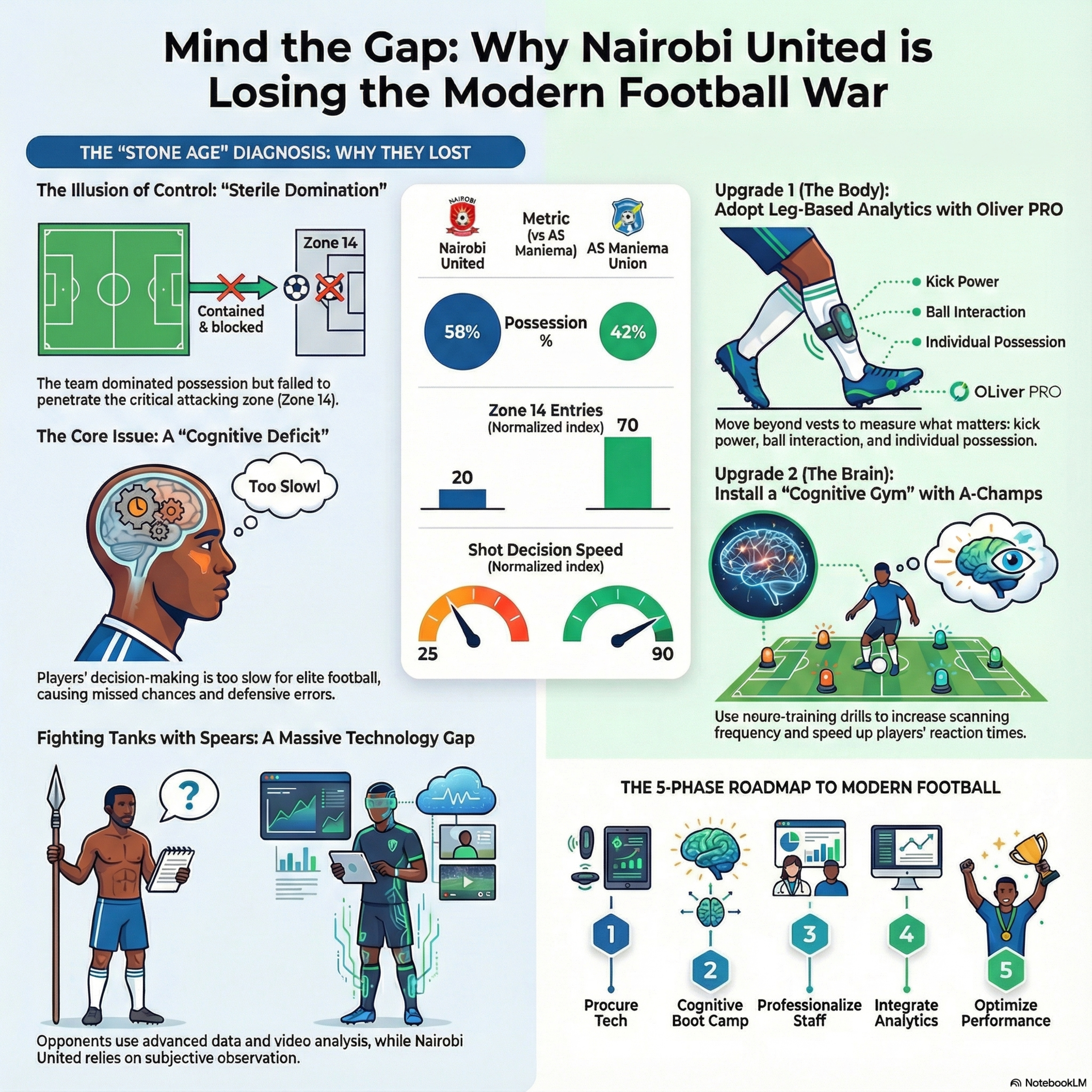
He was ready for multiple scenarios. Nairobi just stuck with a failing strategy until desperation forced their hand with those panic Subs. They were managing a crisis, not a football match. That sets the scene perfectly for the actual breakdown on the pitch. Let's move to the match, A tactical autopsy of the collapse, and it starts with the first half, which the report calls the False Dawn. It looked great if you were an Eye Boy fan, but it was completely hollow. They controlled the ball, they hit 58% possession, they dominated territory, pushed Manny Amber right back, but this was fundamentally an illusory dominance.
Why? Illusory. Because Manny Amber was comfortable, they were happy to let them have the ball. They knew Nairobi didn't have the cognitive speed or the precision to actually break down their low block. So they were just absorbing pressure, knowing the attack would eventually fizzle out. Exactly. And the warning signs of anxiety were there right from the start. You had defensive errors early on. Otieno nearly gifted them a goal. It showed the pressure was already leading to bad decisions. But the real technical failures, the ones that just laid bare that clinical deficit, they happened around the 27th and 40th minutes.
OK, let's breakdown that first moment, minute 27, the forward Omala, the moment of brilliance and failure. He's got explosive speed. Oh, pure professional grade athleticism. He uses this incredible burst of speed to get into the golden zone. That Zone 14, the little arc right outside the penalty box. It's the most critical area to penetrate in all of modern football. Who does the hard part? He gets there. He does the hardest part, but then instead of composure, instead of precision, he just unleashes this wild, uncontrolled shot that goes nowhere near the goal.
Why? What happened in that moment? The analysis suggests a classic biomechanical failure. Under pressure he probably leaned back when he hit it over strided, which are all symptoms of anxiety induced muscle tension or, and this is critical, just poor neuromuscular control because of fatigue. He did 99% of the difficult work the elite run, but failed at the 1% that actually counts. That was a huge warning sign. And then, not long after, Caramore misses what the report calls the match ball chance.
Minute 40 This is the one Caramore is clean through one-on-one with the goalkeeper deed and the expected goals. The XG for this specific chance was .65. So you're expected to score that goal two out of every three times you're in that position. It's a guilt edge chance. This is the moment the game should have been one. But his shot. It lacked power, it lacked placement, it lacked belief. It was an easy save for the keeper in the end. And the psychological impact of a miss like that is huge. It's a disaster.
It doesn't just keep the score at 00, it completely transfers all the psychological momentum, all the belief to the opposition. So my name walks into the locker room at halftime 00. But mentally they feel like they're winning. They know Nairobi can't land the killer blow. Which is exactly why their coach Komodo won the game. In the locker room, he saw that Nairobi's fullbacks were already showing signs of fatigue, both physically and cognitively. Mange was pushing too high, Otiende was tiring. So he brought on James of Boma specifically to exploit that inevitable second-half collapse.
And the tactical shift was to move to an aggressive counterpress right targeting those wide areas. Yes, they stopped being passive. They shifted from defense to proactive exploitation, and that takes us directly to the 66th minute goal. And you have to see this not as one player's mistake, but as a collective system failure born from that cognitive deficit. OK, walk us through the error as it unfolded. So Money Emma gets the ball back, they recycle possession. Nairobi tries to press high up the pitch, but the press is disjointed, it's not coordinated.
This creates a huge gap in the middle of the field. The ball finds in Boma on the edge of the box, and this is where the critical lapse happens. The Night Boy defenders, Ogutu and Otieno, they suffer a failure of nerve, they back off. They're jockeying way too passively. They're afraid of giving away a penalty. Exactly. But that tiny fraction of a second of hesitation, that inability to commit and close him down decisively, it gave him Boma all the time and space he needed to curl a perfect, precise shot right into the corner, unreachable for the keeper.
A fatal paralysis and the reaction from the bench was just confirmation of everything we've talked about the panic Subs at 69 minutes. It was pure desperation. They took off their entire attacking spine, Amala, Machaka and Magur all at the same time. This just chaotic disruption completely destroyed any rhythm the team had left. It was proof that the coaching staff had no proactive plan to influence the game. And the final data snapshot just puts it all in black and white. A-01 loss despite an XG 85 for Nairobi versus just .75 for Manny Emma.
That's the. Painful, quantifiable truth right there. Nairobi created nearly three times the quality of chances as their opponent, and they still lost. They had eleven corners to four. They won all the metrics of dominance, but they failed the one metric that matters, Execution. They were slow to decide, slow to shoot, and fatally slow to react in defense. OK, so this brings us. Right to the heart of the problem we're moving into the forensic match audit the cognitive deficit we have to get past saying bad finishing and really look at the neurological root 'cause we have to and the.
First big symptom the report identifies is this idea of sterile domination. Sterile domination. They had the ball. But they just pass it around in this big non threatening U shape around many Emma's defensive block. The heat map shows it perfectly. All the activities out wide and deep in their own half, but in that critical Zone 14, there's a massive void. So it's. Possession without any purpose. Precisely and. The root cause of that sterile play is what we're calling cognitive latency. Our analysis shows that for a night blah midfielder to get the ball, look up, scan the field, decide on a forward pass and then actually play it.
That whole process is taking between 1.5 and two point O seconds and in. Continental football. That professional window for a pass, it closes in .8 seconds. That's a gap of up to 1200 milliseconds. It's an insurmountable. Chasm. I mean, think about it this way, 700 milliseconds is about the time it takes you to blink 3 times. So if the defense can read the play, react, and shut down the passing lane in the time it takes your midfielder to simply decide what to do, you lose that battle every single time.
Minniem's defense wasn't necessarily faster physically, they just knew Nairobi's brains would be late. This is where the. Report gets really really interesting it re examines those key moments not as bad luck but as specific neurological breakdowns. The three smoking gun incidents let's start with. Incident Alpha The phantom cross at minute 54. The striker Caramour was described as being a step late to the cross. This isn't a physical issue, it's a failure in anticipatory scanning. What does that mean?
Anticipatory scanning. Elite strikers. Don't wait to see the ball crossed to start their run. They predict it, they start their movement based on the subtle cues from the wingers body shape. The instant he plants his non kicking foot for example. So Kara Moore. Was waiting for visual confirmation. He waited to see the ball leave the foot and that caused that critical 200 or 300 millisecond delay he was playing. Reactively to the ball, not proactively to the situation. Now let's look at incident beta.
Almost as big mess at minute 27. This was a failure of task switching. Task switching. Think of the brains. Processing power like a computer CPU dribbling at high speed puts an enormous cognitive load on your brain. You're focused on motor control, balance, scanning the field. You're running a very demanding piece of software, exactly your. CPU is maxed out, so when that shooting window suddenly opens, Oma's brain has to instantly switch from dribble mode to shoot mode, and shooting requires complex spatial calculation, target acquisition, precision motor commands.
His CPU was already overloaded, the system crashed, he had no processing power left for the precision, and the result was that wild shot that just. Makes the link between fitness and intelligence crystal clear. Being fit is being neurocognitively fit, and that brings. Us to incident Gamma, the defensive lapse on the goal in the 66th minute, the defenders backing away from embalma. That is a classic case of inattentional blindness. OK, explain. Inattentional blindness in a football context. They were victims of ball watching.
Their brains fixed all their attention on the immediate primary threat, the ball itself and the player who had it, but in doing so, they failed to scan and process the critical secondary threat, which was Emboma. Moving into the empty space, their brains overloaded with tracking, the ball literally filtered out the most important piece of information on the field. They just didn't see the real danger until it was far too late. And the data. From the possession quality analysis chart, it just confirms all of this high possession percentage, but absolutely catastrophic scores for Zone 14 entries and a really low shot decision speed and on the flip.
Side Manima had less of the ball, but their efficiency scores were near perfect. They spent less time thinking, which resulted in faster transitions and ultimately the goal. Nairobi was trying to fight a digital war with analog weapons, which takes us. Straight to the root cause, the infrastructure. Let's tackle the Stone Age infrastructure and technology gap. Why is this cognitive latency happening? What tools are failing them? IT really. Boils down to three pillars of systemic failure. First, their complete reliance on subjective analysis.
Coaches judging performance with their eyes, which is notoriously prone to bias and just misses all the micro failures we just discussed. OK, that's one. 2nd. Is their physical only conditioning. They run. They run a lot. They measure total distance covered. But there is zero brain gym integration. They're training their bodies to be fit, but their brains to be slow. And the third. Pillar is the flawed technology they're using. The report is very critical of the standard vest based GPS systems and that critique.
Is absolutely necessary. Look, vests measure gross movement, total distance, top speed, number of sprints. That's fine for an athlete, For a runner, but they cannot fundamentally measure ball interaction. And ball interaction is the whole point of football. This is where you get. What the report calls the passenger problem. That's it exactly. You have the player who runs 11 kilometers in a game, he gets a beautiful high GPS score from his vest. The fitness coach is happy, but he only touched the ball 15 times and actively avoided responsibility.
The vest actually rewards him for running away from the action. And there's a physical. Disconnect. Too, right? A huge one. The sensor in a vest is on the upper back, near the scapula. Football is played with your feet. A sensor on your back can't possibly measure the force of a pass, the intricacies of ball control, or the tiny footwork adjustments you need to succeed in Zone 14. It's a blunt instrument trying to solve a precision problem. So the tech they're. Currently paying for is actually creating a massive cognitive blind spot.
They are literally measuring the wrong things in the technology. Stack gap chart in the audit proves the cost of that ignorance. Look at how they do opposition scouting. They rely on manually clipped highlight reels. The modern standard is platforms like White Scout or instat real time video feeds. This explains why Manny Emma knew everything about them while Nairobi was playing completely blind. The mandate is. Clear. Then they can't afford to just catch up. They have to leapfrog this whole generation of basic GPS and manual video.
They need to go straight to Smart Sauce solutions. This is the. Strategic pivot, This is where we move into the mandatory procurement phase and we have to start with the body technology solution, I Oliver pro the hardware of truth. So Oliver Pro it's designed to completely replace the vest. The Smart OI sensor is placed in a calf sleeve, shifting the point of data collection to the lower limb. Why is that specific change so revolutionary for football? It immediately. Cures the leg disconnect we just talked about.
By putting the sensor on the tibia on the calf, you are fundamentally closer to where the action happens. The running gate, the kick, the ball impact vest. Can only estimate if a player is near the ball. Oliver Probe measures actual ball interaction, the G force of every touch, the frequency of touches. So this is how you. Finally, identify those hiders, the players who run a lot but don't actually want the ball. You can't hide. From this data and it also captures all those micro movements, the short explosive steps, the last second adjustments that vests completely miss and it's this.
Precision that allows them to finally tackle that clinical deficit head on through the kick power analysis. This is the game. Changing proactive metric Oliver Pro measures the G force generated every time a player kicks the ball so the staff can establish A baseline for a striker like Omola. Let's say his powerful shots are normally around 80 GS of force. OK, now during a match, if the coach sees on his tablet that Omala's kick power has dropped to 60 GS by the 60th minute, Oliver Pro triggers a real time red flag alert on the bench.
So the technology. Is flagging the problem before the critical mistake even happens? Yes. The coach gets objective physiological proof that Omala is hitting the neuromuscular fatigue zone. This lets him make a professional proactive substitution before Onla gets that game losing chance and misses it because his body can no longer execute what his brain wants. You turn a high percentage miss into a professionally managed goal and it goes. Beyond just performance, there's a massive benefit in protecting the assets through its injury wrist AI for a club like the.
Night Boy With a high stakes campaign and limited squad depth, a soft tissue injury to a key player is devastating. It can cost millions in lost points and replacement players. Oliver Pros AI uses something called the Acute Chronic Workload Ratio or ACWR. So what? Is the ACWR measuring. It compares the. Workload a player has done this week that's the acute part to their average workload over the last month, the chronic part and why is. Balancing that ratio so important because injuries. Almost always happen when a player suddenly spikes their workload.
They train say 50% harder this week than they normally do. Their body isn't prepared for it. The AI prescribes the exact personalized training volume for each player to keep that ratio in the safe zone. You basically eliminate hamstring and quad strains, preventing just. One of those injuries to a star player would pay for the technology many times over. It's an enormous. Financial win. You're ensuring your most valuable assets to players are always training at their optimal level without breaking down.
OK, so if. Oliver Pro fixes the body The second recommendation, technology solution to H amps, is designed to fix the slow, overwhelmed brain. That's right, the. H Amps ROX Pro system goes right to the heart of the problem cognitive latency. It uses something called Multi Sensory Neuroplasticity Training or MSNP to literally rewire that cognitive loop. We talked about perceive process, react. This isn't about traditional fitness. This is about making the brain faster, and it requires. Building a permanent smart court at their training facility.
Yes, you're. Basically turning the training ground into a cognitive gymnasium. You use these interactive light pods, the ROX Pro pods, and specialized rebounders to train the nervous system to handle multiple sensory inputs at incredible speed. You're trying to eradicate that hesitation we saw in the match. Let's get. Specific. The report outlines 2 drills designed to cure the exact deficits we saw against Maniama. First, the Maniama breaker scanning Brill. This one targets the ball watching and the failure of midfielders to turn and play forward.
The mechanics. Of the drill Force dissociation. A player stands in a square of these ROX pods and a passes play to him. But here's the key. A pod behind him flashes a color. He has to check shoulder, scan his blind side and call out that color before the ball arrives. Then he receives the pass and lays it to a target that corresponds to the color he saw. So you're. Forcing his brain to detach its attention from the ball, he has to perceive information that isn't directly in front of him precisely.
This directly targets the anticipatory scanning failure we saw in that phantom cross incident, and the goal here is incredibly ambitious. Increase the player scanning frequency by 200 to 300% over a six week period. They'll start to know where the space is and where the defenders are before the ball even gets to their feet. That's how you kill the delay and the second drill. The Zone 14 simulator reaction drill. This one is for curing the the hesitation, the task switching failure that we saw with Omola's miss.
Yeah, this uses a. Really dense pattern of pods that flash randomly and rapidly. The player has to react and tap them instantly, forcing the reaction time down below 400 milliseconds. This intense high speed cognitive load is designed to move decision making out of the slow deliberate conscious brain, which is where hesitation lives, and push it into the fast instinctive subconscious brain. So the next time. Omola gets into zone 14 in a match. The decision to shoot or pass is no longer a calculation, it becomes an automatic ingrained response it completely.
Cures that task switching failure. The cognitive process becomes instinct and the way you implement this is by using this ROX training for just 15 minutes of intense pre activation before every single training session. It just wakes up the nervous system and primes the players for high speed processing and to make sure the. Players buy into this. They introduce gamification, a simple leaderboard. Who is the fastest thinker on the team? This is absolutely essential. It changes training from a chore into a competition.
It creates a culture that values cognitive excellence just as much as it values physical fitness. This is a. It's a. Nominal sporting strategy. But it costs money. It requires stability. So let's pivot now to the business imperative governance and the road map. Because all of the tech in the world means nothing if the underlying club structure is unstable. And this is the. Elephant in the boardroom, The report calls it the patronage trap. The patronage. Trap. Yeah, the. Foundation's money gave them stability, but the club's entire strategic timeline is intrinsically linked to political cycles, to election cycles, not to the long term three to five year sporting cycles.
You need to build a real lasting institution, which means. Decisions can be very short sighted. They're focused on getting an immediate visible win rather than on sustainable long term development. Exactly. The audit flags the urgent critical need for a dedicated sporting director, someone who is technically competent and, most importantly, completely independent of the political structure. That independence is the only thing that ensures sporting decisions play. Recruitment, coaching, contracts, tech investment are made based on technical merit, not political convenience and.
Beyond the governance risk, there's a clear economic imperative for all this cognitive modernization, and it ties directly into player valuation. This is so. Critical for their long term survival. The modern global transfer market. It runs on data. European scouts. They don't just ask how many goals did he score. They demand a cognitive passport of verifiable data. A cognitive. Passport they want to see. The players kick power baseline, they're scanning frequency scores, their time to release on a pass.
By operating in the Stone Age, the nibar actively devaluing their primary assets, young promising players like Omala they can't provide. The objective evidence of professionalism that modern clubs demand. So they're leaving millions in potential transfer fees on the table. They're missing the data. Points that justify a high price tag. And on top of that, the report points out significant revenue leakage from their current operations. Their ticketing system is manual, it's physical, it's inefficient, and it's wide open to fraud.
So a. Relatively simple investment in digital infrastructure could solve a major financial headache immediately. Implementing Mpisa, the mobile money platform that is just ubiquitous across the region, or even a simple RFIDE ticketing system would instantly secure a vital revenue stream. And that's the money you need to sustain the technical investments we've just discussed. It's about building commercial independence. OK, let's lay it. All out the mandatory road map from Stone Age to Space Age.
The audit provides 5 very clear phases for immediate action. Phase 1 is. Immediate correction. We're talking December 1st to the 7th, 2025. It's about authorizing the expenditure right now, not next month. And the immediate goal is to establish a horrific baseline. You get out there with a stopwatch and you manually count scanning frequency. You show the players the hard data. You're operating at less than .1 scans per second. Nothing motivates a professional athlete like undeniable proof of how far behind they are.
Then you hit the. Intense training period The cognitive boot camp in phases 2 and three, which spans from December into January 2026. This is the. Rewiring phase. It means double sessions. The mornings are for Oliver protract physical conditioning focusing heavily on that ACWR load management to get rid of that 60 minute fatigue crash. The afternoons are all a champ Circuits drilling head of play and decision speed and the KPI for this phase is aggressive. Reduce the time to release pass metric by 0.5 seconds across the entire midfield.
Phase 4 is. The moment of truth. The double header deployment against their big rival Azam FC in late January. This is the acid. Test the KP is for this match are non negotiable. They must achieve with a 30% increase in zone 14 entries and a 100% increase in scanning frequency. The goal is to field a team that is cognitively unrecognizable from the one that lost to any Emma, and to get those six crucial points to salvage their campaign and finally phase. Five, the long term goal achieving true commercial independence.
This is about the future. It means operationally detaching the club from the political foundation. It means monetizing the data they're now collecting, selling those cognitive passports to European clubs, and it means establishing a professional, independent commercial board. That is what secures the club's future beyond any single election cycle. This entire. Strategic Brief really comes down to 1 core lesson that we've seen throughout this deep dive, that defeat against Manny, Emma. It wasn't a failure of heart.
It wasn't a failure of effort or even talent. It was a complete and total failure of modern professional systems. They were, as the report so bluntly puts it, fighting modern tanks with Spears. It's a harsh but. Necessary truth. If you want to evolve, the only path forward is to professionalize every single micro process to adopt this smart technology and to drill neurophysically until that millisecond precision becomes completely automatic. You have to move decision making from the slow conscious brain to the fast instinct negative subconscious.
So the final. Assessment is that the NYBOR are running on this high octane ambition, but they're doing it with a leaking analog technical structure. They have to evolve from being a rapid project that depends on outside money into a self-sustaining institution built on quantifiable professional process. The recommendation? Is absolute. Procure the technology, train the brain and evolve the governance. This is about more than winning One Cup. It's about establishing a legacy of technological innovation that can define the next decade of sports business in the entire region and that brings.
Us to our final provocative thought. For you the listener, this whole assessment shows us that so many football clubs, particularly in Africa, are sitting on these massive undervalued data assets. So if a club's biggest systemic failure is cognitive latency just slow thinking? How much money is actually being lost every single time a talented young player misses a critical shot, not because he lacks skill, but because the club failed to provide him with a modern neurophysical education? The cost of.
That Stone Age thinking, especially when the global football market moves at the speed of verified data. It isn't just a lost game, it's the systemic devaluing of your entire playing squad. Year after year. The pressure is on to bridge that cognitive gap, not just to win, but to secure a legacy of innovation for the future.
 Apple Podcasts
 Castbox
 Castro
 Goodpods
 Moon FM
 Overcast
 Pocket Casts
 Podbean
 Podcast Addict
 Podcast Republic
 Spotify