The Story of Football Agents 2025
About this episode
The Story of Football Agents 2025
Listen now on Spotify, Apple Podcasts, Amazon and other streaming services! Don’t forget to subscribe, share, and leave a ⭐⭐⭐⭐⭐ review to help more players and coaches discover the power of Techne Futbol and Data Technology in the beautiful game.
#TechneAfricaFutbol #TechneFutbol #TrainWithTechne #Playermaker #TraceFutbol #Hudl #FootballTech #FootballInnovation #PlayerDevelopment #CoachTools #SmartFootballTraining #AfricanFootball #CAFOnline #FIFA #FIFAYouth #CAFDevelopment #YouthFootballAfrica #NextGenFootball #FootballScouting #TalentIdentification #DigitalScouting #EliteYouthDevelopment #FootballJourney #FootballAnalytics #FIFAForward #FutebolAfricano #TrainTrackCompete #FootballExcellence #FootballAfrica #TheFutureOfFootball
Welcome to the Deep Dive, where we take the most complex source material, the raw data, the research, the market insights, and distill it into rapid, actionable understanding. Today we are undertaking a deep dive into the opaque, high stakes world of professional football agents. We're looking at the figures defining late 2025, a year that I mean, it just saw a massive regulatory change alongside an explosion in market spending. Our mission is crystal clear to navigate what feel like tectonic shifts happening right now.
We need to unpack this whole licensing revolution, which is, you know, fundamentally changing who can even operate in this space. Then we pivot to the money, the truly unprecedented financial growth defining the men's game. And finally, we have to shine a light on the crucial and I think, often underreported role that agents are playing in the rapidly scaling women's professional game. The 2025 data tells a story of transformation, and it's really defined by a new colossal headline figures on the regulatory side.
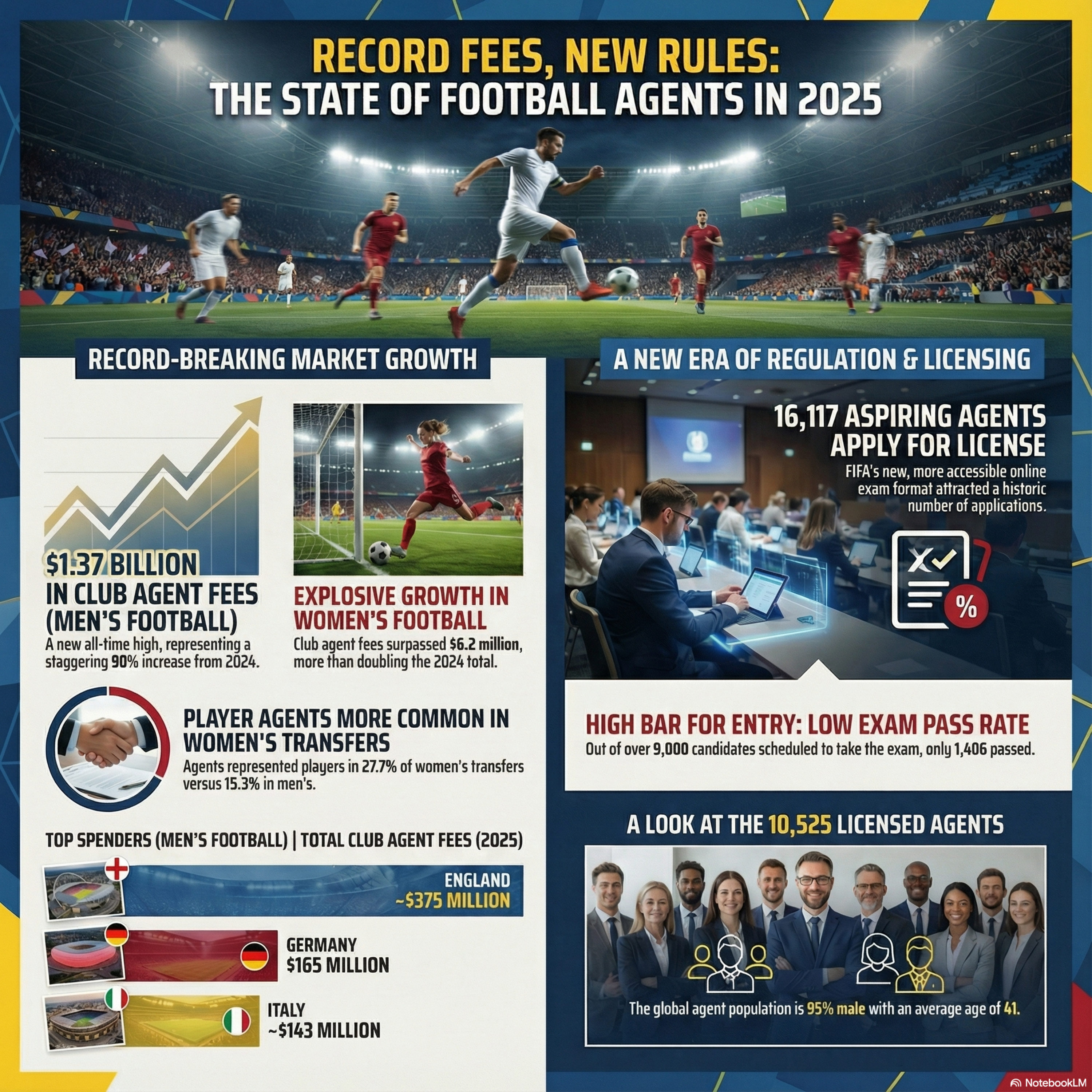
This attempt to professionalize the industry just drew a tidal wave of interest. We saw a record participation of over 16,000 total applications for the new FIFA Agent license. 16,000 applicants worldwide. Wow, that level of demand really sets the stage. But the true financial shockwave of 2025 hit when we look at the spending Clubs paid an unprecedented sum, staggering 1.37 billion U.S. dollars in service fees. And that's specifically for club agents involved in men's international transfers. To put that 1.37 billion into perspective, it didn't just inch up from last year, did it?
Not even close. It represents an increase of more than 90% compared to the spending level recorded just the previous year in 2024. 90% in one year. In one year, the acceleration of spending on agent fees is, I would argue, the single most important financial development in the transfer market this year. And we absolutely cannot overlook the women's game and all this. Well, the absolute dollar figures are, you know, they're much smaller. The trajectory is perhaps even more telling about the future.
Absolutely. The fees paid to club agents in women's football more than doubled compared to 2024, and that continues a multi year trend of just explosive expansion. It shows that investment is flowing into professionalizing every single facet of the women's ecosystem, from player contracts to transfer for negotiations. And agents are, of course, key beneficiaries. OK, let's unpack this. We have to start at the beginning. Before anyone can touch that 1.37 billion, they first have to get through the new regulatory gate, the licensing process itself.
The fundamental shift, what we're calling the exam licensing revolution, is that FIFA made this bold move to hold its football agent exam fully online, and they use live, sophisticated invigilation to maintain security. Moving this process online just fundamentally changes the dynamics of who can even attempt to join the profession. It sounds like a real attempt to democratize access by removing these huge logistical barriers, right? Exactly, the stated goals were very clear, vastly simplified logistics, better use of candidate time and a significant reduction in the expense associated with travel, visas, accommodation, all the things that previous in person exams required.
By pushing this global access button, the result was historic. And the numbers confirm that pent up demand opening the door resulted in 16,117 total applications under this new format. That's a massive influx of people seeking to professionalize their roles. It's a huge number, and to manage that scale, FIFA actually had to schedule 2 separate exam windows out of that application pool. Just over 9000 candidates were actually scheduled to take the test, though only around 7700 ultimately attended.
Managing that volume is an incredible logistical effort. The global reach for me is the key take away here. This truly standardized the exam globally. You had candidates from 157 different countries sitting the same test, which proves that the barrier to entry is now knowledge, not, you know, not where you live. And this wasn't some easy test you could just cheat your way through. The commitment to maintaining integrity even in an online setting was substantial. They used 527 invigilators from 79 countries, all to ensure a really strict invigilation ratio.
1 invigilator for every 4 candidates. This level of intense live oversight is crucial. It signals that FIFA is treating this online exam with the same weight and rigor as any high stakes in person professional examination, which is, you know, vital for the credibility of the new license. And we also get a clear snapshot of the business language of the global transfer market just based on what languages the candidates chose. Right English was the clear language of choice used by 55% of candidates, followed by Spanish and French, which accounted for 21 and 20% respectively.
Now what I found genuinely fascinating and maybe a little alarming given how high stakes this test is, is the pre exam preparation or I guess the lack of it. Yes, all scheduled candidates were offered an optional readiness check. It was just a way to ensure their equipment was working and that they understood the platform before the big. Day, but nominee took them up on it. Shockingly few. Only 5122 out of the 9000 plus scheduled candidates that's just 56% even bothered to use the check that's. Crazy when you have a global brand new high stakes online exam.
Skipping the technical readiness check just suggests either, I don't know, overconfidence or a concerning lack of attention to detail. Not a great sign for a prospective professional agent. You'd think not. That lack of readiness aside, the administrative process itself acted as an incredibly rigorous filter. Let's look at how the compliance checks just stripped away a huge portion of the applicant pool. That's right. The first step was enforcement. FIFA opened 714 investigations into potential failures to comply with basic eligibility requirements, and this was during the application phase.
They were actively filtering the pool before the test even started. And the rejection rate for those who are investigated was pretty high. Very high. Approximately 69% of those investigations led to the rejection of a license application. That's roughly 493 rejections based on compliance and integrity issues alone. So what were the main reasons? We can break these down. The single largest administrative failure was, believe it or not, simply failing to meet the application deadline. That accounted for 373 rejections.
Just missing the deadline, OK. Beyond pure timing, the regulators also drew of a very clear line in the sand about conflicts of interest rate. Precisely, we saw 85 rejections for for individuals who held positions of authority or employment within a football governing body, whether that's SIFA, A confederation, a club or a member association. The license is meant for independent agents, not, you know, club officials trying to operate a side business. It's a crucial ethical boundary. And what about this significant 1?
The rejection of applicants who are basically practicing illegally right before they applied. Yes, 23 rejections were for that exact reason, applicants who had performed unlicensed agent services in the 24 months right before their application. This sends a powerful message. You can't just wait until a regulatory shift to legitimize activities you are already conducting outside the rules. It maintains the integrity of the whole process. Exactly, it punishes prior non compliance. And finally 11 rejections were based on previous criminal convictions.
Just ensuring a basic standard of ethical conduct. OK, so those are the integrity filters, but then there's the sheer administrative scale of rejections, which is where we see almost 5000 people fall at the very first hurdle. This is truly the most astonishing number in the whole application process. The failure to pay the exam fee by the established deadline accounted for a colossal 4792 rejections. Almost 5000 people. You have to wonder what that tells us. Is it just an administrative bottleneck, a system failure?
Or does it reflect a general lack of professionalism? I mean, if an agent can't manage the deadline and payment for their own license, what confidence should a player or a club have in them managing A multimillion dollar transfer? It definitely suggests a significant portion of those initial 16,000 applications were either casual, ill prepared or just lack the financial commitment required. We also saw over 1600 applicants formally withdraw 59 rejections for breaching exam rules, perhaps related to that lack of readiness we talked about, and 13 because the applicants were underage.
So after all that filtering, let's get to the result of the actual exam. Right. So out of the 7745 candidates who actually attended the exam, only 1406 initially achieved the pass mark. Wow, that is an incredibly stringent barrier to entry. It really confirms the high academic bar FIFA has set. It does now. There was a review mechanism in place for those who narrowly missed the mark. And did that change the numbers much? It did increase the final pass count, but only slightly. It didn't change the overall picture of how tough it was.
FIFA received 662 requests for review and after that 164 candidates were regraded to a pass. It shows the system allows for appeals, but the exam remains very difficult. OK, so we have the main pathway, this rigorous new online exam, but there is a parallel route, one designed for veterans. We should look at the national law pathway, which relies on recognizing established systems abroad. This pathway, it's detailed in Article 24 of the regulations and it's a system designed to integrate agents who are already licensed under robust accredited national laws before January 9, 2023.
It's not a loophole, it's a recognition of prior professional regulation. What are the conditions? It can't be a free pass. Definitely not a free pass. Agents have to provide concrete proof they held a license under that specific national law before the cut off date. They still have to meet all the standard eligibility requirements, so no criminal convictions or conflicts of interest, and they have to pay the license fee. But the core of this pathway is the member association itself, isn't it? FIFA has to recognize that the national system is robust enough.
What standards do they have to meet? The member association has to implement mandatory eligibility requirements that align with FIFA's and, critically, their agents have to pass an exam that covers football regulations. The national test has to be demanding enough to warrant an exemption from the new global standard. And to date, FIFA has only recognized 2 national systems. Who are they? The French Football Association, The FFF, they were recognized early on in May 2023, and the Italian Football Federation, the FIGC, which was recognized more recently in September 2025.
And this is where we get some real insight into the global challenges of trying to harmonize all this. Let's compare the stringency of these two recognized national exams, because they illustrate very different philosophies about what makes an agent competent. We can start with Italy's FIGC. If their system is highly concentrated. It requires candidates to get a score of at least 26 out of 30 in a rapid 40 minute special exam, 40 minutes. It suggests a focus on rapid, high stakes competence and quick recall.
In stark contrast, the French system sounds like a multi layered marathon. It is. It prioritizes regulatory understanding. Candidates have to pass 2 separate exams. 1st a general exam which is a 2 hour written test including a complex case study with a pass mark of 10 out of 20. And that's just the first part. That's just the first hurdle. They then face a specific exam, a 90 minute test with multiple choice questions and practical case studies focusing deeply on national and international rules.
And this one requires an even higher pass mark of 14 out of 20. The French system clearly values broad methodical understanding and case application over that rapid recall you see in the Italian system. So on one hand you have Italy's condensed high score rapid fire approach and on the other France's two-part multi format deep dive examination. This difference, even among the recognized systems, really reveals that global harmonization is still a complex process, not an endpoint. The advantage for agents who qualify this way is significant, though.
They are exempt from the FIFA exam, and they also get a temporary exemption from the continuous professional development, or CPD, requirements for five cycles. It's a pragmatic system to integrate experienced, previously licensed pros into the new global roster. Once an agent is in, the work of compliance never stops. The license is a privilege, not a lifetime guarantee. What are the ongoing requirements for maintaining that status? The professional status requires 2 things, year on year, paying the annual license fee to FIFA and actively complying with the continuous professional development requirements to make sure their knowledge stays current.
And if they slip up, what's the consequence? The penalty is immediate and severe. If an agent fails on either the fee payment or the CPD, their license is automatically provisionally suspended. They get a strict 60 day window to fix it. And if they fail to correct it within those two months? Then the license is officially withdrawn. Once it's withdrawn, they have to restart the entire application process from scratch, including passing the exam again. This policy creates a powerful loop, ensuring that maintaining the license requires constant active participation.
So let's check the industry's progress in adapting to these strict rules. As of October 1st, 2020, five 1824 licenses were provisionally suspended. Now, while that number seems high, it's actually a very encouraging sign. So it represents a 30% improvement compared to the suspension rates from the very first regulatory cycle. The industry is adjusting and professionalizing, and it's doing so rapidly. What were the main reasons for those suspensions? Still administrative stuff. Mostly non payment of the annual fee was the biggest culprit leading to over 1200 suspensions and failures to complete the mandatory CPD requirements accounted for 951 suspensions.
Again, we see that administrative and educational compliance is often the weakest link for agents. And the final consequence of this enforcement? How many were ultimately kicked out? By December 1st, 2020, five 433 licenses were ultimately withdrawn. That means over 400 individuals who secured their license are now out of the system and have to start all over again if they want to practice. So after the application flood, the filtering and the ongoing enforcement, what's the size and composition of the final compliant roster?
As of December 4, 2025, the total number of licensed football agents worldwide stood at 10,525. This is the pool that will be competing for the massive financial rewards we're about to discuss. And what do we know about the demographics of these 10,000 agents? The average age is 41, which suggests a level of experience remains in the profession. But the most striking demographic feature is still the stark gender imbalance. The profession is 95% male and only 5% female. 95 to five. That is a massive disparity.
It raises serious questions about whether this is a reflection of lower interest among women, or if there are structural, environmental or cultural barriers to entry and success that these new regulations haven't yet addressed. It's a crucial structural challenge. Finally, we should note that 69% of currently licensed agents are authorized to represent minors. This figure is significant because it connects directly to the mandatory educational component required for safeguarding young talent, which we'll come back to later.
OK, the regulatory journey is complete. We know who is allowed to play. Now let's turn to the financial behemoth, the men's game, and see where that $1.37 billion went. We have to anchor this discussion on that central unprecedented figure. Club spent 1366.8 million U.S. dollars on Club agent service fees in international transfers in 2025. It is the definitive measure of the financial scale of this profession. And again, the context of the increase, a jump of more than 90% in just one year. The market isn't just growing, it's accelerating at warp speed.
This is the moment, however, where we have to inject the critical insight for you, the listener. Even this massive $1.37 billion figure is a significant, significant underestimate of the total revenue flowing to agents. Explain that caveat. Why is it so conservative? This figure only covers agent fees paid by the clubs, both the engaging club, the buyer and the releasing club, the seller, and only for international transfers. It excludes 3 enormous revenue streams, all domestic transfers, fees generated from renegotiating existing contracts, and any service fees paid directly to player agents.
So if we were to tabulate all of that excluded revenue, the domestic fees, the contract extensions, the player side commissions, we would easily be talking about a multi billion dollar annual industry that is fundamentally opaque outside of this one metric. The 1.37 billion is just the very visible taxable tip of the iceberg. Precisely now focusing on the activity generating this revenue, Club agents were involved in 3010 international transfers in 2025, which is a record number. And who is hiring the agents?
Most often, the buyers are the sellers. The engaging club The buying club was the primary driver and over 2300 transfers only the engaging club employed an agent. In about 350 cases both clubs were represented, showing a more complex negotiation, and only about 300 transfers involved just the releasing club employing an agent. So relative to the overall transfer volume, this means engaging club agents were involved in 11% of all international transfers. Yes, and releasing club agents had a slightly lower involvement rate at 9.2%.
These figures confirm that while using agents is far from universal, it's a routine component of a significant slice of the international market. And here is the ultimate bottleneck figure, the one that makes those 16,000 applications look almost futile. Only 1559 agents out of over 10,000 licensed individuals actually provided services and received fees from clubs in these international transfers. That is the ultimate hurdle. We have over 10,000 license agents, but approximately 86% of them are operating entirely outside the international club fee market that generated that $1.37 billion.
The financial concentration is just. OK, let's get into the correlation between agent involvement and the size of the deal. We know agents specialize in high stakes complexity, which usually means high transfer fees. The data provides undeniable proof of this for transfers that involved a transfer fee. So not free transfers. The presence of an agent just skyrocketed. Engaging club agents were involved 35.3% of the time and releasing club agents 13.8% of the time. Agents are a necessary component of deals where cash is changing hands.
And that necessity only escalates as the fee bracket goes up. Yes, the complexity filter is clear. For the top bracket transfers valued at over $5,000,000, the presence of an engaging club agent jumped to 68% involvement. Almost 7 out of 10 mega deals require the expertise of a professional agent on the buying side, likely for legal, financial, structuring and negotiation purposes. Now we get to the core economic insight, and this is where it gets really interesting for anyone analyzing the finances of top clubs, this inverse relationship between the absolute fee and the percentage fee paid to the agent.
Right. In absolute terms, the fees are of course massive. For those transfers over $5,000,000. The median fee for an engaging club agent was nearly 1,000,000 dollars 976,000. But the proportional cost, the agent fee as a percentage of the total transfer fee actually shrinks dramatically as the deal size gets bigger. This is that volume discount we talked. About This is the crucial finding. For smaller transactions, say those between zero and $500,000, the median engaging club agent fee was a whopping 25.4% of the transfer.
Fee 1/4 of the fee. 1/4 But in contrast, for those transfers over $5,000,000, that percentage plummets to just 6.8%. That's a huge difference. Why is the cost relative to the size of the deal so much cheaper for these mega deals? It comes down to negotiation leverage and sort of fixed costs. Imagine the negotiation effort for a smaller club to sell a young player for $400,000. The agent still has significant legal, travel and administrative overhead, so that fixed effort demands a higher proportional cut 25% or more to make it worthwhile.
But when a major club is spending, say, 100 million on a superstar, the agents work, while still complex, scales differently. A 6.8% fee on that 100 million is $6.8 million. It's a massive payout, but the club only had to give up a relatively small percentage compared to what a smaller club would kick. Exactly. The high value deals benefit from extreme scaling efficiency. The agents are willing to accept a smaller proportional slice because the absolute numbers are so immense. It offers the buying mega clubs a kind of proportional discount on their transaction costs for their biggest acquisitions.
Let's finish this financial segment by looking at how that 1.37 billion was distributed. While almost 90% of club agent fees were individually under $1,000,000, the true concentration of wealth is staggering. The 348 instances where the service fee exceeded $1 million accounted for 68.4% of the total amount paid globally. So a tiny fraction of elite deals accounts for the vast majority of the spending. It's a hyper skewed market, and yes, a handful of isolated cases even saw agent service fees surpass $15 million for a single transfer.
Just incredible. OK. So the geographic distribution of the spending is heavily weighted toward one continent, reflecting where the money and media power reside in football. Uefa's dominance is absolute. Clubs in the European region accounted for 89% of that total, 1.37 billion outlay. They are the engine room of the transfer market. Let's drill down into the top spending nations. Who's driving this acceleration? England is the clear global leader. English clubs spent over $375 million combined. That highlights the vast purchasing power of the Premier League in Championship clubs.
Notably, England also had the highest share of incoming transfers involving an engaging club agent at 51.1%. So half of all international deals coming into England involved a buyer side agent who follows them. German clubs were the second biggest spenders with 165,000,000 total. Then we see Italy, Spain and Portugal as the other major spending powerhouses. And we have to acknowledge the newer market forces impacting the global landscape. Absolutely. Saudi Arabia, a non UEVA member, continued its aggressive market push, spending $74.2 million just on engaging agents in 2025.
This shows a rapid strategic effort to professionalize and expedite their massive recruitment drives via agency services. We also have an outlier on the selling side. Yes, Serbia had the greatest share of outgoing transfers, with a releasing club agent involved at 28.7%. This suggests that Serbian clubs, who often act as key development in selling leagues, are strategically using agents to maximize their outgoing transfer revenue. Finally, let's look at the agents themselves. Which nationalities are collecting the most money?
British agents were involved in the highest number of club representations, followed closely by French and Italian agents. And when you look at the money received, British agents led the pack with $171.5 million, followed by the French and the Italians. The agents that are winning are overwhelmingly those based in and near the top spending European nations. Now we have to move to a topic that frequently causes controversy, agents representing multiple parties in a single negotiation. This issue of dual and triple representation is inherently tied to ethical debate and conflict of interest.
And the numbers show this is not a theoretical problem, It's a widespread, active practice. It includes 55 instances of triple representation where a single agent represented the engaging club, the releasing club and the player simultaneously. 55 times. Wow. And what about the more common dual representation? There were 962 total instances, and the breakdown tells a story about the structure of modern transfers. So what's the most common dual representation, the one we see most often? That would be the agent representing the engaging club and the player, which happened 851 times.
This is highly common because the agent's goal getting the player moved to the buying club with a high contract is aligned with the buying clubs goal of signing the player. The agent acts as a facilitator. What about the less common scenarios? Representing the releasing club and the player happened 68 times, but the rarest scenario was an agent representing both the engaging and releasing clubs only 43 times. That makes sense. An agent trying to represent both the buyer and the seller in negotiating a single transfer fee is a direct conflict of interest.
It's the most difficult and ethically questionable arrangement. It requires extreme transparency, and the rarity confirms how difficult that is. Let's return to the concentration of wealth now, focusing on single agent performance, because this just underscores the power dynamic. We established that just over 1500 agents shared that 1.37 billion, but how concentrated is that wealth even within that elite group? The difference between the moderately successful and the elite is monumental. The single agent with the highest volume of transactions handled 37 transfers, earning about 2.9 million in fees.
Highly active, very successful. But then there's the ultimate winner. Yes, the agent who registered the highest total service fees in the system for 2025 amassed A staggering $45.3 million. $45.3 million for one agent and that's only the money declared via club side fees. What kind of power does that level of revenue by you in the football ecosystem? It creates immense vertical power. An agent earning that much can afford to control entire pipelines of talent, invest in youth academies and maintain deep powerful relationships with the executives of top global clubs.
It means a very few individuals are now operating essentially as financial institutions within the transfer market. OK, let's shift focus from the club side to the player side of the transfer equation. In 2020, five 3730 international transfers involved in agent acting on behalf of the player. That's about 15% of all transfers and marks a solid 19.9% increase over 2024. And again, the exclusivity point applies here too. Absolutely. Only 1829 of all licensed agents, just 16.7% actually provided services to players in international transfers.
So over 80% of licensed agents are not active in this high level international market. We analyzed what drives club agent involvement, which was transfer fee size. What are the main drivers for player agent involvement? The data clearly shows two things. High salary expectations and youth player agent involvement is highly correlated with higher total fixed remuneration. The higher the salary, the more likely of players to use an agent. Why does that correlation hold so strongly, especially for young, high earning players?
If we look at players under 18 earning over 5 million dollars, 75% of their transfers involved in agent. Contrast that with the oldest, lowest earning players where involvement drops to just one point, 3%. For a young, high potential player. That initial contract is so complex. They're negotiating salary endorsement rights, image rights, future clauses, and agent is essential for protecting that future value. The necessity of professional representation skyrockets when career earnings are at their highest potential risk or reward point.
Exactly. The agent is a risk mitigator and a financial optimizer. While involvement decreases as the player gets older, the salary effect remains the stronger driver. Which players by nationality were most reliant on agents for their international moves? Players from Checkia topped the list with 51% of their international transfers involving an agent. Norway followed at 45.4% and New Zealand at 44.7%. This might reflect the complexity for players from those nations to secure moves into the major European leagues.
And the most active agent nationalities on the player side. British agents LED here with 542 player transfers, followed by French and German agents. This reinforces the finding that British, French and German agents are central pillars, operating successfully across both the club and player side of the market. Now let's step away from the scale of the $1.37 billion men's ecosystem and look at the market where the growth rate is truly defining the future of the sport, women's professional football.
The growth rate in the women's game is just phenomenal. It reflects the overall necessary investment boom. Clubs and women's professional football spend over 6.2 million U.S. dollars on club agent services in 2025. 6.2 million. While we have to maintain perspective, that's less than half a percent of the men's total spending. The rate of change is a real story here. Absolutely. That 6.2 million figure is more than double the spending in 2024, and incredibly, it is more than 13 times the figure recorded just four years prior in 2021.
The market is transitioning from nascent to professionalized at an unprecedented velocity. And agent involvement in transfers is also hitting record highs. Agents were involved in a record 298 transfers, a 60% plus increase over 2024 and similar to the men's game. The vast majority, 283 transfers involved only an engaging club agent, meaning clubs are proactively using agents to scout and secure talent. OK, let's go to that striking piece of analysis, the relative player agent penetration rate in the women's game versus the men's game.
The comparison is essential for understanding the structure of the women's market. In women's international transfers, 27.7% of all transfers involved a player agent. Compare that to the men's game, where the equivalent figure was 15.3%. So player agents are involved in women's international transfers at a rate that is more than 10 percentage points higher than in the men's game. Why? Why this difference? It's just that agents are fulfilling a more fundamental, necessary role in the women's market structure right now.
Because the club structures, salary mechanisms, and league systems are generally less standardized or mature than in the top men's leagues, players rely much more heavily on external representation to ensure contract terms are professionalized and fair. Agents act as crucial professionalizers of the player club relationship. When we look at club agents in the women's game, which nationalities are driving the activity? Italian agents led the club representations with 41 transfers, followed by British and French agents.
It shows the same major footballing nations that dominate the men's market are also the most active in professionalizing the women's market. And in terms of service fees received? French agents led the club service fees with $1.2 million received, followed by British and Italian agents. The dominance of European agents is evident in the financial flow of women's football transfers. On the player side, the sheer number of transfers involving an agent increased by nearly 30% compared to 2024, reaching 664 total transactions.
Which players are most actively utilizing this high rate of agent services? Japanese players were the most likely to use an agent, with over 54% of their international transfers involving one. Players from the UK and Australia followed closely. This likely reflects the complexity of moving players from established domestic leagues into the globally competitive European. Circuit and finally, which agents are representing them? British agents were the most active and play representation involved in 111 transfers.
Interestingly, agents from the United States followed with 75, reflecting the strong professional base of women's football in the NWSL. French agents were third. OK, we've now established who is regulated, the financial scale they operate on and the explosive growth in the women's game. Let's pivot to the final major area of regulatory focus, compliance enforcement and mandatory education. The enforcement arm of the regulations is designed to handle the inevitable conflicts and breaches that arise.
FIFA has established clear channels to handle complaints regarding infringements of the Football Agent regulations. How busy is the enforcement department given the massive influx of applicants and the record spending? Between January and November 2025, FIFA received 199 complaints concerning various infringements. These complaints then fuel the subsequent investigations. Let's start with the rogue operators, the individual performing agent services without a license. 61 investigations were opened into these unlicensed activities.
The outcomes are instructive. 25 We're still pending. But 18 individuals were immediately prevented from taking the upcoming agent exam. This is a critical regulatory tool, cutting off the path to legitimate status for those caught operating illegally. That leads to the persistent challenge we saw in the report. The difficulty in resolving many of these cases is due to a lack of documentation. The significant hurdle is the lack of sufficient evidence. Proving non compliance, particularly concerning unlicensed activity, requires documentation that is frequently unavailable.
This leads to a high number of cases being closed as unsubstantiated, even when the suspicion of wrongdoing exists. Now, what about the licensed agents who violate the ongoing rules? 40 investigations were open concerning existing license agents failing to meet the eligibility requirements, things like maintaining financial probity or avoiding conflicts of interest. The outcomes were mixed again, with many cases closed due to that evidence problem, but various provisional suspensions were handed out for specific failures.
To manage this massive administrative workload, FIFA had to centralized its communication efforts dramatically. They did. As of October 2024, all communications are channelled through a single e-mail address. This allowed them to create a single repository, standardized responses, and measure the administrative burden accurately. And the volume flowing through the single channel reflects the massive public interest we saw with the 16,000 applications. The administrative load is intense. They received almost 12,000 tickets between October 2024 and September 2025, averaging about 47 tickets every single business day.
But the breakdown of the inquiry topics is the crucial insight here. It tells us what is consuming the regulatory bodies time. Absolutely. The overwhelming majority of those tickets, a massive 8002, pertain directly to the FIFA football agent exam. This just far outpaced everything else. The data shows that the sheer logistics of running the new exam and filtering those 16,000 applications is dominating FIFA's administrative workload right now. FIFA's role isn't just to police, but to educate and professionalize the upper echelons of the industry.
Let's look at their high level educational efforts. The FIFA executive program and football agency is their elite offering. The second edition, held in 2025, brought together 24 participants from highly diverse industries for a personalized educational experience in Miami, Zurich, in Paris. The purpose goes far beyond the basic regulatory knowledge of the exam, focusing on complex deal structuring and advanced ethical practices. And they're also focusing on reaching agents in emerging markets, with outreach in Africa and the Americas.
In April 2025, FIFA participated in the African Football Agents Conference in Rabat, Morocco. This event was huge, attracting 450 participants. The FIFA delegation focus on the new exam format and, critically, on collaborative efforts to combat human trafficking in sports. And the Americas saw similar efforts. Yes, the inaugural America's Agents Summit in Buenos Aires drew over 300 attendees, emphasizing the rising prominence of the CONCACAF and Canaveral regions in the global transfer market. Finally, the proactive push for ethical recruitment guidance is central to the entire regulatory objective.
FIFA collaborated with its Football Agent Working Group and Mission 89 to develop the FIFA Ethical Recruitment Guide. The goal here is multifaceted. Raise ethical awareness, reduce the abuse and exploitation of young players, and ultimately enhance overall professional standards. The protection of minors is the most sensitive area of the transfer market and Article 13 of the FFAR makes the associated educational course mandatory for any agent who wishes to deal with young talent. The FIFA Representing Minors course is required for authorization.
This ensures agents involved in these transactions understand the specific regulations and ethical requirements to safeguard the younger generation. What was the feedback from the agents who completed the course? Was it just a box ticking exercise? A survey of 852 authorized agents suggests it was much more than that. The feedback was overwhelmingly positive. Agents reported high confidence in applying their learning and deemed the content highly relevant. Crucially, many reported developing A deeper sense of responsibility and empathy after completing the material.
That reported increase in empathy is highly encouraging. It suggests the course is successfully moving beyond simply reciting rules to genuinely influencing professional perspective and ethical practice. Exactly. And the agent sought out the course not just for authorization, but to learn the most recent regulatory developments affecting minors, confirming it's working as a continuous development tool. And the authorization process itself requires regular renewal, preventing complacency. The authorization is visible on the digital license card and is valid for three years.
To extend it, the agent must repeat the required CPD course. This ensures that agents handling the most vulnerable segment of the market keep their knowledge current. We've covered a massive amount of ground today, from the 16,000 people who wanted in to the millions of dollars that only a fraction of those agents actually secured. It's been a journey through scale, regulation and acceleration. The story of 2025 is really defined by two opposing forces. Massive regulatory access designed to professionalize the field and extreme financial concentration at the very top of the market.
Exactly. Let's bring it back to that big picture. The new regulatory structure spearheaded by the online exam succeeded in democratizing access globally and filtering out those who failed to meet basic standards. However, the financial reality in the men's game is 1 of radical inequality marked by that eye watering 1.37 billion where the vast majority of wealth is controlled by a small percentage of agents operating in the high fee UEFA markets. The implication for you, the listener, is that while transparency and access are improving, the structural power of the elite agents who secure those multi $1,000,000 deals remains immense.
And frankly, it's growing. Even the explosive growth in the women's game, while fantastic, only serves to under score the fundamental financial contrast with the men's market. The system is professionalizing, but it is simultaneously consolidating wealth at the top. And that leads directly to our final provocative thought for you to Mull over as you conclude this deep dive. We established that over 16,000 individuals applied for a license, demonstrating this overwhelming global desire to enter the profession.
Yet we know that only about 15159 agents are actually involved in generating those billion dollar international club transfer fees. So what happens to the remaining 90% of licensed football agents? They're roughly 9000 professionals who aren't currently accessing that high end international club revenue. If they can't break into that elite market, how will their strategy change? Will they focus hyper aggressively on domestic transfers, corner the market on contract renegotiations? Or perhaps become hyper specialized in lower leagues or critically in youth player development where the fees are smaller but the volume could be higher.
And what impact will that strategic shift have on talent discovery and player development globally in the coming years? Something for you to ponder and explore on your own. A huge thank you for joining us on this deep dive into the evolving world of football agents. We'll see you next time.
 Apple Podcasts
 Castbox
 Castro
 Goodpods
 Moon FM
 Overcast
 Pocket Casts
 Podbean
 Podcast Addict
 Podcast Republic
 Spotify