The South African Youth Football Blueprint
About this episode
The South African Youth Football Blueprint
You know, if you look at a global map of where raw athletic talent actually comes from, there is this this one massive, undeniable hotspot. Right. It's like a geyser that just never stops erupting. Exactly. I mean, if you tune into the top football leagues like the Premier League, La Liga league, when you are watching an absolute master class and it's powered by players either born on the African continent or directly stemming from its diaspora. The numbers are, they're truly staggering. We're talking about a region that consistently produces, you know, 35 to 40% of Europe's elite football talent.
The individual brilliance is just undeniable. Almost half the players letting up the biggest stadiums in the world. But then, you know, you zoom out, you look at the global tournament, right? The World Cups, yeah, the World Cups. And suddenly that same region systematically struggles to convert all that raw, undeniable ability into consistent international dominance. It's a massive paradox. There really is. It's like owning the world's biggest diamond mine, but for some reason you just can't seem to craft the crown jewels.
Yeah, that is the defining structural paradox of African football. There's this stark difference between a continent that exports world class talent and a continent that actually wins on the world stage, right? And it's an incredibly frustrating dynamic for anyone watching because you know the ingredients are all right there. And it has baffled sports analysts for decades. Like, why does the talent pipeline leaks so badly when it comes to national team success? Well, that is exactly what we are going to figure out today.
Absolutely. To do that, we're tearing into some incredible intelligence recently put out by the Afratech Sports Technology and Innovation Group. It's their May 2026 forensic intelligence brief. Yeah, and it's a fascinating document. It really is. They've done this massive forensic analysis on something they call the South African Way and it points to a radical solution for this continent wide paradox. It's a it's a complete paradigm shift. For sure, our mission today is to look at the systems, the philosophies, and the actual mechanics of how you take raw potential and engineer into greatness.
Because that is the core theme here, right? The gap between raw talent and world class performance is not closed by just throwing money at the problem. Oh, definitely not. We see Federation's attempt at all the time they build a shiny new facility, hire an expensive foreign coach and just, you know, expect miracles. And it fails every time. It fails. That gap is actually closed by systems, it is closed by intentional environmental design, and perhaps most importantly, it's closed by mindset architecture.
OK, let's unpack this. Because to understand this massive structural revolution, we actually we need to zoom all the way in on a highly unusual, very specific setting. Yeah, this isn't your typical sports story. Not at all. We are starting the story in a glittering corporate Academy in London or Madrid. We are starting in a church. Specifically, the Growth Point Church in Rustenburg that's located in South Africa's Northwest Province. Let's paint the picture for you. We're looking at a seemingly small event that carries massive diagnostic importance.
It's a coaches development session hosted by the local Rustenburg Junior League. Also known as RUL. LFA Right now, the Northwest province is a mining corridor. It's home to the global platinum industry. It's largely rural. It's a region that produces a lot of youth talent playing on dusty, uneven pitches. But historically it hasn't had the systematic development infrastructure of the big cities like Johannesburg or Cape Town. Exactly. The football ecosystem there relies heavily on, you know, community leagues, school competitions, informal structures.
Grassroots. Stuff pure grassroots. It operates on the margins of the formal, highly funded development pyramids. And yet this Junior League made an incredibly deliberate organizational decision. They didn't just host a generic motivational talk for their volunteer coaches, did they? No, they didn't. They brought in elite intellectual architecture and placed it directly into the hands of the grassroots. Right. And to understand why that's such a big deal, we have to look at how youth football usually works in a lot of places.
Grassroots coaches, the parents and volunteers who spend their Saturdays out on the dirt pitches, they're treated basically as babysitters for raw talent. Yeah, totally. They roll the ball out, make sure no one gets hurt and watch the kids run. That is the standard model almost everywhere. Yeah, but this session in Rustenburg represents a completely different philosophy. It treats the grassroots coach as the first architect of high performance identity. I love that phrasing. The first architect.
Yeah, it's a deliberate pipeline. It transmits intelligence from the absolute top of the national pyramid directly down to the base. And when we say the top of the pyramid, we mean it. The guest speaker sitting in that church in Rustenburg wasn't just like a local enthusiast. It was Sinessa fo Mali. Yeah. And when you look at his trajectory, it's phenomenal. Sinessa fo Mali is objectively one of the most consequential figures in African football intelligence right now. He starts out as a performance analyst for a local club, Chippa United.
Then he's scouting for Kaiser Chiefs, which is a massive institution. Huge. He moves to the South African under 23 setup, helping them qualify for the Tokyo Olympics. Then he's the analyst for the women's national team, Banana Banana at the FIFA Women's World Cup. And it doesn't stop there. Right, by the time he's speaking at this church, he is the head performance analyst for the senior men's team, Bufana Bufana. Let's contextualize those Bufana Bufana results too. I mean, he was on the technical staff that secured A historic bronze medal at the 2023 African Cup of Nations, the AFCON, exactly the AFCON, which is essentially the European Championship of Africa.
And he was the head analyst during their successful 2026 FIFA World Cup qualification campaign. So his. Fingerprints are just all over this. On every major success across genders and age levels in recent South African history. He also holds a UEFA Elite International Scout certification and a CFB coaching license. For context, getting that UEFA certification is a it's kind of like passing the bar exam for global football intelligence. It really is. It means you don't just watch a game, you know how to mathematically and spatially deconstruct it.
It is a benchmark for technical player evaluation that very, very few analysts in sub-Saharan Africa hold. It means he operates at the cutting edge intersection of data, video analysis and live observation. So when he walks into that church in Rustenburg, he is bringing the highest level of operational intelligence available anywhere in the world straight to the volunteers. He also runs a firm in Johannesburg that organizes these massive symposiums to build analytical capacity. And there is this one specific story he tells at these master classes that perfectly illustrates why his mindset is so crucial.
Oh, the Camboli case. Yes, about a play on named Lazarus Camboli. Yes, the Lazarus Camboli case is a lesson that needs to be permanently etched into the institutional memory of every sports organization. Seriously. Camboli was a highly touted Zambian striker. He held the record for the fastest hat trick in African Champions League history. Kaiser chief signed him for a massive transfer fee. The expectations were just astronomical. A huge financial investment and yet he really struggled to adapt.
He couldn't find his footing. Now normally the media and the fans just say oh he was a flop. Bad scouting. Right, they blame the player. Exactly. But Molly's analysis of this failure completely flips the script. He basically points out that clubs are willing to spend 10 million Rand on a player, but they completely fail to build the environmental infrastructure for that player to actually succeed. Yeah, and to adapt to their new surroundings, Molly argues that protecting that investment requires surrounding the player with the best sports scientists, the best analysts and a robust psychological support system.
It's not just plug and play. No, adaptation isn't just about raw talent, it requires a high level of infrastructure from the club. You are bringing a human being into a new city, a new tactical system, a new dressing room culture. If you just drop them in and expect magic, you are negligent. It sounds exactly like buying a 10 million Rand Formula One car but then forcing it to drive on a dirt Rd. because you didn't want to spend the money to pave a proper track. That's a perfect analogy. And then when the car breaks down, you blame the car.
You're punishing the car for the environment you put it in. What's fascinating here is that Molly shifts the entire paradigm of how we view player failure. Transfer risk or developmental risk becomes an infrastructure problem, not a talent selection problem, right? If a player fails, the first question shouldn't be did we scout the wrong player? The first question must be, did we build an environment that allowed this talent to survive and grow? That is a total shift in perspective. It takes the blame off the individual and puts the responsibility entirely on the system.
Exactly. And that exact analytical lens is what Molly is bringing to the volunteer coaches sitting in the pews at the Growth Point church. He's telling them you aren't just looking for talent, you have to build the environment around it. Starting today on on your dirt pitches. Which is incredibly empowering for a grassroots coach. Which brings us to the actual blueprint they are using to build these environments. It's called the South African Way and it has some incredibly deep roots. Yeah, the South African football philosophy, or SAFP isn't something a committee just dreamed up over a weekend retreat.
It's a multi layered strategic architecture. It goes way back. It does. Its intellectual thread traces back 30 years to a foundational document compiled in 1995 by the late tactical pioneer Ted To Be True. 30 years. That is practically geological time in football administration. I mean, usually whenever a national team has a bad tournament, they fire the coach, tear up the playbook and start over from scratch with whatever the trendy new European tactic is. Precisely. Most Federations suffer from chronic tactical amnesia.
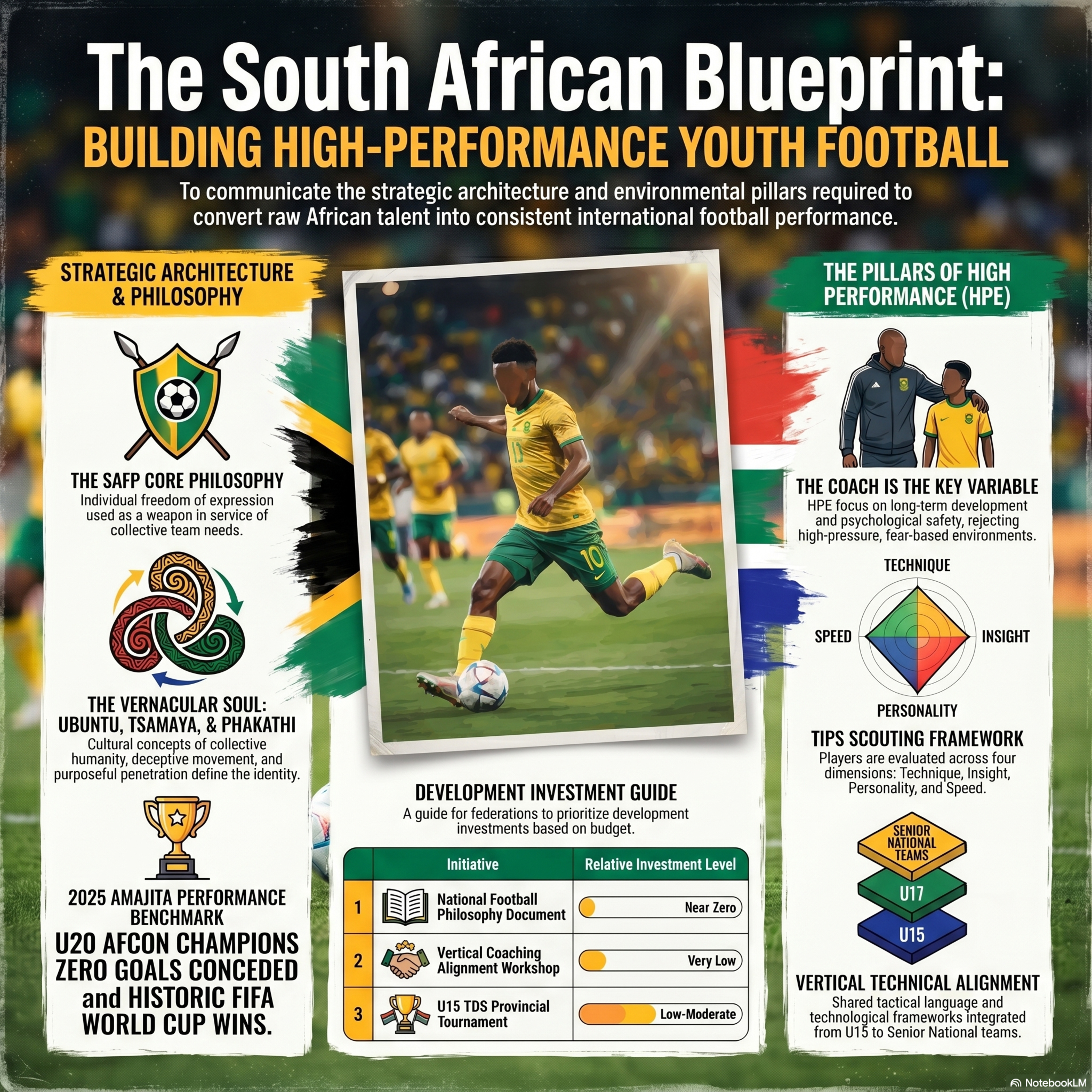
Tactical amnesia, Yeah. But South Africa took Dimitri's 1995 concepts, formally codified them in 2017 into the SAF, and then gave them real operational teeth at a massive national Teams coaching methodology workshop in January 2024. They built a consensus. So what actually is the philosophy? The brief breaks it down into 3 cultural concepts that serve as the living vernacular of the sport in South Africa. And these are crucial to understand. And I love this because it's not just dry academic jargon, it's deeply rooted in the language and the street culture of the country.
The first concept is Ubuntu. Right. Ubuntu is a deeply ingrained Pan African philosophy of collective humanity. The translation is often I am because we are OK in the context of the AF. It defines the defensive and team ethos. It means there is no room for individual glory at the expense of the collective shape. So how does a philosophical concept translate into defending on a grass pitch? Think of the team as a giant interconnected fishing net. OK, a net. If one string in that net decides to stretch out on its own to try and catch a fish, the whole net tears and the fish escapes.
Ubuntu means the team presses as one single Organism. They retreat as one. So it's heavily synchronized. Exactly. If the left back moves forward, the midfield naturally shifts to cover the space. They win and lose, as a unified block is the absolute bedrock of their tactical discipline. Right, so Ubuntu is the structure and net. But then you have the second concept, Samaya. This is the attacking soul of South African football. Samaya is the deceptive shimmy, the drop of the shoulder, the roll of the ball into the studs.
It's pure joyous individual. Flair it. Really is beautiful to watch. It's the reason a winger cuts inside, completely fakes out a defender and leaves them stranded. It comes straight from the informal St. games. But here's the crucial connection. Samaya is not allowed to exist in isolation. The SAF is explicit that individual freedom of expression is nonnegotiable. They don't want robotic players, but that flair must always serve the collective. So no showing off, just to show off. Exactly. Tricks and skills aren't ends in themselves.
You aren't doing a step over just to get a cheer from the crowd. You are using that skill as a weapon to create space and time for the rest of the team. Which perfectly leads to the third concept for coffee. This translates from Zulu or Nguni as inside, meaning purposeful penetration. Fakathi provides the discipline for Samaya. It demands that skill must penetrate the opponent's defensive lines. It must advance the ball with lethal intent or create a scoring opportunity. If you do 3 brilliant stepovers but you end up passing the ball backward or you don't advance the play, it's just showing off.
It's a useless Fakathi ensures the flare has teeth. It's the killer pass that splits the defense open. Ubuntu Samaya Fakathi, Collective Unity, Individual flare, Purposeful penetration. It's a beautiful way to describe a style of play, but here's where it gets really interesting. It's how the SAFP treats failure while trying to execute these things. The framework explicitly encourages players to take initiative without the fear of failure. It says the individual is encouraged to try again without losing self esteem.
And we cannot overstate how radical that stance is in the broader context of competitive youth sports. Because normally it's pretty cutthroat. Oh, absolutely. In many standard high pressure Academy environments, the entire system operates on fear. Kids are constantly competing for limited spots. Coaches often act as selectors who cut players from making mistakes, rather than acting as developers who help them learn from those mistakes. So a mistake in a typical Academy, say trying a risky Fakathi pass and giving the ball away, means you might get benched or worse, sent home.
It's a selection event. It defines your worth. Exactly, but the SAFP demands that a mistake is treated purely as a development event. It replaces FEAR with what they call Game Based Learning, or GBL. Game based learning. Yes, the philosophy mandates that training must always resemble game character. They don't want kids doing isolated robotic drills where there is no pressure. They want a chaotic game, realistic environment where kids are forced to try things, fail and try again even at the under 12 level in a community league.
If you think about it, this applies perfectly to the workplace too. If you manage A-Team and you scream at an employee every time they make a typo on a first draft, they're going to stop proposing new ideas. They adopt A fixed mindset. They'll just play it safe to avoid getting yelled at. You've basically killed their Samaya. That is exactly the psychological mechanism at play. The famous research from Stanford psychologist Carol Dweck on the growth mindset is deeply embedded here. If a player knows they won't be punished for a creative failure, they will push the boundaries of their skill they develop into problem solvers.
OK, so we have the philosophy, but if we step onto the pitch, what does this actually look like tactically? How do you map Ubuntu and Samaya onto a whiteboard? The execution. They use a very specific game model, the 442 formation with inverted wingers. This is the tactical expression of the philosophy. It was presented by the highly respected South African coach Pitzo Mussimani at that 2024 workshop. And opting for A442 with inverted wingers is not a random choice. No, it is perfectly calibrated to the natural South African talent profile.
Let's explain what an inverted winger actually is, because it's key to this. Traditionally, if you have a winger on the right side of the field, they are right footed and their job is to run down the sideline and cross the ball into the middle. That's the old school way, yeah. But an inverted winger is the opposite. You put a left footed player on the right side or a right footed player on the left. Precisely. And what that naturally forces the player to do is cut inside, toward the center of the pitch, onto their stronger foot.
This unleashes that Samaya, that individual freedom to dribble at defenders, but more importantly, it creates asymmetric overloads and attack. When the winger cuts inside, it drags the defender with them opening up a massive lane down the sideline for the fill back to Sprint into. It creates chaos for the defense. But out of possession, it demands the Ubuntu principle. When they lose the ball, those wingers don't just hang out up top waiting for a pass. They drop back and the team forms 2 highly disciplined compact banks of four players.
Let's breakdown the actual phases of play because this model is incredibly granular. Let's say a South African youth team is in possession. What are they actually doing? Well, the brief says in possession the model prioritizes intelligent buildup from the back. This means no long hopeful kicks down the field, Even the goalkeeper and the center backs must be technically proficient enough to pass the ball under severe pressure. Midfielders are expected to receive the ball on the half turn, meaning their body is already angled forward when the ball arrives to facilitate rapid forward movement.
And in the final third, that's where the attackers are unleashed to use disguise and one-on-one dribbling. But they do it within a set positional grid so they don't leave the team exposed to a counter attack. When they lose the ball, the out of possession phase, there is an immediate shift to Ubuntu. The model entirely rejects passive containment. They don't just sit back in their own half and wait for the opponent to make a mistake. They go after. It they deploy aggressive high pressing, every player must instantly recognize specific pressing triggers.
What does a pressing trigger look like? A trigger is a specific cue that tells the whole team to attack the ball simultaneously. For example, if the opposing center back takes a heavy, clumsy touch, that's a trigger. OK, that makes sense. Or if they play a slow, looping sideways pass, the moment that happens, the entire net of the South African team snaps shut around the ball. And the transitions, the moments right after the ball changes hands. The analysis highlights a critical 3 to 5 second window.
Transitions are where modern games are won and lost in a positive transition, meaning you just won the ball. The demand is immediate verticality. You don't mess around. You don't pass backward to settle the game down, you instantly Dr. the ball forward to exploit the opposition while their defenders are out of position. And in a negative transition when you just lost the ball. The demand is a violent coordinated counterpress within that exact 3 to 5 second window to win it back instantly. Why specifically 3 to 5 seconds?
Because after 5 seconds, the opponent has had time to look up, expand their shape and find passing options. If you don't win it back in that tiny window, the trigger is off and you rapidly retreat into your compact 442 defensive block. It sounds incredibly demanding, physically and mentally, but here's the thing. It works. It absolutely does. And we know it works because the intelligence brief provides the ultimate proof of concept with the results of the South African Under 20 national team known as Amahita in 2024 and 2025.
The results under coach Raymond Baca are a massive validation of this methodology under competitive fire on the international stage. Just listen to this run. They won the 2024 KASAFA U20 TUP. That's a regional championship for Southern Africa without conceding a single goal. Wow, zero goals conceded in an entire international tournament. Then they go to the 2025 U20 Akon in Egypt, the continental championship, and they win the whole thing, a historic first for South Africa. And then they go to the global stage, the 2025 FIFA U20 World Cup in Chile, they reached the round of 16.
They demolished New Caledonia 50 and beat the USA 21. They became the 1st South African national team ever to win two matches at a FIFA World Cup. And they didn't do it by getting lucky. No, they did it by executing exactly what the SAFP prescribes Discipline, bend of blocks, aggressive technical, wide play and managing games under intense pressure. Hold on, I'm stuck on one specific detail from their defensive setup. The tactics enforce strict 8 to 12m distances between the defensive lines, even down at the under 15 level.
Yes, that's right. If the whole point of Samaya is freedom and flair, isn't putting a 15 year old in a strict geometric grid the exact opposite of that? It sounds robotic. It sounds like putting a straitjacket on a jazz musician. It's a great observation, but the reality is quite the opposite. Think about your jazz musician analogy. Jazz only works. It only sounds like music instead of noise because the musicians all agree on the underlying key and the tempo. OK, I see. The structure allows the improvisation to shine.
Giving creativity A strict tactical home actually maximizes its impact. Because if you have no structure, you just have chaos, 11 players doing whatever they want isn't effective. That's exactly by teaching a 15 year old defensive discipline and spatial awareness. That 8 to 12m rule you ensure that when they do finally get the ball, the team is in the optimal shape to support their attacking flair, right? The structure protects the creativity. It prevents the Somaya from just becoming isolated, showing off where the player gets surrounded and loses the ball.
That makes perfect sense. The structure is the tempo, the flare is the solo. Now let's bring the focus back to that church in Rustenburg, because Sanasafamali was there to talk about something deeper than just drawing formations on a whiteboard. His core theme for these grassroots coaches was what does it take to have a high performance mindset? And this is where we have to fundamentally redefine what high performance actually means at the youth level. As Molly states, a high performance youth environment is absolutely not a high pressure environment.
Which seems so counterintuitive in sports and even in corporate culture. We've been conditioned to think high performance means screaming coaches, fear of failure and intense pressure to win at all costs right now. But decades of pedagogical research show that is counterproductive for long term development. A true high performance youth environment provides psychological safety alongside calibrated challenge. You want the task to be hard, but you want the environment to be safe. And to achieve that exact balance, the coaches at the session are taught something called the Four Co Active Model.
This is a fascinating way to design A practice session. I look brilliant. It dictates that you can never train just one thing in isolation. You have to train the tactical, technical, psychological and physical elements all synchronously. Right. It means the days of sending kids out to run mindless laps around the pitch to build fitness are over. Why running builds stamina? Right. It builds physical stamina, yes, but a simple linear run is cognitively useless in a football match. You are never just running in a straight line with no obstacles.
That's true. You're constantly calculating space, anticipating the ball, and managing your own frustration or excitement. If you isolate the physical training, you are wasting valuable developmental time. So what's the alternative? Let's walk through a concrete example of this four Co active model in action on that dirt pitch in Rustenburg. OK, instead of a lap, the coach designs a small sided game, let's say A4 versus 4 match on a very tight constrained pitch. To succeed in this drill, the players have to constantly scan their shoulders, make complex split second decisions about whether to pass or dribble.
That covers the tactical and psychological element. OK, that's 2. They have to execute tight passing and close control under pressure. That's the technical element. And because it's non-stop action on a small field with no place to hide, their heart rates are going to be absolutely through the roof. That's the physical element. It's. Brilliant efficiency. You hit all four coactives in one single drill. The 14 year old brain is processing spatial geometry, physical exertion, emotional regulation, and ball control all at the exact same time.
And to execute that properly, the intelligence highlights a critical pedagogical shift that youth coaches have to master. And it entirely depends on the biological and cognitive age of the kids they are coaching. They divide it into the youth development phase, or YDP, and the professional development phase, the PDP. This is where so many youth programs, and frankly a lot of corporate training programs get it totally wrong. So what is the YDP? The YDP covers players from under 12 to under 16. In this window, the cognitive development of the child dictates that they need positive hands on highly instructional coaching.
So very direct. Yes, you are building foundational technical habits and movement patterns. You are fostering a love for the game without inducing anxiety. It's about technical repetition and establishing the absolute basics. You literally show them exactly where to place their foot when striking the. Ball and then they hit the PDP, which is under 17 to under 23. The stakes get higher. And here, the coaching style has to shift radically. You move away from didactic instruction telling them exactly what to do, and move toward guided discovery.
Guided Discovery. You use intense tactical periodization. Instead of telling a 19 year old to pass to the left, you stop the drill and ask them questions. Why did you make that pass? What did you see the defender doing? Making them think. Because by that age they should already have the technical tools. Now you must refine their split second decision making under duress. Confusing these two phases is a fatal developmental error. If you screen complex tactical demands at a 12 year old, you just create a highly anxious child who hates the sport.
And if you treat a 20 year old like a beginner who needs to be told exactly how to pass the ball, you stunt their tactical maturity. They never learn to think for themselves. Exactly. The coach must adapt to the biological and cognitive stage of the player. You are managing the evolution of a human brain, not just a pair of legs. Which brings us perfectly to the next massive of challenge for any national system, finding those players in the 1st place, the scouting pipeline. This is a huge logistical hurdle.
Because South Africa has an incredible resource but also a massive logistical nightmare. The numbers here are just staggering. The South African Football Association Safa uses a digital platform called May Safa and they have over 500,000 FIFA registered players on it, half a million players. It is a massive data foundation. The theoretical visibility into the talent pool is incredible compared to decades past. But as any data scientist will tell you, a massive data set is completely useless without a precise filter.
Right. How do you find the right needle in a haystack of half a million? Well, they use the FIFA talent development scheme, the PDS, they run these massive under 15 interprovincial tournaments. But there is a very deliberate, fascinating constraint they apply to these tournaments, right? They mandate that the games are played 9 versus 9 on the significantly smaller fields. Why not just play normal 11 aside football? That's the real game, right? Wait, so if they were playing 9V9 on a tiny pitch, the kid who relies purely on being faster or taller suddenly has nowhere to run?
They're neutralizing the biological advantage to force them to use their brains. Exactly. That is a brilliant piece of environmental design. In a full size 11 V 11 game on a massive pitch, a kid who is just naturally bigger and faster at age 14 can dominate the entire game simply by outrunning everyone. Right. Just bully past the smaller kids. It completely masks a lack of actual football skill. The scout watches the game and thinks, wow, that kid scored three goals, He's a genius, but really he just hit puberty a year early.
But on a small field, speed doesn't save you. You can't just kick the ball past a defender and beat them in a foot race because the sideline is right there. You run out of room. The tight spaces expose your true technical ability, your first touch under pressure, and your positional intelligence. It forces exponentially more decisions per minute. The scouts can actually see who has the Samaya and the fukathi rather than who is just physically dominant today. This connects to a huge warning from South Africa's technical director Mullah Finki, about biological literacy in scouting and something called the relative age effect.
It's a widely known cognitive distortion in sports scouting globally. The relative age effect means kids born in January of a selection year are often significantly physically bigger and emotionally more developed than kids born in December of that exact same year. Nearly a full year of extra growth. At age 14, an 11 month age gap is a massive biological chasm. It's like judging a baking contest where 1 Baker was given a 30 minute head start. The big 14 year old born in January isn't necessarily a better player with a higher long term ceiling.
They just started growing sooner. And if your scouts aren't biologically literate, if they don't understand how to account for that growth disparity, they will consistently pick a squad full of early matures. And what happens then? Those kids will dominate it under 15, but they will completely plateau by age 18 when everyone else catches up physically. Meanwhile, your system has systematically ignored the smaller, highly technical late developers who would have been international superstars at age 21.
To combat this bias on the dirt pitches, they train their scouts using a practical taxonomy called the TPS Framework, Technique, Insight, Personality, and Speed. It's a framework originally developed by the famed Ajax Amstram Academy, and it aligns perfectly with the South African philosophy. Let's look at how a scout measures this In reality. Technique is the ball control under pressure. That's the Samaya. Are they comfortable when 2 defenders are rushing them? Insight is spatial awareness and decision making.
That's the facathy. Does the player look over their shoulder before receiving the ball? Do they see the passing lane before it opens? And personality. That's Ubuntu. Is the kid resilient when they make a mistake? Are they coachable? Do they track back to defend when they lose the ball, putting the team first? And speed isn't just about running fast. Exactly. Speed isn't just about running fast in a straight line. It's explosive agility, the ability to change direction, and crucial cognitive speed.
How fast can their brain process a changing scenario which is required for their high pressing game model? And the analysis points out something fascinating about how this TPS framework completely redefines the role of the goalkeeper. The modern South African goalkeeper is no longer just a big kid who stands on the goal line to stop shots. Not at all. Under this high performance system, the goalkeeper is the explosive, sweeping first line of attack. The sweeper keeper. Because the team plays a high defensive line to press the opponent, there's a massive amount of empty space behind the defenders.
The goalkeeper is assessed on their footwork, their distribution under extreme pressing and their ability to Sprint out of the penalty box and sweep that empty space. That sounds terrifying for a kid. It requires incredible technical skill with their feet and immense psychological composure. So we've built this incredible scouting machine. We know how to filter half a million kids to find these 14 year old tactical geniuses who understand Samaya and Vicapi. But there's a dark side to this efficiency.
There is. Yeah. When you pluck a kid out of their community to put them in a high performance lab, you trigger a massive psychological crisis. And that brings us to a very sobering reality in the Intelligence brief, a severe warning about player welfare. Yes, the documentation sites 2026 research from Springer Sports Sciences concerning isolation stress in youth football academies globally. This is the human cost of the talent pipeline. So what does this all mean? It explores the compounded psychological burden placed on kids who are identified as talented and then extracted from their rural homes to live in centralized residential academies in big cities.
The burden is multifaceted and immense. You take a 14 year old child out of their family unit and their familiar school. You put them in a high stakes, hyper competitive environment where their peers are also their rivals and where they know they could be cut from the Academy at the end of the season. That's intense enough on its own. And then you layer on the socioeconomic expectation that they are the golden ticket who will eventually secure a European contract and provide financially for their entire extended family back home.
The pressure must be suffocating. It leads to severe psychological distress, anxiety disorders and impaired overall well-being. We are treating children like financial assets and their mental health collapses under the weight. And this is where the intelligence connects right back to that church in the Northwest Province, because a community league like the Rustenberg Junior League offers a dramatic structural advantage when it comes to player welfare. Exactly. The players in Rustenberg aren't living in sterile dormitories hundreds of miles from home.
They are still sleeping in their own beds. They are attending their own schools. They have their support system. They have their families, their friends and their community networks intact. Community based environments offer dramatically higher emotional and social support, which actually builds the resilience required for high performance. The documentation frames this through the lens of the South African Governments Department of Sport, Arts and Culture, the DSC. They operate under what they call a social compact.
The government views football development not just as a sporting endeavor, but as vital national infrastructure. In a country dealing with high youth unemployment and social challenges, football is a tool for national cohesion and a direct mitigation strategy against idleness and despair. So investing in a methodology session for volunteer coaches in Rustenburg isn't just about winning football matches down the line. It's about keeping kids engaged, building community leadership and providing structure.
And doing it affordably. And doing it at a fraction of the cost of traditional bureaucratic social welfare programs. It's essentially youth development and social welfare disguised as football training. It is a brilliant systemic synergy. However, the analysts behind this brief are also intellectually honest. They don't pretend this system is a flawless fairy tale. Oh, there are definitely gaps. There are significant gaps that South Africa still hasn't solved and any federation looking to replicate this needs to be aware of the pitfalls.
Right, let's pull back the curtain and talk about those flaws. First is the glaring issue of physical conditioning on the global stage. Even with all this beautiful philosophy, there are stark physiological realities when you face the rest of the world. We saw this at the 2025 Under 20 World Cup. Despite their incredible technical run, Amahita was eventually eliminated by Colombia. The brief notes a poignant observation by former professional player Nathan Pauls, who analyzed the tournament. He pointed out that against European and South American teams, only three South African players actually matched the physical profiles.
The height, the muscle mass, the sheer athletic power of their opponents. So they have the technical skill, the Samaya, the tactical geometry, but they are literally getting physically bullied off the ball at the highest international levels. It's an environmental gap at the community level in places like Rustenburg. They simply don't have the sports science support, the advanced nutritional education, or the highly calibrated physical periodization that European academies have as a standard baseline.
It's a resource issue at that point. The tactical philosophy is world class, but the physical conditioning environment severely lags behind. Another huge structural gap the intelligence highlights is the friction between the National Federation Safa and the massive professional clubs, the Premier Soccer League's big three like Mamelodi Sundowns, Kaiser Chiefs and Orlando Pirates. This is a classic football administration problem globally, but it's acute here. The massive wealthy clubs operate their own own elite, highly funded academies.
And they have their own agendas. And their coaching methodologies don't always align with the national tactical vocabulary Safa is trying to build. A club might prioritize a completely different style of play because their only goal is to win the local pro league, not to serve the national team. So they're producing players to survive the local league, not necessarily to fit the Bufana Bufana game model. That tactical incoherence undermines the national team. When you try to bring all these players together for an international tournament, they aren't speaking the same football.
Language. Exactly. And then you have the implementation gap. It's one thing to have a brilliant PDF document outlining the SAFP, but what happens on the ground? Right. The reality is that there are over 7000 local qualified coaches spread across a massive geographic area. The vast majority of them still lack access to the technological frameworks, the video match analysis tools and the continuous education that Sinisi Fomali was providing in Rustenburg. The architecture is built beautifully at the top, but it hasn't deeply penetrated the grassroots nationwide yet.
And we absolutely must mention the crucial need for women's pathway parity. The brief notes that while the senior women's team Benyana Benyana won the 2022 WAFCON and has achieved incredible global success, the grassroots infrastructure and financial investment for young girls still severely lags behind the boys pathway. It's a critical warning for other federations. You cannot treat the women's development pathway as an afterthought or a secondary priority. If you want systemic, holistic national success, you are ignoring half of your potential talent pool.
I have to ask a tactical question here, going back to the game model, If the entire Bufana Bufana playbook, the 442, the inverted wingers, the specific pressing triggers is fully documented and taught everywhere, doesn't it make the national team entirely predictable to their opponents? If I'm managing Nigeria or Senegal, I just read the SAFP document and I know exactly what South Africa is going to do. If we connect this to the bigger picture, it's a very valid concern. The brief actually quotes the senior national team coach Hugo Bruce acknowledging this exact vulnerability.
He noted that he fully expected opponents to do their homework on South Africa ahead of the next AFCON. Because everyone knows exactly how they are going to set up. Right, but the lesson here is that a high performance system must continuously evolve. It cannot just be about executing a static plan from a 2017 document. So it's more of a foundation. You build the foundation, the SAFP, so that your players share a baseline tactical language, but the specific applications, the set pieces and the micro tactical variations must constantly adapt to counter the opposition's homework.
The philosophy is permanent, but the tactics must be fluid. So we've looked at the incredible successes, the deep philosophy, the physiological and structural gaps. The final section of this intelligence is a blueprint for African replication. Yes, the how to guide. How can other federations like Kenya, Uganda, Rwanda or Ghana actually take this and do it themselves? And the brief emphatically debunks a massive, paralyzing myth right out of the gate. The funding myth. The funding myth The analysts argue fiercely that replicating the success is not primarily about having millions of dollars in the bank to build shiny new academies.
Because, as we discussed, academies can actually be detrimental to welfare if not managed perfectly. The brief provides a highly actionable cost ladder for federations. Let's look at the very low cost steps that any country could implement tomorrow. Step 1. Document a national playing philosophy. It cost practically $0.00 to gather your best football minds in a room. Decide what your country's unique football identity is, write it down clearly, and distribute it to your coaches. It creates instant vertical alignment from the under twelves to the seniors.
Step 2 Hosting vertical coaching alignment workshops. Bringing your under 15, under 17 and senior national coaches together for a 2 day symposium to get on the exact same page regarding tactics and pedagogy. Again, the cost is minimal. Step 3. Running community knowledge transfer events exactly like the one in the Church in Rustenburg. Take your top analyst, your UEFA certified minds, and have them present directly to grassroots volunteers in school halls, churches and community centers. You are building an analyst educator culture without needing to build a single brick of stadium infrastructure.
The brief also shares a highly innovative, entirely unexpected detail about about how Safa is circumventing infrastructure costs to reach kids. They have formally integrated an E sports pathway. They call it Ebafana. Yeah, this is so clever. They are formally registering players and competing in FIFA and Rocket League. This blew my mind at first. You think, What does playing a video game have to do with developing physical football talent? It is incredibly forward thinking in Africa. The socioeconomic reality is that mobile device and Internet penetration is growing exponentially faster than physical stadium infrastructure.
Right, everyone has a phone. Building a pristine grass pitch in a rural area is expensive to build and expensive to maintain. A smartphone is already in the kids hand. By embracing E sports, the federation captures a massive demographic of digitally native youth. Exactly, and it identifies kids with elite cognitive processing, spatial awareness and hand eye coordination who might lack traditional physical markers or access to a local team. That's a great point. Furthermore, it's size steps the massive costs of physical facilities while generating entirely new commercial sponsorships and broadcasting revenue that can then be reinvested back into the physical game.
It's a brilliantly modern doorway into the national system. And when you put all these systems in place, the philosophy, the coaching alignment, the technological integration, the global rewards follow. The Intelligence points to a May 2026 memorandum of understanding with the German Bundesliga as the ultimate proof of this. Yes, under this massive MO U, the South African Under 16 team gets to travel to Germany and train directly against the elite academies of Verter Bremen and our media Bielefeld.
That is massive exposure for those kids. It bridges that physical conditioning gap we talked about earlier. It does, but the crucial point the analysts make is that these global partnerships follow systemic credibility. They do not precede it. Germany didn't partner with Safa out of charity or just because South Africa has raw talent. They wanted to see a system. They partnered because South Africa proved through measurable results like the U20 AFCON, that they have a highly functional, intellectually rigorous, high performance architecture in place.
The system attracts the investment. So let's bring this all together for you, the listener. We started this journey looking at a massive global paradox, the staggering talent of an entire continent failing to translate into global dominance. And the answer to that paradox wasn't found in a billionaire's checkbook. It wasn't found in building a fancier weight room. It was found in defining A cultural philosophy. It was found in translating concepts like Ubuntu, Samaya and Fakathi into a rigid tactical framework that still allows for joy.
Redefining failure. Yes, redefining failure from a punishable offense into a necessary learning event. And above all, it was found in the deliberate systematic transfer of elite cutting edge knowledge from the very top of the professional game straight down to the grassroots level. The gap between exporting raw talent and winning on the world stage is purely organizational, and whether you are building a National Football team, running a corporate division or designing an educational program, the lessons of the South African way are universal.
It is about radical systemic alignment. Which leaves us with a fascinating final thought to ponder. We are so conditioned to look to massive multi $1,000,000 residential academies with pristine grass pitches and biometric labs is the only viable future of elite sports, right? But what is the real frontier of global football? Dominance isn't about building better facilities. What if the ultimate competitive advantage is simply taking the elite tactical intelligence usually reserved for international locker rooms and handing it directly to a parent volunteering on a dirt pitch on a Saturday morning?
That is a powerful image. The next time you see a systemic failure in your own industry or a talented team underperforming, ask yourself, are we just endlessly searching for better talent, OR are we failing to build the environment that allows the talent we already have to actually thrive? Thanks for taking the deep dive with us. We'll see you next time.
 Apple Podcasts
 Castbox
 Castro
 Goodpods
 Moon FM
 Overcast
 Pocket Casts
 Podbean
 Podcast Addict
 Podcast Republic
 Spotify