The Performance Imperative For African Women Football
About this episode
The Performance Imperative For African Women Football
I really need you to put yourself in the room with us for a second here. Like literally imagine you've just walked out of this completely closed door strategy session. You know, the kind of high stakes, highly guarded room where the entire future trajectory of a, well, a multimillion dollar sporting enterprise is just being dictated. Oh, yeah, The energy in there was just, I mean, it was thick, very tense, urgent. Extremely urgent. People were leaning over these massive boardroom tables, pointing at shifting data visualizations, debating these huge structural overhauls, just calculating the exact margins of victory and defeat for like the next decade.
And we really wanted to pull you directly into the hallway with us right now to just process the sheer weight of what we just absorbed. Because you know the reality playing out behind the scenes right now. It's a silent, ruthless revelation. It really is and we need to look at the calendar to understand the gravity of it because today is May 18th, 2026. We are not discussing some theoretical 10 year vision for the sport anywhere. Not at all. Massive continent defining tournaments are just staring us down just weeks from now.
Right. I mean, Wafcon, Chakafa, the U20 World Cup, they are imminent. They are right here, and the mission for our deep dive today is to examine what is being called the performance imperative. The performance imperative, yeah. It's essentially A fundamental restructuring of the African game. Exactly like we are moving way past the traditional reliance on passion, you know, or raw flair and those brilliant moments of unstructured magic. We are entering this incredibly unforgiving era of verified data, technological arms races, and just unprecedented player optimization.
And I mean, this shift from subjective observation to objective reality, yeah, it completely changes the very foundation of how a club operates because for generations, the narrative around African football has leaned heavily on terms like, you know, unpredictable or raw talent, instinctive. Right, which are great things. They are. They're beautiful and foundational, but, well, they are completely insufficient on their own to sustain dominance at the elite global level today. Yeah, that makes sense.
The performance imperative tates this brand new reality. Talent must be quantified. It has to be tracked and optimized through rigorous data architecture. We're looking at a system that takes those subjective feelings and turns them into hard, actionable facts. It's restructuring the entire global valuation of African football. And for you listening, you know, whether you are managing a club, maybe you're scouting emerging talent OR you're just heavily invested in the future of the game. This shift alters the valuation of the athletes, the clubs, the whole ecosystem, which brings up this massive dilemma.
If the global game is operating entirely on verified data, what happens to the teams and the executives who are still relying on their gut instinct? Like, that traditional way of operating can't just be charmingly old fashioned anymore, right? No, it is crossed the threshold into active liability. I mean, the central argument right now at the highest levels is that operating without technological oversight is actively harmful to the WOW. Active liability. Yeah, the standard is stark. They are saying that every single training session conducted without GPS monitoring is classified as capacity loss permanently.
Capacity loss permanently, that is. I mean, that's a heavy phrase. It suggests this physical deficit that a club can never recover no matter how hard they train the next week. Break that down for us. Why does a, let's say an unmonitored Tuesday morning session create a permanent deficit? So the human body operates on this principle of compounding physiological adaptations. Right when athlete trains, the coaching staff is applying a highly specific mechanical and metabolic load to that body. Like trying to build specific muscles or stamina.
Exactly. The goal is to provoke a targeted adaptation. Maybe you're trying to increase their anaerobic threshold, or strengthen fast twitch muscle fibers, something like that. But if the staff does not measure that applied load with absolute pinpoint precision, they have no verifiable idea what adaptation they just triggered. Oh. Wow, so they could be doing the total opposite of what they need. Precisely, they might have under trained the player right, leaving their cardiovascular system completely unprepared for the 80th minute of a match.
Or conversely, they might have over trained them, pushing their soft tissue dangerously close to tearing. Right. And when that Tuesday session ends? That critical window to correctly calibrate that specific day's physical development just closes. You can't just train twice as hard on Thursday to build the foundation you failed to measure on Tuesday. Because the biological calendar of a season is totally unforgiving. Exactly. Therefore, that unmeasured opportunity is capacity lost permanently. To put that into perspective, though, I mean, African football has historically been celebrated for the intuition of its coaches.
We hear all the time about tacticians who have the eye test. The eye test, yeah. You know, the ability to watch a player warm up and intuitively gauge the remaining stamina. They've spent decades feeling the rhythm of the game. So is that deep human intuition just completely obsolete now? Well, no. Intuition remains a powerful starting point, but the current landscape requires that intuition to be verified. Think of the coach's gut feeling as the hypothesis and the data architecture as the empirical proof.
I like that hypothesis and proof. Right, because in a highly competitive environment, if your opponent knows down to the decimal point how fast their wingers can Sprint and the exact volume of high speed runs they can execute before their hamstrings fail, and you were just countering that with a guess based on how a player looks from the touchline. You're at a catastrophic disadvantage. Completely. You're essentially bringing a feeling to a factual arms race. It makes me think of a Formula One race.
Like imagine a team has a brilliantly engineered car and a driver with incredible instincts, but their dashboard is completely blacked out. No speedometer, no tire temperature gauge, no fuel indicator. Just driving blind. Yeah, they're driving purely on the sound of the engine and the vibration of the chassis. Meanwhile, the competing car has this dedicated pit wall analyzing real time telemetry, adjusting aerodynamics milliseconds before a turn. The driver without telemetry might survive a few laps on pure genius, sure.
But over 50 laps. Exactly. Over A50 lap Grand Prix, the team with verified data will systematically dismantle them. So African football clubs operating without data are basically driving blind. That telemetry analogy perfectly captures the decision matrix facing sporting executives today. Because, look, in previous decades there was a grace period. Right. You could catch up, yeah. Clubs could slowly adopt new sports science methods over several seasons without falling irreparably behind, but that window of gradual adoption has definitively closed.
So what are the options now? The Decision Matrix only presents 2 viable paths for leadership. You either aggressively embrace this technological infrastructure or you actively manage the decline of your organization. Manage decline. That is grim. Standing still is literally the equivalent of moving backward relative to the accelerating global standard. Managing decline implies overseeing the slow systemic depreciation of a club's edge. But I can hear the counter argument right now. People will say, well this level of tech is a luxury reserved for massive European clubs with unlimited capital.
You know, they'll ask if this data-driven approach can actually work at scale in the realities of African clubs. The skepticism regarding scalability is definitely a hurdle, and that is exactly why the empirical evidence currently emerging is just so vital right now. Because it's not just theory anymore. Right. This isn't a theoretical exercise reserved for European academies. We have definitive proof of concept operating at an incredible scale right now, which is formalized as the Salisbury blueprint.
OK, the Salisbury Blueprint, this moves the conversation out of the boardroom and onto the training pitch breakdown, the mechanics of this implementation for us. So the model executed by Salisbury Inter basically obliterates the assumption that comprehensive tech integration cannot be achieved within the African sporting ecosystem. This was not a small trial. It wasn't just like handing out 10 trackers for a photo op. Exactly. It wasn't APR stunt for social media. The Salisbury implementation deployed 100 tracking units across a roster of 320 athletes.
Wait. 100 units across 320 athletes. Yes. The defining characteristic here is that it was implemented at scale. It serves as the definitive blueprint for full squad competitive periodization. The logistics of that are wild. Managing 100 units across 320 athletes is a massive data writing challenge. You mentioned competitive periodization. How do you even apply periodization to 320 entirely different human bodies at the same time? That is the magic of it. Competitive periodization of the Salisbury Scale involves actively managing the peak physical condition of athletes who have vastly different physiological profiles all simultaneously.
Give me an example of that variance. Well, the system has to account for, say, 17 year old Academy prospects whose musculoskeletal systems are still actively developing, but at the exact same time it has to track 24 year old senior players who are at their absolute athletic peak. Right, the bodies can handle way more load. Exactly, and then you add in 32 year old veterans who require highly customized recovery protocols just to maintain match fitness. And beyond age, positional demands dictate entirely different physical loads.
Like a central defender versus an attacking wing back. Precisely their metabolic requirements are totally fundamentally different. So when you add in varying competition schedules across youth leagues and elite continental tournaments, the data volume is staggering. I can't even imagine the spreadsheet for that. But the Salisbury Blueprint proves it works. An organization can ingest millions of physical data points daily, process them, and structure the training cycles so that every single one of those 320 athletes physically peaks exactly when their specific match schedule dictates.
Wow, it's basically a global supply chain load balancing system. That's a great way to look at. It like a massive logistics network where 320 distinct packages, all with different weights and fragilities and delivery deadlines have to be routed through a central hub without a single bottleneck. And the system knows that the 17 year old package needs different handling than the veteran package. Yes, and the fact that this blueprint originates from groups with footprints and demanding environments like Nairobi and Sandy Springs.
It represents an indigenous adaptation of global standards. It completely neutralizes the logistical excuses that clubs have leaned on for years. It does. It establishes a brand new operational baseline. But a model like Salisbury succeeds so comprehensively it forces a structural reckoning. It makes every other organization look in the mirror and ask why can't we track our 25 senior players if they are successfully managing 320? That is a tough question for a sporting director and answer, but obviously executing an operation of that magnitude is entirely dependent on the hardware, right?
Because if the physical tech is constantly breaking, or if it's annoying for the players to wear, the whole system collapses under its own administrative weight. Absolutely. The transition from theory to the physical gear is the bottleneck for a lot of clubs. Because to turn those subjective feelings into facts, for hundreds of players, the hardware has to be virtually invisible to the athlete, but impossibly powerful for the data analyst. And the specific tech driving this right now is the Soccer B Pro 2.
Let's get into the specs. Right, The physical and technical specifications of the Soccer B Pro 2 are exactly what facilitate the scale we saw in the Salisbury model. These are elite specifications engineered to solve the real world friction of deploying tech in unpredictable environments. First off, the physical unit weighs 38 grams. 38 grams. I mean, for you listening, that is roughly equivalent to carrying a couple of standard AA batteries. It's nothing. When players insert a device that light into their performance fest, it effectively disappears because we've seen it before.
If a club tries to strap some heavy, bulky tracker to an elite athlete, the resistance is immediate. Oh, they hate it. They will immediately report that it alters their center of gravity or messes with their rotation. Right, but by engineering it down to 38 grams, the psychological and physical barriers to adoption are just neutralized. Exactly, but removing the friction is just step one. The internal architecture of the device is what dictates the actual quality of the data. The unit utilizes multi band GNSS which ensures full satellite redundancy.
OK, GNSS stands for Global Navigation Satellite System, but the critical term there is multiband. Let's explore the physics of this for a second. Why is a standard GPS signal not good enough for an elite football club? Well, a standard single band GPS tracker relies on one frequency from one specific constellation of satellites. OK, so if that signal hits atmospheric interference or if the team is training in a dense urban environment where signals bounce off buildings, which is a phenomenon known as multi path interference, the data quality degrades incredibly fast.
You get those weird spikes on your fitness app where it says you ran through a wall. Exactly, can't have that at the elite level. Multi band GNSS means this 38 gram tracker is communicating with multiple satellite constellations simultaneously. GPS, Galileo, Geo, and AS all across multiple frequency bands. So if one signal path gets blocked, it just instantly on the redundant networks. It guarantees A continuous high fidelity data stream, but even with multiband tracking, stadium architecture presents a unique problem, which is why this device incorporates IMU Fall back.
IMU Inertial Measurement Unit. Let's talk about stadium blind spots, because I think a lot of people don't realize this happens. It's a huge issue. In these massive stadiums, you often have huge cantilever roofs or really duck grandstands, and they create physical barriers that satellites just cannot penetrate. So if a player makes this high speed overlapping run down the touchline right into the deep shadow of that grandstand, older tech just goes dark. The data for that explosive game changing movement is completely lost.
Right, So how does the IMU fall back solve that? It's a process very simple, similar to dead reckoning. When the satellite signal is physically blocked by the stadium roof, the internal accelerometers and gyroscopes inside the IMU instantly take over. Without missing a beat. Literally without missing a millisecond. The gyroscopes measure the angular velocity of the players movements and the accelerometers track linear acceleration. The device continuously calculates the exact speed, trajectory and location until they run back out of the architectural shadow and the satellite reconnects.
So there are literally 0 stadium blind spots. It captures every single meter. Every single meter. And equally important is the operational lifespan. Yeah, it features a 14 hour battery life. Which is so crucial because the reality of the football calendar demands it. Tournament environments are chaotic. You might be operating out of a remote training ground with like 2 functioning power outlets. And if your sports science staff has to babysit battery levels and rotate 30 trackers on and off chargers all day, they will inevitably miss data capture.
Right. A 14 hour battery eliminates charging anxiety completely. A single charge gets you through the pre match warmups, the 90 minute match, the tactical cooldowns, and the recovery sessions. It's built for real world friction. Exactly so with this robust hardware continuously capturing millions of data points, the next phase is establishing kinematic benchmarks. Kinematic Benchmarks. Yes, the data Max the exact physical demands of elite competition. By quantifying the sport in the DPM distance per minute and segmenting it by position, we established the absolute baseline for survival on the pitch.
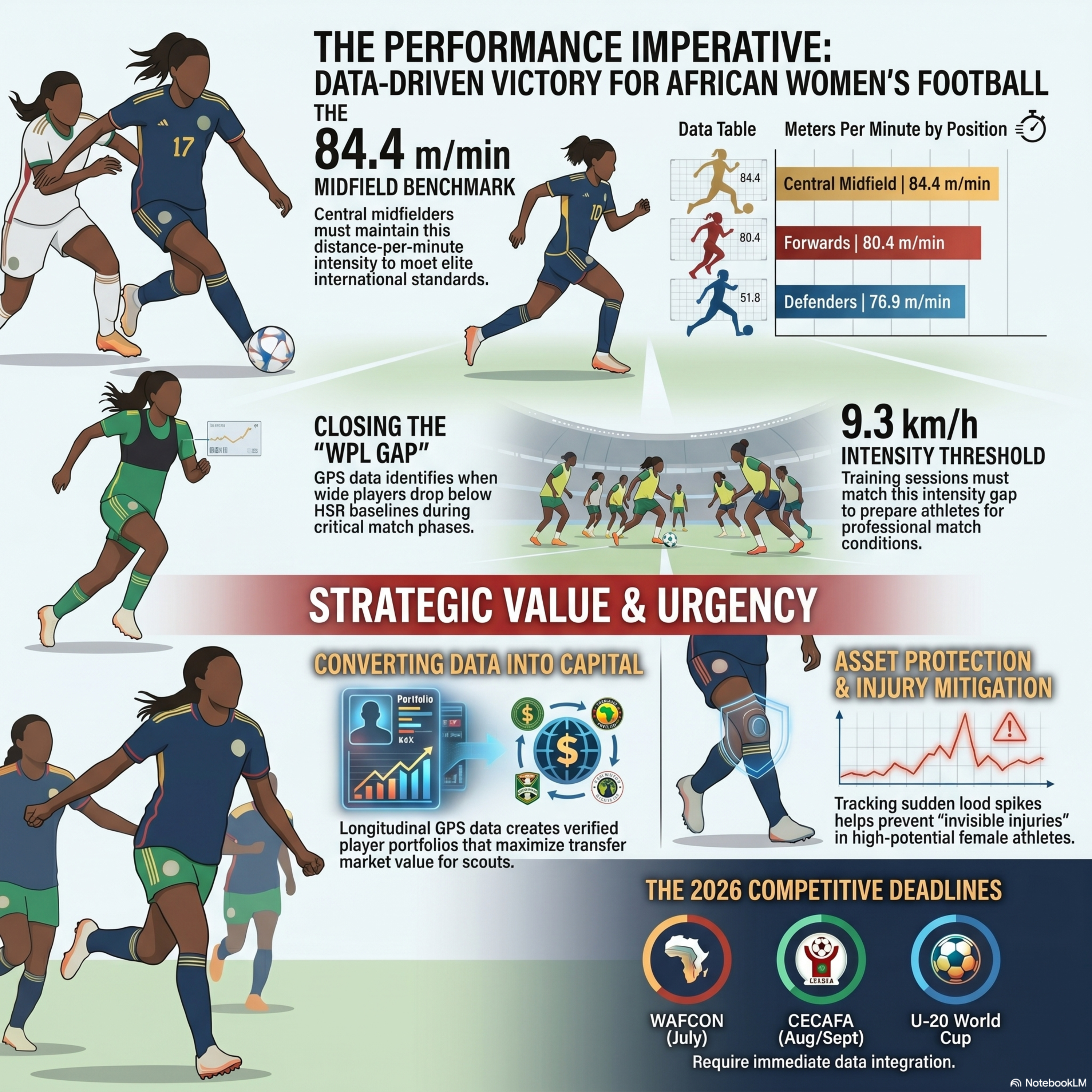
These benchmarks are undeniable. They reveal the sheer volume of athletic output required before a player can even begin to exert their technical skill. What do the numbers actually look like? They are highly specific. For central midfielders, the established baseline is 84.4 meters per minute, for forwards the requirement is 80.4 meters per minute, and for defenders it sits at 76.9 meters per minute. Just visualizing those numbers clarifies how severe the elite game is. A central midfielder has to cover 84.4 meters during every single minute of a 90 minute match.
That is nearly the entire length of the pitch, minute after minute, continuously. All while processing complex tactical decisions under immense pressure. If a manager fields a midfielder whose internal engine maxes out at 75 meters per minute, that player is fundamentally failing. I don't care how good their passing vision is, they are physically being bypassed by the opposition. And that physical reality introduces one of the most critical tenets of modern sports science, the absolute necessity of closing the 9.3 kilometer gap.
The 9.3 kilometer gap. This is the dividing line between adequate preparation and physiological failure. Breakdown the biomechanical rules here. So the threshold of 9.3 kilometers per hour is commonly used to delineate the boundary between just moderate aerobic activity and demanding high intensity running OK. The foundational rule of periodization is that the intensity a player faces on match day must be strictly matched or slightly exceeded during their weekly training cycle. That makes intuitive sense.
If a wide players is expected to execute 30 explosive high speed sprints during a match, their muscle fibers, tendons and central nervous system must be exposed to that exact biomechanical stress during Tuesday and Wednesday training. You can't just jog all week. You cannot run training sessions at a comfortable jog, failing to cross that 9.3km threshold and then magically expect the athletes bodies to withstand the violent demands of a Saturday fixture. Logical gap between the low training intensity and the high match intensity is exactly where structural injuries happen.
That is the danger zone. It's a failure of specific adaptation. It's like preparing A structural support beam for a skyscraper. If you only ever test the steel to withstand 50 tons of pressure in the factory, you can't suddenly subject it to 100 tons of force in the real world and expect it to hold. It will snap and if a coaching staff isn't matching match intensity and training and they don't have the GPS telemetry to verify their loads, they are completely blind. They're relying on hope. Which is the exact opposite of a strategic performance imperative.
But let's take this from the training ground into the match day environment, because that is the ultimate test. The hardware gets the baseline metrics in preparation, but how does a manager use these live demo streams during the chaos of a competitive match? The application of real time telemetry on the touchline alters the fundamental nature of in game tactics. The clearest example is the HSR trigger. High speed running. Yes, high speed running. This metric does not track a player's general jogging or positional shuffling.
It specifically measures the explosive sprints designed to break defensive lines, generate overlapping runs or track back on a counter attack. It's the most metabolically expensive movement on the pitch. And tactically vital. Right, because high speed runs alter the geometry of the game. They create the space that dictates the final scoreline. Walk us through a high stress scenario using this trigger. OK, imagine the 70th minute of a tightly contested match. The manager is observing their wide midfielder.
To the naked eye, the players general posture looks fine. They're maintaining the defensive shape. A traditional evaluation based on the eye test would say leave them on the pitch. Exactly. But the sport scientist looking at the live telemetry gets an HSR trigger alert. The data reveals that while the players total distance covered is fine, their explosive capacity, their frequency of running above the HSR threshold has plummeted way below their established baseline. And the tactical implications of that are immediate.
If a wide midfielders HSR capacity collapses, they lose the ability to stretch the opposing defensive line. They stop being a threat. Right. And when they can't threaten the space and behind, the opposing fullback is suddenly emboldened to push forward, which compresses the pitch and suffocates your central midfield fielders. A single hysiological failure cascades into a full structural tactical collapse. That is exactly what happens, and that alert changes the nature of the manager's intervention.
The decision to sub the player is no longer a subjective guess, it becomes a tactical imperative verified by objective telemetry. Leaving them on the pitch transitions from a calculated risk to an active tactical liability. The manager has to execute the substitution, bringing on fresh legs capable of hitting those HSR benchmarks. What I love about this is how it removes the friction from high stakes substitutions. We see it all the time. A player gets subbed off in the 75th minute, they throw a fit on the touchline.
The crowd boos. The media debates it for three days. The HSR trigger neutralized that completely. Right. A manager can just clearly articulate that the players high speed running volume dropped by an unacceptable percentage. They were statistically incapable of executing the tactics. It removes all the ego and emotion. Clarity like that is invaluable, but the secondary function of this live telemetry might be even more critical. And that brings us to asset protection. Asset protection applying A rigid economic framework to human biology because the athletes are the foundational assets generating the club's value.
Right. And using data to protect these assets involves mitigating what we call invisible injuries. Invisible injuries differentiate that from what people normally think of as sports science. Well, historically, sports science focused heavily on absolute load, the total distance an athlete ran over a week or a month. An absolute load matters, but it is rarely the primary culprit behind acute soft tissue injuries like hamstring tears. So what is the main? Culprit. The danger lies in sudden load spikes.
OK, contrast absolute load with a sudden load spike. Think of the structural fatigue of an aircraft wing. Absolute load is the gradual wear and tear the medley experiences over thousands of routine flights. A sudden load spike is flying that exact same aircraft through a violent Category 5 Hurricane that it was never engineered to withstand. Oh wow, that paints a picture. In physiological terms, a player's longitudinal data might show they are conditioned to perform 500 meters of high speed running per match, but if due to a chaotic game, they are forced to execute 900 meters of high speed running by the 60th minute, they have experienced a massive, unconditioned sudden load spike.
Their central nervous system and their muscular architecture are absorbing stress they haven't been prepared for. The muscle fibers are pushed way past their elastic limits, and this is where the catastrophic hamstring tear happens. It is an invisible injury because the structural damage accumulates on a microscopic level, totally hidden from the coach's eye, right up until the macroscopic tissue fails and the player collapses on the pitch. But real time telemetry allows the staff to see that load spike accumulating before the tissue actually fails.
Exactly. They identify the danger zone, extract the player and protect the asset. They effectively save the player season. I do wonder about the psychological impact on the players though. When we play devil's advocate for a second, if you have this highly motivated, adrenaline fueled young player and they get pulled from a crucial match in the 70th minute because an algorithmic trigger said so, is there a risk they feel micromanage? Like you're stripping the heart and freedom out of the game. That is a common concern, but the reality inside the squad reveals a very different psychological outcome.
When the underlying science is communicated transparently, the data actually empowers the athletes. Yeah, because professional football is a volatile industry, one severe injury can permanently alter a player's career. By replacing subjective fatigue guesses with factual telemetry, the club is actively protecting the athletes livelihood. That makes a lot of sense. The communication shifts. It's no longer a coach saying hey, you look tired, which any elite athlete will instinctively deny. Exactly.
They will always say they are fine, but when a sports scientist explains that the data shows their soft tissue is in the red zone and taking them out as a protective measure, players understand that they internalize that this tech extends their careers and maximizes their long term earning potential. And suddenly the resistance vanishes. They embrace the architecture. The framing shifts completely from surveillance to elite medical preservation, and protecting these assets isn't some abstract goal for a five year plan.
The temporal reality is right now. The competitive deadline imposed by the 2026 calendar is incredibly rigid, and it penalizes unpreparedness severely. Let's get into that timeline because again, it is May 18th, 2026. The Women's Africa Cup of Nations WAVCON 2026 starts in Morocco on July 25. For federation's competing in Group A, the time constraint is absolute. We have just over a 2 month runway. And biologically speaking, two months is an incredibly narrow window for adaptation. This highlights exactly why that elite benchmarking is so critical.
The GPS telemetry is being used right now in May to identify which athletes are consistently hitting Wolfcon match intensities. Because if a player's internal engine is failing to produce 84.4 meters per minute today, there is no biological miracle that will let them do it under the pressure of a July tournament. They will be physically overrun by opponents who have already closed that 9.3 kilometer at gap. The time for experimentation is over. This is the deployment phase. Federations operating without this data are walking into Morocco completely blind to their own physical fragilities.
And immediately after Wolfcon, we have this C KAFA 2026 tournament in August and September, and the stakes there elevate it way beyond a standard regional competition. Oh absolutely. C Kafa is the direct qualification pathway to the CKF Champions League. This is where physical performance on the pitch dictates the massive macroeconomic reality of the club. If a club slips up in C kafa because of, say, a failure in competitive periodization or an unmanaged sudden load spike that tears their star strikers hamstring.
The cost is astronomical. They lose the regional trophy, sure, but they directly fail to qualify for the C CAF Champions League. Which means losing millions of dollars in broadcast distributions, commercial prize money and the global prestige that brings and future investment. The entire financial security of the club for the next year depends on managing hamstrings in August. The margins are that thin and then you have the U20 World Cup, which brings an entirely different set of pressures. Right, because the U20 World Cup operates under the unforgiving glare of the global scouting network, and this environment mandates the presentation of verified athletic profiles.
Tell us exactly what that means for a 19 year old stepping onto that stage. The global scouting apparatus has evolved. Scouts from top tier European and Asian clubs do not make multi $1,000,000 acquisition decisions based solely on the visual observation of technical skill during a two week tournament anymore. They need the underlying kinematic data. Exactly, They need verifiable proof that a technically gifted 19 year old from Lagos or Nairobi has the physical engine to endure the relentless demands of A50 game season in the Premier League.
If a federation shows up relying solely on raw talent without those verified profiles, they're actively suppressing their own players. Market mobility. Regardless of how beautiful their technical execution is on the pitch. And that transition from physiological data to market mobility is the ultimate economic mechanism of the performance imperative. This is where we see how an organization functionally transforms sweat into quantifiable capital. And the economic engine driving that transformation is the verified player portfolio.
The verified player portfolio. So this involves aggregating longitudinal GPS data over months and years and structuring it into an official performance resume. Let's look at the psychology of the acquisition process. When a chief scout evaluates an African prospect. What are the inherent psychological and financial barriers, and how does this data portfolio dismantle them? The historical barrier has always been what we call the risk tax. The risk tax. Yes, a scout sees a layer with phenomenal tactical awareness and technical ability, but without access to longitudinal physiological data, the acquiring club erceives a massive degree of unknown risk.
They ask themselves, can this specific athlete withstand the extreme continuous physical load of our domestic league without breaking down? And because the subjective eye test cannot answer that question, the club prices that unknown risk into their valuation. Precisely, they offer a significantly reduced transfer fee or they demand complex trial periods to hedge their financial exposure. So the risk tax is literally a mathematical reduction in value based on the absence of empirical proof they're paying for potential, not verified capacity.
But the introduction of longitude GPS data completely eradicates that risk tax when a selling club presents a verified player portfolio that proves through irrefutable data that the athlete consistently operates at 85 meters per minute, sustains elite high speed running volumes, and recovers optimally. The whole narrative flips the acquiring club and more importantly, their financial board of directors trust the verified resume. The transaction shifts from a speculative gamble to an informed acquisition.
This empirical proof maximizes the transfer market valuation. It bridges the multimillion dollar gap between a speculative bid and a premium transfer fee. It is the direct monetization of verified athletic output. But you do hear resistance from football purists. They argue that the intrinsic magic of the sport you know a spectacular 30 yard volley, is being unfairly reduced to a sterile spreadsheet. Well, the objective is not to replace the artistic brilliance of the sport, it is to monetize that brilliance efficiently.
The spectacular highlight highlight reel. That 30 yard volley serves as the hook. It gets the scouts attention. But the highlight reel does not secure the final authorization for a multimillion dollar transfer from a club's board of directors. The board demands risk mitigation. And the verified player portfolio is the only thing that provides that. Exactly. Data is the primary currency. Organizations that refuse to integrate this infrastructure are actively hemorrhaging transfer revenue and denying their athletes generational wealth.
The highlight reel gets the interview, but the data secures the contract. Which brings us to the final element of this tech integration, mobile adoption, placing this data directly into the hands of the athletes. Mobile adoption is the true democratization of performance data. The infrastructure allows the athlete to just open an app on their phone right after a match and see their proprietary metrics. They don't have to wait for a coach to tell them how they did. No. They instantly view their distance per minute, their high speed running volume, any load spikes.
The psychological shift inside a locker room must be profound when every player has instantaneous access to their exact physical output. It revolutionizes the internal culture completely. It establishes this environment of supreme accountability and relentless self optimization. The standards of elite professionalism are embedded into their daily routine. Because when your phone gives you immediate empirical feedback that your output was substandard, you can't rationalize it. You can't deny the data.
It forces them to take absolute ownership of their physical development. They effectively become the chief executive officer of their own athletic output. The CEO of their own athletic output that perfectly encapsulates the ultimate goal of the performance imperative. The journey we've traced today really highlights the sheer scale of the transformation required by May 18th, 2026. It's massive. We looked at the biological reality that the status quo is an active liability, right? Unmonitored sessions mean capacity loss permanently.
We examine the Salisbury Blueprint, proving that managing 320 athletes is possible through rigorous data routing. And we broke down the invisible 38G architecture of the Soccer B Pro 2. Right. And how that multiband GNSS and IMU fall back eliminate those stadium blind spots. We explored the tactical application of the HSR trigger in the 70th minute, shifting from subjective guesses to verified substitutions that prevent those catastrophic sudden load spikes. And the unforgiving timeline of Wolf Con and Sakafa.
Exactly where verified capacity dictates the macroeconomics of rival of these clubs. And finally the economic engine of verified player portfolios. Converting sweat into maximized transfer capital by killing the risk tax. The integration of this data architecture is not some future possibility, It is the current operational reality dictating the survival of African football organizations right now. The decision matrix offers no compromise. You either harness this infrastructure or you actively manage your own obsolescence.
But as we conclude our analysis of this strategic shift, I want you to consider the trajectory of this technological arms race. We've detailed the massive effort to map the physical limits of athletes, quantifying stamina, high speed running, mechanical load. But what happens when the global market reaches physical parity? When everyone is perfectly optimized physically. Yes, When everyone's physical output is maxed out, where does the frontier of competitive advantage move next? Consider the possibility that the next massive technological gap in elite football will be neurocognitive.
Oh wow, tracking the brain. If the physical arms race plateaus, the next generation of invisible wearables might track the processing speed of the athletes brain. Will club start measuring spatial awareness in milliseconds? Will they quantify the exact speed of a player's decision making matrix while under severe physical duress? The transition from tracking kinetic speed to neurological speed. Exactly. Keep that neurocognitive frontier in mind the next time you watch an elite midfielder rapidly scanning the pitch to calculate the geometry of the defense before receiving a pass.
Fascinating to think about. Thank you so much for joining us in the hallway outside the Strategy Room today for this rigorous examination of the games of all blueprints. Stay curious, keep analyzing the underlying mechanisms of the sport, and we will reconvene for the next deep dive.
 Apple Podcasts
 Castbox
 Castro
 Goodpods
 Moon FM
 Overcast
 Pocket Casts
 Podbean
 Podcast Addict
 Podcast Republic
 Spotify