The Legal Heist Of Senegal's AFCON Title
About this episode
The Legal Heist Of Senegal's AFCON Title
Picture this, 6 billion people are watching, the confetti is raining down, the stadium in Rabat is just absolutely deafening, and Sario Mane is lifting the continental trophy. I mean, it was a moment of pure, undeniable triumph on the grass. The 2026 Africa Cup of Nations officially had its champion. Right on the grass. Exactly. Exactly. But then two months later, this group of men in suits, just sitting in a quiet boardroom, they stripped that trophy away and handed it directly to the team Senegal had just beaten.
So welcome to the deep dive. Yeah, I mean, it is the absolute definition of a governance earthquake. It completely shatters how we understand, you know, the finality of the sport. It really does, because we all operate under this this assumption that the referee's final whistle is the end of the story, right with the record book snapshot. Game over. But we are looking at a landscape where the real game, the game that actually decides championships, begins after the stadium lights go out. So our mission today is to tear down the walls of that boardroom.
If you were listening to this, you already know the final score of that match. We aren't here for some standard recap. No, absolutely. Not right. We are here for a master class in global sports governance. We're going to analyze the mechanics of this unprecedented retroactive reversal, unpack the hidden legal tripwires that caught Senegal completely off guard, and most importantly, figure out the vital lessons necessary to protect and elevate our African game moving forward. And to do that effectively, we really have to establish the rules of engagement for this analysis, like we are leaving fan rivalries at the door.
Yes, please. We're putting aside the massive emotional weight of Senegal versus Morocco. Instead, we are looking exclusively at the Lex Portiva, which is, you know, the global transnational law of sports, to figure out how to protect federations across the continent. We have to rigorously examine the cold facts, the specific regulatory language and, and this is key, the deep structural inequalities that dictate who actually wields power in modern football. Right, so let's get straight into the anatomy of the breakdown.
To understand how a championship can be, well, legally stolen or legally reclaimed, depending on your perspective, we really have to look at the ignition point. We need to go chronologically through the explosive final moments of that match on January 18th. Yeah, the timeline of those final minutes forms the entire foundation of the legal dispute. I mean, every single second of this sequence was later dissected by international lawyers. So picture the pressure cooker. We are at 90 minutes, +2 stoppage time.
Senegal has a goal disallowed. You can immediately feel the temperature on the Senegalese bench just spike. The frustration is palpable. Then at 90 + 8, the fuses lit the video. Assistant referee VAR intervenes and awards the host nation Morocco a penalty for a foul on Brahim Diaz. The match referee Jean Giacandala goes to the monitor, reviews the footage and confirms the penalty. And the moment that penalty is confirmed, the match ceases to be merely a physical contest of athletic skill. It instantly transforms into this high stakes legal crisis.
Because at 90 + 12 the walkout happens. The vast majority of the Senegalese squad is absolutely furious. I mean, they feel robbed. So they walk toward the tunnel in protest of the decision. It is pure, unfiltered chaos. Broadcast the entire globe. It was wild to watch. But then, at 90 + 20, after this agonizing massive delay, Saudi Omane somehow corrals his teammates. He convinces them to step back from the brink and return to the pitch, and the referee formally signals for the match to resume. And keep in mind, we are now 16 minutes past the original VAR intervention.
The the psychological state of every player on that pitch has just been completely fractured. Oh, entirely. So at 90 + 24, Brahim Diaz finally steps up to take the penalty for Morocco. The weight of an entire host nation is just resting on his shoulders. He attempts A peninka, you know that cheeky chipped shot straight down the middle and the Senegalese goalkeeper Eduard Mendi reads it perfectly and saves it. Incredible moment. The momentum swings violently back to Senegal and incredibly, in the 94th minute of this massively extended extra time, paid guy scores for Senegal.
The final whistle blows. They win one nil. It is a sequence of events that almost defies belief, frankly. I mean, teams simply do not walk to the absolute edge of the abyss, abandon all emotional composure, step back onto the pitch, survive a penalty kick, and then somehow find the focus to score the winning goal. It's phenomenal. But the twist, the thing that changes the course of African football history, happens while Senegal is celebrating. While Maney is hoisting that trophy and the Senegalese players are literally weeping with joy, the Royal Moroccan Football Federation is already treating that final whistle as the starting gun for a legal counter offensive.
Exactly. They didn't even pause to mourn the loss on the grass. Right. And the speed of their reaction is it's the most telling detail here. By January 19th, the very next day, Morocco had moved with terrifying efficiency. They filed a highly structured formal complaint with CF, the Confederation of African Football and FIFA. Just like that. Just like that, they didn't view the 90th minute chaos as some emotional protest that was resolved the moment play resumed. They viewed it as a strict liability regulatory violation.
They anchored their entire legal argument on Articles 82 and 84 of the Afghan regulations. Cloning that the walkout triggered an automatic forfeiture of the match. See, Senegal thought the whistle was the end of the war. Morocco knew it was just the deployment of a new weapon. They argue that because Senegal walked toward the tunnel, they legally abandoned the match, and therefore Morocco is the rightful champion. But when we look closely at the foundation of that Moroccan legal argument, it brings us to a detail that completely changes the complexion of this ruling.
Yeah, we are looking at the forensic center of the entire case right here. Right, what we call the main fact. Let's look at the specific wording of Article 82, because in the exportiva the exact phrasing is everything. Article 82 states that a team forfeits if it quote leaves the ground before the regular end of the match without the authorization of the referee leaves the ground. And the language there is absolute like. There is no Gray area in the text itself. It demands a complete departure from the field of play.
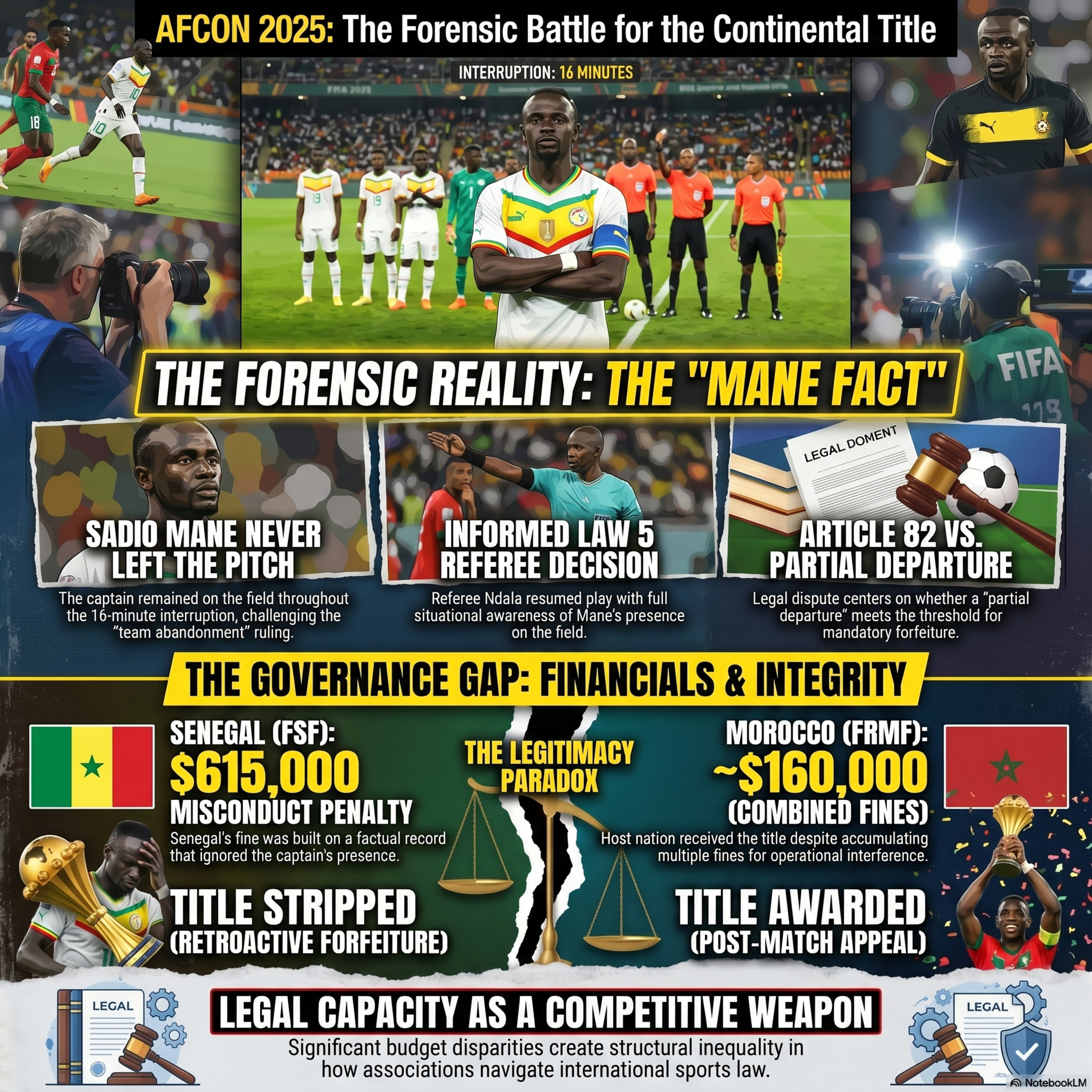
But, and this is huge, 6 billion people watch the broadcast, and the footage reveals A glaring contradiction to the boardroom's ruling. Sadio Mane never left the pitch. He didn't. He stayed on the grass. And he wasn't alone either. At least two other Senegalese players remained within the legal boundaries of the field, with him actively gesturing and urging their team mates in the tunnel to come back out. Which is critical because the legal classification of a team abandonment hinges entirely on whether the entity known as the team cease to be present.
So the presence of the captain and multiple players, it shatters the premise of a total departure. And this is where I really have to push back hard on the C CAF appeal boards logic. If the captain of the team is literally standing on the grass negotiating with the referee, how can any governing body legally classify that as a full team abandonment? Let's use a real world equivalent, you know, think of a classroom. If a teacher gets frustrated and storms out into the hallway, but leaves the substitute teacher standing right there at the chalkboard, the classroom hasn't been abandoned.
The principal walking by sees the substitute and marks. The class is disrupted, sure, but it is still functioning. A partial departure is mathematically and logically not a full abandonment. That's a great analogy. And if we push that classroom analogy into the realm of global sports law, we really have to examine the field of play doctrine, which is governed by IFAB law 5.2 IFAB being, of course, the International Football Association board, the independent guardians of the rules. Right. So what does Law 5.2 actually mandate in a chaotic situation like this?
Well, it essentially dictates that the referee is the ultimate arbiter of facts connected with play. The referee's decisions on the pitch are final. In Rabat, referee Jean Jacques Mandala has full situational awareness, like he wasn't guessing what was happening. He was standing on the grass looking directly at Saudi Omani. He knew the team hadn't fully vanished into the locker. Room, so his decision to restart the game wasn't made in a panic. Precisely when Nidala formally signaled to resume the match at 90 + 20, he was exercising his absolute authority under Law Five.
It was an informed, uncoerced decision to continue a suspended match, not a desperate reaction to an abandoned 1. The boardroom's ruling effectively overrides the on pitch authority of their own elite referee. But wait, surely the appeal board cited precedence to justify stripping the title? I mean, they must have pointed to other times this exact thing happened. Oh, they cited historical precedence, sure, but a close examination shows they are fundamentally mismatched to the events in Rabat. They pointed to the Federbache walkout in Turkey in 2024, the wide ad crisis in the 2019 See half Champions League and even matches going back to the 1920 Olympics.
OK, let's break those down. How do they actually differ from the main fact? Well, in every single one of those historical cases, the abandonment was absolute. The entire team, including the captain, crossed the boundary line, went into the dressing room, and categorically refused to return. The referee in those cases was left standing on an empty pitch, forcing a formal abandonment of the fixture. Wow. Yeah. None of those precedents involved a captain remaining on the field, maintaining A dialogue with the match officials and the referee subsequently choosing to resume play to a natural conclusion.
So the appeal board essentially took a strict liability forfeiture rule, like a rule designed for teams that get on the team bus and drive away, and weaponized it against a partial temporary disruption. They treated a protest exactly the same as a desertion. And that profound misapplication of the rule is the core of Senegal's ongoing appeal to the Court of Arbitration for Sport in Switzerland. If the collective unit never legally left the ground, Senegal argues that the threshold to even trigger Article 82 was just never crossed.
If the legal foundation for stripping the title is this fragile. If the captain was quite literally standing in front of the referee, how did the CFEF appeal board politically and logically justify handing the championship to Morocco? Because honestly, when we dig into the financial penalties handed down in that exact same ruling, we had a paradox that is incredibly difficult to swallow. Oh, the financial forensics of the ruling reveal a deeply concerning philosophy about how misconduct is weighed when a host nation is involved.
Yeah, let's look at the actual Ledger here. Senegal was hit with a staggering $615,000 fine for aggregate misconduct covering the temporary walkout, the behavior of their technical staff and their traveling supporters. I mean, for an African Football Federation, that is a financially crippling sum. It really is. It's an astronomical penalty designed to send a massive message. But then you flip the page and look at the fines levied against Morocco from the exact same 120 minutes of football. Morocco was fined $50,000 for towel gate, which is this bizarre incident where a Moroccan ball boy deliberately and physically interfered with the Senegalese goalkeeper Edward Mendy during play.
They were fined another $100,000 because Moroccan federation officials literally breached at the technical area and invaded the VAR review booth while the referee was making the crucial penalty decision. And finally, they were fined $10,000 because the home Moroccan supporters were systematically using prohibited laser pointers to blind the Senegalese player throughout the match. Let's categorize those Moroccan offenses because the nature of the misconduct is crucial here. The ball boy incident is deliberate operational interference with an opposing player.
The invasion of the VAR booth is a systematic institutional compromise of the referee's independent review process, which is ironically the very process that sparked the walkout in the first place. Exactly. And the laser pointers represent orchestrated crowd interference directly affecting player safety. It is absurd when you lay it all out like that. Like, think about this in the context of Formula One. Imagine you were in a championship race, right? Your opponent's pit crew repeatedly tampers with the engine of your car while you're racing.
Then their team principal storms into the stewards room to scream at the judges while they are reviewing a penalty. The racing authority catches them doing all of this, hands them a massive speeding ticket for their behavior, and then awards in the World Championship trophy anyway. Yeah, and to take your F1 analogy further, the authorities justify handing them the trophy by saying your driver briefly unbuckled his seat belt to complain about the tampering. Oh wow, yes. They penalize the emotional reaction with the ultimate sporting death penalty, but treated the deliberate institutional sabotage as a mere administrative fee.
A business expense. Morocco pays $160,000 in fines, but in exchange they receive a continental championship that generates hundreds of millions of dollars in prestige, sponsorships and national branding. I mean, it completely breaks the concept of fairness, yeah. In governance theory, we actually call this the legitimacy paradox. Obviously, disciplinary frameworks are not simple ledgers. You don't just tally up the fines on both sides and award the trophy to the federation that owes less money. No, of course not.
It's not purely a math equation. But an institution only survives if the public believes its rules are applied fairly. You cannot have a regulatory environment that allows a powerful host nation to accumulate severe deliberate misconduct fines across multiple operations operational categories, especially compromising the referee sanctuary and then crown them champions in the same. Breath. It's unbelievable. It creates a massive crisis of institutional trust across the continent. It signals to every other federation that deliberate interference is actually a viable tactical strategy, provided your opponent stumbles over a strict liability rule in response.
So that's strict, ruthless application of the rules. Feels so modern, so corporate to me. Was African football always governed this way? Like has CF always force the absolute nuclear option the moment A-Team protests a decision? Because when you look at the archives, there is a very specific piece of history from the 1970s that completely undermines the boardroom's current narrative. Ah. Yes, the ghost of 1976. It is a precedent that provides a stark contrast to the realities of 2026, and, ironically, it centers on the exact same nation.
Paint the picture for us. We are going back 50 years to Addis Ababa, Ethiopia. It's the decisive final group match of the 1976 Afcon. Morocco is playing Guinea. Right. And the stakes couldn't have been higher. Morocco is trailing 10 following a deeply contested refereeing decision. The Moroccan national team made a collective decision to protest and they temporarily left the pitch. Wait, they walked off the exact same action? They walked off in furious protest. However, after delay tempers cooled, the team was persuaded to return and play eventually resumed.
Morocco managed to secure A11 draw, which was actually enough points to declare them the tournament winners and the regulatory response from CFF. What was it? Absolute nothing. No forfeiture provisions were triggered. No championship was retroactively stripped. How does a governing body reconcile that? How can the exact same temporary walkout protest in the middle of a decisive continental map by the exact same federation produce 0 consequences in 1976, but trigger a retroactive title stripping half a century later?
Well, it exposes the found tension between strict liability and discretionary governance. The rule Morocco weaponized in 2026. Article 82 uses mandatory language. It states A-Team shall forfeit. It is designed as a strict liability trip wire. Right. Like a speeding camera. The camera doesn't care if you were rushing a pregnant room into the hospital. If your tires cross the line at 60 mph, the machine issues the fine. The context is irrelevant. Exactly. But the Lexpertiva is rarely that blunt. If you look deeper into the wider CF disciplinary code, specifically Article 148, you find a very different philosophy.
Article 148 uses the crucial legal phrase in principle. In principle. Yes, in the realm of international law, in principle introduces the concept of proportionality and discretion. It empowers the governing body to evaluate the context. It allows them to recognize the main fact, to see that the departure was partial, and to apply punishment that actually fits the crime, like a severe financial penalty, rather than and executing the sporting death penalty of stripping a title. But the appeal board in 2026 looked at those two paths, the discretionary route and the nuclear route, and deliberately chose the nuclear option.
They did, and that glaring lack of consistency is the primary ammunition for Senegal's legal counsel at the Court of Arbitration for Sport. Consistency of application is the bedrock of judicial legitimacy. If a governing body overlooks A walkout for one nation in 1976, but applies maximum fatal force for a nearly identical walkout in 2026, the entire system appears arbitrary or, well, worse, politically motivated. I hear that, but to challenge my own point for a second, the environment of the game has fundamentally changed since the 1970s.
Back in Asus Ababa, the players were just arguing with a referee and two guys holding flags. Today we have VAR, and looking at this incident, VAR feels less like a refereeing tool and more like a Wrecking Ball swinging through the emotional structure of the sport. Oh, absolutely. It is entirely fracturing the sociotechnical rhythm of football, and the governing bodies have not updated their legal frameworks to manage the psychological fallout. The data on this is staggering. Let's look at a massive sample size 1520 matches from the English Premier League.
When the on pitch referee is instructed to jog over to that little pitch side monitor, the original decision is overturned 95% of the time. And a 95% overturn rate creates an environment of absolute psychological certainty for the players. Right. The players aren't stupid. They know the statistics. The split second the referee pauses and touches his earpiece, the team that originally benefited from the call knows their reality is about to be erased. It completely destroys the flow of the match. I like NVAR and high stakes knockout football to injecting a laggy, buffering Internet connection into the middle of a high speed Wall Street trading floor.
That is exactly the dynamic. You have athletes operating at peak physical capacity, heart rates of 200 beats per minute, flooded with adrenaline, and suddenly the system demands they power down and stand perfectly still. Please wait. Buffering. You have to stand freezing in the night air for 4 minutes while an invisible official in a remote booth draws geometry lines on a frozen screen. It rips the authority away from the human being on the pitch and creates this massive vacuum. And because nature of horrors, a vacuum that space instantly fills with paranoia, anger and emotional explosions.
Which brings us to the massive jurisprudential gap that caused the explosion in Rabat. That 98th minute VAR review was the spark, but the fuel was the fact that the current IFAB laws, the global rules that dictate how football is played, have a massive blind spot. As of today, there are no technological disruption protocols. Break that down for me. What does the lack of technological disruption protocols actually mean on the grass? Well means the rule book does not explicitly address the governance consequences of AVAR induced team protest.
There is no defined maximum allowable delay for AVAR check before a match must be mandatorily suspended. The administrators essentially bolted a highly disruptive 21st century surveillance technology onto a rule book written in the 19th century. The regulatory framework has entirely failed to catch up to the psychological reality of what a 4 minute technological delay does to 22 exhausted men in the 90th minute of a Continental Cup final. So the athletes are reacting naturally to a completely unprecedented technological trauma, but they are being judged and executed by a binary Victorian era rule that assumes football is still played at a walking pace.
Precisely, the rigid forfeiture regulations simply do not account for VAR induced emotional volatility. I understand the empathy for the players emotional state, but we made a promise at the beginning of this deep dive. We promised to be intellectually honest and rigorously examine all sides of the Lex Portiva. We cannot just act as defense attorneys for Senegal. There are incredibly smart international sports lawyers defending Morocco and C Caf's boardroom decision, and we need to understand their logic.
We have to play devil's advocate. It is essential there are four very robust, neutral legal arguments supporting the decision to strip Senegal of the title, and we must systematically evaluate them to understand the full picture. Let's wrestle with them. What is the first pillar of the Boardroom's defense? So the first pillar is the principle of deterrence. Regulations must possess actual teeth to be effective. Article 82 uses mandatory language for a very specific reason. It's deterrent function requires catastrophic consequences.
Imagine the precedent if a team is allowed to orchestrate a massive walkout protest in a global final. Hold the worldwide broadcast hostage for 16 minutes. Eventually wander back out, win the game and suffer nothing more than a financial fine paid out of their federation's treasury. I see the danger there. If the only punishment is a fine, you essentially put a price tag on a walkout. If you are a wealthy federation, you can afford to authorize a workout just to ice the opponent's kicker, pay the $600,000 fine a month later, and keep the trophy.
The rule becomes decorative for the rich. Exactly Regulatory literalism, enforcing the rule exactly is written without exception, is argued to be the only way to protect the long term integrity of the sport from coercive tactical protests. OK, I can see the logic of deterrence. What is the second argument? The second argument is known as the effective disruption doctrine. We cannot view a 17 minute delay as a mere pause in the action. It is a form of psychological warfare. Wow, psychological warfare.
Yeah, legally speaking, it completely annihilated the match rhythm. It subjected the Moroccan players, particularly Brahim Diaz, to extended freezing emotional disruption. The legal argument is that the Senegalese walkout wasn't just a temper tantrum, it was an illegal competitive weapon that directly and materially altered the outcome of the match by causing Diaz to miss the penalty. That is a brutal point. To counter, they forced the penalty taker to stand alone with his thoughts for 1/4 of an hour.
They altered the competitive environment. OK, what is the third pillar? The third pillar addresses the romance of the game. Sporting finality is not absolute. Fans love the idea that the final whistle is sacred, but the Lex Portiva routinely overturns results. We strip Olympic sprinters of their gold medals years after the race when doping is discovered. We relegate clubs for match fixing long after the season ends. We apply retroactive forfeitures for fielding ineligible players. The final whistle is not an impenetrable shield if the fundamental integrity of the event was breached prior to a blowing.
So the CF Appeal Board is arguing they aren't doing anything unprecedented, they are just applying standard governance logic to a novel situation. The whistle doesn't protect a poison tree. And the fourth argument. The 4th is the inversion argument. During the chaotic fallout, some defenders of Senegal attempted to claim that the walkout was actually a response to safety concerns, like a force majeure event, citing the hostile environment, the tension, and the laser pointers. But legally, you cannot ride two horses at once.
Senegal cannot argue that the stadium environment was so dangerous it justified halting a global broadcast for 16 minutes, but simultaneously argue that the walkout was too minor an infraction to warrant a strict liability forfeiture. The very seriousness that generates public sympathy also generates regulatory jurisdiction. If the protest was a big enough deal to stop the final, it's a big enough deal to trigger the ultimate rule. Those 4 arguments form a highly formidable legal defense for the Appeal Board's actions.
And I acknowledge their weight on paper. In a vacuum they are logically sound, but I immediately have to drag this back to the forensic foundation we established earlier. Every single one of those 4 brilliant legal arguments relies on an assumption that simply isn't supported by the video evidence. None of those arguments survive contact with the main fact. Yeah, the presence of the captain unravels the premise. Exactly. If Sadhyamani and his teammates never legally left the boundaries of the field of play, then the tripwire for Article 82 was never hit.
You cannot argue the vital deterrent function of a rule if the rule itself wasn't actually broken. You cannot justify stripping a title under strict liability if the team only partially departed. That gap between the factual reality on the pitch and the theoretical arguments in the boardroom is the glaring hole that the Appeal Board ruling simply refuses to explain. Which brings us to the most uncomfortable but necessary question of this entire deep dive. How did this happen so incredibly fast? The match ended late on January 18th.
The players were still showering. Yet by the morning of January 19th, Morocco had a highly sophisticated multi tiered legal complaint drafted, filed and referencing specific sub articles of the F Con regulations, perfectly laying the groundwork for a retroactive title transport. It's astounding. How is a federation that prepared to pivot from a sporting loss to a legal victory in a matter of hours? Well, to understand that speed, we have to pull back and look at the brutal reality of structural inequality quality in African football.
What we are witnessing is the overt weaponization of the Lexportiva. Breakdown that weaponization for me. How does it actually work in practice? It comes down to an immense, almost unbridgeable resource asymmetry across the 54 member associations of CF. At 1 extreme of the spectrum you have a powerhouse like Morocco. They are Co hosting the 2030 FIFA World Cup. They operate with a sophistication of a massive multinational corporation. They have elite, deep rooted institutional relationships within the corridors of FIFA.
Most importantly, they have access to world class international sports legal counsel constantly on retainer. They have lawyers watching the match live, waiting for a legal opening. Exactly. Now compare that to the other end of the spectrum. You have federations like Guinea Bissau, South Sudan or Eswatini. These are associations operating on microscopic administrative budgets. For them, comprehensive legal preparedness isn't a strategy, it's a luxury they simply cannot afford. Consider the economics of justice in sports just to file a basic appeal at the Court of Arbitration for Sport and Luzan.
The filing fee alone could be up to 5000 Swiss francs. What? That is just a hand over the paperwork that doesn't cover a single billable hour of a lawyer's time. That is just the entry ticket. A full contested CAS proceeding requiring specialized Swiss legal counsel, expert witnesses, and travel can easily cost hundreds of thousands of dollars for the vast majority of African federations. Those aren't just expensive costs, they are total impassable barriers to entry. So justice is literally priced out of their reach.
If you don't have a massive GDP, you don't get to defend your trophy. And the consequence of this asymmetry is that it dictates behavior during the actual match. Morocco filed their complaint within hours because they didn't have to scramble to discover Articles 82 and 84 after the final whistle. Their legal infrastructure had already mapped out the regulatory trip wires before the tournament even began. That's crazy. While Senegal's bench was consumed by the emotion of the VAR penalty, Morocco's infrastructure recognized the legal vulnerability of the walkout instantly.
Legal capacity is no longer just back office administration. It is a lethal, decisive competitive advantage. It is a weapon. You think you are playing against 11 guys on the grass, but you are actually playing against a team of 50 corporate lawyers in a skyscraper in Switzerland. And what absolutely blows my mind in all of this is the deafening silence from the apex body. Where is FIFA? FIFA literally just launched a massive, highly publicized initiative called the FIFA Legal Journal. They promised it would provide Open Access football law, making CAS decisions public and democratizing legal knowledge for everyone.
Yet on this specific continent defining crisis, FIFA has remained completely silent. And you know, in the realm of global governance, silence is never an accident. Silence is a deliberate policy choice. It makes you wonder, is this Open Access database they built just a prestige library? What good is a free public online library of dense, complex Swiss legal decisions if 90% of the African federations don't have the retained legal experts required to read, interpret and rapidly apply that case law in real time during a chaotic tournament?
That is the crucial distinction between transparency and accessibility. Uploading APDF of a legal decision to a website is transparent, but having the institutional capacity to use that precedent as a shield in a 24 hour crisis window? That is accessibility. And right now, only a tiny handful of elite federations possessed that shield. We have spent the last hour dissecting how the system is broken and how it heavily favors the wealthy, but we promised our listeners that admiring the problem wouldn't be enough.
We aren't just here to complain about the boardroom politics. We promise to figure out how to extract vital lessons to benefit the African game moving forward. It is time to look at actionable solutions. Definitely. If you are one of those 53 other federations without a massive legal budget, how do you protect your players from having their achievements stolen in a boardroom? Well, survival in this new era of weaponized sports law requires A fundamental shift in preparation. There are four specific immediate recommendations that every single African member association must implement to protect themselves.
OK, let's build these out. If the problem is that Morocco knew the rules before the match ended, then the first solution has to happen before the players even get on the plane. Exactly. Recommendation number one is mandatory pre tournament legal briefings. Every coach, every captain and every team manager entering an international tournament must be rigorously briefed on forfeiture triggers, right? They need to understand that their emotional response to a contested VAR ruling in the 90th minute can carry regulatory consequences that entirely eclipse the original sporting injustice.
You cannot discover the rules of the tournament after you've played the final. By then, the lawyers will eat you alive. You need a legal game plan just as much as a tactical game plan. What is the second step? Building directly on those briefings, the second step is establishing an inflexible team rule. The absolute protocol. Never surrender the field. Coaches must drill into their players heads that leaving the pitch is not just an emotional act of protest, it is a binding governance act with championship ending consequences.
The new protocol has to be incredibly clear. Protest all you want, but do it through your captain. Keep every single player inside the white lines of the legal boundaries of play. Let your federation file the angry paperwork the next morning. But never, ever surrender the grass. Never. If you step off the grass, you hand the boardroom the legal jurisdiction to take your trophy. Never step off. Yeah, a physical presence on the field is the ultimate legal shield against abandonment clauses. OK, those first two solve the behavioral side, but how do we solve the money problem?
How does a tiny Federation fight a massive CAS legal battle? This leads to recommendation #3 which is honestly perhaps the most transformative idea for the continent, the creation of a collective continental legal defense fund. We discussed the impossible barrier of CAS fees and elite lawyer retainers. No individual smaller African association can afford comprehensive legal protection alone. But collectively, by applying the African philosophical concept of Ubuntu to sports governance, the idea that I am because we are, they can level the playing field.
Walk me through the mechanics of that. How does an Ubuntu legal fund actually work when federations are also competing against each other? It requires structural cooperation. Smaller associations pool their financial resources into a centralized, independent trust. They scale their financial contributions based on their federation's commercial capacity or national GDP. This pooled fund is then used to keep a roster of elite international sports lawyers on permanent retainer. OK, I see. This shared legal resource becomes available to any member facing disciplinary proceedings or appeals they cannot otherwise afford to mount.
But where is the friction there? What happens if, say, Senegal is playing Ivory Coast, both are members of the Ubuntu Fund, and a legal dispute breaks out between them? Who gets the lawyer? That is the primary friction point, and it requires strict conflict of interest firewalls. The fund would have to operate with a panel of independent external counsel IF2 member nations clash. The fund doesn't pick sides. It simply provides equal financial grants to both federations to hire independent representation from outside the shared roster, ensuring both sides have the capacity to argue their case at CAS.
That is brilliant. It turns legal capacity from an exclusive weapon for the rich into a baseline utility for everyone. It means a federation with a tiny annual budget can still step into a Swiss courtroom with a heavyweight lawyer to defend their players against a megafederation. It democratizes justice and the final recommendation. Recommendation #4 focuses on the governing body itself, structural conflict management. CAF must implement mandatory recusal rules for all host nation competitions. If a tournament is hosted by a specific nation, the regulatory language must mandate the appointment of independent appeal panels with absolutely no historical or commercial connections to that host federation.
Furthermore, the public disclosure of all panel member affiliations must be likely embedded in the tournament rules. Transparency isn't enough, you need structural independence and they need to show their work. If you are going to strip a continental title from a team that bled on the pitch to win it, you owe the 6 billion people who watched it a fully reasoned, comprehensive legal summary of how you arrived at that decision. You have to publicly explain how you bypass the main fact. A three sentence press release is an insult to the sport.
The overarching lesson here is that football in Africa thrives on its unmatched passion, but it will only survive and grow through the establishment of solid, transparent rules, strong independent institutions and a relentless culture of integrity. Legal readiness is no longer an optional luxury, it is basic, non negotiable competitive infrastructure. You wouldn't dream of sending a striker onto the pitch without boots and shin guards, and moving forward, you can no longer send a National Federation into a major tournament without a retained sports lawyer and a rock solid legal protocol.
The environment of the game has irreversibly evolved and of every single federation must evolve alongside it. What an absolute journey. We have been on today. We started in the electric, suffocating chaos of the 90th minute in Rabat. We watched AVAR Review completely break the sociotechnical rhythm of a continental final. We dug deep into the forensic record and uncovered the main fact the captain who refused to leave the pitch, an act that threatens to unravel the entire legal basis for stripping Senegal of their title.
We expose the madding financial paradox where deliberate institutional sabotage is treated with a simple fine, but an emotional protest results in the loss of a championship. We explored how the massive resource asymmetry across the continent has turned the Lexpertiva into a specialized weapon for the wealthy. And finally, we didn't just complain. We laid out the Ubuntu blueprint, giving African federations the actionable tools they need to pool their resources and protect their athletes from boardroom overreach.
It requires A profound shift. In how fans, players and administrators understand the mechanics of modern football. As we wrap up this. Deep dive. I want to leave you, the listener, with a final lingering thought to wrestle with. As surveillance technology like VAR increasingly fractures the natural human rhythm of sports, and as off pitch legal teams wielding Swiss law become just as decisive to a tournament's outcome as the strikers on the grass, Are we rapidly approaching a dystopian future where championships are no longer one with sweat and skill on a pitch, but entirely adjudicated by men in suits in silent courtrooms?
And if that day arrives, who actually owns the beautiful game if the final whistle is no? Longer the final word. The very soul of the sport is up for debate. To everyone listening, thank you for. Joining us on this massive exploration, we appreciate your relentless curiosity and your commitment to looking past the noise to understand the hidden gears turning behind the sports you love. The game is changing faster than the rules can keep up, but as long as we keep analyzing the mechanics and demanding fairness, we can protect the grass until next time.
 Apple Podcasts
 Castbox
 Castro
 Goodpods
 Moon FM
 Overcast
 Pocket Casts
 Podbean
 Podcast Addict
 Podcast Republic
 Spotify