The Ismail Omar Ally Transfer Blueprint
About this episode
The Ismail Omar Ally Transfer Blueprint
Picture the scene. It is exactly 11:00 PM on March 11, 2026. You're sitting in this quiet, dimly lit office. You know the transfer window in Eastern Europe is slamming shut. And in these final frantic minutes before the midnight deadline, an 18 year old Tanzanian left back named Ismail Omar Ally is loaned out from Azam FC. His destination? FC Policia Zitomor, which is a Ukrainian club operating in a nation currently under martial law. Now if you are just scrolling through your feed, this looks like a standard late night transaction, just a minor blip on the radar.
Exactly, just another teenager making the jump to Europe. Right. But if you actually pull out the magnifying glass and look at the gears turning beneath this specific deal, you realize it is a prototype. It's the act blueprint of how African football is being exported right now. It exposes all these hidden traps, the invisible power dynamics, and I mean most importantly, it shows us exactly how the African game can finally flip the script to capture its true value. It really is a master class, but it's masquerading as a minor transfer.
When you look at the underlying mechanics of this deal, it touches every single live wire in global football today. You have extreme technological asymmetry. You have the absolute chaos of wartime regulations. Which is wild. It's completely wild. You have a massive shift in executive power dynamics, and of course you have the raw, undeniable human element of an 18 year old kid stepping into an unimaginably high pressure Crucible. So imagine you're sitting in the silent audience of an intense closed door briefing on the future of African football.
That's what we're doing here. We are going to extract the absolute maximum wisdom from the single event. Love it. We're doing this for the front offices of local African clubs, for the federation headquarters, scouts, anyone invested in the future of the African game. But before we get into the heavy machinery of how this works, we need to establish some ground rules. Very important. Because this deep dive involves a club operating in wartime Ukraine amid the ongoing conflict with Russia, we have to be clear we are going to remain 100% impartial and neutral regarding the geopolitics.
Our focus today is strictly, relentlessly on the objective realities of the football transfer market, the economic forces at play and what this all means for African stakeholders. Exactly right. We are looking at the economic architecture, the regulatory frameworks and the developmental realities. I mean, the geopolitical situation is the environment, but the mechanics of the transfer market are our focus. If we want to understand how the African game can protect itself and actually thrive, we just have to look at the cold hard mechanics of how talent moves.
So let's start with the anatomy of the deal and this incredible executive power shift that made it happen. Let's look at the player first. Ismail Omar Ally, born July 18, 2007. He's 1.72 meters tall. Now. The old days of football, traditional scouts might have looked at that height and said, you know, he's simply too short to dominate aerially. They would have just passed on him, Yeah. Oh, without a doubt. But the geometry of the game has changed entirely, right? At 1.72 meters, his physical profile is actually completely optimized for the modern fullback role.
We are talking about a naturally low center of gravity. Which means what practically? That translates to elite lateral agility, explosive acceleration over short distances, and the ability to change direction rapidly without losing momentum. I mean, the modern left back isn't just a defender who hugs the touchline and kicks the ball away anymore. No, they're like midfielders now. Exactly. They are a hybrid tactical weapon. They have to overlap into the final third to create overloads, they have to invert into the midfield during build up play to act as an auxiliary central midfielder, and they have to carry the ball progressively through the half spaces under immense pressure.
And defensively, their recovery speed is measured and how fast they can decelerate over a 70 meter Sprint to cover a transition. Not just like how many traditional standing tackles they can win against a lumbering target man. And that deceleration aspect is so crucial because that's where all the soft tissue injuries happen, right? But we'll get to the bio mechanics in a minute. The thing is, European clubs don't just take your word for it that a kid has elite lateral agility. They definitely do not.
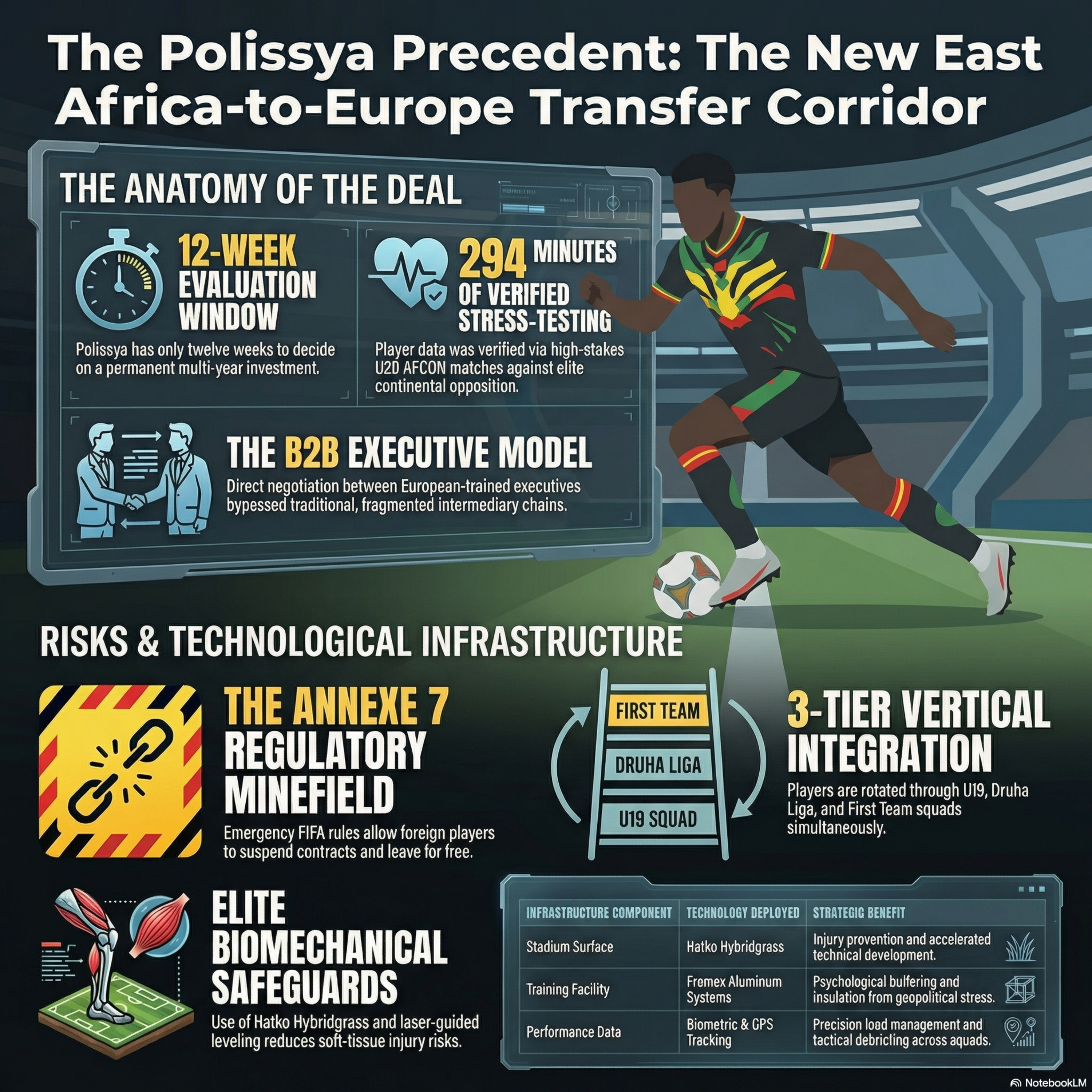
They need verified proof, Yeah, they're going to spend hundreds of thousands of EUR based on a highlights package from a domestic league where you know the camera is shaking. The crucial de risking factor for the buying club here wasn't his domestic league tape at all. No, it was his is 294 minutes at the U20 AFCON. Those 294 minutes are the foundational bedrock of this entire transfer. You have to understand the psychology of a European sporting director. They are deeply skeptical of unverified domestic Academy reports from African leagues because they know the tactical environments can be vastly different and the data collection is often rudimentary.
What they crave is continental exposure. So the U20 tournament is like the ultimate proving ground. Exactly. The U20 AFCON provided a perfect, verifiable stress test across multiple distinct tactical scenarios. If you look at the granular breakdown of those minutes, it's fascinating. First, he plays a full 90 minutes against Egypt's U20 side. And Egypt is always tough. Very they historically produce technically superior possession, dominant teams that methodically probe for weaknesses. So surviving that 90 minutes is a direct validation to European scouts of his defensive discipline under sustained, relentless pressure.
Improves. He doesn't just switch off when he doesn't have the ball. Precisely. Which is usually the biggest knock on young attacking full backs, right? Yeah, they want to attack but forget to defend. Exactly. But then he goes from playing against a methodical Egyptian side to playing another 90 minutes against Zambia, and Zambia is bringing a completely different physical question to the pitch. Completely different style. Zambia traditionally plays a highly physical, combative, high transition style.
It's chaotic, it's fast, and it requires immense stamina. So that match verified his cardiovascular endurance and his anaerobic recovery. It proved he was willing to engage in gritty box to box physical duels and could handle the sheer violence of a transition heavy game. That is quite the contrast from the Egypt game. It is then you look at his 84 minutes against Sierra Leone. That game tests sustained positional concentration over a long period against a team that might sit in a low block and try to catch you on the counter, right?
And finally, he has a 30 minute impact sub appearance against South Africa. Showing he can come off the bench cold, get up to the speed of the game instantly and deliver tactical value when the manager needs to change the shape. Exactly. When you stack those 4 performances together, it isn't just a highlight reel, it is a comprehensive multi dimensional portfolio. But here's where the story pivots. You know, from the player on the pitch to the executives in the boardroom. This is the fascinating part.
Because as MFC, the selling club isn't just a typical local club, they are backed by the Bakrisa Group, which is a massive East African conglomerate. But their true secret weapon, the ultimate game changer in this scenario, is their CEO, Octavia Nouro. Octavia Nouro completely alters the gravity of this negotiation. He is not a traditional domestic administrator who grew up in the local football politics. He is a European trained sports business executive of the highest order. Where did he come from?
He spent eight years directing international business development for La Liga. He has a master's degree from the Royal Spanish Football Federation and the La Liga business into school. And crucially, he hasn't just studied this stuff theoretically right? He is actually authored published research specifically on the strategic acquisition and integration of non EU talent into European football systems. We really? Yes, he literally wrote the playbook on how European clubs acquire African players. That is insane.
It's like bringing a casino floor manager to a neighborhood poker game. Suddenly the European buyers realize they are sitting across the table from someone who speaks their exact corporate language. He understands UEFA compliance architecture, he knows the FIFA transfer matching system inside and out, and he knows exactly how European clubs value risk. It is a massive tectonic shift in executive power. Traditionally, an African club in this scenario is structurally unsophisticated because they lack direct relationships with European sporting directors.
They are entirely dependent on a fragmented, sprawling chain of intermediaries. The middle men. Exactly. You have the local scout who found the kid, the regional agent who represents him, the European broker who has the contacts in Ukraine, and maybe even a club liaison. Every single one of those nodes captures a margin of the deal. They all want their cut. Right. And they actively keep the African Selling Club in the dark to protect their leverage. But because of Anoro, this wasn't an intermediary driven hustle.
It was a direct business to business or B to B negotiation. So what happened to the agent? The agent Manser SAR was absolutely involved and he did his job well, but he was a facilitator of the logistics and the players personal terms. He was not the architect of the club to club strategy. Anoro bypassed the entire shadowy network and got Azam a real authoritative seat at the table. I completely see the power shift there, but I mean even with Anoro at the helm, the actual structure of the deal they agreed to raises a massive red flag for me.
What's that? It's a loan with an option to buy, but the loan is only for 12 weeks, March 11th to June 31. It's incredibly short. That's not even enough time for an adult to figure out a new commute in a different city, let alone an 18 year old trying to acclimatize to a new continent. You've hit on the central tension of the deal. It is a fundamentally flawed window for human talent evaluation, but a ruthlessly efficient one from the buyer's financial perspective. If you look at any sports science literature on international transfers, it is very clear physiological homeostasis, the time it takes for a human body to fully adapt to a new climate, a drastically different diet, new circadian rhythms, and a higher training intensity takes a minimum of 6 to 8 months.
6 to 8 months. Exactly, And tactical assimilation, like learning a new managers complex pressing triggers without speaking the language, takes just as long. Giving a crosscontinental teenager 12 weeks to prove he is worth a multiyear financial investment forces a binary, incredibly compressed decision based on partial noisy data. If physiological adaptation takes a minimum of six months, aren't both of these clubs just setting this kid up to fail by giving him 12 weeks? I mean, it feels like a guaranteed false negative.
Huge risk. Right. If he pulls a hamstring in week 6 because his body isn't used to the cold, or if he makes a tactical error because he didn't understand a shouted instruction in Ukrainian, is he a bad player? Or is he just a normal teenager who is jet lagged, freezing and totally overwhelmed? That is the exact trap of the 12 week window. Policia might end up discarding a player with a massive developmental ceiling purely due to transitional underperformance that was completely inevitable, and as MFC might get their prized assets sent back to them in July with his confidence shattered, his physical rhythm broken, completely devaluing him for future sales.
But you have to view this from Policia's perspective, OK? What are you thinking? For them, the 12 week window is a supreme financial safeguard. If the data isn't overwhelmingly undeniably positive by week 10, they just cut the cord. They send him back with 0 long term financial exposure. They don't have a multi year contract weighing down their wage bill. They are relying on extreme high density data collection to override the short timeline. They believe their internal metrics are so good they can spot the underlying talent even through the noise of his difficult transition.
And that leads us perfectly into what happens the minute he steps off the plane in Ukraine. Because Anoro's executive brilliance got Azam the deal. But once Alley lands, the buyers environment completely takes over. And if you are picturing A scrappy, underfunded operation in a wartime country, you need to recalibrate immediately. The technological infrastructure he is stepping into is staggering. It is entirely counterintuitive to what most people expect. FC Policia Zeidemeyer is heavily subsidized by the BGV group.
Who are they? They have a massive macro investment strategy that treats the football club as an integrated civic and technological project. They aren't just trying to win games, they are building institutional value. They are partnered with Zeidomer Polytechnic for analytics and engineering. So it's very academic backed. Exactly. They have a Framex engineered training center designed specifically with panoramic natural Whiting. Why? To create a psychological buffer zone against the bleakness of the winter and the stress of the environment.
Everything is meticulously engineered. Even the grass he runs on. They installed a Hatco hybrid grass pitch at their central stadium in a record 36 days. Unbelievable speed. For anyone unfamiliar, that involves laser guided sub base leveling to ensure perfect drainage and surface consistency. Literally weaving synthetic fibers into natural grass roots. Yeah. For a player like Ally, whose entire game relies on explosive lateral deceleration, that pitch is literally a biomechanical safeguard. A bad, uneven pitch causes micro slips when a player plants their foot to change direction, leading to hamstring avulsions and groin strains.
A hybrid pitch locks the boot in perfectly. It's elite Champions League level infrastructure, but it's how they deploy the player within this infrastructure that is truly ruthless. They use a three tier integration system. Walk me through that. Within his first few weeks, Ali isn't just assigned to a locker room Until the practice, he is systematically rotated through three distinct squad tiers to generate different types of data. First he plays in EU nineteens. To see him against kids his own age.
Exactly. The goal there is to benchmark his baseline technical superiority against kids his exact age in Europe. Can he dominate his peers? Next, he trains with the first team. Are they expecting him to start right away? No, that isn't to see if he can start on the weekend. It's to evaluate his cognitive processing speed against seasoned senior professionals. How fast does he release the ball when a 30 year old striker is pressing him? But the most critical environment, the true Crucible of this entire deal, is Palicia 2.
Palicia 2 plays in the Drew Holiga, which is the Ukrainian third tier. And we need to be very clear about what the Druha Liga represents. It is not a sanitized, comfortable Academy league where everyone plays beautiful theoretical passing football. Not at all. It is a violent, desperate, highly physical professional league full of older players, aggressive guys in their early to mid 20s who are fighting tooth and nail for their professional survival and their next paycheck. Sending an 18 year old Tanzanian import into the Druja Liga is not a gentle introduction, it is a deliberate, calculated shock to the system.
He's throwing him to the wolves but doing it while he's wearing a heart rate monitor. Precisely, it is a biometric data generation machine. When he is in those Druja Liga matches, getting into intense physical confrontations with desperate professionals, Policia is harvesting incredibly granular, high density data. Like what kind of data? They are tracking his maximum Sprint speeds via GPS vests. They are measuring his collision impact absorption, his deceleration mechanics under fatigue, his recovery heart rate after a 70 meter Sprint while under extreme psychological and physical duress.
They are building a digital twin of his physiological capabilities. But I mean, this reveals a massive, glaring asymmetry. Pelosi has a dashboard lighting up with every step this kid takes. They know his exact lactic acid threshold. They know his top speed in the 89th minute. They know everything. Meanwhile, Azam FC, the club that invested years in developing him, is sitting in Dar es Salaam completely in the dark. They're probably just waiting for the agent to send a text saying yeah he played well today.
Why on earth don't African clubs just demand access to this data if it's their player on loan? Shouldn't Anoro or Azams technical Director have the exact same logging credentials to that GPS dashboard? That is the ultimate question of leverage, and it highlights the technological infrastructure gap perfectly in a truly equitable, modernized B to B partnership. The loan agreement wouldn't just outline the financial option to buy, it would mandate A strict data sharing clause. It would legally require Policia to send weekly GPS and EPTS summaries, monthly tactical video packages and quarterly developmental assessments back to Africa.
But they don't do that. No, because that isn't standard practice yet. The selling club is negotiating completely blind when June 30th rolls around. Policia uses the data they harvested from the three tier system to generate total informational supremacy. They know exactly what the player is worth down to the decimal point, and Azim only knows what Policia tells them. Total informational supremacy that gives the European club a massive advantage when it comes time to exercise that by option. They hold all the cards.
They do. But as incredibly advanced as Policia is, and as much data as they have, there is one massive variable hanging over their heads that absolutely terrifies them. It's a regulatory loophole so large it could wipe out their entire investment overnight. We have to talk about FIFA's Annex 7. If you are operating in Ukrainian football right now, or if you were doing business with them, this is the single most important document in your world. Bring it down for us. Annex 7 is an emergency regulatory provision instituted by FIFA after the full scale Russian invasion.
It essentially states that any foreign player or coach employed in Ukraine can unilaterally suspend their employment contract without penalty and leave for a club in another nation for free without the Ukrainian club receiving a single cent in transfer compensation. Wait, so a club could spend a fortune scouting a player, developing them, getting them acclimated and at any moment the player can just say I'm suspending my contract and walk out the door to another country? Yes, it is an unprecedented disruption of contract law in football.
Because of NX7, there was an immediate mass exodus of high level international talent from Ukraine. Players fled to Brazil, to England, to France, leaving Ukrainian clubs with decimated rosters and zero financial compensation to rebuild. That is devastating for those clubs. Completely. And that exodus created a secondary massive internal crisis, the hyperinflation of domestic Ukrainian players because clubs are terrified of foreign players fleeing via NX7. Everyone desperately wants to buy local Ukrainian talent because Ukrainians can't use NX7 to leave.
I see the domestic demand skyrocketed, but the supply of elite youth was depleted. Now, unless you are a legacy giant like Shakhtar Donetsk or Dynamo Cube with Champions League broadcasting revenue, you simply cannot afford to buy a top tier Ukrainian U20 international. The prices are absurdly inflated. So what does an ambitious, rising club like Policia do? They are priced out of their own domestic market. They are forced to look at undervalued, extreme inefficiency markets, and they look to East Africa.
But they didn't just pick Ismail Omar Ally by throwing a dart at a board. They picked him specifically because of his birthday. He turned 18 on July 18, 2025. This is a brilliant piece of timing arbitrage by Policia scouting department. By targeting a player who has just crossed the legal threshold of majority, they completely bypass FIFA Article 19. And what does Article 19 say? Article 19 is the strict framework governing the international transfer of minors designed to prevent human trafficking in football.
If Ali was 17, transferring him to Europe would be a bureaucratic nightmare. Right Policia would have to apply to the FIFA Players Status Subcommittee. They would have to prove that the player's parents moved to Ukraine for non footballing reasons, which is impossible to prove convincingly when you're signing them to a football Academy. Yeah, that wouldn't fly. They would have to provide extensive affidavits regarding housing, schooling and pastoral care. It takes months and it is frequently rejected.
By Scouting Ally closely when he was 17, building the relationship and then signing him the exact moment he turns 18, they found a completely clear, frictionless regulatory pathway. That completely explains why the European club wants him right now. But the timing arbitrage isn't just about his specific age, it's about the entire macroeconomic situation of the East African region. The 2027 AFCON is going to be Co hosted by Kenya, Uganda and Tanzania. Which means we are currently in an 18 month pre tournament window.
Whenever a region prepares to host an AFCON, several things happen simultaneously. Massive infrastructure investment pours in from the government's stadiums are upgraded, but more importantly, global media exposure skyrockets. Broadcasters start paying attention to the local leagues, scouts flood the region and consequently player valuations inflate massively. They shoot right up. European clubs are acutely aware of this cycle. They know that if they want East African talent, they have to buy it right now at current depressed market prices.
If they wait until after the 2027 tournament, those exact same players will be valued at the premium premium prices you normally see for West African talent from Senegal or the Ivory Coast. It's a race to acquire assets before the market corrects itself. So let's step back and look at the double asymmetry of this entire deal, because it is wild. On one hand, Felicia has the option to buy Ally at the end of the 12 weeks for a fixed price, but on the other hand, because of Annex 7, Ally has the option to flee.
Imagine this scenario. Ally goes into the Druja Liga, absolutely tears it up, scores a few incredible goals and goes viral on scouting networks. It happens all the time. A wealthy club in Germany or Belgium sees the data. They don't even have to negotiate a transfer fee with Policia. They just call up Ally's agent, offer him a massive signing bonus, tell him to invoke Annex 7, and they steal the player for free. That is a terrifying reality for Ukrainian clubs right now. Policia is taking on all the upfront risk.
They are paying for his flight, his accommodation, the elite hybrid pitches, the Framex training centers, the biometric data tracking. And what do they get? And they are effectively acting as an unpaid, high risk developmental showcase for the rest of Western Europe. If Ali turns out to be a superstar tomorrow, Pelosi loses him. The wealth of Western Europe can just reach in and pluck the asset away using FIFA regulations as a shield. Knowing that, if you're Octavia Noro and you know for a fact that the buyer is terrified of Annex 7, shouldn't you be structuring the deal completely differently?
Why wait for an option to buy that might never trigger because the player might just leave? Shouldn't a zombie demanding guarantee performance payments during the loan itself? That is precisely what a fully empowered, analytically driven selling club must do in this specific corridor. You cannot rely on a traditional sell on clause or an option fee when NX7 exists. Because it could be 0. Think about it, if he leaves for Germany via NX7, his transfer fee is 0. Your 15% sell on clause is worth exactly 15% of 0.
So what's the solution? Azam needs to negotiate micro payments triggered throughout the duration of the loan. You pay us €10,000 when he makes his U-19 debut. You pay us €25,000 when he logs 100 minutes in the Dru Haliga. Extracting value constantly. Exactly. You extract tangible financial value continuously, week by week. Because you operate under the assumption that the entire asset could vanish overnight, you de risk your own in position by commodifying his playing time, not just his registration rights.
Because Annex 7 gives the player the ultimate unilateral power to leave, the only way a Ukrainian club can actually keep him is if he wants to stay. He has to actively choose not to flee when another club calls. And that brings us to the single most overlooked factor in exporting African talent human welfare. It is entirely overlooked when we talk about player welfare. The football industry often treats it as this soft, ancillary, almost charitable concept, something for the PR department to handle.
We need to reframe it entirely in this specific corridor. In a conflict zone, welfare is hardcore unsentimental asset protection. Let's contextualize the massive geographical and cultural whiplash this kid is experiencing. Ismail Omar Ally is relocating from Dar es Salaam that is a bustling, vibrant coastal city of seven and a half million people on the Indian Ocean. It's tropical, humid and loud. The lingua franca is Swahili. It's a Muslim majority cultural context where he understands the social rhythms, the food, the community.
It's his home. Right and he is moving to Zeitamar, a city of 260,000 people. It has continental sub zero winters that he has never experienced in his life. The languages are Ukrainian and Russian which is a completely different alphabet. And I mean most critically, there are literal air raid sirens going off. The psychological dissonance is staggering. We discussed earlier that because he is 18, FIFA's Article 19 mandatory welfare protections do not apply. Because he's legally an adult, right? The massive regulatory burden on the buying club vanishes the exact second he turns 18, but the human burden on the player is identical whether he is 17 and 364 days old or 18 and one day old.
Absolutely identical. He faces severe linguistic isolation where he can't even read the labels in a grocery store. He faces massive climate shock, which isn't just about feeling cold. It physically disrupts sleep patterns, lowers immune response, and alters physical recovery times. Wow, I didn't even think about the immune response. It's huge. He experiences acute separation anxiety from being thousands of kilometers from his family, and layering over all of this is the pervasive ambient geopolitical stress of living in a conflict zone.
The neurobiology of stress dictates that his cortisol levels will be constantly elevated. Think about your own job for a second. If someone dropped you in a freezing climate where you couldn't read the street signs, you had no friends or family around, and an air raid siren might interrupt your work day, your performance would crater completely. Why do we expect an 18 year old left back to be immune to that? Just because he can run fast. We shouldn't, and if Palicia fails to provide trauma informed pastoral care, if they don't employ a club welfare officer who speaks Swahili or at least fluent English, if they don't arrange for culturally appropriate food, if they don't facilitate religious observance, if they don't actively help him integrate into the local community, his psychological stability will fracture.
And that fixes game directly. When psychological stability fractures, the physical consequences are immediate performance on the pitch drops, concentration wanes, looting to tactical errors. Stress related soft tissue injuries spike because elevated cortisol impedes muscle repair. And then he leaves. Exactly. Ultimately, when he is miserable and injured, he will simply pull the Annex 7 parachute cord and escape. Providing comprehensive welfare is the only viable way Policia protects its financial investment in the player.
But what about the federation back home, The Tanzania Football Federation? The TFF, they're the ones who ultimately process the international clearance paperwork to allow this kid to move. Don't they have a massive responsibility here? Administratively, they fulfilled their duty by clicking the button in the FIFA system, but morally and structurally African federations largely operate in a massive void when it comes to post transfer welfare. They simply do not have the institutional mechanisms or often the will, to monitor national team players once they are sent to conflict zones.
To just sign off and move on. Pretty much the TFF issued the International Transfer Certificate, but who from the federation is calling him in week 6 to see if he has heating in his apartment? Who is checking if his wages are being paid on time? Nobody. This is where Anoro's role becomes vital once again. Because Anoro has European credibility and understands the leverage Azam holds, he can act as a welfare ceiling razor. He has the executive weight to look Felicia in the eye and demand rigorous pastoral care, not as a favor but as a hard contractual condition of the B to B relationship.
I want to zoom out for a second though, because we constantly assume that moving to Europe is an unquestionable good for an African player's development. It's treated as the ultimate goal. But aren't we blinded by massive survivorship bias here? Oh, absolutely. We see the masalas, the Didier Drogbas, the Sadio Manet's lifting Champions League trophies and we celebrate the pipeline. But we completely ignore the hundreds, if not thousands of teenagers who go to Eastern Europe, suffer acute psychological and cultural trauma, failed to integrate and return home quietly, completely broken as players and people.
That is undoubtedly the darkest blind spot in the African transfer market. The developmental downside is almost never priced into the risk analysis of a loan deal by the selling club. They just see the upside. Right. An African club sends away a confident, thriving youth international who is dominant his domestic league. They assume he will only get better. But there is a very real, statistically significant chance they receive back a traumatized, deconditioned young man whose career trajectory has been permanently derailed by isolation and poor management.
It's. Heartbreaking. The assumption that Europe is always better is a dangerous fallacy when you are dealing with vulnerable teenagers in extreme high stress isolation. The environment has to be meticulously vetted. So the welfare of the player and the pure economics of the deal are actually the exact same thing. You can't separate them to ensure both the human and the asset are protected. African clubs absolutely have to bypass the traditional middle men who only care about getting their cut of the transaction fee.
They have to dismantle the intermediary trout. In the traditional African to Europe transfer model, the intermediary chain is agonizingly long and heavily extractive. As we touched on earlier, you have a massive web of actors. The local scout who first spotted him on a dirt pitch. The regional agent who signed him. The European broker who has the WhatsApp number of the Ukrainian sporting director. The club liaison who translates the contract. Everyone has their hand out. And every single note in that chain demands a cut.
Often, between 15 to 40% of the total deal value is siphoned off through various commissions, facilitation fees and mandates. It's like a leaky pipe. Imagine you have a pipe sending water from a reservoir in Tanzania to a farm in Ukraine, but the water is the actual financial value of the player. In the traditional system, that pipe has five different junctions, and at every junction someone is siphoning off a bucket of water. That's a perfect analogy. By the time the water actually reaches the African club that invested years into developing the player, it's just a trickle.
And here is the worst part about those intermediaries. They are paid for the transaction, not the outcome. They get their Commission. The day the contract is signed, whether the kid becomes a superstar or comes home traumatized 3 months later, they have 0 skin in the long term game. Exactly. The incentive structure is entirely misaligned with player development. The agent is incentivized to move the player as frequently as possible to generate more transaction fees, not to find the best developmental fit, but the Policia precedent bypasses this entirely.
Because of Nora. Right. It is a highly compressed, efficient chain. You have the direct B to B relationship between a Noro and Ukrainian sporting directors, with Mansur Saar acting as a singular efficient facilitator for the players. Personal terms. But what's truly fascinating is how the wider market actually learns about this deal. The agent and the clubs announced this loud and proud on LinkedIn. It feels so corporate to announce a football transfer on LinkedIn, but it's actually brilliant strategy.
It's not just a digital pat on the back or networking fluff. It is strategic infrastructure for an African club. Monitoring those LinkedIn posts is free open source intelligence. It signals to the global market that Policia is an active buyer with liquidity. It shows they have money to spend. Right. It provides social proof that East African talent is viable in Eastern Europe and most most importantly, it generates inbound deal flow. Every African technical director should be mapping these announcements.
They should be taking notes. They should be building a database of which European clubs are buying, what specific positions they're targeting, what age profiles they prefer and who the real effective brokers are that actually get deals across the line. There's a concept that explains this dynamic perfectly, the DAPI framework, decision architecture, and power intelligence. It sounds like something out of a corporate espionage thriller, but it perfectly explains how the Power Matrix shifts in a deal like this.
The DPI framework is a brilliant way to evaluate the power nodes in any negotiation. You essentially have three traditional roles. You have the architect who designs the deal structure, sets the terms and controls the parameters. OK, that's one. You have the conductor who manages the execution timeline and the logistics, and you have the envoy who facilitates trust between the parties. So normally an African club is what? Normally an African selling club has an architect score of maybe A1 or A2 out of five.
They're entirely passive. They just take whatever price, whatever 12 week loan structure, whatever meager sell on clause the European intermediaries offer them. But a zam is different. Because of Anor's executive fluency, because he understands UEFA regulations and value capture, Azam's architect's score shoots up to A4. They are operating at near parity with the European buyer. They aren't just reading the contract hoping they understand it, they're actively writing the clauses. Precisely. But here is the wartime twist that makes this specific corridor so unique.
DAPI normally evaluates those 3 roles in Ukraine. Right now there is a fourth node that overrides everything, exit power. Right, Annex 7. And the ultimate dominant power node in this entire matrix, scoring a 3.5 or even higher isn't a Zam with Anoro and it isn't Palicia with all their BGV group money. It is FIFA's Annex 7 and the 18 year old players ability to pull the parachute cord. He is the exit power. The player, empowered by emergency regulation, holds structural supremacy over the multi $1,000,000 institutions.
So executive brilliance like Anoro's can stop the leaks in the pipe and get you parody at the negotiating table. But let's be real for a second. What if an African club doesn't have an Octavianoro? That's the reality for most. Right. What if they don't have a former Allega executive with a master's degree sitting in their boardroom? How does the average ambitious African club level the playing field against these European data monoliths? They can't just rely on hoping they hire genius. No, they can't.
They have to build their own technological infrastructure, They have to build a digital storefront. The massive infrastructure gap from the African side is the root cause of their historically poor negotiating position. If an African club enters A negotiation without their own verified objective data, they are negotiating from a position of total blindness. They are just guessing. They are entirely reliant on the European club's assessment of their own player. It's like trying to sell a house but letting the buyer's inspector dictate the appraisal without getting your own.
But the technology to close this gap is available right now, it is scalable, and it's surprisingly accessible. We need to talk about the text stack solution that African clubs must adopt. If I'm a Zam FC, I'm tired of sending blurry iPhone videos to Ukraine. How do I prove my player is fast enough? Let's break down the stack. The foundation is Oliver Pro. Oliver Pro is an advanced EPTS and electronic performance and tracking system. We aren't talking about the basic single point GPS vest that just track how many kilometers a player.
Ran those sports bras you see players wearing? Exactly. It's beyond that. It's a dual chest and shin tracking system. This is crucial because it verifies not just gross Sprint velocities and total distance covered, but highly granular metabolic output. It measures deceleration and deceleration profiles. How fast can he stops? Back to the lateral agility. Right. It measures the mechanical load and impact stress on the lower limbs. It generates indisputable scientific physical data that a European sport scientist can read and instantly trust.
So we have the physical data, but football isn't a track meet. You need tactical context. That's where Soccer B comes in. Soccer B provides automated tactical video analysis. It takes the raw match footage and automatically tags it to European scouting standards using AI. Well. That saves so much time. Instead of an intern spending hours clipping video, the software creates immediate, categorized clip packages. It shows every defensive recovery, every progressive ball carried through the half space, every overlapping run, every time he inverted into the midfield.
It strips away the subjective noise of a scout's opinion and provides objective, searchable, tactical context. But none of that works if you don't have high quality footage to begin with. Which brings us to Pixel Lot AI. Pixel Lot AI solves the broadcast problem. It installs automated multi lens broadcast cameras at the stadium. They capture full match panoramic footage seamlessly. Without cameraman. Exactly. They follow the action using algorithms without requiring a human camera crew, a director or a massive production budget.
It ensures that every single minute of first team in Academy football is captured at a professional European broadcast standard. So combine those three. If I'm an African club, I go from having a regional agent send a cherry pick WhatsApp videos set to terrible techno music to handing over a comprehensive digital prospectus. You transform your entire operation from a data desert into a digital storefront. Think about the incredible leverage that creates if, as MFC has this tech stack, they don't just send Ismail Omar allies profile to Felicia and beg for an offer.
They shop it around. They send a verified data rich prospectus containing his Oliver Pro physical metrics, his Soccer B tactical tags and his Pixel Lot full match footage to 10 different European clubs simultaneously. You instantly shift the dynamic from a single buyer monopoly where Felicia dictates the terms to a highly competitive bidding war across Europe. But this technology isn't just for selling the player right? It's the leash that keeps you connected to them after they get on the plane.
Exactly, it enables post transfer monitoring which we established is currently non existent. African clubs must start writing strict data sharing clauses into their loan agreements. They must legally mandate that the European Club sends weekly GPS outputs and video reports back to the analytics department in Africa. You stay involved. You don't just put the player on a plane and hope he survives the Druja Liga. You tether his physiological development to your own club. You monitor his progress week by week.
I have to ask the obvious question then. If the investment for this entire tech stack, the automated cameras, the dual trackers, the AI software is just in the low 10s of thousands of dollars, why isn't every single top tier African club doing this immediately? A single improved transfer fee from one player would pay for the tech 10 times over. Is it a genuine lack of funds or is it a lack of imagination? It is rarely a lack of funds at the absolute top tier of African football, clubs find money for what they value.
It is a lack of institutional imagination and a deep reliance on old intermediary driven habits. The gatekeepers again. Right. The traditional power brokers in African football are used to operating on relationships, handshakes, favors, and opacity. Data brings ultimate transparency, and transparency inherently disrupts the traditional gatekeepers who profit from the shadows. Adopting this tech stack requires A fundamental cultural shift in the boardroom before it requires a financial investment on the pitch.
The tools are available, the blueprint of the deal is laid out, the traps are exposed. Now what exactly needs to happen when the sun comes up tomorrow morning? We have to map the futures for this specific corridor. What happens next to a player like Ally? Let's look at scenario. A Scenario A is success. Ally integrates perfectly into the Ukrainian environment. He survives the Druja Liga transitions to the first team and Palicia happily exercises the option to buy. His valuation rises over the next two seasons and they sell him to a Belgian or Polish club.
So everyone wins, yes. Azem cashes in on their micro payments and a sell on fee. The B2B relationship between Anoro and Palicia deepens, creating a reliable pipeline. The absolute dream scenario. But what about scenario B, the false negative? Scenario B is the 12 week trap springing shut. The window is simply too tight. He struggles to adapt to the freezing weather, the language barrier isolates him and the violent Druhaliga injuries him. Calicia looks at his degraded metrics, panics, declines the option and sends him back to Tanzania in July.
Azam loses crucial development time, the player's confidence is totally shot, his value plummets and the corridor stalls. Out. And then there's Scenario C, the one that gives Ukrainian sporting directors literal nightmares. Annex 7 expropriation ally goes to Ukraine and is a massive hit. He looks incredible. His data is off the charts, but before Palicia can even exercise the option, a wealthy German club whispers in the agent's ear. And he pulls the cord. Ali invokes Annex 7, legally suspends his contract and walks away to Germany for free.
Palisia gets absolutely zero return on their investment. Azam's sell on clause is completely worthless because technically there was no sale. Brutal. The intermediaries get massive signing bonuses, but the clubs themselves get burned to the ground. So there's a scenario E, isn't there? The ultimate sustainable goal. Scenario E is the Annex 7 partnership model. Instead of these fragile, transactional, highly risky 12 week loans, Azam and Palisia realized that Annex 7 makes traditional options too risky for the buyer.
So they team up. Exactly, so they build a formal long term structural partnership. Azam acts as the pre development Academy in Africa using the text act to verify talent. Felicia acts as the European competitive Crucible. They share the developmental risk and they legally agree to a profit split on any future onward transfers, regardless of which club officially holds the registration when the player is finally sold to Western Europe. That is brilliant. They align their financial incentives permanently, bypassing the Annex 7 risk entirely.
What is the map of what could happen? You know, give me the Monday morning test. For the stakeholders listening to this, what is the immediate first step? Let's start with Azam FC and Octavia Nora. First thing tomorrow morning, Azam must formally demand a written development plan from Policia detailing the exact welfare provisions and guaranteed minutes across the three tiers. Furthermore, they need to pre negotiate a loan extension right now to survive the 12 week trap giving the kid until the winter break to actually adapt physiologically.
What about the Federation? The TFF. The TFF must immediately adopt A comprehensive transferred player welfare protocol. They must audit the living conditions and psychological state of every single player they have cleared to play in a conflict zone. And the AFCON tournament. Strategically, they must view the upcoming 2027 AFCON not just as a tournament, but as market access infrastructure. Every minute a Tanzanian kid plays on that broadcast is a verified data point that drives up his European market value.
They need to market the tournament to European scouts aggressively. And the agents who want to survive in this new data-driven era. Agents must build entirely transparent track records. The market is shifting from relationships to data. Stop boasting on LinkedIn just about the deals you closed. Start publishing the long term developmental outcomes of your players. How many professional minutes are they actually playing two years after the transfer? What is their psychological welfare status? Agents who can mathematically prove they generate positive, sustainable outcomes for players, not just quick signatures, will completely dominate the next era of African football.
But are federations like the TFFS actually incentivized to do this? Does the current chaotic, opaque system benefit the people in power too much to ever really change it? Because transparency usually means the people skimming off the top lose their jobs. That is the ultimate grinding friction point of African football. Yes, the current opaque system deeply enriches a specific class of gatekeepers, but the macroeconomic pressure of global football is becoming too immense to ignore. The money's too big.
Right. The financial difference between selling a player blind in the dark for $100,000 versus selling a verified data backed asset for $1,000,000 with a bulletproof sell on clause is the difference between an African club merely surviving and an African club dominating the continent. Eventually, the sheer scale of the financial incentives for the clubs themselves to become the architects of these deal will overwhelm the gatekeepers desire for opacity. The money will force the evolution. We've gone incredibly deep today.
We've dissected the anatomy of a late night deal, looking at exactly how 294 minutes of the youth tournament opened the door to Eastern Europe. We stepped into the biometric crucibles of the Druja Liga, where data is harvested through sheer physical survival on hybrid grass. We navigated the invisible hand of wartime regulations, exposing how FIFA's Annex Seven turns every contract into a high stakes gamble. And we laid out the exact technological playbook. The AI cameras, the dual trackers, the software required to future proof African talent and dismantle the intermediary.
Trap. It all comes down to leverage who holds the verified data, who commands the executive network, and who controls the narrative. The policia precedent proves that when an African club brings executive fluency to the table, they can fundamentally alter the balance of power. They absolutely can't. But without the technological infrastructure to back it up and the rigorous welfare protocols to protect the human asset, that power remains incredibly fragile, The supply side. Africa must start acting as the architect of its own future, Much like how Shakhtar Donetsk built a legendary, highly controlled pipeline with Brazilian talent decades ago.
Africa has to build the pipeline, not just supply the water. I want to leave you with one final lingering thought, something that sits right beneath the surface of everything we've discussed today. We have spent this entire time talking about how African clubs can use advanced technology, executive brilliance and biometric data to sell their players to Europe more effectively. We've been trying to perfect the export pipeline. But what happens? What happens when an ambitious African club realizes that with this exact same technology, with this exact same dual chest EPTS tracking, with these exact same automated tactical cameras and these exact same elite executive networks, they don't actually need to sell their 18 year olds at all?
What happens to the global transfer market when the data finally proves that the absolute best, most optimal developmental environment for African talent is finally in Africa? Keep digging, keep questioning the systems operating around you, and always remember that every single transaction you see on your feet holds a much deeper architecture just waiting to be decoded.
 Apple Podcasts
 Castbox
 Castro
 Goodpods
 Moon FM
 Overcast
 Pocket Casts
 Podbean
 Podcast Addict
 Podcast Republic
 Spotify