The Hidden Crisis Of African Coaches
About this episode
The Hidden Crisis Of African Coaches
Close your eyes for a second, I want to transport you directly onto the touchline of like a massive high stakes African football match. Oh, that's a brilliant way to start. Right. I mean, just feel the thick, humid air pressing against your skin. Listen to the deafening rhythmic roar of, you know, 80,000 fans packed so tightly into the stadium that the concrete almost seems to breathe. You can literally feel the vibration. Exactly. You hear the piercing wail of the vuvuzelas, the deep, relentless pounding of the drums, and just the sheer volume of an entire nation projecting its hopes, its history, and its political pride onto a rectangular patch of grass.
It is an unbelievable environment. It really is. But now I want you to look past the 22 elite athletes sprinting under those glaring floodlights. Look past the flashing advertising boards. You know, past the television cameras. Find the technical area. Right down there on the edge. Yeah, there is a solitary figure standing precisely on the edge of the pitch, toes practically touching the white chalk. The head coach. The architect of it all. Exactly. They're the absolute architect of everything unfolding in front of you, but today we're asking you to look past their tactical brilliance.
We really need to look past the perfectly tailored suit or the sweat drenched tracksuit. Right, and past the carefully rehearsed post match interviews and all those touchline theatrics, we want you to peer into the unseen, silent and frankly suffocating psychological and physiological burden that this single human being is carrying. It's a weight most people can't even fathom. I mean, we are sitting on an absolute mountain of forensic data today. Continental Financial audits Lived experience studies from across the continent.
Some truly eye opening research. Yeah, and we are going to systematically unpack the hidden crisis of coach well-being, mental health and severe financial instability that is quietly but ruthlessly dismantling the beautiful game from the inside out. And we should be clear about our mission for this deep dive. Yes, definitely. We aren't just here to like, highlight a tragedy or complain. No, not at all. We are absorbing this wealth of knowledge and experience to understand exactly how fixing this invisible crisis can completely revolutionize and exponentially benefit our African game.
OK, let's untack this. We are moving forward systematically, step by step. No looking back. We are uncovering the secrets of a sustainable dominant operation model for African football. And it is a paradigm shift we desperately need because when we watch that coach on the touchline, our minds are deeply conditioned by decades of sports media to see an invincible commander. Oh for sure, the stoic general. Right. We expect them to be the anchor in the storm, the one person who never flinches. But the reality borne out by the data we're looking at today is that the storm is literally tearing them apart.
It's just, it's heartbreaking. It is the football ecosystem has fundamentally failed to provide the leaders of the game with the basic shelter and support that they are legally, medically and morally mandated to provide for their players. OK, but I have to play devil's advocate right out of the gate here because I know what some of you listening might be thinking. Go for it. Is an elite sport supposed to be a cutthroat environment? I mean, you sign up to be a professional football manager. You know, it's a pressure.
That's the classic argument. Yeah, right. If a coach loses 3 games in a row and the fans are rioting, shouldn't they just be fired? It's built on this classic tough guy concept of mental toughness. We expect them to be entirely immune to the psychological friction that affects the players. It's a massive double standard. It is if a 20 year old striker misses a crucial penalty, We immediately talk about their confidence, their mental health, their need for a sports psychologist. But if a coach drops points in a Derby, we just call for their head on national television.
The double standard is the exact philosophical rot at the center of the issue. What's fascinating here is how wildly we misunderstand what mental toughness actually means, especially in the African context. How so? Because usually mental toughness just means gritty. Right, exactly. The Western simplified definition of mental toughness is usually just grit. It's the macho idea of pushing through the pain, ignoring your emotions and getting the job done. Right, the whole rub some dirt on it mentality.
Yeah, but the Lib experience studies we have, specifically those focusing extensively on Ghanaian football, revealed that mental toughness is not a monolith. It is a highly complex multi layered survival mechanism in Ghana. The research shows mental toughness actually spans 5 distinct demanding domains. Wait. 5 domains, so it's not just about keeping a straight face when the referee makes a bad call. Not at all. The on field performance is just one domain. The other four are strategic career development, professional development, leadership, and general life management.
Wow, so it's their entire existence? Yes, a club coach in Ghana isn't just managing a starting 11 and a bench. They are managing intense, suffocating community expectations. They are navigating tricky local politics. And family pressures, I'd imagine. Huge family pressures. They're often managing the socio economic hopes of their own extended families while trying to mentor players who are dealing with extreme poverty themselves. It is a massive sociological weight. And here is where I think that weight becomes a weapon.
Institutions, and by that I mean the federations, the club owners, the sports media, they actually weaponize this cultural expectation of mental toughness. They absolutely do. They use it to enforce silent suffering. Because there's such a severe cultural stigma around mental health in many of these regions, coaches are forced to actively conceal severe anxiety, clinical depression, or like chronic insomnia. They hide it because the unwritten rule is that if you show a single crack. You're done.
If you admit to a club chairman that you're having panic attacks before a match, you instantly lose your authority in the dressing room and worse, your future employment prospects just vanish overnight. You get labeled as weak. Right. It is like expecting a master architect to build a state-of-the-art skyscraper, but you refuse to give them a hard hat. You deny a lunch break, you literally set their blueprint on fire, and then you have the absolute audacity to blame them when the foundation inevitably cracks.
That is a perfect analogy. It's an environment completely designed for failure and if we connect this to the bigger picture, the contrast with progressive European models is jarring and it shows us exactly what we are failing to do. OK, give us an example. What's happening in Europe? Take the lead Managers Association, the LMA in the United Kingdom. They have explicitly shifted their philosophy to recognize elite level football managers and coaches as sporting performers in their own right. Sporting performers.
I like that phrasing. It changes everything. They don't view them as disposable administrators, they view them as high performance cognitive athletes. OK, but what does that actually look like in practice though? Are they just giving them a pat on the back and a pamphlet? No, no, it is highly structured and scientifically backed. The LMA utilizes the PERM AH model of positive well-being. Per MA, let's break that down for everyone listening. Sure. So per mAh is an acronym from Positive Psychology.
It stands for Positive Emotion, Engagement, Relationships, Meaning, Accomplishments, and Health. OK, wow, that's comprehensive. It is the LMA actively measures and supports coaches across all these metrics. They also integrate CBT or cognitive behavioral therapy to help coaches reframe negative thought patterns under pressure. Because the pressure is constant. Exactly, and they use neuroplasticity concepts to ensure the brain is in the optimal condition to make high stakes decisions. They fundamentally understand that a coach is a human brain making split second $1,000,000 decisions.
And that brain requires maintenance just like a striker's hamstring. Precisely. African football, conversely, operates on a philosophy of pure attrition. Consume the coach's energy, blame the coach for systemic failures, and discard the coach. But even if an African federation wanted to implement this incredible LMA perma H based model tomorrow, how could they possibly start when the financial baseline is completely fractured? That is the big question. I mean, we can talk about cognitive behavioral therapy all day, but we have to talk about the money.
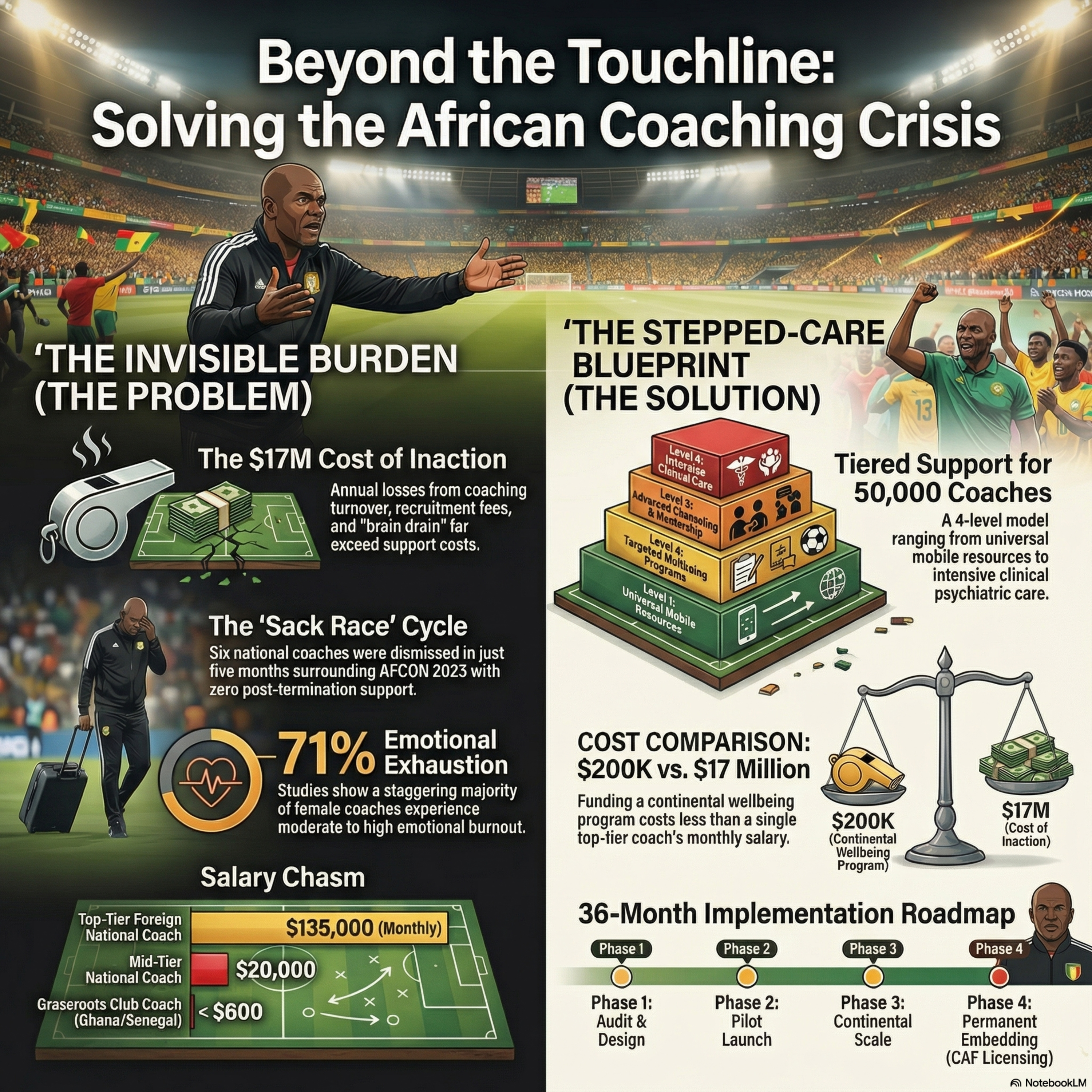
The financial realities are just staggering. The salary chasm in African football is unlike anything else in global sports. It really is two different worlds. At the very apex, you have foreign national team coaches. The data highlights Algeria's Vladimir Petkovich, who earns an estimated $135,000 a month. A month. Let that sink in. Now take a breath and drop down to the base of the pyramid. Top flight, meaning the highest level of professional domestic football. Top flight club coaches in Kenya are earning around $1200 a month.
And that's if they're lucky. Right, because in Ghana, Senegal and Cameroon, pop flight professional coaches often earn under $600 a month. And we have to be incredibly clear about that $600. In many of these leagues, that salary isn't guaranteed on the 1st of the month. It is routinely delayed by weeks, sometimes months. Which is just wild to think about. So you were establishing A chronic, inescapable baseline of physiological stress. Financial strain isn't just an annoyance, it is a scientifically documented primary driver of occupational burnout.
I mean, you literally can't feed your family. Exactly. Let's look at the quantified stressors from the South African coaching data because this is where the daily reality of the job comes into sharp focus. Coaches were asked to rate their daily stressors on a severity scale from 1:00 to 5:00. OK, out of five, what were the numbers? Job insecurity ranked at an incredibly high mean of 4.49. Wow. And the crushing expectation to win despite having inadequate resources. Ranked at 4.23. Those are the professional stressors, which are bad enough, but the environmental stressors are what really shocked me when we were looking at.
This they are appalling. Poor hygiene conditions at training and match venues. Scored 4.52 out of five. That is insane. 4.52 out of five just for basic hygiene. And poorly planned chaotic travel arrangements Scored 4.45. OK, so put yourself in those shoes for a moment. You are a grassroots or mid table professional coach in Senegal or Kenya. You are trying to feed your extended family on $600 a month, but you haven't been paid in six weeks. The stress must be unbearable. You are constantly stressed about basic survival.
You just traveled 10 hours on a poorly maintained bus over unpaved roads to a stadium that doesn't even have running water in the dressing rooms. A 4.52 stressor right there. Exactly how can anyone, no matter how mentally tough they are, possibly be expected to focus on high level tactical innovation? I mean, how do you sit in a sweltering, cramped dressing room and devise a brilliant, nuanced counter pressing trigger against a fluid 433 formation when the dominant thought in your mind is how you're going to pay your daughter's school fees on Monday?
The scientific answer is you can't. Right, you just can't. It is neurologically and psychologically impossible to sustain high level executive function under those conditions, and this brings us to a foundational concept in psychology called self determination theory. Break that down for us. What is self determination theory? So this theory posits that for any human being to thrive, stay motivated and maintain mental well-being, three basic psychological needs must be met, autonomy, competence and relatedness.
OK. Autonomy, competence, and relatedness. Yes. And in the African coaching environment we just described, every single one of those needs is systematically crushed. OK, let's go through them. How exactly is autonomy destroyed? Well, your autonomy, your ability to control your own work, is frequently destroyed by federation officials or club owners interfering in your daily operations. Sometimes they're even dictating your starting lineup. Oh, I've seen that happen. The owner just texts the coach and says play this guy.
Exactly. Then there's competence you're feeling of being capable and effective that is entirely undermined because you are publicly blamed and humiliated for poor results despite being given 0 resources to succeed. It's a setup. And what about relatedness? Relatedness, your sense of belonging and connection to others is basically non existent. You are totally isolated. There's no coaching union, no dedicated HR department, and no peer support network to fall back on. You are an island of stress.
And the most infuriating part is that the structural rot goes all the way to the top of the game's governance. It's not just a sad story about a continent lacking funds, it's a story about the devastating misallocation of the funds that actually do exist. Yes, the audits are very revealing. We have forensic audits of the Confederation of African Football CAF that identified $16.18 million in unrecognized expenses in a single fiscal year. 16.18 million. That's a staggering sum. And it gets worse.
Almost 12 million of that was categorized as technical costs that were simply not allocated to the clubs, federations and host countries who desperately needed them. That's money meant for development. Exactly. That is money explicitly meant for training cones, for advanced coaching license courses, for safe travel accommodations, for proper pitch maintenance. When $12 million vanishes into an administrative void, it is the local coaches who are starved of the vital technical development funds they need to survive and compete.
Precisely. And this is where the causality of the crisis becomes so clear. When you take this level of chronic structural stress, the missing wages, the terrible travel, the lack of autonomy, and you combine it with the relentless fan driven demand for instant on pitch results, you create a highly volatile accelerant. It fuels a toxic, hyper accelerated cycle of hiring and firing. The ecosystem demands miracles, provides absolutely no resources to achieve those miracles, and then ruthlessly punishes the coach when the miracle fails to materialize.
Which perfectly explains the phenomenon known as the sack race. The dreaded sack race. If a club owner is facing immense pressure from fans because the team is losing, there's no money to buy better players. The cheapest and easiest PR move is just to fire the manager to appease the crowd. It's the ultimate scapegoat tactic. Let's zoom in on the human cost of this coaching carousel, specifically looking at the concentrated window around the 2025 Africa Cup of Nations AFCON. Oh, that was rough. It was an absolute bloodbath for managers.
In a mere 5 month window, 6 national team coaches were dismissed. Six in five months. We are talking about Pedro Goncalves in Angola, Michael Nice in Zimbabwe, Avram Grant in Zambia, Mark Bryce in Cameroon, Sammy Trabelsi in Tunisia, Brahmacarore and Burkina Faso. It's. Just a rotating door. Six men carrying the intense, suffocating hopes of millions of citizens, abruptly discarded. And this extreme volatility isn't just at the international level, it is mirrored directly and brutally at the domestic level.
To look at the 202526 bet way premiership in South Africa. Right, the domestic leagues are just as bad. Highly respected coaches like Gavin Hunt, Simba Vemba, Bedella and John Maduca all sacked mid campaign. The Egyptian Premier League is notorious for cycling through dozens of coaches in a single season. I mean, in Kenya, Gormajia burned through Leonardo Noya Meva and Sinisa Mihik in a single campaign. It's unsustainable. Burkina Faso's national team has employed 16 different coaches over a 28 year span.
That equates to an average tenure of roughly 18 months. You cannot build a footballing philosophy in 18 months. It's mathematically impossible. You really can't. But the most damning forensic finding here isn't the sheer volume of the turnover, it is the total absence of a safety net when the axe falls. These dismissals happen with 0 post termination psychological support. Here's where it gets really interesting and honestly deeply sad. Being fired in this high profile context isn't just a loss of income, which is bad enough.
It triggers A profound, devastating identity crisis. That identity fusion is so dangerous. It is the lived experience. Studies of elite football coaches reveal that their entire sense of self, their entire ego and daily purpose is completely fused with their role as the manager. When they are sacked, the psychological response doesn't just look like professional disappointment, it actively mirrors the clinical grief and disorientation of sudden bereavement. It's like mourning a death. Think about it.
You wake up on a Tuesday morning and your phone, which was ringing 50 times a day, is totally silent. The squad of players you mentored, argued with and treated almost like sons is no longer yours. You are legally barred from the training ground. You are totally alienated from your community overnight. It is a violent psychological severing and we have to look at how this carousel is entirely self reinforcing. Think about the mechanics of the sack race. How does it keep feeding itself? When a federation or a club sacks a coach, they hold a press conference and publicly promise the fans a bold new direction.
Always the new direction. Right. And by doing this, they instantly plays heightened unrealistic expectations on the next incoming coach. That new coach steps into an environment where the pressure is already at a boiling point, the resources are still 0, and the fans expect immediate perfection. So the timers already ticking. Faster than before. This drastically accelerates the new coach's own burnout. Their rapid burnout leads to suboptimal tactical decisions, which leads to poor results on the pitch, which triggers their own dismissal.
Six months later, the cycle spins faster and faster, chewing up human beings. And destroying the clubs in the process. Exactly what is the collateral damage to the game itself? It completely destroys the tactical pipeline. It obliterates institutional knowledge. Any long term developmental program, any youth integration strategy is ripped up and thrown away every 8 to 18 months. But the real tragedy is that before that coach is even handed their termination letter in the boardroom, the invisible damage has already been done out on the pitch.
The chronic stress of trying to survive the SAC race literally alters how a coach's brain processes the game of football. The biology of it is fascinating. We really need to explore this cognitive burden. We need to understand what actually biologically happens when a human mind breaks under this level of pressure. To understand this cognitive breakdown, we first have to look at the clinical definition of burnout. In the medical and psychological community, burnout is not just a synonym for feeling really tired after a long, grueling season.
Right, it's not just needing a nap. No, it is a specific syndrome characterized by three distinct dimensions. First, emotional exhaustion. Feeling completely depleted of your emotional resources? Just having an AD tank. Exactly. Second, depersonalization. This is a coping mechanism where the coach emotionally withdraws, becoming cynical and detached from their players, their staff and the fans. Just build a wall, yes? And 3rd, a drastically reduced sense of personal accomplishment, feeling like nothing you do matters or makes a difference.
When a coach hits this clinical 3 dimensional state, it actively and aggressively destroys their tactical efficacy. Let me try to visualize this for everyone listening. Imagine you are playing a game of three-dimensional chess. It requires immense foresight, spatial awareness and strategic planning. A very complex cognitive task. Exactly. But now imagine trying to play that game while someone is screaming in your ear through a megaphone, the game clock is ticking down from 10 seconds and the chess board is literally on fire.
That paints quite a picture. You don't have the luxury of looking 5 moves ahead anymore, you just frantically react to the nearest piece that's threatening you. That is precisely what a burnt out coach is experiencing when they try to make a 70th minute substitution in a tied match. They suffer from what cognitive scientists call cognitive tunneling. That analogy perfectly describes the biological mechanism at play. Under chronic, severe stress, your brain enters a state of pure survival. Blood flow and energy are literally diverted away from the prefrontal cortex.
And the prefrontal cortex does what exactly? It's the evolutionary marvel of the human brain, responsible for complex executive functioning, deep working memory, and nuanced problem solving. When it becomes impaired by stress hormones, cognitive tunneling occurs. Your peripheral tactical vision just shuts down. So you literally can't see the whole game. You failed to notice that the opposition's left winger has subtly tucked inside to overload the midfield. You failed to register the body language of your own holding midfielder who is completely physically exhausted because your brain feels under threat.
You revert to deeply ingrained defensive heuristics. You become overly risk averse. You stop innovating and start merely surviving. Yeah. And we saw the literal physical manifestation of this acute stress response during the AFCON 2025 tournament. It was on global television. Oh, the Pep Thaya incident. Yes, look at the Senegal coach Pep Thaya. During a highly pressurized, highly controversial moment involving a penalty decision, the stress reached an absolute peak. He didn't just argue with the fourth official, he actually let his players off.
The pitch, it was an incredible moment to witness. That wasn't a cool, calculated tactical protest designed to gain an advantage. That was a direct fight or flight stress response, completely overriding his professional judgement and rational thought. Yes, and the clinical term for what caused that moment is allostatic load. Think of allostatic load like the tachometer on a car dashboard. If you constantly drive the car in the red zone, pushing the engine to its absolute limit without ever changing the oil or letting it cool down, the internal wear and tear eventually causes the engine to violently seize up.
Allostatic load is the cumulative physiological wear and tear on the human body caused by chronic stress. Coach the yaw's engine, metaphorically speaking, seized up on the touchline. The allostatic load was simply too high for his prefrontal cortex to manage. And the terrifying part is that this stress doesn't just stay inside the coach's head. The players feel it instantly. I mean, you cannot hide that kind of frantic survival mode energy from 25 elite athletes who watch your every single move.
You absolutely cannot. In psychology, this is known as emotional contagion. Humans are highly social, empathetic creatures, and a dressing room is a closed psychological ecosystem. So the mood just spreads like a virus. Exactly. A burnt out, irritable, anxious and withdrawn coach transmits that exact emotional state to the entire squad. The layers subconsciously ick U on the strained tone of voice, the closed off body language, the lack of patient individual feedback during training drills. And that has to affect performance.
It completely flatlines the energy of the training sessions. It breeds anxiety in the players, which sabotages their technical development. A chronically stressed coach inevitably creates a chronically stressed squad. Which honestly blows my mind because modern football is utterly obsessed with data and optimization. We track every single micrometric of a player. To an obsessive degree. Yeah, we know exactly how many times a left back sprints over 25 kilometers per hour. We know their deep REM sleep cycles.
We know their blood hydration levels before kicking, yet we have completely missed this massive cognitive breakdown happening in the central leader of the team. This brings us to a massive technological blind spot in the sport. The preparation protocols in contemporary elite football are defined by a vast, incredibly expensive and highly sophisticated technological stack. We were talking about predictive artificial intelligence, GPS tracking vests, daily readiness scores and biomechanical analysis.
All the bells and whistles. But this entire multimillion dollar ecosystem is almost exclusively athlete centric. We have engineered the perfect frictionless environment to protect and optimize the physical player. But the architect of that entire environment, the coach making the decisions, is completely ignored by the technology. It's baffling if we know a coach on the Dutch line is experiencing heart rates that mirror intense physical exertion, which the biometric data absolutely proves they do during a 90 minute match.
Why on earth are the sports scientists only looking at the players iPads? It's a massive oversight. We are standing on the frontier of coaching support right now. We have the immediate ability to equip coaches with the exact same biometric wearables the players use. We're talking about loop straps, R rings, smartwatch, HRV monitors. And the data we could gather would be revolutionary. HRV, or heart rate variability, is an incredibly accurate metric for measuring nervous system recovery. OK, so how do we use that?
Well, by tracking a coach's HRV, their sleep architecture and their cardio circulatory stress during match days, clubs could shift their entire operational paradigm from reactive firing to proactive rest. Explain how that proactive rest would actually work during a busy season. Give me a scenario. OK, imagine an analytics team monitoring the head coach's data just like they do a star striker. They see that the managers HRV has plummeted into the red zone for three consecutive days and their sleep data shows they're operating on dangerous chronic sleep deprivation.
So they're about to crack, right? Now, instead of letting the coach leave a complex tactical session where their irritability will cause emotional contagion, the club intervenes. They mandate a 24 hour rest period for the head coach. The assistant manager takes the training session. That proactive rest allows the coach's nervous system to reset, literally saving their prefrontal cortex function. It preserves their tactical brilliance for match day. You are actively protecting your most valuable intellectual asset.
That makes so much sense, but we have to ground this exciting technological frontier in the African reality. Yes, context is everything. We are talking about a continent dealing with a severe digital divide. You have German Bundesliga clubs mandating elite performance labs and hyperbaric chambers, while many African grassroots and even professional clubs don't even have basic level training pitches. It's completely different world. When a coach lacks that fundamental physical infrastructure, they are forced to overcompensate with sheer emotional and cognitive labor.
They have to use their own willpower, their own personal funds and their own immense stress to bridge the infrastructure structural gap, and that overcompensation accelerates their psychological burnout tenfold. And that highlights a highly critical point. Yeah, technology is just a tool. It is entirely useless and sometimes even harmful if it cannot function within an institutional safety net. Yeah, handing out gadgets won't fix the core issue. You can give an African club coach a $300 or a ring, but if diagnosing their extreme fatigue doesn't come with a funded referral pathway to a doctor or an institutional mandate from the club owner to actually take a day off, you aren't helping them.
You just increase their frustration by showing them exactly how broken their body is without offering a cure. That is so true. It's just a digital reminder of their suffering. Exactly. This exposes the invisible void. We need to talk about the massive global maturity gap in how coaches are supported structurally. Let's do a global audit here, because the contrast is staggering and frankly embarrassing. Look back at England's League Managers Association. They have in house fully funded psychiatrists available on speed dial.
They run mandatory master classes on mental well-being and stress management. Incredibly mature system. Look at the United States, where multiple state laws now legally mandate mental health and trauma informed training for sports coaches. Look at Australia, where the Professional Footballers Association is aggressively pushing safe football standards that encompass technical staff. Now look at Africa. The contrast is grim. Across policy frameworks, mental health screening tools, dedicated support services and ring fenced funding, Africa scores a one out of 10 on the Global Maturity Matrix.
It is an absolute echoing void. If we connect this severe institutional void to the bigger picture, you uncover what is arguably the ultimate paradox in world football, the FIFA Pro Paradox. Oh, the players union. Yes, FIFA, for those who might not know, is the massive, powerful global union representing over 77,000 professional football players worldwide. They advocate brilliantly and effectively for player mental health, player working conditions and player rights. And rightfully so. But the coaches, the managers, They have absolutely nothing.
No global union, no collective bargaining, no safety net. The fates of the players and the coaches are intimately and symbiotically intertwined on the pitch. A coach's tactics dictate a player's success, and a player's execution dictates a coach's employment, yet the institutional support provided to them is totally asymmetric. There is one rare private exception that is desperately trying to fill this void, an organization called African Coaches Connect, or ACC. Yes, they are doing fantastic work.
They are doing incredible grassroots proof concept work. They are setting up massive WhatsApp study groups, creating educational pathways and building peer networking channels across borders. They are proving beyond a shadow of a doubt that the demand from coaches for this kind of support is mess. The demand is definitely there. But they are a private entity. They rely on the passion of a few individuals. They are not a legally binding institutional safety net backed by the billions of dollars within C Calf or FIFA.
Precisely. And the cascading nature of this institutional gap is incredibly dangerous. Identifying a coach who is in a severe mental health crisis, perhaps through an ACC WhatsApp group, without having a funded structured medical referral pathway to get them clinical psychiatric health is borderline negligent. Because what do they do next? Exactly. It leaves the individual stranded. A holistic, ecosystem wide approach is required, driven by the governing bodies. But before we can even begin to build that beautiful supportive ecosystem, we have to aggressively tear down the deeply ingrained false assumptions that are holding African football back.
We have to dismantle the cultural blind spots to unlock African dominance. Let's systematically deconstruct 3 major unstated assumptions that are quietly killing the game. Assumption #1 Coaches are inherently resilient by default. This is the old school narrative we discussed earlier. It dictates that a strong, worthy coach must silently endure extreme distress to prove their value to the club. Right, Rin and Barrett. But if you look outside of football, elite military frameworks like Special Forces selection and advanced sports psychology confirm the exact opposite.
True mental readiness and resilience do not come from silent suffering. They require profound self-awareness, active emotional regulation, and the rigorous utilization of support networks. You have to know your limits to be tough. Exactly. Assuming coaches are naturally invulnerable creates a toxic system that blames the individual character of the coach for failing rather than fixing the poisonous under resourced conditions that mathematically guaranteed their failure. OK, assumption #2 and this is a massive one that plagues almost every African federation.
Foreign expertise is inherently superior. The bias is overwhelming. African Federation's constantly predictably bypass local coaching talent. They pay expatriate coaches from Europe or South America massive premiums. I mean remember Petkovic is $135,000 a month in Algeria while leaving local coaches totally under resourced, paying them literally pennies. And just what the data shows, foreign coaches often fail for the exact same infrastructural reasons. A German tactician can't fix a flooded pitch or delayed flights any better than a local coach can.
But the difference is the foreign coach leaves with a massive multimillion dollar severance package. This preference for foreign managers is a devastating, self fulfilling prophecy. It starves local coaches of opportunity, respect and vital experience. Which directly leads to a massive brain drain. Talented African coaches are fleeing to the Gulf states or to lower tier European and Asian leagues because they mathematically and psychologically cannot sustain a living or a career at home. And that brain drain leads directly to assumption #3 results are the only measure of success.
The ultimate trap. When a federation evaluates a national team coach purely on short term tournament results, like sacking a coach because they lost a quarterfinal at Afghan, they systematically fire the exact developmental visionary coaches needed to build lasting competitive infrastructure. You cannot build a 10 year talent pipeline. You cannot integrate the Under 17 squad into the senior team if you are terrified of losing your job after three bad matches. It makes absolutely no sense. Look at the player export data.
Since 2020, Nigeria alone exported 3915 professional players. Ghana exported 2064 players. We are exporting thousands of brilliant players to Europe. A massive exodus of talent. We are enriching their leagues, filling their stadiums and generating billions in television revenue for them, while impoverishing our own domestic leagues. If we do that and simultaneously refuse to develop, protect and invest in our own local tactical masterminds, aren't we just volunteering to be a global talent farm rather than a global powerhouse?
We are actively choosing to be the subservient periphery, while Europe remains the dominant core. We absolutely are. The muscle drain of our best athletic players leaving the continent is severely compounded by the brain drain of our best tactical coaches leaving or burning out. We are hemorrhaging our intellectual capital at an astonishing rate. It is a double blow. It is, but as we established at the beginning of this deep dive, identifying the problem isn't enough. We must pivot to the solution.
We need a highly structured, scientifically backed continent wide blueprint to arrest this decline. And here it is, the blueprint, the step care model and the 36 month road map. We are talking about a very specific actionable 4 tier model tailored for the estimated 50,000 plus football coaches working across the African continent at all levels. Let's break this down tier by tier. Level 1 is universal support. This targets all 50,000 perches from grassroots youth teams to the national squad. Level 1 involves structurally integrating mental health and stress management modules directly into all CF coaching license curricula.
You cannot get your CFAB or C license without understanding cognitive load. It becomes foundational knowledge. Furthermore, it means deploying mobile first digital resources. This is crucial for Africa, where smartphone penetration is high but broadband is scarce. These resources must be accessible via smartphone in the five major languages of the continent, English, French, Arabic, Portuguese and Kiswahili. So no one is left out. Exactly. By doing this, you establish a continental baseline of mental health literacy.
You give coaches the vocabulary to understand what is happening to their own brains. Brilliant. Then we move up the pyramid to level 2 targeted support. This is for at risk coaches who are actively dealing with high stress. This tier relies heavily on peer mentorship networks using trained facilitators drawn directly from the coaching community itself. And we have to explain why using peer facilitators is so crucial to the success of this model. It completely bypasses the intense cultural stigma we discussed earlier.
Because they're talking to their own. Right, a proud veteran African coach who is struggling with anxiety will sit down and talk to another veteran coach, someone who intimately understands the exact unique pressures of the touchline, the media scrutiny and the unpaid wages, long before they will ever agree to step into the sterile office of an external foreign psychiatrist. You build vital trust through shared lived experience. That makes perfect sense. Moving to Level 3 selective intervention.
This is for struggling coaches who have slipped past burnout and are entering crisis territory. We are talking about providing telehealth counseling with certified professionals who have sport specific expertise and crucially Level 3 includes strict mandatory post dismissal check in protocols. This is perhaps the most vital intervention of all. We talked about the grief and identity crisis of the SAC race. Implementing a system where a trained professional reaches out to a dismissed coach exactly one week, one month and three months after a sacking costs almost absolutely nothing in the grand scheme of a football budget.
It's literally just a phone call, yes. But biologically and psychologically, it breaks the devastating cycle of total abandonment. It catches the coach during their most acute identity crisis and provides A tether to reality. And finally, the top of the pyramid, level 4 intensive care. This is for the severe clinical cases, specialist psychiatric intervention, and potentially residential support for extreme trauma, severe clinical depression, or substance abuse issues that have developed as coping mechanisms.
The ultimate safety net. So what does this all mean? How do we take a four tier psychological framework and make it real across 54 diverse nations? It means following a strict 36 month implementation road map. It starts with the foundation phase, moves to a regional pilot, expands to a continental scale and finally the sustain phase. And the absolute genius of this blueprint is in that sustained phase, embedding these well-being standards directly into the Sam Club licensing requirements. That is the silver bullet.
By embedding it into club licensing, it becomes structural, inescapable law, not just a matter of voluntary goodwill from a generous club owner. If a club wants a license to compete in the domestic league or the CF Champions League, they must legally prove they provide well-being support for their coaching staff. But naturally, a federation president or a club stakeholder will look at this grand blueprint and say, this sounds incredible, but we are operating in a continent where resources are incredibly tight.
We can barely afford kits and footballs. How do we possibly afford a continental psychiatric safety net? Which brings us to the ultimate financial forensics. Let's look at the financial ROI, the return on investment of empathy. The math here is not just persuasive, it is genuinely staggering. We have to calculate the annual cost of inaction across African football. OK. What goes into that cost? This cost includes the massive severance payouts when a coach is fired early, the exorbitant recruitment agency fees to find a replacement, the lost commercial sponsorships due to constant technical instability, and the unquantifiable cost of the brain drain of local coaches.
When you tally all of that up, the cost of inaction is conservatively calculated at $17 million every single year. $17 million. Let that sink in, $17 million bleeding out of the African game, vanishing into thin air simply because we refuse to support the mental health and stability of our coaches. This raises an important question. What does it actually and operate this entire Continental step care model serving all 50,000 coaches across the continent would cost a maximum of 150,000 to $200,000 annually.
Wait, I am going to repeat that. Because the disparity is almost unbelievable. The entire continental safety net providing digital resources, peer support, telehealth, and crisis intervention for 50,000 human beings costs less than a single month salary for one top tier expatriate coach like Petkovic. It's an incredible realization, isn't it? Refusing to invest in coach. Well-being isn't just morally cruel. It is catastrophic, indefensible business practice. It is the definition of false economy.
Investing in a coach's psychological capacity isn't a luxury. It is the ultimate performance multiplier. Retaining, developping and supporting a coach is exponentially cheaper than paying out a massive unitive severance package and starting a tactical rebuild from absolute 0 every eight months. If this $200,000 program achieves even a modest 20% reduction in coach turnover across the continent, it completely pays for itself by year 2. It's unbelievable. OK, we have. Covered massive ground. Today.
We have systematically unpacked the dangerous myth of the invulnerable coach. We've exposed the brutal financial realities of $600.00 salaries delayed by months. We analyzed the psychological devastation of the SAC race, and we broke down the exact biological cognitive breakdown of a stressed mind facing cognitive tunnelling. We really went deep into the weeds. We. Did we exposed the? Biometric blind spot where we track players but ignore the architects. And we highlighted the FF Pro Paradox. And finally, we laid out a $200,000 blueprint that could save African football $17 million a year.
Shifting this paradigm from ruthlessly disposing of coaches to sustainably managing human capital will directly and exponentially elevate the quality of the African game. By treating the architect of the team with scientific and psychological reverence, African football transitions from being a fractured, exploited talent exporter to a self-sustaining, dominant global powerhouse. It is, without a doubt the single most. Impactful structural deficiency in the continent's football development architecture.
Fixing this invisible crisis elevates and multiplies every other financial and technical investment the ecosystem makes. Consider this if the relentless. Suffocating pressure of the modern game is accelerating everywhere across the globe. What if the next great tactical revolution in global football doesn't come from a newly invented formation? What if it doesn't come from a new pressing trigger or a billion dollar AI data algorithm? That's a powerful thought. What if the? Next great revolution comes.
From the first continent brave enough to truly unlock the unburned, fully supported and protected psychological potential of its coaches. Thank you for joining us on this vital exploration. We hope you leave inspired, energized, and ready to look at the game and that solitary figure standing on the touchline in a completely new light. Until next time.
 Apple Podcasts
 Castbox
 Castro
 Goodpods
 Moon FM
 Overcast
 Pocket Casts
 Podbean
 Podcast Addict
 Podcast Republic
 Spotify