The Genius Behind Southgate’s Boring Tactics
About this episode
The Genius Behind Southgate’s Boring Tactics
Listen now on Spotify, Apple Podcasts, Amazon and other streaming services! Don’t forget to subscribe, share, and leave a ⭐⭐⭐⭐⭐ review to help more players and coaches discover the power of Techne Futbol and Data Technology in the beautiful game.
#TechneAfricaFutbol #TechneFutbol #TrainWithTechne #Playermaker #TraceFutbol #Hudl #FootballTech #FootballInnovation #PlayerDevelopment #CoachTools #SmartFootballTraining #AfricanFootball #CAFOnline #FIFA #FIFAYouth #CAFDevelopment #YouthFootballAfrica #NextGenFootball #FootballScouting #TalentIdentification #DigitalScouting #EliteYouthDevelopment #FootballJourney #FootballAnalytics #FIFAForward #FutebolAfricano #TrainTrackCompete #FootballExcellence #FootballAfrica #TheFutureOfFootball
I want you to close your eyes for a second. Seriously, just for a moment, picture the scene. It's mid-july. The air is thick, it's humid, smelling faintly of, you know, sunscreen and stale lager. You are squeezed into a pub garden, or maybe you're crammed into your living room, shoulder to shoulder with people you barely know. And there is that feeling, that collective holding of breath. It's a physical sensation and not in the stomach. That is equal part sheer terror and desperate hope. It's the specific, unique agony of being an England football fan in the summer.
It's a feeling we became addicted to, isn't it? That absolute emotional roller coaster. Completely. And just think about the arc we've just lived through. We went from the absolute rock bottom of 2016, losing to Iceland, the the national humiliation, the sheer disbelief that we could sink that low to a decade of hysteria. Waist coats, penalties against Columbia, Sweet Caroline blasting out of every speaker, back-to-back Euro finals. And standing in the middle of that storm, usually looking incredibly calm, was Garrett Southgate.
The calm in the eye of the hurricane. Exactly. But here is the paradox, and this is really what we are digging into today. We aren't just reminiscing, we are trying to solve a puzzle. Because the picture of the Southgate era is, well, it's incredibly conflicting. Statistically, Gareth Southgate is the second most successful England manager in history. Only Sir Alf Ramsey, who actually won the World Cup, ranks higher. Which is just staggering when you say it out loud. It is he did things and no other manager had done for 50 years back-to-back finals, a World Cup semi final, consistent deep tournament runs.
He he sort of normalized getting to the end of the tournament and. Yet the era was defined by this constant gnawing battle, a war between the results, which were historically great, and the style, which, well, it divided the nation. Brake argument. The handbrake. The idea that he was a substitute teacher driving a Ferrari. So our mission today is to look past the memes. We are just looking at the scores. We're going to dismantle the tactical evolution, which I promise you is way more complex than the boring tag suggests, and the psychological reconstruction of what was, let's be honest, a toxic workplace.
And we're going to uncover why Southgate was so obsessed with his specific job title. It wasn't just ego, it was a philosophical stance against modern football. And we'll explain why Gareth Ball might actually be misunderstood genius. Or perhaps a fatal flaw? Let's get into it because Gareth Ball became a slur, didn't it? If you were on social media during a group stage game, specifically at halftime when it was 000 against a team like Slovenia or the USA, the timeline was just toxic. That was a meltdown.
Why is he so defensive? Why isn't Foden playing? Release the handbrake. It's the narrative of caution, and to be fair to the listener, on the surface it often looked valid. You saw a lot of sideways passing between the center backs. You saw England controlling the ball but creating very little in terms of expected goals or XG. Right. It looks slow, it looks safe. It did, but if we pop the hood and look at the actual mechanics of what Southgate and his assistant Steve Holland were building, it is incredibly intricate.
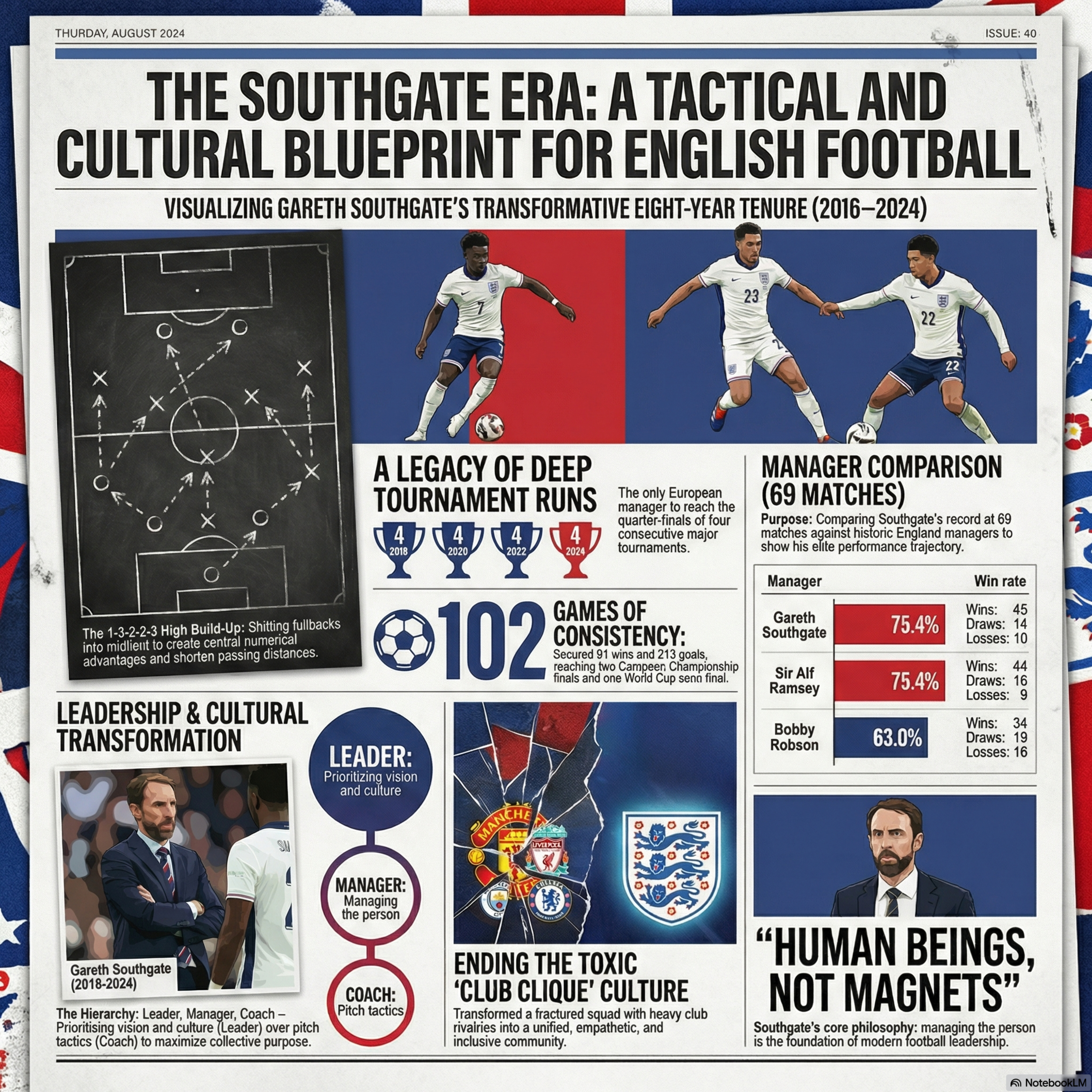
OK, so take us inside the tactics board. We see the lineup on TV usually says 4231 back, 42 holding midfielders, 3 attackers, Harry Kane up top, standard safe. Right, and that's the low build up shape. That is what they look like when the goalkeeper has the ball deep in their own half. But modern football is fluid. The real magic, or the real problem depending on your view, happens in the high buildup when the team moves past the halfway line. In Southgate system that 4231 dissolved, it morphed into something that looked more like a 3223.
A3223 that sounds less like a formation and more like a POST code. Bring that down for us. How do you get there from a back 4? It usually hinged on specific player roles, so think about Kyle Walker on the team sheet, he's a right back, but in possession he wouldn't run up the way. Right, he doesn't overlap much. No, he would tuck inside and become a third center back that gave England a solid base of three defenders who are fast and physical to stop counter attacks. Then on the other side you'd have a left back, Luke Shaw or Karen Tribbier pushing high up the pitch to act as a genuine winger.
OK so you have 3 at the back, one full back bombing on. What's happening in the middle? I keep seeing this term box, midfield and all the tactical analysis. What is this obsession with the box? This is the absolute key to understanding Gareth Ball. Southgate prioritized the center of the pitch above everything else by tucking players in. He created a square or a box in the midfield, 2 holding players, usually Deplin Rice and someone else sitting behind two number 10s or attacking midfielders. So 4 players all crammed into the middle of the park.
Why do that? Why crowd the busiest area on the pitch? Two reasons, and the first is about possession. If your players are close together in a box, you can circulate the ball incredibly fast. It's all short passes. Tic tac toe passing. Okay, that makes sense. The second reason is the most Southgate reason of all safety. Safety, of course. It's called rest defense. If you have 4 players centrally located in a tight box and you lose the ball, well, you are perfectly positioned to counter press. You can swarm the opponent instantly because you're already right on top of them.
It minimizes the risk of being hit on the break. So it's defensive possession. You keep the ball close so that if you drop it, you can pick it up again immediately before the other guy can even think about running with it. Precisely. It's highly sophisticated risk aversion. But here is the catch. And this is really the crux of the frustration fans felt. When you pack the center of the pitch to be safe, to ensure you don't lose, you often sacrifice the chaotic, risky runs that actually score goals.
You prioritize control over creativity. You do. You take the chaos out of the game, but sometimes you need the chaos. Which brings us to the Harry Kane dilemma. Because Kane is the captain, the goal scorer, the legend. But in this system, his habits became a real flashpoint for debate. Absolutely. Kane loves to drop deep. He sees himself as a #10 as much as a #9 in Southgate system. This was a feature, not a bug. It was encouraged. It was Kane dropping to that box created a massive numerical overload.
You'd have England's 4 midfielders plus Kane all in the center circle. That's five guys against usually two or three opposition midfielders. It's a five on three power play in the middle of the park. Which sounds great on paper. We have the ball, we have the numbers, but, and it's a huge but if Harry Kane is in the midfield pinging passes around who is in the penalty box. That is the $1,000,000 question. That was the scream you heard from every pub in England. You'd see England dominate possession 6570% but the penalty area would be completely empty.
Else infuriating to watch. Because you've bypassed the opponent's midfield? Great. But now you're staring at their back line and you only have two wingers, maybe Saka and Foden, and trying to beat 4 defenders. The army is stuck at base camp and you've sent 2 poor guys to storm the castle. The visualization is perfect. The army at base camp, so you have all this control, all this possession, but zero threat. But surely Southgate isn't blind. He sees the empty box. What was the plan? What was the countermeasure to that?
The solution was supposed to be balls in behind. This is why players like current Alexander Arnold became so debated and so important to the system. The idea was lure the opposition up the pitch. Bait them in. Exactly. Play that slow boring passing at the back to bait them into pressing you. Once they step up and leave space behind them, you use a laser guided pass from Trent or McGuire or Stones to hit a fast runner like Rashford or Saka in that empty space. So the boring passing was a trap. It was a lure.
It was meant to be, but here's the problem. International teams aren't stupid. After a while, they stopped taking the bait. They just sat back. Teams like the USA or Scotland realized if we just sit deep in a low block and don't press them, England will just pass it around in AU shape forever. And because Kane was dropping deep, there was no one pinning their defenders back or occupying them. They could just sit comfortably. And that's exactly what happened. We watched 90 minutes of U-shaped passing from side to side.
Now there's another criticism. I want challenge you on the idea that Southgate parked the bus, that he was a defensive manager who sat deep. The data doesn't actually support that, does it? No, it's a total myth. It's one of the biggest misconceptions, in fact. Under Southgate, England played with a surprisingly high defensive line. They wanted to squeeze the pitch. Squeezing the pitch? Explain that concept for us. Imagine the football pitch is a room. Southgate wanted to make that room as small as possible for the opposition.
He instructed his defenders to stand on the halfway line. The forwards press the other teams goalkeeper. Now the opponent only has about 30 meters of space to play in. It's claustrophobic. So you're. Forcing them into mistakes. You're forcing mistakes, you're forcing long, hopeful balls which England defenders, guys like Stones and McGuire who are aerial monsters, would just eat up all day. Is the narrative that he just plays defensive is lazy? It's incomplete. He played controlling football. He used defense as a form of attack, and he used possession as a form of defense.
It wasn't attacking in the chaotic, heavy metal football sense of a Jurgen Klopp team. It was methodical. It was chess, right? And unfortunately, watching grandmasters play chess isn't always thrilling for the casual observer who just wants to see a knockout punch. Right. We wanted fireworks. He gave a structural integrity. But let's pivot, because Southgate wasn't just a tactician. In fact, he might argue tactics are secondary. There's a fascinating detail about his LinkedIn profile. I love this detail, it's so telling.
I mean most people don't know the England manager even has a LinkedIn, but he does. And his bio didn't just say England manager, it listed three titles in a very specific order. Leader. Manager. Coach. Leader first, coach last. That feels incredibly deliberate. It was a manifesto. You have to understand the context of modern football to get why this matters so much. In the last 10 years, the role of the traditional manager has been dying at big clubs. Chelsea, Manchester United, Real Madrid. Power has been stripped away.
They hire head coaches. Right. The club hires a sporting director or a technical director to buy the players, negotiate the contracts and set the long term strategy. The guy in the dugout is just there to pick the team on Saturday and run training. He's a glorified wide consultant. Exactly. He's a tactical mechanic and Southgate saw that as a trap. When he took the England job, he insisted on the title manager. He refused to be just a head coach. His argument was that a head coach just moves magnets around a board.
A manager handles the melting pot. The melting pot being the media, the pressure, the egos, the culture. All of it. Southgate believed that in international football, you aren't just coaching a sport, you are managing a national mood. You're managing 25 multi millionaires who are all individual brands. You are managing a press pack that is financially incentivized to see you fail. He believed that if he didn't have authority over that wider culture, the tactics wouldn't matter one bit. There's that famous quote of his players are not magnets on a tactics board.
That is the core of his philosophy. Think about the managers before him, Fabio Capello. Strict authoritarian, my way or the highway. Southgate moved to a model of empathy and empowerment. Now it sounds like corporate HR speak, but it was revolutionary in football. Give me an example of that in practice, because the critics, you know, they call this woke or soft. Look at how he handled decision making in meetings. He stopped telling players exactly what to do in every single scenario. He would ask them.
He'd put a situation up on the screen and say, what do you think we should do here? So he's asking for their input. He's forcing them to think for themselves. His view was in the 85th minute of a World Cup final. I can't hear you. The crowd is too loud. I can't make the decision for you on the touchline. You need to own it. He shifted the culture from command and control to shared ownership. He was trying to build leaders, not just soldiers. But to really appreciate why this was so necessary, we have to look at the ghosts he was fighting.
Because I think we forget we view the Southgate era through the lens of we didn't win the trophy, but we forget just how toxic the England setup was before he arrived. It was poisonous. It was a completely broken workplace. To really illustrate this, we have to go back 2010, the Fabio Capello era, Rustenburg, South Africa. Oh God, the boredom, the misery. I remember the reports coming out of that camp. It sounded awful. It was worse than boredom. It was a prison camp. There's this incredible story from a journalist who was embedded with the team.
Capello treated the media with utter contact. He viewed them as the enemy. He wouldn't even look at the cameras during open training sessions. He'd literally stand with his back to them. Just a total wall of silence. So the journalists, desperate for any footage, found out the players were playing golf at a nearby course on their day off. They hid in the bushes to get some B roll footage. Just harmless shots of Wayne Rooney hitting a tee shot, right? Capello spots them. He walks over, catches the journalist's eye and just says one word.
Imbecile. Imbecile. And walked off. That was the relationship. So the players hated the media because they felt haunted. The media hated the players because they were treated like scum. And inside the camp, the players hated each other. The club cliques, right? The famous Manchester United table versus the Liverpool table. Rio Ferdinand and Frank Lampard have spoken openly about this since retiring. They were best friends growing up at West Ham, but once they moved to United and Chelsea, they basically stopped speaking.
They couldn't sit together at dinner, because they were. Rivals. That's insane. It is. The England shirt weighed heavy, that was the phrase. It was a burden. Players would genuinely fake injuries to avoid getting called up because they dreaded the atmosphere. Imagine being one of the best players in the world and faking an injury to avoid playing for your country. So Southgate comes in, he's seen this. He was AU 21 manager he he watched the senior team burn to the ground against Iceland in 2016.
What was his exorcism strategy? How do you fix a toxic workplace that's being watched by 50 million people? He. Humanized them. It sounds so simple, but it was radical. He realized the media attack dogs were attacking faceless millionaires. So he opened the doors. He told the players to tell their own stories. Remember the 2018 World Cup? The Unicorn inflatables in the pool. How could I forget Bukai Osaka and the lads racing on inflatable unicorns? It was the moment the whole nation went, wait, these guys are, they're just young guys having fun.
That was 100% strategic. By letting the media see the players as human beings, it broke the cycle of antagonism. The press started writing favorable stories. The fans started liking the players again. Southgate realized that if the players felt loved, they would play with less fear. He also simplified the football itself, didn't he? We hear about this England DNA. Yes, this was a huge, huge project. He worked with the FAA to strip away all the confusion. They distilled the England philosophy into simple core principles, things like look up, play forward.
And crucially, he ensured this message was consistent from the under fifteens all the way to the senior team. So it's a production line, a single coherent philosophy. Exactly. When a young player like Cobie Meno or Jude Bellingham steps up to the senior squad today, they already know the language, they know the drills, They aren't learning a brand new system, they're just changing the shirt size. That continuity simply didn't exist before Southgate. So he fixes the culture, he fixes the vibes, the team is likable, the results improved drastically.
But and here is where we have to pivot to the uncomfortable reality, right? Because despite all that, the end of his tenure wasn't a love him. It got ugly again. It did. And this brings us to the court of public opinion, because there are effectively 2 Gareth Southgates. There is the Gareth Southgate of the history books, the most consistent manager we've ever had. And then there is the Gareth Southgate of the Reddit threads. And the radiophone ends the beige manager. The beige manager, Yeah, that stings.
But that was a feeling, wasn't it? That he was a nice guy, a great HR manager, but a championship level tactician who got lucky with a Ferrari of a squad. A golden generation. That's the luck factor argument. Critics will point to the tournament draws. They say, look, in 2018 he only beat Colombia on penalties and Sweden. In 2020 he beat Ukraine and Denmark. The narrative is that whenever he met a truly top nation, Croatia in the semi final, Italy in the final, France in the quarters, he failed.
Is that fair though? It's harsh, but it's not entirely baseless. He did struggle to beat the top tier nations in competitive knockout games. However, the statistical defense is robust. 102 games, 61 wins. He reached the quarterfinals or better in four consecutive major tournaments. OK, contextualize that for us. How good is that really? England was the only European team to do that in that period. The only one. The only one. Not France, not Germany, not Spain, Just England. Consistency is the hardest thing in sport and he delivered it tournament after tournament.
And when you compare them to the so-called golden generation managers? It's night and day. It's not even a contest. Svenger and Erickson and Fabio Capello had Rooney, Lampard, Gerard Beckham, Skulls, Terry Ferdinand, Ashley Cole, a team of absolute once in a generation superstars and they failed to reach a single final. They barely won knockout games. Exactly. Southgate won more knockout games than all post 1966 managers combined. If you put it like that, the criticism seems completely insane. So why did the plastic beer cup start flying at him in 2024?
Why were fans booing him after a 00 draw in the group stages of the EUR? What changed? I think it was fatigue and the shifting baseline of expectations. Southgate was a victim of his own success. He raised the bar so high that a semi final was no longer seen as a miracle. It was seen as the minimum requirement. But there was also a new factor in 2024 pundit power. You mean Gary Lineker? Specifically Gary Lineker calling the team's performance shit on his podcast during the tournament. Which, to be fair, is what every fan in the pub was saying.
It was a terrible performance. It was. But when the former England captain and the main presenter of the BBC says it, it legitimizes the anger. It creates a permission structure for the fans to turn, and Southgate admitted that this noise finally penetrated the camp in 2018. The bubble protected them. By 2024, the bubble had burst. He said best side just focus on the final. But you could tell he was hurt. The protection he offered the players for so long was eroding. And I think this leads us to the biggest question of all, the question of why?
Why does the England job do this to people? Why do we as a nation project so much onto this one man in a polo shirt? This is where we have to zoom out. This isn't just about football. It's about the psychosocial dimension of England. We are a country with a, let's say, a somewhat fragile identity right now, and we are constantly searching for a savior. We want a Churchill figure. Exactly. We have a deep seated nostalgia for a stoic British character. We want a leader who resolves conflict through strength, through dominance, through shouting, the hair dryer treatment.
And Southgate, it was just not that. Southgate was the opposite. He was soft power. He was empathy. He was articulate. He talked about feelings. He supported the players taking the knee. And for a large segment of the fan base, let's call them the Somewheres, that clashed with their idea of what a boss should be. The Somewheres versus the Anywheres. This is a sociological concept from the writer David Goodhart, right? Break that down for us in this context. Well, it helps explain the divide. The anywheres are often more urban, liberal, usually university educated people who value openness and fluidity.
They generally loved Southgate. He represented a modern, inclusive England. The Somewheres are more rooted in tradition, place and national distinctiveness. They often viewed Southgate's woke gestures, like taking the knee or talking about social issues with suspicion. They just wanted a football manager, not a social worker. So the England team became another battleground for the culture. Wars. Precisely. Southgate wasn't just managing a 4231, He was managing A polarized nation. He filled a void of leadership left by politicians.
Think about it. During his tenure, we had how many prime ministers? 4-5. When the government was in chaos, Southgate was often the only grown up in the room. That's a good point. But that is an impossible burden for a football coach. You can't be the Prime Minister and the tactical genius at the same time. Eventually, the resentment builds. And the resentment was fueled by the football being, well, beige. If he was winning four Zell every game, playing like Brazil 1970, nobody would care about his politics.
That's the crux of it. Winning cures everything. If you win, you're a genius. If you lose, or even if you draw boringly, you're a woke supply teacher. Woke supply teacher. I have definitely seen that tweet. So looking at the full arc from the toxicity of 2016 to the resignation, what is the final verdict? Because he leaves the role having changed everything but winning nothing. He leaves as an architect. That's the best word for him. He rebuilt the foundation. He took a toxic brand, the England national team, and made it likable again.
He made the shirt lighter. He proved that culture eats tactics for breakfast. He showed that you can lead with decency. There's a but coming. I can hear it. The butt is the empty trophy cabinet. Southgate proved that you can get almost there with good culture and good vibes. But he perhaps also proved that without a ruthless tactical edge, without that killer instinct to twist the knife when you're 1 nil up in a final against, Italy almost is the ceiling. She fixed the floor, but he couldn't breakthrough the ceiling.
Exactly. He raised the floor so that England will hopefully never be a complete disaster again, but he couldn't quite reach the stars. And now the squad reset is happening. Kane and Walker are phasing out. It's the era of Bellingham menu Foden Palmer. The foundation is there for the next guy. So here is the final thought to chew on. We've spent years debating Garrett Southgate, but maybe the question isn't about him anymore. It's about us. Can the next manager keep the harmony Southgate built while adding that ruthless killer instinct?
Or was the Harmony entirely dependent on Gareth being Gareth? That is the danger we might look back in five years if the toxicity returns, if the club clicks, come back and realize that Southgate Superpower wasn't the tactics board at all. It was keeping the demons at Bay. And if those demons come back, we might just miss the waist coats and the beige football more than we think. That's it for this deep dive. Thanks for listening.
 Apple Podcasts
 Castbox
 Castro
 Goodpods
 Moon FM
 Overcast
 Pocket Casts
 Podbean
 Podcast Addict
 Podcast Republic
 Spotify