The Data Blueprint For African Football
About this episode
The Data Blueprint For African Football
Imagine, if you will, sitting completely silently in a highly secure covert boardroom. Yeah, the heavy wooden doors are locked tight. Exactly. All mobile phones have been confiscated, left in a basket. We are talking about the African continent, which remains the most vital, complex and high yield reservoir of elite footballing talent anywhere on the planet. It's the absolute goldmine of the sport. It is, but the global landscape is undergoing this massive seismic shift. Specifically, we are looking at the post Brexit UK regulations that have completely, and I mean utterly, rewritten the rules of talent acquisition.
The traditional pathways are basically blockaded at this point. Exactly. So for the African game to truly benefit, to capitalize on its immense wealth of human potential, there has to be a structural shift. The old ways of doing business are entirely dead. Dead and a buried. Yeah, the new currency of global football is empirical, undeniable data. Which brings us to the core mission of today's Deep Dive. For you, the listener, we are uncovering exactly how cutting edge technology and brilliant bespoke data ecosystems are completely revolutionizing the African football game.
We are permanently leaving behind the dusty, intuitive era of scouting. We are entering an age of algorithmic proof and we have some strict rules for our journey. Today we are moving systematically. We have to. It's too complex otherwise. Right. So we're going to start at the absolute foundation, looking at how grassroots Academy models are being entirely re engineered. From there we need to know what tools they're using, the hardware, the exact physical technological hardware being deployed on the pitches.
Then we step into the tactical lab to understand forensic data-driven match analysis. And once we understand the player and the data. We crack the incredibly complex code of UK immigration laws to see how this talent actually moves, and we will finish with real world high stakes case studies of massive player transfers. Step by step. We are moving forward step by step with no looking back. It is really the only way to truly grasp the scale of what is happening. But to understand the sheer magnitude of this technological revolution, we first have to paint a very clear picture of what we are actively dismantling.
The old way. Right, we have to look at the old archetype of the scout. Think about the classic legal pad coach. I know this image perfectly. We all do. You picture a guy standing on the touchline of a dusty pitch somewhere, right? Squinting into the blinding sun. Chewed up, pen in hand. He has a chewed up pen and a yellow legal pad. He is watching 22 kids run around and he is relying entirely on subjective visual cues. That is the exact image and it is a terrifying way to conduct high stakes business.
Terrifying. I mean, you have a human being with all their inherent flaws trying to rely on memory, personal bias and gut feeling to evaluate an asset that could eventually be worth 10s of millions of euros. It's madness when you say it out loud. He writes down #7 looks fast or #4 seems strong in the tackle. It is incredibly flawed. First of all, human memory degrades rapidly. Right by the time that Scout gets back to his hotel room. Or files a report a week later. Exactly, he has completely forgotten the nuances of a player's off the ball movement.
Plus you have massive psychological biases creeping in. Like the recency bias? Yes, a kid misplaces a pass in the 89th minute and suddenly the scout forgets the flawless game the kid played for the 1st 88 minutes. Or you have the physical maturation bias. This one is huge. Oh, it's a career killer. A scout looks at a 14 year old who happens to have hit puberty early. He's 6 feet tall and he dominates the game purely through physical size. And the scout writes down generational talent. But they completely miss the smaller, late blooming 14 year old who actually has vastly superior spatial awareness and neural processing speed.
The physical maturation bias has ruined countless potential careers. The scout on the touchline cannot see cognitive processing speed, they cannot see underlying biomechanical efficiency their way, and on a purely logistical level, that legal pad is a single point of failure. It gets lost at the airport. It gets ruined in a sudden downpour. It is just not a sustainable foundation for a multi billion dollar industry. So this entire antiquated system is what the performance innovation revolution is actively replacing, Yes, But let's pause right there, because performance innovation sounds like a slick corporate buzzword.
I want to know what that actually means on the ground. It's highly practical. Right, because from what I understand, the solution here isn't just calling up a massive tech conglomerate in London or Munich, ordering a crate of their latest GPS sports best, shipping them to an Academy in West Africa and calling it a day. No no, that plug and play approach has been tried. And it fails. It fails spectacularly. You cannot simply copy and paste a European technological solution onto an African reality.
The environments are totally different. Fundamentally different. The infrastructure, the daily challenges, what we are seeing now is the curation of a technological infrastructure that is specifically intentionally tailored to the African continent. OK. And this ecosystem is built on 4 distinct non negotiable pillars of tech empowerment. Let's unpack those 4 pillars for the listener. What is the absolute foundation? The first pillar. The first pillar is deep local expertise. OK, let's look at the hardware itself.
A tracking solution or a wearable device built for the pristine, manicured, temperature controlled hybrid grass pitches of the Alliance Arena or the Emirates Stadium. That is a delicate piece of machinery. Right, it's a sports car. Exactly when you take that same delicate device and expose it to the high resistance, erratic merm or sand pitches characteristic of grassroots African football, it breaks. Just immediately fails. The technology has to be fundamentally ruggedized. It has to survive erratic power grids where you might only have electricity for four hours a day to charge the devices.
Oh wow, I didn't even think about the charging logistics. Yeah, and it has to survive extreme heat, torrential rain, highly abrasive playing surfaces, because if the hardware can't survive the environment, the data doesn't exist. That makes total sense. You need a tank, not a sports car. So if they can't just ship European tech to Africa, how are they solving the hardware problem without having to build entirely new technology from absolute scratch? That seems incredibly expensive. That leads directly to the second pillar, which is global integration.
Global integration The. Leading minds in African football technology aren't sitting in a room trying to reinvent the membership. They aren't building proprietary hardware in a vacuum. That would take decades. Instead, they are partnering with the absolute best global tech companies, the ones who already have the billion dollar R&D budgets, and they are working with them to completely adapt those interfaces and harden that hardware for the local African market. It is a brilliant synergy. You take global horsepower, but you apply local contextual steering.
I love that phrase. Global horsepower, Local steering. So we have rugged hardware that actually works. What's the third pillar? The third pillar is arguably the most important for the long term health of the game, data sovereignty and legal advisory. Right, we just talked about the scout with the legal pad. When you move from a paper notebook sitting in a filing cabinet to a highly secure digitized cloud based biometric profile, you are entering highly complex legal territory. You're harvesting physiological data of minors.
Exactly. Highly sensitive medical data. You are tracking their heart rates, their sleep patterns, their injury histories. That is intensely private. And historically, African resources, including data, have been vulnerable to external extraction without fair compensation. Right, a very dark history there. So this third pillar ensures that the African athletes data is legally protected from exploitation. It establishes verifiable, secure, legally compliant frameworks. It's an ethical mandate. It is, but it's also a strict business requirement.
When a European club comes looking to make a €10 million investment in an 18 year old, their legal and compliance departments demand absolute auditable proof of how that data was collected and stored. So if your data ecosystem isn't sovereign and legally sound. The European club will walk away from the transfer entirely. Wow, so it's about owning your own worth and having the legal armor to protect it. That brings us to the fourth pillar. Skill, Ability. Right, because all of this rugged, legally protected tech means absolutely nothing if it is locked behind the gates of only one or two elite hyper funded academies.
Skill ability is the true democratizer here. The goal of this revolution is to bridge the massive sprawling gap between the elite national teams competing at the highest levels of the African Cup of Nations and the grassroots, severely under resourced village clubs. Because the mathematical reality is that the next global superstar is probably not currently sitting in a pristine Academy. No, they're likely kicking a bundled up rag on a dirt road right now. Exactly. The technology has to scale down to reach them without losing its empirical validity.
So we have the blueprint. We understand the theory of these 4 pillars. We know we're throwing away the legal pad and bringing in ruggedized, protected, scalable tech. But an Academy is only as good as the underlying philosophy it uses to develop these kids. The technology does not operate in a vacuum. No, it has to be applied. It is grafted onto highly specific localized Academy models, and these models are laser focused on financial sustainability and most importantly, player welfare. Let's look at the actual developmental canvas.
This is where the theory becomes flesh and bone. There are four primary Academy models currently elevating the African game, and each utilizes the data in radically different ways. Let's start with the first one, because the philosophy behind it is incredibly powerful. Powerful. The character and education model. Right. A prime example of this is the Right to Dream Academy. And the foundational belief here is a simple truth, right? Talent is universal, but opportunity is absolutely not. What does this look like on the inside?
It is a massive paradigm shift from the old football camp mentality. These institutions are operating as elite, high functioning educational facilities first and football Academy second. Which is huge. We are looking at sustained investments of up to $25,000 annually per student. Wow. And that money isn't just going into football boots, it is going into providing A rigorous Cambridge level academic education. They are intentionally building a dual pathway. Because the mathematical reality of football is absolutely brutal.
The vast overwhelming majority of kids entering any Academy anywhere in the world will never secure a professional contract in a top tier European league. The funnel is incredibly narrow. So narrow. And in the African context, failing to make it as a professional carries a weight that is difficult for outsiders to fully comprehend. It is deeply tied to something known as the black tax. Let's break that down for the listener. What exactly is the black tax in this specific football context? In many African communities, when a young child is identified as a highly talented athlete, they instantly become the lottery ticket for their entire extended family.
That's a lot of pressure. The psychological and financial expectations placed on a 14 year old's shoulders are staggering. The family might pool all their meager resources to buy the child boots or pay for transport to trials. So if that child reaches age 18 and gets released from the Academy without a European contract. The perceived failure is devastating. The family remains in poverty. And the child carries A crushing guilt. That is immense pressure. How does this character and education model cure that?
By utilizing the data to create an ironclad safety net. Under this model, if a player reaches the end of their developmental cycle and a Premier League club doesn't come calling, their football career isn't over. The Academy takes the players heavily quantified, undeniable athletic data, their top speeds, their tactical awareness metrics and combines it with their Cambridge level academic transcripts. A dual profile. Exactly, they package this dual profile and use it to secure highly lucrative full ride university scholarships in the United States.
That is incredible. So instead of going back to the Village as a failure, they're heading to a Division One College in America with a quarter $1,000,000 education fully paid for. Exactly. And the psychological relief of that safety net cannot be overstated. It completely neutralizes the black tax. I can imagine. When a 15 year old steps onto the pitch in this Academy, they know that their future and their family's financial future is entirely secure, regardless of whether a scout from Ajax or Dortmund is watching that day.
They can just play. They play with joy, with freedom, and without fear. And ironically, removing that fear of failure often leads to elite, uninhibited athletic performance. It frees them up to actually be superstars. Yes, it is no coincidence that graduates of this specific model like Muhammad Kudus and Simon Odingra have gone on to command massive transfer fees in Europe. They were allowed to develop without the weight of the world on their chests. It is a profoundly humane and effective system.
But let's pivot to the second archetype, because it takes a completely different, almost obsessive approach. Technical purist model. Exactly, institutions like the JMG academies champion this. If the first model is about dual academic pathways, this one is about extreme biomechanical feel and creative risk taking. And there is one specific rule they have That absolutely blew my mind. You're referring to the mandate regarding footwear. Yes, the fact that they forced players to train completely barefoot for the first 3 to 4 consecutive years of their Academy life.
No boots. No boots, no shin pads, just bare feet on the ball. Help me understand the science behind this, because to a European coach that sounds like absolute madness. It sounds like madness, but it is rooted in brilliant biomechanical science. By completely removing the barrier of the modern, heavily padded synthetic boot, you are maximizing the sensory interaction between the sole of the foot and the surface of the football. Because the foot is so sensitive. The human foot is packed with thousands of nerve endings.
When you train barefoot for years, you are developing a micro level touch. You build an intimate, almost subconscious, biomechanical understanding of the ball's weight, its spin, its texture. And how it reacts to the slightest manipulation. Right, it is a level of proprioception that is nearly impossible to replicate once a young player's foot is strapped into a rigid modern boot. So they are basically turning their feet into highly calibrated sensory instruments. Precisely. But it gets even Wilder than the barefoot rule.
They also completely ban competitive league matches until the players are 14 years old. Completely banned. Think about that in the context of global football culture today. We live in a world obsessed with under nines, winning meaningless plastic trophies, coaches screaming from the sidelines. But this model shuts all of that down. Why? To deliberately kill the win, it all costs mentality before it can infect the players. Developmental psychology. Think about it, when a 10 year old plays in a highly competitive league where the coach's job depends on winning, what happens?
The child becomes terrified of making a mistake. Exactly. If they try accomplished like dribble in their own half and lose the ball, they get benched. So they learn to play safe. They just boot the ball out of bounds. Clear it. The technical purist model argues that if you are terrified of making a mistake, you will never ever attempt the creative, high risk, high reward plays that ultimately define elite world class football. So they remove the scoreboard so the players can focus entirely on mastering the instrument, the ball.
It's pure artistic development. But here is the critical question. If they aren't playing matches and they aren't wearing boots, how does a coach know when a kid is actually ready to graduate from this barefoot phase? In the old days, the legal pad coach would just guess he looks big enough give him some boots. Where does the technology integrate into this purest model? This is where the marriage of street football, philosophy and high science occurs. They don't guess, they use advanced cognitive benchmarks.
Cognitive. Benchmarks. They aren't looking at the players physical size or their chronological age. They are utilizing data to measure the players neural processing speed, their spatial awareness, and their technical consistency under controlled pressure. Graduate from the barefoot phase and get your first pair of boots, not because you turned 14, but because you're cognitive and technical data proves objectively that you have mastered the foundational curriculum. That is fascinating science meeting street football.
Now the third model shifts gears entirely. This one is pure, unapologetic business. The sustainable revenue engine. The sustainable revenue engine AC com mimosas is the absolute gold standard for this on the continent. The entire concept here is building a highly efficient direct export pipeline to Europe. And there was no shame in that. Not at all. This model treats the Academy as a primary vital revenue Center for the domestic club, and this is where data serves its most crucial role as the ultimate auditing tool.
How so? In this model, they use technology to track every single micro development of a player longitudinally over years. Every training session, every Sprint, every pass completion rate is logged and graft. But why go to that level of forensic detail if you know you're just going to sell them anyway? Because they are maximizing the financial valuation of the asset prior to export. Driving up the price. Let's say a scout from a top French club arrives. The Academy doesn't just point to a kid and say he's got a great left foot.
They bring the Scout into an office and present a flawless, scientifically verified dossier of potential. A completely de risked asset. Yes. They show the scout, the players, year over year acceleration curves, they show the injury prevention data. They remove all the risk for the buying club. And when you remove risk, you drive at the price. You are selling a known verified commodity rather than a lottery ticket. But the really crucial part of this model is what happens to the money after the sale.
Precisely. They aggressively capture those primary transfer fees, but they also meticulously track and claim the FIFA mandated solidarity payments and training compensation every time that player moves to a new club later in their career. That's a massive revenue stream that often gets lost. And instead of that money disappearing into the pockets of agents or corrupt officials, it is pumped directly, systematically back into local infrastructure. They build better pitches. They buy better tracking tech, they hire better nutritionists.
It creates a self-sustaining loop of wealth generation that permanently elevates the African game. Which perfectly sets up our 4th and final developmental canvas. And I have to admit this is my favorite one the. Ecological Lab. The Ecological Lab. It is essentially an adaptation of the famous Benfica Academy model in Portugal, but it has been heavily engineered to fit African realities. The core concept here is brilliant in its resourcefulness. You take your obvious infrastructure weaknesses and you systematically turn them into massive competitive advantages.
It is the ultimate expression of making virtue out of necessity. To understand this, contrast it with a top tier European club. A club in the Premier League will spend millions of EUR building a high tech 360° virtual reality simulator room. They put their young players in there with VR headsets to train their cognitive reaction times and spatial awareness. Highly sanitized and incredibly expensive. Right, and an Academy in Senegal or Ivory Coast likely doesn't have a spare €3 million for AVR room.
So what do they do? They achieve the exact same if not better cognitive load but utilizing the environment they already have. They play intense Kati games. Kati Games What exactly is a Kati game? Think of it as a highly constrained, rapid fire, small sided possession grid. Like a Rondo. Like a Rondo on stereo roids. But the genius is where they play it. They don't play it on a flat, perfect artificial turf. They play it on totally erratic, unpredictable, uneven surfaces. Patches of thick grass mixed with deep sand and hard dirt.
The environmental constraints are the simulator. Exactly, I see, Because on a perfect European pitch, if you pass the ball 10 yards, you know exactly how it will roll. You don't even have to look at it. But in the ecological lab, you have to process chaos. When the ball hits a patch of uneven sand, its trajectory and seed change unpredictably in a millisecond. It bounces U at your knee out of nowhere. Yes. This forces the young layer's brain to engage in constant rapid visual scanning. They cannot anticipate, they must react.
It builds immediate hyperfast neuromotor responses. The brain is working overtime just to control the ball. They're developing elite cognitive reflexes simply by adapting to a harsh environment. It is ecological dynamics in its purest form. They are building supercomputers in the minds of these players using dirt and sand. That is just incredible. So we have these brilliant tailored Academy models, we have the philosophy of the black tacks, the barefoot purists, the business engines in the ecological labs.
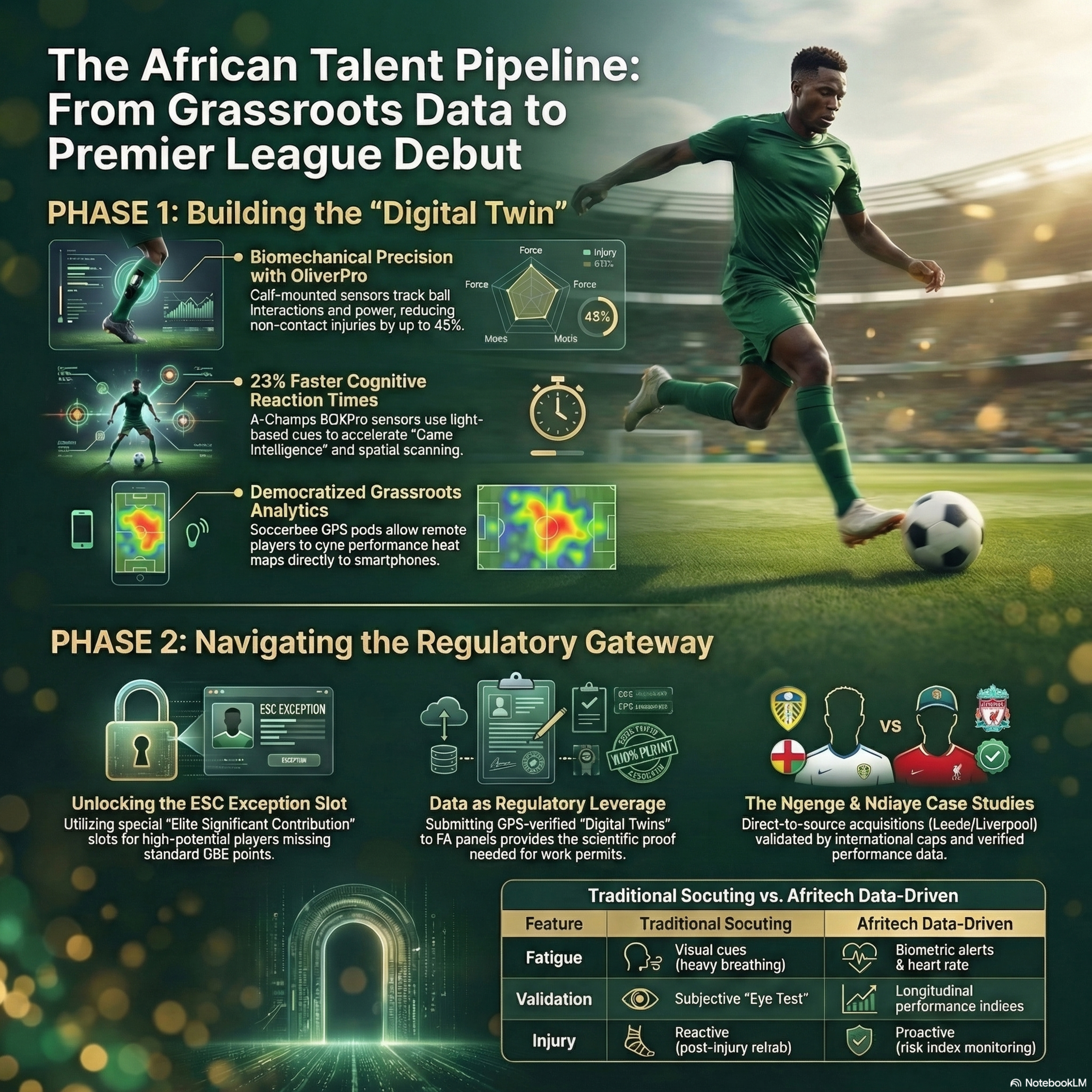
But an Academy is only as good as the tools it uses to measure success. The hardware. What does the actual physical tech look like when these kids step onto the pitch? Let's move into the technological arsenal, because the hardware being deployed right now is fundamentally democratizing objective verification. Let's start with the piece of kit that is completely revolutionizing how we track player movement. We have to talk about Oliver Pro and the Vestry Revolution. To truly appreciate why Oliver Pro is a game changer, you have to understand the status quo of the last decade.
For years traditional GPS tracking and elite football has meant one thing, the sports bra style chest vest. You see players wearing them under their shirts all the time. Now, these vists are perfectly fine for macro movements. They're essentially highly advanced pedometers. They can tell you the total distance a player ran, their top speed, and their general heat map. Right, but wait, European clubs spend millions on the chest vests? Are you saying a new device is actually better or just a cheaper alternative for the African market?
It is fundamentally better for the specific data required to develop elite players, and it solves massive logistical headaches. What kind of headaches? In under resourced African environments, those chest vests are a nightmare. First, they're incredibly uncomfortable in extreme heat and humidity. Second, imagine the logistics of washing and maintaining 40 sweaty, specialized electronic garments every single day in an Academy with limited running water. Right, that is totally impractical. But most importantly, the chest vest has a massive functional blind spot.
A blind spot? What can't it see? A monitor sitting between your shoulder blades on your upper back cannot tell you anything meaningful about how your foot is interacting with the football. It tracks the body, but it ignores the ball. Enter the solution, a revolutionary GPS tracker that isn't worn on the chest at all. It is a tiny pod worn on the lower leg, slipped seamlessly into a specialized calf sleeve. Now help me understand the physics here. Why does moving the sensor down to feet change everything?
The genius is in the extremity placement. By putting the advanced sensors directly on the striking limb, you unlock an entirely new universe of micro metrics. You are moving from tracking near aerobic capacity to tracking direct mechanical interaction. The Oliver Pro device measures specific physical force at the point of impact. It measures the force of the kick. Yes, it uses complex algorithms to categorize every single touch of the ball. It can differentiate between a low intensity tap, a medium intensity pass, and a high intensity shot.
It measures overall shot power. Hot Wild. It tracks the precise volume of ball strikes and the exact distance covered while the player is actively dribbling the ball, rather than just running empty space. So the chest vest is like a pedometer, but the calf sleeve is like a high tech swing analyzer in golf? That's a perfect analogy. Think about what that means for a coach. You aren't just looking at a spreadsheet that says your striker ran 10 kilometers today. You are looking at a granular timeline that shows that in the 80th minute of the match, the physical force of their right footed shots dropped by 20%.
It empirically quantifies fatigue induced technical degradation. You can literally see the moment their legs get too heavy to strike the ball cleanly. It is unprecedented insight, but the Oliver Pro ecosystem does something even more important for the African game. It keeps the players on the pitch and out of the medical room. You're talking about the injury risk index, Yes? By constantly monitoring both the internal load, how hard the heart is working, and the external mechanical load on the legs through this localized calf data, the software calculates a highly individualized injury risk profile for every single player.
It flags a warning when a player's biomechanical movement suggests an impending muscle failure. And this isn't theoretical marketing. Empirically, this specific tracking protocol has been shown to reduce non contact injuries like hamstring tears by up to 45%. 45% that is massive. Keeping your best assets healthy is half the battle. You are effectively bringing Champions League level sports science and physio protection to African federations without needing a staff of 10 data scientists or massive stadium antenna arrays.
But again, Oliver pros still elite tech. It requires a system. Right. What about the absolute grassroots? What about the thousands of underfunded village clubs across the continent who are operating on a shoestring budget? That is where we see the ultimate democratization of data. Soccer B. Soccer B. This is a bottom up decentralized smartphone revolution. The financial barrier to entry for elite GPS systems has always been the insurmountable wall for rural African clubs. A club in a remote area simply cannot afford a $10,000 tracking infrastructure.
Impossible. Soccer B completely shatters that wall. It shifts the power dynamic. It takes the power away from the wealthy institution and gives it directly to the individual player. How does a player use it? A player can purchase or even just rent for the weekend a very small, highly affordable, lightweight pod. They call them the B Pro or the B Light. They don't need a club to manage it for them. They just put the pod on, go out to their dirt pitch and play their match or run their training session.
And the second they step off the pitch, the magic happens. They pull out their smartphone. They sync that little pod directly to their phone via Bluetooth. It takes seconds. And instantly, right there on their screen, they generate their own professional grade analytics. They see their heat maps, their Sprint counts, their top speeds and a holistic positional performance score. That is wild. So instead of a kid praying a scout happens to be driving by their specific pitch on a Tuesday afternoon, they're basically handing over a verifiable digital resume.
The implications of this for the broader African game are staggering. Consider that talented kid in a remote Township. Previously, their entire future depended on microscopic chance. Now that kid is taking control of their own destiny. Over months and years, they build a verifiable longitudinal empirical data profile. So when they finally get an audience with a club in the capital city, they don't walk in and say, trust me, coach, I'm really fast. They hand over a digital dossier proving that they have consistently hit elite European standard Sprint speeds every single week for two years.
It systematically replaces hope with undeniable proof. And for the grassroots coaches, they aren't left behind line either. They use something called the SCB Team PC Dashboard. The coach simply takes their laptop or tablet and aggregates all those individual players smartphone profiles onto 1 screen. Suddenly a village club is professionalizing their conditioning management at a fraction of the cost of legacy systems. They can see exactly who is working hard and who is slacking off purely based on the players own devices.
But here is where we hit a massive evolutionary leap in the technological arsenal. Up to this point, we have tracked the body with GPS and we have tracked the ball with the calf sleeves. But to truly prepare an African athlete for global dominance, we have to track the brain. We have to close the cognitive gap. Yes, and this is being done with technologies like a Champs and Blaze pod. Let's talk about this cognitive gap because it is something scouts whisper about but rarely explain. Clearly, African players are known for being physically dominant, So what happens when they transfer to Europe?
Where is the disconnect? The physical dominance is a well established empirical fact. Young players coming out of African academies are frequently stronger, faster and more aerobically gifted than their European counterparts at the same age. But when they arrive in the top tier European leagues, the Premier League, La Liga, the Bundesliga, they often hit a brutal invisible wall. The European game is highly chaotic, rigidly structured and moves at an absolutely blistering cognitive speed. Tighter spaces, relentless pressing.
Exactly. So it's not that they aren't fast enough, it's that they don't think fast enough. They often face a steep tactical adaptation curve because in their domestic youth leagues in Africa they were physically dominant but cognitively under challenged. They relied on their athleticism. If they made the positional mistake, they could just rely on their raw physical speed to recover and win the ball back. Yeah, they never had a process complex spatial information in milliseconds because their athleticism always bailed them out.
So how do you fix that before they leave the continent? How do you prepare their brain for the speed of the Premier League? You introduce multi sensory neuroplasticity training. MSMP. Multi sensory neuroplasticity. That sounds like we're plugging these kids into the matrix. What does that actually look like in plain English for a teenager sweating at a training camp? Anakra. It looks like a video game brought to life on the pitch. They're using H Amps ROX Pro pods. These are not your average plastic training cones.
These are highly interactive sensor devices constructed from jet fighter grade materials. They have to be incredibly durable because they're taking direct high velocity ball strikes and surviving extreme African weather conditions. These pods emit completely randomized programmable light, sound, and vibration cues. OK, picture this for the listener. Imagine a player standing in the middle of a specialized training arena. They are surrounded by goal stations, smart rebounders, basically tension walls that bounce the ball back to you perfectly.
Suddenly, AROX Pro Pod flashes a bright red light behind the player. A specific buzzer sound goes off to their left and a ball is fired at them from the front. The cognitive load in that moment is massive, incredible. The player has to perceive that complex environmental stimulus, process the conflicting visual and auditory information, make a split second tactical decision based on what the red light means, and then execute a precise physical pass to the correct target. All in a fraction of a second and.
They were doing up to 1000 highly focused, intense repetitions of this procession. You are literally rewiring the neural pathways of the athlete. Yes, you are systematically training their sensory capacity, their deep concentration and their emotional management under pressure. And the results aren't just subjective, they are empirical and astonishing. Academies utilizing the system are seeing up to a 23% faster cognitive reaction time and a 30% improvement in visual perception and spatial scanning.
It is training the brain alongside the body. And with Blaze Pod you have flash reflex training doing the exact same thing. Specifically gamified for goalkeepers and strikers who rely entirely on snap decisions in high stakes environments in the penalty box. You are scientifically accelerating their game intelligence so that when they finally land in Europe, the blistering speed of the Premier League actually feel slow to them. They have already processed that level of chaos thousands of times. So we have built the elite athlete, we have engineered them physically and we have rewired them cognitively.
We have tracked every conceivable metric. Now we must transition into the lab. We are moving into advanced methodologies. This is the realm of forensic match analysis. This is how all that beautiful data is actually manipulated by managers and analysts before and after the referee is the whistle. Let's start with pre match algorithmic preparation. This goes way beyond a manager drawing arrows on a whiteboard in the locker room. Let's ground this in a real world scenario. You have a massive AFCON knockout fixture.
Zimbabwe is playing South Africa. The match is being held in the stud America in Morocco. The ambient heat is absolutely blistering. The altitude is a factor. How does a data ecosystem win this game before the players even step onto the grass? By establishing completely complete mathematical dominance over fatigue management. Fatigue management. A modern coaching staff doesn't guess who is tired. They look at the historical internal load and the heart rate variability data that has been harvested continuously over the past month from those Oliver Pro calf sleeves.
OK, they take that dense physiological data and cross reference it with the extreme environmental constraints of Merrick, the specific temperature, humidity and altitude. And what does that tell them? The algorithms can mathematically predict with frightening accuracy which specific players on the pitch will suffer catastrophic metabolic crashes in the final 20 minutes of the match. Wait, really? So the manager isn't just standing there waiting to see a player put their hands on their knees or start gasping for air?
No. The manager already knows 24 hours before kickoff exactly who is going to hit a physiological wall at the 72nd minute. That is mind blowing. And they build their entire starting lineup. They're pressing triggers and their substitution strategy entirely around that mathematical certainty. They know when the engine will run out of fuel. But the pre match prep goes even deeper into tactical profiling. Let's say your team is preparing to play against an elite world class swinger. Let's use Mohammed Sala as an example.
OK, a terrifying prospect for any fullback. How does data stop Mosala? You use aggregated tracking data from Sala's previous fifty matches to identify highly specific subconscious opponent behaviors. The analysts don't just watch video, they analyze the exact positional drift. They map his exact spatial tendencies. They quantify how often Salah moves from the wide right channel into the central half spaces specifically during the transition phase of play. Yeah. Now here is the genius part of the integration.
You take that precise spatial data and during your micro cycle of practice the week before the game, you program those a champs light sensors as we just talked about to simulate those exact spatial and temporal triggers. That is diabolical. You are literally programming Mosala's signature movements into the training ground lights. Exactly. The defenders aren't reacting to a scout team player, they are reacting to the lights flashing in the exact zones Saulah likes to operate in. They're building a subconscious, automatic defensive muscle memory.
By the time Sala actually makes that run on match day, the defender's body has already solved the geometric problem 1000 times. In practice, they step into the passing lane automatically. And then there is the offensive side of pre match analysis, the exploitation of SRA or Sprint repeat ability. Sprint. Repeat. Ability in their pre match planning analyst deeply evaluate the acceleration profiles of their own explosive wingers against the physiological data of the opposing full backs. They were looking for the exact temporal mismatch.
What do you mean by temporal mismatch? They calculate the precise minute of the game where the opposing defenders physiological ability to recover from a high intensity Sprint statistically degrades beyond a functional threshold. Say the 68th minute. The data says the defenders muscle recovery is shot. That is the exact second the manager substitutes in their fresh high paced winger. It is no longer a tactical guess or a gut feeling. It is a physiological ambush. You are deploying your weapon at the exact moment the enemy's shield cracks.
It is absolutely ruthless and this level of forensic examination is just as rigorous. After the final whistle blows, let's look at post match statistical deconstruction and the primary goal here is vital stripping away human emotion. Football is an incredibly emotional, chaotic tribal game. Managers get fired because of emotion. The date is there to provide the cold clinical truth. Let us examine a hypothetical AFCON fixture between Senegal and Sudan. If you are a club executive and you only look at the base score line in the newspaper the next day, you might get a completely distorted view of the game's reality.
Let's see, Sudan scores a late goal and wins one Dill. A traditional manager might panic, scrap their entire tactical system and drop three players. But the post match data reveals that Sudan's expected goals or XG was only .43. Meaning that statistically, the quality of the chances they created were very poor. They relied on a highly opportunistic lucky bounce or an unsustainable wonder strike from 30 yards out. Exactly. Meanwhile, the data shows that Senegal, despite losing, actually dominated all the underlying performance metrics.
They generated a massive 1.68 XG. Furthermore, the granular passing data shows Senegal had an 86% pass completion rate specifically while under high intensity pressure in the middle third. Whereas Sudan's possession was largely categorized by panicked, uncoordinated clearances. So the data proves to the Senegalese manager that the tactical system is working. Florida State, they just got unlucky on the day. The data prevents the manager from making panic driven, emotion based changes that would actually ruin the team's long term progress.
The post match analysis also has to rapidly adapt to the new officiating technology, which is fundamentally changing the geometry of how the game is played. Consider S 880. Semi automated offside technology. This system uses dedicated tracking cameras and microchip sensors inside the ball to provide offside decisions with absolute millimeter precision in a matter of seconds. Right, the days of the linesman guessing if a striker's shoulder was offside or over, the computer knows instantly. And because the computer knows instantly, post match analysis now rigidly evaluates how defensive line adapts its highline triggers to this robotic precision.
You can no longer rely on the dark arts of tricking the human linesman. Your defensive stepping the exact moment the back four steps up to catch the striker offside must be mathematically perfect. Analysts review the data to see which specific defender is lagging behind by half a second, breaking the offside trap. And how do we evaluate individual players in this cold, data-driven system? Forget the traditional Man of the Match award, which is usually just chosen by ATV commentator who liked a player's haircut or saw them score a tap in.
We are talking about the 9.2 rating. What is that? The 9.2 rating is a proprietary fusion of qualitative observation and hard, unyielding quantitative data. Let's use a player like the Senegalese midfielder Paid Guy as an example. In a crucial match, you might not score a goal. You might not even register a primary assist to the casual fan. He had a quiet game, but the data analytics system awards him a massive 9.2 rating. Why? Because it mathematically quantifies his box to box dominance. It sees the invisible work.
Exactly. It mathematically proves his ability to control the match tempo. It shows he broke up 14 opposition attacks before they reached the final third. It shows he maintained a high intensity running output perfectly aligned with his Oliver Pro load data, creating space for others. True tactical value, divorced from the glamour of goal scoring, is finally being recognized and quantified. But let's be real for a second, because we need to ground this in reality. We're talking about deploying this across Africa.
Right. Hardware fails, power grids go down, Wi-Fi drops out in the middle of a storm. What happens when the high tech multi $1,000,000 Arsenal is temporarily offline? You don't just go back to the legal pad. No, you do not regress. This is where the resilience of the ecosystem shines. When the tech fails, you pivot to low tech and AI alternatives. You implement standardized field based physiological monitoring that requires almost zero electricity. Like what? You run the classic yo-yo intermittent recovery test level 1 using just a whistle and some cones.
To measure aerobic power you use basic 10 meter Sprint gates. And what about player Wellness? If the cap sleeves aren't sinking, how do you know who is fatigued? You use basic psychology. You track Wellness via simple, daily one to five subjective ratings. Every morning, players rate their sleep quality, their muscle soreness and their mental stress on a scale of 1 to 5. It is incredibly low tech, just a piece of paper or a basic text message, but it remains systematic, consistent and objective over time.
And when you only have a standard smartphone camera and no high tech pods, you bring in cutting edge computer vision like a scout. This is brilliant. Imagine a kid in a remote village. They don't have GPS vest, they just do a standardized agility jump in front of a coach holding an old smartphone camera. The video is uploaded. The AI in the cloud processes that grainy video extract the exact biomechanical joint angles of the kids knees and hips, measures the stride length and spits out an objective to Lana index score.
And the beauty of the computer vision is that it completely removes all socio economic and environmental bias. The AI algorithm does not care if the kid is playing on a pristine watered grass pitch or a dusty dirt Rd. It does not care if they were wearing $300 boots or playing barefoot. The AI only sees the raw physics of the human body. It sees the pure, unvarnished potential. So we have built an incredible machine. We have identified the generational talent in the villages. We have trained their bodies and rewired their brains in the academies.
We have verified their performance with undeniable forensic data on the pitch. But here, here's where we hit the absolute ultimate hurdle. All of this is useless if they are trapped. Identifying the talent is only half the battle. We must crack the good. You have to legally export this talent to the top leagues in the world. We must discuss the UK regulatory barriers. This is the invisible bureaucratic wall that dictates the flow of the entire global transfer market. We are talking specifically about the post Brexit bottleneck.
When the United Kingdom officially left the European Union, the Home Office and the English Football Association implemented a massive, highly restrictive points based immigration framework. It is known as the GDE. The governing body endorsement system. Imagine you're a club manager in the Premier League. You found the next masala in Nigeria. You have the transfer fee ready. The kid desperately wants to come to England, but a spreadsheet at the UK Home Office says no because his domestic league doesn't have enough points.
How did this system paralyze the African game? The GBE system uses a complex matrix to assign points to a player based on their international caps, the domestic minutes they've played and, critically, the relative strength of the league they're currently playing in. The banding status. The structural problem is that almost all African domestic leagues, whether it's the Nigerian Professional Football League, the Senegalese Premier League or the South African Premier Division, do not possess the elite banding status required by the UK Home Office to automatically generate sufficient GBE points.
So it effectively locked the entire African continent out of direct access to the biggest Football League in the world. A generational talent in Nigeria simply couldn't get a work visa. This forced English clubs to buy. The player immediately loaned them out to a secondary European market, like a club in Belgium or Scandinavia for three years, just to earn the necessary points and then recall them. It was deeply inefficient for the English clubs and it deeply hurt the African game by commodifying the players and denying African academies direct access to Premier League wealth.
It was a broken system, but there is a lifeline, a heavily guarded backdoor in the legislation called the ESC exception. The elite Significant contribution framework. The FA quickly realized that by locking out Africa and South America, their English clubs were being vastly outmaneuvered in the global transfer market by clubs in France and Germany who didn't have these restrictions. So they created these ESC slots. English clubs get a very limited precious number of these slots to sign overseas players who fail the automatic GBE points threshold.
But there is a catch. They can only use the slot if they can legally prove to an FA panel that the player has significant potential. And the criteria to unlock that ESC slot over a 12 to 24 month reference period are highly specific. If the player comes from a top 50 FIFA ranked nation countries like Nigeria, Senegal, Morocco, Ivory Coast, they only need one single competitive youth or senior international cap to be eligible for the panel. If they are from a nation outside the top 50, they need 5 caps.
You can also qualify through substantial appearances in continental club competitions like the CF Champions League. But here's the magic trick. Earning the cap just gets you in the door of the courtroom. How do you actually win the case? Because you cannot simply walk into an FA exceptions panel, hand them a USB stick with a flashy YouTube highlight reel of stepovers and goals set to loud music, and say trust us, he has significant potential. The panel will laugh you out of the room and reject the visa instantly.
Subjective scouting is completely dead at the border. The UK government does not care about your scout's gut feeling. This is where the entire Afrotech data ecosystem we have been discussing for the last hour pays off exponentially. This is where data becomes regulatory leverage. The African academies utilize their industrialized scouting funnel to submit what is essentially A flawless digital twin of the athlete to the UK government. They submit a massive, irrefutable scientific data stack. They provide the FA panel with GPS, verified top speeds and acceleration curves that mathematically prove the African player already matches or exceeds the physical intensity of the English Premier League.
They submit long term biometric durability screenings and injury risk indexes from the Oliver Pro software to prove the player won't physically breakdown after three months in England. They submit tactically tagged video deeply integrated with cognitive reaction times from the MSNP training. This subjective data stack is the absolute unarguable currency required to guarantee an ESC work permit. You are mathematically proving to the UK government that importing this specific human asset will directly enhance the quality of their domestic sporting product.
It is brilliant. You are using hard science to defeat bureaucratic red tape. And to prove to you that this isn't just high level academic theory, we are moving to our final stage. We are bringing all of this conceptual framework into vivid, high stakes reality with two massive modern case studies. These examples will show exactly how this systematic, data-driven approach plays out in the cutthroat modern transfer market. Let us begin with the absolute textbook execution of this strategy, the acquisition of Leonard and Jenge by Leeds United in January 2026.
And Jenge is the perfect prototype for this new era. He is an 18 year old Nigerian defender. Physically he is an absolute monster, 1.88 meters tall and crucially he is left footed, which is highly coveted by modern managers for opening up passing angles from the back line. But Leeds didn't just buy him because he is tall left footed. The data verified an elite repeatable recovery speed and a hyper aggressive tackle first mentality that was quantified in his defensive action metrics. The physical data categorically proved he was ready to endure the brutal, relentless physical rigors of English football immediately.
No three-year developmental lag required. But the true masterpiece of the Leonard and Jenge transfer is not just his physical profile, it is the ESC execution. It was a completely flawless navigation of the regulatory framework by all parties involved. Remember the criteria we just discussed? And Jen should earn 2 senior caps for the Nigerian national team. Nigeria is comfortably ranked within the top 50 nations globally. The ESC requirement for a top 50 nation is just one cap. He had two. He fulfilled the baseline requirement instantly.
The door to the panel is open. Furthermore, he had played extensively in the CAF Champions League for his domestic club Remo Stars. He had double the required verification when Leeds presented his massive data stack alongside these caps. The visa approval was not a debate, it was a pure procedural formality. The math was undeniable. But the brilliance of the system doesn't stop once he gets his passport stamped at Heathrow. Look at the transition plan. Leeds United did not take this 18 year old kid from Nigeria and throw him directly into the chaotic high pressure fire of the Championship first team on a rainy Tuesday night.
That is a classic historic mistake that ruins young talent. Their confidence shatters. Instead, Leeds systematically integrated him into their Under 21 setup. They are protecting their multimillion dollar investment through patient data, monitored onboarding, slowly acclimating his body and mind to the English game. It is holistic asset management from identification to integration. Now let's look at the second case study, which highlights a different but equally vital aspect of this revolution, the immense financial efficiency for both the European Buying Club and the African Selling Academy.
We're looking at more in DA's transfer to Liverpool FC. NDI is an 18 year old Senegalese defender. His profile was heavily flagged by automated systems during the U-17 World Cup in Qatar. Now major international youth tournaments are heavily saturated with advanced optical data tracking. Every movement is logged. Liverpool utilizes perfectly. They didn't just rely on their head of global talent sitting in the stands with a cup of coffee watching the game. They cross reference the visual scouting reports with the massive amounts of verified athletic and tactical data being generated by the tournament's broadcast systems.
They meticulously matched the human eye test with the algorithmic proof. But here is the absolute kicker, the aspect that is changing the global economy of football, the strategy of direct acquisition. Liverpool acquired Daiya directly from his grassroots Academy Amity FC in Senegal for roughly 1,000,000 lbs. And why is that specific details so revolutionary? Because it represents the ultimate African financial benefit of this new data verified system. Consider the alternative. In the past, because European clubs lack D to confidence and fear the visa issues, Liverpool would have never bought India directly from Senegal.
They would have waited for an intermediary club, perhaps Red Bull Salzburg in Austria or a club in Belgium, to buy him for peanuts, maybe €50,000. That European club would develop him, harvest his data and get him accustomed to Europe. Two years later, Liverpool would buy him from Salzburg for 20 or 30 million pounds. And the original African Academy, Amity FC, the people who actually found him and trained him for a decade would see almost none of that massive multi £1,000,000 markup. They were cut out of the wealth they created.
Exactly. But today, because the standardized biometric data provided Liverpool with total confidence in the players true ceiling, and because the youth international caps easily cleared the ESC visa pathway, Liverpool bypassed the middleman. They bought direct to source. The European club saves 10s of millions of pounds by completely bypassing the inflated secondary European market. And crucially, the African Academy gets the direct, immediate, life changing payout of £1,000,000. They take that money and reinvest it into their infrastructure, creating the sustainable revenue engine we discussed earlier.
Everybody wins except the European middleman who used to exploit the gap in the market. It is the perfect, beautiful synthesis of deep data analytics, regulatory intelligence and sheer financial efficiency. Which brings us to our final synthesis. Think about the incredible sprawling journey we have just taken you on today. The transition of African football is no longer a theoretical concept happening in the distant future. It is accelerating exponentially right now on dirt pitches and in high tech cloud servers.
Data is the new absolute currency of the sport. Cognitive development Training a kids brain to process chaos in milliseconds using flashing lights and sensors is the ultimate differentiator that separates a good player from a truly elite world class asset. We have seen how grassroots democratization, powered by something as ubiquitous as a smartphone and a Bluetooth pod, is uncovering hidden gems in the most remote corners of the continent. We have seen how forensic emotionless match analysis is removing all historical human bias, replacing a scout's gut feeling with undeniable mathematical truth.
And why does this matter to you? If you are listening to this, why should you care about tracking vests in Senegal or visa laws in London? Because this entire deep dive is a master class in how technology, when applied with local contacts and deep respect, can genuinely democratize global opportunity. This isn't just about scoring goals or winning trophies. It's about systematically stripping away entrenched socioeconomic bias. It is about creating legally compliant, highly profitable, undeniable pathways that elevate the potential of an entire continent.
It is about taking the raw hope of millions of kids and turning it into verified, undeniable truth. It is a structural revolution, and I will leave you with one final, deeply provocative concept to Mull over. We have spent this entire time analyzing how this incredible expanding technological infrastructure is being used to efficiently export the very best African talent to the wealth of Europe. But consider the long term trajectory. Exactly as this objective digital infrastructure compounds year after year, and as these African academies utilize models like ACC mimosas to build self-sustaining multimillion dollar domestic revenue engines, the balance of power will inevitably shift.
How long will it be until these academies stop being just highly efficient, underpaid pipelines for the English Premier League? How long until they possess the sheer financial power, the elite coaching and the massive data ecosystems to simply keep their verified elite talent at home? Think about it, when they don't need European money to survive, they can finally build a domestic African Super League, A league that rivals the economic and athletic dominance of Europe itself, played on African soil, generating wealth for African nations.
The talent is there, The data is already there. It is only a matter of time. Now that is a truly massive thought to leave you with a total recalibration of the global sporting hierarchy. Thank you for joining us in the silent boardroom today. Keep questioning the consensus, keep looking for the underlying data, and we will see you on the next deep dive.
 Apple Podcasts
 Castbox
 Castro
 Goodpods
 Moon FM
 Overcast
 Pocket Casts
 Podbean
 Podcast Addict
 Podcast Republic
 Spotify