The Data Behind One Game-Winning Substitution
About this episode
The Data Behind One Game-Winning Substitution
Listen now on Spotify, Apple Podcasts, Amazon and other streaming services! Don’t forget to subscribe, share, and leave a ⭐⭐⭐⭐⭐ review to help more players and coaches discover the power of Techne Futbol and Data Technology in the beautiful game.
#TechneAfricaFutbol #TechneFutbol #TrainWithTechne #Playermaker #TraceFutbol #Hudl #FootballTech #FootballInnovation #PlayerDevelopment #CoachTools #SmartFootballTraining #AfricanFootball #CAFOnline #FIFA #FIFAYouth #CAFDevelopment #YouthFootballAfrica #NextGenFootball #FootballScouting #TalentIdentification #DigitalScouting #EliteYouthDevelopment #FootballJourney #FootballAnalytics #FIFAForward #FutebolAfricano #TrainTrackCompete #FootballExcellence #FootballAfrica #TheFutureOfFootball
Welcome to the deep dive. I want you to close your eyes for a second and just feel the pressure. It's the biggest game of the year, a championship final. The stadium is just shaking. The score is locked at 11 and the clock it's just ticked over to 70. Minutes, the defining moment. Every drop of sweat, every single yell from the sideline, every calculated move in these next 20 minutes, well, that determines everything. And this isn't a moment for just inspiration, you know, This is a moment for data.
It absolutely is. This is the difference between relying on, I don't know, a desperate prayer, and executing A precise surgical evidence based strategy. And that's what we're doing today. We are going deep. It's the ultimate high stakes examination and today we are literally going inside the mind of a coaching team facing this exact Crucible. We're not interested in gut feelings or superstition. We have the complete analytical blueprint. It shows how they use granular data. I'm talking specific player metrics, passing accuracy, benchmarks, opponent vulnerability assessments to select one single substitution, one move and trigger a radical formation change designed from the ground up to maximize the probability of scoring the winner.
And here's where it gets really interesting for me. This deep dive, it's not just a clinical breakdown of, you know, elite European football strategy. This methodology, this rigorous data-driven approach to allocating resources and taking quantified risks. This is a blueprint. A blueprint that can revolutionize coaching and strategy across any competitive field, but especially in the context of African football. You know, where optimizing every single tactical decision and maximizing the impact of every player is absolutely paramount to sustain success?
Exactly. Our mission today is to thoroughly unpack this specific case study and answer that big question. How could we leverage statistical insights and calculated risks to gain the decisive edge in the last 20 minutes of any crucial match? We are moving beyond general tactics and into the realm of tactical probability. OK, let's unpack this. We're jumping right into Section 1, the critical match context. 70 minutes 11 and it's time for a data checkpoint. Before you decide what to do, you have to diagnose the precise problem.
So what were the cold, hard facts the coach saw flashing on the screen at that 70th minute? Well, the first fact is the emotional reality of it. It's A11 tie, 70 minutes in. This is a moment of just maximal tension. Psychologically, both teams are balanced on a nice edge. Absolutely. One mistake and it's over. But tactically, the coach needs to identify the core weakness that is currently preventing victory. If they intervene proactively now, they retain control of the narrative. If they wait, fatigue and opponent pressure will just force a desperate reactive change later on.
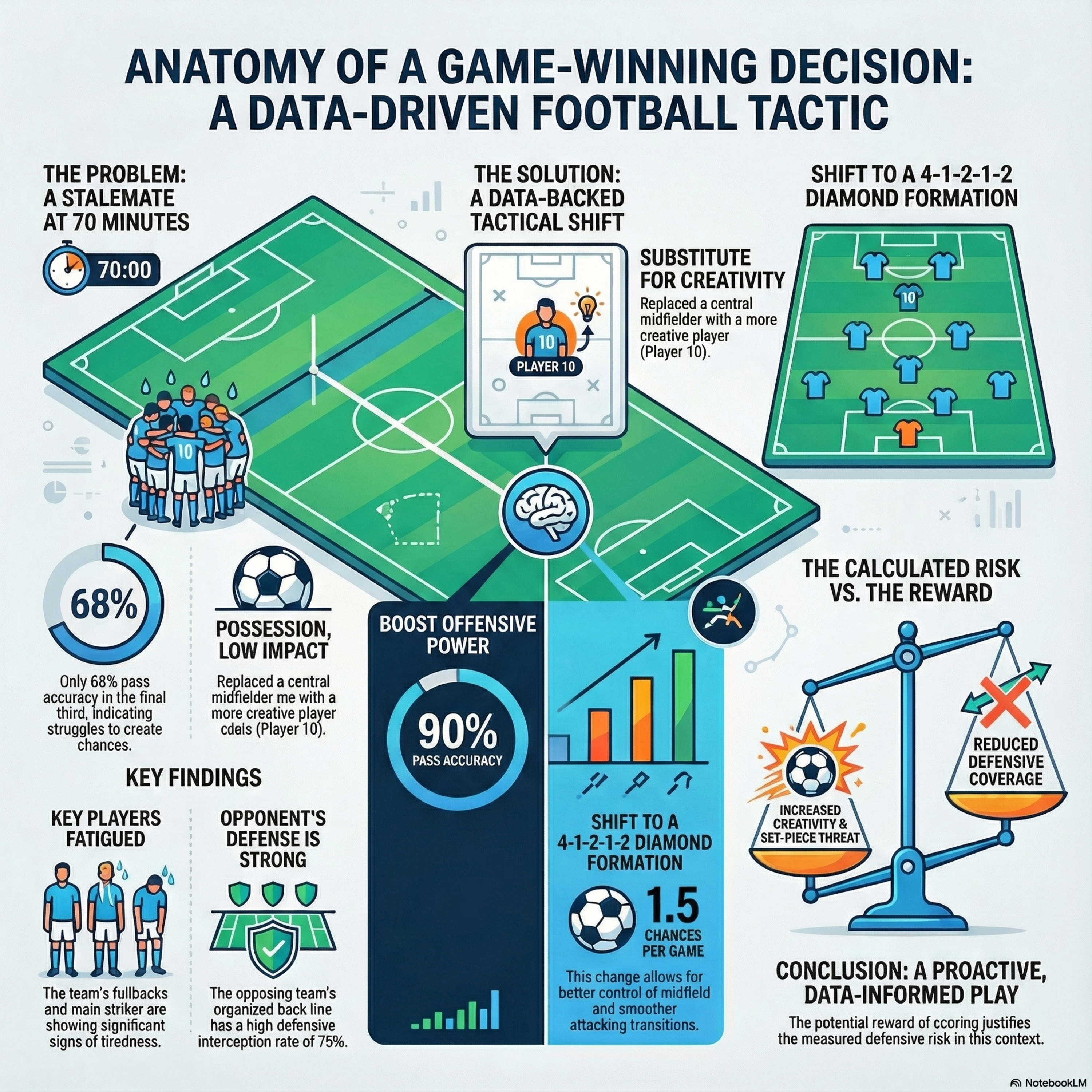
In the first metric, the big one you see on the screen immediately tells a lie. Our team holds 56% possession. On the surface, that suggests dominance control the game flow. But that control is completely deceptive. It's the productivity paradox in action. It's the classic symptom of a team that can move the ball but cannot hurt the opponent. And the critical flaw was identified through a single damning number inefficiency in the final third. The data showed that the passing accuracy in the dangerous zones.
OK, so the area where passes directly lead to shots or high quality scoring chances? Exactly. There it was only 68%. Only 68%. Let's just let's put that into context for everyone listening. In championship level football, 68% passing accuracy in the final third is, well, it's unacceptable. It's a huge red flag. Most elite teams are aiming for 80% or higher. When you were sitting at 68, that means that nearly one out of every three attempts to create a decisive action a three ball across a quick 1-2 is failing.
It's a massive quantifiable tactical bottleneck it. Paralyzes the entire attack. I mean, just imagine a sequence of five passes trying to break down the defense. The mathematical probability that sequence succeeding just drops off a Cliff when the foundational accuracy is so so low. So the 56% possession, it proves the team can hold the. Ball right, they can play keep away in safe areas, but the 68% accuracy proves that every single time they enter that critical zone they lack the technical quality or you know, the strategic positioning to unlock the goal.
The team is just running into a brick wall of their own making. OK, so now we have to look at the wall itself. Why is that 68% so low? It's because the opponent, let's call them Team B, they're not passive. They are running a highly disciplined 433 formation. And they're focused on intense pressing, particularly using their wide players to compress the flanks. And this is where the opponent's metrics become, frankly, a bit terrifying. They do. Their defensive effectiveness is highlighted by their high 75% interception.
Rate 75%. Think about what that actually means when our team attempts to make a probing pass, especially through the middle where it's most congested. Team B is organized enough and positionally disciplined enough to cut off the service three out of every four times. So a 75% interception rate essentially means the central areas are locked down. The coaching staff sees this number and they know that a sustained central attack with the current personnel is it's just suicidal. It is. The current strategy just allows the opponent to be compact, organized, and effective at continually stifling any creativity.
The current approach is only leading to turnovers and, well, a lot of frustration. And dangerous turnovers at that. Exactly. The combination of our 68% inefficiency and their 75% effectiveness means we are not only losing the ball frequently, but we are losing it in highly vulnerable positions. We're potentially setting them up for dangerous counter attacks, so the primary intervention must directly and statistically address that 68% number by somehow bypassing that 75% interception rate. All right, so moving on to the human element now, because tactics can't ignore biology, we have the crucial point, the fatigue factor, the player status.
At the 70th minute, it's not just about tired players anymore, it's about vulnerable players. That's a great way to put it. The data flagged specific red zones on the pitch. Both fullbacks and the main striker were showing significant fatigue indicators. The fullbacks in particular were performing below 70% capacity in high speed sprints and crucially, their jewel success rate. And why are the fullbacks so critical right now, at this exact moment? Because the opponent Team B is utilizing high pressing on the flanks.
It's their whole strategy. They know these wide zones where the most ground needs to be covered and where decision making airs start to creep in first when you're tired. So our tired fold acts are constantly being exposed. Constantly they're being forced into lung busting recovery runs or rushed clearances. If the coach ignores this existing physical risk, a defensive error isn't just possible, it's statistically probable. And that's how the 11 tie turns into a 21 deficit VO wide attack. So the tactical adjustment has a dual mandate.
It must protect the physically spent players, the full backs, and simultaneously unlock the creativity bottleneck that's defined by that 68% passing accuracy. You can't just fix one problem, you have to fix both with one calculated move. It requires a really high degree of precision in your resource allocation and this is where the methodology becomes so so applicable to resource constrained environments. Like many teams in the African game. Every substitution is a valuable non renewable resource and it has to be deployed where the data guarantees the maximum rate of return.
That sets the stage perfectly for the big moment. So let's move into Section 2, the data-driven solution. We're talking about player 10 and the diamond shift. The coach had the diagnosis. What was the surgical choice to fix that 68% accuracy problem while mitigating the flank fatigue? The coach opted for what was listed as option 2, selecting the catalyst. They substituted a currently fielded central midfielder for the highly creative player we're calling Player 10. So this was a choice that prioritized quality over raw energy in the midfield.
Exactly. They skipped the obvious tired striker substitution. They skipped bringing on a defensive midfielder. They went straight for the source of the creation problem. So tell us about Player 10's statistical profile. What makes him the statistical outlier here? Player 10 is the technical solution to the tactical bottleneck. His data profile is, well, it's scaggering compared to the rest of the team. He boasts a 90% pass accuracy across the entire field, 90% And critically, he averages 1.5 chances created per game, which is significantly higher than any other midfielder on the roster.
When your team is failing with 68% accuracy, injecting a 90% accuracy player immediately shifts the mathematical odds in your favor. And here's where it gets exciting for me. Player 10 isn't just a fresh set of legs, he is a specialist tool designed for a surgical task. He is going in to stabilize the ball and execute those penetrated high risk passes that the opponent's 75% interception wall simply cannot stop because his technical skill elevates the probability of success beyond the statistical average they're used to dealing with.
Precisely. Your insight is spot on there. The choice was not about general freshness, it was about injecting a specific high percentage skill set into the most strategically influential zone, the midfield, to enhance final third efficiency. This is resource optimization defined using your best possible technical asset exactly where the team needs it most. OK, so the substitution is made, but that triggers the biggest shift, the formation transformation. The team moves from their initial kind of broad 442 base formation into a narrow, very tactical 41212 diamond shape.
Why is the diamond the perfect geometry for this moment? The diamond shape is a deliberate, highly specialized countermeasure. It's designed to address the opponent's pressing structure and at the same time mitigate that fatigue roblem we talked about. Player 10 goes straight to the tip of that Dom and the central attacking midfield position or the Cam. The number 10 position. The classic #10 This maximizes his influence. It gives him immediate passing access to the two strikers in front of him, the 2 central midfielders beside him, and the defensive midfielder behind him.
He becomes the hub. But I have to ask, how does this new geometry, this narrow diamond, help the tired fullbacks out? Why? That was the biggest physical risk we identified. And this is the genius of the tactical shift, the wide midfielders who were previously running the flanks as wingers in the 442 or pulled in. They adopt deeper, more central defensive roles to support the defensive midfielder and, crucially, to act as a shield for those tired fullbacks. This shift is all about securing the critical half spaces.
OK, let's define that for the listener, because it's a key concept. The half spaces are those diagonal channels of vulnerability, right? The space between the center back and the full back. Exactly. And when a full back is tired and slow to track back, the opponent's wingers can just exploit that space for crosses or shots. It's a nightmare. A total nightmare, but by creating that narrow 4 man central block, the diamond, you essentially flood the middle of the pitch. The wide players are now defensive support, creating an internal diagonal shield.
This forces Team BS high pressing wide players to either move far out to the touchline where their crosses are way less dangerous, or to try and penetrate the now congested central corridor. So you are essentially saying we can see the empty space on the touchline, but we make the area where you can actually score goals impenetrable. You are leveraging their wide pressing against them by creating central numerical superiority. Manipulation of space and effort and the instruction that accompanies this is vital.
The coach tells them to encourage short, quick passing combinations through the central zones, using Player 10 as the pivot. So you're not even trying to play wide anymore? You're bypassing the opponent's aggressive wide focus press entirely. You are attacking their structure where they are weakest, which is the corridor they left open when they committed so hard to the flanks. And that detailed movement instruction, That's the difference between a successful formation change and just total chaos on the field.
The quick short passing is the ideal way to utilize player tens 90% accuracy. Absolutely. High accuracy thrives on low risk, high frequency passing. The diamond provides the perfect structure for that frequency. OK, before we move on from the solution, there's one more powerful metric tied to the substitution that I found fascinating. The set piece leverage. The coach wasn't just planning for open play. No, not at all. They identified set pieces as a massive potential opportunity. The team already had a decent track record of 50% success rate from corners.
Which means half the time they got a corner, they generated A meaningful chance on goal. A 50% chance in a tight championship game is huge. It's basically a coin flip in your favor every time you get a corner. Now you introduce Player 10. His profile explicitly includes exceptional technical quality and delivery accuracy. He takes over all the corner kicks and free kicks. That 50% success rate, which was already a huge asset, instantly becomes significantly higher. It becomes a calculated opportunity on the SWOT analysis.
So Player 10 guarantees better quality balls into the box. He does, which improves the probability of scoring via direct assists. Or, you know, the secondary plays that happen after the initial delivery, the chaotic scrambles in the box. In the final minutes of a match, when open play is messy and fragmented, this attention to detail, knowing who has the best technical delivery profile, can win you the championship with a single swing of a boot. This is peak resource optimization. It shows the analysis is holistic.
They're not just focused on the movement of the ball and open play, they are focused on the strategic moments of controlled chaos, like a corner kick. We've established the plan, it sounds brilliant, but we need to be clear that this is a dangerous move. It's a gamble. So let's head into Section 3, calculating the risk reward balance. The SWAT breakdown. A proactive decision in a high stakes scenario is always a calculated gamble. This is the core of game theory applied to the pitch, really. The coach is accepting certain disadvantages for the chance at a decisive advantage, and the data allows them to quantify exactly what they're giving up and what they hope to gain.
OK. So let's start with the upside, the offensive strengths and opportunities. What was the immediate positive statistical impact of the change? The strengths are pretty obvious. You get an immediate increase in creativity and passing precision, which directly addresses that 68% deficiency we've been talking about. The diamond establishes a better link between the lines, which is crucial for bypassing Team BS High Press. And importantly, by maintaining their natural possession control at 56%, they minimize the opponent's chances to counter attack.
Exactly. By imposing their passing game, they are suffocating the opponent's ability to even launch an attack. They're forcing them to spend energy chasing the ball in congested areas. They are defining the offensive narrative. They're making the other team play their game. Yes, and the opportunities flow directly from this control. First, you can exploit the spaces behind Team B's high pressing line. If Team B's wide players are still aggressively pressing our tired full backs, the central diamond has the passing density and the high accuracy.
Pivot player 10 to slice right through the middle into the attacking third and second. Second, you're maximizing decisive scoring chances before the uncertainty of extra time kicks in. The goal is simple. Player 10s influence ensures that when chances do arise, they are high quality, high probability scoring opportunities, not just hopeful shots from distance. But let's flip the coin. This is the part that you know keeps the coach awake at night. What was the great cost of this move? The defensive weaknesses and threats?
The calculated danger. And this is where the data becomes so important. The main weakness is the fundamental trade off player. 10s, low defensive contribution. We know he's a 90% accurate passer, but he only wins 40% of contested duels. 40%. 40 When you insert a player who is statistically poured defensively into the heart of the midfield, even in that advanced Cam roll, you are instantly creating a reduced defensive coverage in a crucial area of the pitch. OK, wait a minute. Let me just process that.
You're telling me that in a championship final, with only 20 minutes left to play, the coach consciously decided to put a player on the field who is statistically likely to lose 6 out of every 10 tackles he contests in the central zone? That that sounds like madness. It does on the surface. So how did the data reassure them that the system wouldn't just collapse? That is the ultimate question, and the answer is that the system was specifically redesigned to cover for that individual weakness. Remember the diamond structure we talked.
About the wide midfielders dropping in. Exactly those wide midfielders who dropped in to support the center? They are now tasked with covering the ground that Player 10 will inevitably shirk. The coach accepted the 40% dual rate on the individual level because the team structure provided sufficient robust insurance behind him. It's a risk, but it's quantified and, crucially, it's mitigated. So the structural integrity of the diamond is designed to shield player 10 from having to engage in those high intensity defensive duels, allowing him to save his energy for what he does best.
Those 90% accurate passes. That makes sense, but the threats are still very real. Oh, they are substantial. First, we know from the data the Team B is proving transition efficiency, a 55% success rate when they're putting drops back or loses the ball. So player 10 does lose one of those tools. TB is already proven to be highly efficient at turning that opportunity into a dangerous counter. And the second threat? Second, there's the obvious vulnerability to fast attacks exploiting the existing fatigue in the defensive line.
Even with the half space coverage from the Diamond, those tired fullbacks are still only one misplaced pass away from being completely exposed. This is where we can bring in an analogy to say business strategy. If you're CEO and you have a limited budget, you might invest aggressively in R&D. That's the high reward, high accuracy area, even if it means reducing your budget for standard operational security. The defensive duels you accept, the increased risk of an internal breach, the 40% dual rate because the potential pay off.
The game-winning goal is necessary to achieve your primary objective, which is winning the championship. That's exactly right. The decision is measured. They looked at all the data and they concluded we most accept the 40% risk and the 55% transition danger because the 90% accuracy and creativity potential justifies it. The data dictates that a proactive attack is actually less risky than a reactive defense at this specific moment in the game. Moving on now to Section 4, which is just as important as the choice itself.
Why data vetoed the alternatives for the coach you know in the African game who is resource constrained knowing why you didn't use your final substitution on a seemingly obvious option that validates the calculated choice of player 10 it. Absolutely does. It reinforces the systematic logic if you can dismantle the alternatives using data, you confirm that your chosen pass is the only optimized one for this specific match state. So let's start with the most obvious one, rejecting the fresh striker option one.
Common sense says swap a tired striker for a fresh striker, increase the pressure up top. Why did the data veto this logical option? The rationale hinges entirely on the tactical hierarchy we discussed earlier. Service must proceed finishing. The data clearly showed the primary issue was the 68% passing accuracy. A fresh striker would still be running into the opponent's 75% interception wall and would be starved of quality opportunities. So swapping the striker would have injected energy, sure, but it wouldn't have solved the fundamental problem of ball progression.
The fresh striker would have been isolated, forced to run harder and likely would have ended up just as frustrated by the poor service. Precisely, we can even hypothesize with the data if the team's creation rate remained at 68%, giving the new striker, say, three chances in 20 minutes. Even if he converse him at a great rate of 30%, his impact is still statistically limited compared to the systemic improvement that Player 10 guarantees. Injecting 90% accuracy into the midfield exponentially increases the total number of quality chances created for all players, including the tirade striker who is still on the pitch.
The technical quality of the pass was the priority, not the energy of the finisher. OK. Next up, rejecting the defensive retreat option 3. Defend the draw, play for extra time, take your chances later. That's the default safety mechanism for a lot of coaches. Why was it rejected with 20 minutes left? Because the coach assess the dropping back to defend the draw would be counterproductive against this specific opponent. Remember, Team B is playing a high pressing 433. If our team retreats, we are just inviting sustained pressure onto our already tired defensive line and our vulnerable full backs.
You'd be handing control of the game to the opponent, allowing them to gain numerical superiority in the midfield area they already partially dominated. That's the key. Retreating would increase team BS sustained pressure, which in turn increases the probability of a defensive error from our exhausted players, especially those vulnerable full backs. The data suggests that defending passively against a high pressing team dramatically increases the risk of conceding a goal, making the draw less likely, not more.
So playing it safe was actually the riskier option. In this context, yes, defending the draw is only appropriate in the very final moments, the 88th minute onward, what they call the game management phase, not with 20 minutes still remaining. They needed to stay proactive. Finally, let's talk about rejecting the counter attacker option 5. Bring on a speedy forward, sit deep and look for a fast break. This is the classic late game gamble. And this fails for the exact same reasons as the fresh striker option.
The core issue remains the inability to progress the ball efficiently into advanced areas. That 68% accuracy problem, A counter attacking forward, needs space and more importantly needs a precise ball delivered quickly into that space. Without effective transition play guaranteed by high accuracy, they would just be isolated. And crucially, relying on counters means abandoning their primary strength, that 56% possession dominance. They would be conceding control of the tempo and the territory of the game.
Exactly. The data dictates that the probability of victory is higher when you play to your strengths and address your weaknesses simultaneously. Relying solely on counter attacks means you lose control and your success rate becomes too reliant on luck or defensive blunder from the opponent rather than your own calculated tactical execution. So the systematic dismantling of these alternatives, it really confirms that the introduction of Player 10 was the only choice that directly elevated the probability of success by solving the core tactical problem.
This is the systematic thinking that separates top level coaching from just simple substitutions. It's about minimizing tactical waste. And it standardizes the decision making process under immense pressure. It does. OK, so let's move now into our final section. Beyond the decision, we're talking about contingency and long term learning. The substitution is made, the diamond dysfunctioning. But what if player 10 scores in the 80th minute? A plan to win is useless without a plan to secure the win.
Absolutely. The coach must demonstrate strategic flexibility. The game management protocol must be immediately engaged if the team successfully takes the lead using the diamond formation. So what's the immediate predefined action to secure the result? The immediate action is this replace the remaining tire forward with an extra defender and switch to the formation to A541 for the closing minutes of the game. Wow. Going from an attacking diamond designed to penetrate to A5 man defensive fortress, that's a dramatic 180° shift in philosophy.
Why the 541 specifically? The 541 formation maximizes defensive stability. It adds 1/3 center back creating a compact 5 man defensive line. This block is then supported by a four man midfield bank which eliminates any spaces in front of the box. The instruction here shifts from aggressive pressing to discipline zonal defense aimed at congesting the box and maximizing bodies behind the ball to withstand the opponent's final desperate assault. This shows the plan for every eventuality. The courage to attack with a diamond is matched by the discipline to defend and lock down the result with a 541.
It's the ultimate expression of strategic sequencing. They knew the window for attacking was limited, let's say from the 70th to the 80th minute ideally, and once if the goal was achieved, the priority changed from maximizing scoring probability to minimizing concession probability. Now you also highlighted something interesting, the real time alternative strategy that the coach recognizes possible even outside the specific constraints of the exercise. Yes, and this just demonstrates a deep tactical awareness.
The coach noted that if the strategic priority had been strictly defensive, IE we absolutely cannot concede and the goal is to stabilize the tie and get to extra time, and alternative strategy would have been more appropriate. And that was. That would be to substitute the fatigue striker with a defensive midfielder and simultaneously adjust the formation to A433. So matching the opponent's formation, the 433, why is that a strong defensive choice? Well. Tactical mirroring is a very powerful tool.
Team B is running a 433. By switching to a 433 ourselves, we eliminate the opponent's numerical advantage in the midfield. It becomes three against three parity. This maximizes defensive stability and midfield control instantly. That makes sense. And more importantly, introducing a fresh defensive midfielder offers crucial immediate support to those exhausted full backs, alleviating the pressure caused by team BS aggressive wide press much more robustly than the diamond shaped did defensively. So to put it simply, the diamond was the optimal solution for scoring while mitigating defense, but the 433 mirror would have been the optimal solution for defending while maintaining midfield control.
Exactly. It highlights that the data provides multiple optimized paths depending on whether your strategic priority is offensive dominance or defensive stability. And this brings us to the most vital section for our listeners, particularly those focused on maximizing potential in the African game. The lesson for the African game? We've seen this master class of tactical adaptation. What is the fundamental take away here, especially regarding resources and success? You know, the key take away is not the specific formation, not the diamond or the 541, but the methodology making calculated data informed proactive adjustments under pressure.
And this process, it doesn't require multimillion dollar data facilities. It requires disciplined observation and specific metric tracking. So how can coaches without those vast resources still implement this level of precision? By focusing on low cost data acquisition I mean video analysis tools, simle tagging software or even just dedicated analysts with clip charts can track these key metrics. Final third assing accuracy set bee success rates, an opponent interception rates instead of general fatigue tracking.
They can tag successful and failed duels for specific vulnerable players, like the full backs for the 1st 60 minutes of a game. And this allows them to move past generic observations instead of a coach to saying our attack looks dull today they have the number. Our final third passing accuracy is 68%. And that knowledge transforms the discussion from subjective frustration to objective solution finding. And understanding those specific player metrics, like player tens 90% accuracy versus his 40% dual success, allows coaches to tailor decisions to the exact match state.
When resources are limited, you must prioritize the deployment of your highest probability assets. If you only have one player 10 on your roster, this methodology ensures you use him precisely when and where he will have the most statistical impact. This level of precise tactical adaptation is essential for resource optimization and for achieving championship success. It reduces tactical waste by vetoing suboptimal options and confirming that every single substitution is a calculated investment, not just a hopeful prayer.
It bridges that gap between coaching and tuition and execution with statistical evidence. It provides A definitive, quantifiable road map for maximizing your chances of victory and the tight margins that define knockout competitions. This deep dive has been an amazing journey into the specifics of tactical decision making under pressure. We started with the championship on the line, one 170th minute and the conclusion for me is inescapable. The decision to introduce Player 10 and shift to the diamond formation was not luck.
It was a rigorously calculated risk, and it was justified entirely by the data. It proactively solved the critical creativity bottleneck, elevating the probability of scoring and securing the title, all while mitigating known physical vulnerabilities on the pitch. The most profound finding here is the commitment to knowledge and analysis. Football decision making, particularly when the stakes are highest and resources are tight, moves entirely beyond mere intuition. When it's informed by clear statistical evidence, the methodology is the championship winning tool.
It removes the emotion from the decision and replaces it with probability. So we focus today on the critical final 20 minutes of a Tide game, but I want to leave you with a provocative thought to Mull over one that extends this methodology. If coaches can use this level of data to manage the end of the game, what metrics should they be tracking earlier, say in the first half hour, to predict the necessary tactical changes before fatigue even sets in? How does pre match data on an opponent's pressing intensity influence the starting lineup, knowing that a player 10 might be needed later, or that a defensive mirror might be necessary if the game is still locked after 60 minutes?
The analytical framework is always evolving. The analysis never truly stops. Thank you for joining us for the Deep Dive.
 Apple Podcasts
 Castbox
 Castro
 Goodpods
 Moon FM
 Overcast
 Pocket Casts
 Podbean
 Podcast Addict
 Podcast Republic
 Spotify