The Daniel Sakari African Football Intelligence Blueprint
About this episode
The Daniel Sakari African Football Intelligence Blueprint
Imagine standing on the concrete terraces of a packed stadium. Oh, there's nothing quite like that feeling, honestly. Yeah, the air is just heavy, thick with the smell of impending rain, and you've got this deafening, pulsing roar of thousands of fans all around you. Yeah, it completely swallows you up. It really does, and down on the pitch the ball is loose, a winger is bearing down on the right flank and this lone defender steps out to meet him. Which, to the naked eye, you know, to the guy eating sunflower seeds in the front row.
Yeah exactly. It just looks like 2 incredibly fit athletes about to crash into each other. Just pure instinct. Right. You assume it's raw aggression, but if you could freeze time, like if you could somehow plug a monitor directly into that defender's brain, you wouldn't see chaos. No, not at all. You'd see a master class in spatial geometry. You'd see a live split second calculation of closing speed trajectory, the moisture on the grass, tactical risk, and today we are stepping right into that matrix.
I love that. We're unlocking the raw, pulsing heartbeat of the African game and really looking at how the very fabric of football intelligence is evolving right before our eyes. And it, I mean, it is a profound paradigm shift. For decades, the narrative around African domestic football has leaned so heavily on just, you know, raw athleticism. Like who can run the fastest? Right. Exactly who has the most stamina? Who can win the physical battle? But what is happening underneath that surface right now?
It's a transition into an era of deep tactical performance tracking. Yeah, it's fascinating. We're seeing cognitive science and biomechanical data meld with that traditional athletic grit. And to really explore that shift with you, we are putting one specific player under an absolute microscope today in this deep dive. Oh, and he is the perfect case study. He really is. We are breaking down the intricate anatomy of a top tier modern African defender, Daniel Sicari. He's a 27 year old right back for Kenya Police FC in the Harambee Stars.
But I want to make a promise to you listening right now. This is not just a biography, not at all. This is a blueprint. By unpacking the specific performance data this one player generates by looking at his tactical discipline and his highly unusual career trajectory, we're going to uncover the exact methods that African clubs can use to revolutionize their scouting, their conditioning, and their match day strategies. And it doesn't matter if you're a hardcore tactician drawing arrows on a whiteboard or just someone fascinated by the limits of human performance, you know?
Right, exactly. This is going to fundamentally change what you see when you watch a 90 minute match. Because when you look at a player with this specific profile, you aren't just analyzing a defender, you're basically analyzing the future blueprint of the continent's domestic leagues. Yeah, it's about sustainable success. Right, you're looking at how a club can maximize the intelligence of the players they already have, rather than constantly searching for external saviors. So I want to start with the machine itself.
Like how a player with this specific type of footballing brain is even built because his origin story completely shatters the mold. It really does. It defies all the conventional wisdom. We're so conditioned to think that elite football intelligence only comes from these sterile, highly funded, European style Academy of pipelines. Right where kids are manicured from the age of 8. Playing on perfect artificial turf, they have nutritionists running through perfectly spaced cones. Daniel didn't have that.
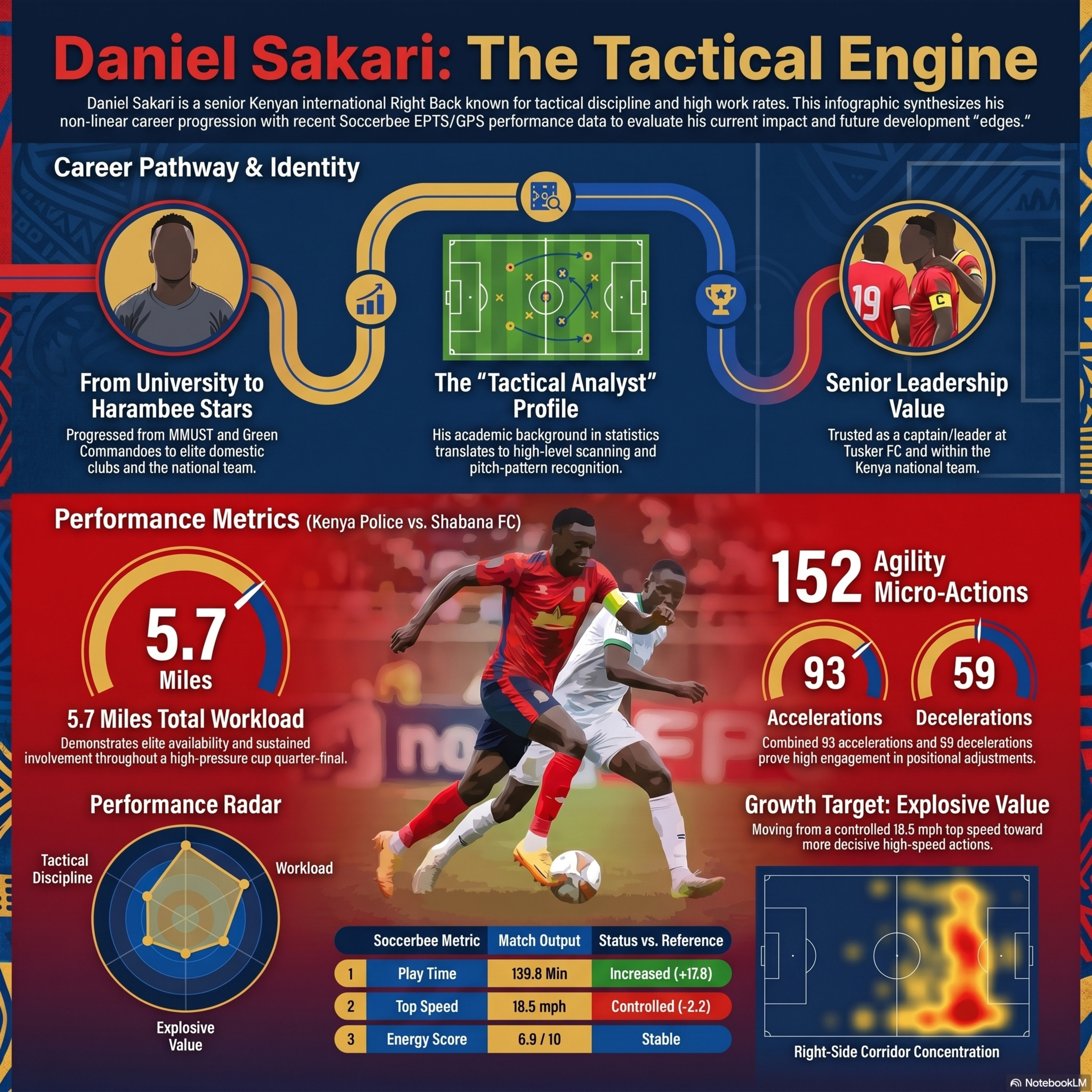
No, his roots are actually in rugby of all things, which is. Wild and his academic background is in pure mathematics and statistics. Yeah, he ground his way up through the university system at Missinde, Muluro, University of Science and Technology, MMUST, then move through Green Commandos, Kaka, Mega Homeboys, Karaobenge, Sharks, Tusker FC and finally to Kenya Police FC. And you know, the tendency is to look at a nonlinear path like that and think of it as a disadvantage. Like he missed out on those crucial developmental Academy years Exactly.
But in the context of the modern African game, that unconventional route is actually a massive competitive advantage. Wait, really? How so? Well, it builds A psychological and physical resilience that you simply cannot manufacture in a pristine Academy environment. Let's break down the rugby component first. Yeah, please do, because if I'm playing rugby, I'm using my hands. The ball is a totally different shape. How on earth does that translate to playing right back in football? It translates through contact tolerance and spatial awareness under physical duress.
In football, players are often taught to avoid contact right to draw the foul. Yeah, to go down easily sometimes. Right, but in rugby you're conditioned to absorb and initiate contact continuously. Your central nervous system actually adapts to trauma. Wow, OK. A rugby player learns how to lower their center of gravity in a split second. They learn how to brace their core for an impact and how to maintain balance when 100 kilogram opponent is trying to drive them into the dirt. That makes a lot of sense.
So when you take a nervous system that's completely desensitized to physical intimidation and you put that player on a football pitch, you get a fullback who views a shoulder to shoulder Sprint with a winger not as a threat but as a comfortable environment. OK, let's unpack this. So he isn't going to get bullied off the ball because his baseline for what constitutes getting bullied was set on a rugby pitch where the hits are infinitely harder. Exactly. He has an intensely high physical responsibility threshold, but the physical side is really only half the equation.
Right, because we also have the math degree. Yes, the pure mathematics and statistics background is where the profile elevates from just being tough to genuinely elite. Pure math is essentially the study of patterns, structures, and spatial relationships. OK. But I want to push back on that a little bit. Sure, because it's easy to say, oh, he's good at math, so he's smart on the pitch. But does a degree in pure statistics actually survive the chaos of a live match? That's a fair question. Like when a winger is doing step overs and the crowd is screaming, is a player really doing trigonometry in their head?
It's like he's playing 3D chess while everyone else is playing checkers. Well, they aren't consciously solving an equation on a chalkboard, obviously. Yeah, but they are relying on a heavily ingrained analytical habits. Think about what a statistician does. They look at data. Right. They look at a massive set of chaotic variables and they instantly calculate probability. Now put that brain it right back. The winger has the ball. Variable 1. Is the winger right footed or left footed? Variable 2. Where's my center back positioned?
Variable 3. How wet is the grass in the channel behind me? I see where you're going with this. A brain trained in statistics automatically calculates the probability of the winger's next action. If the winger is left footed and the channel is wet, the probability of them cutting inside is maybe 80%. So the defender intuitively shifts their body weight a fraction of an inch to the inside. Exactly. It's an unconscious calculation of spatial geometry. So the math degree fundamentally changes how he perceives the pitch.
It's less about doing math and more about seeing the game as a series of probabilities rather than just random events. That is the perfect way to phrase it, and you can see the results of that cognitive processing when you look at his breakthrough period. They carry bunky sharks. Yeah, he really evolved there. He evolved into this highly adaptable marauding fullback. He was deployed as a right back, a right wing back, sometimes even a right midfielder. And a coach only trusts a player in all those different roles if they really understand the geometry of the whole right channel.
Precisely, they know when to hold the off sideline, when to step up and press, and when to drop and recycle possession, regardless of their starting position. And there was a specific tactical weapon he developed at Karibangi Sharks that I find absolutely fascinating, his long throws. Oh yes. It's something that feels like a forgotten art in modern football, but it is incredibly effective. It is arguably one of the most undervalued set piece weapons, particularly in the context of African domestic football.
You really have to consider the environment. Right, the pitches aren't always perfect. Exactly. In many local leagues, pitches might be uneven or teams might sit back in very deep organized defensive blocks. Settled passing based chance creation can become extremely difficult. So a throw in changes everything. If you have a full back who can turn a mundane sideline throw in near the halfway line into a direct entry into the opponents penalty box, you instantly change the territory of the game. It's literally like having a cheat code to bypass the midfield completely.
Yeah, because it forces the opposition to suddenly defend a high pressure set piece situation out of absolutely nowhere. They aren't set up for a corner kick. Right, They're scattered trying to mark a throw in and suddenly the ball is dropping into the six yard box, right? And we saw this exact weapon scale up perfectly when you transition to the national team, the Harambee Stars. Oh totally. During the AF Con qualifying campaigns against heavyweights like Egypt and Togo, those long throws were a massive part of the plan.
Against Egypt, his forward movement and his ability to weaponize the touchline created constant anxiety for the Egyptian defense. Just think about the magnitude of that leap for a second. He takes the physical brutality of a rugby background, combines it with the probabilistic thinking of a math degree, grinds through the university and domestic system A. Huge grind. And suddenly he's standing toe to toe with the Pharaohs of Egypt in an AFCON qualifier. That trajectory is just incredible. Which is exactly why this highlights a massive lesson for African scouting, right?
The traditional inherited European model dictates that scouts should hover around polished youth academies looking for technically flawless teenagers, right? But this blueprint proves that talent isn't just found there. Resilience, education and multi sport backgrounds create highly adaptable professionals. They are completely battle tested by the time they reach the top tier. Which brings us perfectly to the ultimate proving ground. We've built the player, we know his brain and his body. Now let's drop him into an absolute pressure cooker.
The Crucible. Yes, we're looking at a very specific match. May 2, 2026 a Mozart Bet Cup quarterfinal high stage takes knockout football Kenya police FC is playing away against Shabana FC at Gucci stadium. Huge game. And Kenya Police secures A narrow one nil win thanks to an Abboud Omar free kick. To extract any real meaning from the performance data that match, we first have to deeply understand the environment. Gucci Stadium is not a manicured hybrid grass pitch in London. No, not at all. This is a hostile away ground.
The crowd is intense, they're vocal and they're physically close to the pitch. But the most critical factor that day was the weather. It had been pouring in the Kisi region. Heavy rains. The pitch was wet, heavy, muddy and incredibly unforgiving. This isn't a pristine European pitch, it's a gritty, rain affected African knockout tie. Anyone who has ever played any sport in the mud knows how deeply that changes everything. It alters your entire biomechanical reality. The ball doesn't roll cleanly.
It skips or just stops dead in a puddle. You're slipping. Every single muscle movement feels like you're carrying ten extra pounds. Exactly. A wet, heavy surface fundamentally alters how a human body moves. Let's look at the specific physical tool on a fullback. Break it down for us. On a dry pitch, a fullback can open up their stride and reach maximum velocity easily. On a slippery itch, taking a long stride is incredibly dangerous. Because you'll just wipe out. Right. To maintain traction, the layer has to consciously take shorter strides and lower their center of mass.
They're constantly bending their knees slightly more than usual. Which has to burn. It puts an immense continuous strain on the quadriceps. And what happens when they have to change direction? Because football isn't a track meet, right? You're constantly stopping and starting. That is where the neuromuscular cost just skyrockets. Yeah, every time the player decelerates to change direction on mud, the ground shifts underneath their cleats. The calves and hamstrings have to work twice as hard to stabilize the knee and ankle joints.
If a player tries to Sprint at absolute maximum velocity and then break suddenly on wet grass, the lack of friction means the breaking force travels violently up the leg. So they risk an immediate soft tissue injury like a torn hamstring. Or catastrophic slip. And a slip in this context isn't just embarrassing, it's fatal. This is a knockout cup tie. One slip. The winger, it's past you, they score and your entire team is eliminated from the tournament. Which introduces the whole psychological layer of this Crucible.
We really have to consider how A1 nil lead alters the cognitive processing of a defender in that specific environment. Yeah, how does that one nil lead change his brain? Well. When a Buddha Omar scores that free kick, the tactical mandate for Daniel Sicari completely transforms. Before the goal, he is an attacking outlet. After the goal, he becomes a primary risk manager for the right flank. OK, here's where it gets really interesting, because if I'm a fan watching from the Sands, the adrenaline is pumping.
We are up one nil. I might be yelling at him. Push up, make a run down the wing. Let's get a second goal. It feels counterintuitive to suddenly pull the handbrake. It is entirely counterintuitive to the emotion of the crowd, which is exactly why it requires such an immense tactical discipline. But you're saying doing less running was actually the genius move here? Absolutely, an aggressive overlapping Sprint down the wing might look fantastic, gets the crowd on their feet. But think about the probabilities going back to our mathematics discussion earlier.
I run the math. If he overlaps and the winger misplaces a pass in the mud, which is highly likely given the conditions. Very likely. Or if Daniel loses his footing on the heavy pitch, what is left behind him? A gaping empty 50 yard corridor for a Shabana FC counter attack. Wow, so by holding his ground he's basically managing the math of the game. It is the pinnacle of a lead tactical caution. The absence of a chaotic top speed Sprint is not a sign of fatigue or laziness, right? In this specific Crucible, a heavy pitch with a narrow lead holding your position is a sign of a mature player actively managing space, managing the surface conditions, and managing the scoreline.
Which completely reframes how we should look at scouting and data. Context is literally everything. It is African clubs cannot simply copy paste European performance benchmarks. You can't just buy a fancy GPS tracking system, download a spreadsheet of what a Premier League fullback does on a pristine pitch and then complain when your player in Kisi on a rainy Tuesday doesn't match those exact numbers. It is analytical malpractice to do that. They must account for local weather, highly variable pitch conditions and the unique emotional weight of regional cup ties.
So we know the context. We know what the naked eyes saw in the rain at Goosey Stadium. A gritty discipline, one nil win. But let's look at what the GPS satellites actually saw. Yes, let's dive into the telemetry. We are diving into the raw physical metrics and these numbers tell a wild story. So playtime recorded 139.8 minutes, distance 5.7 miles or about 9.17 kilometers, top speed 18.5 mph, accelerations 93, decelerations 59 and his high speed running portion the HSR was just 2.9% which is roughly 266 meters.
And the very first thing that jumps out to a sports scientist looking at this data set is how incredibly deceptive it is. This is the ultimate example of the danger of naked data. Because of that playtime number, right? Exactly. Let's examine that 139.8 minutes. A standard football match is 90 minutes. Even with stoppage time, you might reach 98 or 100. Right. So a recorded time of almost 140 minutes immediately tells us that the device captured a vast amount of non match activity. Like the warmups?
Yes, the warmups, the entire 15 minute halftime interval where he is sitting in the dressing room and the post match pacing around the pitch. So the device was just blindly recording. It was, and this creates a massive systemic analytical problem known as dilution. Dilution, right? Many clubs look at aggregate metrics like distance per minute or actions per minute. In this match, his distance per minute was 65.2 meters and actions per minute was 1.1. OK, but because the denominator is 140 minutes instead of 90, those intensity metrics are severely artificially lowered.
So what does this all mean? It sounds like judging a marathon runner's pace, but including the time they spent stretching in the parking. Lot. That's a great analogy. I mean, how do clubs fix this? What happens if they just take this data at face value? Well if a club takes this naked data at face value, they might unfairly bench a highly effective player for quote UN quote low intensity. Because on paper he looks slow. Right, but the solution is establishing rigorous internal data hygiene. A performance analyst most meticulously segment the raw file.
They crop the timeline, isolate the warm up completely remove the halftime break and isolate the halves. So they aren't misled by their own expensive tech. Exactly. African clubs must establish this hygiene, but once we mentally clean that dilution, we can look at the output. His top speed was 18.5 mph. Which is decent, but not his fastest. Right, it's slightly below his previous baseline of 20.7, and the 2.9% HSR is modest. But when we synthesize this data with the context of the Goosey Stadium Crucible, it's totally logical.
Given the heavy pitch and the one nil tactical clamp down, if he tries to Sprint 20 mph in mud, he's going down. Precisely. However, the most telling metrics in this dossier are the 93 accelerations and the 59 decelerations. Paint a picture of that for us, because that's not just running 100 meter dash. No, it's a grueling game of repeated high stress stop start micro movements. You push off explosively, you step up sharply, and then you slam on the brakes. And hitting the brakes on mud. You mentioned eccentric loads earlier.
Break that down for me. Think of your muscle like a heavy duty bungee cord. When you accelerate, the muscle contracts and shortens. That's a concentric movement. But when you decelerate, your muscle acts as a brake. It tries to contract to stop your momentum, but the force of your body weight moving forward is physically stretching the muscle out. At the same time that lengthening under massive tension is an eccentric load. It creates microscopic tears in the muscle fibers. Now add the mud. The ground is slipping, so the muscle has to fire even harder in chaotic directions to keep the joints stable.
So 59 decelerations on wet grass isn't just tiring, it's taking a massive neuromuscular toll on the calves and hamstrings. It is an immense toll, and this realization is a critical evolutionary leap for African clubs. It's the leap from merely owning the tech to actually understanding it. Yes, a club must understand that a player who registers 59 heavy decelerations in the mud might require a lot more recovery time than someone who ran 10 kilometers on dry turf. The distance is lower, but the damage is higher.
Exactly. So if the speed was moderate and the distance was diluted, what exactly was Daniel Sicari doing out there? We have to pivot from physical data to spatial and tactical intelligence. Let's look at the heat maps. When analysts process this GPS data, they generate heat maps and movement direction histograms, and the visual representation here reveals a highly disciplined vertical performance concentrated entirely in the right back corridor. Zones 3 and 4. Right. Yes, localized entirely to the defensive and middle thirds of the right flank.
Wait, so you're saying his heat map is basically a blueprint of self-control? But if I'm a scout, don't I want to see a guy lighting up the whole pitch? I want to see red everywhere. That is one of the most pervasive misconceptions. A full back roaming chaotically all over the pitch, leaving a massive heat trail in every zone might look energetic, but tactically that heat map is a nightmare. Because he's out of position. Exactly. He's abandoned his structural responsibility. This concentrated heat map doesn't show random roaming, it shows a player who stayed completely connected to his right sided center back and his holding midfielder.
Like they're tied together with invisible string. Yes, maintaining that REST defense structure. When the team attacks, he's holding a shape designed to prevent a counterattack. The histograms show a huge volume of inside support actions. So if the winger goes wide, Daniel tucks inside to block the central passing lane. Precisely, and it also involves critical back post protection. If the ball is on the left flank, he's tucking in to protect the back pose from a blind side runner. So this is the invisible work of a right back adjusting body shape to force a winger outside checking shoulders dropping with the defensive line.
Yes, and managing the yellow card risk late in a physical game, if you're constantly out of position, you arrive late to challenges, you dive in and you get sent off. So this really highlights the difference between effort and impact. The true value of a senior defender isn't the tackles they make, it's the tackles they prevent by holding the correct spatial geometry. That is exactly right. An explosive overlapping fullback might have actually lost Kenya Police FC the game by leaving wide open transition lanes for Shabana FC.
This proves that tactical maturity is just as vital as raw athleticism for the African game. Developing players who understand when to hold elevates the tactical sophistication of domestic leagues. Making teams way more competitive in continental clashes where mistakes are punished instantly. Exactly. And this level of reliability doesn't just win Cup matches, it generates massive value off the pitch. Let's look at how this profile translates to the boardroom and the national stage. Well, at 27, Sicari is in his prime career window.
He's a senior dressing room asset. We've seen him wear the captain's armband in his Tusker FC days. Yes, and he's a vital part of the Harambee Stars setup, especially for domestic only tournaments like Sachin. So let's talk about market value, because it goes beyond just transfer fees. In African football, a domestic international right back is a highly scarce asset. Why is that? Because it requires such a unique blend of aerobic engine, tactical restraint and technical ability, he stabilizes the defense, he handles intense media and national pressure without cracking, and he acts as a role model for Academy players.
This raises an important question, though. It's like having a veteran pilot in the cockpit during a storm. You don't pay him for the easy flights, you pay him for the turbulence. But how do you quantify leadership on a spreadsheet? You quantify it by analyzing the pressure environments they've successfully survived. Compare a regular league match to stepping onto the pitch for an Afghan qualifier. Yeah, totally different emotional load. The emotional control required to handle that pressure is exactly what Sakari brings to Kenya Police FC's dressing room.
When younger players panic, they see him holding his shape, not panicking. That regulates the whole team. So allowing a player of this caliber to drift into contract uncertainty is a massive recruitment risk for a club. Huge risk. The club must integrate performance data with contract and succession planning. Because African clubs must learn to value and protect their domestic internationals, building a team for the C Half Champions League requires a core of battle tested, psychologically resilient local players, not just imported talent.
That domestic bedrock is the absolute core prerequisite. OK, so we've analyzed the player, the match and the value. Now how does a club take all this insight and turn it into a repeatable winning machine? We enter the final phase, the 90 day blueprint, yes. This is where we operationalize the data. We've outlined a specific actionable micro plan for Kenya Police FC. Let's break it down. What happens in weeks one through 3? Weeks one through three are dedicated to validating device protocols, cleaning the data, establishing rigid rules for charging vests, time stamps, cropping out halftime.
Fixing that dilution problem we talked. About exactly because you cannot build a high performance culture on polluted data. OK, so weeks 4 through 6. This is the game changer connecting GPS data to video clips. I passionately believe that data without video is useless. Why is that? If the spreadsheet says he ran slow, he ran slow. Because the spreadsheet tells you what happened, but the video tells you why. If touch speed drops, video shows why. Was he tired? Or did the winger just never pass him the ball?
Oh wow, so he might have made brilliant runs but the teammate ignored him, right? So this section outlines how Kenya Police FC can use Sakari as the ultimate pilot case to build internal club benchmarks for every single position. So weeks 7 through 9. Targeted training speed, exposure, overlap, timing. You coach the exact physical movement you want reflected in the data. And weeks 10 through 12. Integrating this into club wide decision making, medical monitoring, squad selection contracts. I love this but isn't there a risk of paralysis by analysis?
If I'm a coach in a high pressure African league? Do I really have time to sit down and sync 93 accelerations to video clips every single Tuesday? That's a valid concern. The system has to be streamlined. The blueprint suggests a very tight weekly player coach meeting. You bring the player in and show them exactly 3 things. Keep it human, keep it practical. Yes, one video clip of the strength, one video clip of an area for improvement, sync to data, and one specific GPS trend. Like your eccentric load was high, let's focus on recovery.
Exactly. Teach the player how to read their own data without fear. And if Kenya Police FC masters this, they stopped relying on generic European benchmarks. They create a uniquely African performance standard. They track fatigue, prevent soft tissue injuries caused by heavy African pitches, and optimized training loads. And that is the ultimate take away. The future of African football dominance lies in combining the continent's raw, undeniable talent with biscoke culturally adapted sports science systems.
It's just amazing. I marvel at how a single match and a single tracking device can reveal the entire future blueprint for a football club. A complete paradigm shift. We've gone on such a journey today from a math loving rugby player to a tactically elite right back, navigating a wet pitch in Keesai, generating complex data and ultimately serving as the catalyst for a sports science revolution in African football. Yeah, we've really seen the true performance isn't just about running fast, it's about running smart.
Absolutely. And you know, just leave the listener with this final concept. I'm all over think about the thousands of matches played across the African continent every weekend. Just so much football. How much invisible genius is happening out there, just waiting for the right lens to capture it? When data finally meets the unique rhythm and environment of African football, we aren't just going to catch up to the rest of the world. We are going to redefine the benchmark entirely. Redefine the benchmark.
What an incredible note to end on to you listening. Thank you for joining this incredible journey of discovery. I hope you feel like you've just unlocked the secret vault of modern football intelligence. Next time you're watching a match, remember you're witnessing A profound calculation. Catch you next time.
 Apple Podcasts
 Castbox
 Castro
 Goodpods
 Moon FM
 Overcast
 Pocket Casts
 Podbean
 Podcast Addict
 Podcast Republic
 Spotify