The Afcon Legal Arms Race War: Senegal vs Morocco
About this episode
The Afcon Legal Arms Race War: Senegal vs Morocco
Picture the sheer sensory overload of this moment. Like just put yourself right there. Oh man, yeah. We are inside the Prince Mulay Abdullah Stadium in Rabat, January 18th, 2026. The rain is just coming down in absolute sheets, soaking everything. It was a total monsoon out there. Literally. And the air is so thick with humidity and tension you can barely breathe. Like you are surrounded by over 50,000 roaring screaming fans. The noise was just deafening. And it is the 95th minute of the Africa Cup of Nations final.
The hosts Morocco are locked in this 00 war against the defending champion Senegal. The stakes physically cannot be higher at that point. Right. And so Senegal pushes forward. They swing a desperate cross into the box. Dooley Sess rises up and hammers A header against the crossbar. A powerful header too. So powerful the ball violently ricochets downright is my lesser crashes into the six yard box, pounces on the rebound and just buries it into the back of the net. Pure chaos. The Senegalese bench completely erupts.
Substitutes are sprinting down the touchline, but then the oxygen is just sucked right out of the stadium. Because of the whistle. Yeah, referee Jean Jacquandala is blowing his whistle and waving his arms. He calls a foul on Sucker for a push against the Moroccan captain Araf Hakimi. And this happens moments before the ball crossed the line. Right. And because that whistle blew just a fraction of a second early, the play is legally dead. Which means VAR cannot legally intervene to check. It exactly the goal is wiped entirely off the.
Board And you know, the psychological whiplash of that sequence is so dangerous. Oh, I can't even imagine. I mean, you have players who have pushed their bodies to the absolute physiological limit for 95 minutes, right? They experienced the ultimate euphoric high of a championship winning goal, only to have it ripped away by an unreviewable technicality. It's. Brutal. The emotional temperature in that stadium instantly goes from a boil to a nuclear meltdown. And the meltdown accelerates like 3 minutes later.
Yeah, it gets worse. It gets so much worse. We hit the 98th minute. Senegal's El Haji Malik Duf goes into a challenge with Brahim Diaz inside the Senegalese penalty area. Really tight challenge. Very tight initially, referee Andala weighs it off. Play on, right? But this time the ball is still in play right. The whistle hasn't blown to kill the phase, so the VAR room buzzes the referee's earpiece. And here we go. Yeah, and Dolla jogs over to the pitch side monitor. The stadium is literally vibrating at this point.
You. Could feel it through the screen. Absolutely. He comes back onto the grass and points straight to the penalty spot. A 98th minute penalty. For the host nation, and that is the exact moment the dam completely collapses, They. Just broke them. Yeah, Senegal's coach Pate Thaya, he just snaps. He turns to his bench, turns to his players on the field and orders them off. And they don't just walk over to the touch line to argue, right? No, they physically cross the white line and abandoned the playing surface.
Which is unprecedented in a final like this. Totally. We are suddenly looking at a 14 to 17 minute walk off. Utter, unadulterating chaos. Fans surging forward. Yeah, trying to breach the advertising hoardings, Riot police in full tactical gear are stepping onto the stadium track. Projectiles raining down from the upper tiers. It honestly looked like the tournament was going to end in a full blown riot. It really did. But then Sario Menne, you know, the veteran, the leader. He disappears down the tunnel into the dressing room.
Right, he goes to get them. Yeah, he gets his teammates in a circle, calms the absolute hysteria, and physically marches them back out into the rain to finish the match. Which sets the stage for one of the most surreal, breathless passages of play in the history of the sport. Oh. Absolutely. I mean, you have a team that is essentially quit the match. Right. Yeah, they walked off. They've been coaxed back from the brink of a riot, and now they have to stand on the edge of their own penalty box and watch Brahim Diaz try to win the tournament for Morocco in the 24th minute of stoppage time.
It's like a movie script. So Diaz steps up to the spot. The weight of an entire nation is on his shoulders. Massive pressure. He runs up and he tries a pennenka. A Pennenka in that moment. I know a chipped, arrogant floating penalty straight down the middle. But he completely misjudges it. Completely. He misjudges the weight of the wet ball. It just floats harmlessly into the air and the Senegalese goalkeeper Edouard Mendy barely even has to move his feet. He just reaches up and catches it. Just catches it, the stadium goes graveyard silent and Dolla blows the whistle for full time.
We go into extra time. And the momentum is violently swung by now. Violently swung and Senegal's paper guy unleashes an absolute rocket from outside the box. It tears into the top corner. Unstoppable. One nil. Senegal. The final whistle blows. The marathon is over. They did it. Yeah, the podium is built on the pitch. C Cap president Patrice Motsepi walks up, shakes the hands and hands the gold trophy to Khalidou Kulabali. The confetti cannons fire. Senegal are the back-to-back champions of Africa.
And you know, the physical reality of that night was absolute. What do you mean by that? Well, the medals were around their necks. The broadcast beamed the celebrations to hundreds of millions of people all over the world, right? The history books were seemingly written right then and there. But 58 days later, that entire reality is just vaporized. Completely erased. March 17th, the See Half Appeal Board releases a document, an operative ruling right, and the trophy is retroactively stripped. Senegal's one nil extra time victory is entirely erased from existence.
It's just wild to even think about. It is in its place the document awards a three nil administrative forfeit to Morocco. So the Champions of Africa were dethroned. Exactly. Not by a tactical master class, not by a legendary striker, but by a legal brief filed in an office building 2 months after the stadium lights turned off. Yeah, which is why we're doing this deep dive today. Right. So today we are tearing the mechanics of this impending Court of Arbitration for Sport appeal down to the studs.
We have to. Because if you sit on the board of a domestic Football Federation, or if you were an agent negotiating a player's transfer fee, right? Or a commercial director writing sponsorship contracts. Exactly. The shock waves of this legal war are about to hit your desk. How do we take this unprecedented administrative earthquake and use the lessons to fundamentally bulletproof our African game? Right, we have to figure out how would a trophy won on the grass get stolen by the paperwork. Exactly.
I mean, imagine winning the lottery, cashing the check, spending the money, and two months later the bank says your ticket was printed on the wrong paper. That's a perfect way to put it. It's just insane. But to even begin answering how this happened, we have to look closely at what actually happened on the pitch, right? Yeah, we have to look past the dramatic VAR penalty and the walk off itself. Because there's a bizarre subplot involving a goalkeeper's towel that is about to become key legal evidence.
Right, the legal battle being prepared right now does not start with the 98th minute penalty. Where does it start then? It starts with the climate, the environment and a deeply bizarre operational failure regarding those goalkeeper towels. The towel war. Yes, the towel war, because to understand the legal defense Senegal is building, you have to understand the concept of cumulative operational hostility, OK. So I was reviewing the timeline of the match and this tower war subplot is just wild to me.
It really is. It sounds like a petty touchline squabble, but you're telling me this is actually the foundation of a multi $1,000,000 international sports arbitration case? It absolutely is. Let's break down the mechanics of what actually happened behind the goal posts in Revat. OK, let's do it. So let's look at the basic physics of goalkeeping in torrential rain. A modern goalkeeper's gloves are made of highly specialized Latex in dry conditions. That latex provides immense grip on the synthetic panels of a modern football.
Sure, that makes sense. But when that latex becomes saturated with water, it becomes incredibly slick. I mean, it is practically frictionless. Wow, so you really can't grip anything? Exactly. In a game where a single spilled cross or a slip catch dictates a continental championship, a dry towel to wipe those gloves before a set piece is not a luxury. It's a necessity. It is a fundamental non negotiable piece of of competitive equipment. So throughout the 1st 90 minutes Edward Mendy play several dry towels in the back of his net.
Like most goalkeepers do. Right and systematically, the Moroccan ball boys, the individuals employed by the host nation to facilitate the fair operation of the match, began sneaking behind the goal and stealing them. Just taking the towels. Taking them away in the heavy. And it wasn't just opportunistic kids either, like I watched the wide angle tactical feed. Yeah, you could see it clearly. You actually see Moroccan national team players getting involved, right? Atraf Hakimi, the captain, and Ismail Sibari, the winger, are actively participating in removing these towels from Mendy's area.
Which elevates this from a minor stadium management issue to direct player driven competitive sabotage. That's a huge escalation. It is. And what makes this so legally significant is that Senegal saw this coming. Wait, they knew about the towels? They had intelligence on this exact tactic in their semifinal match against Nigeria. The Nigerian goalkeeper Stanley Uno Bali face the exact same towel removal campaign for the Moroccan ball boys. Oh yeah, it got so bad that Noah Bali lost his temper, flipped his middle finger at the ball boys during the live broadcast, and later posted an incredibly angry message on social media.
What did he say? He told them to use all my towels to wipe your tears. Oh wow. Yeah, so Senegal's coaching staff knew this was a systemic operational tactic employed by the hosts. So they prepared for. It exactly. They prepared a countermeasure. They literally assigned their substitute goalkeeper Yevon Duf to act as a dedicated towel guardian on the touchline. Think about the absurdity of that for a second. It's completely absurd. You are managing a team in the biggest match on the African continent and you have to burn a substitute.
Players focus by making him stand guard over a pile of cotton towels. Just because you cannot trust the stadium infrastructure. Right. The footage of this is unbelievable. You have a professional international footballer in Yvonne Dyouf wearing his warm up bib, physically clutching a towel to his chest. Like a shield. Literally. And he is surrounded by hostile ball boys who are aggressively trying to wrench it out of his hands. Yeah. And the situation devolved into physical altercations. Yeah, I saw that.
The footage shows ball boys pulling d'youf to the wet turf. You have Cybari running over and physically inserting his body between Dyouf and Mehndi to block Dyouf from handing a fresh towel to his goalkeeper. Unbelievable. Hakimi is caught on camera grabbing a towel from the pile and just launching it over the LED advertising hoardings into the crowd. Just throwing it away. Yeah, you even see a suited match official, someone meant to be maintaining order, aggressively confronting Dyouf instead of the ball boys.
It got so out of hand that the CF Disciplinary Board actually reviewed it after the fact, right? They did. And they slapped the Moroccan federation of the $200,000 fine specifically for the aggressive conduct of those ball boys. That fine is crucial. So there is already an official administrative record acknowledging that the host nation failed to control the touchline. Exactly. Do you even posted a picture on Instagram holding his winner's medal in one hand and the famous white towel on the other, treating it like a joke?
Right. He thought it was funny in hindsight. But Senegal's lawyers aren't laughing at this, are they? Not at all. For Senegal's legal team, that $200,000 fine is evidentiary gold. How? So when they walk into the Court of Arbitration for Sport in Lausanne, they are not going to argue that walking off the pitch was a legally permissible positive action. Right, because that's a losing argument. That is a total losing argument. Instead, they are utilizing an equitable defense. An equitable defense, Yes.
They are framing the 98th minute walk off not as a sudden unprovoked act of petulant Rage Against a single VAR call, but is the inevitable, foreseeable breaking point caused by a completely unsafe and hostile sporting environment. I see. They are building a narrative of cumulative operational hostility. Wait, so if I'm understanding this equitable defense, it's kind of like a landlord tenant dispute? OK, go on. Say I sign a strict lease that says I absolutely cannot abandoned the apartment before the year is up or I forfeit my entire deposit, right?
Semander Lease. But then the landlord intentionally shuts off my heat in the winter. Oh man. They turn off the running water. They let wild dogs roam the hallways. The horrible landlord. Exactly, and eventually I pack my bags and I walk out right when the landlord tries to keep my deposit for breaking the lease. My lawyer argues that the landlord fundamentally broke the environment first. I. Like this analogy? So at certain point, the hostility of the environment forces the exit. Does sports law actually recognize that kind of breaking point?
It is a phenomenal analogy, actually, and it strikes at the very heart of the tension between written rules and human realities. So it is a real legal concept. Yes. The legal concept is called force majeure or sometimes excusable breach, depending on the jurisdiction. Excusable breach. OK Senegal is arguing that the Moroccan federation, as the host, had a binding contractual obligation to provide a safe, neutral operating environment. Which they obviously didn't. Right, by allowing ball boys to physically assault a substitute player.
By allowing opposing players to steal equipment and by allowing the stadium security to completely fail, Morocco breached that duty. So Senegal is saying they were pushed to the brink. Exactly. Senegal will argue that their players were subjected to psychological and physical warfare that push them beyond reasonable human endurance. The walk off, therefore, was a protective measure, a desperate attempt to reset a fundamentally broken operational environment. But what is the take away here for our domestic leagues?
Because if I'm sitting on a Federation board right now listening to this, I am terrified. And you should be. The immediate, urgent lesson for every African club in federation is about risk management. What do they need to do? You have to understand how governing bodies currently interpret these events. You must proactively train your coaches, your captains and your match day staff that a walk off, no matter how justified you feel in the moment, is an existential threat. So even if the crowd is hostile or the ball boys are actively sabotaging you.
It doesn't matter. A walk off is an existential threat to your entire organization. Emotional reactions, even completely human reactions to extreme sustained provocation, now carry irreversible legal consequences. So you basically just have to take it. You have to train your staff to protest within the confines of the pitch. Document everything, file protests with the Match commissioner, but do not cross that white line. Because the moment you step off the grass, you give the governing body the ultimate weapon to destroy your campaign.
Exactly. Which brings us to the actual weapons CF used. Let's put the towels aside for a second and look at the paperwork. Regulations. Because the Senegalese players did walk off. They crossed the touchline, Yeah, absolutely did. But Sario Manet went into that tunnel, grabbed them by the scruff of the neck and dragged them back out 15 minutes later. And they resumed play. Right. The referee blew the whistle, they played extra time and they won. The game was completed. So how does a committee sitting in a boardroom 58 days later find the legal justification to erase a completed match?
That is the $1,000,000 question. I was digging through the AFCON regulatory framework and it all comes down to the drafting of three specific articles. It's a total mess. It is a game of commas, conjunctions, and incredibly aggressive language. Let's break down Article 82 first. All right, so Article 82 is the entire foundation of Morocco's forfeiture victory. OK. In legal terms, it is drafted as a strict liability provision. And what does strict liability mean in this context? Think of a speeding camera on a highway.
The camera does not care why you were speeding. It just takes the picture. Exactly. It does not care if you were rushing your pregnant wife to the hospital, or if your throttle got stuck, or if you simply weren't paying attention. The camera just registers that your car exceeded the limit and the ticket is automatically issued. Intent, context and provocation are completely irrelevant. Wow. So no excuses whatsoever. None. Article 82 is designed to be the football equivalent of that speeding camera.
Let me give you the exact phrasing. Go ahead, it states. Quote. If for any reason whatsoever A-Team withdraws from the competition or does not report for a match, or refuses to play, or leaves the ground before the regular end of the match without the authorization of the referee, it shall be considered loser and shall be eliminated for good from the current competition. End Quote. For any reason whatsoever, that is the ultimate trapdoor. Exactly that phrase is engineered to kill any defense based on stolen towels, hostile crowds, or perceive referee bias.
Right, it just nullifies all of it. But the truly fatal phrase for Senegal is leaves the ground before the regular end of the match. Because that's exactly what they did. This captures the precise physical reality of what the Senegalese players did in the 98th minute. The regulation does not say leaves the ground permanently. Oh I see, it does not say leaves the ground and refuses to return. Right? If you read the text literally, the traps saps the exact millisecond the last Senegalese boot stepped off the playing surface without referee Indala's explicit permission.
So the length of the walk off doesn't matter. Not at all. 15 minutes or 15 seconds the strict liability trigger was pulled. Oh, wait. If I'm reading the rule book correctly, Article 82 doesn't operate in isolation, right? No, it doesn't. You have this sweeping aggressive rule, but then you turn the page and the drafting gets incredibly messy. It's famously messy. There is a massive fork in the road here, and it all hinges on a single three letter word. This is where the legal battle stops being about football and becomes a high stakes grammatical war.
A grammatical war. I love it. Let's look at the subsequent rules. First, you have Article 83. OK, This article governs a completely different operational failure. It states that a team not present on the ground dressed to play at the time fixed for kickoff or at most 15 minutes later shall forfeit the match. So article 82 is about abandoning a match mid game and article 83 is about never showing up in the first place. Exactly. OK, that's clear. Senegal definitely showed up. They were there at kickoff.
They played 98 minutes. They absolutely did not violate Article 83. Right. And here is where the bomb drops. We move to Article 84, which is the enforcement mechanism that actually hands out the three O forfeiture. OK, what does 84 say? Article 84 states that a team that contravenes the provisions of Articles 82A and D83 shall be eliminated and hit with the administrative forfeit. And they wrote the word and. The conjunctive versus disjunctive nightmare. Wow, this is a classic drafting error that haunts sports federations globally.
I could see why a. Highly respected former member of the FIFA Disciplinary Committee, Acas arbitrator named Raymond Hack, has pointed to this exact word as the fatal flaw in Morocco's entire legal theory. Because it's an and not an or. Exactly. Hack argues that AD is explicitly conjunctive and legal interpretation. It means you must fulfill both conditions to trigger the penalty. So you have to off the pitch mid game AD you also have to fail to show up for the kickoff, Yes, which is obviously a chronological impossibility in a single match.
It makes no sense physically, but strictly reading the text. Because Senegal showed up for kickoff, Hack argues you cannot legally apply the 3DS forfeiture from Article 84. The conditions were not met. So Senegal's lawyers are looking at that word A&D and treating it as a shield, Absolutely. But the suck half appeal board and obviously Morocco are looking at the exact same sentence and saying no you're reading it wrong. Right, they're reading A&D disjunctively, as if it means or. They are arguing that breaking either rule independently is enough to trigger the death penalty.
Yes, I was reading an analysis by Workman's attorneys, you know, the major South African law firm, and they noted something fascinating. What did I say? They said that if you put this in front of a pure textualist judge, someone who only looks at the exact letters on the page, Senegal wins that argument easily. Oh yeah, I had a doubt. Only Article 82 was triggered, not 83. So the Article 84 penalty fails. But they also warned that sports governing bodies will routinely twist grammar, ban language and ignore their own poorly drafted text to protect the broader objective of competition integrity.
That happens all the time in sports law. Right, they will argue that the spear of the law clearly met or are even if the drafter was incompetent and wrote A&D. Which brings us to the ultimate jurisdictional clash. Because while the lawyers are arguing over commas and conjunctions, there is a fundamental century old law of football that supersedes all of this. What's that? IFA Law 5 Senegal is bringing IFA Law 5 to CAS as their ultimate trump card, OK. Let's get into Law 5. The International Football Association Board IFAB writes the Universal Laws of the Game.
Law 5 explicitly establishes that the referee is the sole supreme and final authority on the field of play. The ultimate boss, the absolute boss Referee, has the absolute power to stop, suspend, resume, or abandoned a match. Period. OK, so let's look at what Referendalla actually did. He did not blow his whistle, point to the tunnel and abandoned the match. No, he didn't. He used the Supreme Law 5 authority to wait to manage the crisis and ultimately to resume play. Right, he cooks them back. He oversaw the pinnacle penalty, he officiated another 30 minutes of extra time and he blew the final whistle to end the game naturally.
So how does Senegal use this legally? Senegal's constitutional argument is this. Once the referee exercises his absolute Law 5 authority to resume and finish the game, no administrative committee sitting in an office in Cairo 58 days later has the jurisdictional power to retroactively override his field of play decision. That sounds pretty bulletproof, but I have to push back on that though. OK, late on me. Let's look at this purely from the perspective of regulatory compliance. The Moroccan media has been pushing a specific narrative to defend the strict interpretation of Article 82, and I find it incredibly compelling.
I know exactly what you're talking about, the bank robber. Yes, the bank robber, if I understand the strict liability concept correctly. Say I walk into a bank, I point a weapon at the teller and I demand $1,000,000. I put the cash in a bag and walk out the door. The crime of bank robbery is complete. Yes, it is. If I get to the parking lot, suddenly feel a wave of guilt, turn around, walk back into the bank and hand the bag of money back to the the teller. The police don't just say, Oh well, the money's back in the vault.
No harm, no foul, you're free to go. You still go to jail. Exactly, you still go to jail. The act of stealing was the crime. So applying that here, the regulatory bomb exploded the exact second they left the pitch without permission. That's Morocco's entire argument. The fact that Satya Mane acted as the conscience of the team, walk them back into the bank and return the money 15 minutes later doesn't unexplode the bomb. The crime was completed. It's a very powerful image. Right, so the referee managing the rest of the game is irrelevant to the fact that a mandatory competition rule was broken.
It is a devastating counter argument right because it cleanly separates the referee's physical authority from the governing bodies regulatory authority. Right, the physical versus the regulatory. Morocco is essentially actually telling CAS we completely agree that IFA Law 5 controls the sport. The referee controls the grass, but C CAF regulations control the competition framework. The referee deciding that the game can physically continue does not magically erase the administrative reality that a team breached A mandatory strict liability competition rule.
Think about how governing bodies draft these rules. They frequently copy and paste templates from FIFA or other confederations, tweaking a word here or there without understanding the cascading legal effects. That's terrifying. But the wake up call for the African game is deafening. It really is. I mean, if C Caf's flagship tournament, the absolute crown jewel of African football, has regulations drafted with such ambiguous and saw nations and ORS that elite legal scholars are violently divided on basic definitions, exactly what does that say about the rulebooks sitting on the desks of our domestic federations?
It. Means our domestic leagues are operating on top of unexploded legal ordinance. Unexploded ordinance. That's a great way to put it. Every single African federation, every domestic league CEO needs to order an immediate forensic regulatory audit today. Yes, today you need to pull out your domestic rulebooks, gather your legal committee and ask a very simple question. What's the question? If a team in our cup final walks off the pitch in protest for 10 minutes and then comes back, do our rules clearly, unambiguously state what happens?
Do your rules say A&D when they mean, OR do you have a clear delineation between the referees authority to finish a match and your disciplinary committee's authority to sanction a walk? Off, because if you don't, you're in trouble. If you do not bulletproof your domestic rule books right now, you're going to face this exact same multimillion dollar crisis with your own sponsors and broadcasters in your local cup final next year. And when the rule book is this fundamentally messy and the stakes are the Continental championship and millions of dollars in prize money, you don't just need a lawyer.
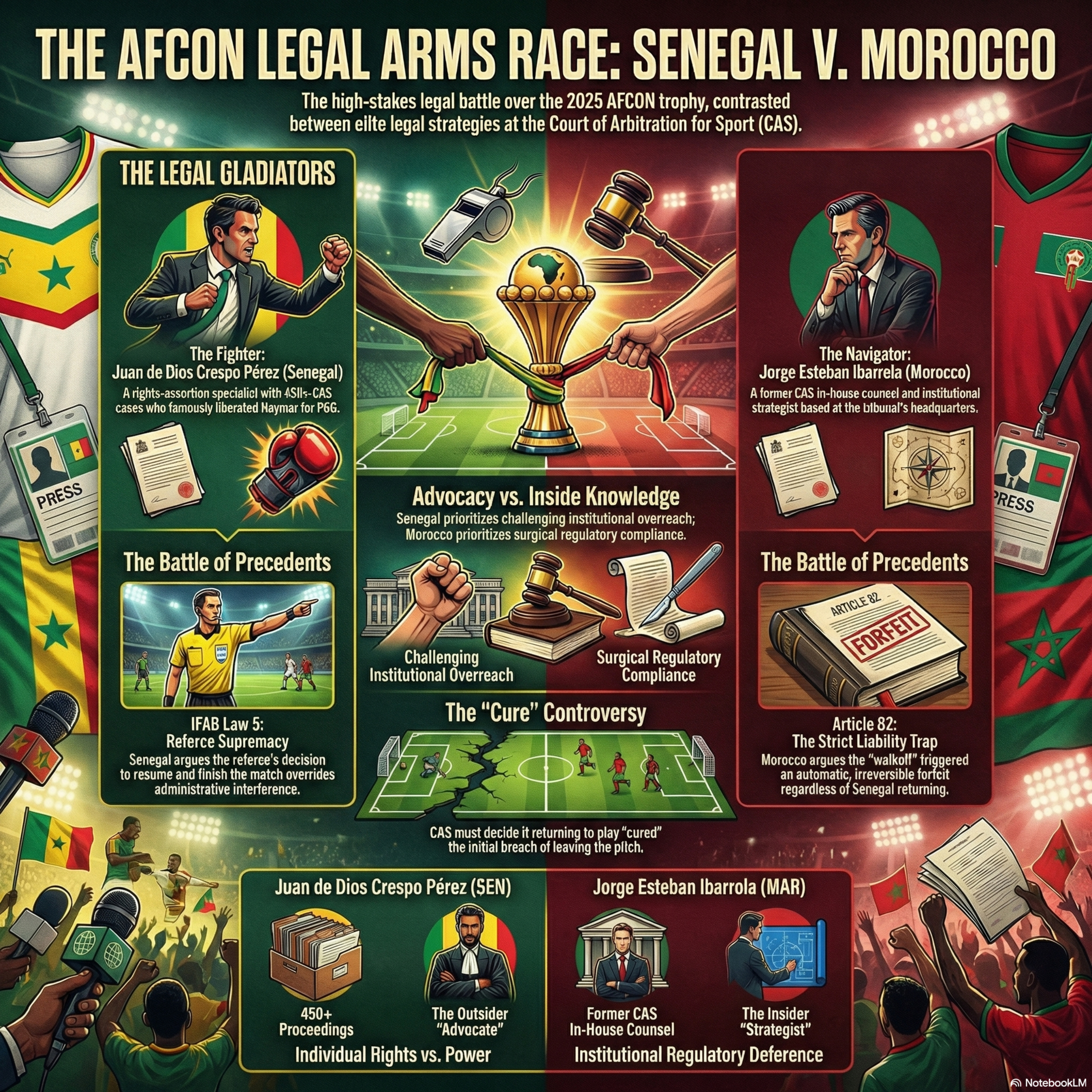
No, you need a gladiator. Exactly. You need a gladiator. Let's look at the elite legal mercenaries that Senegal and Morocco have hired to fight this war. These guys are fascinating. Because their backgrounds, their resumes, and their psychological profiles tell us exactly the strategies they are going to deploy. It is the ultimate legal arms race. We have the fighter versus the navigator. Let's break them down. The world of elite sports law at this level is incredibly insular. Like how small are we talking?
There are perhaps 50 people globally who possessed the specific expertise, the gravitas and the experience to lead Acas case of this magnitude. 50 people in the whole world. Yeah, and the two federations picked a diametrically opposed archetypes, OK. Let's start with Senegal. When their back was against the wall, they didn't look locally. They picked up the phone, called Valencia, Spain, and hire Juan de Dios Crespo Perez. So I was reading through Crespo Perez's case history and it reads like a Hollywood script.
It really does. We are talking about 36 years of hardcore sports law experience. He has lead counsel experience in over 500 CIS cases. A staggering number. But the headline that everyone in world football knows the defining image of his career is from August 2017. The name our case. Yes, this is the man who literally walked into the Spanish La Liga headquarters in Madrid physically carrying a briefcase containing a certified check for €222,000,000 to forcefully trigger Neymar's release clause and move him from Barcelona to Paris Saint Germain.
Carrying it by hand. By hand, and when La Liga initially refused to accept the payment because they felt PSG was violating Financial Fair play, Crespo Perez didn't back down right. No, he bypassed. Him he went directly to Barcelona's offices, forced the payment through and shattered the global transfer record. Just an absolute power move. He has represented Lionel Messi when FIFA banned him for insulting A referee, successfully getting the ban overturned. He was the external lawyer for La Liga for a decade.
He is a heavyweight. He is, but you have to look deeper at his intellectual DNA to understand why Senegal hired him. What do you mean by intellectual DNA? Crespo Perez is, in the purest, most aggressive sense, an advocate. His entire 4 decade career is a chronicle of asserting individual and club rights against entrenched massive institutional power. OK, so he's a rebel. He represents players fighting leagues, agents fighting FIFA clubs fighting federations. He is wired for conflict. He loves a fight.
He doesn't operate quietly within the system. He tests the system's structural integrity by throwing his shoulder against the door. He specifically looks for where a governing body has exceeded its legal mandate, and he prized that weakness wide open. You know, you can hear that aggression and how his team is operating right now. Oh, definitely. Senegal's lead domestic lawyer Sedou Dianya, alongside Crespo Perez, held a major press conference in Paris shortly after the appeal was filed. I saw clips of that.
The language they used wasn't the typical measured lawyer speak. It was explosive. What did they say? They publicly called the See Half Appeal Board's ruling so crude, so absurd, so irrational, that it cannot even be considered a true sporting justice ruling. That does not sound like a legal team preparing to have a polite academic debate about the definition of the word and. No, it definitely doesn't. No, it sounds like a constitutional lawyer preparing an insurgent campaign. Insurgent campaign.
OK, explain that. Let me explain the core legal doctrine Crespo Perez is going to rely on. It's called ultravirus. Ultravirus. It's a Latin term that means beyond the powers. OK. Let me give you a non legal example. Imagine you are driving on a major public highway. You have a broken tail light. OK, suddenly a mall security guard in a golf cart pulls you over on the highway, demands your license, and tries to write you a traffic ticket. That's ridiculous. Exactly. Now your tail light might actually be broken.
You might actually be violating a rule, but the mall security guard has absolutely 0 jurisdictional power on a public highway. Right, because it's not a mall. Their ticket is meaningless because acting on the highway is ultra virus for them. I see Crespo Perez is going to walk into CAS and argue that CFF is the mall security guard. That's brilliant. He will argue that CF had absolutely no jurisdictional authority to retroactively overturn a referee's field of play decision regarding IFA Law 5. He is bringing a multi jurisdictional 6 lawyer team to fight on legal, procedural and political fronts.
Simultaneously. He wants to put the entire governance structure of African football on trial. Now contrast that entirely with Morocco. They didn't hire a Street Fighter at all. No, they would a completely different. Route. They dialed Lausanne, Switzerland, and hired Jorge Esteban Iberola. Iberola is a fascinating figure. Iberola has over 20 years of elite experience and over 400 CAS cases under his belt, but there is one specific detail about him that just jumps completely off the page for me. Let me guess his address.
Yes, his address, his law firm Libra Law, is physically located at the Maison du Sport International in Lausanne. Which is. He shares an office address with the Court of Arbitration for Sport itself. Literally in the same building. Literally in the same building. That is not a geographical coincidence, right? No, it is a profound, calculated strategic advantage. Iberola was the senior in house legal counsel for CAS for four years early in his career. Oh wow, so he's from inside the house? He literally spent a formative part of his professional life inside the machine.
He knows the institutional culture. He knows how they operate. He knows the unwritten procedural conventions that aren't in the public rule books. He knows the exact way arbitrators deliberate behind closed doors, what arguments annoy them and what formatting they prefer. He probably knows what kind of coffee they like. Probably he understands on a cellular level how the CAS machine thinks and operates. I find this contrast absolutely fascinating. It is the classic defense attorney dilemma. It really is.
Senegal hired the guy who will walk into the courtroom, put the entire legal system on trial, shout at the heavens and bang his shoe on the table to demand justice against a corrupt system. The fighter, yes, and Morocco hired the guy who used to write the judges training manuals, who knows the tribunal clerks by their first names and who knows exactly what font the arbitrators prefer in their legal briefs. The navigator. A navigator? Exactly. Iberola is the ultimate institutional translator. Morocco was not running an insurgent campaign.
They are running an airtight institutional defense. So what does that look like in court? Iberola isn't going to bang a shoe on the table. He isn't going to talk about fairness or stolen towels or the spirit of the game. None of that matters to him. None of it. He is going to present a sterile, clinical, mathematically precise argument of pure regulatory compliance. Just sticking to the text. He is going to stand in front of the CAS panel and say the rules, however poorly drafted, are written in Article 82.
Senegal physically broke them. CAF is the autonomous governing body applied the standard penalty. You, as CAS arbitrators, have a decades long history of deferring to the autonomy of governing bodies in managing their own competitions. We simply ask you to respect that autonomy now, as you always do. It's so clean, but I have to ask you about the reality of the CAS. OK, ask away. Does Eberola's insider status, his literal physical proximity to the court, give Morocco a guaranteed rubber stamped win?
Because from the outside looking in it, it sounds almost unfair. That is the crucial blind spot that some of the more optimistic Moroccan media might be overlooking. So it's not a sure thing. It is a massive, potentially fatal assumption that institutions proximity equals inevitable victory. You have to understand the psychology of CA's arbitrators. How do they think? They fiercely, almost aggressively, protect their reputation for independence. If an arbitral panel feels that an insider connection is being leaned on instead of rigorous substantive law, they could backfire catastrophically.
Oh, like they'll push back just to prove a point? Exactly. The panel for this case will be drawn from a closed global list of independent arbitrators, top tier judges and academics from around the world, not the administrative staff that Iberola used to work with in Lausanne. OK, that makes a big difference. If the substantive law regarding IFA Law 5 and the referees authority heavily favors Senegal, all the insider knowledge and perfect font choices in the world will not save Morocco. So what does this legal arms race mean for the African game?
What should a club president take away from this? It means that legal strategy is no longer a footnote you deal with at the end of the season. It's central. The final whistle on the pitch is no longer the final whistle of the competition. Your legal strategy is your final whistle. African federations and elite clubs can no longer rely on enthusiastic amateur legal advice from a board member's cousin, right right, or assume that sports results will simply stand because the game is over. If you are operating at the elite level of African football today, you must have specialized high level International Sports Arbitration Council on retainer.
You have to pay for the big guns. You need to budget for it just like you budget for a star striker. The game is now played just as fiercely in the briefing documents as it is on the grass. That is profound. But here's the thing right Crispo, Perez and Iberola aren't arguing in a vacuum. No, they have history to contend with. There is a ghost haunting this entire trial, a massive controversial match from 2019 that sets the stage for everything we are talking about today. The press. It is the only legal precedent that matters.
We have to talk about the wide at Esperance finally. We definitely have to talk about that. If you follow African continental football, the date May 31st, 2019 is burned into your memory. I burned in. It was the second Champions League final second leg Esperance de Tunis was hosting Whitehead Casablanca in raids Tunisia. OK, set the scene for us. Esperance is leading 73 in the night. In the 59th minute, Whitehead scores what looks like a perfectly good equalizing header, but the referee immediately disallows it for an alleged infringement.
Sound familiar? Very familiar. the Y dead players swarm the referee, demanding he go to the VAR monitor to review the goal. But here is the catastrophic operational failure. What happened? The VAR system in the stadium is physically broken. The monitors aren't working. You're kidding. Critically, nobody informed the teams before the match started that they were playing without VAR. That is the absolute nightmare scenario for a major final. So what are the Y dead players do? They walk off the pitch.
Wow, just like Senegal. Exactly. They refuse to resume play until the VAR is fixed and the goal is reviewed. This turns into an agonizing 80 minute standoff live on global television. 80 minutes, That's insane. The C GAF president at the time, Ahmad, actually leaves his VIP seat, walks down onto the pitch and tries to physically mediate between the club presidents, the coaches and the referee. Did it work? It fails. Finally, the referee declares that Wydad is forfeited by refusing to play, abandons the match entirely, and awards the victory and the Champions League title to Esperance.
OK, so the ref abandoned the match. But the chaos doesn't end there. A few days later, CFS executive committee convenes an emergency meeting in Paris and decides, you know this was a disaster. Let's void the result and replay the entire second leg at a neutral venue. Wow, they just tried to replay it? Yeah. Both clubs are furious with this compromise and both immediately appeal to CAS. So what did CAS say? And CAS drops a landmark ruling that echoes directly into our current crisis. CAS completely rebuked CAS Executive Committee.
Slapped them down. Hard. The arbitrator stated unequivocally that the CF Executive Committee had absolutely no legal authority to order a replay because the referee's decision to abandon the match and award the win to Esperance was final and binding under IFA Law 5. There's IFA Law 5. Again, exactly. CSS ruled that a team that walks off the pitch and explicitly refuses to return forfeits match period. Why? Dad's appeal was dismissed, the replay was cancelled and Esperance were permanently confirmed as champions.
I see the dots connecting here and it is fascinating. You have a massive continental final, a dispute centered around VAR, A-Team walking off the pitch in protest and see half boardroom chaos trying to retroactively fix the mess. All the same ingredients. Right. So how do the lawyers use this? Does this 2019 case help Senegal because CAS explicitly ruled that the referee's decision is final and administrative bodies cannot meddle after the fact? Or does it help Morocco because CAS clearly established the precedent that a walk off equals an automatic, undeniable forfeit.
That is the multi $1,000,000 question right there, and it is exactly why this current Senegal Morocco case is so legally dangerous and fascinating. So they'll both use it. Both Ibarola and Crespo Perez will use the 2019 case, but they will highlight completely different paragraphs of the ruling. But the defining legal difference between 2019 and 2026 is monumental. In 2019, Wydad physically refused to return and the referee formally abandoned the match. It was over. In 2026, Senegal was coaxed back.
They returned to the pitch, played extra time and the referee blew the natural final whistle. Huge difference. Massive CAS has literally never ruled on a temporary walk off in a match that was subsequently completed. There is a total terrifying gap in the sports law jurisprudence. It is a completely blank slave. Which is why this ruling will reshape the sport, because it teaches us that walking off the pitch is basically a game of Russian roulette. How, if CAS decides to lean toward Morocco's strict interpretation of Article 82, it will establish a permanent ironclad precedent that walk offs carry a mandatory administrative death sentence for a teams tournament run.
Regardless of what the ref does. Completely regardless of whether the players calm down and come back, and completely regardless of whether the referee decides to forgive the protest and finish the game, it fundamentally strips the referee of the discretionary power to manage the emotional temperature of the match. But while Ibarola and Crespo Perez are locked in a library in Switzerland preparing to argue that precedent, a completely different, much darker war is being fought right now in the court of public opinion.
The information War. We are seeing full blown information warfare. We are talking about state sponsored geopolitics, viral fake news and rumors of secret audio tapes. It is getting incredibly messy off the pitch. The the off pitch chaos surrounding this 58 day delay has reached state level. Proportion. OK, tell me about the politics. First, look at the geopolitical reality. The Senegalese government, LED directly by Prime Minister Uzmani Sanco, has heavily intervened in what should be a purely sporting dispute.
Oh wow, so the government is involved? Deeply, the Senegalese state is demanding International Criminal investigations into suspected corruption within the CF Appeal Board. Criminal investigations. Yeah, the Senegalese national team, operating with the full backing of their state, engaged in acts of open institutional defiance. Like what? They paraded the trophy to their fans during a friendly in France, they publicly refused CFS demands to return their winners medals, and they actually manufactured and wore official national team jerseys with a second championship star permanently stitched above their crust.
Just totally ignoring the ruling completely. Now obviously setting aside the politics because we aren't taking sides on the politics here, but looking objectively at the mechanics, this is full blown information warfare. Oh absolutely, because while the governments are posturing, there is a shadow war happening online to control the narrative. Disinformation is everywhere. I was tracking the media fallout right after CFF stripped Senegal of the title, and I saw this massive story exploding across social media and mainstream francophone sports networks.
The 1976 story. Yes, the 1976 story. The story claimed that the Moroccan national team had engaged in an identical walkout in protest during the 1976 AFCON match against Guinea. Right. The narrative was that Guinea was now officially demanding that CF strip Morocco of their 1976 title on the grounds of hypocrisy. Such a calculated attack. It was a perfectly weaponized narrative designed to completely delegitimize Morocco's current legal victory in the court of public opinion. It made Morocco look like massive hypocrites.
It was a brilliant piece of narrative warfare, yeah, but it was entirely, fundamentally fabricating. Wait, it was completely fake? Completely fake, The Guinea Football Federation was caught completely off guard and had to issue a rapid formal press statement categorically denying the whole thing. Wow, so they had nothing to do with it? Nothing. They confirmed they had never contacted CFCF or Morocco. They had to provide the actual historical facts to the public. What were the facts? The 1976 match in Addis Ababa was A11 draw.
Morocco scored an 86 minute equalizer. There was no protest, no walkout and no abandonment. So it's just made-up out of thin air. Independent archival researchers dug into the records and couldn't find a single photograph or match report supporting the walkout claim. Where did it even come from them? The entire viral story traced back to a single fabricated interview and a set of forged documents that actually used a modern CFF logo that didn't even exist in 1976. That is just crazy. It is exactly like modern cyber warfare, but applied to football history.
Precisely. You manufacture a virus, you drop it into the media ecosystem and it immediately erodes the enemies moral authority. And the terrifying thing is, even when the Guinea Federation debunked it, the damage to the narrative was already done. People scrolling on their phones Just saw the headline Morocco Hypocrites 1976 and moved on. That's how disinformation works. But the disinformation is one thing. The rumors about the VAR audio or something else entirely? What is this explosive rumor about the referee's earpiece?
This is potentially the single most volatile factual element of the entire CAS case. OK, let's hear it. There are widespread reports currently attributed to a prominent sports journalist named Keenan Mutaraji claiming that the CF Technical Committee has forensically reviewed the actual audio recordings of the communications between referee and Dolla on the pitch and the VAR room during that chaotic 17 minute walk off stoppage. Oh, so there's a tape? The rumor is that on this audio, referee and Dolla clearly states his intention, saying they've decided to withdraw.
I'm going to end the match. He actually said. That that's the rumor. But crucially, he is then explicitly instructed through his earpiece by senior CF officials who were either in the VAR room or passion to the comms channel to wait to hold his whistle and not to end the match. Oh my goodness. Think about the implications of that. If that audio is real, it changes absolutely everything we know about this case. It creates a massive, almost unsolvable governance paradox. How so? Think about Crespo Perez's ultra virus argument.
Senegal is resting their entire legal defense on IFF Law 5 that referee and Dolla made an independent supreme field of play decision to wait for the players and continue the game, right? If this audio exists and proves that CF officials interfered and ordered him to wait, it destroys the foundational premise of Senegal's argument. Because he wasn't acting independently. Exactly. It proves the referee was not acting independently but under administrative duress. That's bad for Senegal. But at the exact same time, if CF officials interfered in a live field of play decision, the entire legal foundation of Morocco's forfeiture crumbles as well, because it proves that CF manipulated the very match timeline they are now using to strictly apply Article 82.
Oh wow. If CF artificially extended the match, they cannot legally punish Senegal for events that happen during that artificial extension. It perfectly exposes the ultimate human in the loop vulnerability of VAR technology doesn't. It absolutely does. We sell this technology to the fans by claiming it makes the game perfectly objective, scientific and infallible. Which is a lie. But at the end of the day, it is still just exhausted, stressed humans making highly subjective decisions through a headset under extreme riot level pressure.
And that technological vulnerability leads to a critical structural directive for our African football infrastructure. What do we need to do? Look closely at how Morocco built their evidentiary case to prove the walk off happened. They relied on the official written match reports submitted by the referee, the match commissioner and the general coordinator. Standard procedure. But let's be honest about what those reports actually are. They are handwritten, subjective, inherently biased accounts produced by exhausted officials sitting in a hostile, chaotic environment hours after a near riot.
That's a good point. Human memories flawed. To protect the integrity of the African game moving forward, Federation's must urgently upgrade from these subjective paper reports to what technology security experts call immutable digital chains of custody. Immutable digital chains of custody. What does that actually look like in practice for a stadium? How do we implement that? It requires A fundamental upgrade in how we treat matched data. We cannot rely on a referee's memory of what was said. We need time stamped, cryptographically secured digital logs of all referee communications, all pitch movements and all VAR decisions.
Cryptographically secured like blockchain stuff. Think about cryptographic hashing. When an audio file was recorded in the VAR room, a system like HA26 can instantly generate a unique digital fingerrint for that exact file at that exact millisecond. If anyone tries to edit the audio later to cut out a California official's voice, the fingerprint changes and the tampering is mathematically obvious. So you can't fake. It you can't fake it. If we had an immutable digital log of that earpiece audio locked in a secure server the moment the match ended, there would be no rumors.
There would be no information warfare. Exactly, there would just be verifiable facts for CAS to review. That makes total sense. Furthermore, this crisis proves that federation's need rapid response PR teams. When a fake story like the 1976 Guinea walk off drops, you can't not wait three days to issue a press release. Because the new cycle has already moved on. You need a dedicated team that can Fact Check, verify, dig into the archives, and publicly debunk the lie with unassailable proof within hours.
OK, so we have broken down the physiological realities of the towels, the grammatical nightmares of the rulebooks, the psychological profiles of the lawyers, the ghosts of past finals and the vulnerabilities of the technology. We've covered a lot. Now it is time for the ultimate playbook. Let's synthesize all of this intelligence into actionable insights. How do we actually bulletproof the African game? Right, let's get into the Monday morning directives. If you are professional operating in the football ecosystem listening to this right now, what do you do on Monday morning?
Let's start with the player agents and the mechanics of contracts. This 58 day reversal represents a massive tectonic economic shift. Talk to me about the money. Traditionally, agents negotiate lucrative performance bonuses and transfer release clauses explicitly tied to AFCON victories, right? Like when the Cup get $1,000,000. The model? Simple. Your player wins the tournament on Sunday, the bonus condition is met, the plus triggers, and you get paid on Monday. Easy. But this CAS case throws that entire financial model into total Jeopardy.
If a continental title can be administratively revoked 58 days later, when does the bonus actually vest? Oh man, I didn't even think of that. Player contracts must be immediately, urgently rewritten. You must sit down with the club sporting director and specify exactly what triggers the money. Is the financial trigger activated by the on pitch result at the sound of the final whistle or is it activated by the officially certified appellate result months later only after all CAS legal avenues are totally exhausted?
Think about what that actually means on the ground. Like if you were an agent listening to this and your client just want a domestic cup or continental trophy, you physically cannot spend that bonus check. Not safely, no. The money is toxic until the appeals window is fully closed. You might be putting a down payment on a house with money that AC CAF appeal board is going to demand back two months later. And that fundamentally changes the entire cash flow and economic velocity of African football.
What about the broadcasters and the massive corporate sponsors? They have the exact same, if not larger, financial exposure. Major commercial deals are built on the assumption that the final whistle is final. Right. Imagine you are a major telecom sponsor. You activate a multi $1,000,000 marketing campaign celebrating the Champions, you print the billboards across the country, you shoot the commercials and you pay out a massive championship bonus to the federation. Millions of dollars just out the door.
What happens to the commercial value of that investment when the title is revoked 58 days later? Are you sponsoring a champion or a disqualified team? That's APR nightmare. Broadcast and sponsorship contracts urgently need heavily lawyered retroactive result change clauses. These clauses must detail, line by line, exactly who bears the financial risk and the burden of reimbursement in the event of an administrative reversal. And how does this bleed into the transfer market? What about the European scouts looking at African talent?
The walk off wasn't just a collective team event, it resulted in severe individual disciplinary action. The suspensions. Multiple Senegalese and Moroccan players received long term suspensions from officials C CAF matches for their roles in the chaos. Which hurts their value. For elite European scouts tracking African talent, these suspensions are a critical negative data point. They directly affect a player's availability for the crucial AFCON 2027 Qualifiers and upcoming C CAF Champions League matches.
So if they can't play, they aren't worth as much. If a player cannot legally step onto the pitch in continental showcases because they are serving a suspension from a walk off, their transfer valuation in the European market drops significantly. So scouts have to factor that in. Scouts and sporting directors must integrate disciplinary risk and suspension exposure deeply into their valuation algorithms immediately. Finally, as we look at the macro picture, we have to talk about sea Cafs institutional credibility.
We really do. Because Morocco is Co hosting the 2026 World Cup alongside Spain and Portugal, the eyes of the entire global sporting community are fixed on how they operate. And the 58 day delay between the final whistle and the forfeiture ruling was an absolute institutional disaster. Total disaster. It allowed both sides to dig their trenches, weaponize the media, and turn a sporting dispute into a volatile geopolitical crisis. Right C caps global standing is severely damaged by this administrative flip flopping.
The old model of deferential compliance, where C CAF makes a ruling in Cairo and member nations quietly, obediently accepted, is clearly eroding. Senegal, prove that. Senegal's aggressive public defiance, backed by the full power of their state, shows that the power dynamic is shifting away from the center. So what's the solution for C CAF? Africa football governance must urgently evolve. It has to move away from reactive, politically sensitive decision making and build proactive, airtight, legally and technologically unassailable available frameworks.
And to bring all of these threads together, the stakes here are just monumental. This is not just a parochial argument about whether Senegal keeps the gold medals or Morocco gets them. It is about establishing the absolute legal limits of a referee's authority on the grass versus a committee's boardroom power. It really is. It is Hani Dios Crespo Perez's insurgent table banging constitutional challenge against Jorge Esteban Ibarola's flawless, perfectly formatted institutional. It's incredible theater.
It is the fighter versus the navigator playing out on the highest, most consequential stage in global sports arbitration. And, you know, it leaves us with a profound, lingering question to consider. What's that? We have always romanticized the idea that the beautiful game is played and decided on the pitch. Right, it's all about the 90 minutes. But if CAS ultimately rules in Phaser Morocco, if they establish the precedent that a governing body can retroactively reverse a completed physical match result months later based purely on a strict textual reading of a poorly drafted regulation.
Are we crossing a Rubicon? Are we entering an era where the winner of the next World Cup won't be decided by the brilliant swing of a striker's foot, but by the interpretation of a comma in a lawyer's brief? Wow is the sports lawyer becoming the final ultimate referee of the beautiful game. That is a chilling thought and it changes how we have to watch the sport. It changes everything. Take these lessons, take these warnings about contracts, technology and rulebooks and bring them back to your clubs, your federations and your boardrooms.
The rules of the game are changing beneath our feet, and it is up to us to elevate, adapt and protect the African game. Until next time, keep diving deep.
 Apple Podcasts
 Castbox
 Castro
 Goodpods
 Moon FM
 Overcast
 Pocket Casts
 Podbean
 Podcast Addict
 Podcast Republic
 Spotify