The 5 Day German Method Training Camp
About this episode
The 5 Day German Method Training Camp
Listen now on Spotify, Apple Podcasts, Amazon and other streaming services! Don’t forget to subscribe, share, and leave a ⭐⭐⭐⭐⭐ review to help more players and coaches discover the power of Techne Futbol and Data Technology in the beautiful game.
#TechneAfricaFutbol #TechneFutbol #TrainWithTechne #Playermaker #TraceFutbol #Hudl #FootballTech #FootballInnovation #PlayerDevelopment #CoachTools #SmartFootballTraining #AfricanFootball #CAFOnline #FIFA #FIFAYouth #CAFDevelopment #YouthFootballAfrica #NextGenFootball #FootballScouting #TalentIdentification #DigitalScouting #EliteYouthDevelopment #FootballJourney #FootballAnalytics #FIFAForward #FutebolAfricano #TrainTrackCompete #FootballExcellence #FootballAfrica #TheFutureOfFootball
OK, let's unpack this. For decades, the whole idea of getting good at something, sports, business, really anything, has been all about dedicated practice. The 10,000 hours rule. Exactly. You do the same movement, the same action, over and over and over until it's just second nature. Conventional wisdom says perfect repetition makes perfect. But what if that whole idea is? Well, what if it's wrong? What if that Ursuit of Erfection actually creates a really fragile skill set? Right, a skill that looks great on the training ground, but just falls apart in a real game.
And that is the core Aradox we are diving into today. If you can only execute a perfect technique in a sterile, predictable environment, that skill will shatter the moment chaos and stress enter the equation. Which they always do in a high level football man. Always. So we're looking at a methodology that says the most robust, the most transferable skills, they come from constant calculated imperfection. And that is our mission. For this deep dive, we're going to walk you through a seriously effective, high intensity 5 day training blueprint, A microcycle drawn right from authentic German football principles.
This isn't about running laps or setting up cones for standard drills. This is a complete overhaul of how we think about skill acquisition. It sounds like it forces the player to become a relentless problem solver, Rep after Rep. That's exactly this entire approach is designed to just dismantle a player's ability to go on autopilot. The system is driven by something called differential learning. Differential learning it. Uses small, precise changes in the constraints of a drill. We we sometimes call this introducing noise and that noise forces the athletes body and brain to self organize the best solution for that specific moment.
So the core question we're answering for you is this. How do you train adaptability into athletes so that when the chaos of a real match hits, their technique doesn't just hold up, it actually gets better under pressure? We're. Going to unpack the three foundational pillars of this whole system. First, the absolute non negotiable demand for technical precision as a prerequisite. OK. Second, this idea that the highest form of intensity isn't just physical exhaustion, it's actually maximizing cognitive load.
The mental workout. The mental workout. And 3rd, really understanding the engine behind it all. Repetition without repetition. It's the core of differential learning and it dictates every single minute of these five days. Let's start right there with the philosophical shift this requires, because this is a huge departure from traditional coaching, isn't it? The coach as the drill Sergeant, telling you exactly where to step, when to pass. It's a complete departure. It's a move from that prescriptive coaching model to a constraints based model.
The coach is no longer the one providing the solution. The coach is providing the problem. The coach provides the problem and the player has to find the solution. But before we get into all that chaos, we have to establish the bedrock, the absolute foundation. Right, which brings us to that first pillar technique. Technique as the prerequisite. I find this point fascinating because it almost sounds contradictory. You're talking about embracing imperfection, but you start by saying the technique has to be flawless.
Why that order? Well, it's a sequencing issue and it is absolutely non negotiable. The whole philosophy insists that clean ball contact, correct body shape, fundamental movement efficiency, all of that has to be demanded and corrected before you introduce any real speed or fatigue. Or tactical complexity. Or chaos. Any of it. Think about it. If a player can't execute a simple pass with the right technique when they're standing still, what chance do they have when they're sprinting and there's a defender breathing down their neck?
None. You're just setting them up to fail, so you have to make sure the foundational tools are solid before you start stress testing them. Precisely. We often use a hardware software analogy for this. The technical ability that clean strike, the perfect first touch, the mechanics of receiving a pass, That's the hardware. OK, I like that. And if that hardware is faulty, if it's full of bugs or it's just structurally wink, then no amount of sophisticated software that tactics the speed the decision making is going to stave you when the pressure really mounts.
That makes perfect sense if you have a core flaw in your technique. Say you always strike the ball with the side of your foot instead of your laces on a long pass. You can practice the tactic of a long switch all day long. But that flaw will just be amplified every single. Time magnified, probably. It'll be magnified exponentially under pressure. So the coach's primary job, especially on day one, is technical correction. They intervene, they fix that fundamental flaw. But once that basic competence is there, the code has to step back.
Because the hardware is sound. The hardware is sound, so now we introduce the environment that forces the software to adapt and become robust. The constraints themselves take over the teaching. Which brings us right to that core operating principle you mentioned. Repetition Without repetition. It's a beautiful phrase. It immediately clashes with traditional motor learning. It does, traditional coaching says, do the perfect movement 100 times to create muscle memory. What does differential learning say instead?
DL says that if you practice the exact same movement 100 times perfectly, you create a motor pattern that's rigid. It's brittle. It only works in that one narrow controlled context. So the minute something changes in a game. The moment an external variable changes, a defender is a yard closer. The grass is a bit wet, the ball bobbles. That perfect pattern fails because the brain is relying on the input cues being exactly the same as they were in training. OK, so if you're not letting them go on autopilot, what does all this constant variation force the brain and the body to actually do?
The constraints of the task are constantly being varied minute by minute, Rep by Rep. You are never asked to perform the same movement twice in exactly the same way. Something is always changing. The environment, the ball, the required action, the cognitive cue, something is always different. This constant variation, this introduction of noise, it forces the players motor system into a state of continuous search. A search for what exactly? For the optimal solution for that specific moment, the body has to self organize the technique.
The brain is constantly generating new motor solutions and then refining them in real time. So you're not building one single motor pattern. You're preventing it. Instead, you're building a motor repertoire, a vast library of micro solutions that are ready for any unpredictable circumstance a match can throw at you. So the goal isn't a perfect performance in a drill, it's a robust technique that actually holds up when the pressure is at its highest. Exactly the technique becomes what we call antifragile.
Antifragile. It doesn't just resist chaos, it can actually thrive or improve in its presence. The players already solved hundreds of these little micro problems in training. The smaller ball, the late shoulder check, the restricted arm swing. So when some random factor hits in the match, their system already has a close fit solution ready to go. And this brings us to a really crucial redefinition of intensity. In this method, it's not just about running until you drop. No, not at all. The real intensity here is cognitive load.
Mental output. We are maximizing mental output. If you're doing the same drill over and over, your body gets into a groove, your cognitive load plummets, and learning just plateaus. But when every single Rep demands a new pass angle, a late called target, a totally different ball or restriction on how you can move, you are maxing out your mental energy. So a drill that might look slow to an outsider could actually be incredibly intense. It could be the most intense drill of the day because the player is using 100% of their mental bandwidth just to solve the problem in front of.
Them they're constantly comparing the goal with the constraints. Constantly the goal is say score in the top corner. The constraints are use only the outside of your foot with a half inflated ball while sprinting. The player has to solve that problem and that immense mental effort, that high cognitive load is what tries deep, rapid and lasting skill acquisition. It's so much faster than just running to exhaustion. OK, the philosophical case is airtime, but let's get practical. How do coaches actually do this?
If the core of the system is introducing noise, what are the specific mechanics they use to manipulate the environment? Right, this is where the coach becomes less of a drill Sergeant and more of an architect of chaos. The German method really categorizes the constraints into 4 main manipulative fields. Let's start with ball variation. This sounds simple on the surface, but the effect seems profound. It's fundamental because the ball is the player's primary interface with the game, so the coach will rotate rapidly between different balls.
A size 3 which is small and forces precision and a really delicate touch. Then a standard size 5. Standard size 5A, size 4. They might throw in a foot sole ball which is heavier, has less bounce, and demands incredibly quick feet and tight control. You mentioned varying inflation level, so you're deliberately making the ball harder to control. That just sounds completely counterintuitive. It's designed to be. It has to be a slightly under inflated ball forces a player to have a much softer touch.
It requires higher sensitivity when they receive. It so their brain has to instantly adjust. Instantly and without conscious thought, the moment they strike or receive that ball, their brain has to register the difference in weight, in resilience, in bounce, and then self adjust the force in the contact point. It's refining their sensory mechanism at a very deep level. And a quick change from, say, a light ball to a heavy one. It forces the entire motor pattern to recalibrate, strike, power, leg swing, speed, angle of approach, all within seconds.
It's tactile learning at its most extreme. Wow. OK, let's move to the next one. Perception constraints. This is all about awareness, right? Scanning the field. Absolutely crucial for building the intelligent player, these constraints force players to process external information while they're under duress. What are some examples? A simple 1 is a mandatory shoulder check before receiving the ball, forcing them to scan for opponents or open space. Or the coach might call out a color or a number on a cone that's behind the player just as the ball arrives.
So the player is receiving a pass, but they have to mentally process that external cue at the exact same time as they're technically controlling the ball. Correct. Their attention is divided. If they don't process the information fast enough, the execution fails. But the failure is rooted in their decision making, not just their technique. What about calling the target late? That's a very potent one. The coach calls the final pass target or the direction of the shot late, just milliseconds before the ball arrives.
It forces the player to adjust their body shape and line of action instantly. It directly links technical execution to high speed decision making. OK, the third category is my favorite because it just sounds like deliberate sabotage. Body geometry constraints. They're specifically designed to disrupt a players natural balance and their comfort zone. It forces them to recruit stabilizing muscles they wouldn't normally rely on, or to find new neural pathways for movement. Give us some examples of how you'd artificially restrict movement like that.
You might see players doing a dribbling drill while they have to keep their arms held straight overhead. Which would totally mess with their balance. It drastically interferes with the natural arm swing they use for balance and stabilization. Or sometimes they'll do passing drills while standing on a slightly unstable surface. Or they're restricted to using only their weak foot for a 5 minute window in a possession game. And I think you mentioned even hopping or pivoting while receiving the ball.
Yeah, for low risk technical blocks, they might be instructed to receive the ball while performing a controlled pivot or a small hop just to disrupt that smooth transfer of weight. The goal isn't just to make it hard for the sake of it, it's to force those stabilizing muscles to become stronger and more adaptable. That's it. So when the player finally returns to the normal technique without the constraint, say they're dribbling with a free arm swing again. That technique is now far more robust. The body has learned multiple, highly efficient ways to stabilize itself under duress.
OK, finally we have environment constraints. This is about the tactical side, the space. These manipulate the field conditions or the rules of the small sided game, The SSG. The coaches will constantly vary the field dimensions. They might make it really narrow and long to force quick vertical combination play. Or wide and short to emphasize switching the play. Exactly. Or they'll introduce specific scoring zones. You can only score from outside the box, for instance, or time limits. You have to get a shot off within 8 seconds of entering the final third.
It forces rapid tactical adjustments. So a tactical session on day three might be a four V4 game where the field dimensions literally change every 5 minutes. That is a massive cognitive demand on the players. It's constant resolving all these constraints, all four categories. They ensure the players are constantly reacting to a shifting environment. They're refining their technique based on the immediate tactical need, rather than just executing some static, predictable pattern the coach drew on a whiteboard.
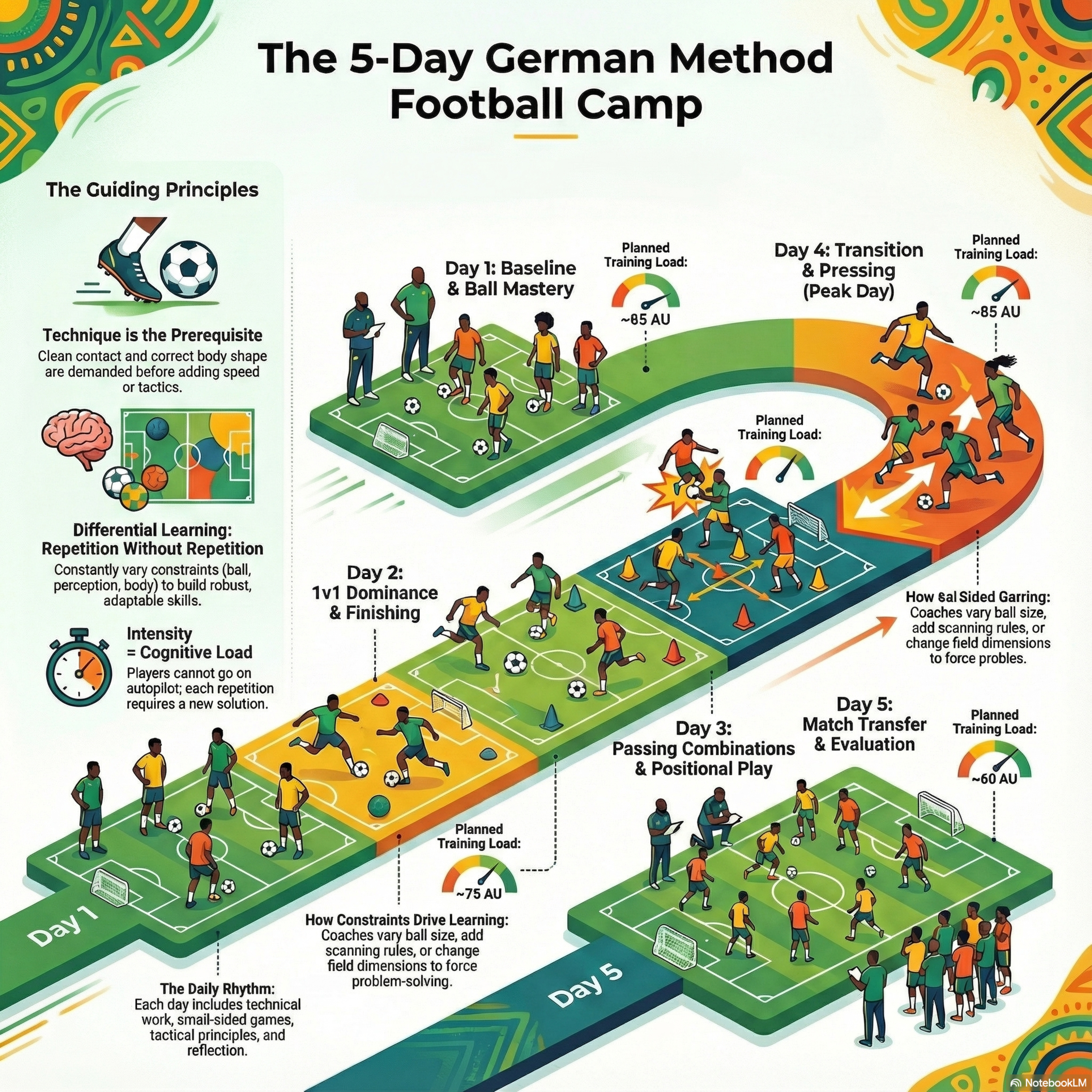
That all sounds incredibly demanding on the players minds. If the cognitive load is that high, the physical and mental recovery has to be just as intentional. How does the methodology manage the risk of burnout across A5 day camp? The structure is the safety net. This is not just random high intensity training, it's very carefully periodized. The entire five day micro cycle is built around a meticulously planned load curve to maximize learning without causing burnout that compromises quality. Walk us through that intensity curve across the week.
Day one is always moderate. It's about assessing the technical baseline, establishing the camp standard and introducing the rules of differential learning. Then it ramps up. Days two and three see a steady ramp up. Yeah, we're increasing the volume of high speed duals. We're expanding the tactical concepts. So we're increasing both a physical workload and the cognitive challenges. And then day four, that's the peak, the crescendo. Precisely, Day 4 is the planned peak day for both physical output and cognitive load.
We're talking a rate of perceived exertion and RPE around 8 out of 10. That's measurable, right? Not just a feeling. Oh. Absolutely. Yeah, it's measurable through RPE, but also by monitoring data from their electronic performance tracking systems, the EPTS wearables. We're tracking high speed, running, metabolic load, all of it. So why is that peak load specifically reserved for transition and pressing work? It seems almost counterintuitive to put the most complex tactical stuff on the day they're most tired.
Because the entire philosophy is about building anti fragile skills transition moments, Those five to seven seconds right after you win or lose the ball are the most chaotic, high speed and physically demanding moments in modern football. You're stress testing them at their limit. We're forcing them to execute their fundamental techniques first, touch, precise passing, rapid body orientation when they're severely physically and mentally taxed. It's the ultimate stress test. If the skill holds up there, it will hold up anywhere.
And if it breaks down? Then you know the player is still relying on conscious effort rather than that robust self organized solution library we talked about. Got it. And then comes the crucial taper on Day 5. The load drops significantly on day 5, down to an RPE of about 6 out of 10. The goal is simple, fresh legs and fresh minds. The priority shifts completely from conditioning to match transfer and evaluation. We don't want their final demonstration of cometence to be compromised by fatigue. We want to see quality.
Let's breakdown the daily rhythm. The day camp blueprint, say 10:00 AM to 3:00 PM, seems highly structured to maximize that learning density. It is precisely scheduled for maximum cognitive impact. It starts immediately with activation from 10.00 to 10.15. And this isn't just jogging around cones. No, the ball is included from minute one. The coach uses this time to set the high energy tone and practice the specific queuing language for the day. It's about preparing the nervous system for what's coming.
Then you go straight into the longest and you said most important block the technical block. From 10.15 to 11.30, this is the engine room of differential learning. It's 75 minutes of the highest volume of high quality ball contacts, all driven by the rapid application of constraints. And the key here is speed of change. The rapid constraint rotation. Coaches are told to rotate the noise every 60 to 180 seconds. Any longer than 3 minutes and the brain starts to groove. Cognitive low drops and learning stops.
After that intense technical focus, it's immediate transfer duals and S S GS. Yeah, from 11.30 to 12.10. This is the observation block we see if the isolated technical gains actually translate when there's an opponent. It's high repetition, intense 1V ones up to 4 V fours. The coach is explicitly watching for first touch quality and scanning habits under immediate threat. And then the part that often gets overlooked, the recovery break. From 12 point Zen to 12.40 by and it is absolutely non negotiable in this kind of camp.
30 minutes dedicated to hydration, refueling, physical and metal recovery. Crucially, coaches are told to limit teaching points to 5 minutes Max. You don't want to overload their brains while they're trying to reset. You can't. They need to recover for the afternoon session. The afternoon starts with the tactical block. 12.40 to 1.3 This is where individual technique meets team structure. We're teaching principal spacing, pressing QS, support angles, but it's all done through constraints in game design, not lectures.
So you teach width by limiting touches for central players. Exactly. Forcing the ball wide. It's experiential learning. And the final block is the ultimate Test match play. From 1.3 to 2.45, the primary goal here is just flow immersion formats like 5V5 up to 99 with minimal stoppages from the coach. This is the ultimate test of their decision making, their fitness and the automaticity of the skills they've been building all day. This sounds like a system that requires forensic levels of observation.
If constraints are rotating every 90 seconds, you need keen eyes watching what's the staffing situation look like. Staffing is a make or break factor. The ideal is a very low player to coach ratio. We're aiming for 5:00 to 1:00. Five players per coach. Why so low? Because the feedback has to be immediate and individual. If a coach is trying to manage 15 players, they can't accurately see if a player's failure was because of the constraint, which is good learning, or because of a fundamental technical flaw that needs correction.
So the coaches have specialized roles. They're not just supervisors. Absolutely not. The lead coach is the macro manager, the architect of the chaos. They're designing the constraint rotations. The assistant coaches are the micromanagers. They run the stations, enforce the changes, and critically, they record key performance indicators, the KPI's and their observations. And the goalkeeper coach. Deeply integrated, we often have the keepers acting as an extra outfield player in build up exercises to really emphasize their modern role as distributors and decision makers.
We touched on the EPTS wearables earlier. How are they used beyond just tracking how far someone ran? They're crucial for adding context to the RPE and making sure we stick to that load curve. For example, if a player's RPE is 8 out of 10, but their EPTS data shows their high speed running is actually low for the day. Then you know the intensity is cognitive. You know they are mentally exhausted but physically OK. And the reverse is also true. If the physical load is getting excessive on a day that's supposed to be moderate, the coach can intervene to maintain the quality of the cognitive work.
It's about taxing the right system on the right day. And all of this culminates in a highly structured, measurable output on day five. It's not just a handshake and a certificate. The entire five days are structured to generate actionable, personalized data. Every player leaves with a concrete, individualized action plan. What does that look like? It includes 3 measurable targets and two sustainable weekly habits. This is the mechanism that ensures the learning actually continues once they go back to their home club.
Can you give me a specific example? How do you move from a vague idea to a measurable target? You move from. You need to be better at switching the play to in possession games. Increase your successful switch of play passes. That's passes over 20 meters from your current 25% to 40%. Well, that's specific. Or for technique, achieve an 80% first touch retention rate in pressurized 4V2 rondos. And the habits are sustainable routines. For example, habit 20 minutes of specific weak foot passing drills against the wall four times a week.
It bridges the gap between the camp and their ongoing development. Let's transition into the on pitch execution now, starting with that foundation. Days one and two are all about refining the individual and then layering on the stress of winning those high pressure 1V1 duels. Day one is the induction day. The objectives are strict. Establish the non negotiable standards for intensity, assess the technical baseline, first touch, scanning, passing weight and introduce that core rule. Constant variation, no autopilot.
The morning technical block is all ball mastery. How is that designed to use differential learning right from the first hour? It's a ball mastery DL circuit, usually 6 to 8 micro stations and the rotation is rapid. Every 60 to 90 seconds the player moves and the constraint shifts instantly. Give me a few examples of those station shifts. OK, so station 1 might be cone dribbling using only the inside of the foot, with a small size 3 ball forcing incredible precision. 90 seconds later, you're at station 2.
Now it's a size 5 ball, but you have to keep your arms overhead, disrupting your balance while you do sole rolls. Station 3. Station 3 uses a weighted ball and it's weak foot only V turns. The cognitive system is just overloaded, constantly trying to find the right speed and muscle recruitment for the new input. And then you escalate the cognitive challenge even further with the cone weave drill. The cone weave is where we introduce divided attention. The physical pattern of the weave is always changing.
Outside, inside, a fake, a drag back, but at the same time the coach is standing on the side calling out colors or numbers. And that external cue dictates the next. Move. It dictates the direction of the next move or what kind of finish they have to execute. So the player is mentally processing this call, which has nothing to do with the physical task, while executing a complex movement and keeping the ball under control. That's it. They are training the essential match skill of scanning, processing tactical info, and simultaneously executing a technical action.
If the technique is too hard, they fail the cognitive cue. If the cognitive cue distracts them too much, they lose the ball. It's perfectly balanced chaos. And the wall pass progression. That refines the core receiving and passing. Players pass against the wall or a partner and move to receive the return. The DL constraint here is varying the return service. The ball might come back bouncing, or a chest height, or rolled at different speeds and angles. So it forces their receiving technique to be adaptable.
Exactly. It's a perfect simulation of match conditions where no pass you receive is ever. Perfect. How do you immediately transfer and measure this in the afternoon session? The afternoon session jumps straight into pressurized rondos like a four V1 or 5V2 with variable constraints, a strict one touch limit, or you have to play a split pass through the defender. This immediately tests those technical gains under pressure, and that leads right into one V1 duels. And the constraints for the one V ones must be intense.
They are the start positions change every single Rep. Sometimes the attacker faces the goal, sometimes their back is to goal. The type of pass they receive changes A rolling pass, a clipped aerial ball. The scoring zones might shift. The variability prevents them from relying on a learned pattern, forcing genuine adaptive problem solving in every dual. So what are the key KPIs for day one? What are you measuring? We're intensely specific. We track the first touch retention rate in those rondos. Success is defined as keeping the ball within 1m of the body under pressure.
Because if the first touch is poor, the whole play breaks down. The player has lost the ability to execute the next tactical step. Simple as that. We also track passing accuracy through target gates and the One V1 success rate across multiple reps to establish that technical baseline for the week. Day 2 then takes that raw technical foundation and layers on the ability to win the duel and, crucially, to finish under pressure. How do you design a shooting drill that deliberately introduces volatility?
We're building what we call antifragile finishing. That means the quality of the strike actually improves under noise and stress. The technical block is the differential shooting set. It's a rapid, short series of strikes that rotates between different techniques. Laces curl. Laces for power inside, curl for precision outside the foot for deception. 1/2 folly to test reaction time. And the constraints applied here must be dizzying. They're designed to destroy any rhythm the players approach. Angle changes for every single shot, approaching from the left, then immediately from a central position.
But the most challenging constraint is the ball size rotation. You're changing the ball between shots. Consecutive shots, a size 5, then a heavy training ball, then a light size 4. This forces an immediate involuntary calibration of their striking power in contact point with no time to settle. I can just imagine if a player hits that size 4 ball with the power they needed for the heavy one, it's ending up in the parking lot. Exactly. It forces a sensitivity that goes beyond conscious thought. Then we add finishing off movement, the ultimate cognitive test.
The play receives a pass, turns and finishes. The DL constraint is the coach calls the target corner high, left, low, right, late, sometimes after the turn has already started. So the player commits to the turn, but the final decision on where to shoot is made mid strike. It forces them to instantly adjust their body geometry and their strike line. It moves the shot from a predetermined action to a reactive high speed decision. It's training precision under fatigue and surprise. And the duels on day 2, the one V1 starting with the attackers back to goal, what's the focus there?
That's all about the attackers turning technique and immediate decision. Do I shield and turn or play a quick wall pass and spin? We introduce constraints for the defender too, focusing on their timing and angle of approach. It's all about making sure the technique holds up under physical confrontation. And Day 2 brings in the first mindset module, growth mindset. Why is that so critical right after you've subjected them to this? It's vital because the entire environment is designed to induce failure.
If a player expects to be perfect, they will get frustrated very quickly, so the reflection exercise asks them to review one miss they learned from that day. So you're normalizing error. You're reframing it in a differential learning environment. You have to teach the player that failure isn't a deficiency, it's the engine of adaptation. It's essential data. So the KP is for day 2 Reflect this focus on finishing and decision making. Yes. We're tracking shots on target percentage in that constrained series and not just hitting the frame, but hitting the call target.
We also track the One V1 defending stop rate, but most critically, we track decision time. How quickly they act. How quickly the player executes that first action. Pass, turn, dribble after receiving the ball. Measure down to the millisecond with video analysis. We're training fast, accurate execution under pressure. OK. So we built the individual engine on days one and two. Now days three and four shift the focus to connectivity, passing combinations, positional awareness and decision making under high speed transition pressure.
The focus shifts from the efficiency of the individual body to the efficiency of the group. Day three is all about upgrading their passing ability, weight, angle, timing and building their tactical vocabulary for combination. The wall pass, the third man run overlaps. The key is doing it all while in continuous motion. And even the warm up maintains that cognitive principle. Always the activation Rondo on day three includes A constraint where players have to call out a color or a number of scanning queue before they even receive the ball.
So it's reinforcing that habit of checking your shoulder. It's linking perception immediately to the action even in low intensity setting. Then you get into the core of the session, wall pass and 3rd man triangles. How do you use DL to elevate what sounds like a basic passing drill? These are stations where they execute specific combinations. The variability comes from changing the touch limits and the starting distances. For example, one block might be one touch only over a short distance, demanding sharp precision.
The next block might require 4 touches over a longer distance. So the changing distance forces them to adjust the weight and type of pass. Exactly. A driven pass, a lofted 1A rolled 1. The constraint isn't always about making it harder, it's about making it different. And this transfers into the afternoon in the directional possession games like a four V 4 + 2 neutral players. And the constraints here are purely tactical. They are, and they change constantly. We might enforce a rule like you must involve both neutral players sequentially before you can score or mandatory switch of play.
The ball has to move from one flank to the other before you can enter the end zone. So it forces them to use the full width of the field. It forces them to adhere to depth and width principles that they probably ignore in an unstructured game. And what about the positional game focus? That sounds like teaching team shape under dynamic conditions. It is. We use smaller blocks like a 5V3 where the constraints limit the touches for wide players. This forces the central players to distribute the ball quickly and maintain proper spacing.
Your teaching structure by restricting movement so the player understands why they need width rather than just being told to stand there. The coaching cues here must shift dramatically, then, away from technique and toward principles. The language changes, Yeah. The emphasis is on body orientation. Hips open to the next pass. We're teaching principles. Create triangles, find the free player, maintain the diamond, shape the constraints. Guide the player to the right solution without the coach having to lecture them on theory.
So the learning is functional, not just academic. Exactly. OK. Day 4. The physiological and cognitive summit. RPE 8 out of 10. You're combining fatigue with the most demanding tactical concepts, transition and pressing. This is where you find out if those anti fragile skills are really automatic. The objectives are crystal clear. Train that immediate 5 second reaction after you win a loose ball and build unified pressing cues. The trigger, the angle, the cover. We're deliberately stress testing everything they've learned under Maximum fatigue.
The first step is the transition Rondo. This just sounds like pure chaotic speed. It's the ultimate test of reaction speed in a standard 4V2 Rondo. The moment the two defenders win the ball, they have to immediately counter attack to a mini goal within a strict 2 second window 2. Seconds. That's brutal. It is. It trains that explosive, immediate reaction. The mental demand is intense because the switch from defense to attack has to be instantaneous and error free. There's no time to think. It has to be instinct.
And you still apply other constraints here. Oh yeah. Touch limits weak foot only, but now under this intense time pressure. Then we move into the pressing waves block. And in pressing waves, the time limit is on the defense. In a 3V3 plus a goalkeeper, the pressing team has a strict 6 second window to either win the ball back or force a major error like a clearance. Variation is key. The play starts from different points, a pass from the keeper, a throw in, forcing the pressing team to dynamically adjust their angle and speed of approach.
So you're training a coordinated press under massive fatigue, which is where it usually fails. That's the stress test, and to make the learning stick, the afternoon uses high reward conditions. The SSG with a transition bonus gives double points for any goals scored within 6 seconds of winning the ball back. So you're gamifying it? It immediately and physically cements the importance of the rapid counter attack, the reaction before explanation concept. We also use contrast learning. 4 minutes of a high press, followed immediately by 4 minutes of a compact mid block.
This forces rapid cactual switching under fatigue. Given the stress, mistakes are inevitable. This is where the resilience module comes in on day 4. It's absolutely vital we're addressing emotional control under duress. The life skill focus is on reset routines. If a player totally exhausted makes an error, they have to have a pre rehearsed mental routine, a deep breath, a physical cue, a mantra to discard the failure and refocus. So one mistake doesn't spiral into 4. It's a critical mental component for sustained high level performance when your body is screaming at you.
And the measurable K key eyes for this peak day. We track successful regains in the opponent's half for 10 minutes, measured with video or EPTS data. And crucially, we track the percentage of goal score within that designated transition window, those six second bonus goals that directly measures the speed and efficiency of their collective reaction under maximum fatigue. We arrive at Day 5, the final calibration. The load is intentionally reduced, ensuring mental clarity for the crucial evaluation block.
This day is about confirmation, not just more conditioning. The load is strategically dropped to a moderate RPE, maybe a six out of 10. Tapering is paramount for achieving high quality output. In the final assessment. You're looking for automaticity and precision, and that requires sharpness. So the morning is a short, precise tune up. Exactly. The AM tune up is a short DL circuit, low volume, high precision. It's a final calibration of the technical system. Then we go into the game model rehearsal, maybe A7V7 or 9V9 with minimal stoppages from the coach.
Minimal stoppages. That's to confirm if the complex cues from day four, like the pressing triggers, have become subconscious habits. Precisely. The coach is watching for automaticity. They only intervene for a universal teaching moment. The goal is to see fluid, self corrected movement patterns that reflect the concepts learned all week. The core of the afternoon is the 40 minute match block. This is the proof of concept moment. It's not just a game, it's a formalized assessment. The coaches use what we call scouting style notes, specific, honest, actionable feedback.
The core philosophy is the total avoidance of vague praise. You played well is meaningless. Great job, good effort. It's useless. So what does a scouting style note look? Like give me an example. Instead of saying you need to work on your strength, the physical attribute note might read Stamina held up. Your EPTS data shows top speed was maintained, but you lost four out of five aerial duels in the final 20 minutes. Wow. Quantified and contextualized. For technical ability instead of good passing, it's successful third man runs completed 6 out of eight.
Forward pass ratio in the final third was 75%. It's specific the mental strength evaluation is critical after day 4A. Note might say successful reset routine after a critical error. 4 out of four you're measuring their resilience. And this all leads directly to the mechanism for lasting improvement, the action plan. This is the critical output each player leaves with their personalized action plan, those 3 measurable targets and two weekly habits. It formalizes their journey and ensures they own the next phase of their development.
And the camp concludes by putting the player firmly in the driver's seat of that development. Exactly. They do an exercise called The Letter to My Future Self. They write down a goal card for the next 30 days, articulating how they're going to implement their targets and habits. It internalizes the goals and fosters that crucial sense of ownership. And you extend that learning environment to make sure the knowledge transfers home. The final step is a parent or guardian briefing. The coach explains the top themes of the week, explains differential learning.
They also provide home training templates so the support structure at home understands the methodology and can help reinforce those new anti fragile habits. So after five days of this deliberate chaos, how do the coaches really know it worked? What are the ultimate markers they're looking for in that final match? They track specific transfer markers, KPIs. These are the DL trained habits that should now show up automatically in the game. A successful half turn receive under pressure which was trained on day one, the immediate execution of that six second press trigger from day four, or the spontaneous accurate execution of a third man run from day three.
So if the player is solving complex problems in the chaos of the game using the skills they were forced to adapt this week. Then the methodology has succeeded. It's built a robust anti fragile footballer. What an incredible, detailed breakdown of how you create a world class problem solver. We started with that philosophical shift technique first and move through establishing constant calculated variability. The key take away seems to be that differential learning is the shortcut not to robotic perfection, but to truly robust, adaptable skill.
The system works because it bypasses those fragile, consciously learned motor patterns by forcing the athletes motor system to continually self organize and find new solutions. When it's presented with constant noise, the varied balls, the restricted movements, the Lake Hughes, it builds a vast library of movements that can be deployed subconsciously. It's the ultimate lesson in embracing chaos. If you can only perform when the conditions are perfect, your skill is rigid. If you can perform when the conditions are constantly changing and demanding, your skill is anti fragile.
And that's the highest level of performance. And that concept, as we've said, goes far beyond the football pitch. We've seen how challenging the body's established patterns with specific constraints can unlock superior performance and adaptability. O we'll leave you with this provocation. Think about the predictable areas in your own daily professional life or your own learning process. Where have you settled into an autopilot routine where the inputs are always the same? What specific deliberate noise or chaos could you introduce?
A new tool, A dramatically shifting requirement, a completely different environment. Something that forces your own mind to generate novel, more robust, and more adaptable solutions. Because that continuous self organization is where lasting mastery truly begins.
 Apple Podcasts
 Castbox
 Castro
 Goodpods
 Moon FM
 Overcast
 Pocket Casts
 Podbean
 Podcast Addict
 Podcast Republic
 Spotify