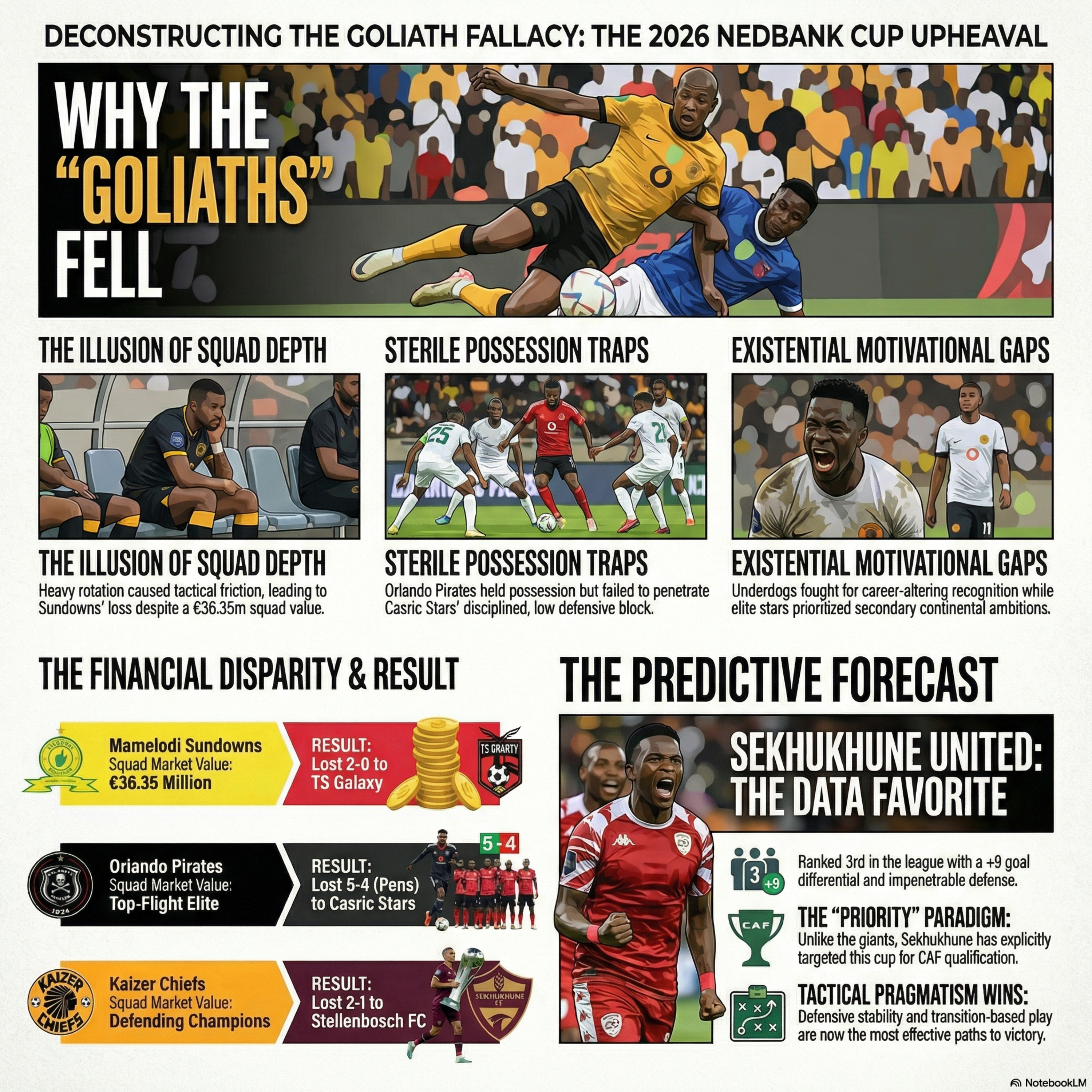
The 2026 Nedbank Cup Goliath Fallacy
About this episode
The 2026 Nedbank Cup Goliath Fallacy
I have to be honest with you, I I woke up this morning, I grabbed my phone, checked the scores and I genuinely thought I was still dreaming. Oh, I did the exact same thing. Right. Or maybe that my app was broken. You know that feeling when you look at something in your brain, just it just refuses to process it because what we are looking at in the 2026 Nedbank Cup, it doesn't make sense. It defies physics. It defies logic. It certainly defies the odds, but I think if we look closer, it defies the very structure of of how we think football works in this country.
Defies the odds. I mean, that is the understatement of the century. We are talking about an absolute earthquake in South African football. The landscape has been completely flattened. It's like a meteor hit the PSL. It's a structural upheaval. That's really the only way to describe it. We are seeing a complete inversion of the hierarchy. Let's just set the scene for anyone who has been living under a rock or anyone who hasn't looked at the bracket yet. The big Three, the Titans, Memelodi Sundowns, Orlando Pirates, Kaiser Chiefs, the teams that are supposed to be invincible, the teams with the checkbooks that could buy small countries, the teams that have dominated the headlines for decades.
They're all gone, eliminated. And we haven't even reached the quarterfinals yet. Exactly. It's unprecedented. Usually in a tournament like this, you might lose 1 along the way. Maybe Chiefs have a bad day at the office or Pirates slip up on a muddy pitch in the rain. But to have all three? The entire hegemony of the Betway Premiership. Wiped out before the last date, it feels like the world is turned upside down. It feels like the laws of gravity just stopped working. You look at the bracket and you're like, where are the giants?
And that's what we're doing today. We aren't just looking at the scores in this deep dive. We are unpacking this phenomenons, treating this like a crime scene investigation, because there's a name for this, right? It's not just bad luck. No, it's not bad luck. If you look at the data and if you look at the tactical setups. This wasn't an accident. In analytics, we call this the Goliath fallacy. The Goliath fallacy. I love that title. It sounds like a Robert Ludlum novel or something, but tell us what it actually means in this specific context.
It's this deeply ingrained belief we all have fans, pundits and crucially, the coaches themselves. The belief that money and pedigree guarantee success in knockout football. We assume that because Mamelodi Sundowns has a squad market value of over €36 million and they have the best training facilities and the best nutritionist, they will naturally beat A-Team whose entire payroll is a fraction of one player salary. Right. You look at the spreadsheet and say, well, the math says Goliath wins. It's a transaction.
I pay more, I win more. Precisely. But the 2026 Nedbank Cup has taken that spreadsheet and set it on fire. The mission for us today is to figure out exactly why. We need to dissect why these giants failed. We need to analyze the new rules of the tournament now. The favorites are dead and buried. And perhaps most daringly, we're going to try to scientifically predict who is actually going to lift this trophy now. I love it. We're playing detective on a football murder mystery, and the victim is the status quo.
So before we get to the prediction part, we have to look at the carnage. Let's walk through the timeline of this disaster. It started with Kaiser Chiefs. It did the first domino to fall round of 32 against Stellenbosch. And that wasn't a penalty shootout lottery either. That was a 21 defeat in regulation. Time. It was a systematic unpicking of a giant. Stellenbosch didn't steal that game they wanted outright, but the real shock waves came later. The round of 16. This is where things went from surprising to quite frankly, impossible.
Mamelodi Sundowns lost to TS Galaxy, and then Pirates lost to Kasrik Stars, a second tier team in the last 16. And then, just to add insult to injury, Stellenbosch, the team that actually beat Chiefs, got knocked out by Golden Arrows. It's total chaos. It is chaos, but it's organized chaos. If you look closely, it's not random. OK, let's unpack that, because to the naked eye it looks like a total fluke. But you're saying there were massive blind spots here? Let's start with the first one. You call it the illusion of squad depth.
This is the big one. This is the specific trap Mamelodi Sundowns fell into. The assumption is simple. A coach thinks my B team is better than your A team. Which sounds arrogant, but usually for a team like Sundowns, it's true, right? I mean, they have international players sitting on the bench. They have players who would walk into the starting lineup of any other team in the league without a trial. On paper, yes. If you played that match on a simulator or a video game, Sundowns wins every time.
But football isn't played on paper. It's played by human beings with rhythms and connections. Let's look at the context of the Sundowns versus TS Galaxy match. Sundowns had just come off a massive high intensity 2 one win over Orlando Pirates in the league. That's the so Widow Derby context. Huge emotional expenditure. Physical exhaustion. Exactly. So coach Miguel Cardoso looks at his squad. He sees the fatigue. He sees the Champions League fixtures coming up and he decides to rotate and. When you say rotate, you don't mean changing the striker and maybe a winger to freshen things up for the last 20 minutes.
No I mean he changed almost the entire starting 11. He only kept Nuno Santos, everyone else was swapped out. He brought in the 19 year old thought OCB at the back. But the most critical change, and this is where the game was lost, was in goal. Replacing Ronwyn Williams. Replacing Ronwyn Williams with the veteran Dennis Onyongo. Now, I want to be clear here, Anyongo is a legend. He's won everything there is to win. But at this stage of his career, and specifically regarding his style of play, he is the polar opposite of Rhonda Wynne Williams.
Break that down for us. Why does the goalkeeper change affect the whole outfield team so much? Surely the job is just to stop the ball from going in the net? In modern football, and specifically in the possession heavy system Sundowns plays, the goalkeeper is the first attacker. Ronwyn Williams is arguably the best ball playing goalkeeper on the continent. When he plays the center back split wide, they trust him to receive the ball under pressure and ping a pass through the midfield lines. He is the conductor of the orchestra.
So the whole team is calibrated to his distribution. Exactly. The spacing, the movement, the angles, it's all built around Williams's ability to break the press. And you put on Yongo in, he's a shot stopper, he's old school. He is not comfortable having the ball at his feet when a striker is sprinting at him at full speed. And you think TS Galaxy knew this going in? Oh, absolutely. At Nan Baganovic, the Galaxy coach read it like a book. He didn't just park the bus and hope for the best. He used on Yongo as a pressing trigger.
A pressing trigger? That sounds fascinating. Break that down for us because I think a lot of people just see players running and don't see the underlying structure. So in pressing systems, you don't just run at everyone blindly. You wait for a cue, a specific event that tells the team to go. Galaxy decided that when the Sundown center backs had the ball, they would sit back. They let them have it. But the moment the ball was rolled back to Onyongo, that was the trigger. So they basically baited the pass back to the keeper.
They baited it perfectly and when it happened, they swarmed. They knew he isn't comfortable playing out from the back under pressure like Williams is. They shifted from passive to aggressive instantly. And that's how they scored the opening goal. That's exactly how the first goal happened. Divine Lunga had the ball. He was under pressure. Usually with Williams behind him, he knows exactly where to drop the ball without even looking. But with Onyango, the chemistry wasn't there. The angles were slightly wrong.
Lunga lost possession because the passing options weren't crisp. Again, lack of chemistry. Sifaman La Naguena pounced, got the turnover and beat Onyango. Low one nil. Wow. So it wasn't just that Sundowns played bad, it was a tactical targeted strike on their rotation policy. 100% it was surgical. And then the second goal, you remember that teenager, that Osibia. Yeah, the 19 year old center back. Inexperienced, he gets caught out of position, makes a bad tackle on Salulu Leko Malambi inside the box penalty.
Junior Zendoga steps up and converts A2 nil. Game over. He had Sela Milongu, the former Sundowns player, analyzing this afterwards and he was furious. He said the rotation completely destroyed their philosophy. The players didn't know the system because they hadn't played together in that specific configuration. That is fascinating. So blind spot number one is thinking that talent creates A-Team when actually time creates a team. Cohesion beats collection every single time. You can't just throw 11 expensive strangers on a pitch and expect them to dismantle a well drilled unit that fights for each other every week.
OK, let's move to the second giant that fell, Orlando Pirates. This felt very different to me. They didn't lose because of rotation in the same way, right? They played Kazrich Stars at Orlando Stadium. They had 120 minutes to score a single goal. And they couldn't do it. This brings us to blind spot #2 tactical hegemony. It's the assumption that if you have the ball, you will eventually score. Possession is 9/10 of the law. Right in court, maybe. In football, possession without penetration is sterile.
It's useless. It's actually dangerous because it lulls you into a false sense of security. Kazrek Stars played what we call a low block. Paint the picture for us. For someone listening, what does a low block actually look like on the field? Imagine two banks of four players, 4 defenders, 4 midfielders. They're standing very close together, right on the edge of their own penalty area. They congest the center of the pitch completely. There is absolutely no space between the lines. They're basically saying to Pirates you can have the ball on the wing, you can pass it sideways all day, but you are not coming through the middle.
And pirates just took the date. They fell right into the trap. They passed around the perimeter. It looked pretty. The passing stats were through the roof. They probably had 70% possession, but they created very few high value chances. They lacked vertical penetration. They needed someone to rim through the wall, not just walk around it. And Kaswik stars were just happy to wait it out. They were delighted. Their coach Bucksmith on Benny basically admitted it. They wanted to drag the game into deep waters because the longer it stays nil nil, the more the pressure builds on the favorite.
The crowd starts to groan, the players start to panic. And then the penalty shootout. Ah, the lottery. Everyone always says penalties are a lottery. See, I hate calling it a lottery. It's not random chance. It's a test of nerve. It is a psychological examination. And in the shootout, the skill gap vanishes. It doesn't matter if you earn 5 million or 5000, it's you, the ball and the keeper from 12 yards. And this is where the pressure cooked pirates. We saw some really big names miss. Huge names, Ginzanathi, Sabisi, Pho Chapatani, Tough leg pros.
Why did they miss? Because the weight of the badge was on their shoulders. If they score, it's expected, it's just doing their job. If they miss, it's a national disaster. Meanwhile, the Kasbrik stars guys Zebulunish. When he steps up to take the winner, ice in his veins. He has everything to gain and nothing to lose. 54 History made. It's incredible. The psychology of that moment must be insane. Which actually leads perfectly into our third blind spot. You call this the psychology of priority. This is the hunger gap.
We have to be honest about motivation here. It's uncomfortable to talk about because professionals are supposed to be motivated for every single game. But let's look at the reality from Amalodi Sundowns and Orlando Pirates. What is the Nedbank Cup really? I mean, it's a nice trophy, it's prestigious, but compared to the C CAF Champions League, compared to the league title, it's dessert. It's not the main course. Exactly. It's a secondary trophy, maybe even tertiary. For club like Sundowns, it's a distraction from their continental ambitions, but for Milford FC, for Kasrik Stars, for a team like Jax's Spears from the third tier.
This is the World Cup final for them. It is everything. It's contracts, it's TV exposure, it's survival, it's feeding your family for the next year. You cannot manufacture that kind of desperation in a training session. I remember reading a quote from Eric Tinkler, this sick Kuna coach, about this specific dynamic. Yes. Tinkler hit the nail on the head. He said the biggest danger for top players is that they subconsciously drop their level against small teams. You look at the guy opposite you, you don't recognize his name.
His kit looks a bit cheap, the stadium isn't full. And your brain says I can take it easy today, I don't need to go 100%. And by the time you realize, you're in a real fight. It's too late. You can't just flip a switch and turn the intensity back on in the 70th minute. The underdog is already running at 110%. That existential hunger fighting for your life often beats talent that is just fighting for a win bonus. That is so true. It's the difference between running a race and running from a lion.
The Lion makes you run faster. Brilliantly put. Fear is a very powerful motivator. So we have the illusion of squad depth, tactical hegemony, and the priority gap. There's one more you mentioned in the intro, Understanding Variance. Right, this is the math part of the equation. Leagues are designed to find the best team. You play 30 games. If you have a bad day, you fix it next week. Over 30 games, the richest best team almost always wins. The law of averages protects the big teams. But the cup is a different beast entirely.
The cup rewards variants. It rewards luck. It rewards one bad referee decision, one slip on the turf, 1 moment of magic from a striker who will never hit a ball like that again. Forecasters forgot that history repeats itself. We've seen this before in African football. Maludi Fatih beating Pirates in 2013. TS Galaxy beating Chiefs in the 2019 final. This isn't completely new. It's just happening all at once right now. It's like the dam, finally. Broke the variance, caught up with everyone at the exact same time.
The probabilities aligned perfectly to wipe out the entire top tier. So the giants are slain, the dust has settled, and we are left with a very strange looking bracket. Let's move into Part 2 of this deep dive. The new landscape. What does this world look like now that the kings are dead? It's an open matrix, the hierarchy is gone, and the first thing you're going to see is a massive shift in tactics across the board. In what way? More attacking because surely with the big scary teams gone, everyone feels like they can win.
You'd think so, but paradoxically it goes the exact other way. We are going to see extreme risk aversion. Really. Why would they play tighter now? Think about it, when you play Sundowns, you know you're probably going to lose, so you might try something crazy. You might play with freedom because you have 0 expectation of advancing. But now you're playing a team you know you can beat. The fear of losing becomes significantly greater than the hope of winning. We are going to see intense pragmatism.
Ugly football. Effective football transition play, set pieces, defensive attrition. We saw it in the last 16. Lots of NIL. NIL draws. Lots of one NIL wins. The beautiful game takes a back seat to winning at all costs because the prize is simply too big to gamble with. And let's talk about that prize, the CFF Golden Ticket. This is a crucial detail that casual fans might completely miss. It's the most important detail of the entire tournament now. Usually Sundowns or Pirates wins the cup since they're usually already in the Champions League via the league table.
The CF Confederation Cup spot that comes with a Ned Bank Cup trophy usually trickles down to whoever finishes second or third in the league. Right, so usually the league table decides everything when all is said and done. But now a mid tier team or even a lower tier team will go to Africa. That spot is going directly to the Cup winner. That changes the trajectory of a club. Forever. It's transformational institutional transformation. Imagine Sick Cocoon United or TS Galaxy touring the continent.
The broadcast revenue from see half the travel experience, the exposure to international scouts for their younger players. It changes the club from a local participant to a continental brand. The stakes have shifted from winning an ice piece of silver to changing the future of the institution. And with those massive stakes comes massive pressure and controversy. We have to talk about the tech debate here. Oh. Absolutely. Without those three nil blowouts where the result is never in doubt, the games are now being decided on razor thin margins.
A single decision changes everything. The Golden Arrows versus Stellenbosch game that was the flashpoint for this entire debate. The handball incident. Arrow's defender Ayanda Gianni. It looked like a clear handball in the box. Referee Michael Mosman didn't give it. And there's no VAR to check it in this tournament. Exactly, and this is fascinating. Mankuba Minkwathi, the Arrows coach, even though his team benefit and won the game, he came out and said we need VAR. He admitted the game is too fast for the human eye now when the playing field is.
This level 1 refereeing mistake is a difference between glory and absolute nothingness. The pressure for technology and domestic cups is going to skyrocket after this tournament. It really feels like the margin for error is 0 now. And that brings us to the psychology of the survivors. You mentioned earlier that the pressure was entirely on the big Three. Where is it now? It's shifted completely. The pressure is a heavy coat and someone has to wear it. Now say Kakuni United and I'm a Zulu, have to put it on.
They are no longer the plucky underdogs trying to cause an upset. They are the favorites. Can they handle that? It's a completely different game when you have to win rather than when you just hope to win. That's the multi million Rand question for teams like Milford and Kasrick Stars. They are dangerous because they still have that nothing to lose energy. But say, Kukuni, they have to look in the mirror and say we are the Goliaths now. We're the ones expected to dominate possession and break teams down.
That creates anxiety. That is a terrifying thought for those players. OK, let's meet these new Goliaths. We have 8 teams left, the Elite 8. Let's profile them quickly before we get to our prediction model. Who are the survivors of this purge? Let's start with the big dog in the yard, Sekukuni United. Pragmatic heavyweight. They are the highest ranked team left, sitting third in the league right now. Eric Tinkler is the coach, and his philosophy is remarkably simple. Clean sheets first. Goals will eventually come.
And they proved it against the University of Pretoria. Very gritty one nil win. It wasn't pretty, but it was incredibly professional. A stunner of a goal from Vigolet Lapa from what, 35 yards out? Yeah, an absolute rocket. But the key here is they treat this cup as priority number one, no complacency. They are organized, disciplined and very hard to beat. Then we have the giant killers, TS Galaxy. The Hoodoo team, they beat Sundowns 2 nil. They are tactical disruptors. They can press high or they can sit deep.
They're shape shifters depending on who they play. What's their main weakness then? Inconsistency. They are eighth in the league. They are great at ruining someone else's party, but can they host their own? They often play down to the level of their opposition. That's a very dangerous trait in 1/4 final against a smaller team. That's a great analogy. Next up, Emma Zulu FC, the Road Warriors. These guys are grinders. They won back-to-back away games against Pole, Queen City and Richard's Bay. That is difficult travel, difficult conditions, and they absolutely love extra time.
They seem to thrive on suffering honestly. They do Tandle when Cozine and Gwenya scoring in the 113th minute that shows incredible fitness and mental resilience. They don't panic when the clock runs down, but playing 100 and 20 minutes takes a serious toll on the legs. And then we get to the weirdest team in the bracket, Durban City, the Iron Wall. The anomaly They have played 240 minutes of football in this cup so far. Do you know how many goals they've scored? 0. Zero. Do you know how many they've conceded?
00. They won two consecutive penalty shootouts. Their strategy is literally to not play football, but to prevent football from happening. And they have Darren Keaton goal which helps. Which is their cheat code. Keat is a penalty specialist. He saves penalties for fun. But the problem is you can't rely on playing for nil nil forever. It's unsustainable. Eventually someone scores a deflection and then you have absolutely no Plan B it's playing with. Fire OK, next golden arrows. The opportunists to make Kobo Mckeithy's team Fast, direct, high variance.
They beat Stellenbosch. Angelo Van Ruy is the danger man on the break. They rely on chaos. If the game is orderly, instructured, they struggle. If it's chaotic, they win. They want a basketball game end to end. Now the NFD threats Milford FC and Kasrix stars. Milford are the NFD league leaders. They score a lot of goals. They beat Mukambathi 3 nil. They have immense confidence. They look at the PSL teams and think we can take them, we are better than them right now. And Kasrick stars. We talked about them earlier, the defensive block that stopped Pirates, mentally strong, but they play very, very negative football.
They park the bus and hide the keys. They are difficult to watch, but incredibly difficult to beat. And finally, the Cinderella story. Jack Spears. The Romance of the Cup. Third tier ABC Mungsepe League. Only the 4th amateur team ever to reach the quarterfinals. It's a beautiful story. They beat Vasco da Gama but. I hear a massive butt coming. But reality calls eventually. They've only beaten other amateurs. The jump in speed, decision making and physicality to play a professional team is massive.
It might be midnight for Cinderella very soon. OK, we have the profiles. We have the context. Now we put our necks on the line. It's time for part 4 of this deep dive. The predictive model. Who wins this thing, right? We are going to do this systematically. By process of elimination, we cut the field until only one remains. Let's start cutting who goes first. I'm sorry to break hearts, but we have to cut the amateurs and the NFD teams first. JAXA Spears, Kazrich Stars, Milford FC. Why Milford is top of their league.
They are flying. It's the physical toll. History shows us this time and time again. The deeper you go in a cup run, the more the physical disparity matters. Professional PSL teams have better nutrition, better recovery protocols, deeper squads. Eventually the lower tier teams just break physically in the quarters or semis. The fairy tale usually ends here simply because the legs give out. Fair enough, Biology wins. Who's next on the chopping block? We have to cut the no offense team, Durban City.
You can't penalty shoot out your way to a trophy. Mathematically, no. Eventually Darren Keat will dive the wrong way. You need to score goals to win a tournament. You cannot bank on nil nil four times in a row. It is statistically nearly impossible. OK, Durban City is out. Who else? I'm cutting the high variance team golden arrows. She's too reliant on counter attacks. If a team sits back against them, arrows don't know what to do with the ball. They struggle to control the tempo of a game. In a semi final or final you need control.
You can't just hope for chaos to bail you out. And AmaZulu. I'm cutting the grinders. AmaZulu live on the edge. Winning an extra time is great for morale, but it destroys your muscles. Fatigue will catch up with them. You cannot play 120 minutes every week and expect to be fresh for a final. So we are down to two the final 2 standing in your model. The final two are TS Galaxy and Sekakuni United. The giant killer versus the pragmatist. Exactly. TS Galaxy has the tactical flexibility and the immense momentum from beating Sundowns.
Adam Beganovich is a very smart coach. He knows exactly how to set up a team for a specific opponent. But but but my 4 based on all the data, all the tactical trends is Sekakuni United. Make the case, defend the pick. Why Sekatun it? For clear reasons, number one league form. They are the best actual football team left in the draw. 3rd place plus nine goal difference. Quality is quality. They have the best players remaining in the tournament, pound for pound. Consistency matters. #2 defense wins cups.
Tinkler's absolute obsession with defensive shape. The Cardoso and Levu partnership at the bag is rock solid. They are harder to break down the Galaxy and a final defenses usually come out on top. #3. Mentality we talked about priority earlier Tinkler prioritizes tournament from day one they are just happy to be here enjoying the ride. They plan to be here. They have a road map to the trophy. And finally stability. TS Galaxy is dangerous but they are volatile say Kakuna stable. They have been to the final recently.
They have the institutional memory of what the week of a final feels like. They know how to navigate the media pressure. They won't freeze in the spotlight. So Seikakuni United is your official pick to lift the 2026 Nedbank. Cup. The data points firmly to them. The Goliath fallacy took out the big boys. But the smart Goliath, the pragmatic, well coached, hungry team is Seikakun. Fascinating. So as we wrap up this deep dive, what does this all mean for the health of the game? I think it's incredibly healthy.
The Goliath fallacy is dead in 2026. Names don't win matches, systems do. Hunger does. It forces everyone top to bottom to innovate. You can't just throw money at the problem anymore and expect a trophy in return. It's a wake up call for the establishment. A brutal, beautiful wake up call, it forces the big teams to respect the game again and it gives genuine hope to every small team across Africa that if you get your tactics right and you fight, you can beat anyone on your day. I want to leave you, our listeners, with a final thought.
We've talked a lot about football today, but this concept applies to everything in your own life, in your business. Are you relying on your brand name? Are you acting like Sundowns thinking your past reputation will win the day? Or are you hungry? Are you adaptable? Are you acting like JAXA Spears or TS Galaxy? Looking for the tactical blind spots and the giants above you? That's the real lesson here. Never get comfortable. The moment you think you've won before the game even starts, you've already lost.
Spot on. The Giants have fallen. The new era is here. Thanks for diving deep with us. We'll see you next time.
 Apple Podcasts
 Castbox
 Castro
 Goodpods
 Moon FM
 Overcast
 Pocket Casts
 Podbean
 Podcast Addict
 Podcast Republic
 Spotify