The 2025 African Football Transfer Blueprint
About this episode
The 2025 African Football Transfer Blueprint
OK, stop what you were doing. If you're driving, keep your eyes on the road, but open your ears wide. If you're sitting at your desk, close the spreadsheet. We need to talk about money. A lot of money. And I don't mean the kind of money you find in your couch cushions. I'm talking about an avalanche. Yeah. I'm talking about a figure so large it actually, you know, it breaks your brain a little bit if you try to visualize it in cash. It is the kind of number that signals A tectonic shift, not just a Goodyear.
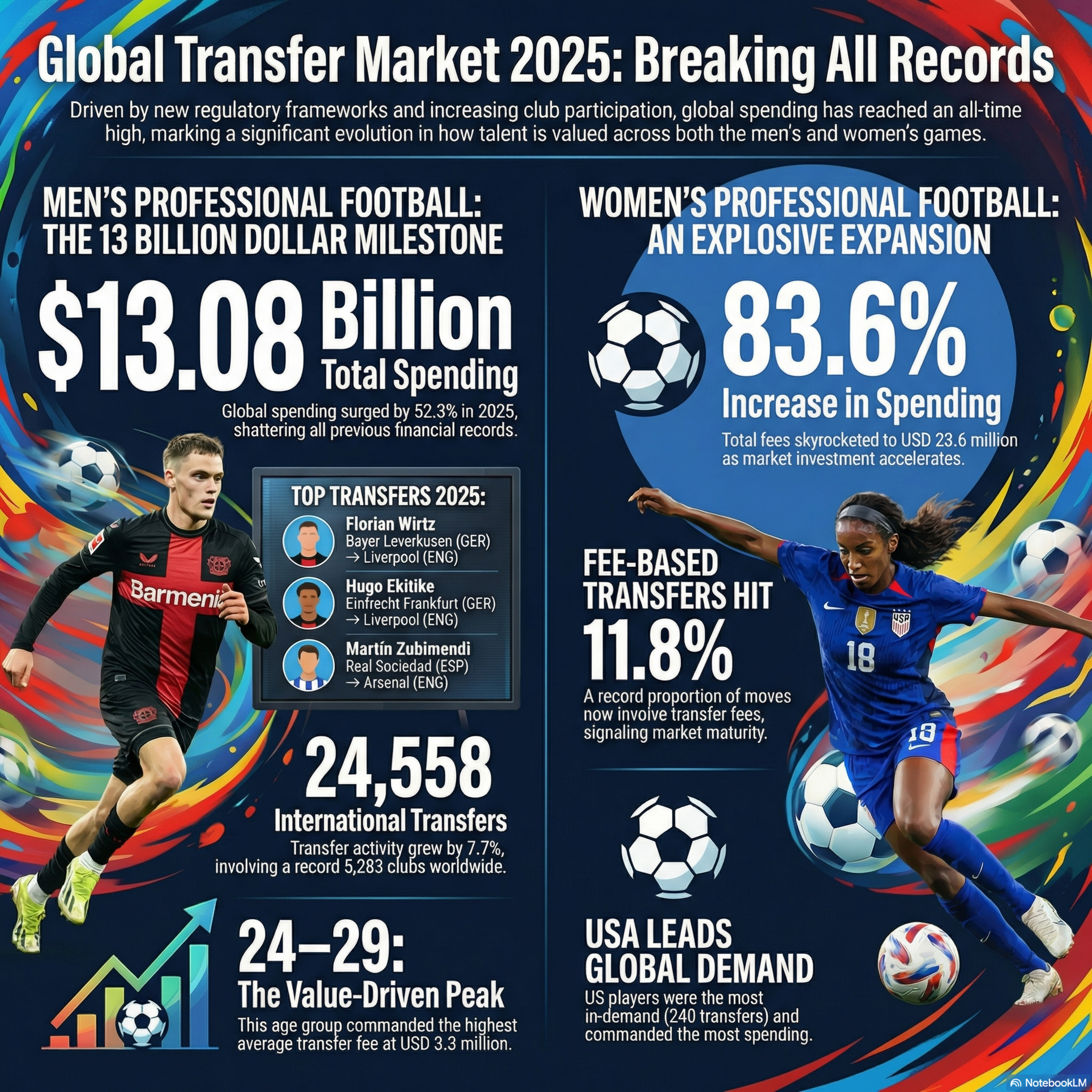
We are looking at the business of football in 2025 five and forget the kit launches, forget the TikTok dances, forget the VAR drama. For just a second. We are looking at the engine room and the gauge on the engine room is reading $13.08 billion. That is billion, with AB $13 billion spent on transfer fees in just one single calendar year. 13 billion. That is the GDP of a small nation. And here's the kicker, the part that made me spill my coffee when I saw the data. I know exactly what you're going to.
Say that is a 52% increase from the previous year, 52%. Staggering. In what other industry on planet earth do you see 50% year on year growth without a bubble bursting 5 minutes later? You don't. You really don't. Tech doesn't do that. Real estate doesn't do that. This is this is unique to the football ecosystem. It's insane. It tells us that the market isn't just recovering or growing, it is exploding. There is a gold rush happening right now. A gold rush. That is the perfect image. Everyone is grabbing their pickaxes and running to the hills.
Exactly. But here is why we are doing this deep dive today. We aren't just here to clap for the big European clubs spending this money. We aren't here to celebrate Manchester City or Real Madrid's accounting departments. We are here to ask one very specific, very urgent question. How much of that $13 billion is landing in Africa? That is the critical question because when you see a number that big, it creates a like a hydraulic pressure. That money has to go somewhere. It flows down. It has to. And if you were running an Academy in Accra or a club in Lagos, or you are a scout in Abidjan, that $13 billion isn't just a statistic, it's a potential livelihood.
It's infrastructure. It's the future. And is the future of your community. Exactly. So today we are stripping away the noise. We are going to look at the mechanics of this market. We are going to decode the blueprint of 2025. Yep, we're going to talk about why selling a player for free might actually be the smartest move you can make. Which sounds insane, I know, but stick with. Us it does sound crazy, but it's true we're. Going to talk about the volume trap, the explosion of the trial system and why West Africa has become the world hunting ground.
This isn't about reading a scoreboard, this is about survival strategy. It really is. I mean, if you are operating in the African football space and you are using a playbook from 2015 or even 2020, you're leaving millions on the table. The game has changed. Completely. So let's get into the mechanics. The headline is 13 billion. Yeah, but when you look closer at the data, it's not just one big pile of cash, is it? It feels like we are looking at 2 completely different markets operating side by side.
It is a classic bifurcation. We see it in other mature industries, but it has become incredibly stark in football this year, right? You essentially have two economies. I call them the potential market and the performance market. Potential and performance. OK, let's break the potential market down first. Who are we talking about here? This is the volume game. If you look at the age distribution of transfers, there is this massive towering spike for players aged 18 to 23 a. Huge spike. We are talking about over 10,000 transfers in that age bracket alone in a single year.
10,000 players moving that's I mean that's a small city of young men packing their bags. It is, and the reason for that volume is simple. Clubs are buying lottery tickets. Lottery tickets. When you sign an 18 year old or 19 year old, you aren't paying for what they can do today. You are paying for what they might do in four years. You are buying the ceiling. Right, it's venture capital. You invest in 10 startups hoping one becomes Google. That is a very apartment comparison though, with much higher human stakes in this potential market.
The fees could be decent, but the volume is the driver. So it's about quantity. It's about quantity. Clubs are stockpiling talent. They'd rather sign 4 promising Nigerians for a modest fee each than put all their eggs in one basket. OK. So that's the 18 to 23 bracket, that's where the noise is, that's where all the movement is happening. Now contrast that with the performance market, the. Performance market is the age bracket of 24 to 29. Now the number of transfers, the sheer volume drops off significantly.
Here you don't see as many players moving, but the value, the average fee, it goes vertical. Because now you aren't guessing. You are buying certainty. The average fee for a player aged 24 to 29 peaks at roughly $3.3 million per player globally. That is the premium you pay for performance. This player has data. They have played five seasons. They have weathered injuries. You know exactly what you were getting. So if I'm an African Academy owner listening to this, what's the lesson here? Because I feel like a lot of us get frustrated.
We have a 19 year old talent, he's incredible and we want to sell him for $5,000,000, but the market is saying no, he's unproven. The lesson is no, you're lame. African academies, by definition, operate in the potential market. You are the producers of raw material. You were the diamond mine, not the jewelry store on 5th Ave. I like that analogy. You cannot expect performance market prices for potential market assets unless you have a true generational anomaly, a once in a decade player. So the strategy shouldn't be to hold out for the mega fee at age 19, no.
Because you might stifle the player's career, the strategy is to understand that you are selling potential. You need to price your players to move into that volume stream. Get them in the system. You want them in the ecosystem because, and this is crucial, the big money, that $3.3 million average usually happens on the second or third transfer. Right. And we're going to get to how you get a piece of that second transfer later, because that is the magic key to all of this. That's the whole game. But before we do, I want to shatter a myth.
I think when we hear $13 billion, we imagine that every time a player moves, a briefcase full of cash is exchanged. The Hollywood version of the transfer market. Exactly. We picture agents in smoky rooms handing over checks, but the data shows something completely different. It is the single most sobering statistic in the entire landscape. What is it 17.7%? 17.7%. That is the percentage of global transfers that actually involved a transfer. Wait, wait, let me just pause there. You're telling me that more than 80% of transfers 4 out of every five times a player moved clubs in 2025, no transfer fee was paid?
0 Nothing free agents loans out of contract moves. That is the reality of the market. Unbelievable. The vast majority of movement is fluid and cashless in terms of transfer fees. That is wild. We get so blinded by the MBAPI money or the awesome hen money that we think that's the norm. But it's the exception. But the norm is actually free. The norm is efficiency, Clubs are trying to reduce risk and even within that 17.7% that do pay fees, it is heavily, heavily weighted at the top. How so? The top 3.8% of transfers the elite deals over $20 million accounted for nearly half of that $13 billion spending.
Talk about the 1% or the 3% in this case, it's incredibly top heavy. It is the Pareto principle on steroids. OK, for those of us who skipped economics One O 1 breakdown the Pareto Principle. It's the 8020 rule, the idea that 80% of consequences come from 20% of the causes, right? In football, it's more like the 964 rule. You know 96% of the market is fighting for scraps, while 4% of the market is passing billions of dollars around in a circle. That sounds depressing if you're a small club in Senegal.
It sounds depressing if you try to compete with them directly, but if you are smart you realize you don't need to be the club spending 20 million. You need to be what? You need to be the feeder to the club that spends 20 million. You need to be the entry ramp onto that highway. You want to be the one supplying the parts for the Ferrari, not trying to build the Ferrari yourself. Precisely, you need to get your players into that elite pipeline. Once they are in, the mechanics of the market will take over.
But the hardest part is that first step. Right, the first step, crossing the border. Which leads us perfectly to the gateway. How do these players actually get seen? How do they get from a dusty pitch in Kumasi to a pristine Academy in Lyon? It's not just magic, it's a system. And that system is the trial. The trial ecosystem. This is the heartbeat of recruitment and looking at the 2025 figures, the heartbeat is racing. How so? We saw confirmed trials jump to 2366. That's a significant jump. Why are we seeing such a surge in trials?
I mean, why aren't scouts just watching video? We have why scout? We have AI, we have data. Why fly a kid 4000 miles? Because data can't measure heart. Data can't measure how a kid reacts when he gets tackled hard on a cold Tuesday morning in November. Good point. Clubs have realized that video can be deceptive. Highlights are called highlights for a reason. They hide the mistakes. They don't show the 10 times he lost the ball. Exactly. To really know if a player from a different cultural and footballing environment can adapt to Europe, you have to bring them in.
You have to see them in the cafeteria, not just on the pitch. It's a cultural fit test. It is, and what jumped out at me immediately in the 2025 data was where these trialists are coming from. Oh, this was fascinating. It's like a heat map of talent. It is a giant arrow pointing at West Africa. When you look at the top five nationalities for trial is globally, 2 of them are African. Who are they? Ivorians and Ghanaians Let's. Put some numbers on that. 116 trials for Ivorians, 104 for Ghanaians. That is astonishing volume.
116. That means essentially every three days, an Ivorian kid is landing somewhere in the world for a trial. Why those two nations specifically? I mean, Nigeria is bigger, Senegal has the pedigree. Why Ivory Coast in Ghana right now? It's a combination of infrastructure and history. The academy's there like Right to Dream in Ghana or ACS. Mimosas and Ivory Coast have set a standard. A proven track record. A proven track record. They produce players who are technically ready but also tactically educated.
Scouts know that if they bring in a trial list from there, the baseline quality is high. It's a trusted marketplace. But there's a flip side to this trial data that worries me. We aren't just talking about Academy kids, are we? No, there was a category in the data called Unregistered. Yes, this is the street football category. A significant portion of these trialists are listed as amateurs or not registered with any club at all. So these are kids playing in unauthorized tournaments or local community leagues who get spotted by a fixer or a scout.
Exactly. And this is the Wild West. This represents raw, unpolished talent being scooped up. And that sounds romantic. It does the story of the kid plucked from obscurity. But it's also where the danger is. It is also the area with the highest risk of exploitation. Right, because if you aren't registered to a club, you don't have an institution protecting you, you don't have a director of football looking out for your contract. It's just you and the agent. And if the trial fails? If the club says no thanks, who pays for the flight back?
Who ensures the kid gets home? Historically, that has been a nightmare scenario. I've heard the stories. We call it human cargo in the worst cases. That's a chilling phrase. Human cargo. It is, which is why the regulations that have come into play are so critical. We have to talk about the safeguards because if you are a parent listening to this or a coach, you need to know the rules. OK, so walk us through the rule book for 2025. I have a 16 year old player. A scout wants to take him to Italy. What's the law?
The law is strict. Generally, minors under 18 cannot transfer internationally. That is the FIFA golden rule to prevent child trafficking. OK. However, trials are allowed, but there are guardrails first. The age floor is 16 for African players moving to Europe. Not younger. You cannot take a 14 year old on trial internationally. OK, so 16 is the magic number. 16 is the gateway, but here's the most important rule, the eight week limit. For any player under 21, a trial cannot last longer than 8 weeks, two months.
Why 8 weeks? Why not six months? Because six months is a displacement, 6 months means you have dropped out of school. You're upgrading your life. Six months means you have lost your social structure at home. 8 weeks is an internship, 6 months is a relocation without a contract. Right. This rule prevents clubs from parking players. You know, keeping a kid around for a year, treating him like a backup, and then cutting him loose with nothing. It forces a decision. It forces a yes or no, it professionalizes the interaction and frankly, it protects the African academies too.
How so? You don't want your best striker gone for six months on trial while you were trying to win the league, only for him to return demoralized. Makes sense And parental consent. Mandatory written. Not a handshake, not a phone call. Paperwork. It has to be official. The parents most explicitly authorized the travel, the duration, and the conditions. If a scout tries to bypass the parents, that is a massive red flag. OK. So we have the players going out, we have the volume, but we established earlier that most of these moves, especially for the young, unproven potential market players, are happening for low fees or zero fees.
So the $1,000,000 question literally is how does an African club actually make money? If I'm giving my player away for free or for peanuts, how do I pay the electric bill? This brings us to the most important financial tool in modern football. If you remember nothing else from this deep dive, remember this term the sell on fee. The sell on fee. This is the Holy Grail. It is the great equalizer. It is how the small eat at the table of the big. Explain it like I'm five. What is a sell on fee? Simple.
You sell a player to club B instead of asking for all the cash. Now you put a clause in the contract that says when you Club B, sell this player to Club C in the future, I get a percentage of that money. So it's a royalty check, you get paid. Later it is equity. You are retaining a share share of the players future value. And is this catching on? The data from 2025 shows that African clubs and selling clubs globally are finally waking up to this. Over 3800 transfers had sell on clauses. Wow, 3800.
That's more than half of all permanent deals. But the age breakdown is what really tells the story here. It is striking 75%. Three out of every 4 transfers for players under 18 included a sell on fee. That basically means it's standard practice now if you are moving a minor, you are getting a sell on clause. If you aren't, you should be fired. Seriously. If you are selling an under 18 player and you don't negotiate a sell on fee, you are committing malpractice because you were selling potential and the only way to get paid for potential is to wait for it to be realized.
Let's role play this negotiation because I think this is where people get stuck. I'm a small Academy director in Lagos. You're the sporting director of a French League 2 club. I have a kid. He's a winger, he's lightning fast. You want him, but you tell me. Look, we have no budget. We can only give you $20,000. Right. And the old mindset would be to say no, he's worth 100,000, I demand 100,000. And you walk away. And I, the French club, would say I can't do it and I'll walk away. The deal dies, the player stays, everyone loses.
OK, so what's the new mindset? The new mindset is you say, OK, I understand you have budget constraints, I will accept the $20,000. In fact, keep the 20,000, give me 10,000. Here it comes. I want 25% of his next sale. You lower the upfront price to buy a bigger piece of the future. Exactly. You remove the risk for the buying club. I, the Prince director, think wow this is a cheap deal, low risk, I sign him. OK, now Fast forward three years, that winger tears up League 2. He gets bought by Barouche Dortmund for $20 million.
And now I'm sitting in Lagos. And you get a check for $5,000,000. That 25% of 20 million, that is life changing money that build a stadium that funds your school for a decade. The $80,000 you fight over initially, it's peanuts. It's deferred gratification, which is hard when you have bills to pay today. It is incredibly hard, but it is the only way to build generational wealth in football and the data proves this strategy is working. The average sell on fee in 2025 was around 21.5%. So clubs are getting around 1/5 of the future value.
Correct. But here's the most fascinating nugget in the report. We call it the no fee strategy. The no fee strategy this is sounds even crazier. The data shows that players who move for 0 upfront transfer fee for Nothing for Nothing command the highest sell on percentages. The average for zero fee transfers is 27.5%. That is almost 30%, so you give the player away. To get a bigger slice of the pie later, think about the loss leader concept in a supermarket. A store sells milk at a loss. Why? To get you in the door to.
Get you in the door. So you buy the expensive bread and cheese. In football, the player is the milk. I see you give the player to the European club for free, the loss leader to get him into the system. In exchange, you demand 30 percent, 40%, maybe even 50% of the future sale. It's brilliant. You are essentially partnering with the European club. You were saying I provide the talent, you provide the platform, we split the profit. It turns the transfer market into a venture capital portfolio. How so?
If you place 10 players for free and you keep 30% equity in all of them, nine might fail. They might end up in the lower leagues. You make nothing. A lot of. Risks. But if one of them hits, if one becomes the next victor, awesome hit. That 30% pays for all the failures and sets you up for life. That is the blueprint. Stop obsessing over the table scraps today. Go for the banquet tomorrow. But you have to have the contracts right. You need good lawyers. You need to make sure that clause is watertight.
OK, we've spent a lot of time talking about exporting players to Europe and that is the dominant narrative it is. But looking at this report, I feel like we are ignoring a huge engine that is running right in our own backyard. The internal African market. We tend to think of African football as just a launchpad, but the number suggests there is a lot of trading happening within the continent. There is in fact CAF, the Confederation of African Football have the second highest internal transfer volume of any confederation in the world.
Wait, really? Second highest. Second only to Europe. More internal movement than South America, more than Asia? Yes, 1974 transfers happened within Africa in 2025. That contradicts the idea that the market is stagnant. It's actually buzzing. That's nearly 2000 players moving from one African country to another. Who are these players and where are they going? Well, this is where it gets really interesting. We have to talk about the West African corridor. OK. Specifically the Nigeria to Benin route.
I stared at the stat for 10 minutes. The number one transfer stream in Africa was Nigeria to Benin. 107 transfers. 107 players moving across that. Border and the total fees 00 dollars. Yeah OK solve this mystery for me. Is the Benin Premier League secretly the place to be? Why are 107 Nigerians going there for free? It is certainly not a sudden injection of cash into the Benin League if it's speculated a bit here, but looking at the mechanics, it's likely regulatory arbitrage. Regulatory arbitrage.
Fancy words? Break it down. It could be academies in Nigeria using partner clubs in Benin to process visas more easily. Sometimes it's easier to get a visa for a player from a smaller federation than a larger one due to quotas or scrutiny. OK, a paperwork move. Or it could be about parking players. A Nigerian Academy might not have a professional team status, so they move players to a club in Benin to get them registered professionally so that when they are sold to Europe, the paperwork is clean.
So Benin becomes a staging ground, a logistics hub. Likely it highlights how fluid that border is. It's almost a single market in practice. Fascinating. But if we want to talk about where the actual money is, where players are going to get paid, we have to Look North and South. The. Heavyweights. The spending power in Africa is concentrated in the north. You have Egypt, Al Ali, Zamalek, Pyramids. Of course. These clubs operate with budgets that rival mid tier European teams. They pay serious wages.
I've heard stories of players leaving second division French teams to play for Al Ali because the money was better. It often is, and the pressure is higher. Playing for Al Ali in front of 70,000 people is a bigger test of character than playing in front of 2000 people in the Belgian second tier. True. And then you have South Africa. Memolati Sundowns, Kaiser Chiefs, Orlando Pirates. They are the other pole of economic power. So the lesson here for players and agents is Europe isn't the only destination.
Right, it's about the stepping stone strategy. Exactly. If you aren't ready for the Premier League, don't go to a Latvian third division team where you might freeze and get forgotten. Go somewhere you can shine. Go to Egypt, go to South Africa, play in the sea CAF Champions League, get on TV, raise your profile. A player who dominates the SEA CAF Champions League has a much higher value than a player who is unproven in Lagos. We've seen it happen. Look at the trajectory of players moving from Al Ali to Europe.
They go for fees. They aren't trialists anymore, they are signings. It adds a layer of professionalism to the Cove. And macroeconomically, it's good news. The report lists most African associations as net profit entities. They export more than they import. They are bringing foreign currency into the continent. Which is the goal? Football should be an export industry for Africa, like gold or oil, but sustainable. Sustainable and renewable talent is a renewable resource. Now, Speaking of renewable resources in new markets, there is one graph in this report that is practically vertical.
It's pointing straight up. I know the one. And that is the women's game. The explosion, explosion isn't even strong enough. We're looking at an 83.6% increase in spending in the women's professional game globally. 83% growth in one year. That's not growth, that's a rocket launch. Total spending hit $28.6 million. Now I know the cynics will say 28 million. The men spend that on a left back. Well, you have to look at the trend line. You can't compare the raw numbers you have. To look at the trajectory, the slope is vertical.
The volume of transfers hit 2440. Wow. The women's market is where the men's market was maybe 30 years ago, but it is accelerating at 10 times the speed. And how does this relate to Africa? Because traditionally, let's be honest, investment in the women's game on the continent has been an afterthought. It has been neglected, but that is exactly why the opportunity is so huge right now. This is the ground floor. Buy low, sell high. Exactly. Right now, the barrier to entry to start a top tier women's Academy or a women's section of a professional club is incredibly low compared to the men's game.
You don't need a billion dollar stadium. You don't need millions. You need good coaching, a pitch and organization. But the global demand for female talent is skyrocketing. The NWSL in America, the WSL in England, the leagues in France and Spain, they are desperate for talent. They are expanding. They need players. And Africa has the talent pool. We saw what the African teams did the last World Cup, the raw abilities there. The talent is definitely there. But the structures are missing. So if I'm a club owner, the smartest investment I can make right now isn't a new bus for the men's team, it's launching a women's team.
100% The ROI return on investment potential in women's football over the next five years is higher than anywhere else. It's a bold claim. But the data backs it up. And guess what? The business mechanics are catching up too. About 30% of women's transfers now include a sell on fee. So the same equity strategy applies. The same rules apply. Develop, protect, move them to a bigger platform, Keep a percentage. Well, you have to act now. Why now? In five years the barrier to entry will be higher. The big European clubs are already setting up their networks.
If you wait, you'll be buying at the top of the market. You want to be selling into it. It's a land grab and right now the land is open. It is. OK. We have covered a massive amount of ground. We've done the global billions, the volume trap, the trial explosion, the eight week rule, the sell on strategy, the internal market and the women's boom. My head is spinning a little and I'm sure our listeners are too. You want to synthesize this. Let's bring it home. If I am listening to this, I'm an Academy owner, a club chairman or just an investor in African football, I need a checklist.
What am I doing tomorrow morning? OK, let's boil it down to four non negotiable actions. Action #1. Professionalize the protection. You are going to use the trial system, but you are going to stop doing handshake deals. No more. You need written parental consent for every minor. You need to strictly adhere to the eight week limit. Do not let your player be a tourist in Europe. If they haven't signed in eight weeks, bring them home. You protect the asset. Check. No more human cargo. Professionalism only action #2.
The equity mindset. You are going to stop obsessing over the sign on fee. Let it go. If you have a player under 18 moving or an unproven talent, your priority is the sell on clause. Fight for that 20% or 25%. If the buying club cries poverty. You say fine pay me 0 now but give me 30% of the future. You are betting on your own product. Love that bet on yourself action #3. Diversify the destination. Stop looking only at London and Paris. Look at Cairo. Look at Pretoria. Look next door. Look at the internal African market as a valid, profitable stepping stone.
A move to Al Ali is not a failure, it's an accelerator. Don't ignore your wealthy neighbors and action #4. Ride the women's wave. If you don't have a women's division, start 1 yesterday. Get on it now. If you have one, treat it like a business, not a charity. Yeah, register the players. The growth there is exponential and you want to be surfing that wave, not watching it from the beach. That is a solid blueprint. It's practical. It's doable. It's necessary. I want to end on a specific example that really drives home the potential here.
We've mentioned West Africa a lot, but let's look at the giant in the room, Nigeria. The heavyweight. When you look at the top five player nationalities globally for transfers, who is there? Brazil, Argentina, France, the UK and #5 and Nigeria. 1090 transfers involving Nigerian players in 2025. Think about that. Nigeria is sitting at the high table of global football production. They are producing more export talent than Germany, more than Spain, more than the Netherlands. In terms of raw volume, yes, the factory is working.
So the product is there, we know the talent is there. We have never had a talent problem in Africa. Never the talent is the easy part. The problem is the business, the problem is the extraction. The question is out of those 1090 Nigerian transfers, how many had a 20% sell on fee? How many were smart contracts? That is the billion dollar question, if Nigeria and Ghana and Ivory Coast and Senegal can optimize the business side just 10%. Just a little. Bit if they can turn just 10% of those free transfers into equity deals, we aren't talking about spare change.
Yeah, we're talking about hundreds of millions of dollars flowing back into the ecosystem. And that money changes everything. That money builds the pitches where the next generation plays. That money hires the physios. That money buys the boots. It creates a self-sustaining cycle of success. It's the flywheel. It stops the drain and starts the engine. So here's my final thought for you listening. We see the money, $13 billion, it's out there. We see the volume. Thousands of African players moving the world is mining African talent.
We know this. It's a fact. The question is no longer are we good enough? But we answered that decades ago. The question for 2025 and beyond is, are we smart enough? Are we smart enough at business to own our future? Exactly look at your local club, ask the questions are they negotiating for equity? Are they registering their trial lists? Are they investing in the women's game? Because knowledge of this market, understanding these boring details about sell on fees and regulations, that is the ultimate game changer.
It is the only way to win. We're. Going to leave it there. A massive deep dive into the 2025 transfer market. I hope your head is full of ideas. I hope you're ready to negotiate. I know I am. Thanks for listening to the deep dive. Go out there and get your slice of that pie. Catch you next time.
 Apple Podcasts
 Castbox
 Castro
 Goodpods
 Moon FM
 Overcast
 Pocket Casts
 Podbean
 Podcast Addict
 Podcast Republic
 Spotify