Tech on the Pitch: FIFA Playbook
About this episode
Tech on the Pitch: FIFA Playbook
Listen now on Spotify, Apple Podcasts, Amazon and other streaming services! Don’t forget to subscribe, share, and leave a ⭐⭐⭐⭐⭐ review to help more players and coaches discover the power of Techne Futbol and Data Technology in the beautiful game.
#TechneAfricaFutbol #TechneFutbol #TrainWithTechne #Playermaker #TraceFutbol #Hudl #FootballTech #FootballInnovation #PlayerDevelopment #CoachTools #SmartFootballTraining #AfricanFootball #CAFOnline #FIFA #FIFAYouth #CAFDevelopment #YouthFootballAfrica #NextGenFootball #FootballScouting #TalentIdentification #DigitalScouting #EliteYouthDevelopment #FootballJourney #FootballAnalytics #FIFAForward #FutebolAfricano #TrainTrackCompete #FootballExcellence #FootballAfrica #TheFutureOfFootball
Welcome back to the Deep Dive, your shortcut to being well informed. Today we are strapping in for a a really high speed technological tour of the biggest game on the planet, global football. That's right. And this isn't just about VAR drama anymore. I mean, we're talking about an evolution that is fundamentally changing how the sport is governed, managed and and even played. We really are. We're diving into the global road map for the future of football, which was, well, it was all synthesized at this major gathering of technology and sports experts, right?
And our mission today is clear. We want to uncover how these new initiatives are driving fairness, how they're improving the temo of the game, and maybe most critically, how they're building this massive AI powered infrastructure that's needed to run the tournaments of the future. And the immediate payoff for you, the listener. It's just crucial insight. We have the specific details on why referees are now wearing body cameras. We're going to talk about how a really minor sounding change to a goalkeeper role fixed a major time wasting issue, and exactly how these huge corporate partnerships are aiming to democratize data across every single football playing nation.
It's a fascinating convergence of sport and really high tech engineering it. Is. And if there is one foundational principle that came across so clearly from this conference, it's that innovation in football now has to be strictly purposeful. Purposeful, yes. It is not tech for tech's sake. The goal is to address real evolving challenges and to drive progress at all these different levels of the sport. That distinction feels so key. I mean, they aren't just bolting on new tech because it's shiny and new.
Not at all. They're using it only when it can genuinely help the game, whether that's ensuring fairness on the pitch and enhancing player safety or just making the sport more accessible to everyone. And you know, achieving that level of globally relevant, purposeful innovation, it requires massive collaborative input. We are talking about hundreds of experts exchanging ideas across every single continent. Who are we talking about here? Well, you've got the FIFA member associations, all the tech providers, independent test institutes, you have the academic world and even other sports organizations.
That scale is absolutely essential if the road map that comes out of it is going to apply equally well in London as it does in, say, Lusaka. OK, so let's start with the context for all this. This major 2 day gathering, the first of its kind. It took place in November 2025 at the home of FIFA. And this wasn't some, you know, closed door policy meeting. It was explicitly billed as a collaborative space. Yeah, the theme was from concept to reality. This wasn't just about brainstorming futuristic ideas in a vacuum.
The experts were brought together to synthesize how these conceptual innovations could actually be translated into practical, deployable realities that will genuinely shape the future of the sport. I thought the opening activity was particularly inspired. Attendees got to tour the Innovation and Action exhibit at the FIFA Museum. That must have created a really powerful context, you know, tracing the history of technology in football. It really did. It reminds everyone that technology integration isn't some recent drastic shift.
It's an acceleration of a consistent commitment over many years. 'Cause you're tracing the lineage from what? From those really rudimentary early goal line systems. Exactly which were, you have to remember, completely revolutionary in their time. You trace that all the way to today's sophisticated multi sensor solutions. It sets this historical precedent that technology's main role is to solve problems. Especially those problems around objectivity and fairness. Especially those, yes. So given that clear mandate that tech must help football, how is the institutional structure actually organized to, you know, operationalize this massive vision and turn all these concepts into reality?
The effort is, it's highly structured, and it all feeds into this comprehensive innovation road map. We're seeing 2 primary engines driving this whole thing. OK, first you have the overarching FIFA innovation program. You can think of this as the conceptual arm, the part that's looking toward the long term future of the game, exploring all the possibilities. And the second engine, the one that actually puts the tools into the hands of officials and administrator. That's the technical development side, OK And that's powered by a company called Football Technology Center AG.
Now this isn't a traditional in house department, it's a joint venture. A joint venture between FIFA and Hawkeye Innovations Ltd precisely that joint venture structure is fascinating. So you're marrying the high level FIFA policy goals with the well with the very practical technical expertise of a company that is basically synonymous with real world sports tech. It is. But let me ask you a probing question here, because doesn't merging those two things, FIFA's high level goals and a commercial partners technology, doesn't that risk prioritizing say a quick deployment over maybe a more long term strategically neutral solution?
That's a really critical point to raise, and the structure is designed to mitigate that exact risk, mainly through transparency and a very clear delineation of roles. How so? Well. FIFA provides the policy and the rule requirements that here are the problems it needs solving and Hawkeye provides the technical means for implementation and for testing. Their expertise is specifically in taking cutting edge sensors, camera systems, data processing and making them robust enough for live global competition.
I see. So the structure ensures that everything discussed at this conference, from revcams to global pitch data feeds directly into this structured mechanism. It guarantees consistency, technical relevance, and, you know, rapid, globally deployable solutions. OK, so we've got the philosophical foundation and the institutional plumbing required to execute this vision. Let's move to the most visible area of impact, what they actually tested and deployed to make the game better right now. Let's do it.
All right, let's unpack this. The most visible innovations, the ones fans really see, They centered around refereeing technology, specifically the stuff trialled at the inaugural 32 Team FIFA Club World Cup 2025. Yes, and these trials generated immediate and really crucial data, all focused on making officiating fairer but also faster. This section really does represent a shift. Then we're going from conceptual people planning to well to measurable results. Exactly the key performance indicators here.
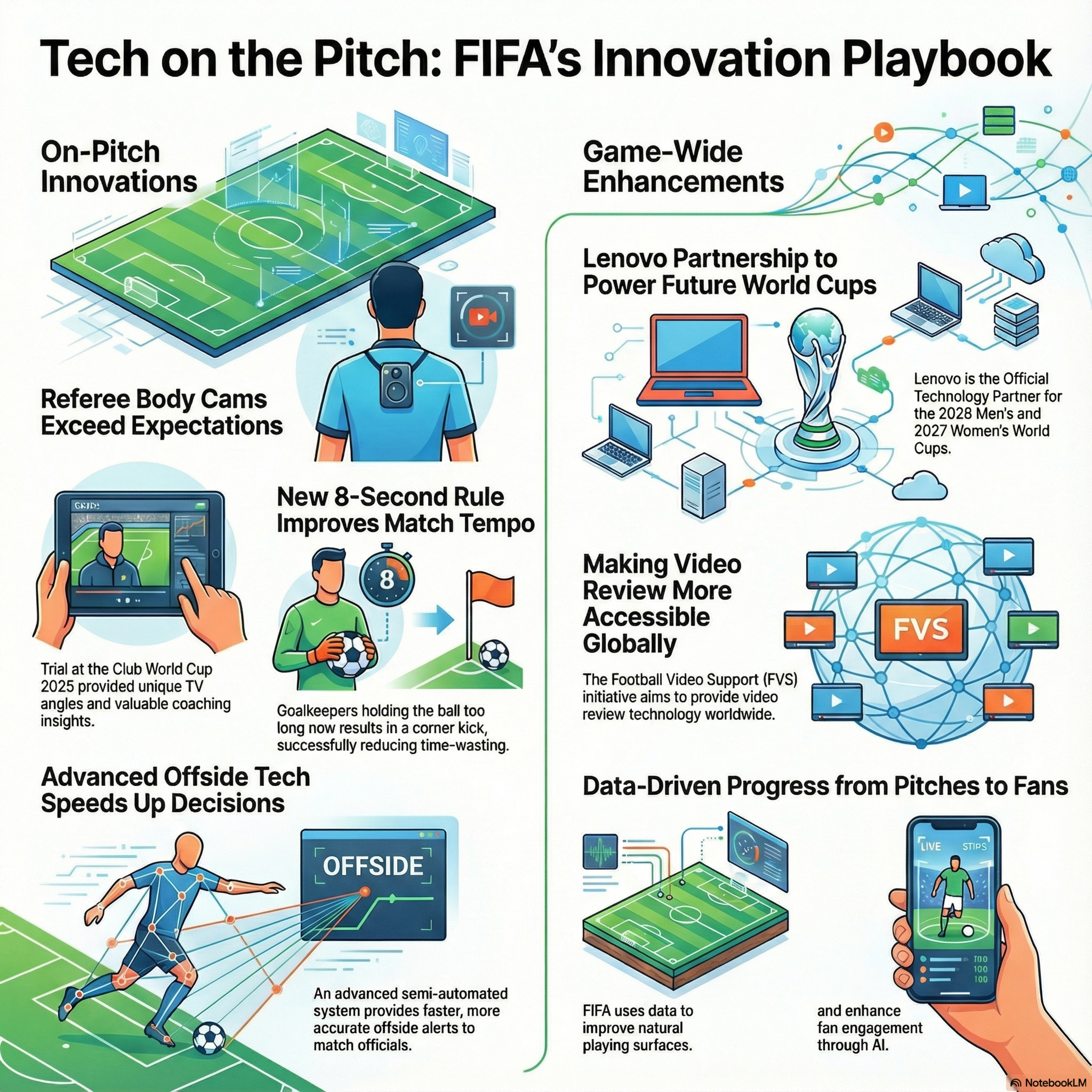
We're all about reducing controversy, increasing the efficiency of the decision making, and critically improving the flow of the game itself. Let's start with the one that got all the headlines. The buzz around ref cams was incredible. The Club World Cup served as the testing ground for these body cameras worn by the officials. And the response? According to figures like Pier Luigi Kalina. It went beyond our expectations. The initial public reaction was immediate and it was highly positive. The trial was successful in its original mandate, which was, you know, to improve the viewing experience for fans on TV and online by offering the referees unique perspective.
They received great comments and then the demand just followed instantly, right? People started asking why not in all. The matches. Why not in all sports? Yeah, that level of demand is so rare. Usually, new officiating tech is met with a lot of skepticism. But this success wasn't just about public entertainment. What was the crucial internal sort of dual purpose? Well, while the public viewing aspect was a huge benefit internally, the results were described as very, very positive and that's because of the coaching aspect.
A coaching aspect. Yes, fundamentally ref cams are a training and accountability tool for the referees themselves. Tell us more about that coaching value. I mean, how does seeing exactly what the referee sees help FIFA train them? These are already the best officials in the world. It moves the entire assessment process away from speculation and toward verifiable evidence of perception. Referees are so often criticized from missing an incident that was obvious to a camera angle from 100 yards away.
Of course the riff Cam rovides the ability to see exactly what the referee's line of vision was at the recise moment of the incident. This is vital for internal review. It allows coaches to understand decisions or non decisions based on real time visual information. But how do you ensure that the officials feel supported by this? I mean, rather than feeling like they're constantly being monitored and scrutinized, which could, I imagine, hinder their instinctive decision making in a really high pressure moment.
That is the balance they are actively trying to strike. The key is that the technology isn't punitive, it's diagnostic, and we have the perfect anecdote from the trials to illustrate how it actually supports the official. The Athletico de Madrid versus Paris Saint Germain group stage match. Tell us about that specific incident. So in that game, a defender handled the ball. It was subsequently flagged by the VAR system. When FIFA reviewed the incident afterwards, the ref Cam footage provided absolutely clear evidence that the official on the pitch could not have seen the handball live.
Why not? Because another player's body completely blocked the officials line of vision. Wow, that is absolutely critical. So the refcam didn't just entertain the viewers, it provided irrefutable objective proof of why the official missed the initial call. It validated their real time position and it confirmed the VAR system's structural necessity within this whole technology ecosystem. Precisely. It shifts the entire discussion from the referee was wrong to the referee was human, and this technology compensates for human limitations.
It's a perfect convergence of technology, aiding both accountability and, crucially, defending the integrity of the officials performance. OK, let's move on. We're going from judging these really complex incidents to something aimed squarely at improving the flow of the game. The universal fan frustration, time wasting, The new 8 second rule for goalkeepers is a massive step for match tempo. It really is. It addresses a subtle but but an insidious problem. Goalkeepers, especially when their team is leading, often hold onto the ball for extended periods and it just slows the game to a crawl.
And the International Football Association Board, IFAB, they addressed this by passing an amendment to Law 12.2 A in March of 2025. That's right. Walk us through the history and the change. Because previously the rule was 6 seconds, right? And it resulted in an indirect free kick, which as a penalty, always felt like a bit of a nuclear option. That is the key distinction. The old 6 second rule was technically there, but it was so rarely enforced because the penalty and indirect free kick inside the penalty box was considered too severe.
It was messy. It was unpopular. Felt disproportionate. Totally. It often led to defensive chaos and just felt out of proportion for the offense of holding a ball for a few extra seconds, so referees just ignored it. So what's the mechanical difference with the new rule? How does it actually work? The new rule allows goalkeepers to hold the ball for longer, up to 8 seconds, but the penalty is fundamentally different. After 8 seconds, the attacking team is awarded a corner kick. A corner kick A. Corner kick and crucially the referee signals this time limit with a visual countdown starting after 5 seconds which allows the goalkeeper a clear final three second warning.
OK, so why the change in punishment from that chaotic in directory kick to a corner kick? What's the thinking there? The corner kick is just a much more natural, accepted and and common mechanism of restart in football. It's still a potent attacking opportunity, of course, but it doesn't carry that high chaotic drama of an indirect free kick 10 yards from the goal. The punishment is high enough to be a genuine deterrent, but it's proportional enough that referees actually feel empowered to call it.
So what was the success metric here? Was the goal to award a ton of corner kicks? Absolutely not. The true goal, as it was confirmed by the referees Committee, was to prevent the rule from being broken in the first place. It was about deterrence. All about deterrence and the results were overwhelmingly positive. The tempo of the match was improved and the time lost due to goalkeepers holding the ball was greatly improved. That purpose prevention, was declared 100% achieved. And the data backs it up perfectly.
I. Assume it does. Violations were minimal. I mean, only two goalkeepers were punished during the entire tournament. Only two, Just two. And that low number shows that the combination of the visual countdown, the eight second threshold, and the proportional corner kick punishment, it's successfully altered goalkeeper behavior almost immediately. This is a massive win for the fan experience. OK, shifting now to precision technology is enhancing the most contentious and often the most time consuming decision in football offside.
The advanced semi automated offside technology or SO is now focusing on the speed of delivery. Yes. SO has evolved past just simple positioning confirmation. This advanced version focuses on integration with the on field team to enhance the flow of the game. It's designed to provide the refereeing team with information much faster, which minimizes unnecessary stoppages. So how does the mechanism work differently now for the assistant referees on the touchline? Well, the technological alert now goes directly to the assistant referees well before they raise their flag.
This happens almost instantaneously when the system detects a clear offside position. Previously, the process relied much more heavily on VAR confirmation after the attacking run was made. That seems like a small logistical change, but the practical benefit for the flow of the game, for players and for viewers must be substantial, especially for attacks that end up being disallowed anyway. Oh, it avoids a major source of frustration and wasted effort. It stops forwards from making these needless runs of, you know, 30 to 40 meters only for the flag to be raised at the end.
Right, but you see all the time. All the time. If the assistant referee receives that clear signal early, the run is immediately curtailed. This preserves player energy, it maintains better defensive shape, and it eliminates that frustrating visual stoppage for the fans who hate seeing a brilliant pass just wasted by an eventual offside call. And the confirmation of success was clear. Then the tech worked well. Very well, it provided speed and it supported the correct decisions, whether it was correctly disallowing goals or allowing valid ones to stand.
The referee's committee was apparently very pleased with how seamlessly the system integrated into the on field decision making process. The focus is always on minimizing the time required to achieve maximum accuracy. That's the balance. Okay, we focus heavily on elite tournaments, but Fifas mandate is global accessibility. That brings us to football video report or FS. This is the mechanism for democratizing video review. This is a direct response to the reality that traditional VAR is expensive, it's infrastructure heavy, and that puts it out of reach for many domestic competitions, particularly in less resourced regions around the world.
So FES is FIFA's explicit vision for a more accessible pathway to video review. That's it. So FES is essentially A streamlined sort of leap version of VAR. What specific technical limitations or simplifications make it so much more accessible compared to the complex full VAR system we see in, say, the Champions League? That's the key difference. Full VAR requires multiple operators in a dedicated centralized VOR video operations room. It requires multiple high speed camera feeds, often 10 or more, and really complex network infrastructure.
FES simplifies this significantly to make it accessible. FES typically uses fewer camera angles. It relies more on existing broadcast feeds or a smaller dedicated camera array, and it often has a single dedicated operator who can only review a limited set of high impact incidents. So you're not checking every little thing, you're just checking what goals, penalty decisions. Exactly. Goals, penalty decisions, direct red cards or a case of mistaken identity. The big stuff. So by limiting the scope of reviewable incidents and reducing the camera and personnel requirements, they drastically reduce the cost barrier, but they still ensure review capability for the most consequential moments.
Precisely. It brings that necessary level of assurance and fairness without the prohibitive cost of implementing a full VAR infrastructure, and the conference served as a key platform for gathering impressions from these early experiences. Because FES is currently being trialled in domestic competitions across several regions. It is, and it's showing that it is moving forwards and gaining global momentum. That gathering of real world data from all these varied infrastructural environments, that must be crucial.
It ensures that when FES is finally rolled out fully, it will be robust enough to handle the demands of a truly global sport, regardless of local broadcasting or network limitations. That's the whole point of the pilot phase. Tested everywhere. OK, we've covered the dramatic on field changes, but now we have to shift gears and look at the backbone of all of this. Here's where it gets really compelling because beyond the pitch action, the modern game relies so heavily on centralized data, massive infrastructure, and the corporate partnership ships that are required to power a sport played on every continent.
Yeah, we're moving from the granular match day impact we just discussed like that split second SEOT decision to the macro global operational scale. You simply cannot run multi continent multi nation tournaments like the World Cup 2026 with 48 teams without a technological backbone that is resilient, powerful and deeply intelligent. The data generated by the innovations we just talked about, the Revcam footage, Sao alignments, ball tracking metrics that must require petabytes of capacity. Oh. Absolutely.
The scale is mind boggling. So let's start with that data ecosystem. How is all this information being managed and leveraged before it even reaches the fans? It begins with these centralized data platforms. The Video Exchange platform, for example, serves as a crucial hub for all the match video in the Core Data, but the development process is ongoing and is focusing heavily on capture trials. Tell us about those capture trials, particularly at the youth level. What are they looking for there? New insights are being gained from broadcast tracking technology trials conducted specifically at FIFA youth tournaments.
By applying sophisticated tracking tech which follows player movement, speed, passing patterns, effort levels at the youth levels, they are building a massive deep baseline of developmental performance data. And that data can then inform training models globally. That's the idea. This moves way beyond simple scorekeeping. This is about building a comprehensive profile of player development based on hard physical data. So how is this raw data then translated into something that enhances the fan experience?
Well, that's the fan connectivity piece and it's often powered by AI algorithms that personalized content for the viewer. They are actively using this data to enhance engagement through initiatives like the FIFA Rivals Project. Which likely pits players or teams against historical or statistical metrics. That's a good guess, Yes, and also through specific artificial intelligence based initiatives designed to create unique statistical narratives during broadcasts. So the data isn't just for coaching, it's for creating, you know, these unparalleled and unforgettable fan experiences.
That immediately transitions us to the scale of the infrastructure required to do all this. In late 2024, Lenovo was announced as the official FIFA technology partner. A huge deal. This is a top tier sponsorship deal that just underscores the absolute centrality of technology to modern tournament logistics. This part ownership is not just about placing logos on banners, it's about providing the literal engine room for the next 4 years of global football. And the scope is it's gargantuan. It covers the organization of two of the most technically demanding events in history.
Let's start with the FIFA World Cup 2026. I mean, we're talking about 48 teams hosted across three nations, Canada, Mexico and the United States for the first time ever. That presents geopolitical, logistical and network complexity on a scale we just haven't seen before. Absolutely. The technological lift for managing that complexity across three different legal and networking environments, massive geographical distances, and unprecedented demands for data synchronization. It's immense. And let's not forget the FIFA Women's World Cup 2027 in Brazil that also features 32 teams, and it marks the first time the tournament has been held in South America, which demands robust infrastructure in totally new territories.
A. Huge undertaking. It's all right. So what exactly is Lenovo providing beyond just the high end sponsorship? We're talking about the nuts and bolts of the infrastructure. They're providing the foundational ecosystem, so this includes the high performance data center infrastructure, the servers that are required for all the processing, and a massive amount of end user devices like what they're iconic ThinkPad laptops for the administrators, tablets for the training staff, and Motorola mobile phones for operational communications across all the venues.
It's the whole stack. And the centerpiece of this entire partnership seems to be AI. How is AI being integrated into the sheer logistics of an event this size? It can't just be for post match analysis. You're exactly right. The partnership explicitly details their emerging suite of innovations that both leverage and power AI. This means AI is integrated right into the operational core. Give me an example. Think about logistics management. You have AI optimizing travel schedules and accommodation across thousands of personnel and 48 different teams.
You have predictive analytics for ticketing and stadium capacity management, and, critically, cybersecurity and network load balancing to handle the unprecedented spikes in global demand during matches. The Lenovo chairman and CEO Young King Yang, he put it pretty starkly. He said they will be powering the largest sporting and entertainment events in human history. I mean, this partnership has to handle an unprecedented global demand for data processing. It's an enormous undertaking. And feets. This perspective, which was articulated by President Infantino, aligns perfectly with that scale.
He's focused on growing the game globally and leveraging this powerful technology to understand fans better. But the core promise that impacts the future of the global game is the democratization of data. That is the real listener relevance here, isn't it? How does this massive top tier corporate infrastructure partnership actively aim to democratize data across the entire global football landscape? Well, by establishing the standardized state-of-the-art systems, the servers, the data platforms, the analytical tools, they are building a global framework that is accessible to all 211 member associations, not just the wealthy ones.
So this ensures consistency and quality. It does. If developing nation in Asia or Africa has access to the same quality of performance metrics, the same tactical analysis tools and the same infrastructural standards as, say, Germany or Brazil. It fundamentally changes scouting. It changes player development. So it levels the playing field not through direct financial aid, but through technological capacity. That's it. It allows smaller, less resourced member associations to kind of skip the decades of proprietary technology R&D and immediately access world class data systems.
That's the ultimate goal, fostering innovation that truly aims to reduce the technological gap. They're creating an ecosystem where the best talent, regardless of their location, can be identified, tracked and developed using globally standardized metrics. It transforms the sport from being resource dependent to being data-driven. Finally, we have to touch upon the physical side of this technology integration. It's not just the software and the AI. It's about the very grounds the game is played on.
Even the grass and the lights are not being standardized through data. And this really speaks to the level of my new detail in this global road map. FIFA is actively using a global pitch data framework. This system standardizes and analyzes data points related to natural and hybrid playing surfaces across competitions globally. We can't just say it's to improve quality. What specific metrics are being tracked within this framework, and why is standardizing these metrics globally such a technical challenge?
The framework tracks highly detailed biophysical metrics, things like rotational resistance, which. Is critical for player safety and injury prevention. Absolutely. Then you have moisture content which effects how the ball rolls, light reflection, drainage mapping, and grass composition consistency. Standardizing this is a challenge because climates vary so wildly. You can't apply the same maintenance plan to a pitch in Qatar as you would to one in Norway. So the framework provides the standardized metrics that must be met, and it allows the local groundskeepers to adapt their maintenance methods to achieve that global standard.
The ultimate goal, then, is safety, consistency and a predictable playing environment no matter where in the world the game is being played. Exactly. It ensures that when teams travel for a global competition, the quality and the behavior of the playing surface remain consistent, and this standardization extends to the entire stadium environment. I noticed they also mentioned new methodologies for flip light testing. Why is lighting now a major focus of innovation? It feels like we've had lights for 100 years.
Well, it's threefold player performance, safety and broadcast quality. Poor lighting effects visibility and it can contribute to fatigue. But more importantly, the performance of technologies like SAT Key and VAR, which rely on high speed tracking cameras and clear visual fidelity. Their performance is fundamentally dependent on optimal lighting conditions. Of course, the cameras need good light. They do so new methodologies are actively influencing modern stadium standards to ensure lighting provides optimal conditions for global broadcasts and for the performance of all these various video technologies that are being deployed.
It's a holistic technological loop. It really is a holistic approach. From the specific light hitting the grass to the massive server architecture processing the data in the cloud, everything is designed to feed standardized high quality data into a single global ecosystem. That's the vision. This has been an absolutely fascinating look into the future of football. Just to quickly recap the scope that was confirmed at the FIFA Innovation Conference, we saw immediate visible impact on officiating highlighted by the revolutionary ref Cams.
Offering that unprecedented support and training data for referees. And the highly effective 8 second rule which dramatically reduced time wasting and really did improve the match tempo. We also moved off the pitch to see the monumental operational scale required, all driven by that new partnership with Lenovo. This is integrating data center infrastructure and cutting edge AI to power the biggest global tournaments in history. And crucially, to democratize access to world class data and technology across all the member associations and underlying everything is that core powerful mission driving progress through purposeful technology to make football more inclusive, safer and more accessible for all.
This is not a technological arms race. It's a shared endeavor focused on fairness in judgement and and fairness and opportunity. And what's so fascinating here is how the data connects the entire system. You know, given the global standardization of pitch data, the deployment of AI powered analytics and the democratization of these systems across all the member associations, this raises a really important question for the future of the sport. Which is, what does this influx of standardized, high quality performance data mean for the future of scouting and talent development in smaller, less resource nations?
Exactly. If everyone has access to the same quality of performance metrics, training data, and infrastructural standards, will the level playing field that's promised by technology truly disrupt the traditional football power structures? Will it allow unexpected nations to rise? That's the legacy question, isn't it? Will technology be be the catalyst that finally breaks up the old hierarchies? It's something to consider as you watch the next major tournament. And finally, think about the success of the ref Cam given the global adoption and the demand we saw.
What other sports, I mean maybe hockey or even basketball? What other sports might benefit most from adopting standardized referee body camera footage, not just for fan enjoyment. But critically, for coaching, for training, and for objective decision review. A provocative thought for you to Mull over until our next deep dive. Thanks for tuning in.
 Apple Podcasts
 Castbox
 Castro
 Goodpods
 Moon FM
 Overcast
 Pocket Casts
 Podbean
 Podcast Addict
 Podcast Republic
 Spotify