Surviving Football's New Digital Infrastructure
About this episode
Surviving Football's New Digital Infrastructure
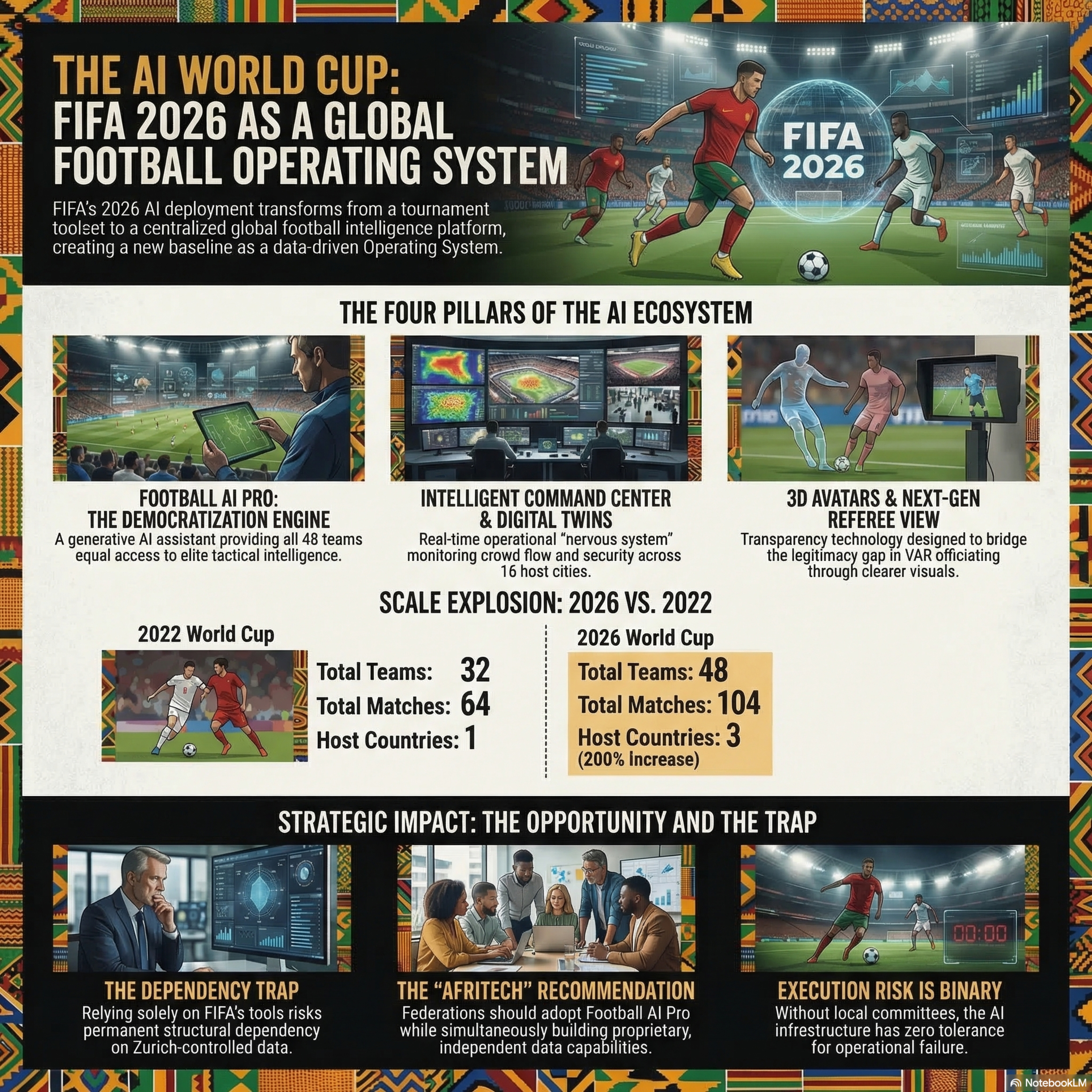
The 2026 World Cup represents the most complex operational deployment in modern history. The logistical models that ran every previous tournament have reached their limit. This bar chart outlines the scale of the expansion. By increasing the field from 32 to 48 teams, organizers are managing a 50% expansion and participating national delegations. That team expansion forces a 62.5% increase in total matches, bringing the tournament load to 104 fixtures. The tournament footprint also increases, dispersing the event across 3 sovereign jurisdictions.
For the first time, the 2022 tournament in Qatar relied on extreme geographic compression, with every venue sitting within a 50 kilometer radius. The 2026 layout spans a 4000 kilometer distance from Vancouver to Guadalajara. Operating across the United States, Canada and Mexico introduces friction Organizers must route data and broadcast signals through three separate telecommunications and regulatory regimes. They must also coordinate crowd safety across three national emergency response networks, each operating with distinct protocols and communication standards.
Coordinating this volume of cross-border telemetry, broadcast feeds, and security alerts requires processing data at a speed human operators cannot match. The logistical burden of 2026 has crossed a mathematical threshold, evolving into a pure enterprise complexity problem. To manage the scale, organizers made a structural change that has gone almost entirely unreported. They entirely eliminated the traditional local organizing committee. A Local Organizing Committee, or LOC, is the domestic workforce historically appointed by the host nations to manage ground level tournament operations.
In past tournaments, the LOC absorbed the operational risk using local institutional knowledge to navigate vendor relationships, cultural norms, and sudden crises. FIFA is now bypassing that domestic layer and assuming direct operational risk across 3 borders simultaneously. Lenovo is the systems integrator for the largest enterprise technology deployment in global sports history. This AI. Ecosystems Central Hub replaces the LO CS human institutional knowledge. It's built on 4 distinct pillars, Football, AI, Pro 3D player avatars, Next Generation Referee view, and an intelligent command center mapping the continent in real time.
Artificial intelligence has transitioned from a supplementary analytical feature into the core operational infrastructure of the World Cup. The first pillar is Football AI Pro, a generative AI knowledge assistant built on a proprietary football language model. A football language model is an AI architecture trained on millions of historical football data points to understand and generate tactical insights. The platform analyzes over 2000 specific football metrics per match, allowing coaches to simulate opponent tactics and generate 3 dimensional visual models.
FIFA. 'S strategic framing for this tool is aggressive democratization. The goal is to provide world class tactical analytics. To all. 48 competing teams, in theory providing a uniform baseline of data levels the playing field for under resourced tournament debutantes. A Tier 1 footballing nation like Germany arrives at the tournament with a massive pre-existing analytical advantage supported by dedicated data science departments. A lower tier nation historically lacks any dedicated analytics staff.
They are the target user for the democratization. Project. However, enterprise AI adoption research reveals a severe constraint providing equal access. To a. Tool does not provide equal organizational readiness to extract value from it. Elite coaching Staffs operate in a conservative culture. Forcing them to adopt entirely new software workflows months before the most important matches of their lives will generate significant friction and uneven adoption. There is also the latent risk of data bias baked into the football language model itself.
A model trained predominantly on granular European league data will likely produce structurally skewed tactical intelligence when applied to the distinct play styles of African or South American federations. Nations with pre-existing analytical cultures and high technical literacy will seamlessly integrate these new insights. Teams lacking that baseline will struggle to operationalize the data mathematically. The tool will widen the exact competitive gap it claims to close. The second pillar relies on AI enabled 3D player avatars.
The system utilizes sub second biomechanical scanning to track player movement through space. These digital models. Capture highly precise body. Part dimensions Maintaining lock on even during fast or obstructed movements in the penalty box. This biomechanical scanning functions as a governance technology rather than a broadcast enhancement. It is designed to address the core institutional failure of VAR. VAR stands for Video Assistant Referee, the off field system used to review contested decisions.
The system's primary failure is a persistent inability to earn public trust regarding correct calls. By replacing 2 dimensional replays with surgically precise 3D visuals, organizers aim to close the legitimacy gap between the officials and the audience. This strategy extends to the Next Generation Referee View, which uses AI to instantly stabilize live body camera footage from the on field official. FIFA is making a specific strategic bet, treating officiating skepticism as a visual communication problem.
The blind spot here is profound. Improved visual transparency cannot resolve A cultural philosophical distrust of technology in sports. Providing higher resolution evidence of a millimeter tight off site call will likely just amplify the controversy. The final, most critical pillar is the Intelligent Command Center, the hidden operational brain of the entire tournament. This system connects live telemetry across broadcasters, transportation networks, and venues spread across 16 distinct host cities.
It monitors this network using stadium digital twins. A digital twin is a virtual real time replica of a physical space continuously updated with sensor data. Organizers use these models to observe live crowd flows and environmental conditions without being in the building. The AI processes this incoming telemetry to generate daily executive summaries, allowing administrators to anticipate security bottlenecks and infrastructure risks before they materialize. Achieving this requires real time data integration across distributed international borders, which is exceptionally difficult.
The data ingested by the command center is subject to severe compliance friction. As the United States, Canada and Mexico all enforce different sovereign data protection laws, this raises a critical question for C-Suite executives. If latency issues or a cyber breach crashed the command center during a crowd crisis, what is the fall back? Because FIFA eliminated the local organizing committees, they have replaced local human improvisation with an untested single point of AI dependency. If the network stutters, they face a massive operational blind snot at the exact moment they need visibility most.
The 2026 tournament serves as a high stakes enterprise audition for FIFA's integrated AI ecosystem. The strategic goal is clear. If the AI infrastructure survives the stress test of the tournament, the platform will be rolled out to all 211 member associations globally. Smart wayfinding and digital twins provide the foundational infrastructure for a massive commercial data platform, leveraging the fan experience layer for long term revenue. Look at this flow chart. It reveals the permanent vendor lock in risk waiting for any federation that adopts this infrastructure.
Relying exclusively on FIFA's analytical tools means outsourcing data governance. Federations lose control over how their own player metrics are collected, categorized and validated. Utilizing Football AI Pro exclusively means every prompt and analysis feeds proprietary federation intelligence directly back to Zurich, permanently cementing Central Market control over the sports data for African federations. The immediate upside is massive. The platform offers access to world class baseline analytics, instantly upgrading technical preparation for resource constrained teams.
Economically, players operating in leagues without tracking data can generate highly accurate performance profiles, finally unlocking their visibility to the global transfer market. But there is a trap hidden inside this opportunity. Permanent structural dependency. The Afrotech mandate is direct. African federations must adopt Football AI Pro enthusiastically but strictly as a baseline tool. Simultaneously, stakeholders must aggressively invest in independent electronic performance and tracking systems.
EPTS encompasses the physical camera networks and wearable technology used to track movement and output. Federations must build proprietary local data collection methodologies specifically tailored to African environments, securing insights that external models miss. There is a critical operational distinction between renting access to a global tool and owning an independent analytical capability. African Federations. Must. Own their data and their infrastructure. Anything less guarantees structural.
Disadvantage in the. AI driven era of global football.
 Apple Podcasts
 Castbox
 Castro
 Goodpods
 Moon FM
 Overcast
 Pocket Casts
 Podbean
 Podcast Addict
 Podcast Republic
 Spotify