Stop Selling Football Talent for Pennies
About this episode
Stop Selling Football Talent for Pennies
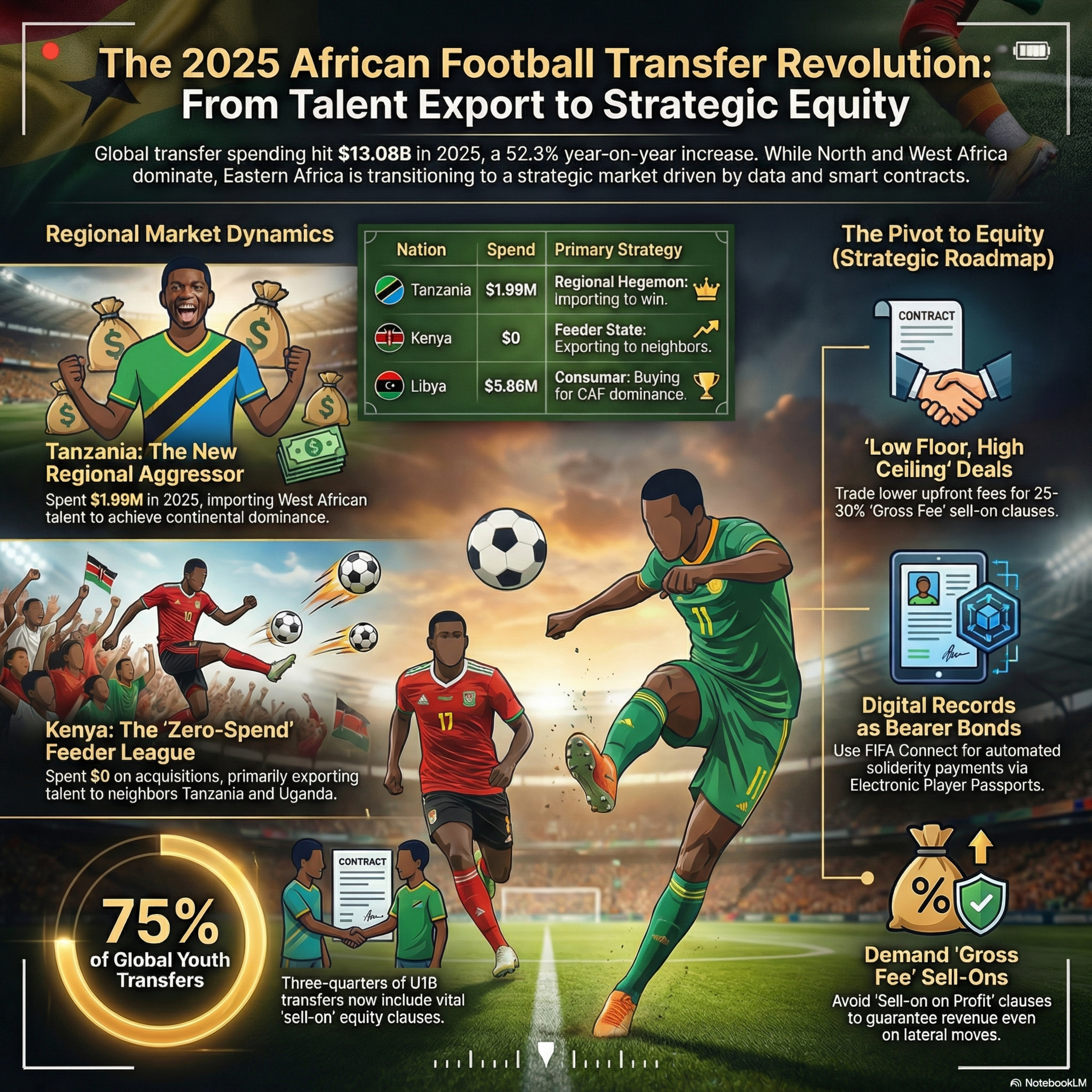
$13 billion. I just want to start there with that number, $13.08 billion in 2025. That is the amount of money of sheer capital that moved across international borders, for one thing. Just for a football transfer. Just for transfer fees. We're not even touching salaries, right? Or stadium cost or merchandise. This is just a fee one club pays another to buy a player. It's a figure that honestly, you have to stop and just let it sink in. And for anyone listening who tracks, you know, global markets, here's the really wild part.
That's a 52.3% increase year on year. 52%, I mean, most industries right now would they'd kill for 5% growth, they'd throw a party for single digits. Exactly. And football, in the middle of a pretty stagnant global economy, is posting over 50% growth in, well, what is essentially asset trading volume. It just completely blows up that old idea, doesn't it? The idea that if the global economy gets a cold, football gets pneumonia. That's dead. That link is broken. You look at the data for 2025, you see sluggish GDP growth, you see inflation issues everywhere.
And the football market just it decoupled. It said no thank you. We're going to be own a high growth asset class. It's become its own ecosystem. It has its own gravity, its own rules. But, and this is a huge but, we have to be really careful not to confuse global growth with distributed growth. OK, unpack that. Because the money is moving, but it's not moving everywhere equally. Not even close. The distribution of that 13 billion is, I mean, it's aggressively unequal Europe. So the UEFA confederation is responsible for about 80% of that spend.
Yeah, you give you percent, almost $11 billion just circulating within, you know, the European theater. Then you've got the secondary poll that's completely cemented itself. Saudi Arabia. Saudi Arabia dropping just under a billion dollars. So if Europe is the central Bank of football and Saudi Arabia is the big new venture capitalist, the question that we really want to dig into today is what is Africa's role in this $13 billion economy? And I don't want the generic answer. We all know the Africa has talent line.
Of course it does. I want to know where the money is actually landing on the continent because looking at this data it feels like we can't even use the word Africa as a single entity anymore. That is the first and maybe the most critical realization. You have to throw out the idea of a monolithic African football economy. It's dead. So what are we seeing instead? The 2025 data shows these very distinct, very different economic zones. You have North Africa, which operates almost like a high consumption European market, right.
You have West Africa, which has perfected this vertically integrated production line directly into Europe, the pipeline model exactly. Then you've got Southern Africa, well, specifically South Africa, which has become the sort of insulated high wage bubble. A golden cage. A golden cage, Precisely. And then you have the focus of our deep dive today. East Africa. The awakening giant, Or maybe the confused giant. It's not quite sure what it wants to be yet. That's what's so striking to me because East Africa is sitting on the exact same goldmine of human capital as West Africa, right?
The talent is there, but the business model feels, I don't know, it feels outdated. It's like they're running a liquidation sale while everyone else is building an investment portfolio. Yes, that's it exactly. And that's the core of it. That is the mission for us today, to unpack why East Africa is selling its best assets for pennies on the dollar and how specifically how they can switch from this liquidation model to an equity model. How do you stop taking the quick cash today so you can bank millions tomorrow?
And before we get into the regional stuff, and I really want to dig into that Kenya, Tanzania dynamic, we have to set the table, we have to talk about the new rules of the game because the legal reality of the transfer market fundamentally changed in 2025. It really did. And if you're a club chairman or an agent still using the old playbook, you're going to get run over. You are going to lose. We have to talk about something called the Dyer effect. This is the bedrock, this is the foundation of the modern market.
If you don't understand the Lasana Dyer ruling from the European Court of Justice, you simply cannot trade players effectively in 2026. Let's break this down, because these legal rulings often get glossed over as just more player power, but the details here are what matter. This all came from Daira's fight with Locomotive Moscow. Is that right? That's the one and to really get it you have to understand how bad his situation was. He had a dispute with the club, they terminated his contract and then they demanded he pay them €10 million in compensation.
OK, that's already pretty wild. Here's the kicker. The old FIFA regulations said that any new club that signed Ayara would be jointly liable for that €10 million debt. Wow, so he was basically radioactive. No club is going to sign a player if it means they also inherit a €10 million fine. No one would touch him. He was unemployable. A Belgian club. Sure, Leroy wanted him, but they backed off. They couldn't take the risk. So DRS sued. He argued that these FIFA rules were a restraint of trade, that they violated EU competition law.
And the court? The European Court of Justice agreed with him completely. They ruled that this whole system of holding a player and their future employer hostage over a contract dispute was illegal. So practically speaking, how does this change the game for a club chairman in, say, Uganda? The old way of thinking was I own this player's registration. You can't leave until someone pays my price. That model is dead. It's over. The Diera effect means the market has shifted from what we call coercive retention to, well, to necessary agreement meaning.
You can't just force them anymore. You can't. You can't use the threat of sporting sanctions or these massive fines to trap a player or to force an inflated transfer fee if a player wants to leave and you don't have a mutually beneficial contract in place. The legal framework now tilts heavily in favor of the players freedom of movement. On the surface, that sounds like a total disaster for small clubs if they lose that leverage that you can't play unless I say so. Power. How do they protect the value of their assets?
They have to get smarter, that's the only answer. The value is no longer just in the players registration, the value is now created and stored in the contract. A player with no long term contract or a poorly written 1. He has zero asset value because you can't force him to stay. But a player with a secure, well structured long term contract that includes a clear exit strategy, that is a liquid asset. So the lesson is you have to work with the player on the exit, not block it. You have to facilitate it because if you try to block it, the courts will likely just let the player walk away for free.
The days of the chairman locking the transfer certificate in a desk drawer are over. So that's the legal shift, the stick, if you will. But at the same time, there was a technological shift, the carrot, the. Carrot, the automation of money. We have to talk about the FIFA Clearing House, the FCH. This feels like the other half of the puzzle. Yeah. For decades, the big story in African football was the lost check, right? A player starts at a tiny Academy in Nairobi. He goes to Sweden, then to England.
Millions of dollars are moving around, but that little Academy that discovered him never sees a penny of the training compensation that's legally owed. Because the old system was designed for the rich to get your training rewards you needed lawyers. You had to track the players career yourself, file all this paperwork, send invoices to clubs in another continent who would just ignore you. And a small Academy in Kenya can't afford to sue a club in France. Of course not, so they just gave up. It was too expensive to chase the money they were owed.
It was lost. And the clearing house fixes this out. It automates it. It completely revolutionizes it. In 2025, the FCH distributed over $350 million in training rewards. 300 and 50 million. That is triple what the old manual system ever managed in its best year. OK, but how does it work? I want to visualize this. A player moves from Denmark to Germany. What happens? It all starts with something called the Electronic Player Passport, or EPP. Think of it like a digital bearer bond for a player's career.
Every time a player is registered in any official league, even at 12 years old, that registration is logged in a global system called FIFA Connect. It creates a digital footprint, a history. A permanent record A. Permanent unchangeable record. So when that player makes a big international transfer at age 23, the system automatically kicks in. It looks back at his EPP. It identifies every single club that trained him from age 12 to 21. It calculates the exact percentage owed to each one based on the transfer fee.
And the clearinghouse automatically collects that money from the buying club and deposits it directly into the bank accounts of those little training clubs. No invoice. There's no lawyer. No phone call, no chasing. The money disappears. But, and this is the massive strategic failure point for so many clubs, it only works if the data is there in the first place. This is what you call data sovereignty. Yes, if a club in Tanzania has a 12 year old genius on their books, but his records are just in a paper folder and some dusty filing cabinet, then as far as the global system is concerned, that child does not exist.
And when he transfers for $50 million in 10 years time? The system will look for his history, it'll find a blank space and it will pay 0. That's a terrifying thought, That administrative laziness. Just not doing the data entry could literally cost a club millions of dollars. It's the new reality and Academy's most important employee is no longer the head scout. It might just be the data entry clerk who makes sure every single 12 year old is correctly registered in FIFA Connect. That digital entry is a lottery ticket.
If you don't put the ticket, you can't win the prize. OK. So we have the new legal framework from the Dyer case demanding better contracts and we have the new financial infrastructure with the clearinghouse rewarding better data. With that said, let's look at how the different regions in Africa are actually playing this new game. Let's start with the big spenders, North Africa. The aggregators. That's the model Egypt, Morocco, Tunisia and now increasingly Libya. The old view is that these were just final destinations for players, but the data shows they're running a very specific commercial strategy, which is buy high, sell higher.
Is that actually sustainable though? I mean, when you see an African club spending big money, the assumption is often that it's just a vanity project for a rich owner. In North Africa, it's becoming structural. Look at Libya. In 2025, Libyan club spent $5.66 million on transfer fees. That's a huge trade deficit and talent they're importing aggressively to compete right now. What are they selling? Morocco is Morocco is the really sophisticated 1. They're the trader of the continent. They spent nearly $7,000,000 on players, but they earned $18 million in sales.
So they're running a $11 million profit. They're operating like a Portuguese or a Dutch club. Precisely. They use their financial muscle, which comes from strong local TV deals and ticket sales, to go into sub-Saharan Africa. They cherry pick the absolute best 18 or 19 year olds, develop them in a high pressure professional environment for two years, and then they flip them to Europe or the Gulf for a massive profit. So they are capturing the value that the sub-saharan clubs are failing to realize themselves.
They're the smart middleman. They add value and the market rewards them for it. OK, now let's pivot and go West. When I look at the data from West Africa, I see what you called vertical integration. This feels like a completely different universe from the North African trading model. It's a whole different ball game. The huge success stories in West Africa, you're talking about institutions like Right to Dream in Ghana or Generation Foot in Senegal. They've almost bypassed the open market entirely.
What do you mean they're not selling to the highest bidder? No, they've built a manufacturing pipeline. They are not an auction house. OK, walk me through the mechanics of that. How does a player move in that system? So take a kid at Generation Foot in Senegal. That Academy is, for all intents and purposes, a satellite campus of FC Mets in France. When a player there reaches a certain level of development, the Academy doesn't call up agents and shop him around Europe. They just sent him to Mets.
He moves directly to Mets. It's a frictionless transfer. It's an internal promotion. But doesn't that mean they lose money on that initial transfer? I mean, if there's no bidding war, they're not maximizing the fee. They might take a lower fee upfront or even no fee at all, but what they do is they retain equity. The entire business model is built on the second and third transfer. OK. The Academy in Senegal participates in the massive upside when that player eventually moves from Mets to, say, the Premier League for 30 million counts.
They're not just selling raw materials anymore. They are shareholders in the finished product. That distinction is everything, isn't it? Shareholder versus raw material supplier. Wow. OK, now let's go South. The Premier Soccer League, the PSL and South Africa. He called it a golden cage. It's a fascinating economic trap they've built for themselves. South Africa has by far the most commercialized and professional league on the continent. The broadcast deals, the sponsorships. It allows clubs like Maimoli Sundowns and Kaiser Chiefs to pay very, very high wages.
Which sounds like a good thing for the players. It's a great thing for their immediate lifestyle, absolutely, but it kills the export market. Think about it, if you're a top player in Johannesburg and you're earning say 15 or $20,000 a month and a mid tier club from Belgium or Sweden gives you a call. And they offer you maybe eighteen, $20,000. Right. Is it worth it? Is it worth uprooting your entire life, your family, moving to a new culture, a new climate for what is basically a marginal financial gain?
For most, the answer is no. So the high internal wages effectively price South African players out of that crucial stepping stone tier of European football. Exactly, they miss the move that gets them into the showroom window so they stay in the PSL. The capital just gets recycled regionally. Sundowns buys a player from Super Sport. Chiefs buys one from Pirates, but the whole ecosystem misses out on those 10, twenty, $30 million mega transfers that West Africa gets because their players never get onto that European ladder in the first place.
Which brings us to the main event, East Africa, the region that seems to be in a state of total flux and the divergent here is massive. Let's start with the country that has finally decided to open his wallet, Tanzania. Tanzania has become the undisputed regional hegemon. The data is frankly startling. In 2025, Tanzanian Club spent $1.99 million on international transfer fees. $2,000,000 Now a listener in London might hear that and chuckle. 2,000,000 is what a Championship club pays for a backup goalkeeper.
Of course. But in the context of East African football economics, that number is an earthquake. It is a full blown revolution. You have to understand, for decades the way you did business in East Africa was free agency. You waited for a players contract to expire, you gave him a signing bonus and that was it. You never ever paid a transfer fee to a rival club. And Tanzania has just shattered that taboo. They've smashed it. Young Africans Yanga and Simba SC are now actively going out and buying players who are under contract.
Is this a strategy though? Or is it just a two team arms race? It started as an arms race for sure. Yanga's transfer ban was lifted and they just went on a spending spree. But it's created a legitimate market. They are importing high quality W Africans players from Ivory Coast, from Mali because they want to compete for the seat CAF Champions League. But are they just burning cash? This is the crucial part, no? They also received $1.52 million in transfer fees. OK, that's the metric that matters to me.
They spent nearly 2,000,000, but they recouped over one and a half million. They're not just assuming, they're trading. They are operating as a healthy, functioning football economy. They buy talent, they use it, and then they sell it on. They have become a destination. It's incredible. They even ranked 7th globally for incoming transfers in women's football. This aggressive growth is happening across the board. Now let's contrast that with their neighbor to the north, Kenya. The data here is, I mean, there's no other word for it.
It's damning. It's what I call the zero spend crisis. In 2025, Kenyan clubs spent exactly $0.00 on international transfer fees. Wait, wait. Say that again. 0 Not one single cent was paid by a Kenyan club to a foreign club for a player's contract. That implies a total 100% reliance on scavenging for free agents. It's a scavenger model. They're only picking up players who are out of contract. And here's the brutal, cold economic reality of that model. Let's hear it. If you invest zero capital in acquiring your assets, the market assumes your assets have a baseline value of 0.
You have no grounds to demand a premium price for something you picked up for free off the street. And the report says Kenya earned about $970,000 from exports, which on the surface looks like, you know, good business. Yeah, but the devil is in the detail. Where are these players actually going? They are not going to Europe, that's the key. The number one destination for players leaving Kenya was Tanzania, nine players. The number 2 destination was Uganda 8 players. So Kenya has effectively demoted itself.
It's become a feeder league for its own neighbors. A feeder league for Tanzania that has to sting for Kenyan fans. Nairobi used to be the economic hub of the region. Now the best Kenyan talent players like Mohammad Vijab are moving to Simba. They're all heading South to Dar es Salaam. And what's driving that? Pure wage arbitrage. A top club in Tanzania pays 5, sometimes 10 times the salary of a top club in Kenya. If you are a Kenyan player, your dream isn't immediately the Premier League anymore.
Your dream is getting a contract with Yonga or Simba because that's where you can actually make a living. And the Kenyan clubs just let them go. Because they don't invest in long term contracts for their young players, they're either broke or they're too risk averse. So when Tanzania comes calling, the players just run down their six month deals and leave for free or for a tiny fee. It is value leakage on an industrial scale. OK, then there's Uganda, which seems to be playing a completely different game.
Again, a volume game. Uganda is the volume merchant. They did 144 international transfers in 2025. That's a huge number. 51 players coming in, 46 going out. It is a transit lounge a a constant churn. Players come in, they stay for a season, they move on. The good news is that the federation FUFA has been incredibly strict on data reporting, so the chaos is at least being professionalized. They have good data, but they're selling volume, not value. They're moving a lot of players for 10 or $20,000, not one player for $1,000,000.
I want to spend a moment on a part of the region that often gets left out of these economic talks because of, you know, the geopolitical situation. Sudan, the report calls it the displacement economy. Yeah, this is a wild story. It is one of the most unique situations in all of world football. The conflict in Sudan has of course suspended the domestic league, but the huge clubs, Al Halal and Almarik, they are massive institutions. They couldn't just cease to exist. So what did they do? They've effectively outsourced their entire football operations.
You mean they're playing in other countries leagues? Yes, in 2025 we saw three top Sudanese clubs being admitted into the Rwanda Premier League. To stop and think about the logistics of that for a second, you were taking a massive professional sporting entity and just transplanting it into a foreign country's league structure. What on earth does that do to the Rwandan football economy? It's a massive, unexpected injection of capital and quality. These Sudanese clubs are wealthy. They're bringing in full squads of highly paid professional players, coaching staff, physios, they're renting stadiums, they're filling hotels, they're paying for top class training grounds.
It must raise the level of the whole eigue overnight. Instantly. And for the Sudanese clubs, it's purely a survival mechanism. They are spending money to stay alive, to keep their squads match fit so they can still compete in continental competitions like the SEA CAF Champions League even though they don't have a home country to play in. It's surreal. Truly surreal. And then going in the complete opposite direction, you have Ethiopia. Ethiopia is the market that's cooling down. The government had to step in.
They looked at the spending by the big clubs, which are often state linked, and they saw what they called reckless spending and illicit financial flows. Wages were being inflated beyond all reasons. So they just put a stop to it. They put a hard stop to it. So Ethiopia is now going through this very painful correction period, trying to force its clubs toward a model of sustainability rather than just relying on government handouts. So if we map all this out, Tanzania is buying, Kenya is scavenging, Uganda is churning, Sudan is displacing.
This creates these clear patterns of movement. The report calls them rivers of talent. And strategy is all about knowing which river you're swimming in and which way the current is flowing. Right now, the strongest current in the entire region is the internal loop. Kenya to Tanzania. Kenya to Tanzania, It's a torrent. And your advice for the Kenyan clubs is don't try to build a dam? You can't fight gravity, you can't fight basic economics. If Tanzania pays 10 times more, the best talent will go there.
Period. The strategic pivot for Kenya is to monetize that flow. How? Instead of letting your players contracts rundown and then complaining on Twitter that Simba stole your Stryker, you need to proactively treat Tanzania as your primary customer. Sign your best 18 year olds to three-year deals with the specific intention of selling them to Yonga in a year. Become the best, most reliable supplier to the Tanzanian market and charge them a premium for it. Then you have the West and N route, the premium continental highway.
That's the most lucrative stream, the best talent from West Africa moving to the big clubs in North Africa. East Africa has been completely bypassed by this for years, but Tanzania is trying to break. In by importing W Africans themselves. Exactly. Now, bringing in players from Ivory Coast, Yanga and Simba are trying to prove that they can be a new node in that network. They want to show the world that Dar Salaam can be a credible stepping stone to Cairo or Casablanca and then on to Europe. But the Holy Grail, the one everyone wants to build, is the direct pipeline, East Africa straight to Europe.
Why is that route so broken compared to what Senegal or Ghana have built? It all comes down to one word. Risk. When a European scout looks at a 17 year old player in Senegal from an Academy like Generation Foot, there's a track record, there's reliable data, there's trust. And when they look at a player in Kenya or Uganda? There's a risk premium, a big one, The scout is thinking, is he really 18 or is that a football age? Where is his medical history from the last five years? Has he had a knee surgery that no one is telling me about?
Yeah. Is his agent the real agent or five other guys going to pop up demanding a Commission once a deal is done? All of that and because of that uncertainty, that lack of data reliability, the European clubs just lower their offers. They price the risk into the deal. If East Africa wants to open that direct pipeline, it has to 1st build the infrastructure of trust. That means verify birth certificates, clear medical histories, transparent agent representation and perfect obsessive data entry in FIFA Connect.
But let's say we do all that. Let's say we fix the data. We still have a pricing problem. The market today simply does not value an unproven East African player at $1,000,000 upfront. We can't just demand fees that nobody's willing to pay. No, you can't dictate the price to the market. So you have to change the deal. This is the pivot and this is the absolute core of our whole discussion today. You have to switch from an upfront cash model to an equity model. We are talking about the sell on clause.
The financial savior of the small club. The lottery ticket that actually pays out. I really want to break this down because I think a lot of club administrators, they hear sell on clause and they nod along, but they don't really internalize the math. They just see the small upfront fee and they feel insulted. Let's do the math. Let's run 2 scenarios. Scenario a your Kenyan club. You have a star striker. You demand $100,000 for him. A European club comes in and offers you 30,000. You say no. You feel disrespected.
The deal collapses. The player stays. He gets frustrated, his form drops, he runs down his contract and he leaves for free. A year later, your net gain is 0. That is the standard story in East African football for the last 20 years, OK. Scenario B. You accept the $30,000. It feels low, it barely covers your cost for the month. Your fans think you got fleeced. But in negotiation you fight for a 20% sell on clause. The player goes to Sweden, he gets good coaching, he develops, he thrives. Three years later, he gets sold to a club in the Bundesliga for $3,000,000.
And your 20% clause suddenly kicks in. $600,000 That is the amount of money that automatically lands in your club's bank account via the FIFA Clearing House. 600,000 that's 20 times the initial fee you accepted. That's infrastructure money. That's build a new youth Academy, money that's pay your players on time for the next three years money. But you had to be patient. You had to be an investor, you had to hold equity. This. Is coming elsewhere. Globally, 70, 25% of all international transfers for players under the age of 18 now include these kinds of clauses.
The rest of the world has already figured this out. For young players, the real value is in the future, not the present. And we have a perfect and painful local example of why this is so important. Michael Oolunga, arguably the greatest Kenyan striker of his generation. The Oolunga case should be taught in every football administration course in Africa as a case study in the failure of value capture. Just look at his career path. He leaves Kenya for jur gardens in Sweden. Fine. Then he moves to Gizi Ji Chang in China for a massive fee A. Huge fee.
Then to Kashua Raisal in Japan, another fee. Then to Al Duhail in Qatar, another massive fee. Over the course of his career, we are talking about cumulative transfer fees in the 10s of millions of dollars. 10s of millions. And what did the Kenyan club that developed him, that gave him his start? What do they get? They got solidarity payments, which are, you know, statutory crumbs, a few percent mandated by FIFA. They missed out on the real wealth generation because they didn't have a robust, aggressive sell on clause attached to that very first move to Sweden.
Or if they did, it was a weak one. Or it was a weak one that got bought out early. They liquidated their position before the stock went to the moon. Weak clauses. OK, that's a crucial point. Let's get into the fine print. Because not all sell on clauses are created equal, are they? If I'm a chairman, what specific herds do I need to be looking for in that contract? This is where you live or die. This is where millions are made or lost. There are basically three types you'll see. The 1st and the most dangerous is sell on on profit.
OK. That sounds reasonable on the surface. You get a piece of the profit. It is a trap avoided at all costs. Profit is legally defined as the difference between the selling price and the buying price. So if a club buys your player for 50,000 and then sells them on for 50,000, the profit is 0, you get 0. And they can easily use accounting tricks to minimize that profit figure. Of course. So sell on on profit is garbage. What you want is the second type sell on on gross fee. The gross fee. This is the gold standard.
This means you get a percentage of the entire next transfer fee, regardless of whether the selling club made a profit or a loss. If money changes hands for the player, you get your cut of the total amount. No arguments. So if he sells for 50,000 and I have a 10% clause on the gross, I get 5000. Simple as that. Simple as that. It guarantees your revenue. Then there's a third, more sophisticated type. The variable sell on. This was validated by the Court of Arbitration for Sport CAS in a famous Arsenal case.
It means the percentage you get actually changes based on the destination of the next transfer. How does that work in practice? You write it into the contract, something like the sell on clause is 10% of the gross fee if the player is sold to a club in Belgium or Sweden. However, the clause becomes 20% of the gross fee if the player is sold to a club in one of the big 5 leagues, England, Spain, Germany, Italy or France. Oh that's clever. It perfectly aligns your incentives with the buying club. You're telling them, look, if this player really hits the jackpot and you sell them to the Premier League, we both win big.
That is next level contract strategy. It's the only way to play the game if you're a small club trying to compete in a global market. OK, let's make this really practical. Enough theory. I want to run a scenario. I am the chairman of a Kenyan Premier League club. You're a scout from a mid table team in Denmark. I've got this brilliant 19 year old winger. My starting price is $100,000. Your move. In character. OK, Mr. Chairman, Look, I've seen the boy. I like him. He's got pace for sure. But let's be honest with each other.
He has 0 tactical discipline. He's never played on a freezing pitch in February. I'm going to have to basically retrain him from scratch for two years. And his data, his history, I can't find a single record of his injury history from when he was 15. There is way too much risk here. I can't give you 100K. My final offer is $25,000 and a bag of used footballs. In character 25,000. Are you kidding me? That doesn't even cover my team's bus travel for the season. I can't sell my best prospect For that, the fans will crucify me.
In character. OK, OK, the fans want to win. I get it. Here's the win. You can sell them. I'll give you $30,000 cash right now, but I will also give you a 30% sell on clause on the gross fee of his next transfer and I'll put in a performance clause. If he plays 20 games for our first team, we pay you another $20,000 bonus. In character, 30% on the gross fee. So if you sell them to Manchester United in three years for £5,000,000. In character you get £1.5 million, Simple as that. You are betting on your own boy.
Do you believe in him or not? Breaking character and see when you frame it like that I have to take that deal. You have to take that deal. That is the entire strategy. It's called low floor, high ceiling. You lower the upfront asking price, the floor to get the deal done, to get your player into the European system where his value can explode, but you keep a huge piece of the future equity, the ceiling. You keep the lottery ticket. But even if I sign that brilliant deal, there's still ways I can get cheated, right?
If you hear about these multi club ownership models, the sister club trick. The dreaded anti circumvention clause. This is absolutely vital now with the rise of groups like the City Football Group or the Red Bull Network. So walk me through the trap. OK, you sell your player to Red Bull Salzburg in Austria. You have your beautiful 30% sell on clause. A year later, Salzburg sells the player to their Big Brother club RB Lexig in Germany for a nominal fee of $1 million. Which is an artificially low price.
The player is actually worth 20 million on the open market. Exactly, but because they are related parties, they just move the asset internally and suppress the fee to minimize your payout. You get 30% of that fake $1 million fee instead of 30% of the real $20 billion value. You've been robbed. So how do I protect myself from that in the contract? You need a specific clause clause that defines the transfer value in the event of a related party transaction. It must state something like if the player is transferred to a related entity, the sell on fee will be calculated based on an independent market value assessment, not on the nominal transfer fee exchange between the clubs.
That is incredibly savvy. That closes the loophole. It stops the creative accounting. But there's one more trap, the second contract trap. This is a psychological test of the chairman's nerve. Six months after you sell your player, he's doing great. He's scoring goals. The Danish club sporting director calls you back. He's very friendly. He says, hey, we've got a bit of extra budget this quarter. We really love doing business with you. As a gesture of goodwill, we'd like to buy out that 30% sell on clause from you right now.
We'll give you $50,000 cash tomorrow. And I'm sitting there in Nairobi, I've got salaries to pay. The team bus needs new tires. That $50,000 in cash? It looks like a godsend. That is the trap. The only reason they are calling you to buy out that clause is because they know a massive offer from a bigger club is coming. They are trying to clear their future debt for pennies on the dollar before they sell him for millions. So if I get that phone call. If you get that phone call, it is the single greatest signal you can receive that your lottery ticket is about to win the jackpot.
You hang up the phone or you tell them the price to buy it out is now $1 million. You do not sell that ticket cheap. That requires. Nerves of steel and a degree of financial stability to be able to say no to the quick cash. Which is why the final and maybe most important step in this whole implementation guide is Federation's support. The National Association. Yes, a small club in the Kenyan second division cannot afford to hire a high-powered Swiss sports lawyer to review these complex transfer contracts.
They're going to miss the gross versus profit distinction. They're going to miss the need for an anti circumvention clause. So the federations, the FKF in Kenya, FUFA in Uganda, the TFF in Tanzania, they need to step up and provide the service. They should use their annual FIFA Forward funding to establish a Transfer legal aid desk, a centralized office staffed by one or two top tier sports lawyers. Any club in the country that receives an international transfer offer can send the contract to this desk for a free expert review before they sign it.
A legal safety net for the entire ecosystem. Exactly, the federation lawyer reviews it and tells a small club this is a bad deal. Don't sign this until you change the word profit to gross and add this anti circumvention clause. It would cost the federation very little, but it could save the country's football economy millions of dollars in lost revenue over a decade. It just raises the floor for everyone. It professionalizes the whole market from the bottom up. It does. So let's try to bring this all together.
We've gone from the $13 billion global picture down to the death of the old coercive model with a Daiara ruling, to the automation of payments with the clearing house, and now to these very specific practical strategies for East Africa to stop hemorrhaging value. When you boil it all down, it's about 1 fundamental shift in mindset, a shift from subsistence to strategy. Explain that. Right now, too many clubs in the region are operating on a subsistence model. How do I get enough cash today to survive this week?
The pivot is to a strategy model. How do I build equity today so my club can dominate for the next decade? And the incredible thing is, the difference isn't the raw material. The kid in a Nairobi slum can dribble just as well as the kid in an Acura slum. The talent is the same. The talent is not the variable. The difference is the quality of the paper the talent signs. The difference is the discipline of the data entry into a computer. The difference is the nerve of the chairman to say no to a bad deal today so he can say yes to a life changing deal tomorrow.
East Africa really is sitting on a gold mine. The money is already in the system, waiting. The FIFA clearinghouse pipes are laid and ready to pump cash into the region. The Daiara ruling has kicked the door open. It feels like it's just time for the region to be smart enough and brave enough to walk through it. The whistle has blown. The rules of the game have changed. It's time to stop playing the old version. Thank you for listening to this deep dive. If you're someone working in a club's front office, maybe it's time to call your lawyer.
If you're a fan, maybe it's time to demand a bit more strategy from your club's leadership. We'll catch you on the next one. Take care.
 Apple Podcasts
 Castbox
 Castro
 Goodpods
 Moon FM
 Overcast
 Pocket Casts
 Podbean
 Podcast Addict
 Podcast Republic
 Spotify