Sporting Director’s Modern Club Blueprint
About this episode
Sporting Director’s Modern Club Blueprint
Listen now on Spotify, Apple Podcasts, Amazon and other streaming services! Don’t forget to subscribe, share, and leave a ⭐⭐⭐⭐⭐ review to help more players and coaches discover the power of Techne Futbol and Data Technology in the beautiful game.
#TechneAfricaFutbol #TechneFutbol #TrainWithTechne #Playermaker #TraceFutbol #Hudl #FootballTech #FootballInnovation #PlayerDevelopment #CoachTools #SmartFootballTraining #AfricanFootball #CAFOnline #FIFA #FIFAYouth #CAFDevelopment #YouthFootballAfrica #NextGenFootball #FootballScouting #TalentIdentification #DigitalScouting #EliteYouthDevelopment #FootballJourney #FootballAnalytics #FIFAForward #FutebolAfricano #TrainTrackCompete #FootballExcellence #FootballAfrica #TheFutureOfFootball
Welcome back to the Deep Dive. If you follow elite professional football, you know it's a world that seems to be defined by, whoa, high stakes turbulence. Constant chaos. We see it every single day, right? The manager getting sacked after a few bad results, the panic in the transfer window, all that pressure from owners and fans. It's a business that really feels like it runs on adrenaline. It's the ultimate pressure cooker. Yeah. And that instability, you know, it often hides this really fascinating paradox inside the clubs.
How so? While we're all focused on the drama on the pitch, there's this entire infrastructure, this team of hyper focused executives who. Exactly. And today, we're pulling back the curtain on one of the people who manages to see that chaos not as a crisis, but just as as the normal state of things. We're diving deep into the mindset of the modern sporting director, specifically through the lens of Johannes Spores. And the background for this is just perfect because it catches spores right in the middle of a perfect storm.
We pick up his story at Southampton, where he's leading technical direction for Sport Republic. Right. And at the time the club is sitting 17th in the Championship. They've just dismissed their manager and then they install this but totally untested 30 year old German interim coach Tonda Eckert I. Mean on the outside, that looks like a total meltdown. It really does, but the captivating part, the thing that really hooks you, is Spores response to it all. When he's asked about this turmoil, his voice is described as steady, almost amused, and he has this one quote that just sets the stage for everything.
It's so simple. In our business, a bit turbulent is always normal. And that phrase, a bit turbulent, is always normal. That's a complete reframing of the whole problem, isn't it? It changes chaos from being, you know, the exception to being the rule. It's the environment you have to build your strategy inside of, and if you accept that, you stop being surprised and you can actually start planning for it. And when you look at his resume, you get it. You see why he's so calm. He's just over 40 but he's already been sporting director at Vitesse, Arnum and Genoa.
And involved in the 777 network globally and now he's focused on Southampton and the whole Sport Republic structure. The experience is just so broad. Germany, the Netherlands, Italy, Brazil, France, Belgium, Australia, the Premier League. I mean, he hasn't just seen Chaos. He's seen culturally specific chaos. Yes, that's the perfect way to put it. The pressure points in a historic Italian club like Genoa are a world away from the logistical nightmare of running a club in Brazil. Absolutely. And that global experience, it just makes him incredibly agile.
He can't be tied to one idea of how a club should run. If you survive Syria expectations and South American travel schedules, a bit of turbulence in the Championship probably feels manageable. So that's our mission for this deep dive. We're going to move past the transfer rumors, past the match results and really try to deconstruct the operational framework of a modern football executive. We're looking at the blend of strategy, finance and the really crucial human dynamics that go into building a club in the 21st century.
We're trying to find the operating system that lets him stay steady while everything else is spinning. OK, let's get right into the Southampton case study then, because it illustrates the sheer scale of the change he's willing to embrace. This wasn't a small thing. The transformation after the club's relegation was just massive and fast. Like 9 months fast. The word overhaul just doesn't do it justice. The numbers are genuinely staggering. In less than a year, Spores and his team executed 36 transfers.
36 Let's just pause on that for a second. That's not a gentle rotation. No, that's like rebuilding the foundation, the walls, the roof, and all the furniture of a house all at the same time while you're still living in it. I mean, think about the operational load there. You're scouting, negotiating fees, dealing with agents, doing medicals, contracts, international clearances, all while you're trying to offload what, 1520 other players? It's an insane amount of administrative stress. And crucially, this wasn't just reckless spending.
This is all driven by financial prudence. He pointed out that the club generated just under €100 million in transfer profit during that same period. And that profit margin is what makes it so impressive and also so risky, right? Because to generate that kind of money, you're selling your biggest assets. Your best players, yeah, the ones who are supposed to give you that immediate quality on the pitch, so. You have to ask, isn't that much turnover just inherently damaging to the team? To the cohesion, how do you manage the psychological cost of ripping A-Team apart that fast?
Well, that's the central bet, isn't it? You're selling players on high Premier League wages who are used to a certain culture and you're replacing them with high potential younger players who fit a new budget and a new technical profile. So the bet is that the future value of the new guys plus the financial stability outweighs the short term pain of, well, of all that instability. Exactly. And it wasn't just the players. The source material is really clear that he restructured key departments, completely rebuilt the coaching staff from scratch.
This was his decision to RIP the bandage off all at once, not. Looking for quick fixes, he was going for a deep foundational change. And the natural result of that kind of speed is, well, it's the instability we started with. Which brings us back to Tonda Eckert, the interim coach. Right, his appointment looked like a panic move from the outside, but. Spoor's explanation frames it very differently. He says I brought him in for a reason. That tells you this wasn't an improvisation, it was a. Contingency plan it.
Was a planned crisis response. In these multi club structures they're always scouting coaches and staff, not just players. So when the manager fails, you don't start the search, you just activate the next part of the plan. That's how you survive. That level of planning, it really demands an executive who is grounded in reality, which leads us perfectly into his foundational philosophy, this huge focus on context before anything else. This is maybe the most underrated skill he has, and it's so counterintuitive.
We all assume a new sporting director comes in, pulls out the data, the EPTS, wearables data, the XG, and immediately starts pointing out tactical gaps. Yeah, you look for the hole at left back or the lack of a goal scorer. But Spores says he doesn't start there at all. He intentionally bypasses the hard metrics at first to analyze the softer human stuff. Why? What's the? Logic there because the metrics tell you what is happening, but the context tells you why it's happening and more importantly, how you might be able to fix it.
So what does that look like in practice? Analyzing culture. It's about getting a feel for the club, the country, what the fans are used to, what the people inside the building need. You look at the history, the local media temperature, the existing power structures. And he has this great line about it, he says. Every club has problems, otherwise I wouldn't be coming in right. That acceptance is so liberating. It means you stop searching for a perfect situation and just start working with the perfect reality you've actually got.
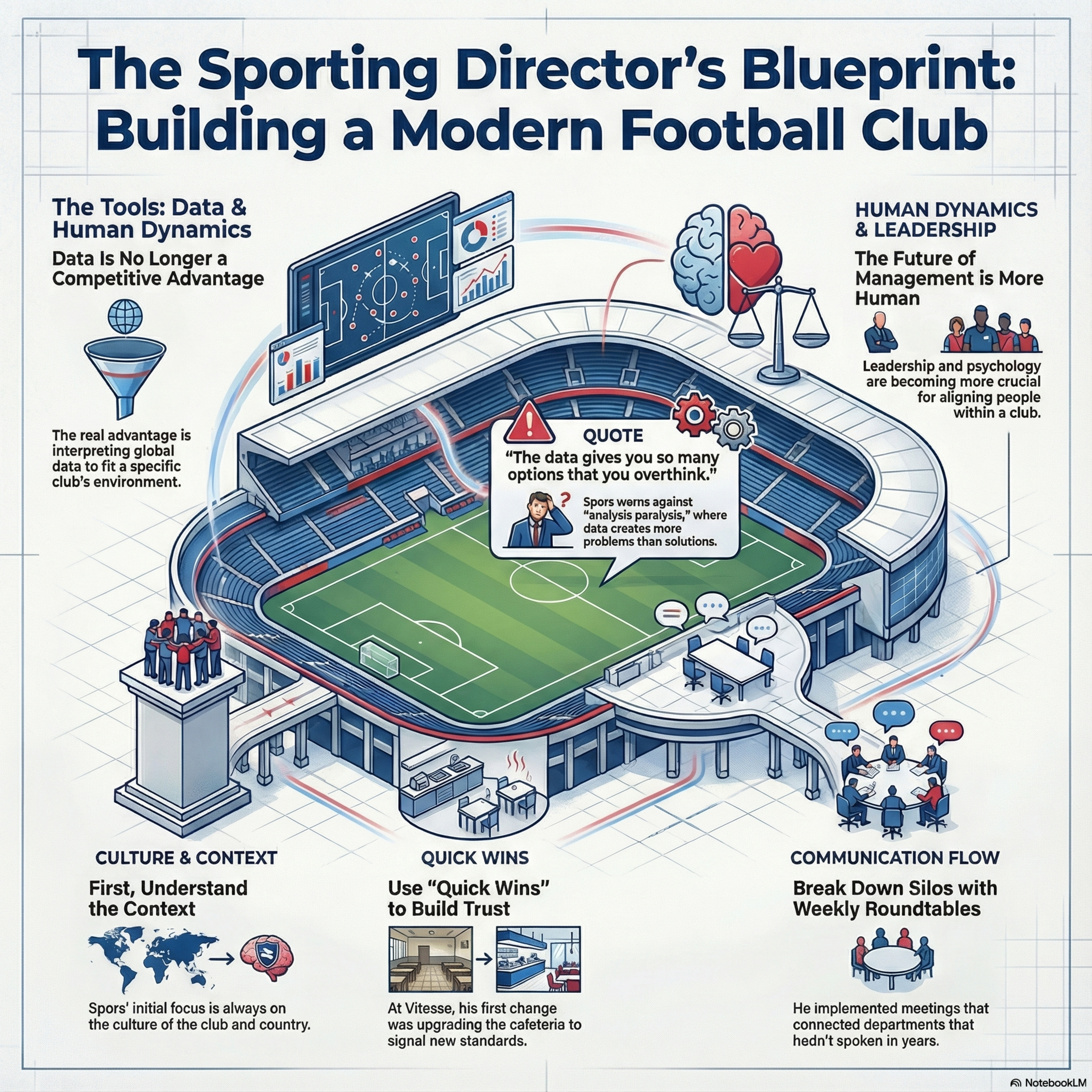
So once he has that context, that understanding of the the nervousness in the organization, what's next? He moves fast on what he calls quick wins. These are immediate, really visible changes designed to reset the momentum and build a bit of trust in what is, you know, pretty anxious environment. And this is where that great anecdote from his time at Vitesse comes in. It's so mundane, but it's strategically brilliant. The first big overhaul wasn't a player or a tactic. It was the cafeteria. Exactly.
He looked at the facility and saw they were serving things like white bread and milk. A diet for a school kid, not an elite athlete. And he realized that it just signaled mediocrity. So he immediately changed everything to reflect hyper performance, nutrition. New kitchen, new process is the works. I love this because it's basically behavioral science applied to football management. I mean, a new kitchen doesn't win you the game on Saturday. No, not directly. But it sends this incredibly clear message to everyone from the star player to the person washing the kits, that the standards have changed, that professional excellence is now the baseline for everything.
It's a tangible, visible win. It builds trust. If the stats and players see you're serious about fixing the basics of their welfare, they're way more likely to trust you when you come to them with a high risk transfer strategy or a grueling new training plan. You're signaling your competence before you ask for their compliance. It's brilliant. That psychological foundation is just essential, especially in a struggling club. OK, so building on that foundation of trust spores then identifies what he sees is the root of almost all problems in football.
Poor communication silos. He basically sees football as an alignment problem. If you've got all these different departments, commercial, the Academy, finance, the first team and they all have slightly different goals. The coach wants to win now. The Academy wants to develop for five years from now. Finance wants to cut costs. Exactly, and if they aren't talking to each other, the club just starts pulling itself in 10 different directions at once. And his solution is so simple, but in the traditional sort of hierarchical world of football, it's totally revolutionary.
The weekly roundtable meeting. With every department head, not just the football people, everyone. And the anecdote from his time at Genoa is just it's almost shocking. He discovers that the silos are so deep that the Academy director had not spoken to the first team coach in years. Years. Just think about that for a second. It's organizational malpractice. How can you have any kind of club DNA, any pathway for young players if the two guys in charge of that pathway aren't even talking? It just shows you how deep that kind of institutional rot can go.
It wasn't necessarily malicious, it was just broken structures and a lack of accountability. So the simple act of putting everyone in the same room once a week force that communication. It shattered the silos. And he talks about this aha moment he had. Right, it does. A few weeks in, he sees these two directors who hadn't spoken in years just chatting freely over lunch. And he thought to himself, now it works. Now they're connected. That casual conversation was the proof that the human system was starting to heal.
It all comes back to that core principle. Only through communication can development happen. If people don't talk, they can't coordinate, they can't learn, and the whole club just stagnates. It's about creating a structure where that communication is mandatory, not optional. OK, let's pivot now to the world of hard data. Because spores came up in these very analysis rich environments, you'd expect him to be a pure data evangelist. But his view on it now is, well, it's a lot more nuanced. It's quite sobering actually, and he directly tackles this conflict we always see between the sophisticated analysis and what actually happens on the pitch.
He calls it the table lying, Yeah. And he points right to what happened at Southampton. The underlying numbers their analytics team were producing were really strong. At one point they ranked third in the league and expected points. 3rd So statistically, based on the quality of their performances, they should have been fighting for promotion. But their actual results had them down in 17th place. And he gives that perfect, infuriating example. The match where they racked up 3.4 expected goals, meaning on average they should have scored three, maybe four times.
And the final score was 00. 00 draw. He calls it statistically impossible, but it happened. And that right there is the beautiful, madding chaos of football that no spreadsheet can ever fully capture. That has to be so frustrating. As an executive, you do all the work, the process is right, the numbers are great, and the ball still hits the post and goes out for sure. And that reality leads him to this really important warning about what he calls analysis paralysis. Which is what exactly? It's the idea that the sheer amount of data we have now is actually becoming a problem.
It gives you so many options, so many tiny variables to consider, that leaders just end up overthinking every single decision. So instead of finding 1 clear solution, you end up fracturing one problem into many problems. Precisely. You get so caught up in the details that you can't make a decisive call, he says. The real job of a modern sporting director isn't just a process data, it's knowing when you have enough information to act. It's about synthesis, not just analysis. And this leads to an even deeper point he makes about competitive advantage.
He says, and this is pretty blunt, the fact that clubs use data that hasn't been a competitive advantage for 10 years. Wow, 10 years. That's a bold claim, but it makes sense when you think about it. It does. If every top club, and even clubs in the second tier have access to the same global data providers, then the information itself is no longer special. It's a commodity. So the competitive edge isn't having the data, it's what you do with it. It's entirely in the interpretation. It's about how you contextualize that data for your specific club.
As he says, the global data providers don't think for Southampton Football Club. So the art is building the internal human filter that can pull out only the information that matters for your budget, your league, your style of play. Exactly. And to hammer this point home, he gives the amazing counterexample of Genoa. When he got there, the club was basically in the dark ages. Technologically, he said, more than e-mail. There was no technology. That's incredible for a major European club. It's starting from absolute 0, but it meant when they did switch on the lights the impact was huge.
Within two weeks, they had data providers and analysts up and running and. What was the result? Did it actually change anything? Immediately, they use this new system to identify and sign two key players who became central to their success, Albert Gobenson and Morton Frindrup. It allowed them to find undervalued players in unusual markets that fit their profile perfectly. So data can be an advantage, but only if you're coming from nothing, or if your human interpretation is just that much better than everyone else's.
The edge is in the application, not the information. This focus on interpretation and human filters, it feels like it naturally led him to evolve his own focus, right? Moving from pure analytics to. Something else? Absolutely. He started focusing more and more on the psychology and the social dynamics of the organization. He realized the most complex variable wasn't on a spreadsheet, it was in people's heads. So he starts asking these more sociological questions. Yeah. Like what leadership roles exist in the squad?
Who's the guy who connects the different social groups? What roles are we missing? And how do those group dynamics change when you're in Italy versus, say, Brazil? Which brings him to this core belief in pragmatism over a rigid philosophy. His international experience really hammered this lesson home for him. The Brazil example is just perfect. The logistics there are just a different world. A whole different ball game. You're dealing with three time zones, massive climate shifts, enormous travel distances.
You simply can't impose A rigid, high intensity German style pressing system in that environment. The players would be physically broken. So the conclusion is that pragmatism sometimes beats philosophy. You have to adapt your ideal style of play to the reality on the ground. But that doesn't mean he has no principles. He comes from that Ralph Randic school of thought. So there are non negotiables, intensity, aggressiveness, verticality. His teams have to have that identity. But the. Dial on how radical you can be with those principles.
That's what changes. Exactly. It depends entirely on the environment. In a stable club you can push the limits. In a nervous club sitting 17th, you have to be way more pragmatic. You need stability first than revolution. You know, a lot of people listening will be curious about his background. He's part of this new generation of executives who didn't have a big playing career. Yeah, local track, yeah. And he's really quick to push back on the idea that he just, you know, thought his way into the job.
He emphasizes that it was a real education built on hard work and deep exposure. He calls his start at Hoffenheim a huge stroke of luck. Because it was a small club but with top expert. Right. Less bureaucracy meant he could get his hands dirty. He could learn by doing, by watching games every single day, by being in the room where decisions were being made. And you can really map out his learning process in these clear progressive layers. You can. It starts with pure tactical analysis, understanding the shapes on the pitch.
Then it moves to individual player study, then the scouting, then recruitment strategy, and finally all the way up to cross cultural leadership. He built his knowledge step by step. He didn't just jump to the top. And each one of those steps, each new country. Arnheim, Genoa, Rio. It reshaped his worldview. It forced him to adapt. That's why he values context so much, because his entire career has been about learning to survive in different contexts. It really reframes the whole Moneyball narrative.
It's not just about the numbers, it's about combining that analytical skill with the really deep cultural and psychological sensitivity. That's the blend, that's the job. So as we start to wrap this up, what's the future of this role with AI? More data? Bigger front offices? Does the sporting director just become a highly paid algorithm manager? He argues the exact opposite. He says the job is becoming more human, not less. Why? Because despite all the technology, the core challenge is still alignment.
As he says, people still need to be brought together. Data can tell you what player to sign, but it can't convince a dressing room full of different personalities to buy into a single vision that takes human leadership. And that brings it all back to that delicate art of blending innovation with tradition. It's the ultimate human challenge. He talks about the two extremes you find in every club, the 70 year old legend who lived the great times and the young analysts who wants everything new. And if those two can't see eye to eye, the club just stalls.
Right, so the goal isn't for one to win. The goal is to create an identity, a shared story where both the legend and the analysts can see themselves, and that takes humility, respect and all that communication we talked about. And what's so satisfying as we're having this conversation is that the methodical approach seems to be working at Southampton after all that turbulence we discussed. They've won six of their last eight matches. The table is starting to correct itself, yeah. And Spores remains completely composed about it, he just says If we continue the good run, I'm confident.
His belief is that the underlying structure they built was strong enough to eventually win out, that the table would, as he puts it, start telling the truth again. He's not banking on hope, He's banking on his system. He's trying to control every possible variable in a business that's designed to be uncontrollable. And that leads us to that final, really provocative thought he leaves us with. He says his job is to make sure that nothing is left to chance, except the part of football where chance always wins.
That's the line. That's the thing I want you, the listener, to think about. In a world of so much data and preparation, where exactly is that line drawn? Where does strategic control end and the beautiful random chaos of the game begin? And how much of the job is just about accepting that tiny, uncontrollable element, the lucky bounce, the impossible 00, while you ruthlessly control everything else you possibly can? It's the tension at the very heart of the beautiful game. Thank you for joining us for this deep dive.
We'll catch you next time.
 Apple Podcasts
 Castbox
 Castro
 Goodpods
 Moon FM
 Overcast
 Pocket Casts
 Podbean
 Podcast Addict
 Podcast Republic
 Spotify