Spies, Sabotage, Tactics At AFCON 2025 PreMatch Final
About this episode
Spies, Sabotage, Tactics At AFCON 2025 PreMatch Final
Listen now on Spotify, Apple Podcasts, Amazon and other streaming services! Don’t forget to subscribe, share, and leave a ⭐⭐⭐⭐⭐ review to help more players and coaches discover the power of Techne Futbol and Data Technology in the beautiful game.
#TechneAfricaFutbol #TechneFutbol #TrainWithTechne #Playermaker #TraceFutbol #Hudl #FootballTech #FootballInnovation #PlayerDevelopment #CoachTools #SmartFootballTraining #AfricanFootball #CAFOnline #FIFA #FIFAYouth #CAFDevelopment #YouthFootballAfrica #NextGenFootball #FootballScouting #TalentIdentification #DigitalScouting #EliteYouthDevelopment #FootballJourney #FootballAnalytics #FIFAForward #FutebolAfricano #TrainTrackCompete #FootballExcellence #FootballAfrica #TheFutureOfFootball
OK, stop what you are doing. Seriously, just pause for a second. I want you to close your eyes, take a deep breath. Can you feel that? I want you to transport yourself mentally to the center of Rabat, Morocco right now. It is Saturday evening, January 17th, 2026. OK, I'm there. The sun has just dipped below the horizon, casting those long, deep purple shadows over the city. But the energy, the energy is absolutely incandescent. You. Can almost cased it. The air is so thick with tension you could practically cut it with a knife.
Looming over everything like a modern Coliseum is the Prince Mulay Abdullah Stadium. And tomorrow. Tomorrow isn't just another match day. Tomorrow is the day. It really is unique, isn't it, That specific frequency of nervous energy that only happens on the eve of a continental final. It must be absolutely suffocating in the streets of Rabat right now in the best possible way. For sure. We are standing on the precipice of the 2025 AFCON final and. What a final we have on our hands. This isn't some underdog story or a lucky run.
We are looking at the host nation Morocco going toe to toe against the defending champion Senegal. The big one. This is the heavyweight prize fight the entire continent held, the entire footballing world was praying for. It is a collision of the two most dominant football philosophies in Africa right now. That's the perfect way to frame it. It's a philosophical clash as much as a sporting 1. You have the structural, almost geometric rigidity of North African football right at colliding with that fluid, high octane, rhythmic dynamism of West Africa.
It's the classic immovable object meeting the unstoppable force. I love that. But what makes this deep dive so exciting and why I'm so pumped to get into this today, is that we aren't just here to toss a coin and guess the score. No way we are going deeper than that. We are on a mission today to understand what I like to call the Invisible game. I love that term, the invisible game, because look, when you turn on the TV tomorrow, you're going to see the passes, the tackles, the goals. Yeah, obvious stuff.
Exactly. But we are going to peel back the curtain and look at the stuff you don't see on the broadcast, the tactical nuance, the psychological warfare, and honestly, the administrative battles happening in the shadows. Oh, absolutely. Because let's be real, in African football, the game starts weeks before the referee even thinks about blowing that whistle. Weeks, sometimes months. And to really grasp the magnitude of this invisible game, you have to understand the context. You have to feel the stakes.
Think about the pressure on Morocco right now. It's immense. They were the absolute darlings of the world in 2022, reaching the World Cup semi finals. They shattered the glass ceiling for African football. But this is a big but. Look at their trophy cabinet. It's gathered a bit of dust, hasn't it? It's been barren since 1976. Wow. That was the last time they won the African Cup of Nations. That tournament was played in Ethiopia. We are talking about 50 years. 50 that's a huge number. Half a century of waiting, half a century of almost of maybe next time of heartbreak.
50 years, that is generations of fans who have never seen their country lift this cup. Exactly. So you combine that 50 year drought with the immense, crushing pressure of hosting the tournament on home soil. The burden of history isn't just heavy, it's monumental. It can make or break you. It can either forge a diamond or crush you completely and then you look across the pitch at Senegal. The Champions. They're on the precipice of a dynasty. If they win this back-to-back titles, they cement their status as the singular force of the Twenty 20s.
And it validates the Ranager. Pipsy are right, he kind of came in under the radar. Usually he came in as an interim, stepped into big shoes and has steered the ship brilliantly. A win here proves he's not just a caretaker, he's an elite manager. So we have the setup. The narrative arc is perfect, but before we get to the tactical board in the formations, let's talk about that invisible game you mentioned because the rumors coming out of Rebut this week, they are spicy. We are talking about psychological warfare and what some might politely call gamesmanship.
This is the administrative undercurrent that defines major African finals. It's almost a tradition at this point. Sadly, the Senegalese Football Federation, the FSF, has been incredibly vocal this week. What are they saying? They're accusing the local organizers of what effectively amounts to espionage. Espionage. We're entering spy novel territory here. Are we talking guys in trench coats hiding in the bushes with binoculars? Effectively, yes. They've dubbed it training Ground warfare. Senegal actually took the drastic step of refusing to use the official training sites designated by the tournament organizers.
They claimed they had credible intelligence and they were very firm on this, that there were drones and unauthorized personnel filming their closed tactical sessions. OK, hold on, is that legitimate paranoia or is that just preloading excuses in case they lose? Oh, we lost because they stole our plans. It's a valid question, but in this case, it seems mostly legitimate. In modern football, information is the ultimate currency. Specifically, Senegal believes Morocco is trying to see how they are reorganizing their defense, which is a huge talking point we'll get to in a minute.
Right, because of the suspension. Exactly if the Moroccan manager will lead, rugby knows exactly who is playing where in Senegal's back line. He can script the 1st 15 minutes of the match to exploit it perfectly. So what's the fallout? Senegal just went rogue. They've been forced to rent private facilities. They are locking themselves away behind closed doors, away from the official bubble. And while that secures their tactics, think about the mental toll. It's got to be draining. It disrupts their rhythm.
It fuels a siege mentality. They feel like they are behind enemy lines, like the very ground they are walking on is hostile. And it's not just the training grounds, is it? I've heard whispers about the logistics too. Standard operating procedure in the dark arts of home advantage. There are reports of suboptimal hotel conditions, mysterious transport delays for the Senegalese delegation. The classic move? The team bus shows up 30 minutes late or the air conditioning just happens to break in the Star Strikers room the night before the game.
Precisely. And while it sounds petty or like minor inconveniences, expert analysis of sports psychology tells us these are designed to induce fatigue and irritability. It's physiological sabotage. It is if you can make the opposition just 5% more tired, or have them arrive at the stadium feeling rushed and stressed rather than calm and focused, you've won a massive victory before kickoff. That is wild. It's like death by 1000 cuts. And then there's the refereeing. This feels like a powder keg waiting to explode.
There's already a narrative bubbling up that the host nation is being protected. That narrative is strong and honestly it's dangerous. You look at the semi final Morocco played against Nigeria. I saw the highlights, the Nigerian fans were not. The Nigerian officials and fans were absolutely furious about the disparity and foul calls. Morocco committed 19 fouls in that game but didn't see a single yellow card. That is statistically highly unlikely. 19 fouls and no booking. It's highly anomalous. And let's not forget the VAR controversies.
Adam Messina, the Moroccan defender, seems to be getting away with quite a bit in the penalty box. The elbow incidents, I saw this clip, they were flying. The elbow incidents, exactly. The fact that VAR hasn't intervened in those situations has created a perception of of bias. And you have to consider the 12th man effect crowd. Tomorrow there will be 60,000 people in that stadium and 95% of them will be screaming for Morocco. That creates a wall of red. It's intimidating, sure, but does it actually change the referees decision making?
Are they that susceptible? It absolutely influences refereeing psychology. There is hard data on this. It becomes incredibly difficult for a human referee to make a 5050 call against the home team when 60,000 people are screaming at it. Subconscious. It's not necessarily corruption, it's human nature being weaponized. The crowd noise acts as a psychological pressure valve that makes the referee hesitate to blow the whistle against the hosts. So Senegal is walking into a hostile environment, feeling like the world and their organizers are against them.
Talk about motivation though it. Can go either way. But let's transition from the shadows to the grass. Let's talk about the actual football. We have a serious clash of styles here. We do. As we touched on earlier, it's the North African rigidity versus West African dynamism. But let's break down the architects of these styles. Yes, the managers will lead Rigragui for Morocco versus Papathea for Senegal. Rigragui strikes me as the ultimate pragmatist. He's not an idealist, is he? He just wants to win.
Far from an idealist, he's built this family atmosphere. You know the avocado head nickname bringing the players moms into the stands which creates this warm fuzzy image. Right, everyone love that. But do not let that fool you. Beneath that warm exterior where Groggery is ruthlessly disciplined, he's willing to suffer. He is willing to seed possession completely to control the space. We saw that at The World. Cup We started the World Cup against Spain and Portugal. He doesn't need the ball to win.
In fact, he sometimes views the ball as a liability. That's so counterintuitive. I don't want the ball. His philosophy is if you have the ball, you can make a mistake. If you have the space, you control the game. He builds a cage and waits for you to walk into it. And Thea, how would you describe him? Thea's fascinating because he was the interim boss who earned the permanent job through results. He represents a new wave. He's an adaptive manager. He's not rigid. Not at all. He's not dogmatic. He's a master of in game management.
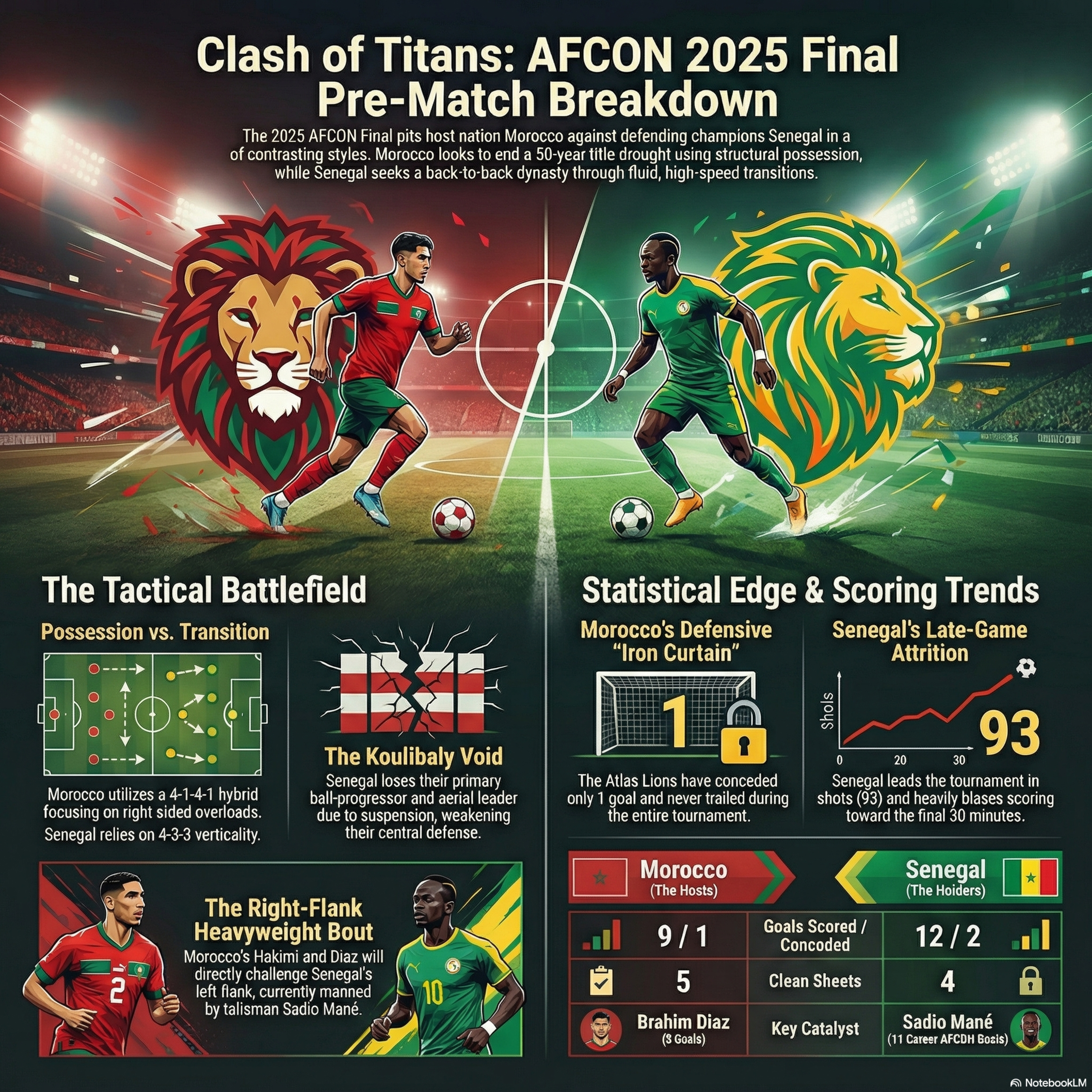
He's not afraid to shift from A433 to A451 to close out a game. He's very fluid, reacting to the game state rather than just sticking to a Plan A regardless of what's happening. Let's visualize Morocco's shape for the listeners. They call it the Iron Curtain for a reason. What does that look like on the pitch? Defensively, they set up in a very compact 4141. The linchpin here is Sofian Amrabat. He sits as the screen in front of the defense. Explain Amrabat's role for the listener who maybe just sees him running around.
What is he actually doing structurally? Think of him as a windshield wiper. He clears the danger before it hits the glass. But more importantly, Morocco doesn't necessarily engage in physical duels. Why? Not. Because they know they might lose those against W African teams who are often physically stronger. Instead they cut off the supply lines. OK, they nullified Viktor Awesome Hen against Nigeria. Not by wrestling him, because Awesome Hen would win that wrestling match, but by starving him. Armor Bat stands in the passing lane so the bull never gets to the striker in the first place.
That is so smart. Starve the beast rather than fight it. But when they attack the shape shifts completely. This is the part I love. It transforms into this 325 monster. It's a fascinating rotation and it happens fluidly. The left back, usually Mozzarelli or Messina, tucks in to become a third center back. I got it. That movement allows Akroff Akemia on the right side to basically abandoned his defensive duties and become a full blown winger. He bombs forward and that pushes Brahim Diaz inside. So they overload that right side.
It's a lopsided attack. Exactly. It creates A numerical overload and a cognitive crisis for the opposition's left back. It puts them in a bind. Do you track Hakimi wide? If you do, Diaz is free. If you do, you leave Diaz open in the tent space, that dangerous pocket just outside the box. Do you stay with Diaz? Then Hakimi has a free run to cross. It's a lethal dilemma. Now let's flip the board. Senegal. People usually think of them as a counter attacking team. Fast breaks, boom boom goal. The classic stereotype.
Right, but the stats tell a different story in this tournament. That's the big surprise of F Con 2025. Senegal has averaged 63% possession. 63%, that's huge. That's the second highest in the entire tournament. They aren't just sitting back and waiting. They're controlling games. But because they have the ball so much, they've developed a very specific rest defense. Rest defense. That sounds like an oxymoron. Break that down for. Us It sounds complicated, but it's a simple concept. Rest defense is how you position your players when you have the ball specifically to prepare for the moment you lose it.
So it's defense during offense? It's defensive preparation during during the attack. Senegal knows Hekimi is going to fly forward for Morocco. So even when Senegal is attacking, they are positioning their players to exploit the space behind Hekini the moment they win the ball back. They're baiting the trap. They're baiting the trap. They want Hekimi to come forward so they can hit that empty space. That is chess on a grass field. It's absolutely cerebral. But, and this is a massive but, there is one huge piece missing from the chess board for Senegal, and this to me feels like the defining variable of the match.
Without a doubt, we have to pivot to the Coulibaly factor. Senegal's captain, their defensive anchor, the legend Khalidou Coulibaly, is suspended. That is a massive blow. I mean, he's the captain, he's the leader. But help us understand, is it really that critical tactically? Can't they just slot in another tall defender and tell him to head the ball? It's so much more than that. It's not just about defending. That's the common misconception. Coulibaly is their primary ball progressor. What do you mean by that?
He is the one who starts the attacks from the back. He has the ability to break the lines with a sharp vertical pass. When he's not there, the whole structure wobbles. His replacements likely Mamadou, SAR or Second. They're good players, talented players, but they don't have his passing range. They play safe. So what's the domino effect of playing safe? The domino effect is that the midfielders, the Gaia duo, have to drop much deeper to collect the ball because the defenders can't pass it forward effectively.
And that pulls them out of the attack. If the midfielders drop deep, they aren't supporting the attack and it invites Morocco to press higher up the pitch. It disrupts Senegal's flur before they can even get started. It forces them to play a game they don't want to play. And. What about in the air? You've got to think about set pieces. Huge vulnerability. Kulabali is their main aerial defender. Now think about Morocco set pieces. You have Hakimi delivering laser guided corners to guys like Nayef, Agrador and Nasiri who are incredible in the air.
Oh yeah. Without Kulabali there to command the box and hit it clear, Morocco's threat from dead balls increases drastically. Every corner kick becomes a potential heart attack for Senegal. OK, so Senegal is wounded at the back. Let's zoom in on the individual battles, the heavyweight bouts. My favorite part? We have to start with the main event, Akraf Hakimi versus Saudi Omani. This is the duel that decides the game. It's cinema. It's Morocco's greatest weapon against Senegal's greatest threat. And they're operating in the exact same channel.
It's a direct collision course. Exactly. It's a direct confrontation. Hakimi wants to attack. That's his instinct, but if he pushes too high, he leaves the space behind him open. And who is waiting in that space? Saudio, Amani and Monet is informed. He's the ultimate clutch player. He scored the winner in the semi final. He has eleven career AFCON goals. He lives for these moments. It's a huge risk for Morocco. If Hakimi gets caught up field, Monet will destroy them in transition. But in here are the catch.
If Hakimi stays back to guard Monet, Morocco loses their offensive overload we talked about. Their whole system is blunted. It's a massive risk reward calculation for Rick Grogowy. Does he unleash Akimi and risk the counter or does he chain him down and lose his attack? What about the other side? We talked about Brahim Diaz. He's been incredible since switching allegiance from Spain. He's the MVP candidate of the tournament. Five goals already. He operates in those half spaces. He's going to be attacking the zone that Kula Bali would have been defending.
So he's targeting the weakness. He's going up against the replacement center back and Ismail Jacobs. If there is any miscommunication there. Diaz will punish it instantly. He drifts inside. He's hard to pick up because he's small, has a low center of gravity, and is technically gifted. If Jacobs and the backup center back aren't perfectly In Sync, if they aren't talking constantly, Diaz finds a pocket of space and scores. It's that simple. Then there's one more match up that feels chaotic. Please, I know which one you mean.
Nicholas Jackson versus Adam Messina. The agent of chaos versus the makeshift center back. I love it. Jackson receives a lot of criticism for his finishing. He misses some sitters. He does, and rightly so. He is wasteful in front of goal, but his movement creates absolute havoc. He never stops running. He drags defenders out of position. And Messina. Remember, he is a converted fullback playing center back because of injuries in the Moroccan squad. He's strong but he's clumsy, He can be rash in the tackle.
I can see Jackson just running at him trying to draw a foul. That is absolutely the strategy. Senegal will play long balls into that Channel, hoping Messina makes a mistake, commits A foul, gets a red card or creates AVAR situation A. Deliberate tactic. It's a pressure point they will hammer on until it cracks. OK, let's look at how this game plays out over 90 minutes or 120 minutes. How does the flow of the game look to you? Because games have rhythms. Well, we have to look at the temporal analysis, how these teams perform over time.
Morocco are the front runners. They like to lead from the front. They haven't trailed for a single minute in this entire tournament. Wait, not one minute. Not one minute. Think about the discipline required for that. Their pattern is to sustain pressure early, get the goal, and then establish control. So if they score first. If you score first, statistically it is nearly impossible to break them down. They've conceded one goal in over 477 minutes of football. So for Morocco, the 1st 25 minutes are crucial.
Huge. If they get an early goal, they are in their comfort zone. They can sit back, absorb pressure and hit on the counter. But Senegal, they're different. They are the closers. They've scored twelve goals in the tournament but they're heavily weighted to the second-half. Like the semi final against Egypt, that was a late. Winner. Exactly. The winner came in the 78th minute. Their strategy is attrition. They use that physical midfield to grind you down, make you tired, make you sore, and then strike late when your concentration lapses.
So let's play out a scenario. It's the 60th minute, it's 00. Who is happy? Advantage Senegal, definitely. Really, even with the home crowd, I would think the home crowd helps Morocco. Especially with the home crowd and 60 minutes. But if it's still 00, that crowd in Rodmont starts to get anxious. Oh, I see where you're going with us. The cheering turns into nervous murmurs. You hear the groans when a pass goes backward. That anxiety transfers from the stands to the players. The Moroccan players will feel the weight of that 50 year drought creeping onto their shoulders.
They start to rush, they make mistakes. And that's when Senegal brings on the fresh legs. Exactly, they bring on Nicholas Jackson if he didn't start or illumine NDI. Fresh, fast attackers running at tired, anxious legs. So Morocco needs to strike early. They need to strike early to kill that anxiety. If it's late and close, the momentum shifts to the holders. Senegal. Now we can't ignore the technology. It's the silent arbiter in modern football. We've got SO semi automated offside technology. How does that change the game?
It fundamentally favors the defense. It eliminates the margin of error. In the old days, an attacker like Manet could time a run and maybe be a toe offside, but the linesman gives the benefit of the doubt. Not anymore. The computer sees everything. It sees everything down to the millimeter. This means Senegal has to delay their runs. They have to be perfect. That split second delay allows the Moroccan defense to recover. So fewer breakaways, I predict. We won't see many goals from marginal breakaways.
The goals will have to come from cutbacks or set pieces where the off sideline isn't the primary factor. And the VA, they are protocols. We touched on this with the protection narrative earlier. The bar for clear and obvious is set very high in this tournament, especially for penalties. OK, that is bad news for Senegal if they are expecting soft calls to go their way, but it's good news for a physical defender like Messina. He can probably get away with more contact than usual because the VAR is reluctant to overturn on field decisions unless they're egregious.
So high bar for penalties, precise offsides, it sounds like goals will be hard to come by. Very hard. We are looking at a cagey, tactical affair. Neither team wants to lose this. Which brings us to the moment of truth. We have analyzed The Dirty tricks, the tactics, the matchups, the tech. How does this end? What is the verdict? The statistical forecast points to a low scoring, attrition based encounter. Morocco has conceded one goal all tournament. Senegal has conceded 2. These are the two best defenses on the continent.
It's going to be tight, nail biting. I think it's a tactical stalemate for the first hour. Both teams are too smart to leave themselves open early on. Rig Ragi won't risk it and Theo will be patient, but I think there's an X Factor here that tips the scale. Goalkeeping. Yasin Buno. He is, Simply put, the best goalkeeper on the continent, maybe the best in the world in high pressure situations. The penalty shootout specialist. He is a penalty specialist. He saved four of the last 7 penalties he's faced.
That is an absurd statistic. That's over 50%. Most keepers save maybe one in five. It's psychological dominance. If this game goes to penalties, Morocco wins before a ball is kicked because Senegal knows who is standing in that goal. They are terrified of him. And Mendy on the other side. On the other side, Edouard Mendy is elite, don't get me wrong, but his distribution is going to be tested without Coulibaly and he doesn't have that same invincible aura on spot kicks right now. So give me the prediction.
Put your reputation on the line. I'm predicting A11 draw after extra time, A grueling physical battle. I think Morocco scores first. Senegal equalizes late, but in the end I think Morocco wins on penalties. The home advantage, the Baonu factor, and the ghost of 1976 finally being laid to rest. And the structural weakness in Senegal's defense due to the suspension, it just gives Morocco enough of an edge to hold on and take it to the shootout. Wow, a penalty shootout win in Rabat to break a 50 year drought.
The country would absolutely erupt. It would would. Be pandemonium. It would be the perfect ending to a tournament defined by tension and defense. Yep. Before we sign off, I want to leave the listener with a thought. We spent a lot of time talking about the invisible game, the espionage, the hotel sabotage, the refereeing pressure. We have, and it's fascinating, isn't? It, it is. And we see this evolution in the African game where it's shifting from just pure individual talent to these complex systems and marginal gains.
But I have to ask, regardless of the result tomorrow, does this heavy focus on administrative gamesmanship, the spies, the bad hotels, does that hold the continent back? Or is it simply a unique characteristic of the intense passion in African football? Is it a bug or is it a feature? That is the $1,000,000 question. Does the paranoia prevent the football from reaching its peak because everyone is focused on the wrong things? Or is that intensity what makes AFCON so special and unlike any other tournament in the world?
Something to Mull over while you watch the game tomorrow. And when you are watching, don't just watch the ball. Watch the space behind Hakimi. Watch how the Senegalese midfielders drop deep. That's where the real game is happening. Enjoy the match, it's going to be a classic. Thanks for listening to this deep dive. We'll catch you on the other side of the final whistle.
 Apple Podcasts
 Castbox
 Castro
 Goodpods
 Moon FM
 Overcast
 Pocket Casts
 Podbean
 Podcast Addict
 Podcast Republic
 Spotify