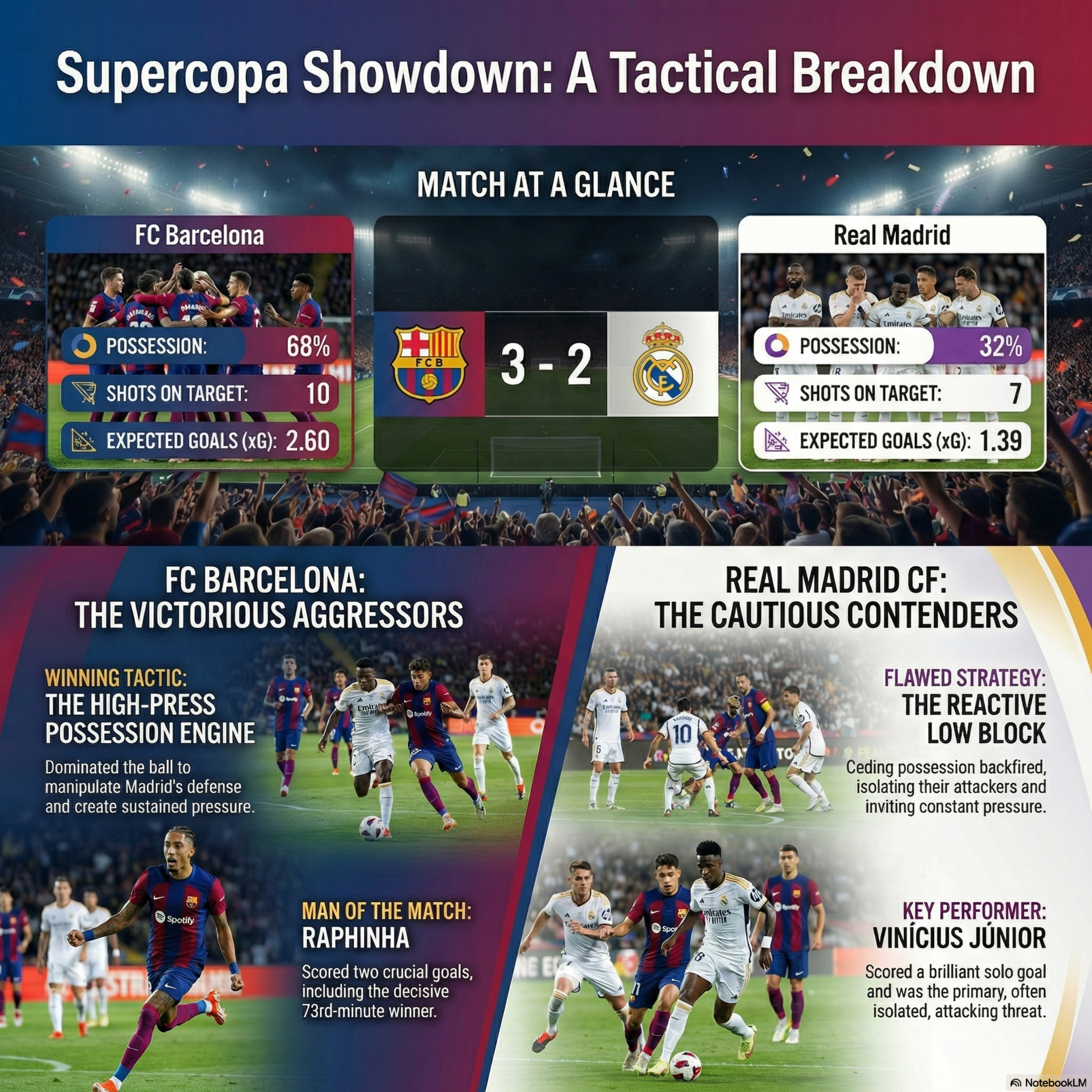
Spanish SuperCopa Barcelona vs Real Madrid Tactical Collapse Lessons for Africa
About this episode
Spanish SuperCopa Barcelona vs Real Madrid Tactical Collapse Lessons for Africa
Listen now on Spotify, Apple Podcasts, Amazon and other streaming services! Don’t forget to subscribe, share, and leave a ⭐⭐⭐⭐⭐ review to help more players and coaches discover the power of Techne Futbol and Data Technology in the beautiful game.
#TechneAfricaFutbol #TechneFutbol #TrainWithTechne #Playermaker #TraceFutbol #Hudl #FootballTech #FootballInnovation #PlayerDevelopment #CoachTools #SmartFootballTraining #AfricanFootball #CAFOnline #FIFA #FIFAYouth #CAFDevelopment #YouthFootballAfrica #NextGenFootball #FootballScouting #TalentIdentification #DigitalScouting #EliteYouthDevelopment #FootballJourney #FootballAnalytics #FIFAForward #FutebolAfricano #TrainTrackCompete #FootballExcellence #FootballAfrica #TheFutureOfFootball
Welcome to the deep dive and look, this is not just another recap show at all. We are going straight into the heart of a match that was, I mean, it was just dripping with high stakes drama, political undercurrents and a sporting weight that reached far, far beyond the final whistle. Oh absolutely. I'm talking about the recent Spanish Super Copa final, staged in that incredibly humid electric atmosphere of Jetta. It was a global event really set against that magnificent backdrop, top of King Abdullah, Sport City, the environment itself, you know, it almost became a character in the drama.
It really did that humidity. That high humidity, it influenced player fatigue in some profound ways, and we saw that manifest directly in the score line. A score line defined by what can only be described as profound chaotic drama. Absolutely. The final result 32 It tells the story of a definitive victory for one side, signaling a massive successful resurgence under new management. But for the losing side, it generated some significant friction and frankly some very difficult questions for their managers tenure.
Yeah, a lot to answer for. So our mission here right now is not simply to celebrate a trophy. It is to take this elite European clash, this this collision of footballing philosophies, and dissect every single tactical oscillation, every moment of brilliance and yes, every managerial failure to extract universal, actionable wisdom. We're using this as a template. This deep dive is about finding lessons that transcend geography. Exactly. It's not just about what happened in Jeddah, but how this knowledge about high defensive lines, precise positional play and you know, minute to minute game management, how that can fundamentally benefit and uplift the strategies we see employed across the African game.
From developing local leagues all the way to the biggest continental championships. Precisely, we want to give you, the listener, the shortcut to applying elite analysis to your own coaching, your own viewing, and your own understanding of the game. OK, so let's unpack this, because what we saw was just a magnificent clash of ideas. The clash of ideologies, really. On one side we had what we're calling the Dominator, the eventual winning side, and on the other the Reactor, the team that chose to play well much more conservatively.
Yeah, let's start with the Champions and their approach, the high press possession engine. Tell us about this new iteration of their famous philosophy. Well. What's so fascinating here is that the winning side under their German management has purposefully evolve their game beyond what a lot of critics call sterile possession. Right. The kind of passing that goes sideways and ultimately nowhere. Exactly. We are seeing Hansi Flick's evolution toward what analysts are now calling vertical tiki taka.
It's a complete philosophy shift. What specifically defines vertical tiki taka for someone who hasn't heard that term? It's the blend. It takes that traditional control and security of possession, but it injects 2 absolutely crucial elements. Aggressive ball recovery speed. So that intense high up the pitch press. Right, and that's combined with a constant, ruthless vertical threat. The possession isn't just for holding the ball to look pretty, it's a tool for manipulating the opponent, for dragging them out of position and then ruthlessly exploiting the vertical lanes that you've just created.
And the statistical proof of this dominance is genuinely astonishing. We are talking overwhelming territorial control right from the kickoff. The numbers don't lie. In the opening quarter hour alone, their possession peaked at a staggering 81%. 81. That is not just having the ball, that is suffocating your opponent. It forces them immediately into a deep passive block, and it dictates the entire psychological landscape of the match from minute 1. That kind of statistical smothering, it speaks volumes to the mental and tactical preparation.
They use the ball to systematically manipulate the opponent's defensive shape. They moved it laterally, you know, side to side with real precision, constantly probing and specifically looking to create those tiny vertical lanes that they could then suddenly accelerate through. The pressure was just it was constant, relentless and suffocating. So who are the key components of that engine room that made this new vertical system tick? We can really identify 3 crucial roles that worked in in perfect synchronicity.
First you have the anchoring pivot. Frankie Dion. The metronome. He controls the tempo, ensures the structural stability of the midfield, and he acts as the starting point for pretty much every attack. OK on the 2nd. 2nd, the true creative fulcrum was pedry was not static at all. He had license to roam the left half spaces, those dangerous channels between the opponent's fullback and center back, consistently overloading their defense, enforcing them in a difficult decisions. And the third key element, this is where the innovation really lies for me, was the disruptor, Fermin Lopez.
He acted almost in a what's the term a round do to roll? That's a term we use a lot in tactical analysis. But for those unfamiliar, Romduter literally translates from German to space interpreter, right? This player doesn't stick to a fixed position. They are constantly looking for and making these off the ball runs, those crucial third man runs to stretch the opponent's center backs. Lopez's movement was well, it was calculated chaos. And that dynamic movement, you've got Pedri roaming and Fermin aggressively running into those pockets.
It just created havoc. Total havoc. It confused the opponent's marking assignments completely, which then allowed the central striker Lewandowski to drop into space and connect the play without being tracked by a dedicated marker. Exactly. And if you are an African coach listening to this, this is where your training has to focus. It's not just about passing accuracy, it's about intelligent movement that confuses the defense and creates numerical advantages where they matter most. It's synchronized, intelligent chaos.
And to enable this high press attack, they employed A crucial and very high risk element, the high defensive line. Correct. That line was often near the halfway line, marshalled primarily by their center backs. This compresses the field vertically, which serves 2 purposes which are one, it keeps your attackers closer to the goal, and two, it suffocates the opponent's outlets when they try to build from the back. This compression resulted in a massive difference in what we call field tilt. And for those listening who haven't encountered that term, what exactly is field tilt?
It's a really crucial metric field tilt. It measures the proportion of passes completed in the final third of the pitch by one team compared to the other. So it's a measure of dominance in the attacking area. Exactly. If one team has a field tilt of 75%, it means 75% of all the completed passes in the final third belong to them. It's essentially a measure of sustained territorial dominance, and in this final the winners had an exceptionally high fuel tilt. But surely this highline comes with a massive inherent risk, especially when you are playing in a physically demanding environment like Jetta.
Are you suggesting that African teams who often have limited budgets for elite fitness conditioning should just automatically adopt this? Isn't that high risk strategy bordering on suicidal? That's a very, very important challenge. And the answer is nuanced. Yeah, yes, it is an incredibly high risk strategy that demands high risk recovery runs when that press is broken. And we saw that, didn't we? We saw that vulnerability exposed immediately in the game, specifically in the build up to the losing sides first goal.
If your fitness levels are not absolutely elite, or if your tactical awareness isn't crystal clear about tracking runners and recovering what we call transitional defense, this strategy fails spectacularly. And often leads to goals conceded. Oh, absolutely becomes a liability. So the immediate actionable lesson for the African game is well, it's tempered by reality. High possession has to be aggressive and manipulative, not passive. But to successfully run a high defensive line, to truly implement this vertical tiki taka, you must invest heavily and relentlessly in two things world class fitness conditioning that can sustain 90 minutes of high intensity sprints, and the tactical awareness training needed to track and recover when that press fails.
There is absolutely no shortcut. Without that foundation, the risk far outweighs the reward. OK, now let's turn our attention to the other side, the reactor. The losing side who placed their faith entirely in the counter attack. Their managers approach was surprisingly conservative for a club of their stature. They deployed a low block, retreating deep into their defensive third, intending to absorb pressure and then release their star wingers into those vast spaces behind the highline. And that backfired almost instantly.
The 1st 15 minutes were just proof that they had surrendered the initiative completely, both mentally and physically. So why did it fail so badly at the start? It failed in those opening minutes because they couldn't perform the crucial second step of the counterattack, which is retaining possession once you win it. They were hovering around 19% possession at the 12 minute arc. They won the ball back, yes, but their transition passes were immediately inaccurate or poorly weighted, handing the initiative right back to the dominator and.
Structurally, this deep line created a disaster. I mean, it LED directly to the dangerous isolation of their primary offensive threat, Venetius Junior. A total disaster. He's a world class player, but he often found himself facing 2 or even 3 defenders with no support options within 30 yards. The strategy was predictable, it was easily defended and it was incredibly frustrating for their star player. And, crucially, look at the midfield. This is perhaps the most damning structural failure of the match for them.
The space between their midfield quartet and their forwards became, well, it was gargantuan. Just a massive gap. The midfield was bypassed so easily, allowing the opposing center backs to advance unharassed deep into the reactors half. They effectively became auxiliary midfielders, just pushing the attack relentlessly. So the opponent's defense was building attacks where the reactor's defense was stuck deep defending, and their own midfield was nowhere near the action. They were functionally playing with only six or seven active players in the build up.
It was unsustainable. Precisely. Yeah. And the structural gap, that lack of midfield connection is such a critical lesson for African coaches. Relying solely on a low block against a highly technical, high pressing system can surrender far too much initiative. You allow your opponent to dictate the tempo, build their confidence, and probe for weaknesses endlessly. Passive defense is pointless if your transition speed that moment you win the ball and try to launch a counter is not immediate, accurate and supported.
You're just inviting pressure you can't relieve. That relentless first half attrition felt like one side was just waiting for the dam to break, but then as the half wound down, everything went absolutely manic it. Was chaos. Let's move smoothly into what we've dubbed the manic breakdown. We need to systematically cover the five goals, focusing not just on the brilliance but on the severe mental and technical errors that African teams can absolutely learn to avoid. And we have to start with that statistical anomaly.
The concentration collapse was frankly it was staggering. We saw three goals scored in first half stoppage time alone. Three goals in stoppage time. In normal circumstances that would be highly unusual, but here it was compounded by those humid, draining environmental conditions in Jetta. It all came to a head. Analysis suggests this points directly to extreme mental fatigue and a severe lapse in concentration that hit both teams equally hard. Neither side could maintain their composure after scoring or after conceding.
It was just end to end madness. OK, let's start the sequence of chaos with goal one, the opener in the 36th minute. Ruffinia's precision. This goal was the tactical payoff of all that sustained pressure. The winners were near 75% possession, cycling the ball, wearing the defense down. The reactor sat deep, but they failed to clear their lines with inequality. The goal came from a rapid vertical shift, a sudden acceleration that caught the defense completely disjointed after 10 minutes of just sideways passing.
And Rafina. Rafini was smart. He exploited that transient half space gap between the left back and the nearest center back, drifting centrally from the right wing. And the technical detail of the finish is something every young African player really needs to study. Analysts noted the bio mechanics were trademark Rafina. He didn't just smash it, no. He opened his body orientation to shield the ball, maximizing his view of the goal while generating maximum torque with minimal back lift. That low hard shot across the keeper gave him milliseconds of reaction time.
It's pure technique. The overarching lesson here is that precision finishing and the ability to exploit those tiny half space gaps isn't random luck, it's a direct product of sustained, intelligent, system driven pressure. When the defense is mentally and physically tired and disjointed, that is when the precision finisher has to execute, not before. Then in the 45 + 2 minutes we got a flash of pure genius. Gol 2 Venetius Juniors Isolation Master class The equalizer completely against the run of play.
This goal was defined entirely by solar brilliance and the sheer athleticism of the player Venetius, who had been, you know, tactically isolated and frustrated for most of the half. He received the ball near the halfway line and just executed A defining, devastating run. What did he do that was so effective? He used rapid deceleration to throw off the defender, followed immediately by an explosive burst of acceleration to split two key defenders and just leave them grasping at air. It was a moment of true, unadulterated individual excellence that defy the systemic failures around him.
And the metrics, they completely confirm this isolation. The expected goals The XG for this specific opportunity was only about .09 given how dense the defense was in that central. Area sort of low probability. Chance very low, yet Venetius generated .61 XG on his own throughout the entire match. He was a singular high value outlet in a nonfunctioning system. This underscores a dual lesson for developing teams. 1st, the undeniable value of isolating A genuinely worldclass talent and finding ways to feed them even if the system is struggling.
And the second lesson? The necessity for defensive discipline. The goal was only possible because of one defenders momentary hesitation. They feared committing a foul in a dangerous area, and that small pause, that split second of indecision, created the exact space Phoenicia's needed to execute the finish. That momentary lapse of discipline is fatal at this elite level. Absolutely fatal. But the Champions showed an instant resilience that was truly impressive. Goal 3, just 120 seconds later. 45 + 4 minutes.
Levandowski's immediate counterpunch. It's a stunning sequence. It just shows the reset mentality the coach had drilled into the team. They conceded a brilliant goal but instead of dropping their heads, they attacked immediately. And Pedri was at the heart of it. Pedri, the creative fulcrum, received the ball and spotted Levandowski peeling away from the center backs. And those center backs made a cardinal error. They stepped up, but they were static, failing to pressure the ball carrier pedry. They likely assumed the half was over, they conceded, thought they could regroup in the tunnel and then they were hit with a quick 1-2 punch.
Exactly. Pedry delivered a weighted, accurate through ball that completely bypassed the opponent's midfield line, which was struggling to transition back. The structural error was massive. What was it specifically? The Mona's midfield pivot failed to track Pedry's movement, and the center backs violated defensive organization One O 1 by stepping up without pressuring the ball carrier. The lesson is crystal clear for African teams. Mental resilience and immediate counterpunches after conceding are crucial.
You have to maintain structure You do. Defensive units must never, ever assume the half is over, especially in those added minutes when physical and mental fatigue are at their absolute highest. A lapse of two minutes can cost you the game. And the chaos wasn't done. Goal 445 + 7 minutes. Garcia's set piece scramble. We are now deep, deep into stoppage time. This was just a chaotic second ball scenario. It stemmed from a corner that hit the crossbar. It wasn't clean skill, it was pure anticipation and persistence.
And it exposed a returning fundamental vulnerability for the eventual champions, which is something African teams often suffer from too. Which is. Poor aerial duels and slow reaction speed to 2nd balls in the box. The equalizer came because their defense was static while the opponent reacted with superior anticipation and aggression. In a ridiculously congested 6 yard box, they were beaten by simple desire and quick feat. This is a lesson that translates directly to every single level of football, particularly for African coaches who often prioritize fitness and speed over rigorous set piece drilling.
It's. Fundamental. Set piece defense and reacting quickly to 2nd balls in the six yard box remain a non negotiable fundamental aspect of the game that requires specific rigorous drilling. These are the details that separate winners from losers and tight contest regardless of the budget. Finally, we move to the decisive goal in the 73rd minute. Goal 5. Ruffina's fortuitous persistence. This is the moment the game finally broke. This goal arrived from sustained pressure in the final third, specifically in what is known as Zone 14.
For our listeners, Zone 14 is that high value central area just outside the penalty box shaped like AD. That's where the best chances are created. And Ruffini was working in that high value zone. He attempted a low driven shot, but video analysis confirmed he actually slipped upon contact, planting his standing foot poorly. The connection was scuffed. And this is where the element of luck comes in. But it's a luck that was earned through pressure. It was, paradoxically, that technical error made the shot far more dangerous.
The scuffed connection resulted in a heavy deflection off a defender who was forced into a reactive block that completely wrong footed the goalkeeper, looping over him into the net. So the goal was fortuitous, yes, but it was absolutely a product of forcing the defenders into reactive blocks rather than allowing them proactive interceptions. That's the key. The Champions kept putting the ball into that dangerous zone 14, forcing chaos, forcing decisions and forcing mistakes. And the lesson is undeniable.
Sustained pressure creates its own luck. If you continuously spend time forcing chaos in the opponent's high value zones, zone 14, the half space is. Eventually the margin for error runs out for them and you benefit from the ricochet, the slip or the deflection that. Philosophical insight leads us perfectly into Section 3, where we focus on key individuals. We saw flashes of brilliance, but also one major tactical neutralization. Let's start with the protagonist Ruphenia, who earned a Man of the Match rating of 9.5.
Well beyond his two goals, the analysis highlighted his supreme tactical intelligence, which is far more valuable than just speed. He wasn't just fast. He wasn't just that fast. He knew exactly when to hug the touchline to stretch the defense wide, and when to drift centrally to overload the box. That relentless work rate and tactical flexibility made his movement untouchable by analysts. He was the decisive veteran edge in a team of young stars, always making the high percentage decision. Then you have the orchestrator Pedry, rated 8.5.
His performance was just a clinic in central midfield control, particularly in maintaining that offensive rhythm. His vision for the Levandowski goal was truly outstanding, drawing comparisons to historical playmakers like Iniesta. But what often goes unnoticed is his quieter work. What's that? He controlled the tempo, slowing it down when the defense needed rest. And critically, he consistently drew fouls to relieve defensive pressure. When the opponent managed to successfully press high, he was the pressure release valve, ensuring the team maintain control even when under threat.
And we cannot skip over the rising star Laminium, all rated 8 point O. At his age, his performance spoke volumes about composure under pressure. Immense maturity. He completed the most dribbles and won the most duels in the match, which indicates relentless persistence and bravery. He was a constant threat. A. Constant menace, successfully dragging defenders out of position through pure skill. And crucially, late in the game he showed the composure to hold the ball in the corner and kill time when the game state demanded secure, low risk possession.
That's a veteran's decision from a kid. Now we have to turn to the flip side, the tactical neutralization of a truly world class talent, Jude Bellingham, who was rated only 5.5. He was described by some analysts as ineffective and a ghost on the pitch. It begs the question, how does a player of that quality fail so spectacularly in a final? It's the perfect illustration that talent is not enough. Bellingham was just marooned upfront, isolated from the play both statistically and visually. He failed miserably to link the midfield and attack effectively, a role he usually dominates so.
Why? Was it a lack of effort or was this a systemic failure? Oh, it was systemic. He was starved of service because the losing side struggled so much to build centrally. The opposing defensive pivot constantly stifled him. They cut off the passing lanes that feed him the ball, forcing the reactor to push everything wide to Venetius, which just made their attacks predictable. He was a genius, starved of even a sniff of the ball in a dangerous area. This is perhaps the most important sobering lesson for African teams, who so often rely on one or two star players, the progression of that superstar talent to build their identity.
It's critical. Player quality is nothing without system support. Bellingham's failure proves that elite talent, if isolated and not supported by what you call connective midfield tissue, can be completely neutralized. Absolutely, African teams have to prioritize creating that. Central construction and linkage systems must facilitate creative players being involved in the build up phase, getting touches deeper up the pitch rather than just waiting for them to receive the ball and impossible isolated positions in the final third.
You need a system that enables the star. Not just relies on them to perform magic. This issue of system failure leads us right into Section 4, which is perhaps the most critical teaching moment of the entire match, the failure of game state management, specifically focusing on the losing side's structural and mental collapse. We have to revisit the deep ingrained failure of that low block. The passive strategy they used for 70 minutes set a deep psychological muscle memory to defend, defend, defend.
They were playing reactively. So when they finally needed to chase the game in the final 15 minutes, they had to suddenly hit the accelerator. And the psychological and physical switch to attack was jarring and failed completely. They could not shift gears effectively because the muscle memory was set to containment and defense. They ran out of time to mentally adapt to the need for sustained structured attack. And that inability to change their tactical and mental identity mid game cost them dearly.
It did, and this psychological failure then set the stage for the most damning tactical collapse of the night, the 11 versus 10 scenario that occurred from the 90th minute onwards. Let's set the scene. The eventual winners went down to 10 men for seven critical minutes after a straight red card. That red card was a calculated risk that prevented a likely goal scoring opportunity, but it handed the reactor A distinct numerical advantage with the clock running down. Now, the optimal universally accepted strategy in this situation is widely known, right?
It is widen the pitch, rapid circulation of the ball to tire the 10 men and exploiting the gaps that inevitably open up, especially in those high value zones near the corner of the box. But the reality was the exact opposite of optimal. They completely abandoned structure. The losing side panicked. They abandoned their passing structure immediately and resorted to what we call hero ball, and this is just a fundamental failure of preparation. For a listeners define hero ball. What does that look like on the pitch when the structure is gone?
Hero ball is the opposite of structure. It's when players stop trusting the system and start relying on individual desperation. So instead of patiently circulating the ball. Exactly. Instead of doing that to create a clear numerical overload, they attempt difficult low percentage passes, forcing the ball through narrow channels. They rely almost entirely on hopeful long crosses into the box, aiming for their center backs or substitute forwards, rather than systematically working the overload on the wings and feeding the ball back to the center of zone 14.
It's the football equivalent of just throwing up a desperate 3 pointer in basketball instead of running the final play. That's a perfect analogy, and the ten man defense, which was reinforced by a late defensive substitution, dealt with those hopeful aerial threats very easily. So the key lesson here it seems to be a failure of the coaching staff to prepare for this specific critical game state. It is a crucial teaching moment for the African game. Coaches must have a mandatory coherent and practice plan for breaking down A10 man defense.
Relying on hopeful aerial threats against a reinforced deep line defense is the definition of inefficient football, and it demonstrates a failure of structure under pressure. You must have the discipline to play wide and wait for the gaps. We also saw the impact of the tactical substitution of a superstar. The Mbappe Paradox, a massive name, was introduced in the 76th minute, intended to be the winning move. But analysis shows that it arguably disrupted the team's balance more than it helped the player.
Clearly coming off a knee injury, he lacked his trademark explosiveness and that drifting movement. This lack of vertical acceleration was key. And what was the tactical cost of introducing an UNFETT *? Crucially, he occupied similar channels as the existing star winger Venetius, clogging the offense and making the teens attacking shape redundant. Instead of providing fresh penetration and stretching the defense, he simply provided a static target, forcing the existing star players to change their roles on the fly.
Which led to confusion and inefficiency. And the psychological cost was visible to everyone watching. We saw visible frustration, poor body language, and it sparked post match controversy and created a negative feedback loop in team morale during those critical dying minutes. If the star player is frustrated, the whole team feels. It the lesson here, which resonates at every level from youth to professional football, is profound fitness and collective tactical objective trump individual profile.
100%. Introducing an unfit star, even one of that magnitude, can be detrimental to system balance and morale in a high stakes final. If a star cannot execute the high intensity demands of the system, their presence can actually be worse than their absence. It's a hard truth. As we transition into Section 5, let's bring in the element of Afratech, how data and technology are now non negotiable for defining risk, guiding substitutions and validating these complex tactical outcomes. The first technological component that dictates modern tactics is semi automated off site technology or SAOT right.
The ultra high defensive lying played by the winners relies heavily on this technology for instant, precise validation. Why is that validation so critical for the highline? Because the margins are razor thin in the build up to the two one goal, the decision was marginal, but the instant accurate validation maintained momentum and allowed the goal to stand. Without a momentum killing delay for a lengthy VAR review. It allows the team to play with confidence that the officials will be right and quickly.
And this technology impacts the attackers too. Absolutely. Sao forces attackers like Phoenicia's to precisely time their runs. They have to alter their Sprint mechanics, check their high risk plays knowing the automated flag will catch even the slightest errors. The attackers have to be technically perfect or that Highline will catch them every single time. So the lesson for African leagues is essential. The adoption of precise officiating technology dictates the level of tactical risk a coach can safely take.
He does. If you don't have this precise validation, attempting an ultra high defensive line becomes far too risky due to inevitable human error, and your defense will be punished more often than not. The second area is data analytics in in game management, specifically GPS tracking fests. Analysis noted the substitution of the center forward in the 66th minute was likely a data-driven trigger. We've talked about the high intensity press. How did the GPS data inform that decision? Real time GPS tracking data would have shown a crucial drop in his pressing intensity, measured in sprints per minute or distance covered at high speed.
The high intensity system demands constant running, and when your main strikers metrics dip below the acceptable threshold for that system, the coach has to act scientifically, not just visually. And the result validates the data-driven decision. Injecting fresh energy via the substitute directly led to the sustained pressure that caused the winning goal just 7 minutes later. The fresh legs maintain the intensity required to force the opponent's final mistake. Data-driven rotation is non negotiable for maintaining the physically demanding high intensity press required at the top level.
Coaches need scientific indicators of fatigue, not just a visual assessment to guide rotation. This is where African teams need to invest in understanding and applying the science of physical maintenance. Finally, let's look at the expected goals or XG reality. The disparity here statistically validated the result, showing that the better team did in fact win. The Champions finished with an XG of 2.60 compared to the opponent's 1.39. This gap shows that the winners sustained quality chance creation over individual moments of brilliance from the reactor.
While the losing side had flashes of genius, the Champions consistently manufactured and sustained better scoring chances. This just reinforces the tactical importance of encouraging shots from high value zones, central areas inside the box, rather than taking hopeful shots from acute angles or from distance. The winning side shots, even the deflection, were taken from those high probability zones, systematically increasing their chances of scoring. Now that we've picked apart the chaos, the systems and the data, let's zoom out.
What is all this tactical drama mean for the developing African game? Let's distill this into our four key actionable priorities for coaches and administrators across the continent. Priority one Defensive mastery focusing specifically on set pieces and transitions. We must address the recurring vulnerability in aerial duels and 2nd balls, a weakness exposed in the final and often observed across African leagues. So what's the solution? This requires implementing rigorous drills focused on reaction speed, anticipatory movement, and clearing lines decisively every single time.
Furthermore, we devise coaches to consider structural adjustments like using a back 3IN possession to provide better cover for full backs exposed by elite wingers. Thus mitigating the extreme risk during defensive transition that can be fatal against fast opposition. Exactly. Priority two tactical flexibility and the mid block press. We cannot afford the risks of ultra passive deep lock strategies in major tournaments. No, we can't. We need to discourage overly passive deep lock strategies against technically superior opposition because they just surrender too much initiative.
African coaches must implement a more aggressive mid lock press to disrupt build up higher up the pitch. It keeps the team vertically compact and denies the opponent's space in zone 14. Precisely, and we must move beyond reliance on single playmakers learning from the ghost midfield failure we discussed. Systems have to facilitate central construction, ensuring creative players are involved earlier in the build up phase, not just isolated in the final third. Priority three psychological and game management protocols.
This is about professionalizing the response to high pressure moments like stoppage time. Coaches must instill better emotional control immediately after scoring goals to prevent those chaotic basketball style exchanges we saw in the final. Teams have to be drilled to control the tempo when momentum shifts. And the 11 versus 10 scenario? Most critically, mandatory training for 11 versus 10 scenarios is non negotiable. Coaches need to ensure the team executes A coherent wide circulating strategy when holding a numerical advantage, thus avoiding the costly hero ball panic that ruins numerical superiority.
And finally, priority four, integration of technology and fitness. This is about professionalizing decision making and ensuring sustainability. African clubs and national teams must embrace data analytics using GPS tracking even at a basic level for match day decisions. Play rotation should be dictated by scientific indicators of fatigue like sprints per minute to sustain high intensity systems throughout tournaments and full seasons. It helps manage the brutal physical demands required to run modern tactical systems like the vertical tiki taka we discussed.
That's right, this deep dive proves one essential fact. Winning at the elite level requires much more than just individual talent. It requires systemic coherence, meticulous tactical management in those critical high pressure moments, especially added time, and the ability to combine secure possession with aggressive forward thinking verticality. And if we connect this to the bigger picture, the champion successfully blended a traditional emphasis on ball control with aggressive modernity, constantly seeking to manipulate and attack space.
The losing sides, conservatism, their reliance on being reactive. It exposed their inherent limitations when they needed to switch gears. So if elite European giants struggled to successfully shift their muscle memory from containment to creation within 90 minutes, what does this tell us about the deep seated psychological hurdle African teams must clear to move from playing reactively to playing proactively on the global stage? It raises the ultimate provocative question for everyone. Listening is the greatest weakness on the continent, not technical skill, which we know is abundant.
We know it's there. But the mental discipline required to consistently sustain a modern high intensity system under pressure, and the courage to move away from deep passive containment. A question that demands an answer from every coach, administrator and fan aiming for the top of the global game. Thank you for joining us on this deep dive. We'll see you next time.
 Apple Podcasts
 Castbox
 Castro
 Goodpods
 Moon FM
 Overcast
 Pocket Casts
 Podbean
 Podcast Addict
 Podcast Republic
 Spotify