Senegal's Comeback Versus Football Nomads Sudan
About this episode
Senegal's Comeback Versus Football Nomads Sudan
Listen now on Spotify, Apple Podcasts, Amazon and other streaming services! Don’t forget to subscribe, share, and leave a ⭐⭐⭐⭐⭐ review to help more players and coaches discover the power of Techne Futbol and Data Technology in the beautiful game.
#TechneAfricaFutbol #TechneFutbol #TrainWithTechne #Playermaker #TraceFutbol #Hudl #FootballTech #FootballInnovation #PlayerDevelopment #CoachTools #SmartFootballTraining #AfricanFootball #CAFOnline #FIFA #FIFAYouth #CAFDevelopment #YouthFootballAfrica #NextGenFootball #FootballScouting #TalentIdentification #DigitalScouting #EliteYouthDevelopment #FootballJourney #FootballAnalytics #FIFAForward #FutebolAfricano #TrainTrackCompete #FootballExcellence #FootballAfrica #TheFutureOfFootball
You know, there are moments in sports and they are pretty rare. Oh, they're few and far between. Where the match itself, it just isn't a game. It becomes this profound cultural event, a lightning rod for national identity, for political context and just the sheer weight of human hope. And when the reigning continental champions Senegal face Sudan in the Afghan 2025 round of 16, that's exactly what we got. It was more than a knockout tie. It was a collision of the polished elite machine versus, well, the ultimate defiant underdog.
It truly was a story written in extremes. On one side you have this squad just bursting with European pedigree, built for, you know, sustained domination. And on the other, the rugged fighting spirit of Sudan A-Team essentially operating as football nomads, which is just an incredible concept. They were battling for their identity, fighting to provide even a fleeting moment of national solace amidst a brutal civil conflict back home. The stakes were astronomical. They instead of the score line before a ball was even kicked for sure.
So our mission today is simple, but I think it's deeply important. We've taken the raw match data, the tactical diagrams, the coaching notes, the socio political context and we are doing a deep analysis. We're giving you the shortcut. Exactly the shortcut to understanding how that profoundly human and geopolitical context interacts with high level strategy and tactical acumen on the biggest stage of African football. Every lesson we can pull from this is really a blueprint for development across the continent.
And here's the executive summary that immediately hooks you in Senegal 131. But that final score is it's incredibly deceptive. So deceptive. It masked A calculated tactical ambush orchestrated by Sudan, which led to a stunning early goal that genuinely, and I mean genuinely rattled the Champions. It forced them into a mid match crisis, right? So we're going to spend our time today on packing step by step how Senegal used a surgical tactical adjustment in that first half to secure the comeback. And how Sudan A-Team literally without a functioning domestic league, forced the defending champions to show their true ruthless pedigree.
Let's do it. OK, let's unpack this story. And we have to start with what I call the ultimate context, because you just can't analyze Sudan's performance purely on footballing merit, Section 1. It has to be about the profound sociopolitical backdrop, the football nomads that. Term football nomads. It's, I mean, it's simultaneously tragic and heroic. You have to really grasp the depth of their challenge. It's almost unbelievable. Since April 2023, their nation has been engulfed in a conflict between military factions.
This wasn't just destabilizing, it resulted in the complete and immediate halt of all organized domestic sporting activities. So for nearly two years, the Sudanese League, which is the engine room for the national team, has just been silent. Completely silent. I mean, just stop and think about the logistics of that for a moment. They couldn't train consistently at home. They couldn't play their home qualifiers in their own capital. No, they were forced to play their home games in surrogate nations, places like Libya.
Their training camps were scattered across the globe, Saudi Arabia, Rwanda. It's incredible. The very act of preparing for AFCON, the continent's most prestigious tournament, became this exercise in extreme international travel and logistical scrambling. It speaks volumes about their dedication. It does. But what's truly remarkable is how they internalize this challenge. The head coach, Quiziapia, the veteran Ghanian tactician, he was explicit about their objective. He said their goal wasn't trophies.
Not trophies, no. The primary objective was to be a vehicle for national solace. That is just immense pressure. They weren't just playing for three points or to get to the next round, they're playing for Unity. Exactly. Appia openly expressed the hope that success on the pitch could cause the war back home to, and I'm quoting here, calm down or even cease. Well, and there's actual evidence for this, right? It's not just wishful thinking. There are tangible anecdotes. The coach himself referenced reports of combatants reportedly laying down their arms just to watch the national team play during the World Cup qualifiers.
So every single time those Sudanese players stepped onto that pitch, they were carrying the mental burden of an entire nation's collective hope. That intangible motivation, that deep sense of fighting for a 'cause that's so much bigger than the game. That is a powerful, powerful force. It can absolutely allow A-Team to temporarily over perform, to transcend their physical and technical deficiencies. It's the ultimate why? But I have to ask, does that immense emotional pressure eventually become a burden?
You have to wonder if that same spiritual energy, when it's confronted by the sheer ruthlessness of an elite opponent, is what broke when they conceded that second goal right before halftime. That's a critical point. It's an unsustainable weight, surely, regardless of the motivation. It is intangibles can get you so far, but physical conditioning and, you know, tactical depth are what sustain you over 90 minutes. OK, so let's pivot to the opposition. Senegal's evolution. They came into this tournament with that championship mentality, but they were also undergoing a massive tactical transition.
They were trying to move forward. Exactly the long serving, highly successful coach Al Yousse, who delivered their very first Afghan title. He stepped down in late 2020. Four, and he was replaced by Pathea. Right. And Sasse was the master of pragmatism, of that defense first, stability. Yeah. However, his task is to implement a philosophical shift, a move toward a more fluid possession based offensive system. The aim is greater control and a much higher attacking output. And this isn't just a new coach coming in.
It's about integrating this wave of extraordinary youth talent. I mean the likes of Lamine Kamara and Pete Matarsar. While still maximizing the experience of that revered golden Generation corps. Players like Sadio Manet and Idris Agoe, it's a high stakes transition of power happening while they are actively defending their Continental title. And that transition hit its first major crisis point right before the Sudan game. We have to talk about the crucial vulnerability. The suspension of their captain.
The suspension of their defensive stalwart and captain Khalidou Coulibaly due to a red card he picked up in the group stage. And this wasn't a minor loss. This was the loss of the defensive brain of the team. Analyst everywhere universally identified Coulibaly's absence as the key weakness. Specifically because of his vocal leadership and his phenomenal recovery pace, which is so important for covering Senegal's naturally high defensive line, right? And for the African game in general, this just highlights the challenge of maintaining elite depth.
You lose one key player 1 linchpin and the entire structure can shift. So the question immediately became, would Sudan, despite their obvious lack of competitive fitness, be disciplined enough to instantly exploit that momentary vulnerability in Senegal's backline? And as we're about to see, Quesiapia had absolutely done his homework. That tactical ambition brings us neatly to the blueprints. Let's get into what the coaches laid down, what they hope to achieve and what they feared in Section 2. OK, so Sudan lined up in that deep, applying compact 451 shape.
It's a defensive strategy we call the low block. Their core strategy was not to win the ball, but to deny space. Coach Appia's strict instruction was to compress the space between the defensive line and the midfield line to less than 15 meters. OK, walk us through what that actually means on the pitch. What's the geometry of that low block? Think of it like a spring coil, highly compressed and tightly wound just outside their own 18 yard box. By keeping that distance, that 15 meters, they eliminated the most critical, most dangerous area of the pitch.
The space just outside the box. Exactly the space where players like Saudio Manet thrive. Their mandate was simple. Suffer without the ball, accept the possession deficit and force Senegal wide. So they were basically saying we'll let you have the ball on the wings, but you're not coming through the middle. Precisely. They relied on the sheer physicality and aerial presence of their center backs, Mustafa Karshum and Muhammad Airing, to deal with the inevitable crosses from the flanks. So they're sacrificing control for structural integrity and their transition plan, their attack, it had to be highly direct.
Right. Oh, absolutely. No complex build up was allowed. It was a pure direct approach when the ball instantly hit it long. They were relying on the pace of Amir Abdullah on the flanks and the hold up play of Muhammad Issa to skip Senegal's entire aggressive midfield press. Goalkeeper too. The goalkeeper, Mond Elniel, was instructed to play along immediately to bypass that Senegalese pressure. It was all about prioritizing speed over possession. This was really the only viable tactical blueprint for a team with their physical limitations.
OK, now contrast that conservative rigidity with Senegal's complex fluidity. Fails side started as a 433 but that was just a starting position, wasn't? It it was a placeholder in possession, it transformed into an extremely aggressive, asymmetrical 235. 0235 That's the hallmark of modern possession, dominant football. It is. It means the two central defenders stay back, Pape Guy the anchor and Adrisa guy the box to box form this pivotal 3 with either Kamara or SAR and the remaining five players.
The full backs and the front. 3 exactly. They flood the final third. It's designed for total domination. This midfield dynamism is just fascinating. Pape Guy specifically was listed as a box to box, but he operated as a genuine destroyer, a creator. He's capable of a ferocious tackle one second and then threading a through ball the next. You was immense, but let's focus on the tactical lynchpin, Sadio Manet. This is where the high level coaching really comes in. For sure, Manet was not a traditional winger.
Hugging the touchline, Theo instructed him to play as an inverted playmaker, frequently drifting and settling into the technical area. We call Zone 14. OK, hold on. Walk me through the geometry of Zone 14 again. Why is that specific area, that central attacking pocket just outside the penalty box, so critical and so difficult to defend? Because it forces an immediate catastrophic choice for the defense. Zone 14 is that area right at the tip of the attacking penalty arc. By placing Monet there, Senegal aimed to overload the central channels.
He essentially functioned as a false 10. So what's the choice for the defense? Well if the central midfielders track him, they leave the pivot area exposed behind them, but if the center backs step out to meet him, they create a massive gap behind them for the striker or pip guy to run into. It's the hardest spot on the pitch to defend without compromising your entire low block structure. So Manet wasn't just maximizing his own skills, he was strategically pulling Sudanese entire defense out of shape to create space on the wings for the fullbacks Jacobs Indiata to exploit.
It was a calculated elite move. It was designed to dissolve that tightly wound 15 meter spring. And the defining instruction from Thea that tied all this complexity together was aggressive gig and pressing. The German term for counter pressing the demand was to recover possession within 5 seconds of losing the ball. This is the Champions mindset in its purest. Form Why is 5 seconds the critical number? What's the science behind that? Well, studies show that in high intensity football, those first 5 seconds after a turnover are the most chaotic.
The defending team hasn't organized its structure yet and the attacking team, the one that just won the ball, is still looking up, deciding on their next pass. Sophia was saying exploit that chaos, don't wait, recover immediately. Exactly this high intensity demand on his players was the mechanism designed to negate Sudan's transition game and ultimately break their discipline. Absolutely. This contrast Senegal's investment in adaptive sophistication versus Sudan's reliance on structural discipline and shear effort.
It's the central dynamic. Let's jump into Section 3, the match narrative. Because the 1st 15 minutes, I mean, it felt like a massive geopolitical upset was actively unfolding. It was pure shock. Despite all the tactical planning, Senegal started the match with what analyst quickly labeled A pedestrian tempo. They were slow, complacent maybe, or just emotionally drained from the build up. Could be any of those. It's a common failure for elite teams and knockout openers. But Sudan? They were coiled and ready to capitalize immediately, immediately on that lag.
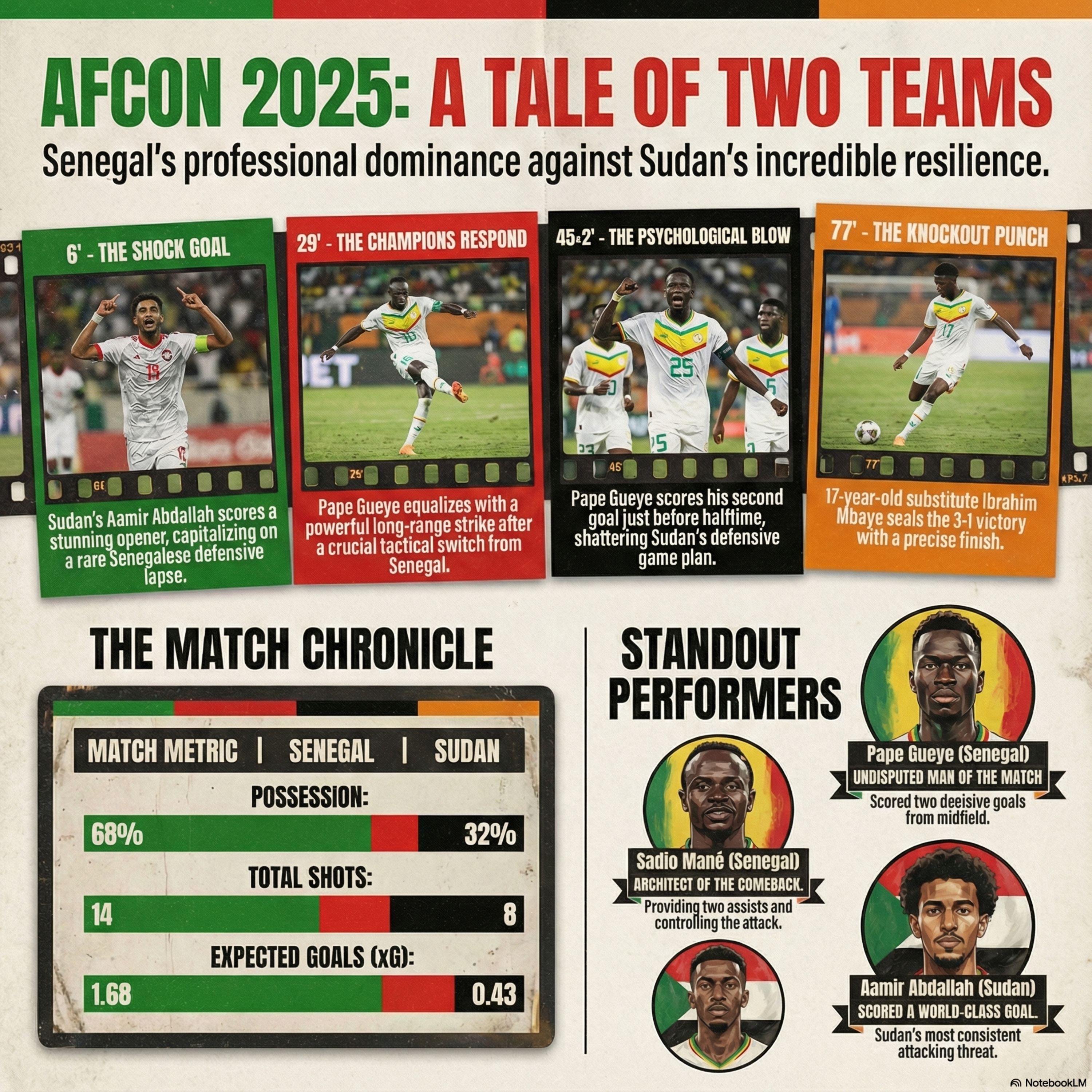
And they executed Florida State the 6th minute. The goal sequence was a masterpiece of opportunism, exposing the exact vulnerability. We flagged Kulibali's absence. It wasn't just the lack of recovery pace, it was the lack of communication, a total structural breakdown. So what happened? Ismael Jacobs, the left back, he momentarily lost sight of his runner. And Musa Nyakate, who is deputizing in central defense, he failed to shift over quickly enough to cover the half space. It created this crucial structural lapse.
Just a momentary gap. That's all it takes, and violin Kadir spotted that seam threading a precise pass right into the channel between the fullback and the center back. Amir Abdallah recognized the opening, made that sharp diagonal run inside. And he received the ball on the edge of the box and what happened next was just unforgettable. He took one touch to cut onto his favored left foot, giving himself just enough space, and then unleashed a world class curling effort that bent around the despairing dive of Edward Mendy and just nestled into the top corner.
Silence in the stadium. One goal, 6 minutes in and the world champions were behind. You have to explore the psychological impact here. For Sudan, they were energized, motivated by the highest possible cause, and they felt justified. And for Senegal, Dung almost humiliated realizing their champions mentality had been punished instantly. The initial vulnerability, that high defensive line without Kulabali's covering speed, was immediately validated and punished by a focused opponent. So Senegal's immediate reaction was to try and elevate the intensity, but Sudan did exactly what they planned.
They retreated, they went into an ultra low block, parking the bus on their 18 yard line and just invited Senegal to try and breakthrough a now galvanized defense. But this is where the Champions mindset and Pape tiles quick thinking came into play. Phase two from about the 15th to the 45th minute, this is where we saw the Champions implement that a decisive mid match correction. You could feel the change from the touchline. Thio, who we rated as an 8.5 out of 10 coach for this performance, demonstrated masterful emotional management.
He didn't panic. He adjusted the plan. Around the 20 minute mark, he signaled for that critical tactical tweak. Sadio Manet was instructed to abandon the left flank fully and operate permanently in that central attacking pocket Zone 14. So he made a non personnel substitution, which is often the most profound kind of change. How did Manny's shift create an immediate and permanent advantage? It instantly achieved the goal of that 235 system. It created A4 VS 3 overload in central midfield. So Manet and the three midfielders were now just dominating Sudan's Central 3.
Yes, and this forced Sudan's defensive wingers, who were supposed to be guarding the flanks, to tuck in drastically to help deal with Manet's central threat. Which in turn finally provided the necessary width for the overlapping fullbacks Diata and Jacobs to run into. The structure of the low block was finally cracking under the pressure. And you could connect that tactical shift directly to the equalizer in the 29th minute. It wasn't just a goal. It was the textbook manifestation of Thea's new philosophy in action.
Absolutely. The sequence started with Manet operating exactly in that central pocket, triggering the gig and pressing mechanism. He aggressively and relentlessly pressed Abu Aglo Mohammed, stripping the ball from him in a dangerous area high up the pitch, right in zone 14. That is the essence of immediate recovery. It wasn't a slow buildup, it was a punishment for a 5 second moment of chaos. Correct. Ane, instead of trying to dribble through, immediately drove forward and laid the ball off to Pip Guy and Guai, finding time and space because Manet had pulled 2 central defenders out of position, took aim from 25 yards out.
And what a strike. A powerful low drive that skidded off the surface and into the corner. It wasn't just a goal. It was the entire coaching plan translated into reality. Discipline under pressure. That tied the score 11, and you have to think about the psychological toll that took on Sudan. They had worked tirelessly for almost half an hour to hold that lead, only to concede to a goal that came directly from a momentary lapse under pressure. So incredibly demoralizing. And that psychological blow?
It became fatal right at the end of the half, 45 + 2 minutes. This was a critical failure of concentration by Sudan. And we have to attribute this to the core issue, the systemic lack of competitive match fitness. Mentally they were strong, but the physical exhaustion was setting in you. Could practically hear the collective sigh of exhaustion from the Sudanese bench when they that second goal went in. Senegal executed a rapid passing interchange on the left flank. Nicholas Jackson drifted wide, intelligently pulling a center back out of the equation, and then he cut the ball back.
And again, it was Pape guy. Pape guy demonstrating incredible timing and stamina for a midfielder. He arrived late from deep, timing his run perfectly into the void created by Jackson's movement. He met the cutback with a first time finish, showing the skill of a seasoned poacher. Two goals from midfield and suddenly it was 21 to Senegal. That goal, scored literally seconds before halftime, was crucial. It effectively killed Sudan's game plan. Their entire structure was built around holding a clean sheet or maintaining that one nil lead.
They could no longer play for containment. The psychological damage was immense. So the second-half phase three, it shifted entirely to game management for Senegal. Completely. They had the lead. They simply reduced the verticality of their passing and began using lateral circulation, moving the ball side to side deliberately. They were using the ball not to score immediately, but to systematically tire the Sudanese players out, forcing them to run and chase relentlessly across the width of the pitch.
Which is where the physical disparity became unavoidable. And that leads us to Section 4, where the power of data and sheer conditioning expose the fundamental challenges facing Sudan and provided a massive lesson for African football development. By the 60th minute, that lack of consistent, competitive league football for Sudan's players, it became fatal. It did, and you could see the visual cues. Players were visibly cramping. They were slower to react, losing individual duels they had easily won in the first half.
And critically, they could no longer sustain the disciplined 15 meter compression of the low block. The gaps just began to widen, making Senegal's life so much easier. This highlights a crucial, unavoidable lesson for African teens dealing with infrastructural or logistical limitations. Physical conditioning is not negotiable. It's not. No matter how strong your tactics or your national spirit, if you cannot sustain the physical demands of modern football past the hour mark, you will be punished relentlessly by elite opposition.
And let's validate this with the quantitative evidence. The statistics reveal A staggering gulf in dominance. Senegal dominated possession 68% to Sudan's 32%. That's total ball domination, pinning Sudan back and just draining their physical reserve. And the expected goals or XG. It tells the story of chance quality. Senegal generated 1.68 XG, meaning the quality of their shots and chances should have yielded, you know, slightly under two goals. While Sudan only managed .43 XG. So Sudan clearly overperformed their XG.
They managed one goal from chances worth less than half a goal, thanks entirely to Abdallah's world class finish, right? But Senegal was clinically efficient, turning their 1.68 XG into three goals. They didn't just dominate the ball, they were efficient in turning possession into clinical match winning action. And the technical gap is even more evident. In the past completion rate. Senegal clocked in at a staggering 86%. That's technical security composure, retaining possession under pressure. And Sudan completed only 68% of their passes.
That 18% difference is massive. It's the difference between structured defense and constant panicked clearances forcing their defensive line to retreat again and again without any relief. That technical floor, that basic ability to maintain possession just to alleviate pressure, it's something Sudan simply couldn't achieve consistently. And it's all down to the lack of continuous high level competition beyond the. As a raw domination, this match also served as a clear indicator of the modernization of the African game through technology.
We saw the seamless integration of semi automated off site technology SAOT. And Sara is vital in eliminating those long waits that so often kill a game's momentum. It uses 12 tracking cameras and sensors in the match ball to provide near instantaneous offside decisions. It was crucial in a couple of build up phases involving Nicholas Jackson. Right. And the goal of using technology like this is clear. Maintain the flow, speed up decisions and raise the professional standard of the officiating. We also saw the necessary, though less glamorous, role of VAR early in the first half.
There was that potentially game changing moment when Senegal appealed for penalty. After his male Asar went down, YES and VAR intervened, detected an oxide in the build up phase well before the incident and correctly overturned the potential penalty. It just demonstrates the increasing reliability and integration of video assistance in these crucial knockout moments. This transparency and accuracy, it raises the technical floor for the whole tournament. For African football to achieve global elite status, efficient use of technologies like SEO and VAR is absolutely non negotiable.
Absolutely. OK, let's shift our focus to Section 5, because while tactics win battles, individual brilliance changes wars, and we have to talk about the man who embodied the comeback, Pep guy who clocked in with an unbelievable 9.2 rating. Kauai delivered a comprehensive box to box master class. He was the engine room of that comeback. He controlled the tempo alongside of Drissiguai, he broke up Sudan's limited counterattacks and then, most impressively, he delivered the finishing product. Analyzed his two goals for US.
One was a screamer from distance, that's the Destroyer creator side, and the other was a poacher's finish from inside the box. That versatility is incredibly rare. It speaks to his tactical intelligence and his stamina. The first goal was the result of quick thinking and pure power, struck low and hard. The second goal, however, demonstrated his positional awareness, making a deep, blind side run that a striker would be proud of, arriving precisely when the cutback was delivered. He was the most complete player on the pitch.
By far. But the architect of the victory, the one who executed the coaching vision, was Sadio Mane, rated at 8.8. His transition to that inverted playmaker role is perhaps the single most significant tactical adaptation of the tournament so far. It's the definition of an elite player, evolving to extend his career and his influence. Manet didn't need to score to dominate this game. His constant, intelligent movement into Zone 14 was the pivotal point that disassembled Sudan's low block. He was pulling the strings, dictating pace, creating numerical advantages.
And the data confirms this creative dominance. His two assists in this one match broke Yaya to raise career AFCON assist record. His tally is now at 9:00. That is a concrete statistical confirmation that he has successfully transitioned from a primary goal scorer to a primary goal creator. This kind of tactical adaptation from a global star is a lesson in itself for emerging African players. You must be versatile and intelligent enough to adapt your role as your physical attributes or the team's needs change for sure.
And now we get to Senegal's embarrassing wealth of talent, the inspired substitution of the 77th minute coach Thea brought on the 17 year old Paris Azerman prodigy Ibrahim Mumbai. This was the Super sub moment. It confirms that squad depth truly is the ultimate weapon, and Thia demonstrated real coaching acumen here. He didn't just rotate players, he identified a specific targeted weakness. What did he see? He recognized that Sudan's left back Bakhit Commies was absolutely spent, exhausted from chasing the game for 75 minutes.
Bringing on and by a direct, explosive pacey winger was the perfect way to exploit that individual fatigue. And Abide delivered the knockout punch instantly. Instantly, his electric pace and composure allowed him to accelerate past the weary defender with ease. He finished with a precise shot into the top corner, scoring 1 of Senegal's youngest knockout goals in Afghan history. That one moment just encapsulates the value of high quality depth. You can only make game changing substitutions if you have Champions League level players sitting patiently on the bench.
It allows the coach to actively manipulate the game state, turning physical disparity into an unrecoverable deficit. Which leads us to the comparison of coaching acumen. Pixie OW earned his 8.5 out of 10 rating not just for the win, but for emotional management and adaptability. Absolutely. His immediate response after conceding, preventing panic and quickly implementing that 20th minute tactical adjustment with Manet was masterful. He successfully navigated the crisis of Kulabali's absence and then ruthlessly exploited Sudan's fatigue with that inspired substitution.
He manipulated the game state to perfection. He did, and on the other side Quasi Appia received a very respectable 7 point O out of 10, which given the circumstances, is a victory in itself. His managerial feat was phenomenal. Phenomenal is the right word. The initial setup, that defensive trap, was perfect. It successfully neutralized and frustrated the undisputed champions for 25 minutes. To get a team of nomads to the round of 16 and lead the African champions for 1/4 of the game is truly upstanding work.
But his limitation was systemic, wasn't it? When the game state changed when they needed a goal or need to absorb pressure, he simply had no tactical levers or quality depth on the bench to pull. Exactly, that lack of conditioning and high level competition among his reserves made fatigue management impossible. It just demonstrates the systemic challenges facing teams operating under those circumstances. Which brings us to Section 6, the crucial moment where we distill the concrete lessons and implications this match provides for the development of the African game across the entire continent.
Let's do it. OK, let's start with the lessons from Senegal. The elite machine lesson #1 has to be the architecture of press resistance through fluidity. The rotation within that midfield triangle, Adrisa Guy, Pigma Tarsar and Pig Guy is a highly professionalized system. They function like a revolving door, ensuring there is always a Freeman carrying the ball forward. It makes them incredibly difficult to press effectively. That high level structural integrity is what allows them to recover from setbacks without losing composure.
Lesson #2 is the champion mentality, the resilience to recover from that shocking early deficit not by panicking or abandoning the plan, but by making precise tactical adjustments and sticking to the core philosophy that psychological strength is what separates tournament winners from mere contenders. And we cannot stress this enough lesson #3 is that squad depth is the ultimate weapon. As Senegal proved with Mbai Dia and Kamara coming off the bench, the ability to introduce fresh legs and high caliber talent is essential for succeeding in the grueling, compressed structure of tournament football.
Fatigue sets in quickly and high quality depth allows you to maintain peak intensity for 90 minutes and beyond. But there is a necessary warning sign even for the Champions that they have to address the early defensive lapse. The communication breakdown between Jacobs and Nyakate that led to the first goal is a huge concentration warning. It is a vulnerability that better structured, higher ranked teams like Morocco or Nigeria would likely punish severely and perhaps repeatedly. Senegal needs constant vigilance in that backline, regardless of who is filling in for Kulabali, because their highline is a deliberate risk.
OK, now let's look at the lessons from Sudan. The defiant spirit. Their performance provides immense inspiration for structurally disadvantaged teams across Africa. Lesson 1. Structural discipline despite adversity. For a team without an active league, they're organized 451 shape, and the commitment to that low block were remarkable. This shows that fundamental tactical discipline can be taught and maintained even in exile. Each shows that foundational coaching structure is possible everywhere. Exactly.
Lesson #2 is the immense value of resilience and those intangible that's spirit. The motivation of fighting for A cause greater than football made them mentally difficult to break down for almost 45 minutes. That intangible strength allowed them to over perform initially and challenge the world's best. And in terms of long term sustainability for Sudan, this tournament provides a critical talent pipeline. The excellent individual performances of players like Amir Abdallah and the goalkeeper Monged El Neil will attract crucial attention from clubs in more active leagues in Egypt, South Africa or even Europe.
That potential talent drain is usually seen as a problem, but in this specific tragic context it is necessary for the national teams long term viability if their domestic infrastructure remains suspended. These players absolutely need match fitness and high level competition to be available and effective for the national team in the future. However, Sudan's ultimate failing highlights lesson #4 the technical floor versus the structural ceiling. The high number of unforced errors in possession in the second-half demonstrates that pure structural discipline eventually fails.
Without the technical security needed to alleviate pressure, you need players who can retain the ball for brief spells to relieve the defense. When your past completion drops to 68%, the pressure becomes relentless and exhaustion is inevitable. This was a match decided by contrasting worlds, but both offered fundamental lessons for the African game. Senegal showed how to win when you were expected to dominate with adaptability and depth. And Sudan showed how to fight when the odds are stacked impossibly against you with discipline and spirit.
The three one scoreline tells the sporting reality, but the deeper analysis reveals A masterful coaching adjustment by Pape, the specifically man named Shift, and the overwhelming impact of physical conditioning and elite squad depth. So Senegal marches on toward the quarterfinal. Their status solidified as the team to beat, but they were certainly given a shock. And they're boosted not only by this hard fought comeback, but by the upcoming return of their defensive pillar Kulabali and the explosive arrival of young talent like Ambey.
And Sudan leaves having written a chapter of resilience that will resonate across the continent, proving that even a team of nomads can achieve structural discipline and challenge the reigning champions to their core. We saw first hand how pit those immediate recovery philosophy that gig and pressing trigger LED directly to the equalizer and shifted the entire momentum of the game. That instruction to counter press and recover possession within 5 seconds. It's not just a tactical instruction, it's a competitive mindset.
So we leave you with this provocative final thought to Mull over. We watched Senegal refuse to accept failure, immediately turning a lost moment into a goal scoring opportunity. What aspect of that champions mindset, that 5 second counter pressing instruction for immediate recovery after a set back, could you apply to your own competitive environment? Whether you're dealing with a lost client, a challenging deadline, or a difficult exam, how could you use it to gain an immediate and crucial advantage?
Think about that quick, relentless response to failure. Until the next deep dive, keep learning, keep analyzing, and keep connecting those dots.
 Apple Podcasts
 Castbox
 Castro
 Goodpods
 Moon FM
 Overcast
 Pocket Casts
 Podbean
 Podcast Addict
 Podcast Republic
 Spotify