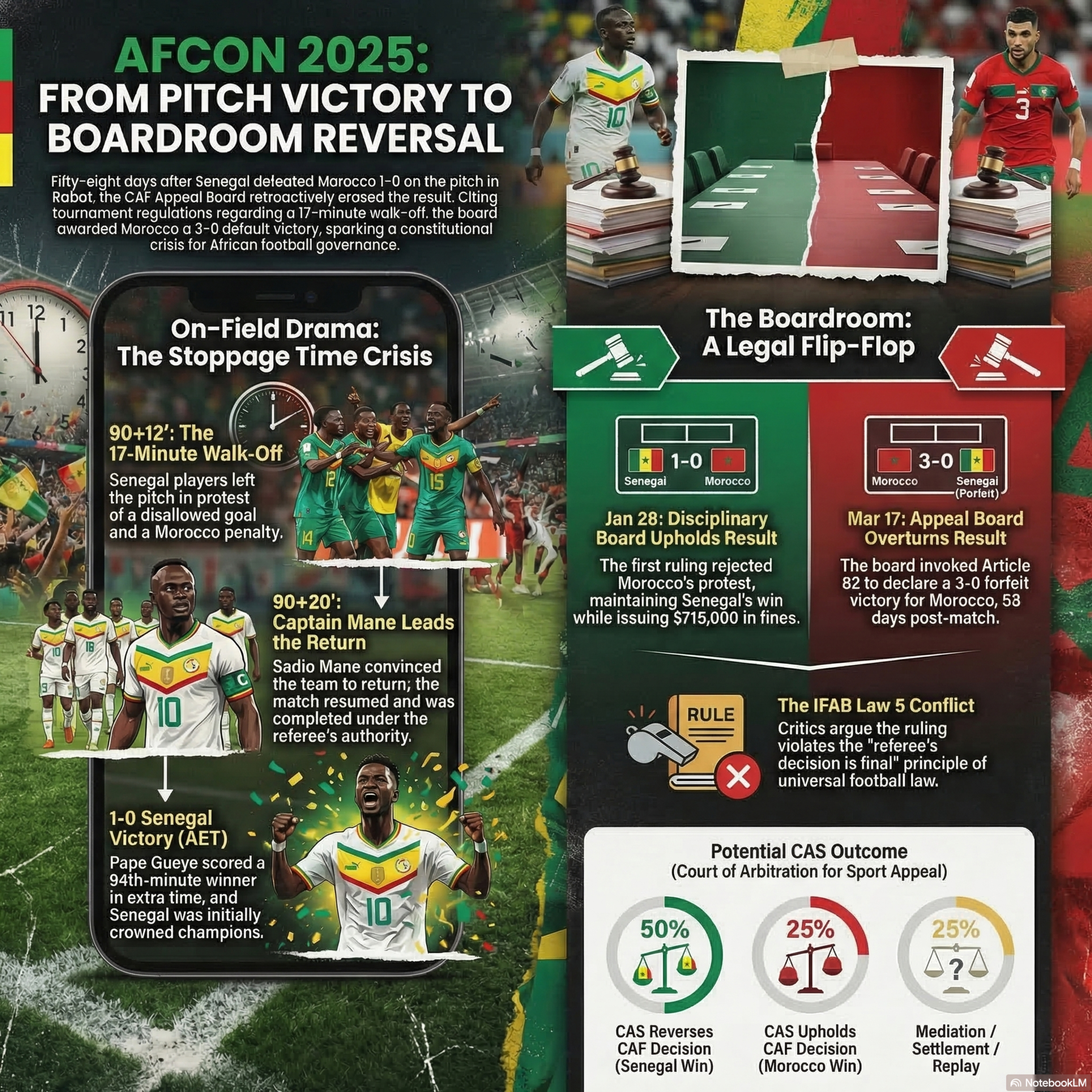
Senegal's AFCON 2025 Title How It was Erased in a Boardroom
About this episode
Senegal's AFCON 2025 Title How It was Erased in a Boardroom
Picture this. You are sitting inside the Prince Moulay Abdullah Stadium in Rabat. Oh wow, what a venue. Right, and you were surrounded by, I mean 70,000 screaming, vibrating fans. The air is so thick with tension you could literally cut it with a knife. Oh, absolutely. So it is the Africa Cup of Nations 2025 final. The whistle blows. After 120 minutes of just pure, unadulterated, exhausting chaos, Senegal lifts the trophy. The confetti falls, you know, burying the pitch in green, yellow and red.
The players are weeping into the grass. The fans are an absolute delirium. It is a moment etched in stone, broadcast to millions, cemented in the physical reality of the universe. Yeah, you saw it with your own eyes. Exactly. But then, exactly 58 days later, the history books are literally erased. Dwight totally clean a. Boardroom ruling stripped the title away. It nullifies the sweat, the tears, the extra time and hands the championship to Morocco. And get this without a single solitary extra ball being kicked on a football pitch.
It's, I mean, it completely shatters our basic understanding of how sports are supposed to work. Yeah. You have a result that was fought for, finalized and celebrated on the grass, which is then systematically dismantled and it's overturned on paper behind closed doors, almost two months after the stadium lights were turned off. And that is exactly why we are here today. We are acting as the voice for you, the silent audience, the fans, the players and, you know, the people who just fundamentally love the sport and are trying to make sense of all this.
Because there is a lot to make sense of. There really is. We are gathering all the accumulated knowledge, all the forensic facts, and the wisdom of what exactly happened here. Our mission for this deep dive today is to systematically walk through this entire crisis. Step by step. Step by step, from the pitch all the way up to the highest, most secretive boardrooms of football governance, we need to understand how a completed final can simply be erased, and more importantly, what we can learn from this incredible stress test to protect the future of our beautiful African game.
Right, but before we even touch the timeline, we have to establish a very strict parameter for this discussion. Oh, absolutely, the ground rule. Yes, the core ground rule, we are navigating incredibly intense geopolitical, financial and emotional dynamics here between the Confederation of African Football, SKF, Morocco and Senegal. Tensions are sky. High, extremely high. So we are not here to take sides. I want to make that perfectly clear. Completely impartial. Exactly. Our entire focus is on unpacking the raw facts impartially.
We're going to explore the structural forces, the legal loopholes, and the administrative architecture at play. We are auditing the ecosystem itself, not the individuals caught inside. It OK, let's unpack this. To really comprehend the boardroom fallout 58 Days Later, we have to start by perfectly reconstructing the final moments on the pitch. We have to go back to the grass. Right, back to the grass. We are going strictly chronologically into the 90th minute that broke football. Let's set the scene.
The score is 0 to 0. We are deep into stoppage time, the 95th minute, so 90 + 5. High stakes. So high Senegal gets a corner kick. Abduli Sarik rises above everyone, heads the ball, it cracks off the crossbar, falls perfectly to his male a SAR and SAR bundles it over the line into the net. An incredible moment. The Senegalese bench completely erupts, but the referee, Jean Jacques Endala from the Democratic Republic of Congo, blows his whistle for a foul just a fraction of a second before the ball crosses the line.
And that fraction of a second, I mean, that is the very first structural domino to fall in this entire crisis. Just because of the timing. Exactly because of the timing, by blowing the whistle before the goal is actually scored and Dolla legally dictated that the ball was dead. The immediate mechanical consequence of that timing is that the Video Assistant referee you know VAR is instantly rendered legally powerless. Wait, hold on. I need to wrap my head around this. We have all these cameras, right?
Everyone in the stadium is looking at the giant screen. Seeing that the contact was incredibly minimal, why can't the guys in the video booth just tell the referee to look at the screen and reverse his own foul call? It seems like they should be able to, but they can't because of the strict protocol that governs VAR worldwide. How so? VAR can only review a goal if a goal has technically been scored during live play. If a referee blows the whistle to stop play for a foul, the play is dead at that exact millisecond.
Yeah. So whatever happens after the whistle, even if it's the ball rolling into the net half a second later, technically never happened in the eyes of the sports laws. That is wild. Because the whistle blew prematurely, the technology that was specifically designed and installed to correct human error was structurally locked out of the process. The system literally paralyzed itself. That has to be the most agonizing loophole imaginable for a player. I mean, you put the ball in the net you see on the replay and it wasn't a foul, but a technicality of timing means the computer isn't allowed to help you.
It's devastating. The frustration for Senegal at that moment must have been just radioactive, but the chaos was somehow just getting started. Oh, it gets much worse. Right, so we jump forward 3 minutes. It is now 90 + 8. Senegal's Al Haji Malikdev gets tangled up with Morocco's Brahim Diaz inside the penalty area. Initially the referee waves play on, but this time he hasn't blown the whistle to stop play prematurely. Which is the key difference? Right, so VAR is active, VAR intervenes and Dollar runs over to the monitor on the sideline and after looking at the screen, he awards Morocco a penalty.
Now to understand what happens next, we really have to look at the physical environment inside that stadium while the referee is standing at that monitor. It was pandemonium. Pure pandemonium. Reports heavily indicate that Moroccan players and team officials actually physically invaded the VAR review area. Which you just can't do. You absolutely cannot do that. That is a massive breach of the referee's protected space. It's an action that later resulted in a massive financial fine for the Moroccan federation.
But it wasn't just the players, the atmosphere turned completely toxic. Yeah, the footage of this is wild. You have green laser pointers being shown in overwhelming numbers directly into the eyes of the Senegalese players to disorient. Them just terrible conditions to play in. But the craziest part is what was happening on the sidelines. The ball boys, who are supposed to be neutral facilitators of the game. Right, they're just there to return the ball. Exactly. But they were actively engaging in psychological warfare.
They were systematically stealing and hiding the hand towel of the Senegalese goalkeeper Edward Mendy. I remember seeing that. It got so bad that Senegal's substitute goalkeeper Yavanduv had to physically leave the bench and intervene just to protect his teammates. Basic equipment. It creates an environment where the game stops being about football and becomes an exercise in survival and intimidation. And this is the pressure cooker that leads directly to the 90 + 12 minute mark. Right 90 + 12 Senegal's head coach Pete Patonatheo has just watched his team's winning goal get erased by a technicality and now he is watching a penalty awarded to the opposing team amidst Blazers, pitch invasions and disappearing towels.
He's had enough. He absolutely snaps. He orders his entire team off the pitch in protest. Unbelievable scene. The players start walking down the tunnel. The Senegalese fans up in the stands start clashing with security. It is total, unprecedented bedlam for a continental final. But amidst all of this retreating, one single man refuses to leave the grass. Yes, Sengal's captain, Saudi Oman. It is one of the most remarkable displays of crisis leadership we have ever seen in modern sports. Mane understands the gravity of the moment.
He really does. He stays on the pitch and spends 17 agonizing minutes practically negotiating with his own team, trying to convince them to return from the tunnel. 17 minutes. 17 minutes. His reported message to the squad was incredibly grounding. He told them, quote, the world is watching. He wasn't dismissing their anger. You know, he validated their frustration with the officiating and the environment. But he insisted that the integrity of the game and their own legacy had to be respected by finishing what they started.
And his sheer force of will actually works. After 17 minutes of a completely empty half of the pitch, the Senegalese team slowly walks back out of the tunnel. Which brings us to the penalty kick itself. Right. Penalty. It is now 90 + 24, a 24 minute delay from the time the foul occurred. Raheem Diaz, who has been the tournament's absolute standout top scorer, finally steps up to take the penalty from Morocco. The pressure there is unthinkable. Think about the psychology here. Imagine taking the final deciding shot in a high stakes championship basketball game, but right as you're about to release the ball, the fire alarm goes off.
Great analogy. You stand there on the court for 17 minutes watching people argue, watching fans riot, watching the opposing coach threatened to forfeit, and then suddenly they tell you, OK, take the shot. Yeah, your ice completely. I mean, no human nervous system is designed to maintain fine motor control through that adrenaline spike and drop. No, the bio mechanics of a football penalty require intense, immediate focus. Diaz, under that unimaginable delayed pressure, attempts a Pennenka. Of all things, a Pennenka.
A very delicate chip shot right down the middle of the goal, assuming the keeper will dive out of the way. Yeah, but Edouard Mendy reads it perfectly, stands his ground and easily catches the ball. The stadium goes dead silent for a split second. The match survives. It goes to extra time, and then in the 94th minute, Senegal's Pap Guy unleashes an absolute screamer from outside the box. Senegal wins 1 to 0. The final whistle blows. Senegal are crowned champions. But let me snap you right there, because this is the detail that the entire 58 day legal nightmare hinges on.
Yes, the referee actually let the game finish when the Senegalese team walked off the pitch. The referee had the power to just end it, right? Yeah. Why didn't he? And why does his decision to let them come back matter so much legally? What's fascinating here is that we have to look at the foundational text of the sport, the IFAB laws of the game, specifically Law 5. OK, Law 5. This is the universal, non negotiable law that applies to the World Cup final and a Sunday League game alike. Law 5 explicitly states that the referee's decisions regarding facts connected with play and the result of the match are final.
Period. Final no debates. Right when Senegal's coach ordered his team off the pitch, referee and Dollar had the absolute, unquestionable legal authority to abandon the game right then and there. But he chose not to. He exercised his designated discretion. He waited it out. He waited the 17 minutes. When Senegal returned, he formally restarted play. He oversaw the penalty, he managed extra time. He awarded A valid goal and he blew the final whistle. By doing that, he legally determined the result on the field of play.
OK, so if the supreme law of the sport says the referee's decision is final and the referee decided to finish the game, how does a boardroom even have the jurisdiction to touch the result? Well, that's the big question. This is where that massive audio leak comes in, right? The Egyptian journalist Kinan Muturaji reported on the leaked audio communications between the referee on the pitch and the VAR room during that crazy 17 minute walk off. Yes, and if that reported audio is accurate, it exposes the internal mechanics of the crisis, according to the league.
Recrean Dalla says into his microphone. They've decided to withdraw. I'll end the match. Wow. So his initial instinct as the ultimate authority under Law 5 was indeed to pull the plug and abandoned the game. But then high-ranking C calf officials allegedly communicated with him via his earpiece. They spoke directly to him. They instructed him to wait. They explicitly told him not to blow the whistle to end the game prematurely. Let me get this straight. The governing body, the people running the tournament, actively interviewed in real time to ensure the match was completed.
That's what the audio suggests. They talk the referee down from abandoning the game, so Senegal returns. The match finishes, a winner is crowned, and the broadcast ends with a champion. But then, weeks later, that very same governing bodies appeal board decides to officially classify the match as an abandonment. It makes no sense. How is that not a massive, undeniable contradiction? You cannot forcefully instruct a referee to save a match in real time, broadcast the final whistle to the globe, and then retroactively claim the match was abandoned in the middle.
It creates a severe legal and logical paradox, and the paradox deepens when you look at how C CAF handled the referee immediately after the tournament. What do they do? On January 29th, shortly after the final, CF officially cleared referee and all of any wrongdoing. They publicly praised his professionalism, his handling of the immense pressure and his integrity for ensuring the final was completed. But doesn't that logically box them in? If CF officially issues a statement saying the referee acted with perfect integrity and followed protocol by finishing the match, how can CF Appellate Wing then turn around and rule that the match shouldn't have been finished?
They can't logically. It is exactly like a corporate boss praising you in a company wide e-mail for working overtime to close a massive difficult deal and then firing you two months later for unauthorized use of company time to sign the paperwork. That's a perfect way to look at it. The contradiction is glaring. And to understand how an organization can simultaneously hold 2 entirely opposing realities, we have to transition from the grass of the stadium to the mahogany tables of the boardroom. We're heading to the offices.
Right. We need to look at the exact chronological legal timeline, because there wasn't just a single sweeping decision. There were two dueling verdicts from two different judicial arms of the exact same organization. Right. Let's look at the first verdict. January 28th, about 10 days after the final, the CF disciplinary board issues their ruling. Morocco had filed a formal protest immediately after the game, demanding the result be overturned because Senegal walked off the pitch. The disciplinary board examines the evidence, looks the laws and they say no.
They reject Morocco's protest. Senegal officially remains the Champions. But it wasn't a free pass. No, absolutely not. They do not let Senegal walk away unpunished. They hand out massive severe sanctions. Senegal gets hit with a staggering $715,000 in total fines. Huge sum, Massive. That covers support or misconduct, the staff's behavior and the team cautions. Coach Theo is handed A5 match ban for initiating the walk off. And Morocco was fine too. Right. Morocco was also punished. They are fined $415,000 for the VAR interference, the laser pointers and the ball boys hiding the equipment.
What the disciplinary board did there was apply the foundational legal principle of proportionality. Proportionality, right? They recognized that a team walking off the pitch, even temporarily, is a severe disciplinary infraction. It threatens the broadcast, the safety of the fans and the integrity integrity of the sport. It deserves massive financial fines and severe suspensions. Which they gave. Exactly. However, they also recognize that because the team ultimately returned and because the match was successfully completed under the referees explicit authority, the infraction did not meet the extreme threshold required to retroactively erase a sporting result.
The punishment was designed to fit the crime. That makes total sense to me. You misbehave, you get fined heavily, your coach gets banned, but the score on the grass remains the score. Exactly. But then we Fast forward to 58 days post match, March 17th, the appeal board steps up to review the case and they completely detonate the disciplinary board's logic. They threw it out. They reverse the decision entirely. They strip Senegal of the title and declare A3 Neuro forfeit victory from Morocco. They cite articles 82 and 84 of the AFCON regulations.
What do those articles actually say? Articles 82 and 84 deal with the specific scenario of a team that, and I quote, leaves the ground before the regular end of the match. The regulations stipulate that if a team abandons a match, they forfeit the game, usually resulting in an automatic 30 loss. The legal ambiguity here is the definition of leaves the ground. Because they did leave technically. Right. But does a temporary retreat to the tunnel followed by a return and the completion of the match constitute a permanent abandonment under the strict text of Article 82?
The disciplinary board effectively said no. The appeal board effectively said yes. But here is the part that I cannot wrap my head around. When the appeal board drops this nuclear option, overturning a Continental final two months later, they publish absolutely zero legal reasoning. None at all. None. Just a media statement with a few bullet points announcing the forfeit. They do not publish a single paragraph explaining why the disciplinary board's interpretation of proportionality was wrong. Which is standard practice to do.
Exactly, they don't explain how a temporary 17 minute delay legally transforms into a permanent abandonment when the referee literally blew the final whistle. How is that allowed in sports governance? Well, the truth is, in any highly developed judicial or quasi judicial system, whether it's a Court of Arbitration for Sport or Uefa's disciplinary bodies, a decision of this magnitude absolutely demands an exhaustive, published and rigorously reasoned written decision. You have to show your work. You have to walk the stakeholders through your logic.
You must explain how you interpret the phrase leaves the ground in the novel context of a team that returned. Crucially, you have to explain how Article 82 interacts with IFAB Law 5 regarding the referee's final authority to restart the. Game then they did none of that. By providing no written reasoning, the appeal board silence is deafening. It doesn't just look opaque, it leaves their decision incredibly vulnerable to being ripped apart upon further legal scrutiny. And the asymmetry of the sanctions in that appeal is staggering.
Morocco is handed the F Con title and on top of that, their previous disciplinary fines are actively reduced. Yeah, that was surprising. The Moroccan player Ismail Sibari, who was heavily fined, has his $100,000 penalty completely removed. The fine against the federation for the ball boy misconduct is slashed in half. Meanwhile, Senegal loses the most prestigious trophy on the continent entirely. I have to ask, what does this actually mean for the rule of law in our African game? If an appellate body can erase a championship without showing their homework, where is the accountability?
That exact lack of accountability is why Senegal immediately announced they're taking this entire case out of CFS hands and escalating it to the Court of Arbitration for Sport, or CAS, located in Switzerland. Big guns. CAS is the ultimate Supreme Court for global sports, and if we want to predict how CAS might look at this Appeal Board decision, we have to look to the past, because CAS actually has a highly relevant, highly controversial precedent involving African football. This is the good stuff.
We have to rewind the clock to the 2019 CF Champions League final. Oh, the 2019 final between wide eyed Casablanca of Morocco and Esperance de Tunis. That match is infamous. Very infamous. Walk us through exactly what happened there, because the parallels and the massive differences to our current situation are fascinating. In that 2019 final, Why Dad scored what they believed was a crucial equalizing goal, but the referee ruled it offside. White ADS players vehemently demanded that the referee go to the monitor and let VAR check the play.
Which makes sense. But in a bizarre twist of fate, the VAR system in the stadium was literally broken. You can't make this up. You really can't. It was experiencing a technical malfunction and wasn't operating because they couldn't get a video review. Why Dad's players refused to continue playing. OK, so another walk off. But here is the critical distinction. Unlike Senegal in 2025, why Dad didn't hold a team huddle in the tunnel and come back after 17 minutes, they refused to play for 80 minutes.
80 minutes. The referee, having waited over an hour and having no other choice, blew his whistle, officially abandoned the game and declared Esperance the winners on the pitch. Right, so the referee ended it. But the boardroom got involved there too, didn't they? Exactly a few days later, C Caps executive committee decided to step in. They tried to order that the match be replayed in its entirety at a neutral venue, essentially voiding the referee's abandonment. Wow, they just tried to hit undo.
But Esperance took that decision to CASCAS, stepped in throughout C caps boardroom order for a replay, and upheld the forfeit against Whydad because Whydad never returned to the pitch. Crucially, CAS explicitly ruled that the administrative arm of CCAP did not have the legal authority to override a referee's field of play decision to abandon a match. OK, so let's line these two cases up side by side. 2019 versus 2026. In 2019, it was an 80 minute walk off. In 2026, it was a 17 minute delay, right?
In 2019, the protesting team never returned to the pitch. In 2026, Saudi Omani brought his team back. In 2019, the referee officially abandoned the game. In 2026, the referee explicitly restarted the game, played extra time, and blew the final whistle. It just hit me. It's a difference between walking out of a restaurant without paying your bill versus stepping outside for a 15 minute phone call, coming back inside, finishing your steak, and paying the tap. That is exactly it. You can't call the police and charge the guy with theft if he came back and finished his meal.
That analogy perfectly isolates the legal discrepancy, and that is exactly why the statistical probability models generated by sports lawyers regarding the upcoming CAS ruling are so heavily skewed. What are the numbers saying? Based on the jurisprudence established in 2019, forensic analysis suggests there is a 50% probability that CAS completely reverses the CAF Appeal Board decision and restore Senegal is the rightful champion. That's a coin flip for total reversal. Exactly. There is roughly a 25% chance CAS somehow finds a way to uphold the CAF decision, perhaps by strictly interpreting the temporary walk off as a fatal breach.
There's a 10% chance they order some unprecedented remedy like a replay, though they hated that in 2019, and a 15% chance this all ends in a mediated behind the scenes settlement before a full hearing. But the core legal logic remains. If CAS was deeply uncomfortable in 2019 with executives overriding a referee's decision to end a match, they're going to be extremely hostile to executives overriding a referee's decision to continue a match. Which naturally leads any observer to ask, how did a ruling with such an incredibly weak legal foundation with 0 published reasoning actually pass inside CAF in the first place?
That's the structural question. To understand that, we have to systematically examine the power structures holding the pen, and I want to reiterate, because this is so important, we are doing this purely by looking at the architectural design of the organization, not accusing individuals of malice. Absolutely. It's about the system, right? We need to talk about the lecture factor. Fuzzy lecture. This man has an extraordinary, almost unparalleled concentration of power within African and global football.
Let me just read this resume because it's staggering. He is the president of Morocco's Football Federation. Simultaneously, he is the 1st Vice President of CF He is a FIFA Council member representing Africa and was elected to that role with 49 out of 52 possible votes. Massive. Unreal. He is the chairman of the Siaka Finance Committee and completely outside of football, he is Morocco's delegate minister for the Budget. When you lay it out like that, you realize it is an unprecedented convergence of administrative, financial and political authority resting in one individual.
It's all centralized and. Structurally, regardless of his personal integrity, this architecture creates an inescapable, massive conflict of interest. We have to look at the mechanical flow of this appeal. Right. How does it actually work? The President of the federation filing the appeal to strip Senegal of the title is simultaneously the financial gatekeeper for the entire confederation that is hearing the appeal. He is the 1st Vice President of that very same confederation. Oh man. When the head of the plaintiff organization is also the direct superior of the judges sitting on the appellate body, the perception of judicial independence is fatally compromised.
Because it just looks bad. And in global sports governance, the perception of fairness is just as vital as the reality of fairness. If the system looks rigged by design, the stakeholders will treat it as rigged. Exactly. We aren't pointing fingers at his character, we are looking at the ecosystems blueprint. How can any 54 member organization function healthily when the referee, the jury, the bank, and the plaintiff essentially all share the exact same boardroom? It creates a huge trust deficit.
How do we build trust in the African game with a structural blueprint like that? Because we are seeing right now that it is causing massive internal fractures. We saw this boil over explicitly at the Sanif Executive Committee meeting in Dar es Salaam. The Dar es Salaam meeting was a watershed moment for C Caf's internal politics. CCAF President Patrice Motsepe attempted to defend the organization against accusations of bias regarding the 2 dueling verdicts. What was his defense? His logic was fascinating.
He argued that because the disciplinary board and the appeal board reached totally opposite conclusions, it somehow proved their institutional independence from one another and from the executive branch. Wow, that is some mental gymnastics. It is rhetorically clever argument if you don't look too closely, but analytically it falls completely apart. True judicial independence is proven by the quality, consistency and transparency of legal reasoning. It is not proven by delivering contradictory outcomes without explanation.
Definitely not. And this defensive posture did not sit well with a member of federations in the room. No, it didn't. Samuel Ito, the legendary striker and current president of the Cameron Football Federation, reportedly stood up in that meeting and confronted Mutsepi directly. Face to face. He demanded direct president to president communication rather than having information and decisions routed through powerful intermediaries. That confrontation completely exposed a deep widening fracture within CAF.
You have a massive trust deficit, a clearly perceived divide between the highly influential North African federations and the sub-saharan African federations. And that very same meeting in Dar es Salaam dropped another bombshell that completely undermines the appeal board's ruling. Oh, right, the referee Commission, Yes. The head of the referee Commission reportedly revealed to the executive committee that during the final, the match officials were actively explicitly instructed not to issue yellow or red cards to the returning Senegalese players for their walk off.
Wait, really? Yes, the instruction from the top was to manage the situation diplomatically so the match could finish without further incitement. Let me make sure I'm hearing this right. The administration instructs the referee not to legally punish the players on the pitch so the game can be successfully finished. That's what was reported. And then two months later, that exact same administration's appeal board punishes the team by stripping their title because they walked off. Yes, that is institutional whiplash of the highest order.
It's absolute madness. And the collateral damage from this boardroom whiplash is immense. This isn't just about a silver trophy sitting in a glass case in Rabat or Dakar. It goes so much further than football. This single decision is rippling out, creating profound damage across the continent and the globe. First and foremost, we have to talk about the human cost. There are 18 Senegalese fans currently sitting in a prison in Morocco. This is where a bureaucratic sporting dispute tragically bleeds into devastating real life consequences.
These are mental people. Exactly 18 individuals were arrested in the stands during the chaos of the final. They have been tried and sentenced by Moroccan courts to prison terms ranging from three months to three years. Just for being at a football match. Well, the charges relate to hooliganism, destruction of property and pitch invasion. But the defendants adamantly deny the charges, claiming they were reacting to heavy-handed security during the walk off. It's just a nightmare for them. Meanwhile, their families back in Senegal are left devastated, struggling to pay for basic food and school fees because they're breadwinners are incarcerated overseas over a football match.
It is escalated far beyond sports. Even the politicians got involved. Senegal's Prime Minister Uzman Asanko has had to publicly intervene. He called the sentences deeply regrettable, noting that for two nations with such deep historical, cultural and diplomatic alliances, this dispute has gone dangerously too far. It is a tense bilateral diplomatic crisis right now and the collateral damage doesn't stop there. It hits the geopolitical and commercial spheres incredibly hard. Morocco is supposed to Co host the 2030 World Cup alongside Spain and Portugal.
Right, that's a massive deal for them. Morocco was pushing incredibly hard, investing billions in infrastructure to host the actual World Cup final in Casablanca, but because of this AFCON chaos, the president of Spains Football Federation, Rafael Luzon, saw an opening. And he took it. He successfully lobbied FIFA and the organizing committee to move the final to Spain. He explicitly cited reputational and governance concerns stemming directly from how this AFCON match was handled. That is a devastating multibillion dollar blow to Morocco's football diplomacy.
It's an incredible self-inflicted. Wound They built world class stadiums to showcase their nation and a boardroom ruling gave their Co hosts the ammunition to take the crown jewel away. It perfectly highlights the paradox of the appeal board's intervention. Morocco won the short term administrative battle to claim the 2025 Afghan title. But in doing so, they provided the exact leverage needed to lose the much larger generational strategic prize of hosting the World Cup final. Global football stakeholders, broadcasters and FIFA executives watch these governance crises very closely.
They crave stability. And that brings us to the commercial ecosystem. The money side of things. On paper, AFCON 2025 was a massive commercial triumph. They triple their sponsor roster to 36 global brands, but right now those massive multinational brands are looking at what corporate lawyers call regulatory uncertainty. I see exactly where you're going with this. If I am the marketing director for a global brand and my company pays 10s of millions of dollars to sponsor a live sporting event, I am paying for the real time.
Drama, you're paying for the live eyeballs. I am paying for the eyes on the screen during the 90 minutes. If you tell me that the result of the tournament can just be flipped 58 days later by a committee and a closed room, what exactly am I sponsoring? Is it a game or a scripted reality show? Right. Am I sponsoring a real competition or am I sponsoring A provisional exhibition that might be rewritten? It absolutely plummets the commercial value of African football. Broadcasters paid for a definitive event, and it's deeply tragic for the players too.
Whether you're Sadio Mane losing a title you physically bled for on the grass or your Brahim Diaz being handed a trophy, you know deep down you didn't win an open play. It strips the soul entirely out of the achievement. It makes the athletes pawns in an administrative game. That is the ultimate most corrosive cost. It fundamentally devalues the labor and the physical sacrifice of the athletes. When players realize that their excellence on the pitch can be nullified by a boardroom appeal based on unpublished reasoning, the incentive structure of the entire sport is compromised.
If morale just tanks. The psychological weight placed on both squads right now is immense. We are seeing Senegalese players openly mocking the C CAF decision on social media, treating it as illegitimate and the federation is refusing to physically hand back the trophy. I don't blame them. On the other side, Moroccan players are placed in the incredibly awkward position of celebrating a title that carries a massive, unavoidable administrative asterisk. This there's no one sporting integrity. It diminishes everyone involved.
So we have systematically diagnosed the disease. We see the symptoms everywhere. Now. How do we actually cure it? We have to look forward. How do we fix the structure to benefit the African game moving forward because the stakes are only getting higher. C CAF President Mutsepa has just announced a massive scheduling shift, moving the AFCON from its traditional 2 year cycle to a four year cycle starting in 2028. How does that change the landscape? That shift to a four year cycle fundamentally alters the risk profile and the economics of the entire tournament.
Because it's rarer now. If the Africa Cup of Nations is only played every four years, each individual tournament becomes exponentially more valuable. The political stakes, the broadcast rights, the commercial sponsorships, everything skyrockets. So you can't afford a mess up? Exactly. This means that the tolerance for the kind of governance failure we just witnessed drops absolutely TO0A biennial tournament played every two years can somewhat absorb a controversial, messy addition, because the next one is just around the corner to wash the pallet clean.
But a four year gap? A quadrennial tournament cannot A failure on a four year cycle stunts the continents football momentum for half a decade. Furthermore, moving to a four year cycle severely restricts the development pipeline for talent in smaller African nations. Countries that don't regularly qualify for the World Cup rely on the AFCON as their primary vital stage for global exposure and player development. If you make it rare, you have to make sure the governance is bulletproof. OK, so if the stakes are essentially doubling, the rules need to be ironclad.
What are the specific structural reforms required right now to prevent 2025 from ever happening again? First and foremost, CAF must implement a true, robust separation of powers. They must structurally separate their executive committee from their disciplinary and judicial bodies. That seems like common sense. You'd think so, but you simply cannot have active Federation presidents who are heavily invested political actors within CF also holding influence or hierarchical superiority over the appellate judges.
We need an entirely independent judicial model. Like other sports have. You look at the International Criminal Court or Uefa's Club Financial Control Body Court. The judges are fiercely independent, insulated from political pressure and they publish exhaustive legal reasoning for every single decision. Second, we need real time dispute resolution protocols codified in the laws. The ambiguity of Articles 82 and 84 must be rewritten immediately. Referees and match commissioners need explicit real time slow chart guidelines on how to handle walk offs versus abandonments.
So they don't have to guess. So that the fate of a match is definitively decided on the night it is played, not two months later by a committee. I completely agree on the separation of powers, but what about the technology? We have VAR, we have goal line tech, we have dozens of cameras. Why didn't the tech save us here? Because technology is entirely useless if the human governance wrapping it operates in the dark. We need mandatory public release of VAR decision logs and audio recordings, just like the English Premier League has recently implemented.
If the fans in the stadium and the federation's watching at home can hear the referees rationale and the VAR room's input in real time, it instantly neutralizes conspiracy theories and backroom deals. Just air it out. Transparency is the only currency that buys institutional credibility. You can install all the electronic performance and tracking systems, the EPTS in the world to measure player speed and ball physics, but if the final ultimate decision on who wins the trophy is made behind closed doors with absolutely no published reasoning, the multimillion dollar technology is just expensive set dressing.
It's an illusion of fairness. OK, let's step back and look at the incredible journey we've just taken through this deep dive. The AFCON 2025 final was supposed to be a spectacular, breathtaking footballing event. And for 120 minutes, it really was. It was, but it was completely overshadowed by a catastrophic governance failure. The ball was kicked. The screamer of a goal was scored. The players, despite the chaos, returned to the pitch to honor the game. But the system itself completely failed to protect that result.
Failed at every level. We saw referees final on field decision essentially overridden, a proportionate disciplinary ruling inexplicably reversed, and an entire continental ecosystem thrown into diplomatic and commercial chaos by a boardroom holding an eraser. It serves as a stark, unavoidable reminder that the strength of any sporting competition is only as robust as the institutions governing it. African football has the raw talent, it has the unmatched passion of the fans, and it is rapidly building the physical infrastructure to rival any continent on earth.
But until it builds an unimpeachable, transparent and structurally independent governance model, administrative crises like this will continue to threaten and undermine the incredible progress being made on the grass. So as you sit down to watch the next major tournament, whether it's here in Africa or anywhere else in the world, I want you to ask yourself this one lingering question. When we introduce more and more advanced technology to make the game perfect on the pitch, are we accidentally giving boardroom executives the exact complex loopholes they need to rewrite history off the pitch?
Something to think about. Because until we fix the humies in the suits, the robots on the grass cannot save us. Thank you for joining us as we unpacked the beating heart and the current structural growing pains of the African game. Keep questioning the systems, keep learning, and we'll be back next time to dive into the next great story.
 Apple Podcasts
 Castbox
 Castro
 Goodpods
 Moon FM
 Overcast
 Pocket Casts
 Podbean
 Podcast Addict
 Podcast Republic
 Spotify