Senegal 4-0 Morocco U15 Boys National Teams Tactical Autopsy
About this episode
Senegal 4-0 Morocco U15 Boys National Teams Tactical Autopsy
Four nil. I mean, in a continental semifinal, when you hear a score line like that, your brain immediately jumps to 1. Conclusion. Oh yeah, absolutely. Yeah. You just assume it's a blowout. Right. You assume it was a total mismatch, like men against boys. You picture one team packed with, you know, future global superstars and another team that just, well, they just got completely lucky to even reach that stage of the tournament. Yeah, you assume one team simply didn't belong on that pitch. Exactly.
But what if I told you that wasn't the case at all? What if I told you that the team on the receiving end of that four nil hammering actually possesses some of the most undeniably gifted technical youth players on the entire continent? I mean, it completely flips your understanding of the game on its head, and that is exactly why this particular match is so fascinating to dissect. It really is. So I want you, yeah, you listening right now to imagine for a moment that we are sitting in the back row of a master class us in a room full of the top Academy directors, tacticians and like sporting architects from across the continent.
Like an exclusive briefing. Yeah, exactly. We are a silent audience soaking up an absolute goldmine of tactical intelligence. Today we are tearing into the forensic analytics from the African Schools Football Championship semifinal, Senegal U15 versus Morocco U15. And it is quite a deep dive, let me tell you. Oh, it's massive. But let me be crystal clear right out of the gate here. We aren't just here to read out a box score, you know. We are here to absorb the raw, unfiltered truth of what happens when massive pressure meets tactical structure.
Yeah, so we can find the blueprint to benefit and elevate our African game to the global pinnacle. Spot on. We are moving forward step by step today. No looking back. So OK, let's unpack this. Where do we even begin to make sense of a four nil result between two highly rated academies? Well, we begin by looking at the anatomy of a match state collapse, because when you're dealing with under 15 players, you're essentially looking at raw clay. Right, they're still figuring it out. Exactly. These athletes are still being molded.
Their habits are forming. So when a match ends 4 nil at this elite level of continental competition, it provides us with this like high definition, unvarnished look into the structural realities of youth development. It's like an X-ray of their tactical system under stress. That's a great way to put it. It shows us exactly what happens when immense psychological and physical pressure is applied. Our goal is to extract the developmental blueprint from this wreckage. Because it is wreckage. I mean 4 Nell is a demolition.
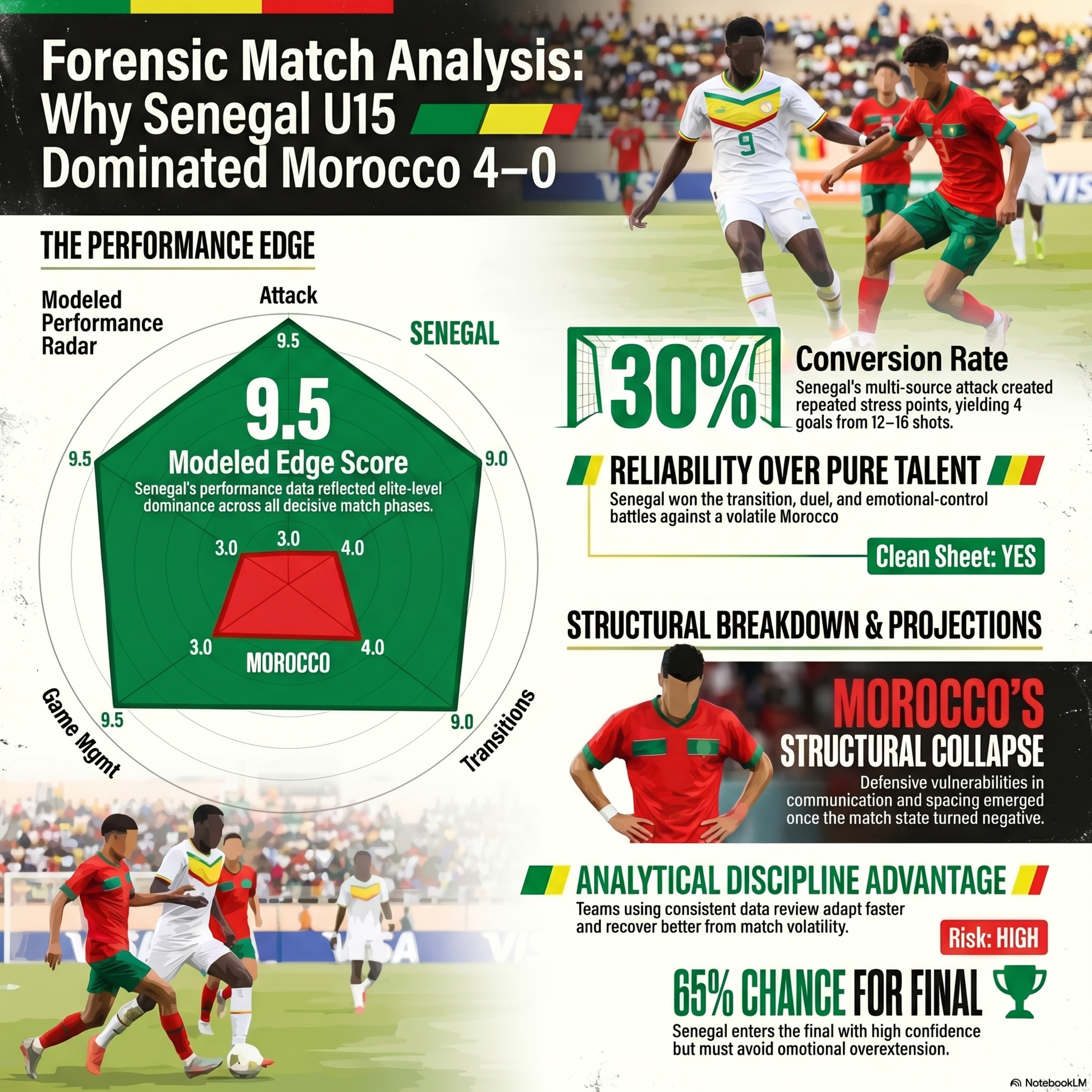
It is, but it's a blueprint that can and should be applied to academies from Dakar to Casablanca, you know, from Legos to Johannesburg. Yeah, for sure. And the analytics we're looking at today, they use this specific modeling system, Afritech, which takes all the underlying data of a match and generates an overall edge score. It measures like true dominance. And the numbers for this match are wild. They really are. Senegal walked away with an edge score of 9.5 out of 10. I mean, that number feels impossibly heavy.
That isn't just winning a game. That's that's total suffocation. It is a profoundly dominant metric. A 9.5 indicates that Senegal didn't just capitalize on a few lucky bounces. You know, they control the geography, they controlled the tempo and they controlled the physical reality of the pitch. Right. They own the whole ecosystem out there. Exactly, but the data points to a very specific reason for this dominance, and it revolves around what we call the first big swing. The first big swing. OK, break that down for me.
Yeah, so in any football match, but especially in youth knockout tournaments where emotions are incredibly raw, there is a hinge moment, a moment where the psychological momentum of the game dramatically shifts. Like the first goal basically. Usually, yes, and the analytics show us that. In this semi final, the match tilted incredibly early. Senegal struck and that early swing created an intensely negative match state for Morocco. And a negative match state, I mean, that just means you're playing from behind, right?
It means the game plan has to change because you're suddenly chasing the game. It means that, yes, but it implies something much more dangerous, which is high volatility. When Morocco went down, they didn't just trail on the scoreboard. Their entire structural stability became highly volatile. Oh wow, so they panicked? Essentially, yes. They suffered an emotional and tactical collapse, and crucially, they never managed to hit the reset button. The tactical scaffolding that their Academy had spent years building basically just gave way under the psychological weight of that early deficit.
Wait, hold on. A four nil loss? Are we absolutely sure this is a systemic failure? I mean, sometimes A-Team just doesn't click on a Tuesday afternoon, you know? That's a fair question. Like a striker hits the post, a center back slips on the turf, the keeper has the sun in his eyes. Why are we treating this like the foundation of their entire footballing philosophy crumbled? Can't we just say hey, Morocco had a bad day at the office? It feels like trying to build a beautiful house on a foundation of sand.
It looks great until the 1st storm hits. I love that analogy, actually, And we can say it's structural because of the nature of the data we are seeing. The analytics explicitly emphasize that Senegal won three very specific things. They won the transition battle, they won the dual battle, and perhaps most importantly, they won the emotional control battle. The emotional control battle at 15 years old, that's huge. It's massive. It wasn't just that they ran faster or shot harder on the day they dictated the temperature of the match.
If we connect this to the bigger picture, this is perhaps the most vital lesson for youth football on the African continent right now. Because culturally we are so often mesmerized by raw, God-given talent, right? We look at a 14 year old with brilliant footwork who can juggle a tennis ball barefoot and we think the developmental job is done. Oh totally. We just assume talent equals winning. Exactly, but the data from this 40 result exposes A reliability gap, not a pure talent gap. For African Youth Academy, is building reliability variable?
Emotional control is just as vital as building technical skill. A reliability gap. Man, that is such a great term. Yeah, because Morocco possesses undeniable technical quality, their youth setups are renowned worldwide for producing incredibly gifted, press resistant ballplayers. However, their technical structure simply could not hold its shape once the match state turned negative. Right, it just completely dissolved. Yes, reliability in football means your system operates identically. Your distances remain the same, you're pressing triggers remain the same whether you are winning one nil or losing 1 nil.
Morocco severely lack that structural reliability under stress. That makes total sense. I mean, you can have the most technically gifted central midfielder on the planet, right? But if his spatial awareness completely evaporates the absolute second his team goes down a goal, if he starts chasing the ball like a golden retriever instead of holding his zone, that elite technical skill is effectively neutralized. Exactly. You cannot pass your way out of a problem if you aren't standing in the right place to receive the pass.
Right. And Senegal's foundation, by contrast, was just bedrock. When we look at the model performance radar for this match, I mean, the visual disparity is staggering. It's a clean sweep on the radar. It really is. Senegal completely eclipsed Morocco across every single measurable phase. In attack it was 9.5 to 3, in defense 8.5 to 3.5, in transitions a massive 9 to 4, and in game management a 9.5 to 3. Senegal didn't just edge out of victory, they suffocated the the opposition in every geographical and tactical zone of the pitch.
Yeah, it's a total eclipse. Every single metric on that radar is a dominant green bar for Senegal and just the struggling, sad red bar for Morocco. It paints a very clear picture of dominance. So knowing that Senegal owned the overall landscape, let's move forward and systematically transition to how exactly they inflicted this damage, because an attack score of 9.5 doesn't happen by accident. No, it certainly does not. And it doesn't happen just because the other team is stressed out. The data points out that Senegal's frontline created repeated agonizing stress points for the Moroccan defense because they were what the analytics called multi source.
Right, multi source attacking. That is the hallmark of a highly evolved tactical system. OK, So what does that actually mean for the guys on the pitch? To understand why it's so devastating, you have to look at what usually happens at the U15 level. In most youth matches, you see a heavy reliance on a single dominant player. Yeah, give it to the fast kid. Exactly. The team gets the ball, they look for their fastest winger or their biggest striker and they just feed that one source of danger over and over.
What we saw from Senegal was entirely different. It was a sophisticated multi layered threat. So they weren't just lumping it forward to a target man. Not at all. It wasn't just a striker looking for a ball over the top, it was runners penetrating the half spaces. OK, for those in our silent audience who might not use that specific jargon every day, breakdown the half spaces for us. Why is penetrating them so vital? Sure. Think of the football pitch divided lengthwise into five lanes. You have the two wide lanes out by the touch lines, you have the center lane running straight down the middle of the goal, and then you have the two lanes right in between the center and the wings.
OK, so those in between lanes are the half spaces? Precisely those are the half spaces, and they are the most dangerous real estate in modern football because they exist in the seams of a traditional defense. The. Seams right? Yeah, if an attacker receives the ball in the half space, A center back has to decide whether to step out of the central zone to engage, which leaves the gap right in the middle, or the full back has to tuck inside, which leaves the winger wide open. Man, so they are forcing the Moroccan defenders to make impossible choices.
Exactly. You're putting them in a lose, lose situation and Senegal had runners constantly attacking these scenes. That sounds like a nightmare to defend. It is, yeah, but it wasn't just the runners in the half spaces. They had finishers operating clinically inside the box and crucially, they had a second wave of midfield support arriving at the exact right moment to sustain the pressure or win the second ball. Ah, so comes in waves. Yes, they were attacking in distinct timed waves from different angles and utilizing different profiles of players.
This creates a massive cognitive overload for the defending team. I can imagine. A 14 year old defender simply cannot process that many overlapping threats simultaneously. They can't just man mark one star player out of the game because if they commit two men to the striker, the second wave midfielder is already running into the space they just vacated. Wow, it sounds like Morocco was out there fighting with a traditional single blade sword. You know exactly where the swing is coming from, and if you can just block that one blade, you are safe.
That's exactly how they played. But Senegal was attacking like a hydra. You chop off 1 head, you tackle the primary striker and two more runners just bite you from the blind side. How do we teach this multi source mentality in grassroots African football instead of just relying on one star kid to dribble past everyone? Well, I love that hydra analogy. It's perfect. And to answer your question, we have to look at platform play. The analytics heavily contrasts Senegal's hydra with Morocco's attack.
The data explicitly states that Morocco never found stable platform play and that their attack became entirely reactive. Reactive. So they were just improvising, yes. Once they were trailing, the quality of their chances dropped sharply. They had moments of territorial pressure, certainly, but they had absolutely zero return. It was the difference between structured, systematic creation and desperate improvisation. So what does a reactive attack actually look like on the pitch for a youth team? I mean, if I'm watching this game from the stands, how do I know their attack has become reactive?
You see it in the shot selection of the passing angles. When an attack becomes reactive, it means the players are no longer trusting or executing a pre planned offensive structure. They are merely reacting to the defensive shape of the opponent, usually with highly forced actions. Like taking wild shots from miles out. Exactly that. You will start to see talented midfielders taking low percentage, desperate shots from 30 yards out because they are frustrated. You will see players forcing passes through incredibly crowded central areas instead of circulating the ball to shift the defense.
Right. Hero ball. They just try to do it all themselves. Yes, they start relying on individual brilliance, trying to dribble past three players rather than collective problem solving. Senegal's clean sheet in this match is highly significant because of this. It tells a story all on its own. It tells us that despite Morocco having the ball and applying pressure at various points, Senegal's defensive structure effortlessly forced Morocco into those highly inefficient attack in areas. Morocco just could not convert their possession into any meaningful threat.
And. When we look at the clinical output from Senegal to contrast that, I mean it is terrifyingly efficient. The models estimate they generated between 12 to 16 quality shots in the match, with a massive 30% modeled conversion rate. 30% is elite. Right. In any level of football, let alone youth continental semifinals, a 30% conversion rate is just surgical. That efficiency is what led directly to the four goals. They didn't need to pepper the Moroccan keeper with 40 shots. You know, they just buried the ones they created.
What was the underlying mechanism driving that ruthlessness? Well, the data emphasizes a specific phrase here. It says Senegal were both more direct and more efficient once they entered dangerous zones. OK, but direct? I feel like that word gets a bad rap. It does. It gets misunderstood constantly. People hear direct and they think of old school Route 1 football just lumping long balls up to a big striker. Yeah, exactly. Kick and rush. Right, but that is not what Senegal was doing. Being direct in this analytical context means eliminating unnecessary touches.
It means having a clear vertical aggressive intention, the absolute second you break into the final third. So it's about speed of thought, yes. When Senegal got into the penalty area, there was no hesitation. There was no over elaboration or trying to like walk the ball into that. The decision making was crisp and immediate. And I imagine that ties directly back into the multi source attacking you described earlier. It absolutely does because they had runners attacking different zones and half spaces simultaneously.
The Brock and Defenders were constantly instantly having to frantically adjust their body shape and their field of vision. Because they're looking over their shoulders at all these runners. Exactly, and when a defender is turning their head to track a runner, their hips are usually out of alignment. That microsecond of defensive imbalance is all to and crater. A Senegalese forward needs to open up a high probability shooting angle. Senegal's efficiency wasn't just because they had great shooters.
It was because their movement created phenomenally clean looks at the goal. Precisely, their system did the hard work for them. So bringing this back to the academies on the continent, to shift from a one source individualistic attack to a multi source hydra like attack, Academy directors have to completely restructure how they evaluate and reward players and training don't they? Yes, 100%. You have to prioritize stable attacking structures, what we call platform play, in your coaching methodology.
Which means telling the star player he needs to pass more. It means teaching the 14 year old winger that the darting run they make away from the ball, the decoy run that drags the center back just two yards out of position, is mathematically just as as valuable to the team as the final shot. Wow, even if they never touched the ball in that play. Exactly because that decoy run is the platform that allows the number 8 to arrive in the box entirely unseen. As a coach, you have to pause the training session and actively applaud the structural discipline and the collective movement rather than just cheering for the kid who completes 10 step overs.
I love that applauding the unseen run. It totally rewires a young player's brain to value the system over their own, you know, personal highlight reel. It builds a mature team mentality and Senegal's U fifteens proved today that this level of collective attacking intelligence is not beyond young players. It can be taught and it can be executed brilliantly. OK, so Senegal's multi source attack was devastating. They cut through the opposition like a hot knife through butter. But an attack is only as lethal as the defense allows it to be, right?
That's a fundamental truth of the game, yes. Yeah, right. Senegal didn't just magic those four goals out of thin air. They were invited into those dangerous areas because the Moroccan structure effectively rolled out the red carpet. So let's systematically move to the other side of the pitch and look at why that happened by diving into the defensive autopsy of Morocco. Yes, and autopsy is definitely the correct word here because we're looking at a fatal structural collapse under stress. The numbers here are grim.
Very grim. The analytics present us with a vulnerability index from Morocco that is incredibly telling. Remember, these scores reflect their state, specifically under stress, meaning after that early negative swing we talked about. Right after they went down a goal. Exactly. Their highline scored an 8 out of 10 in vulnerability. Press resistance was A7, transition defense was a massive 9, defensive errors were at an 8, and communication broke down completely, also scoring an 8. I mean, those numbers are just flashing red lights across the board.
A nine in transition, defensive vulnerability against a team like Senegal who we already know excels in transition, that's basically a death sentence. Really is. But the data makes a very specific distinction here that caught my eye. It calls these gaps structural, not cosmetic. What is the fundamental difference between a structural gap and a cosmetic gap when we're analyzing a defense? It is arguably the most vital distinction in post match analysis and honestly confusing the 2 is how managers get fired.
Oh wow. OK, break that down. A cosmetic defensive gap is an isolated individual error. Imagine a scenario where a team's defensive shape is absolutely perfect. The midfield is compact, everyone is communicating, but a center back simply slips on a wet patch of grass, allowing the striker to go through and score right. Or like a keeper just fumbles a really easy catch. Exactly. It's unfortunate results at a goal, but the underlying system, the actual tactical idea, is still intact. If you replay that exact scenario 99 times, the system holds.
That is a cosmetic error. So a structural gap is when the underlying system itself is broken. Exactly. A structural gap means the platform itself fails, regardless of individual execution. It means the distances between the midfield line and the defensive line are fundamentally incorrect. The spacing is just all wrong. Yes, it means the pressing triggers are disconnected, so one player presses while the rest of the team drops back, creating massive voids of space right in the middle of the pitch.
Which is exactly what happened to Morocco. Yes, when the analytics say Morocco's defensive platform looked vulnerable under stress, it means the very architecture of their defense cracked. The building didn't just have a broken window, right? The foundation split wide open. Man, that's heavy. Let's breakdown that architecture. Because the data maps out four distinct layers of this defensive breakdown, it proves that this wasn't just one thing going wrong in the final third. It was a cascading sequential failure starting all the way up the pitch.
It was a domino effect. Right, so walk us through layer one. Layer one is the very first line of defense, which in modern football is the attacking phases counterpress. The analytics revealed that Morocco's pressing simply did not protect territory early enough. Because they were too slow to react. Yes. When you lose the ball, your immediate reaction dictates everything that follows. If your front 3 lazily jog back into position, or if they presses disconnected individuals rather than a cohesive synchronized unit, the opposition can easily bypass that first layer with a single pass.
Which gives Senegal basically a a free pass to move forward. Exactly because Morocco failed to engage effectively high up the pitch. Senegal was allowed to progress the ball into the middle third without facing any significant resistance. Morocco surrendered that crucial territory far too cheaply. Which instantly exposes layer 2 right the midfield shield because if the forwards don't press, the midfielder suddenly have runners coming right at them at full speed. Exactly, you're exposing your midfield to a full on Sprint.
And the data here is brutal. It says the Moroccan midfield shield looks second best in duels and recovery runs. Once Senegal bypassed that week. First press they were We're running at full speed into a midfield that couldn't win the physical or tactical battles in the center of the park. The midfield shield is supposed to be the breakwater, you know. Its primary function is to absorb the kinetic energy of an opposition transition. To slow them down. Exactly. But if your central midfielders are consistently losing their individual duals, or if they lack the engine and desire to make high intensity recovery runs to get back into a low defensive block, well, that transition wave just washes right over them.
It just rounds them. It does, and that failure at layer 2 is what directly creates the catastrophe at layer 3, which is the back line. Right, because if the midfield is beaten, the center backs are suddenly staring down the barrel of a multi source attack with 0 protection. Precisely because the midfield shield evaporated, the Moroccan backline was constantly facing Senegalese runners who had an abundance of time and space to pick their passes. Which is terrifying for a defender. Oh absolutely. The data highlights severe spacing and communication breakdowns among the Moroccan defenders in these moments, and frankly, you can totally understand why.
Yeah, I'd be panicking too. Right when a 15 year old center back sees an attacker running at him at full speed with absolutely no midfield pressure on the ball, sheer panic sets in. The center back has to make a split second decision. Do I step out to pressure the ball carrier or do I drop off to protect the space in behind? And under that kind of stress, they make the wrong choice. Almost every time they step out when they should drop, they drop when they should step out. The distances between the full backs and the center backs stretch out, creating these massive gaping corridors for Senegal's runners to exploit.
Wow. And then we reach Layer 4, the final tragic stop in this cascading failure, the goalkeeper. Now here's where it gets a really interesting because the data gives a very measured warning. Here it states that without full multi angle goal footage, assigning blame to the goalkeeper should stay measured. Which is incredibly smart analysis. I think it's a brilliant point because general football culture loves a scapegoat, right? Fans, pundits and even grassroots coaches. They love to immediately point the finger at the goalkeeper or the center backs for a four NIL loss.
Oh, always. It's the easiest thing to do. Yeah, they look at the final score on the screen and instinctively blame the guys standing closest to the net. But based on this autopsy, the house was already entirely on fire at layer one and layer 2. If the pressing fails completely and the midfield shield is essentially non existent, the defenders and the goalkeeper are basically just sitting ducks. They are, and it exposes A fundamental flaw in how many people, I mean even professionals, watch the game.
They only react to the final visible action. They only see the end product. Exactly, they see the keeper miss a save and they say well he cost us the game. But defending is a connected 11 man ecosystem. If the striker doesn't press with the correct intensity and angle at layer 1, the goalkeeper at layer 4 is mathematically more likely to concede a goal. That is wild to think about. The fire started at the very front of the pitch. It did for African academies. The massive take away here is that you absolutely cannot coach defending as a series of isolated, desperate tackles by your center backs.
You have to teach defending as a connected 11 man ecosystem. Not just isolated tackles at the back. Exactly. The entire team must move like a single breathing Organism to compress space and deny territory. Morocco failed to act as a connected ecosystem under stress, and Senegal simply dismantled them layer by layer. It's a sobering realization honestly, to realize your strikers laziness is why your keeper is picking the ball out of the net. But it's an incredibly empowering concept. If a coach can successfully implement it, it connects the team.
It builds total accountability. Yeah, exactly. So OK, we've seen how Senegal's multi source attack broke through Morocco's cascading defensive failures, but getting a one nil or two nil lead is only half the battle. We've all seen youth teams go up two nil and then completely fall apart. Right, it has all the time. In youth tournaments, the adrenaline wears off. Right, so we need to systematically examine what happens after that initial breakthrough. How did Senegal keep the door shut so firmly for the rest of the game?
This brings us to the engine room, midfield dominance and game management. This is where we transition from talking about pure tactical execution to talking about deep psychological and strategic maturity. Which is crazy to talk about with 14 year olds. It is, but it's what happened. The analytics point out a profound truth about tournament football. Youth knockout ties are truly decided in how A-Team controls the match after the swing phase. After the first goal goes in. Exactly. Any talented grou of kids can look brilliant for 5 minutes and grab a goal, but what do you do for the remaining 70 or 80 minutes?
Enegal didn't just build the lead, they stabilized the match after earning it. They locked it down. Yes, they took the inherently chaotic, volatile, highly emotional energy of a knockout tie and forced it into a rhythm that they completely controlled. And the Afrotech control ratings are just off the charts. Here we're looking at elite dominance from Senegal in retention, progressive passing, duels, pressing and transitions. But it's the Game Management index that really stops me in my tracks. The numbers there are staggering.
They really are. The data show Senegal perfectly managed the tempo. They protected their lead without simply parking the bus. They showed immense psychological resilience. They utilized their substitutions effectively to maintain energy levels across the pitch. And this is the crazy part. They even managed fouls intelligently. Yes, managing fouls. It's an absolutely fascinating metric to see highlighted at the U15 level. Feels like something a seasoned pro does, not a kid. It implies a level of dark arts, or at least a highly tactical cynicism that you usually only associate with seasoned professionals playing in the Champions League.
Like taking a tactical yellow card. Exactly. It means knowing exactly when to commit a soft tactical foul in the middle third of the pitch to break up an opponent's dangerous transition, happily taking a yellow card in order to buy your team 10 vital seconds to jog back and reset their defensive shape. It's stopping the fire before it even has a a chance to start. Coupled with elite tempo control, knowing exactly when to play fast vertically to exploit space, and when to simply circulate the ball backward between the center backs to take the oxygen out of the opposition's pressinger, you are looking at an absolute master class in game state management.
The psychological aspect of this was wild because I mean, when I hear the phrase game management, my mind immediately goes to a 35 year old veteran dragging the ball to the corner flag in the 89th minute. You know, wasting time engaging the referee in conversation to tick down the clock. The classic time wasting tactics. Right. We usually think of it as a cynical veteran trait learned over a decade of professional play, but this data shows elite tempo and match control coming from kids who aren't even old enough to drive a car.
How in the world are academies achieving this level of psychological sophistication with 14 and 15 year olds? Well, it's remarkable and it dispels a very persistent, frankly harmful myth that African youth teams are only capable of playing chaotic, instinctual end to end street football. Yeah, that stereotype needs to die. It does, because this proves that tactical maturity and structural discipline are completely ageless if they are taught correctly from the foundation up. When an Academy prioritizes deep football intelligence, when they spend time in the classroom teaching players to recognize the match state to understand whether the game needs to be speed up or slowed down based on the score line in the opposition's body language, young players can absolutely execute it.
So it's about education, not just drills. Precisely. Senegal's ability to stabilize the match wasn't about being cynical, it was about being exceptionally intelligent. They recognized that once they had the lead, the onus was entirely on Morocco to take risks to get back into the game. And they just waited for them to make a mistake. Exactly. Senegal simply managed the space and the tempo to wait for those inevitable risks and then punish them. It is a highly sophisticated patient psychological approach.
Man, it is breathtaking to think about young teenager operating with that level of cognitive processing in the heat of a semifinal. Now all of these tactics we've discussed, the multi source attacking the 11 man defensive ecosystem, the elite tempo control, none of it exists in a vacuum. No, it all requires a physical base. Exactly. It requires A foundational engine to physically run it. So let's systematically transition to talk about the physical readiness and the analytics advantage, because the data does not hide from this physical reality.
It really doesn't. The physical numbers are stark. Yeah, Senegal appeared vastly stronger in repeat intensity actions and late phase control. They could make the same high speed lung busting Sprint in the 70th minute that they made in the 5th minute. Now, what's fascinating here is that we must tread very carefully when discussing this, because discussing physicality at the under 15 level requires significant nuance. Because boys mature at completely different rates at that age. Exactly. In youth sports there is a biological reality known as the relative age effect.
Combined with a simple presence of early physical bloomers, you can have 214 year olds standing next to each other on a pitch. One might have the fully developed Physiology, muscle mass and stride length of an 18 year old, while the other is still biologically a child. Yeah, it looks like a grown man playing against a kid sometimes. It does, and the analytics acknowledge this reality. They point out that Morocco might actually possess a higher long term technical upside. Really. Even after losing 4 nil?
Yes. Because they're smaller, highly technical players who struggled with the physical duels today might develop into world class talents at age 22 once their bodies eventually catch up to their brains. But, and this is the brutal, unavoidable point, this specific semifinal tie rewarded pure, undeniable physical readiness right now. Right potential is great, but potential doesn't win semifinals today. Execution does. Exactly. Senegal had the physical capacity to execute their high intensity tactical plan repeatedly, over and over, while Morocco physically degraded as the match wore on.
They just ran out of gas. They did, and that physical degradation directly contributed to Morocco's late phase loss of control and their structural collapse. If you are physically exhausted, your brain stops processing spatial information correctly. You make poor decisions. The mind goes after the legs go precisely. But beyond just muscle mass and lung capacity, the data reveals another, perhaps even more significant foundation underneath all of this, the intelligence of preparation. The analytics explicitly compare the outcomes of teams that utilize forensic analytics versus teams that operate without them.
And the contrast is night and day. It really is across every single category, preparation, in game adjustments, long term development, tactical intelligence and injury prevention. The analytical approach provides a massive, overwhelming advantage. This is the core defining message of the Afratech forensic intelligence. Let's be very clear here so we don't alienate the traditionalist Data does not play the match. Right, a spreadsheet has never scored a goal. Exactly. A laptop has never made a crucial slide tackle and an algorithm cannot heal a pulled hamstring, but data is what helps explain exactly where the edge was found.
The take away for the African game is profound. So what's the big take away for the academies? Teams that utilize rigorous post match review and consistent analytical feedback make significantly fewer avoidable mistakes over the course of a tournament. They adapt to tactical shifts faster because they have been trained to recognize the data backed patterns and they recover from match state volatility far better than teams relying purely on gut feeling and instinct. Because they have a road map. Yes, data provides cold, objective truth in a sport that is heavily clouded by emotion, adrenaline and subjective bias.
I hear that and I respect the objective truth of it, I really do. But I want to push back a little here and talk about the soul of our game for a second. OK, let's hear it. Because in African football, we deeply pride ourselves on instinct. We pride ourselves on flair, on rhythm, on reading the music of the game organically as it flows. Is there a fear among tacticians that injecting all this rigid data, these models and these forensic reviews into youth prep will turn our future stars into over coached, hyper analyzed robots?
Like, are we going to spreadsheet the magic right out of them? That is a very common fear and a culturally significant one that we absolutely must acknowledge. But I'll say this it represents A fundamental misunderstanding of what modern analytics should be. The goal of data is never to replace a player's football judgement. The goal is to sharpen it to a lethal point. OK, so it's a tool, not a rule book. Exactly. Think of data not as a steering wheel that forces the player down a rigid, unchangeable path, but as a compass.
A compass. I like that. The player still driving the car. The player still have to navigate the bumps in the road. They still have to use their instinct, their flair, and their creativity to solve problems in real time, but the compass ensures they're actually heading toward the destination rather than driving in circles. The compass, not the steering wheel. That makes a lot of sense. If a highly instinctual flare based winger learns through post match data review that his success rate in taking on a defender double s when he receives the ball in the half space rather than standing out wide on the touchline, he isn't becoming a robot by moving inside.
He's. Just getting smarter. Exactly. He is becoming a deadlier, more efficient version of himself. He is applying his beautiful instinct where it is mathematically proven to cause the most damage. Data simply reduces the avoidable chaos so that the individual brilliance has a stable platform to shine. It preserves the artistry while upgrading the efficiency. That is brilliant. OK, so we've completely dissected the anatomy of this 4 door result. Now we've looked at the multi source tactical execution, the cascading structural failures, the psychological game management and the physical and analytical foundations.
Now, the final logical step in our orderly flow today is to look forward projections and pathways. Yes, What comes next for these young men? Right, because AU 15 tournament, even a continental semi final, is just a single waypoint on a much longer developmental journey. What do these two teams do tomorrow, next month, and next season? Let's start with the victors. What does the timeline look like for Senegal? For Senegal, the immediate term is all about managing success, which is often harder than managing failure.
The analytics give them a 60 to 65% chance of winning the final based purely on their current form, their physical dominance and the immense confidence they've built. But confidence can be a double edged sword. Right, it absolutely can. That confidence borders on a Cliff edge. The main risk identified in the data is complacency. When you win a semi final four nil with an edge score of 9.5, the psychological danger is emotional overextension. They might just think they've already won the whole thing.
Exactly the players might wake up the next morning believing the final is already one that they just have to show up to collect the trophy. The coaching Staffs immediate vital job is to ground them, to bring them back to reality, reset their focus and ensure they apply the exact same rigorous tactical discipline in the final that they did in the semis. And looking midterm for Senegal because having a golden generation of kids brings its own set of administrative dangers. The data specifically demands better progression planning and load management for their standout players.
And this is critical for African football. When you have kids who are physically dominant and tactically mature at 15, the overwhelming temptation for academies and national federations is to fast track them. Yeah, you see it all the time. They play them in EU fifteens, EU seventeens, EU 20s. Exactly. To play them in every single minute of every single competition, sometimes across multiple age groups, simultaneously. And that is a guaranteed recipe for catastrophic burnout. The midterm goal for Senegal must be to protect this golden core.
Because load management isn't just about resting tired legs, is it? Like it's deeper than just being out of breath. Oh, much deeper. It's about protecting developing ligaments, growing joints and deeply taxed nervous systems. If a 15 year old is constantly operating at maximum physical and emotional intensity week in and week out to win youth trophies, they will physically break down by age 19. And their career is over before it even really starts. Yes, by the end of the season, the objective for Senegal is to carefully, meticulously transition this core group into the next age bracket, EU seventeens, without losing the incredibly sophisticated tactical identity they've established.
They need to prove they can execute their multi source attacking and their eleven man defensive structures against older stronger opposition without being physically destroyed in the process. That makes total sense. Now let's turn to the difficult path, the timeline for the defeated. What does Morocco do after a structural collapse like this? The immediate task outlined by the data is a total ground up reset. Stability has to come first. Absolutely. When a group of talented 14 and 15 year olds experiences a high volatility emotional collapse on a continental stage, the trauma of that four O loss can linger in their minds for months.
It can completely shatter their confidence. It really can. The primary job of the Moroccan coaching staff is to re establish emotional control. They have to remind these kids of their inherent world class technical quality and rebuild their psychological floor before they even think about going to the whiteboard to talk about tactics again. You have to heal the mind before you can fix the tactics. Exactly. But once that psychological floor is rebuilt, there has to be a tactical reckoning, right?
Like a midterm audit? Yes. Once the dust settles, the midterm requirement is a brutal, honest audit of their system. Morocco must look deeply at the data. They must confront those eights and nines and their defensive vulnerability index and audit their transition defense. They need to figure out why the house fell down. Yes, they need to analyze their pressure resistance. They need to look at the leadership behaviors on the pitch. Who stepped up when they went a goal down early on? Who hid from the ball?
They need to take their undeniable technical quality and cast it into a much more resilient tournament model. They possess the raw materials to be the best team on the continent, but they currently lack the structural concrete to hold those materials together when the wind starts blowing. That's a powerful image, but there's a massive caveat here, a blind spot highlighted in the Afrotech Intelligence, and it is a crucial warning for all of us acting as the silent audience today. This entire forensic breakdown, as deep and revealing as it is, is a sample size of exactly 1 match.
One single match, 90 minutes of football. Right, and one match does not define a generation of young players, but as the data notes, it brutally exposes the current edge. It is the ultimate humbling truth of analytics. You must always respect the sample size. We cannot definitively say that Moroccan youth football is fundamentally broken or that Senegalese youth football is a flawless utopia based on 90 minutes of action. Right, that would be a massive overreaction. It would, however a high stress knockout environment acts like a truth serum.
It strips away all the illusions and all the friendly match hype. It shows you exactly where your system fractures when maximum pressure is applied. It's an undeniable stress test. Exactly. It exposes the current edge, and for Academy directors, ignoring that exposure just because it's a small sample size would be developmental malpractice. It's like a forge. This tournament environment is a high heat forge. Senegal came out of that forge as hardened steel, their structural integrity totally intact.
Morocco, on the other hand, melted a bit when the temperature spike. They did, but melted metal isn't destroyed. No, it can be recast into something far stronger and more resilient if they follow that midterm audit and genuinely address the structural cracks. But this brings me back to that crucial midterm point for Senegal, and I really want to emphasize it for our listeners involved in Academy structures. How vital is data-driven progression planning to cure the systemic issue of youth burnout in African football?
Because we have seen far too many next big things completely vanish into obscurity by their 20th birthday because they were run into the ground. It is arguably the single most important administrative intervention we can make for the future of the African game. Historically, our developmental pathways have been entirely reactive. We play the best kids until their bodies break and then we simply discard them and look for the next raw talent to exploit. Which is just a tragic cycle. It is, but data-driven progression planning changes that entire paradigm.
It allows you to monitor not just the raw minutes played, but the actual intensity of those minutes. It tracks physical degradation, it flags psychological fatigue. And it tells a coach exactly when to pull a player out of the fire before they melt permanently. So it's protecting the asset. Exactly. If we want to consistently produce world class senior players capable of winning World Cups, we have to stop treating our U15 stars like infinitely renewable resources. We have to curate their development with absolute forensic precision.
That is the true lasting power of the analytics advantage. Man, that is so profound. Well, we have reached the end of our systematic journey through this remarkable match. We've walked from the overarching executive verdict all the way down to the granular details of the 11 man defensive block and projected the long term pathways for both nations. It's been an incredible deep dive. It really has to summarize the ultimate take away from everything we've absorbed from this master class today, Senegal.
We're simply more ready, more structurally reliable, and more ruthless in the precise moments that mattered. We learned that while technical flair is beautiful, structural integrity matters immensely, and how A-Team responds to a negative match state matters even more than that. Structure and psychological control are everything. Absolutely. We've seen that utilizing rigorous, data-driven post match review isn't about crushing a young player's instinct. It's about isolating repeatable edges, reducing avoidable chaos, and giving that instinct a reliable platform to shine on.
As we digest all of this complex information, I want to leave you the listener with one final lingering thought to Mull over as you return to your own tactical drawing boards, your own academies, and your own pitches. Go ahead, lay it on us. We have spent this time looking at undeniable data back, proof that an emotional collapse under a negative match state completely destroyed a highly technical, deeply gifted footballing team. So as we look to build the future of the African game, we must look in the mirror and ask ourselves a very hard, very uncomfortable question.
What's the question? Are we spending far too much Academy time obsessively drilling stepovers, passing triangles and technical flair while completely and dangerously neglecting the psychological conditioning required to survive a high stakes negative match state because of the mind breaks when the first goal goes in, the feet simply do not matter. Wow, the feet do not matter if the mind breaks. That is the question that should echo in every Academy hallway on the continent tomorrow morning. We started today sitting together as a silent audience, looking at the murky, chaotic waters of A-40 youth blowout.
But by applying this forensic lens, by looking at the structural X-ray of the match, the water has cleared. We can see the blueprint now. We can see the exact fracture points and the brilliant mechanisms of success. Take this knowledge, take this blueprint back to your local pitches, back to your Academy directors, and back to your coaching boards. Thank you for joining us in the auditorium today, for engaging with the immense depth of the game and for caring so deeply about the future of African football.
Keep analyzing, keep challenging the old paradigms, and we will see you on the next deep dive.
 Apple Podcasts
 Castbox
 Castro
 Goodpods
 Moon FM
 Overcast
 Pocket Casts
 Podbean
 Podcast Addict
 Podcast Republic
 Spotify