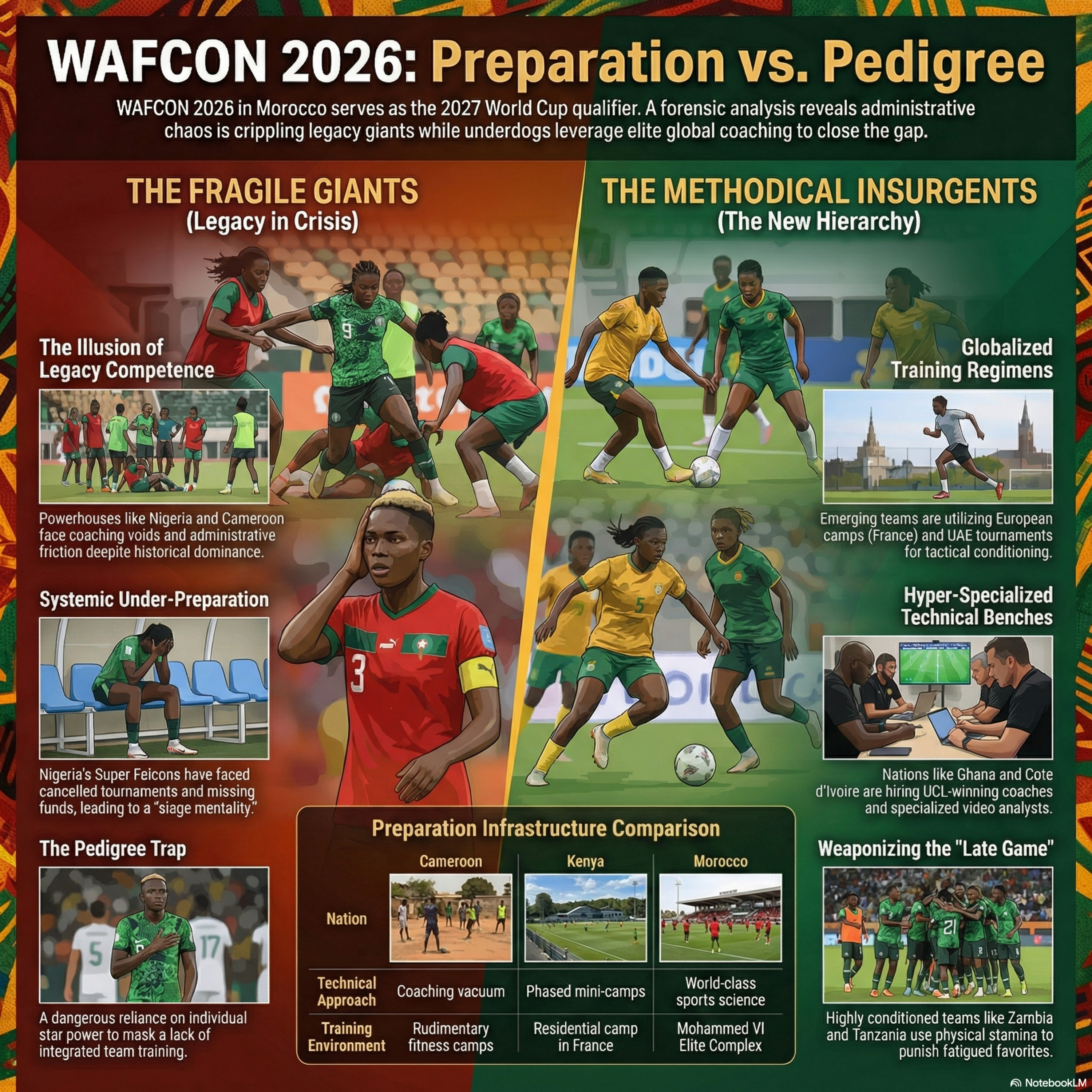
Science Beats History At WAFCON 2026
About this episode
Science Beats History At WAFCON 2026
Welcome back to the Deep dive. Today we are. We're not just talking about football, we are talking about what I can only describe as a tectonic shift. Yeah, that's exactly what it is. We are looking at the upcoming WAFCON 2026 in Morocco and I'm going to be honest with you right out of the gate, everything you think you know about African women's football, it is probably wrong, or at least it's about to be totally shattered. It is a bold opening, I know, but the reality on the ground completely backs you up.
We are looking at a tournament that is typically defined by what we call, you know, the orthodoxy. Right. The orthodoxy, the old reliable script. Exactly. You know the script perfectly well. Nigeria dominates, maybe South Africa gives them a real run for their money. Cameroon is always scary and everyone else, well, they are just happy to be there. They are just making. Yeah, the participation trophy teams, the ones you watch in the group stages and think, well that's a nice story, but they are going home on Tuesday.
But if you look at the forensic evidence today. For the actual digital footprints. Yes, the training, temp rotations, the staffing hires, the body language on the pitch, the structural backing of these federations. That old narrative is dead. It is completely dead on arrival. We are seeing terms like cannon fodder being thrown around in the media for the smaller teams. You see it on social media, you see it in the press, but the reality is screaming that the cannon fodder is well, they are shooting back this time.
That is the perfect way to put it. The cannon fodder is shooting back, and the mission of our deep dive today is to systematically dismantle that traditional hierarchy for you. We aren't looking at who won the cup 10 years ago. No, we aren't even looking at who won it four years ago. We are looking at who is prepared right now, today, who has the logistics, who has the sport science, who has the bench. Up because we're going to categorize the 16 teams playing in Morocco not by their draw, not by their groups, but by their actual current reality.
The ground truth. Exactly. We're going to look at the corporate Titans, the methodical insurgents, the fearless debutantes, and this is the really juicy part, the giants in crisis. And I think that is exactly where we have to start, because if a hierarchy is breaking down, it is usually because the foundation at the very top is cracking. Let's unpack that right immediately when you think of African women's football, the first name on your lips, on everyone's lips, is the Super Falcons of Nigeria of.
Course the defending champions. The most decorated side in the history of the continent. But looking at the situation right now, today, it paints a picture of, well, absolute chaos. It is a fractured ecosystem. That is the only accurate way to describe it. If you look at the preparation for Wavcon 2026, Nigeria is literally the case study for how not to prepare our defending champion. It seems like every single time we hear about them lately in the news, it is not about football, it is not about tactics, it is about administration.
Precisely. The expectation from the fans is dominance, but the reality behind the scenes is administrative paralysis. We see wasted FIFA international windows. We see cancel tournaments. Which is huge. It is massive. These are critical, irreplaceable moments for building team cohesion that are just, you know, gone. Vaporized. You don't get those days back. And it is not just a logistical hiccup, right? It's not just, oh, we missed a flight or the hotel wasn't booked in time. It is deeply systemic.
I mean, look at the coaching situation. That is the smoking gun right there. You had Randy Waldrum, a coach who knows the global women's game inside and out. His departure wasn't a mutual handshake and a good luck in your future endeavors. No, it was explosive. Extremely acrimonious. It was public. He explicitly called out the Federation over missing funds. And we aren't talking about pocket change or per deems here. The figure floating around is $960,000. Nearly $1,000,000. $1,000,000 in FIFA preparation funds Just what unaccounted for?
That is the core allegation and when you have that kind of severe financial and administrative friction at the very top, it always bleeds down to the pitch, always affects the players. Because they read the news, too. They live it. You now have Justin Madugu managing the team, but look at the environment he is stepping into. You have senior players, absolute icons of the global game, who are openly criticizing the federation on social media. That is unheard of in a healthy, functioning setup. Usually you keep that stuff in the locker room.
You complain to your captain, not to your followers. But when players are tweeting about incompetence, you know the rot is deep. It creates what we call a siege mentality and historically, to be fair, Nigeria has actually relied on that. Right, the whole US against the world thing. Exactly, the cultural resilience that we no go grief or anybody attitude. They think we are Nigeria, we have the best raw talent on the continent. We will just figure it out on match day. But you cannot vibe your way to a trophy anymore, not with where the modern game is at.
No, you really can't. Individual European pedigree, you know, having players at elite clubs in Spain or England that cannot mask systemic under preparation forever. You can see it in the footage. Look at the visual analysis of their training sessions. We see fragmented arrivals, players coming in days late because of ticketing issues, missing superstars, a Satsa Oshawala absent from key warm up rosters. It sounds like a weekend pickup game rather than a national team camp preparing to defend a continental title.
Compared to what we are going to talk about later with the other teams, yes, it absolutely does and that is the danger for them. History doesn't score goals. If your administration is paralyzed, you create a kinetic deficit on the field. Your players might be incredibly talented individuals, but they aren't a cohesive team. Speaking of paralysis, Nigeria isn't the only giant stumbling around right now. Let's talk about Cameroon, the Indomitable Lionesses. They are always in the mix, usually terrifying to play against.
But this time around, I mean, did they even actually qualify? Well, technically they didn't. Not on the pitch initially. They were reinstated via the FIFA ranking expansion when the tournament grew to more teams. That alone should be setting off massive alarm bells and yoned, but the situation inside the actual camp is arguably worse than Nigeria's because of the sheer silence. Silence. What do you mean by silence? I mean, there is a vacuum, a complete coaching and leadership void After they struggled in those initial qualifiers.
Jean Baptiste Bessek was dismissed. And who is running the ship right now? And the interim coach? Yes, an interim assistant, Josephine Mike Denduma. Now, absolutely no disrespect to her capabilities as a coach, but you are heading into a continental war with a temporary commander who doesn't even know if she will have the job next month. And while other teams are touring the world, setting up camps in Europe or the Middle East, what exactly is Cameroon doing to prepare? They are running localized fitness camps.
It's this incredibly rudimentary stuff. They aren't playing high level tactical friendlies against diverse opposition. They're basically running laps. They feel so outdated, like something from the 1990s. It is archaic. Reporters who have been observing them note a stark silence on the pish during training. That's. Eerie. It is that is not the silence of intense focus. That is institutional decay. That is a group of players that doesn't know its own tactical identity anymore. So if you're tracking this at home, we have the two biggest brands in African women's football, Nigeria and Cameroon, basically limping into Morocco with no money, interim coaches and fractured squads.
Correct. And that is exactly what opens the door. Because while the legacy giants are sleeping or arguing with their federations or looking for their missing paychecks, there is a completely different class of teams emerging. Teams that are operating like a Fortune 500 company. Exactly the corporate Titans. Let's pivot right into them, because this is such a stark contrast it almost gives you whiplash. We have to start with the hosts, Morocco. The Atlas lionesses if Nigeria is administrative chaos, Morocco is clinical cold precision.
This is their third time hosting the tournament, right? Yes, and they aren't just putting up goal Nets and tinting the lines this time, they are building an absolute empire. Their state investment mirrors the elite echelons of European football. We see the Mohammed, the Sikh football complex in Rabat, mentioned in literally every single report about their prep. I have seen photos of this place and it looks like something built for a Champions League winner. It effectively is. It is a world class facility.
We are talking dedicated medical centers, specialized video suites for tactical review, cryotherapy chambers, the works. And look at the leadership they brought in to use all these toys. They went out and got Jorge Vilda. A World Cup winning manager. Exactly. You don't hire a World Cup winner if you are just hoping to have a nice tournament and maybe reach the semis. You hire Jorge Vilda to win the whole thing. And the vibe in their camp. I was reading this report. They have a 32 player closed camp.
Nobody goes in, nobody comes out, and the atmosphere is described as corporate. Corporate and clinical. What does that actually mean in the football context? Does it mean they wear suits to breakfast? It means there is 0 drama. The players look upright. They look synchronized. There is none of that chaotic energy we just talked about with the legacy teams. Every single minute of their day is scheduled, optimized and analyzed by data scientists. They are completely insulated from outside noise. It sounds perfect, but I have to ask, is it almost too perfect?
Like is it too sterile? That is the primary question our forensic analysis raises. The host nation pressure is a very real, very heavy thing. If a gritty, messy team drags them into the mud in the quarterfinals, into deep waters where tactics breakdown and it's just about heart, can they handle it? Can they handle the psychological burden of being the perfect hosts when the game gets ugly? That is the danger of the ivory tower, right? You get so used to the cryotherapy that you forget how to street fight.
Precisely. But there is another corporate Titan in this tournament that knows exactly how to fight and how to file a flawless spreadsheet. South Africa. Benyana, Benyana, they are the defending champions, biggest historical rivals, but they seem to be operating on a completely different wavelength entirely right now. They are the benchmark for professionalism on the continent. If Morocco represents the new state backed money, South Africa is the smart, established money. They have Doctor Desiree Ellis at the helm, who is arguably the most successful and consistent coach in Africa right now.
And their preparation strategy is fascinating. They have been running these things they call alignment camps. Alignment camps, yeah. It sounds like a corporate retreat where you do trust falls and whiteboarding sessions. In a practical way, it kind of is. They merged the KOSAFA championship directly into their Wolfcon preparation. They didn't treat KOSAFA as a separate, distinct tournament to win at all costs. They treated it as a highly competitive data gathering exercise. So they are continuously monitoring player load, tweaking tactics, testing rotations.
Exactly, and the mentality is what really sets them apart. Doctor Desiree Ellis and key players like Angel Domini. They aren't even really talking about winning Wafcon as their ultimate end goal. Wait, really? What are they talking about? They are already talking about the World Cup in 2027. They view the Wafcon group stage in Morocco as a formality. It is just a mechanism to get to the real global stage. That is incredibly confident. It is bordering on arrogant, but it is completely earned. Their body language is relaxed.
It is deliberate. They are entirely insulated from the administrative chaos we see in West Africa. They know their flights are booked months in advance. They know their bonus structures are ironclad. They just have to go out and play football. So we have the giants in crisis with Nigeria and Cameroon. We have the corporate Titans with Morocco and South Africa. But here's where it gets really interesting for me, and I think for anyone listening who loves tactics, the methodical insurgents. Yes, this is the rapidly growing middle class of African football that is aggressively becoming the upper class.
These are the teams that don't have the unlimited state budget of Morocco and they don't have the historical intimidation factor of Nigeria. So they're using raw intellect. They're outsmarting the system. Cote d'Ivoire is the. Headline here. The elephants. They missed the last Wolfcon entirely. Right. Well, they did, and the federation took that very personally. They didn't just fire the coach and hire another local guy. They went out and hired Reynold Pedros. A2 time UEFA Champions League winner with Lyon.
That is a massive, massive flex for Cote d'Ivoire. It is a profound statement of intent. You do not bring in Reynold Pedros to teach the basics of passing. You bring him in to install tactical periodization. OK, stop right there. Break that down for us. You hear that phrase thrown around on tactics blogs, but what does tactical periodization actually mean on the grass for these players? It means they are fundamentally moving away from just relying on raw athleticism, you know, just running fast and being stronger than the opponent.
It shifts everything to a highly cognitive game. So it's about thinking faster, not just running faster. Exactly. Under tactical periodization, every single drill in a training session is designed to replicate specific complex moments in a real match. There's no running just for the sake of fitness. Everything involves the ball and a tactical decision. They're being re engineered from the ground up by a premier global mind. And they are rigorously testing this new system too. Yes, playing high level friendlies against Benin in Kenya.
They aren't hiding in a closed Cam, just playing against themselves. They are actively building and testing a machine. Then you have Zambia, the Copper Queens. I absolutely love their current motto from copper to gold. It is very catchy, but the real substance is on the pitch. Coach Nora Hoptel is Swiss and she has brought an undeniable level of Swiss precision to that squad. How does her approach differ from Pedros? It is deeply analytical, but it is physically punishing. They're consistently described by scouts as physically imposing.
They're arriving in Morocco to dominate you physically, but it is not reckless, chaotic aggression. It is highly calculated. She focuses on neutral, realizing direct play from the opposition and capitalizing on meticulously rehearsed set pieces. So they're working on corners and free kicks relentlessly. Endlessly. If you watch their training footage, they look like a SWAT team. Intense, highly focused, unsmiling. They aren't there to play beautiful tiki taka and make friends. They're there to blew you off the ball and score from a corner kick routine you didn't see coming.
A. SWAT team is a terrifying comparison. And then we have the third head of this insurgent dragon, Ghana, the black Queens. They have been kind of quiet for a while on the continental stage. They are being labeled the awakened giant and they are leaning heavily into technology to close the gap. They have a Swedish coach, Kim Lars Bjorkigrin, but look closely at his backroom staff list. They have a specialized video analyst named Ronnie Bergdahl. A dedicated video analyst, not just an assistant coach holding an iPad on the bench.
No. A true specialist. Someone whose entire job is breaking down opponent passing patterns, finding the specific weak link in the opposition's defensive chain, and feeding that data to the players. Look at their preparation schedule. They went to the Pink Ladies Cup in the UAE. They're playing teams like Russia, they're playing Hong Kong. That is invaluable global exposure playing against completely different styles of football. And the result of all this tech and global prep? They completely dismantled Egypt 7 to 0 in the qualifiers.
Seven nil. Seven nil. That is not a team that is just hoping to string a few wins together. That is a team that has calculated exactly how to dismantle an opponent and knows it can kill you on the pitch. It is incredible to see this evolution. You have the absolute chaos at the top with the legacy teams, the cold corporate money in the middle, and these insurgents rapidly climbing the ladder with advanced tactics and tech. But, and I think this is the part that will actually surprise everyone the most, there is another group.
The ones everyone dismissively calls the cannon fodder. The small teams, the debutantes, the ones usually expected to lose 5 nil in the group stage, take some nice photos and go home. But this is exactly where the true rebellion is happening. This is the most exciting part of the forensic analysis we've done because the biggest, most bracket busting surprises are going to come from here. Not because they suddenly produced five world class players overnight. No, because of where and how they are training.
Let's start with Kenya, the Harambee starlets returning to the tournament after 10 long years. They are ranked 133rd in the world right now. You would naturally think they would just be thrilled to be on the plane to Morocco. Far from it. Their logistical planning is incredibly ambitious for a federation of their size. They didn't just meet up at the local airport a week before the tournament. They started with extensive mini camps for local domestic players to rigorously assess the talent pool.
Then they flew to Abidjan for tough international friendlies. And right now? Has blew my mind when I read it. They are in a residential camp in Miramas, France. France A-Team, ranked 133rd globally, is holding their final preparation camp in an elite facility in France. That is a staggering level of investment. It changes the entire psychology of the squad. They are physically removing the players from the daily distractions and pressures at home, putting them in a pristine elite environment and focusing purely on what their coach Baldino Demba calls mental strength.
So they aren't just doing fitness drills, they are building a mindset. Exactly. They are polishing their tactical flaws in isolation. They aren't panicking about facing the big teams, They are systematically preparing for them. That is a huge shift in mentality. And they aren't the only ones going offshore to prepare, are they? Look at Tanzania. The Twiga Stars. They uprooted their entire camp and moved to Ismailia, Egypt. Why move all the way to Egypt? What does that give them? Extreme focus, better facilities and acclimatization.
They are specifically using this time away from home to correct what the coaching staff calls naive mistakes from their past performances. Naive mistakes meaning tactical and discipline. Yes, getting pull out of position, losing focus late in halves and they are using heavy video analysis to fix their defensive shape. Plus, they are also using tournaments like the Pink Ladies Cup to build serious match fitness. Stouts are reporting they look incredibly physically robust. So you have Kenya locked away in France, Tanzania grinding in Egypt.
These are clearly not teams that are going to just roll over and concede four goals in the first half. They are aggressively closing the physical and tactical gap before the referee even blows the starting whistle. And then we have the emotional powerhouses of the tournament, Cape Verde and Malawi. These two feel fundamentally different from the others. It is less about the sport science and video analysis and more about the, I don't know, the vibe. It is The X Factor. Let's look closely at Cape Verde.
They are openly calling this tournament their golden era and they are tapping into a massive resource, the European diaspora. The diaspora is such a game changer for these smaller nations. It completely alters your tactical floor. When you bring in players who have spent 10 years being trained in structured Portuguese or French youth academies, the baseline technical level of the entire squad jumps immediately. And the body language of the Cape Verde team right now is universally described as fearless.
Fearless, celebratory, but highly focused. They aren't staring at Nigeria's badge and getting scared. They want to literally be the next Nigeria. They see the throne is shaky and they want it. And what about Malawi? Malawi is what I call the emotional engine of this Wolfcon. This is a team that is deeply driven by tears, singing raw nationalism. The pride is palpable. But crucially, they also have a nuclear weapon on the pitch, Tabitha Chewinga. I mean she is one of the best attacking players in the world period, not just in Africa.
Having an elite generational talent like that upfront, combined with an explicit mandate from their federation president to just play without fear, that is a highly dangerous combination for any opponent. Because they have zero pressure. Exactly. The big teams, the legacy giants, they have the weight of an entire nations expectations crushing them. Malawi has joy, they have momentum and pure joy can be a very, very effective fuel in a knockout tournament. It is amazing how diverse the approaches are.
We've covered the institutional crisis, the cold corporate precision, methodical tactics, and this brilliant underdog rebellion. But I want to pause here and ask you the really big question. The So what of it? All right. What is all this administrative and logistical prep actually mean on a Tuesday night under the floodlights in Rabat? Exactly how does this difference in preparation actually manifest on the field after, say, 70 minutes of intense football? This brings us to what I like to call the weaponization of the late game.
I really like that term. Break that concept down for us. Modern football matches, especially at international tournaments, are very often decided in the final 20 minutes. That is the critical window. When the lactic acid builds up, the legs go heavy and the brain gets foggy. The fatigue zone. Yes. Now consider the teams we just discussed. Zambia, Tanzania, Ghana. They have had rigorous, systemic prep. They have built a massive, durable aerobic base over months of specialized camps. They can essentially run forever.
They can run, but more importantly, they can still think clearly while they are running. Now contrast that specific conditioning with Nigeria or Cameroon, teams that are heavily relying on individual brilliance but whose camps were constantly disrupted. Missed flights? Canceled Friendly. Exactly. Maybe they missed crucial collective fitness windows. Maybe they're relying solely on their players club fitness, which is very different from the specific demands of a dense, hot summer international tournament.
So paint the picture Minute 75 hits, the score is tied zero to 0. Minute 75 hits. The methodical insurgents, let's say Zambia, trigger a coordinated high press. They start sprinting aggressively at the legacy defense offenders, the legacy players, the superstars everyone knows are tired. And not just physically exhausted, but cognitively drained. And fatigue makes you make bad decisions. Always a tired brain makes a lazy pass. A heavy leg causes a slight stumble on the turn. A critical defensive error.
Exactly. And suddenly the quote UN quote lesser player from the smaller nation who is vastly fitter and more rigorously drilled in that exact pressing scenario, steals the ball, drives into the box and scores. And the crowd goes wild. That is exactly how a historical hierarchy shatters. It is not magic. It is not luck. It is pure human biology and preparation. It. Is the kinetic deficit finally coming due the check is cashed? Precisely, and it is also a direct result of the Bench war. We touched on the video analyst earlier with Ghana.
We did, but I want you to really picture the sidelines during that 75th minute. On one side of the pitch, you might have Cameroon's solitary interim coach, just one person standing there trying to process the entire chaotic flow of the game alone. Sweating in a tracksuit, trying to shout over the crowd. Right on the other side, look at Morocco or Ghana. They have an entire multidisciplinary sports science team sitting on the bench. They have a guy staring at a tablet looking at heat maps who can immediately show the incoming substitute striker exactly where the exhausted left back is leaving space.
The solitary genius struggling versus the synchronized hive mind. Elite matches are won by the bench video analysts like Jaleel Buglali, who works for Algeria. They allow their teams to ruthlessly minimize unforced errors. They spot tactical patterns in real time. They can say, hey, their midfield pivot is dropping too deep, push up 10 yards. If you don't have that guy with the tablet on your bench in 2026, you're basically fighting blindfolded. You are, and that is why. Looking at the benches, looking at the legs in the 80th minute, that is where Wolfcon 2026 will actually be decided, not on the Wikipedia pages of past tournaments.
So let's start bringing it all home for you. Listening. We started the show by saying this tournament is a tectonic shift. It is a nutritional battlefield. The main take away is that institutional readiness and sport science are going to unequivocally beat historical badges and reputations. So the quick summary is do not trust the history books. Do not. If you are placing your bets, literal or figurative, based on who won in 2018, you are going to lose. OK, then it is prediction time, or at least warning time for the fans.
What should we explicitly look out for when the group stages kick off? You do not be shocked, do not act surprised when a massive giant falls in the group stage. I'm looking very closely at Group C or D. If Nigeria or Cameroon struggles immensely just to get out of their group or even fails to advance, remember this deep dive. That would be earth shattering news for the casual fan. The headlines would be crazy. It would be. And conversely, do not be shocked when a team like Cape Verde or Kenya goes incredibly deep.
I'm talking quarterfinals, maybe even semi finals. Because the gap is closed. The gap has closed not simply because the big team suddenly forgot how to play football, though their administrations have failed them, but because the small teams got radically professional. They weaponized logistics. It is a brave new world for African football and I have one final, somewhat provocative thought to leave you with as we wrap up. We have talked extensively about the what and the how today. We've talked about the tactics in the camps, but what about the long term future?
That is the really profound question here, if the historically small nations are actively, aggressively closing the gap with better logistics, advanced science and serious financial investment. What happens to the entire ecosystem of the African game if the traditional giants, the Nigerians and the Cameroons stubbornly refused to modernize their front offices? Are we witnessing a temporary blip or a permanent changing of the guard? Because if the Giants do not wake up and drastically fix their back offices, they won't just lose one single tournament in Morocco.
They will lose their aura. They will lose their status entirely. The cannon fodder isn't just shooting back from the trenches anymore, they are actively storming the castle. And on that image, we are going to wrap it up for today for Wolfcon 2026. My absolute best advice to you is this, When you sit down to watch the matches, don't just watch the goals and the celebrations. Watch the benches, watch the heavy legs in the last 10 minutes and whatever you do, do not be surprised when the underdog bites back hard.
Thanks for diving in with us. Always a pleasure to be here. Remember, watch the science, not just the names on the shirts. We will see you next time.
 Apple Podcasts
 Castbox
 Castro
 Goodpods
 Moon FM
 Overcast
 Pocket Casts
 Podbean
 Podcast Addict
 Podcast Republic
 Spotify