Salah Penalty Decides Egypt Crisis Win
About this episode
Salah Penalty Decides Egypt Crisis Win
Listen now on Spotify, Apple Podcasts, Amazon and other streaming services! Don’t forget to subscribe, share, and leave a ⭐⭐⭐⭐⭐ review to help more players and coaches discover the power of Techne Futbol and Data Technology in the beautiful game.
#TechneAfricaFutbol #TechneFutbol #TrainWithTechne #Playermaker #TraceFutbol #Hudl #FootballTech #FootballInnovation #PlayerDevelopment #CoachTools #SmartFootballTraining #AfricanFootball #CAFOnline #FIFA #FIFAYouth #CAFDevelopment #YouthFootballAfrica #NextGenFootball #FootballScouting #TalentIdentification #DigitalScouting #EliteYouthDevelopment #FootballJourney #FootballAnalytics #FIFAForward #FutebolAfricano #TrainTrackCompete #FootballExcellence #FootballAfrica #TheFutureOfFootball
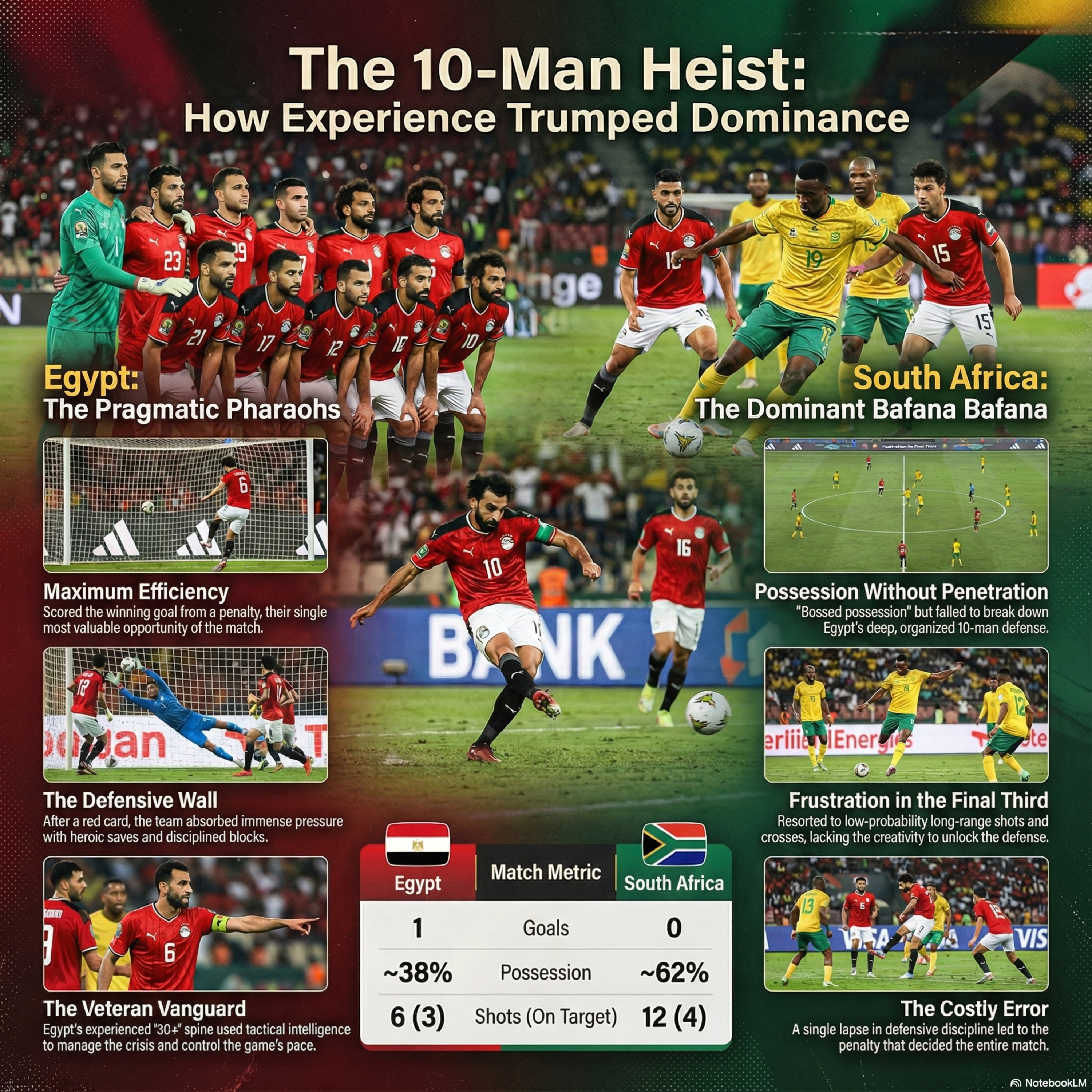
You know that feeling, right? That absolute high tension wire moment in tournament football when a single solitary goal decides who stays and who goes home? We've all been there, just sitting on the edge of our seats, watching 90 minutes of pure drama boiled down to one single stroke of brilliance. Or maybe luck? Or a moment of panic. Exactly, And today we are diving deep into one of those definitive moments, a massive high stakes Group B encounter where a tense 10V secured crucial qualification.
And this wasn't just a game. No, it was a psychological thriller, a master class in how to manage a crisis, and I think the most definitive clash we could ask for between 2 completely opposing footballing philosophies. You're talking about systemic control versus that hard won, almost cynical pragmatism. That's the one. And that one zero score line between Egypt, the Pharaohs and South Africa. Bufana, Bufana, it's it's completely deceptive. Right on the surface, it looks like a close grinding affair.
But the score lies. This result was forged in a very, very small number of high leverage moments. Yeah, and it was delivered under unimaginable duress after a catastrophic early event. So we are moving past the highlights reel. Our mission today is a forensic deep dive. We're getting into the underlying data, the why. That's the challenge. We are going to breakdown every critical variable in this high pressure environment to extract, you know, practical hard won knowledge. The kind of strategic lessons that determine success in knockout African football.
Yes, our goal is to understand precisely how one team managed a sudden, unexpected tactical crisis and why the other, despite dominating possession and territory, failed spectacularly to convert a massive advantage. And if we can give you 1 core finding right up front, it's this. The victory was not about sustained offensive brilliance. It wasn't about generating volume. No, it was about maximizing one critical event and demonstrating what we analysts call elite tournament IQ. This match served as the ultimate stress test in what we call squad reliability.
And the team that possessed the mental fortitude and that shared tactical model to survive that stress test. That's the team that walked away with the points. OK, so let's unpack this core conflict because I think it gives us the blueprint for the entire match. On the one side, you had South Africa, Bufana, Bufana. They came in with this deeply entrenched systemic possession centric approach. Tell us what that looks like in practice. For Bufana Bufana, it's all about structure. It's control. Their game plan relies on consistency, on minimizing chaos and on their midfield acting as the what we call the primordial tool for creating chances.
They want to control the game through the ball. Lots of assing. Lots of assing, rioritizing, safe, accurate sequences. Sometimes, you know, 15 to 20 asses long to draw the opponent out of position before they even think about attacking. So they're built to sustain pressure, but that structure is everything to them. It is. They rely on it heavily. And their opponent, Egypt, the Pharaohs, presented the perfect, almost ancient foil to that modern system. Exactly. I mean, they're the definition of experience laden, transition reliant pragmatists.
So they don't mind not having the ball. They don't mind at all. They'll happily see territory, even possession. Their goal is not volume or, you know, aesthetic football. It is sheer efficiency. Just get the job. Done. Get the job done. Prioritize high probability actions over speculative attempts and wait patiently, sometimes agonizingly so, for the opposition to make one mistake. Or for that one moment of individual brilliance. That's the one. And that mistake, that moment, it came right before half time, didn't it?
In the most critical, highest leverage event possible, the penalty kick. From an analytical perspective, this sequence is the statistical anchor of the entire match. Absolutely. When we talk about maximizing efficiency, you just you cannot beat a penalty, right? We assign an expected goals or XG value to every type of shot in football, right? For an average open play shot, that might be what, .08? Something like that. So 8% chance of scoring. Pretty much, but a penalty kick. Yeah, a penalty kick carries an XG of between .76 and .79.
Wow, so a 76 to 79% chance to? Put that in perspective, you are nearly four times more likely to score a goal from that one event and from all the chances South Africa generated in the second-half combined. That's. Insane. It is essentially a guarantee of a goal, and in a tight knockout game, its weight is enormous. So let's walk through the sequence leading up to it, because it involves the star power that really defines this Egyptian team. It all starts with Muhammad Salah's control inside the box, forcing the South African defender Kalisa Muda into a moment of panic.
It was a simple yet devastatingly effective movement by Salah. He receives the ball, his control is tight and he's moving toward the six yard box. And Muda have to do something. He has to. He's trying desperately to challenge the touch, maybe cut off the pass and he just, he lunges. Analysts called it a desperate intervention. And the contact was. The contact was clumsy, maybe unintentional, but completely undeniable. It struck Salah in the eye face area. It was the definition of losing your composure in a critical zone.
And this brings us to one of the biggest learning points here, what we've termed the sheer gravity of Mohamed Salah. It's not just his running or his shooting, it's his mere presence. It just induces panic in world class defenders. It's true. The psychological pressure of tracking a Player of Solace caliber is immense. You can't switch off for a second. Not for a millisecond. Defenders know that any half second of indecision can be lethal and that pressure it induces irrational decision making. Which is what we saw with Mudo.
Exactly. He's a highly capable defender, but in that moment he lost his spatial awareness, his bodily control. The result? A penalty. So drawing fouls in the box is a legitimate high value component of attacking edge. It's a huge part of it. It shows that generating an efficient chance can sometimes come from capitalizing on the defense's fear rather than overwhelming them with pure skill. And once the decision was made, Saleh composed as ever. He didn't waste it. That left footed strike was pure class.
Complete mastery. He utilized disguise so well he approached the ball with that measured, almost slow run up. Keeping the keeper guessing. Keeping the goalkeeper for Ronwyn Williams guessing until the absolute last moment. Then he strikes it with conviction right down the center of the goal. Freezing the keeper, he. Forces the keeper to commit to a direction and Williams is just left flat footed. 10 right on the 45th minute. Egypt gets the reward for their pragmatism. So Egypt goes into the break with the lead.
They're probably thinking, OK, South Africa has to come out and regroup. But then the immediate tactical full curve, the moment that completely rewrote the rest of the match. It happens almost instantly. Muhammad Hani's dismissal. The red card was a game changer of biblical proportions. It came right around the halftime break. Terrible timing. The worst Hani, the right back. He'd already been booked, likely for trying to contain the pace of a Bufana Bufana winger. Then, right as the second-half begins, he commits a second foul.
A nasty challenge on to Bahama Kuena, I believe. That's the one. The timing was just catastrophic. It removes A crucial defensive player and plunges Egypt into an immediate crisis. And we've established the statistical reality here. In any balanced matchup, a red card reduces your win probability by what, 60? Percent, approximately 50%, yes, Yeah. So Egypt's ability to defy that probability for the next 50 plus minutes is it's truly a statistical outlier. It's incredible. It's almost unprecedented.
That single event didn't just remove a player, it defined the rest of the conversation. It forced Egypt into an immediate, profound tactical transformation. From transition threat. Their preferred mode right to pure survival containment mode right? If they'd been the possession based side, a red card might have been a death sentence, but because they were already comfortable seating the ball it just it's simplified their task. So the game state is now set. Egypt, leading one narrow, is suddenly down to 10 men.
South Africa has the numerical superiority, the possession, the territory and all the momentum. Do you think so? Let's start with Egypt's constrained attacking edge. How did they maximize their limited opportunities? Their efficiency was just clinical. Before the red card, the strategy relied heavily on verticality and individual brilliance. OK, Omar Marmoush. He served as their primary transition threat. His job wasn't necessarily to score, it was to generate chaos across the defensive line through his mobility and his aggressive runs.
And the chaos he created was specifically designed to give Sal a space, wasn't it? Precisely Marmish's efforts forced to South Africa's defensive line to drop deeper, to track more aggressively. His willingness to strike from distance, like that early free kick that narrowly missed the left post, It disrupted the stable shape Bufana craved. He was the dynamic element. The one who pulled the defensive thing, Yeah. And that allowed Solar to operate in clarity closer to the goal. But once Hanny was gone, their strategy shifted into something highly subtle, the threat and being How did they use a player who wasn't actively contributing to maintain an attacking edge?
This is a covert high impact tactic of veteran teams. It's so smart by keeping Salah high up the pitch or by substituting him late to maintain his energy. Egypt psychologically for South Africa to keep defenders back to track it. So just his presence was a weapon. Think of it this way, South Africa had one extra attacker, but they couldn't fully utilize that advantage because they couldn't risk leaving Sala one-on-one with their last defender if they lost the ball. That's. Fascinating. The simple presence, it diluted the number of players Bufana Bufana could commit forward.
It was psychological warfare, leveraging the opponent's fear of the counter attack to manage their own defensive structure. Now let's flip the coin and analyze South Africa's response. They had the man advantage and they bossed possession roughly 62% overall, but the data shows it was blunt force. We're calling it sterile domination. That is the most fitting description. I mean, they had all the ingredients for success, the ball, the territory, the numbers, but they're attacking Edge was completely blunted by a singular issue, a lack penetrated variety.
They failed what we call the final third entry problem. Can you break down what that final third entry problem looks like when we look at the numbers? It means they were phenomenal at circulating the ball between their goalkeeper, defense and midfield, The between the boxes champion, as we'll discuss. But they failed miserably to convert those entries into meaningful box touches. Those moments where the ball reaches an attacking player inside the 18 yard box creating a high XG situation. And that was down to Egypt's defense.
Absolutely. The Egyptian low block defense, anchored by the formidable Rami Rabia and Yasser Ibrahim, was so disciplined. They didn't bite. They didn't chase. They just held their shape. They held their shape and forced South Africa to circulate the ball in predictable slow U shapes around the box, never allowing them to break that central defensive line. And that frustration, that inability to breakthrough, translated directly into their shot profile, right? It was a volume of attempts rather than any real quality.
Absolutely. When a team faces a compact 10 man wall they can't dismantle, they default to low percentage attempts from distance. We saw that over and over. Repeatedly, with Tebow, Homo, Koena and Aubrey Modiba firing shots that were either immediately blocked by a swarm of defenders or sailed wide of the post. It's the clearest sign of creative frustration. It is, and crucially, this played directly into Egypt's hands. Egypt was happy to defend the six yard and 18 yard box and let them shoot from 25 yards out.
Knowing their keeper could handle it. Knowing of their goalkeeper, El Shenawi was more than capable of handling them, or that the shots wouldn't even trouble the frame of the goal. So what happened to Lyle Foster in all this? A player of his Premier League pedigree should be the one unlocking these blocks, but he seemed completely neutralized. He was isolated to an alarming degree. Foster was caught in a tactical dilemma. How so? Well, when he dropped deep to try and link play, something he's excellent at, it removed him from the critical danger zone where he could actually score.
And when he say hi? When he stayed hi, he was immediately smothered by Rabia and Ibrahim. They rarely allowed him a clean touch or a turn. So his frustration became palpable. Yeah, you could see it. He eventually earned himself a yellow card, a clear sign that the defensive planning against him was ruthlessly effective. South Africa's system, for all its structure, just lacked that individualistic spark, that lock picking ability. So the verdict on the attacking edge is clear. Egypt's primary goal source was a set piece, highly efficient, maximum leverage.
South Africa, despite the man advantage, relied on failed open play, Highly inefficient. It boils down to outcome efficiency versus intent. South Africa had the superior intent in terms of ball progression and territory. But intent doesn't win you football. Games. Exactly. Egypt delivered the superior outcome efficiency, and in the high pressure environment of knockout football, the scoreboard only measures outcomes, making efficiency the ultimate metric. Let's delve deeper into how chances are created, or in South Africa's case, how they were prevented.
We discussed Salah's psychological weapon. Let's detail Egypt's asymmetric creativity and the operational reality of solid gravity. So solid gravity is the concept that he shifts the opponent's entire defense regardless of where he stands. Even when he doesn't have the ball. Especially when he doesn't have the ball. The data shows he drew a minimum of two defenders consistently, usually the opposing left back Kalisa Mudao and a covering central midfielder like Tabahoma Koena who had to shift laterally.
And by occupying both of them. He creates crucial negative space on the far side or in the Center for players like Trezeke and Zezo to exploit. So even when he's just standing there waiting, he is actively manipulating the creative space for his teammates. Precisely. And Egypt's offensive connectivity reflects this priority. They're not interested in 30 pass sequences. No, they're all about verticality. All about verticality, quick targeted 3 pass sequences designed to bypass the midfield entirely and expose that negative space.
We saw a pre red card like that long cross from Solid to Zezo who then set up Marwan Atia for a shot. So their creativity is transition based set piece heavy? Yes. High probability non open play creativity. But then, the moment the red card hits, that entire creative architecture undergoes a radical force transformation. It's 180° pivot. Their focus immediately shifted. Their creativity wasn't measured in chances created anymore, It was measured entirely in clearances made and interceptions. They effectively ceased being a creative entity in open play.
Just pure 10 man containment. Pure containment, yet they were smart. Maintaining solo high still allow them to wield that psychological creative weapon, the constant threat of the counter attack which constrained South Africa's defensive numbers. OK, now for South Africa's creative architecture. The Mokorian is 1 Apollos Axis. Mokorian is the acknowledged metronome, the primary playmaker, but the Egyptian low block completely clogged his central passing lanes. And that explains his desperation. McQueen is fantastic when he has time and space to dictate play and switch the ball.
But he hadn't either. He had either against a compact 10 man block. Every single route through the center was blocked. He was forced into those low percentage, long range shooting attempts. Because he couldn't pass through the block. So he tried to shoot over or around it, which is the definition of creative breakdown. Egypt was perfectly happy to absorb those hits all day long. And Oswinopolis, who was supposed to be their dynamic dribbling threat. He also seemed neutralized. He was It was smart, rigorous defense.
Egypt strategically prioritized crowding the wide channels. When Apollos received the ball, he was immediately double teamed. No one V1 situation. None. They prevented him from isolating anyone. When you deny A-Team its primary mechanism for committing defenders and creating space, the entire creative network just stalls. Which is why he was substituted. A clear concession that the Egyptians had successfully stifled his influence. And this leads us to the ultimate strategic flaw for Befana Befana, the predictability of their attack, working the ball wide to full back Scalisa Mudao or Aubrey Mudiba for a high cross.
Strategically, why is that so flawed against Rami Rabia and Yasser Ibrahim? Because it's self defeating. Rabi and Ibrahim are. I mean, they're hard as nails and aerially dominant, especially when they're operating in a packed defensive box. So you're playing to their strengths. You're playing right into their hands. Throwing high crosses into that fortified area against a heightened physical advantage is essentially turning possession back over to the opponent. South Africa Lac de gile. Or a true Chaos agent, a player who does the unexpected, who uses quick short interplay.
Maybe a wall pass or clever chip pass into the channel to draw defenders out of their rigid positions. So this highlights what we're identifying as the creative void for South Africa. They are great at the systemic transition based football, but when forced to lock pick a deep fortified defense they fall short. And that is the crucial strategic take away for the African game. When faced with a team like Egypt who are comfortable seating possession to control space and reduce variance, systemic dominance proves meaningless.
So it's not about effort. South Africa's limitation here wasn't effort or energy. It was the specific type of creativity required to dismantle the deadlock. They were masters at moving the ball, but amateurs at breaking the final line. Now we arrive at the heart of Egypt's victory, the mental fortitude and the execution under stress. This match was the ultimate examination of squad reliability, defined as performing consistently under high variance, like managing a red card or massive pressure. Egypt's display was truly ironclad in crisis.
It was statistically remarkable, yes, to play over 50 minutes with 10 men and concede zero goals against a highly motivated, possession heavy side that is a testament to extraordinary coaching and mental discipline. It's not an accident, no. This level of reliability is built on a shared mental model where every player instantly knows exactly where they need to be to execute compensatory behaviors, meaning covering for the missing man without being asked. It's automatic. And this is where the experience factor comes into play and forming their elite game management.
How did veterans like El Shinoi and Fathy actively kill the game's rhythm? The crucial micro tactics. These are the details younger teams often overlook. When the pressure built, the veterans initiated deliberate delays, like drawing tactical fouls that weren't strictly necessary but allowed the defensive line to breathe and reset, slowing down restarts, taking an extra 20 seconds on every goal kick, delaying throw insurance. All those little things that drive you crazy as a fan of the other team.
Exactly. Even the subtle act of positioning intelligently to intercept a pass rather than chasing the ball, conserving energy while relieving pressure. The tension was sky high, yet Egypt held firm. They didn't panic. They didn't panic, they didn't lose their shape, and critically, they avoided those individual defensive errors that usually play 10 man teams under siege. And it's incredible that they immediately collapsed into a 441 or 531 without any discernible confusion. That's discipline, coaching, reacting to chaos.
The substitution of Imam Ashawar for the attacker Marmish immediately after the red card wasn't an emotional reaction, it was a clinical, strategic move. To add a midfield grit. Necessary midfield grit and defensive stability. It showed that the coach Hossam Hassan, correctly identified that preserving the one NIL lead was the only strategic necessity. OK, let's contrast that with South Africa. They exhibit systemic consistency. They are difficult to beat heavily, but they suffer from what we call outcome volatility in these high leverage moments.
The inability to score against ten men for an entire half points directly to a failure in clutch reliability. They just couldn't get it done. They had the ball, the territory and the numbers, but they lack the necessary ruthlessness or the specialized technical ability to finish the job. So they were dominant but not dependable. Exactly that failure to seize the moment, coupled with the initial penalty concession created a critical reliability gap that decided the outcome. And the age profile of the two squads provides a compelling explanation for this reliability.
Delta, Egypt is the veteran vanguard, averaging close to 30 years old. This brings us to a crucial concept in cognitive science applied to sport crystallized intelligence. OK, break that down for us. Egypt's Spinesala El Shonali Fathi is composed of veterans who possess high game IQ. They excel at utilizing learned knowledge and experience to solve problems under stress. So they've seen it all before. They've seen it all. They might not run as fast as the opposition, but their brains are running the equivalent of a supercomputer, relying on decades of stored experience to reduce the psychological impact of pressure.
El Shinagi's composure saw his nerve on the penalty. Direct results of having been there, done that. But every strength has a weakness. The risk of an aging side is lower fluid intelligence, slower speed, higher risk of fatigue induced error. Correct. That lower physical capacity and higher cumulative physical load explains why Muhammad Hani, even at 29, might have been forced into that reckless, nasty challenge on Maquina. His physical capacity declined just enough, forcing a desperate tactical foul.
That's the risk you accept with an older squad. That's the risk. South Africa, on the other hand, is the prime youth hybrid, averaging under 27 years old. They have the engine. They possess the high fluid intelligence. They have a physical ability to press relentlessly to boss possession and to run the aging Egyptian side ragged for 90 minutes. They have the legs. But the corresponding risk of that youth and energy is tactical naivety, which manifests in rushing the final ball or succumbing to that pressure, right?
Precisely, they lacked the patients required to systematically dismantle the ten man defense. That youthful energy manifested as eagerness, rushing the cross, poor shot selection from distance, or forcing A risky pass instead of switching the point of attack. They had the engine but not the steering wheel. That's a great way to put it. They lacked the steering wheel needed to navigate the specific complexities of the game state. So the forensic conclusion is stark and offers a deep lesson for the African game in this playoff context.
Egypt's experience in game IQ defeated South Africa's athleticism and physical capacity. Knowing how to win, often Trump's the physical capacity to run. The veterans knew they didn't need to outrun South Africa. They just needed to hold the line and execute. The goalkeeper duel here was unexpectedly decisive. It highlighted 2 completely different philosophies and showed which one provided critical value in this specific scenario. It really did. Let's start with Mohamed El Shinawi, Egypt's veteran shot stopper, the wall.
El Shinawi's performance was arguably the technical differentiator that secured the points second only to solve. His penalty, he was immense. He acted as the commander and the immovable last line of defense. He made crucial brilliant saves, maintaining a 100% save percentage on shots on target from open play, denied high leverage efforts from Magopa and Foster when the defense was breached. And in a low block siege scenario, his value skywalkets. Why does the goalkeeper become exponentially more important when the team is sitting deep?
Because the defense is packed deep, they're facing a barrage of shots coming through traffic, constant crosses the goalkeeper has to deal with obscured vision, aerial threats, high deflection risk. To chaos. It is, and El Shenawi's experience allowed him to command his area with confidence, aggressively coming out to claim crosses and punches to relieve the immense sustained pressure on his center backs. He provided the calm in the storm. He did. His reflex saves in command of the six yard box ensured that the 10 man defense survived the siege.
He provided that necessary technical reliability. Then you have Ronwyn Williams for South Africa, the modern sweeper keeper. Williams is analytically excellent. He's an outstanding distributor, anchoring South Africa's systemic build up and circulating the ball efficiently with pass completion rate around 85%. A huge asset for their style of play. A crucial asset, but here's the situational consigned when chasing a game against a low block, his distribution value diminishes severely. Why is that?
Because Egypt was not pressing high, they were sitting deep. So he became a spectator for much of the game, just circulating the ball to defenders who were already free, rather than initiating meaningful attacks. Precisely. The Egyptian strategy rendered his primary modern asset, his footwork and distribution, almost irrelevant. He faced fewer shots, yes, but his failure to save the decisive penalty became the defining statistic of his performance. So the head to head verdict. El Shenawi won the goalkeeping duel decisively.
In a tight playoff where the margin was one single high leverage moment shot stopping in veteran composure proved exponentially more valuable than ball distribution. This forensic deep dive reveals for, I think, non negotiable strategic lessons for any African team seeking success in high stakes knockout tournaments. Absolutely. We have to move beyond aesthetics and focus purely on what generates outcomes. So let's start with the big one, the strategic verdict that feels almost anti modern football.
The myth of possession. Take away 1 possession is a vanity metric. We saw South Africa control 62% of the ball, the flow and the territory, yet they lost the game. It's the classic example. It is, and we must reiterate this concept. Possession is a vanity metric when divorced from penetration. Teams in African tournaments have to prioritize quality over quantity. Territorial dominance must translate directly into high quality box level shots. Not just safe U-shaped circulation around the periphery.
If you can't break the line, all the possession of the world is useless. Take Away 2 addresses South Africa's specific structural limitation, which we're calling the glass ceiling problem. This is a common and critical structural weakness. South Africa demonstrated the limitations of a team built for systemic dominance that lacks 2 things. A clinical striker who can finish half chances and an individual lock picker. A player with the guile to open a deep defense. They were champions between the boxes.
Excellent ball movement for defense midfield, but they were losers inside the boxes. They couldn't defend their own and couldn't attack the opponent. Exactly until they acquire that ruthlessness and variety, that glass ceiling remains firmly in place in high stakes matches. And Take Away 3 focuses on Egypt's genius, the absolute triumph of pragmatism and crisis clarity. The red card paradoxically made Egypt's tactical identity clear. That's a great point. It removed the burden of creativity and simplified their task to pure, unyielding survival defense.
This suited their veteran age profile and innate reliability perfectly. They didn't need to think about complicated attack patterns, They only needed to survive. The ability to suffer and survive. That's what wins tournaments, the ability to adapt immediately to chaos and execute basic defensive tasks under extreme pressure. Finally, let's wrap up by identifying the key currencies that this data proves are most valuable in African knockout football. The blueprint for advancing. Based on this forensic analysis, the most valuable currencies are not speed or volume, but reliability and number one, First, goalkeeping reliability.
A match winner like El Hanawe who can absorb A50 minute siege. Second, individual match winning quality. A player like Salah who can create and execute a high leverage moment out of nowhere. And 3rd. And third, elite crisis management. The ability of the entire squad to execute those compensatory behaviors and hold structural integrity when everything goes wrong. Those 3 currencies combined delivered the win. That was an incredible, granular breakdown. We started with a simple 10 score line, and we've uncovered an entire master class in tactics and psychology.
The decisive penalty, the shock red card, and how experience and ruthless efficiency absolutely trumped useful energy and mere volume. It really shows that winning is often a function of minimizing mistakes and maximizing the single opportunity you're given, not dominating every single metric. The margin for error is razor thin, and in that high pressure environment that foundational competence in defense and game management is worth far, far more than technical creativity in midfield. Absolutely.
And that leads us to our final thought for you to humble over as you think about the future of the African game. In the pressure cooker of tournament football, we often talk about needing a player who can run for 90 minutes. The engine, the young athlete with unlimited fluid intelligence. But what this deep dive definitively shows is that perhaps the Most Valuable Player is the one who knows exactly when not to run, but instead stands firm, demands the ball, and organizes the chaos using their decade of stored knowledge.
Is the old guard theory proving its worth Once again a powerful thought Indeed, The brain often beats the legs when the stakes are highest. Absolutely. We'll catch you on the next deep dive.
 Apple Podcasts
 Castbox
 Castro
 Goodpods
 Moon FM
 Overcast
 Pocket Casts
 Podbean
 Podcast Addict
 Podcast Republic
 Spotify