Protecting African Youth From Predatory Agents
About this episode
Protecting African Youth From Predatory Agents
Right now, across the entire African continent, there are literally thousands of young boys and girls kicking a worn out football on a dusty pitch. Yeah, absolutely everywhere. Right, and they are all believing that they are just one scout away from playing for a top tier club in Europe or you know, a giant of the African leagues. The passion is just electric. It really is. It's unmatched. It is. The talent is undeniable, but here is the terrifying reality that we really have to confront head on today.
Statistically, less than one in a hundred of those young athletes will ever sign a professional contract. Less than 1%, it's a staggering number when you really think about. It less than 1% and waiting in the shadows of those odds is this massive multi $1,000,000 global industry of football agents. Now some of these figures, they have the power and the integrity to elevate a young person to unimaginable heights. Right, the good ones. Do but others, while others are backed by highly sophisticated networks that are literally designed to exploit that burning dream for their own financial gain.
Yeah, and it's it is the ultimate bottleneck in global sports right now. You have this massive, roaring ocean of raw talent, and it's all funneling into a highly unregulated, incredibly complex legal system. Exactly. And for the people standing on the sidelines, I mean the parents, the guardians, the local mentors, that system is deliberately designed to feel impenetrable. The language is dense. The contracts are really intimidating and the pressure is immense. Which is exactly why we are doing this deep dive.
Because this conversation is dedicated entirely to you. You, the parent, the guardian, the protector of the next generation of African football stars. That's our focus. We are not here to casually chat about the beautiful game today. We are here to systematically arm you. We are going to decode the global regulations and the ethical frameworks that actually govern football agents. Right, giving you the actual tools. Exactly. Our mission is to equip you with the exact operational knowledge you need to protect your young players, force higher standards of representation and ultimately safeguard the African game.
And we're doing this in order, right? Yes, we are walking a very straight chronological path today. From the very moment a stranger walks up to you on that dusty pitch, to the day you sign a contract, all the way through international trials and finally, how to legally escape a bad deal. No jumping around. I love that. And you know, if we were going to build that road map, we have to start by completely tearing down the historical foundation of youth scouting. OK, let's tear it down. Where do we start?
Well, before you even take a meeting with an agent, before you entertain a single conversation about European clubs, you have to adopt what's called a child's rights based approach. A child's rights based approach. Yes, and this concept is anchored directly in the United Nations Convention on the Rights of the Child. OK. I want to stop you right there for a second because honestly, United Nations conventions sounds like like corporate diplomatic jargon. Oh, it definitely does, I know. Right. When you are a parent sitting on a plastic chair watching a youth tournament on a Saturday morning, you aren't thinking about international treaties.
What does a child's rights based approach actually mean for a kid who just wants to play ball? OK, Fairpoint, in practice, it means fundamentally rejecting the way the global football system has operated for the last 50 years. How so? Historically, the system has treated young African players as commodities. I mean they were viewed as passive assets, just raw materials waiting to be bought cheaply developed and then sold for a massive profit. Like trading stocks basically. Exactly like that, and the rights based approach destroys that model.
It mandates that children are active participants and they are agents of change in their own lives. Their rights are not favors granted by a generous club. Right, they aren't gifts. No, they are absolute, legally binding entitlements and we categorize these rights into 3 rigid pillars, provision, participation and protection. OK, let's break those pillars down into practical reality for the listener. Start with provision. What does that actually look like? Well, provision is about the foundational, non negotiable needs of a human being.
It means the child has an absolute right to formal and informal education, primary healthcare and adequate standard of living and, you know, recreation just. Being a kid. Exactly. Now map this on the football. If you as a guardian are focusing solely on a child's football skills, you are walking into a massive statistical trap. Because of the 1% stat we mentioned. Exactly. We just established that less than 1% make it to the professional ranks. Therefore, your primary duty is holistic. You must ensure that basic academic or vocational training is happening parallel to the football.
OK, so if an agent comes up to me. Right. If an agent approaches you and says this kid is a prodigy, pull him out of school. He needs to be training twice a day to get ready for Europe. That agent is actively violating the child's right to provision. Wow, OK that makes total sense. The agency is a lottery ticket, but you as the parent have to see a whole human being. You have to. What about the second pillar? Participation. So participation is the child's right to express their views on matters affecting them and, crucially, to have those views taken seriously.
OK, They're not just cargo to be shipped to whatever club offers the best Commission to the agent. I mean, they have a voice in their own journey. And then finally you have protection. Which means what exactly? This is the absolute safeguarding from all forms of abuse, neglect and economic exploitation. OK, I need to push you on this though, because it's incredibly easy for us to sit here in a studio and say, oh, let the child participate in decisions. Sure, theory versus reality. Exactly. Let's look at the reality of a 15 year old.
Their brain is still developing. If an agent comes along offering a trial at a massive club in Spain or England, that kid is going to have a desperate, overwhelming desire to go of. Course they are. It's their dream. They will beg their parents to sign literally whatever piece of paper the agent puts in front of them. So how is a parent supposed to balance the child's desperate desire to participate with their own absolute duty to protect them from a gut feeling that you know the situation might be dangerous?
That is honestly, that is the hardest tightrope any parent has to walk in this industry, balancing participation with protection. But listening to a child's voice does not mean yielding to their every desire. Especially when they can't see the red flags. Exactly. Especially when they lack the maturity to see the legal or physical dangers hidden in a contract. You listen to their desire, you validate it. You look them in the eye and say, I hear you. I know you want to play in Europe and we are going to work toward that.
But my job is your guardian is to make sure the bridge we cross to get there isn't rigged with explosives. That's a great way to put it. In the African context, safeguarding the layer from exploitation means ensuring their value as a human being always supersedes their value as a potential transfer fee. You tell the child your dream matters, but your survival matters more. We do this the right way or we don't do it at all. You essentially have to become the anchor. I mean, the child is the sail catching the wind, full of momentum and adrenaline, but the parent is the anchor keeping the entire ship from smashing into the rocks.
That is a perfect analogy. So let's say you've established that firm rights based mindset. That naturally brings us to the very first Test, the approach. Right, the pitch side meeting. Exactly this is the moment a stranger walks up to you after a match, hands you a business card and claims they hold the keys to your child's future. How do we mechanically vet these gatekeepers? Well, the first operational detail to understand is that agents are not a monolith. You broadly have two types. You have individual agents and you have agencies.
OK, what's the difference in practice? An individual agent operates alone or maybe with the tiny staff. They offer a highly personalized boutique approach. They might have a small roster of clients and can give your child intense one-on-one attention. And an agency. An agency is a corporate team based approach. You might have one person handling legal contracts, another handling public relations at a completely different department handling the pastoral care and travel logistics. So a parent really needs to audit what they actually need.
Like does the kid just need someone to aggressively negotiate a club contract or do they need a massive infrastructure to help them transition into a new country, manage their diet, and handle the media? Exactly. You map your child's specific on pitch and off pitch needs before you even interview the agent. But honestly, all of that is secondary to the most critical, powerful regulation in global youth football. Oh, lay it on me. It is the definitive shield against predatory early scouting. There is a strict mathematical timeline regarding when an agent is legally permitted to even open a conversation with you about representation.
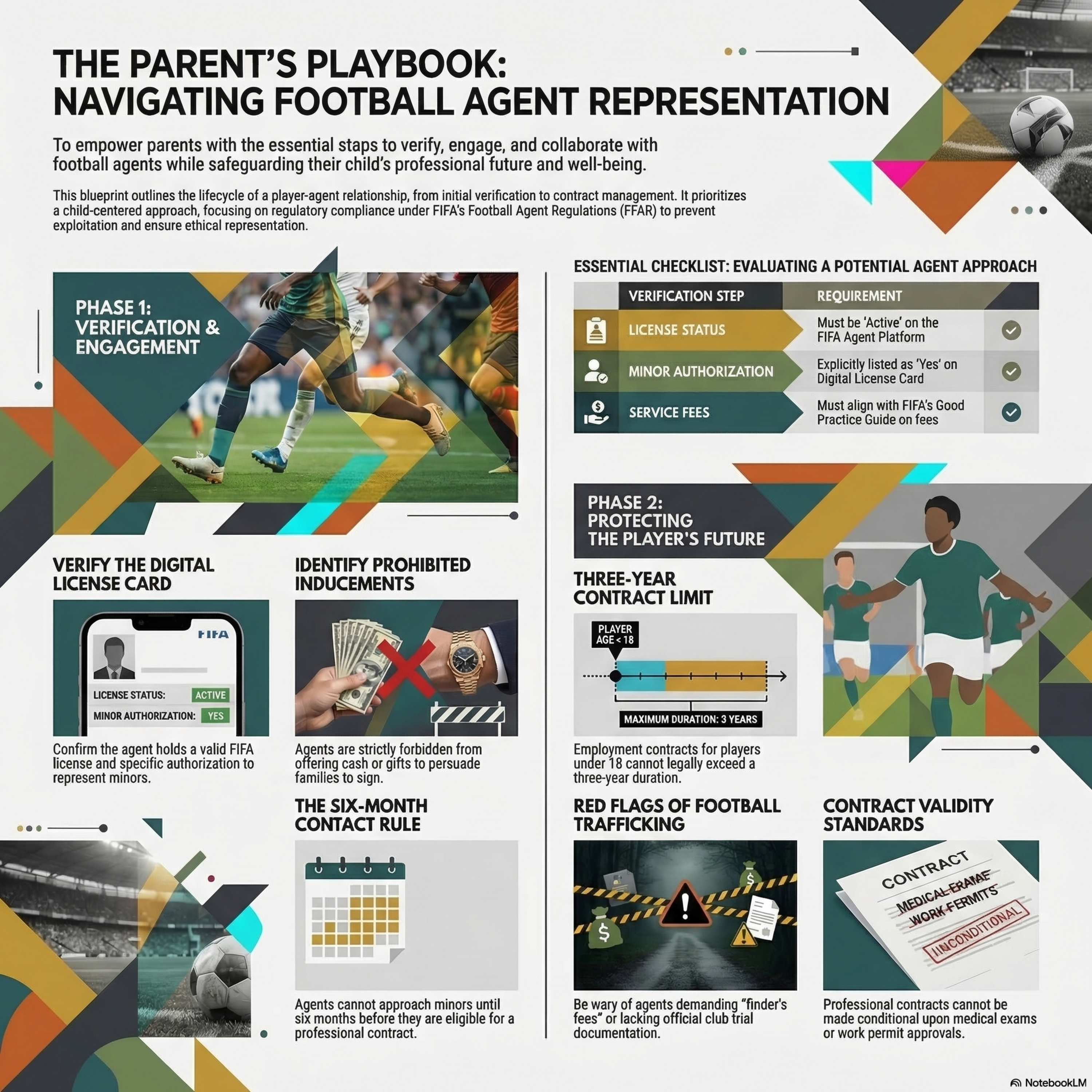
I really want to highlight this because the common assumption is that agents are aggressively scouting and signing kids when they are like 12 or 13 years old to lock up the talent early. They absolutely cannot do that, not legally. Wait, really? Really. According to global regulations, a football agent may only approach a minor or their legal guardian no more than six months before the minor reaches the age where they can sign their first professional contract. According to the lot of the country where they will be employed.
Right? Exactly. OK, let's make sure the mechanics of this are crystal clear for the listener. 6 months before they can sign a pro contract. How does a parent calculate that? You look at the labor laws of the jurisdiction. In many global jurisdictions, a player cannot sign a legally binding professional employment contract until he reached the age of majority. Which is typically 18. Usually 18 years old. Yes, in some specific territories under very strict conditions, it might be 16, but let's use 18 as the standard baseline for this example.
If the law says the child can sign a pro deal at 18, an agent cannot approach you, they cannot offer a representation agreement, and they cannot try to sign your child until they are exactly 17 1/2 years old. 17 1/2 that is. I mean, that's a massive paradigm shift. People think it happens so much younger. It is entirely by design. Why six months? Because the governing bodies determine that six months is enough time for an agent to legally prepare the paperwork and negotiate a contract for when the child turns 18.
Right? But it prevents agents from hoarding 13 year olds and controlling their development for half a decade without any accountability. That makes total sense. So if someone is approaching you on a pitch offering professional representation for a 14 year old or a 15 year old. They are blatantly violating the fundamental global regulations. They are immediately revealing to you that they do not respect the laws designed to protect your child. So that six month rule is a literal tripwire. Exactly.
It tells you who you're dealing with immediately. OK, but let's look at the agent themselves. Beyond the timing, what specific credentials are they legally required to hold to represent a minor? Well, first they must have a valid digital football agent license issued by the global governing body. But it goes deeper than that. Deeper how? To even speak to you about a minor, they must possess a specific secondary authorization to represent minors. Wait, they don't just get that automatically with the main license?
No they don't. They have to pass a designated representing minors continuing professional development course. What does that course actually entail? Because if I'm trusting someone with a child, I want to know what they've actually been trained on. It covers exactly what we've been discussing, the psychology of youth development, the legal limits of minor contracts, safeguarding protocols and the UNCRC principles. The UN rules. Right, they have to prove they understand that representing a child is vastly different legally and ethically than representing a 25 year old veteran.
That's reassuring. And furthermore, that specific minor authorization is only valid for three years. After three years, they must retake the course to ensure they are up to date with the absolute latest safeguarding laws. OK, let's play out a real world scenario here. An agent approaches a family. The agent pulls up in a luxury car. They are wearing a designer watch. They are flipping through photos on their phone showing themselves arm in arm with famous club presidents. We see that all the time.
Right. They are making incredible, dazzling promises, The parent armed with this knowledge we're giving them, says. Great. Show me your digital license and your specific minor authorization. Good for the parent. But the agent scoffs. They get defensive and say I don't need to show you a piece of paper. My reputation speaks for itself. Are you going to insult me with bureaucracy or are we going to make your son a millionaire? What is the immediate tactical response the family should take? Do they try to smooth things over or what?
You walk away immediately should walk away. There is 0 room for negotiation or apology. If an agent is unwilling or unable to digitally prove they are legally permitted to operate, they are either entirely unlicensed, they are unauthorized to work with minors, or they arrogantly believe they are above the rules. None of which are good. None of those are individuals you want within 100 miles of your child, and once you are safely away from the situation, you have a secondary duty. Which is. You report them to the relevant National Football Association or the global governing body.
I feel like reporting them feels like a big step for a parent who probably just wants to avoid trouble. It is a big step, but it is necessary. Reporting suspicious, unlicensed or rule breaking activity isn't just about protecting your specific child, it is about starving the exploitative ecosystem. Wow. If every parent demands the digital license and reports the fakes, the shadows disappear. That's powerful. So we have the first filters in place, verify the license, demand the minor authorization, and strictly enforce the six month rule.
Let's say we've done the work. The agent checks out. They have the credentials. The timing is legally sound. OK, green light so far. You invite them into your home to make things official. This brings us to the paperwork, the contract. What exactly should a parent be scrutinizing to ensure this legally binding document isn't a trap? You are looking at the Representation Agreement. This is the mandatory, legally binding written contract that establishes the relationship between the player, the parent, and the agent.
And they can't do anything without this, right? An agent cannot legally provide any services without this document fully executed. And because the history of football is just littered with horrific stories of young players being locked into predatory decade long contracts that ruined their careers. We've all heard those stories. Exactly because of that, the current regulations place incredibly strict, non negotiable limitations on this document. Let's get into the mechanics of those limitations.
What are the boundaries? First and foremost is duration. The absolute maximum legal duration of a representation agreement is 2 years. Period. Just two years. You cannot sign a five year development deal. You cannot sign a 10 year exclusive right contract. Two years is the absolute ceiling. I'm guessing agents have tried to find loopholes around that though. Oh, constantly. The most common loophole used to be the automatic renewal clause. How did that? Work. The contract would state this agreement is for two years, but if you do not formally notify us in writing 60 days before it expires, it automatically renews for another two years.
Oh. That's sneaky. Very, but that is now strictly prohibited. Automatic renewal provisions are illegal under the regulations. Oh good. The agent must physically re earn your trust and a brand new contract must be drafted and signed if you want to continue after two years. Furthermore, a player can only have a single representation agreement signed at a time. So you can't have three different agents holding exclusive rights to negotiate your employment. And mechanically, who is actually signing this?
Because a 17 year old signature doesn't hold much legal weight. If the player is a minor, the parent or legal guardian absolutely must counter sign the agreement alongside the player. What if they don't? If the guardian signature is missing, the contract is entirely void and unenforceable. The system demands that the adult is formally legally bound to the oversight of the relationship. It sounds like the representation agreement isn't a life sentence anymore. It's just a two year lease. If the agent wants to keep the player, they have to continually earn the right to stay by actually delivering results.
That's the exact mindset to have. But I want to dive into the murkiest, most ethically dangerous part of this entire process. Inducement. Yeah, this is a tough one. This is perhaps the most insidious, psychologically manipulative practice in the Youth scouting network. What exactly is an inducement for the listener? An inducement is any bribe, gift, or direct financial incentive offered by an agent specifically, typically to secure a signature on that representation agreement. And what does that look like?
It takes many forms. It could be a brand new pair of elite top tier football boots. It could be the newest smartphone. It could be an offer to pay the families rent for six months, or you know, cover the younger siblings school fees. Or very often it is simply a thick envelope of cash slid across the table. We really need to be painfully real about what this means in the African context. We are often talking about families who might be enduring severe financial hardship. If a well dressed man sits in your living room, looks at your immensely talented child and says just sign this paper and here is the equivalent of a year's wages in cash or hands over the keys to a vehicle, turning that down requires a level of immense, almost superhuman willpower.
It does. It feels like a miracle. So how can parents practically reframe that gift in their minds so they can see it for the poison pill it actually is? It is agonizingly difficult and unethical. Agents and traffickers weaponize that exact financial desperation. They literally study it. Yeah, but parents must ruthlessly reframe the transaction. In their minds, an ethical, legitimate agent invests their time, their network, and their expertise to earn a regulated percentage of a player's future professional earnings.
They bet on success, right? An unethical agent buys the player upfront at a massive discount so they can own and control them completely. So it's not a gift at all. No, that car, that envelope of cash is a predatory loan with toxic, soul crushing interest, and the interest you pay is the total surrender of your child's autonomy. That is dark. Think about the psychology. Once you take that cash, you owe them a year later when that same agent demands your child sign a terrible low paying contract with a third tier club simply because that club is willing to pay the agent a massive hidden side Commission.
You won't be able to say no. You won't be able to protect your child's development because the agent will hold that initial gift over your head. They will say I bought your house. You do what I say. Taking an inducement willingly hands all your leverage over to the agent. It is a severe regulatory violation and it must be rejected immediately. It is essentially a down payment on owning a human being. That is a chilling reality. It really is. So if a parent has the strength to reject the bribe, there is still one massive vulnerability before the ink dries on the legitimate contract.
How do we know the terms inside the two year lease are actually fair? You secure independent legal advice. Before you ever put pen to paper on a representation agreement, you must have it reviewed by a qualified legal professional. Oh, OK, and here is the absolute critical distinction that traps thousands of families. The lawyer reviewing the contract cannot be the same lawyer who represents the agent. Oh, that is the classic maneuver. The agent smiles and says, look, lawyers are expensive. Don't worry about finding one, my personal attorney will look it over for you right now, completely free of charge.
Exactly. It is a massive structural conflict of interest. The agent's lawyer have one job to protect the agent's financial interests. Not yours. Right. You need your own lawyer, a local legal aid clinic, or a sports law specialist whose sole fiduciary duty is to look at the service fee percentages, the specific termination clauses, and the exact description of services to ensure they're actually fair to the player. And what if the agent pushes back on that? The agent is legally obligated to provide you the opportunity and the physical time to seek this independent advice.
If they use pressure tactics, if they say the offer is only good for the next hour, sign it now or I'm walking away. That is a blazing red flag. Walk away professionals. Do not fear independent legal review. Scammers do. So let's trace our steps. We enforce the six month rule, we verify the specific minor authorization license, we rejected the cash inducement, we had an independent lawyer audit the contract, and we, as the parent, countersigned a legally compliant 2 year agreement. Perfect. The ink dries.
What happens on Tuesday morning? How did the parent, the player and the agent actually operate together? In reality, a lot of agents act like the parents job ends the second the contract is signed. That outdated dynamic is exactly what we have to dismantle. A successful modern representation relationship is a continuous collaboration. Think of it as a triangle of success, parent, player and agent. OK, I like that. When you transition into this active phase, your role as a parent shifts, but it does not diminish.
You are no longer just the defensive gatekeeper. You become an active collaborator and a strict supervisor. So you're still involved? Heavily you maintain a constant open dialogue and you actively monitor the agent to ensure they continue complying with the legal and regulatory standards they promised. I like to think of it like a ship. The agent is the navigator, they have the maps, the contacts. They are charting the course to the destination, but the parent remains the captain of the ship. That's right, you don't just go below deck and take a nap because the journey started.
You are up in the wheelhouse checking the coordinates, making sure the navigator isn't steering you into a hurricane. Exactly, and the communication lines must reflect that hierarchy if the agent tries to cut the parent out of the communication loop once the contract is signed. Like talking to the kid directly. Yes, if they start exclusively messaging your 16 year old on social media by passing your phone calls and making private plans with a minor, that is a massive breach of trust. It's in a severe red flag.
They can't do that. No. A collaborative relationship requires shared objectives, positive conflict resolution and continuous respectful inclusion of the child's views, but always mediated by the guardian. Let's put this partnership to its ultimate test, the absolute pinnacle of this journey, international trials and transfers this. Is a big one. A major club in Europe, or maybe a dominant club in North Africa, wants to fly the player out for a six week trial. What happens now? This is where the theoretical rights based approach we discussed at the very beginning collides with harsh reality.
For a young African player moving abroad, the psychological and environmental shock is immense. Oh, I can't even imagine. You were taking a teenager out of their community. The climate might be freezing, the language barrier is profoundly isolating, the food is unfamiliar, and the style of play is hyper competitive and ruthless. They're just kids. Right. It is a deeply vulnerable time. The agent cannot just negotiate a trial date, hand the kid a plane ticket, and sit back waiting for a Commission check.
They aren't shipping a piece of machinery to a factory. Precisely, parents must demand and verify through the agent that destination club will not negatively impact the child's fundamental right to education. Wait, really? The club has to do schoolwork. Yes, the agent must legally guarantee that the club has robust academic support systems in place during the trial. They need to ensure pastoral care, language tutors and emotional support are active components of the trial period. That's amazing.
If a child is moved across international borders and placed in a high pressure environment where they are isolated in a dorm room and stripped to their education, the entire system has failed them. Let's run a hypothetical scenario, because I know this happens all the time. The agent secures an incredible trial at a top tier European club. The family is ecstatic. Right, a dream come true. But two weeks into the trial, the kid called home in tears. The club is completely ignoring their academic needs.
They train for two hours a day, and then they are sitting completely alone in a foreign dorm room for 10 hours a day. No tutors, no schooling, no pastoral care. It. Happens so often. And the agent says just endure it. This is how you make it to the top. As a parent, do I actually have the power to pull the plug on a deal with a multi $1,000,000 club? You have absolute power as the legal guardian. Your legal and moral duty of care overrides any football opportunity, no matter how prestigious the club logo is.
Seriously. Yes. If the club and the agent are failing to provide provision, remember that first UNCRC pillar, the right to education and holistic development. The parent must intervene. How? What do you do? You demand an immediate emergency meeting with the agent and the club's Academy director. If they refuse to instantly rectify the situation and provide the mandated educational and emotional support, you terminate the trial and bring your child home. That takes an unbelievable amount of bravery to look at a towering European club and say you aren't treating my child like a human being.
We are leaving. It takes immense bravery, but consider the alternative. If a club demonstrates that they do not care about your child's mind and emotional well-being during a trial, what do you think they will do the moment your child suffers a knee injury? They'll drop them. They will discard them without a second thought. By pulling the plug, you are saving your child from a machine that is designed to chew them up. Also, during this partnership phase, the issue of payment will inevitably arise.
The representation agreement must clearly, mathematically outline the exact circumstances under which a service fee is due to the agent for negotiating an employment contract. No surprises. Exactly. There should be 0 hidden fees, zero surprise invoices. Transparency is the only metric of trust. We have spent the last half hour talking about the rules of a functioning, legitimate system, vetted agents, legally sound contracts, international trials with proper academic support. The way it should be.
But we would be doing a massive disservice to you, the listener, if we didn't shine a glaring spotlight on the dark inversion of this entire process. Yes, we have to go there. We have to talk about what happens when the trial, the club and the agent are all a carefully constructed, devastating illusion. We have to talk about protecting the African dream from human trafficking. It is the most sobering, horrifying reality of the global game. Human trafficking in football is a severe systemic human rights violation.
And it's organized, right? Highly organized. We are not talking about a few shady characters. We are talking about highly sophisticated, well funded criminal networks that specifically prey on young players and their families using deep deception and coercion. When a parent hears the phrase human trafficking, they they often picture movie plots, kid wrappings in the middle of the night, violence. But in the football context, it doesn't look like that at all, does it? No, it looks like a golden ticket.
It looks like salvation. It usually starts with a fake agent approaching a player directly. How do they do that? They might slide into their direct messages on social media praising their highlight reels, or they might show up at a local match in a sharp suit. They make incredibly detailed false promises of trials at specific European or Asian clubs. And they have fake documents. Oh, very convincing ones. They show forged invitation letters with official looking watermarks and club crests. To understand how the law views this, we really have to look at the United Nations Palermo Protocol.
The Palermo protocol. What is that? It's the international framework that legally defines human trafficking through three distinct elements, the act, the means and the purpose. Break those three elements down mechanically for. US OK, the ACT is what they physically do, the recruitment, transport or transfer the person across borders. The physical movement. Right then, the means is how they achieve it. The use of force, threat, coercion, or most commonly in the football trafficking ecosystem, complex deception and fraud.
Lying about the trial. Exactly. And finally, the purpose is the end goal, which is exploitation. Now here is the absolute most crucial legal distinction that every single parent listening needs to internalize. Listen closely to this. For minors, anyone under the age of 18, the means doesn't even need to be proven in a court of law. We explain the legal logic behind that. Why does the means not matter? It means that if a child is recruited and transported for the purpose of exploitation, it is automatically legally classified as human trafficking, regardless of whether deception, force or fraud was used.
Because they're kids. Because under international law, a child's consent to being trafficked is completely legally irrelevant. Think about it, A 16 year old might eagerly pack their bags, kiss their mother goodbye and happily skip on onto a plane because they truly believe they're going to play for an elite Academy in Paris. They want to go. Right, but their enthusiastic consent means absolutely nothing in the eyes of the law due to their inherent vulnerability and inability to assess the hidden dangers.
If they are taken to be exploited, they are a victim of human trafficking. Period. It is literally a mirage in the desert. It looks exactly like the life saving water you desperately need. You run toward it entirely willingly, but chasing it will cost you your life. That's exactly what it is. How exactly does this specific form of trafficking impact the African game? What is the aftermath? Traffickers weaponize the deep seated systemic desire to lift entire families out of poverty. They target the desperation.
They convince the family that this fake trial is a sure thing. And then what? The traffickers then demand exorbitant administrative fees. Families will sell their ancestral land, they will sell their livestock. They will take out massive high interest loans from local loan sharks just to pay the trafficker for the opportunity. That's. Devastating. And then they fly the child to Europe or Asia or the Middle East, and the moment the child clears customs, the agent vanishes like a ghost. They just abandoned them at the airport.
They abandoned them. The child is left standing in a foreign country. They have no money. They have no return ticket. Crucially, their passport has almost always been confiscated by the traffickers under the guise of safekeeping. Oh my. God, there is no club. There is no trial. It was all a lie to steal the family's money. It creates A catastrophic, heartbreaking safeguarding crisis. We are left with thousands of young African athletes who are suddenly homeless, undocumented, terrified and deeply ashamed.
Ashamed to even call home. Exactly. They're often unwilling to even call home and admit what happened because they know their family sacrificed their entire livelihood to get them there. It destroys families. It makes my blood boil just visualizing it. It is pure evil. We have to arm parents with the absolute, nonnegotiable countermeasures. What are the mechanical red flags of a trafficking operation? The 1st and most glaring red flag is any demand for upfront payments. Real, licensed, ethical football agents do not ask players or their families to pay for flights, visa processing or trial registration fees.
They pay for it themselves. An ethical agent operates on a contingency basis. They earn their money as a strictly regulated Commission only after the player successfully signs a professional employment contract. If someone asks you for money upfront to secure a trial, it is a scam, full stop. Do not pay them a single cent. Never pay to play. What is the second flag? The second red flag is any attempt to separate the child from their official documents. A trafficker will almost always ask for the child's passport upon arrival at the airport, claiming they needed to process the hotel registration or the club paperwork.
Never give them the passport. Never, under any circumstances, surrender a passport to an agent. The parent or the child must retain physical control of their travel documents at all times. And the third The third red flag is the trafficker insisting the child travel entirely alone or with unfamiliar associates while actively, aggressively discouraging the parent from accompanying them on the trip. I am going to lean in with serious intensity here. Let's play out the ultimate nightmare scenario. A family is targeted by a truly professional, high level scammer.
The really convincing ones. Yes, these guys are sophisticated. They don't look shady. They forge visa documents. Florida State. They have professionally photoshopped pictures of themselves with club executives. They have fake fully functional websites for fake scouting agencies. It's all affront. If a family is looking at what appears to be a completely bulletproof life changing opportunity, what is the absolute foolproof lifeline they can pull to verify the truth before they put their child on a plane?
You completely bypass the agent. You go around them directly to the source. First you take their name and you independently verify their digital license through the official global governing bodies online database. If their name doesn't appear in the official verified registry, they are a phantom. OK, check the database. 2nd and most importantly, you independently contact the Football Association of the country where the supposed cry was taking place. How does a parent practically do that from a different continent?
You or your independent lawyer go online, find the official website for that country's federation. If the agent claims they have a trial set up at a club in France, you find the contact for the French Football Federation's safeguarding or player registration department. And you just call them. You e-mail or call them directly, you say. I have an agent claiming my minor son has a trial at this specific club on these dates. Real trials involving international minors require extensive, highly regulated international clearance paperwork through the governing bodies.
So there has to be a paper trail. It leaves a massive paper trail if the Federation checks their system and has absolutely no record of the clearance. It's the phantom trial you verify with the ultimate authorities. Never, ever take an agent's shiny paperwork at face value. Verify, verify, verify. Go run the agent. Call the club's main switchboard directly. Call the National Federation. That is the lifeline that will save your child's life. It's the only way to be sure. OK, we have to transition from the darkest possible scenario to the administrative reality of how all things eventually wrap up.
Whether you need to urgently escape a suspicious situation or simply because the two year contract has run its natural successful course, every representation relationship eventually comes to an end. They all do eventually. We must know the exact legal mechanics of how to walk away safely. Knowing how to legally exit a contract is just as important as knowing how to enter 1 In the regulatory framework, termination generally comes in three distinct forms. What's the first one? The 1st and easiest is natural expiry.
You signed a legally compliant 2 year representation agreement. The exact two years have passed and the contract simply expires. Nice and easy. Legally, no further action is required to end the mandate, though it is always good professional practice to send a formal written notice acknowledging the end of the relationship. Clean, simple, and undisputed. But what if a parent realizes 6 months into the deal that this just isn't working and they want to end it early? Then you were looking at either premature mutual termination or unilateral premature termination.
Let's start with mutual termination. OK, what is that? This is when both parties, the player and parent on one side and the agent on the other, sit down like adults, agree that the relationship isn't yielding the desired results, and mutually agree to part ways before the two years are up. It's an amicable divorce. Exactly. But crucially, even in the most amicable split, every single detail must be documented in a written termination agreement. That's the catch. The most dangerous, often overlooked detail here is the agents continuing entitlement to service fees.
Oh, meaning they still get paid? If the agent successfully negotiated a three-year professional club contract for the player before you mutually agreed to terminate the representation, the termination agreement needs to explicitly, mathematically document whether the agent is still entitled to their Commission on that specific club contract and the exact date those entitlements definitively end. Because if you don't. You must lock this down in writing to prevent the agent from showing up two years later with a lawsuit demanding undue future fees.
Get the clean break in writing checked by your independent lawyer. Now let's talk about the messy divorce. What if the agent refuses to mutually terminate? They want to hold on to the player, but the parent knows in their gut they have to get out to protect the child. That leads to unilateral premature termination. This is when one party breaks the legally binding contract without the other party's consent. But legally, you can only do this safely without facing massive financial ruin if you possess what contract law defines as just cause.
Just cause I need you to define the actual legal threshold for that, because if I'm a protective parent and the agent hasn't answered my text messages in three months, in my mind that's absolutely just cause to fire him. Right in your mind. But I'm guessing the dispute resolution lawyers in Switzerland might see it differently. What is the actual threshold? The threshold is incredibly high. Just cause means that a party cannot reasonably be expected in good faith to continue the contractual relationship.
It usually requires a severe, documented material breach of obligations. Like what? For example, if you can prove the agent is actively working against the child's best interests, if they are blatantly violating international safeguarding regulations, if they have completely abandoned all communication and services for an extended documented period, or if they're demanding illicit payments. I'm going to use an analogy here. You cannot just jump out of a moving car because you see a faster, shinier car driving next to you.
You have to safely pull over, turn off the engine, legally break the lease, and hand back the keys. That's spot on. You cannot break a contract just because a flasher agent promises you more money. That is the perfect way to look at it. You absolutely cannot unilaterally terminate a contract just because another agent approached you offering a better deal or a bigger club. What happens if you do? If a parent breaks a valid agreement without legally proven just cause simply to switch agents, both the parent and the player could be taken to a dispute resolution chamber and found liable for massive financial damages.
Like paying the old agent. You could literally be sued for the entire projected Commission the original agent would have made. It can bankrupt a family. So if an agent is clearly failing a young African player, ignoring them, not finding the trials they promised, but stubbornly refuses to agree to a mutual termination, how heavily does the burden of proof weigh on the parents to legally prove just cause to the governing bodies? The burden of proof weighs entirely on the party breaking the contract, and it is incredibly heavy.
This is exactly why during the partnership phase, we said parents must act as supervisors and document everything. You need proof. If you were going to take the drastic step of claiming just 'cause you need the receipts, you need a paper trail, you need to show the formal emails that went unanswered for six months, you need the text messages proving they violated a rule or demanded an illicit fee. You can't just go off a feeling. You cannot just walk into a legal chamber and say he wasn't trying hard enough.
You have to objectively prove a material breach. This is why seeking independent legal advice before you even threaten unilateral termination is absolutely critical. Document everything, keep the receipts, never rely on verbal promises. And let's say we do navigate that we legally terminate, or the contract expires naturally and we're ready to find a new, better agent. Are there rules for how we transition? There are strict rules for switching agents to prevent tampering. If you are unhappy and looking for a new agent before the final two months of your current active contract, you must actually obtain your current agents explicit written consent to even open preliminary discussions with a new representative.
Oh wow, what if you're close to the end? If you are within the final two months of the contract naturally expiring, the rules loosen. You are free to sign an agreement with a new agent, provided the new agreement clearly states will only take effect once the current one definitively ends. OK, good to know. And finally, never forget your reporting obligations. Terminations, just like the initial signings, must be formally reported through the digital clearinghouse to the relevant football governing body.
The global system must always reflect the players true updated representation status to maintain transparency. OK. We have covered an immense, complex landscape today. We started on that sun baked, dusty pitch with nothing but raw talent and a dream, and we have navigated the entire treacherous life cycle of international football representation. We really went through it all. So what does this all mean for you, the listener? Let's distill this vast amount of information. It means that on the modern global stage, raw passion and immense physical talent are simply not enough to survive.
Talent might get you noticed, but it will not protect you. No, it won't. The ultimate take away from everything we have unpacked today in this deep dive is that deep structural knowledge is your ultimate armor. Knowledge is everything. By adopting A rigid child's rights based approach, you forcefully prioritize the human being over the athletic asset. By rigorously verifying digital licenses and demanding to see specific minor authorizations, you lock the gate against predators before they even enter your home.
Absolutely. By flat out rejecting the psychological traps of cash, inducements and bribe, you maintain total ownership of your child's future. By maintaining an active supervisory collaboration, you steer the ship. And you protect them. Yes, by memorizing the deadly glaring signs of human trafficking, refusing upfront fees, never surrendering a passport, verifying directly with federations, you literally save lives. And by managing contracts legally, understanding the high bar for just cause, and utilizing independent lawyers, you protect your family from financial ruin.
It all comes down to the parents. You, the parent, the guardian, the local mentor, hold the power to dictate the terms of engagement. The system wants you to believe you are at its mercy, but you are not. You are the ultimate decision maker with the absolute power to demand better, safer standards. And I want to leave you, the listener with a final paradigm shifting thought to Mull over. Everything we've talked about today has been focused on how this operational knowledge protects your specific child.
But I want you to think bigger. Think about the entire continent. What if every single parent, guardian and local coach across the African landscape suddenly woke up tomorrow and demanded this exact, uncompromising standard? Oh, that would be incredible. What if every single family demanded digital global transparency, ruthless legal rigor, and ethical treatment before signing a single piece of paper? How quickly would the exploitive shadows of the international scouting network simply collapse under the weight of that unified scrutiny?
They wouldn't survive it. It wouldn't just protect individuals. It wood forest the entire global game to fundamentally restructure It wood forest the world to finally treat African talent not as a cheap, disposable commodity to be traded in the dark, but as the most respected, fiercely protected and highly valued asset in world football. If parents unified around these regulations, the power dynamic between Europe and Africa and youth football would flip overnight. It would change everything and that is the point.
The power to change the global game is not sitting in a boardroom in Zurich. It is not in an agency office in London or Madrid. It is in your hands, right there on the sidelines of that dusty pitch. Thank you for taking this deep dive with us. Stay vigilant, master the rules, and protect the dream.
 Apple Podcasts
 Castbox
 Castro
 Goodpods
 Moon FM
 Overcast
 Pocket Casts
 Podbean
 Podcast Addict
 Podcast Republic
 Spotify