Possession Is Vanity Efficiency Is Sanity
About this episode
Possession Is Vanity Efficiency Is Sanity
Listen now on Spotify, Apple Podcasts, Amazon and other streaming services! Don’t forget to subscribe, share, and leave a ⭐⭐⭐⭐⭐ review to help more players and coaches discover the power of Techne Futbol and Data Technology in the beautiful game.
#TechneAfricaFutbol #TechneFutbol #TrainWithTechne #Playermaker #TraceFutbol #Hudl #FootballTech #FootballInnovation #PlayerDevelopment #CoachTools #SmartFootballTraining #AfricanFootball #CAFOnline #FIFA #FIFAYouth #CAFDevelopment #YouthFootballAfrica #NextGenFootball #FootballScouting #TalentIdentification #DigitalScouting #EliteYouthDevelopment #FootballJourney #FootballAnalytics #FIFAForward #FutebolAfricano #TrainTrackCompete #FootballExcellence #FootballAfrica #TheFutureOfFootball
Welcome. Welcome to the deep Dive. We are about to plunge head first into a tactical ice bath, A single knockout match that felt like a collision of worlds. It really was. This wasn't just another game, this was a philosophical battleground. Absolutely. Picture the scene the floodlights are on at the Almadena Stadium in Rabat. It's the AFCON 2025 round of 16. The tension is, you know, you can feel it through the screen. And in this arena, you had one team's technical, beautiful artistry smashed against the brutal, pragmatic and frankly ruthless efficiency of another.
And only one of those philosophies survived the night. We're talking, of course, about that massive clash between South Africa and Cameroon. A fixture that I think will be studied for years to come. It wasn't just a knockout time, it was a psychological exam for both sides. It tested their nerve, their identity, everything. And the final score, that 21 win for Cameroon, is forcing a, well, a pretty serious rethink across the continent. It is. But here is the central paradox, the one stat that this entire deep dive hangs on.
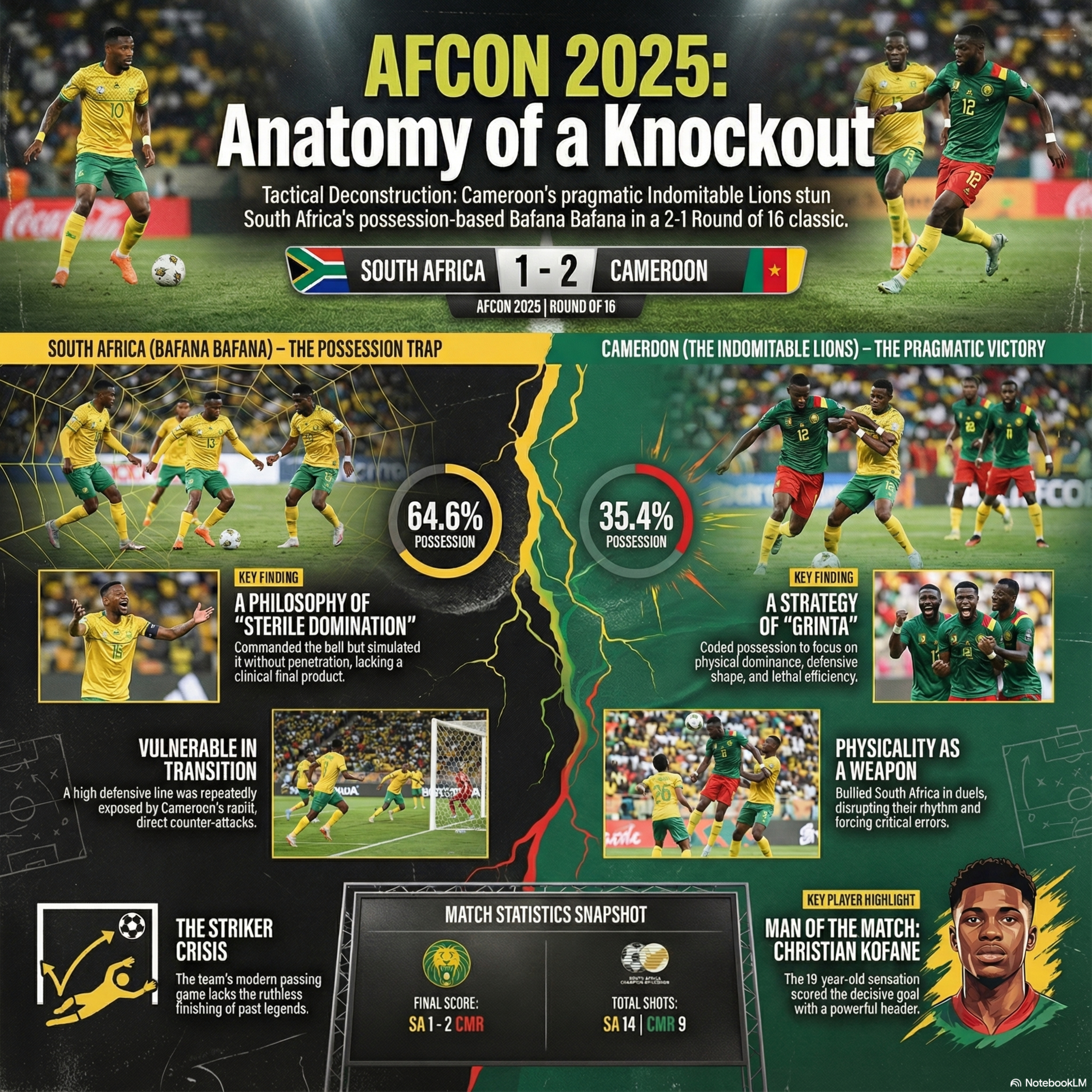
Get this, South Africa had the ball for nearly 2/3 of the match. 64.6% possession. They own the midfield, they look technically superior and like almost every way. And yet they lost. They lost 21 to a Cameroon side that seemed to have fewer ideas but much, much clearer execution. And that right there, is the perfect case study. It's the ultimate example of sterile domination versus lethal efficiency. South Africa's ability to hold the ball, to recycle it, to move it with his beautiful precision, it was undeniable.
It was great to watch. It was. But Cameroon came back with a hard, brutal answer. They proved that in the chaos of a knockout tournament, things like ruthless efficiency, raw physicality and just sheer mental toughness. They often crush even the most sophisticated game plan and. We can't forget the subplot, the personal drama woven through all of this, which made every decision feel 10 times heavier. You're talking about Hugo Bruce. Hugo Bruce, the man who coached Cameroon to that incredible, improbable Afghan title in 2017, was now in the other dugout, trying to dismantle the very monster he helped create.
That just adds a whole other layer of intensity, doesn't it? It? Does, which is why our mission here is to go way beyond that 21 scoreline. We need to systematically pull apart the tactical, the historical and the psychological lessons from this clash. So that you listening right now can really understand what it takes to win an African tournament football. Exactly. We're looking for the blueprint. What is the secret to bridging that gap between looking good on paper and actually performing when the pressure is at its absolute highest?
That's what we're here to find out. All right, let's get into it with the cold hard data, because this is where the story really starts to take shape. Yeah, if you were a betting person and you only saw the stat sheet, you would put your house on a South Africa win. Oh, without a doubt. The disparity in the numbers is just, it's stark. It's set, it's up this whole philosophical debate perfectly. So as you said, South Africa finishes with a staggering 64.6% of the possession. Almost 2/3 of the game.
For 90 minutes they just had the ball, they were patient, they were technical and their passing was beautiful. And 86% pass accuracy rate. That's top tier stuff. And that's the Mamelodi Sundowns philosophy we hear so much about, right? Yeah. Implemented on the national stage. It is in its purest form and it's impressive. But then you look at Cameroon, they're passing accuracy was estimated around what, 71%? They were definitely messier with the ball more direct, maybe even a bit chaotic. But they were the ones celebrating at the end.
Yeah. Which leads to the most important stat of all. Lethal efficiency and here it is. Cameroon managed only 9 total shots in the entire game 9. That's not a lot for 90 minutes. It's not, but they scored two goals. That's a conversion rate of over 22% of their total shots. Just clinical. In South Africa. South Africa took fourteen shots. More shots, more possession, but only one goal to show for it. And that just underlines that brutal truth and knockout football, doesn't it? It doesn't matter how pretty your buildup is.
It only matters what you do in and around that 18 yard box. Precisely. But I think there's an even deeper metric here, the one that really tells the story of how Cameroon won. It wasn't about ball. Skills. It was about the physical battle. It was about the physical battle. The gap was just immense and this, I think, is what completely negated South Africa's technical quality. So let's dig into that. What are we talking about specifically? We're talking about the duels, the one-on-one contests. Look at Cameron's tackle success rate.
It was a phenomenal 83.3%. 83% that's it's almost unheard of. It is. It means when a Cameroonian player decided to go in for a tackle to engage in a physical duel, they almost always came away with the ball or at the very least broke up the play. OK, So what was South Africa's rate in comparison? This is the kicker. South Africa, for all their technical ability, only managed a 42.9% tackle success rate. Wow, that is less than half. Less than half. So the question isn't just that it happened, it's how?
How did Cameroon manage to be so dominant in the physical challenges? Yeah, What were they doing differently? Well, it was a very deliberate philosophy from their interim coach David Pigou. First, it was about timing and body positioning. The players, especially the midfielder Carles Baleba, were coached to wait for the exact moment the South African player took that second touch or was about to release the pass. So they weren't just diving in recklessly. Not at all. This minimizes the risk of a foul and maximizes the chance of a clean dispossession.
Second, they played right up to the line. They understood the refereeing standard at AFCON. They knew they could be more aggressive, more physical. And that relentless clean ball winning just completely shattered South Africa's rhythm. So it's a perfect summary. South Africa won the technical battle, the passing, the aesthetics, but Cameroon won the physical battle and that's what won them the match. They bullied them. They effectively bullied South Africa off the ball, which forced the turnovers that led directly to their vertical counter attacking game.
Which brings us to the formations. So Bruce had up South Africa in that familiar 4231. Yep, possession based technical using the sweeper keeper Ronwyn Williams to start attacks high up the pitch and really compress the field. The idea is to make the pitch small when you have the ball and tire the opponent out. And Pigou's counter move for Cameroon. He set up a very robust, very flexible 433, but the key was how it shifted when they didn't have the ball. It dropped into a deep disciplined 4141 mid block.
A defensive wall, basically. A wall and the goal was simple. Brush straight South Africa's central midfielders and the second you win the ball back you do not mess around in the middle, you bypass it. You hit the channels and exploit all that space behind South Africa's adventurous full backs. So the big take away here for you watching at home, for coaches, for players across the continent, is that possession is often vanity. Efficiency is sanity, especially in knockout tournaments. You can be the most technically gifted side out there, but if you don't have the teeth to finish your chances or the muscle to hold your ground, you're going home.
And that's a hard lesson South Africa had to learn. OK, so we can basically trace the entire story of this game through the three goals or like, narrative markers, right? They show you exactly where one team system broke down and the others succeeded under immense pressure. Absolutely. And knockout football. A whole match can pivot on just a couple of these key moments. Either a bit of brilliance or, you know, a catastrophic defensive error. So let's start with the one that really stung South Africa Cameron's first goal, 34th minute.
And this one hurt because it came completely against the run of play. Completely for 30 minutes South Africa were dominant. They had the ball, they were setting the tempo. It felt like it was their game to lose. And then, from a set piece, disaster strikes. Cameron wins a corner, they whip a physical ball into the box and suddenly all of South Africa's beautiful structure just it dissolves. What was the core failure there? The failure was twofold. It was structural and it was about reaction speed.
South Africa, We're using a zonal marking system on the corner. Which relies on everyone knowing their job. Exactly. It relies on two things. One, you have to win the first header decisively, get it clear. And two, if you don't, you have to react instantly to the second ball. You need communication. You need aggression. But the analysis called a pinball scramble, That doesn't sound very organized. It was total chaos and that's where the zonal system just fell apart. The first clearance was weak, it wasn't decisive and the ball just dropped right into the most dangerous area on the pitch, the six yard box.
The panic zone. Mechanic zone. And in that chaotic scrum, who reacts fastest? It's not a center back. It's not a defensive midfielder. It's Junior Chomadu, the fullback from Stoke City. He just showed incredible alertness to get to the loose ball 1st and rifle it home past a screen. Ronwyn Williams. So why is this such a common problem? Why do technically focused teams sometimes struggle so much with the chaos of a set piece against a physical side? Because set pieces are the great equalizer, they negate passing skill when a ball is bouncing around in the box, it's no longer a technical game.
It becomes a test of raw aggression, commitment, and who wants it more. It's a different kind of football. It's a completely different kind of football. South Africa's entire system is built on control, and in that moment there was no control. The lesson there is brutal. Your technical skill means nothing if you can't handle defensive chaos. You have to win that second ball. So if that first goal was a tactical failure, the second one that felt like something else. The second goal was a catastrophic failure of concentration met by ruthless clinical execution from Cameroon.
And the timing of it was just a killer. 2 minutes after halftime, you've just come out, you've reset, you've heard the coach's speech and bang, sucker punched. That lapse in focus right after a break is probably the single biggest sign of mental fragility and knockout football. It tells you the team hasn't processed the first goal, they haven't switched back on, and the goal itself was a textbook counter attack. It started from a simple giveaway in midfield. Right, simple turnover. And from that turnover, Cameroon immediately did what they had planned to do all along.
Play vertical, instantly forward. No hesitation. And they were exploiting the space behind the full backs. Massively South Africa's fullback Kalisa Mudo was caught way too high up the pitch. That's a direct result of Bruce's high risk, high possession system. So the very system designed to help them control the game became their biggest weakness. In that moment, yes, and the execution from Cameroon was just flawless. The substitute Muhammadu and Nagita delivered this perfect curling cross from the wing.
Just an incredible moment of quality. And the finish from the 19 year old Christian Cofane? He looked like a seasoned veteran. Cofane was outstanding. His movement completely belied his age. He timed his run perfectly, split the two center backs, Indizana and Nimbulkazi. It was just incredible predatory awareness. He met the cross with this powerful, decisive header. Williams had no chance. So the lesson there is twofold. First, if you're going to play a highline with adventurous fullbacks, you have to be prepared for rapid vertical counters.
Absolutely. And 2nd, your concentration has to be at 100% the second that whistle blows for the second-half. It's often the softest, most vulnerable moment in a high pressure match. OK, but even South Africa's goal, the late one in the 88th Mint, that tells its own story, doesn't it? It might tell the most important tactical story of the whole match, funnily enough, especially for Hugo brews. Because they were two nil down, they were desperate, and they finally, finally abandoned that patient, horizontal U-shaped passing that hadn't worked all game.
And that's the crucial point. They were forced by desperation to change. They finally went direct. They went vertical. Aubrey Maidba, on as a sub, gets the ball in the left half space and doesn't recycle it. He whips in an early dipping cross. A ball designed to cause problems, not just keep possession. Exactly. It was designed to disrupt Cameroons organized block and who is on the end of it. Evidence Maccopa the physical presence they brought on to do exactly that. Evidence Maccopa, who was brought on for his aerial ability, gets on the end of it and steers it home.
And get this, Maccopa was rated as 7.5 for his substitute appearance. He was South Africa's highest rated attacker. Which just shows the immediate impact that change in style had. It does, and it raises this huge, profound question that coaches and federations have to be asking. If going direct and using a physical target man immediately caused Cameroon problems, why did Hugo Bruce wait so long to do? It was his commitment to his beautiful possession based philosophy too rigid. Too. Precious for the gritty reality of a knockout game.
That is the central critique, isn't it? The very moment South Africa adapted their style to the opponent they were facing, rather than trying to force their own idealism onto the game, they looked more dangerous and they scored. Tactical idealism has to bend to pragmatic necessity. Which leads us perfectly into the coaching chess match, because this was a fascinating, if a bit of a lopsided, battle of wits. Let's start with South Africa's tactical identity. So much possession, so little penetration.
While the core philosophy itself is sound, high possession, patient buildup, it's designed to control the game, save energy, and wear the other team down. And that 86% pass accuracy shows they executed the possession part of the plan perfectly. But. The penetration just wasn't there. It felt like possession for possession. It did, and it became what we call U-shaped possession. If you can picture the Cameroonian 4141 mid block as a big defensive wall across the middle of the pitch. OK, South Africa's passing just circulated around the outside of that wall, from the right back to the center back, back to the defensive midfielder, then out to the left back.
A big U shape, They were going sideways and backwards, but they weren't taking the risks to play forward and breakthrough the. Wall And why does that happen? What was Cameroon doing defensively to force them into that pattern? The key was Carlos Baleba, that defensive midfielder. He was a shield. Pigou instructed him to block all the passing lanes into that dangerous space between Cameron's midfield and defensive lines. This so-called. Pocket. The pocket he made, that central area so congested that any pass into it was a huge risk.
And South Africa, a team that values keep the ball above all else, chose the safe sideways Passover, the risky forward pass that Belieba might intercept. Which, as we saw with the second goal, would be a disaster for them. A total disaster. And the result of all this is that their main striker, Lyle Foster, was completely and utterly isolated. He was rated A5 point O for the match. He couldn't get into it. He was a ghost. He had this impossible choice, either drop really deep to try and get a touch of the ball which leaves the penalty box completely empty, or stay high up the pitch and just watch his teammates pass the ball around 40 yards away from him.
It's a no win situation for a striker. It sounds like what they were missing, what that system was crying out for, was a creative #10A player whose job it is to find those little pockets of space and break the lines. That was the fatal flaw against a low block. 100% you need a player who can receive the ball on the half, turn between the lines and deliver that killer pass. Without that spark of genius, that moment of unpredictability, A possession system just becomes, well, predictable. Now let's flip it and look at Cameron.
They came into this tournament in, let's call it a state of chaos, administrative crises, the whole 2 coaches saga. A complete mess. And yet their interim coach, David Pigou strips it all back to basics and focuses on one thing. Grinta. Grinta. It's an Italian word, but it perfectly captures that traditional Cameroonian virtue. It means grit, determination. But it's more than that. It's a psychological commitment to being physically superior, to embracing the fight, to winning your duels. So he knew they couldn't outpass South Africa.
He knew, so he decided they would outfight them, and he built the whole system around that idea that 4141 was designed to absorb pressure and punish mistakes. With Carlos Baleba, who was rated an 8 point O as the anchor. The midfield. Destroyer. Exactly. His job was simple, breakup, play win tackles and he was a huge reason for that. 83.3% success rate and shield his center backs. His physical presence was the rock. The whole defense was built. On and the plan when they won the ball was genius in its simplicity just.
Go. The instructions were crystal clear. The second you win possession, you play vertical immediately. You do not get into a passing contest in the crowded midfield. You bypass it. You turn the game into a series of 40 yard foot races. Which is the last thing South Africa's high defensive line wanted. It's their nightmare. It forces their defenders to constantly be turning and sprinting towards their own goal. That's exhausting, and it's where mistakes happen. And Pigou, the interim coach, even managed to out coach the veteran Brews with a forced substitution.
Says so much about his clarity under pressure. Darlin Yongwa gets injured, he's forced to bring on Muhammadu Nagita and Nagita isn't a like for like replacement. He offers a more direct, aggressive crossing threat and what happens? He provides the match winning assist. That single decisive change in personnel and tactics LED directly to the winning goal. That is brilliant in game management that completely outmaneuvered a legendary coach. So let's talk about Bruce, a champion coach. But the criticism of his rigidity here was intense.
Why stick with a system that clearly wasn't creating chances? Why wait until the 64th minute when you're already 2 nil down to make a meaningful change? Well, his stubborn adherence to the system, regardless of the score, it suggests a kind of tactical pride, maybe an unwillingness to accept that his beautiful idea wasn't working on the day. But. Let me challenge that for a second. Isn't there an argument for consistency? If he rips up the game plan at halftime, does that send a message of panic to his players?
Does it undermine the identity they've spent months building? That's a very fairpoint, and it's the eternal dilemma for a coach, but I think true genius is about adapting your philosophy without abandoning your identity. He didn't need to RIP up the whole plan. He could have just brought on Magopa at halftime to give them a different kind of threat, a Plan B. An aerial outlet for all that possession. Exactly. Give the possession of purpose. By waiting until he was too O down, he'd already seeded all the psychological momentum at that point.
The time for philosophical purity is over. It's time for pragmatism. And then you have his post match comments where he's talking about logistical issues and the ACON vibe. Yeah, and that hints at a mindset that maybe wasn't fully focused in these high pressure tournaments. Mental clarity is everything. Any distraction, whether it's real or perceived, can trickle down to the players and show up as a lapse in concentration. Like the one we saw at 2 minutes into the second-half. Exactly like that one.
And if Pigou's edge was creating that siege mentality for Cameroon, then his perfect weapon was the man of the match, Christian Cofane. Cofane rated an 8.5. He was incredible. He is the prototype of the modern African forward. He's fast, he's technically educated at a top European Academy in Bayer Leverkusen, and crucially, he has the intelligent movement to constantly threaten A highline. If you're going to play on the counter, you need an outlet like him. He's not just fast, he's smart. Which brings us to the bigger picture.
How do we connect this one match to the wider story of African football development? What can a nation like South Africa learn from its own history to bridge this gap between technical quality and knockout stage ruthlessness? Well, for South Africa, looking back at the legendary team from 1996 isn't just about nostalgia, it's a vital diagnostic tool. That team won the AFCON because they had a perfect blend of technical skill and these other intangible qualities that the current team just seems to be missing.
So let's. Start in the midfield. The current pairing Mokoena and Setho or Obelbles. They're good players, industrial discipline. They fit the system, but how do they compare to the architects of 96, Doctor Kamalo and John Cheuse Michoux? It's a night and day comparison in terms of style. The legends were defined by a quality called Paza, the pause. The pause. What do you mean? It's this unique ability to slow the game down for a split second, even when you're under pressure to take an extra touch, assess the whole pitch and then deliver a killer pass that nobody saw coming.
They mix that South African flare, this shibbobo, with a kind of surgical precision. So mechanically, what does that look like? We see Mcwana get the ball and move it quickly. What did Kumala do differently? Kumala would deliberately hold the ball for an extra half second. Against a packed defense like Cameroon's, that pause forces a defender to make a decision. Do I step to him? Do I hold my position? And in that moment of hesitation, a passing lane opens up. Kumala would use a body faint, a shift of weight.
He manipulated defenders. Whereas Mukuena and Obaz are programmed to just keep the ball moving safely. Exactly. They are fantastic system players. They cover ground, they recycle possession efficiently. But when they come up against a deep, organized defense, the system becomes predictable because it lacks that spark of creative genius. The lesson is huge. Technical discipline is your foundation, but you have to have someone who can break the rules, someone who can provide that moment of magic. And the striker position feels like an even bigger gap.
Lyle Foster isolated A5 point O rating. You contrast that with Phil Masinga and, of course, Benny McCarthy. The sheer presence of those two was intimidating. Masinga gave you world class hold up play, the ability to bring others into the game, which is so important in physical tournaments. But Benny? Benny was a predator. A pure goal scorer. A pure lethal finisher. He scored from half chances. He lived on the shoulder of the last offender. He put fear into center backs. Foster is a very different type of player, the modern pressing forward.
He is and his work rate is phenomenal. European coaches love that. But in a knockout game, you need goals, and Foster too often drops deep to get involved in the build up in that U-shaped passing which leaves the penalty box empty when the cross finally comes in. It's telling the one goal they did score came from a more traditional physical striker in Magopa. That's the whole point. It took Magopa coming on to show them what they were missing and the lesson for football development across the continent is massive.
A striker's contribution to the build up cannot replace their primary job, which is to be a ruthless goal scorer. You need someone who lives for that one chance. OK, finally, leadership. The defense. We saw that pinball chaos for the first goal. Ronwyn Williams is a great leader from goal, but where was the organizer in the back four at that moment? That is the Neil Tovey shaped hole in that defense. Tovey, the captain of 96, was an on field general. He wasn't just a defender, he's an organizer.
He exuded A calmness that prevented panic. So take us back to that corner in the semi 4th minute, the ball is bouncing around. What would Tovey have done? Tovey would have screamed. He would have abandoned the zonal structure for a second and just commanded someone, anyone to get the ball out. Just clear it, he would have been pointing organizing and his authority alone would have settled things down. The current defenders in Gazanna and in Bokazi. They're technically good players, but they seem to lack that commanding vocal presence.
So that chaotic sequence was a direct result of a leadership vacuum. I believe so. It was a moment where the defense fractured under pressure and there was no on field general to pull them back together. The lesson is clear, you can have all technical defenders you want, but you need a true vocal leader to Marshall the troops when the pressure is on. Right, let's pivot back to the winners, Cameroon to get the 21V and they move on. Despite all that internal drama, their win seems to be less about a single tactic and more about a deep collective identity.
It does. If you think back to the last great Cameroon team, the Ito era from 2000 to 2010, it was all built around individual superstars. The plan was basically give the ball Samuel Lido and let him create some magic. This 2025 squad doesn't have any dough. Not even close. But what they have is a collective. They've gone back to that soldier mentality that, ironically, Hugo Bruth himself instilled in them back in 2017. They're a unit. A unit forged in chaos. Exactly. They're committed to tactical discipline, they use their superior physicality and they have this new generation of players like Buliba and Cofane who are getting top level tactical education in European academies.
And that's the blend, isn't it? Traditional African physicality and resilience combined with modern European tactical intelligence. That's the recipe. It creates this incredibly resilient discipline unit that can execute a simple plan effectively. And the great paradox is that they won. Despite the administrative chaos, the two coaches saga with Ito as the FAA president, overseeing it all. It's amazing. How does that kind of instability actually lead to on field resilience? You'd think it would make them fall apart.
You would, and 99 times out of 100 it probably would. But in this case, it seems the external conflict created a powerful siege mentality US against the world attitude. The players bonded together, focused only on what they could control, their performance, and they channeled all that negative energy into a collective defiance. So chaos became their fuel. In a strange way, yes. Their resilience, born out of that chaos, became their greatest weapon against a technically superior but perhaps more fragile South African side.
Let's touch on the tech side of things for a moment, because that played a role too. Yeah, and there were two big positives that show how the tournament is modernizing. First the semi automated offside technology, or Sao. For Lyle Foster's disallowed goal early on. Right, a huge moment in the 14th minute and the decision was made in about 45 seconds. It was quick, it was precise, and the game moved on. That's a massive improvement. Those long momentum killing VAR delays from past tournaments were so frustrating.
They killed the flow of the game, so that's a huge step forward for the competition. And 2nd, we have to give credit to the infrastructure. The pitch quality and robot was superb. Even with heavy rain. Even with heavy rain, the pitch held up, it was fast, which enabled the kind of quick transition football that Cameron wanted to play. Investing in good pitches, good drainage, it's absolutely critical to improving the quality of football across the continent. So after all this, it feels like we've landed on a fundamental truth.
Technical quality across Africa is rising, but the intangibles, mental strength, clinical finishing, leadership are still the deciding factors in these big tournaments. That's it. So we need to turn these lessons into real, actionable recommendations for the federations. OK, so let's start with South Africa. Bisafa, if you're them, what's the first priority to fix this imbalance between possession and ruthlessness? Priority one, without question, is a complete rethink of Stryker development. They have to stop relying on midfielders to score the goals.
The youth programs need to focus on producing natural, predatory finishers in the mold of Benny McCarthy. Strikers whose main job is to be in the box and score goals, not drop deep. Exactly. Train them to move intelligently in the box, to finish from tight angles, to be a constant threat. That has to be priority #1. Priority two must be that leadership vacuum in defense. Yes, Safa has to actively identify and groom a center back who is a vocal defensive leader. Not just a good tackler, but a general, someone with the presence of a Neil Tovey who can organize that back line when things get chaotic.
It's about character as much as ability. And finally, that mental fragility we saw at key moments. Psychological conditioning. It has to be a formal part of the program. They lost focus right after halftime and on a key set piece. That's not a technical issue, it's a mental one. They need sports psychologist working with the team to build the mental fortitude needed for the unique pressure of knockout football. OK, now for Cameroon and the rest of the continent, the lesson for them is more complicated, isn't it?
How do you keep the resilience that came from chaos while fixing the chaos itself? Well, the first thing is administrative stability. You cannot rely on a siege mentality forever. It's not a sustainable model for success. The political infighting between the FAA and the government has to end. You need a stable, focused environment for the technical staff to work in. And they've got this incredible young talent in Co fame. Who? They have to manage talent very carefully. He's 19. He's a precious asset.
You can't burn them out. Federations across the continent need to get better at managing the minutes and the careers of these young stars to make sure they peak at the right times. And finally, that Grinta, that siege mentality. They need to bottle it, maintain the siege mentality as a psychological tool but not as a result of actual chaos. African teams often thrive as underdogs, channelling that US against the world. Energy is a powerful weapon that goes beyond any tactics board. So when we boil it all down, what did this game truly teach us about the future of African football?
South Africa's technical superiority. That's 64.6% possession. It meant nothing in the end. It didn't. The match was decided by superior execution in the big moments, by physical dominance in the duels and by a stronger mental fortitude when the pressure was on. South Africa's possession model is a fantastic foundation, but it's not enough. It's not. To win the AFCON you need a ruthless blend of modern technical skill and that traditional African grinta. The beauty of passing the ball has to, at some point give way to the pragmatic need to win a tackle and score a scrappy goal.
Which leaves us with a final provocative thought for you to chew on. We've talked a lot about South Africa needing to find the next Neil Tovey, the next Benny McCarthy to compliment their modern technical game. So if the technical mastery is now here, if players across the continent are more skilled than ever, does this generation now need to learn how to win ugly? Do they need to embrace the chaos and the fight before they can truly dominate? That's the billion dollar question. Can the controlled elegance of possession football ever truly conquer the unpredictable, ruthless chaos of a knockout tournament?
Or is mastering that chaos the only real path to becoming champions of Africa? A question of identity versus pragmatism. An incredible tactical Dee dive. Thank you for taking this journey with us. We hope you walk away ready to watch the rest of this tournament with a whole new perspective. We'll see you next time.
 Apple Podcasts
 Castbox
 Castro
 Goodpods
 Moon FM
 Overcast
 Pocket Casts
 Podbean
 Podcast Addict
 Podcast Republic
 Spotify