Petković Risk Breaks Congo Defensive Structure
About this episode
Petković Risk Breaks Congo Defensive Structure
Listen now on Spotify, Apple Podcasts, Amazon and other streaming services! Don’t forget to subscribe, share, and leave a ⭐⭐⭐⭐⭐ review to help more players and coaches discover the power of Techne Futbol and Data Technology in the beautiful game.
#TechneAfricaFutbol #TechneFutbol #TrainWithTechne #Playermaker #TraceFutbol #Hudl #FootballTech #FootballInnovation #PlayerDevelopment #CoachTools #SmartFootballTraining #AfricanFootball #CAFOnline #FIFA #FIFAYouth #CAFDevelopment #YouthFootballAfrica #NextGenFootball #FootballScouting #TalentIdentification #DigitalScouting #EliteYouthDevelopment #FootballJourney #FootballAnalytics #FIFAForward #FutebolAfricano #TrainTrackCompete #FootballExcellence #FootballAfrica #TheFutureOfFootball
If you are looking for the textbook definition of high stakes, high pressure, elite knockout football, you can stop scrolling. You have absolutely found the blueprint. Welcome back to the Deep Dive. We don't just observe the drama of the match, we are here to deconstruct the genius behind the tactics, the coaching decisions and you know, those moments of individual brilliance that redefine success in African football. Yeah, and this was never going to be some simple 90 minute affair. This wasn't going to be decided by a single error or a piece of luck.
This was a tactical cage fight 119 minutes long, waged in Rabat and it presented, I think, the purest, most concentrated lesson you could ask for on how to win when everything is on the line. And that's our mission today, isn't it? To extract that pure knowledge, we're looking at this AFCON 2025 Round of 16 clash between Algeria less Phoenix and Dior Congo less Lopards as a definitive case study. We're going way beyond the score line to uncover the strategic maneuvers that either propelled one team forward or, while ultimately doomed, the other.
The context here is absolutely vital for understanding the stakes. I mean, you have to remember Algeria came into this game burdened or maybe blessed with the status of pre tournament favorites. They had just navigated the group stage. Florida State scored seven goals, conceded only one. They must have felt unstoppable. But momentum met an immovable object, didn't it? This resurgent Dr. Congo side was built on pure tactical rigor. They finished their group stage run conceding only a single goal themselves, and they had successfully held the defending champion Senegal to A11 draw.
They were a defensive fortress designed to frustrate. Right, so the narrative arc of this match was set for minute 1. Attrition. The tactical discipline from both sides just ensured that for nearly two hours, neither the irresistible force of Algeria's attack nor the organized steel of Dr. CS defense could prevail. And that leads us to the core question that Dick takes this whole deep dive. We need to understand how 2 elite coaching strategies, Vladimir Petkovich's possession game versus Sebastian de Sabre's defensive structure, how they managed to paralyze each other for so long.
And I think more importantly, what specific high risk coaching decisions in the final moments finally broke that deadlock. That is the wisdom we're after. OK, so let's start right at the foundation with the team identities coming into this match for Algeria, this entire structure feels like a purposeful exorcism of past demons. I mean, we all remember those painful 2021 and 2023 group stage exits. Petakovich had a clear mandate for change. And he delivered. He delivered a successful generational transition, which is remarkably difficult to pull off at the national team level without sacrificing immediate results.
You just have to look at their starting XI. The average age was just over 25. He injected youth, energy and a real commitment to a specific possession based philosophy. It's a move away from the more, you know, erratic individualistic football of previous generations and you can see that philosophy embedded right in their build up. The inclusion of Lucas Adan in goal combined with the ball playing abilities of central defenders like Ayissamandi and Rami bin Sabani, it tells you everything. They are not just clearance machines, they're the initial playmakers.
They want to pass their way out of trouble, dictate the tempo, and draw the opponent forward to Createspace. Exactly. But if Algeria wanted control, the Dr. Congo wanted chaos. Or at least they wanted Algeria to feel chaos. Sebastian de Sabra built a pragmatic fortress. Their identity is pure defensive organization and using physical dominance to win back the ball. They really don't mind suffering without possession. They are the definition of structurally sound, aren't they? Holding Senegal to that draw confirm that their strength isn't just about individual talent, it's organization.
That back 4 is absolutely foundational. Chancel and Bemba the captain in the rock alongside the physical presence of Pascal Quinzebe. And then you have the world class defensive metrics of Aaron Wandasaka. This is a unit built to absorb sustained pressure and then hit you hard on rapid transitions. That is their clear game plan. Right now, let's look at the specific personnel choices for this high stakes fixture, because they're very telling. Petkovic started Algeria in a 4231, though we quickly saw it morph into A4141 hybrid which showed an immediate intent to just flood that central midfield.
And the choice up front was so instructive, Ibrahim Maza got the nod over the more traditional physical striker, Baghdad Banjo. Why? Because Petkovic wanted fluidity. He wanted movement, technical link up play. In the final third with Benicer and Budawi in the engine room, he was signaling. We will control this game through intricate passing, not through brute force. Well, Dassauer's response was a masterstroke of defensive engineering. He deployed A nominal 433, which, and this is crucial, became a deep, compact 451 defensive shape whenever Algeria had the ball and the specific selection of that robust midfield trio, Samuel Mutusami, Noah Siddiqui and Ghalil Mukao, That was deliberate.
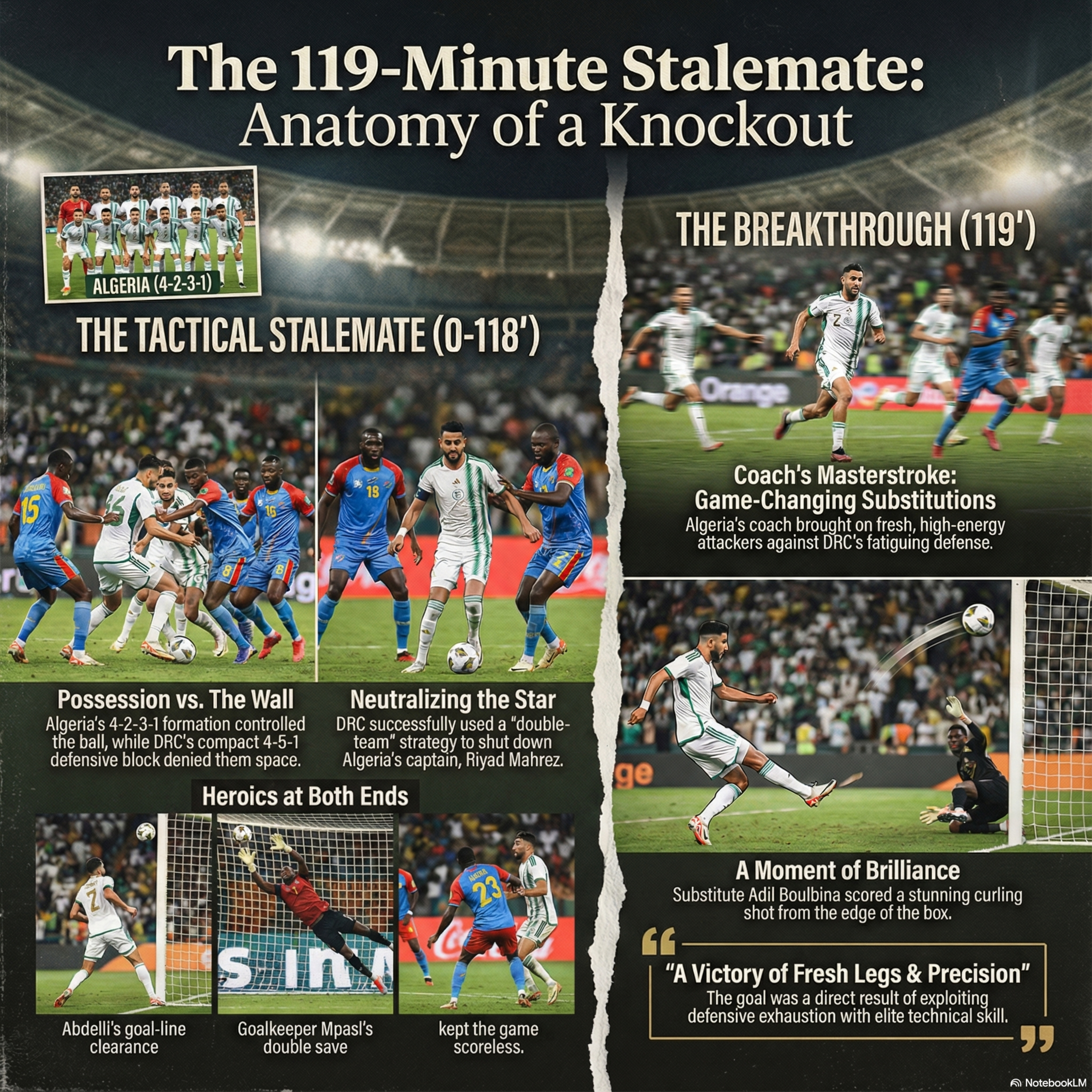
It was a dense screen. Their sole mission was to combat Algeria's technical superiority, deny any half space and ensure the ball could not pass through the center. They essentially conceded the flanks while saying you can pass all you want 50 yards from our goal, but you will not penetrate this box. The 1st 45 minutes were a pure tactical exhibition. I mean Algeria dominated the stat sheet, nearly 59% possession. They were patient, they were methodical, but you could just see they were walking right into a highly sophisticated trap that the Sabre had set.
They struggled critically to translate that ball circulation into high quality chances, or XG as we call it. Algeria's buildup was structured as a 235. This is highly dynamic. The fullbacks push extremely high. You had Ryan Eitnery on the left, often acting as an effective winger, creating overloads with Mareas holding the width on the right. And that structure was explicitly designed to force the DRC fullbacks Juan Bisaka and Kiambi deep to Createspace in those aft channels. But the Congolese structure simply refused to break that midfield trio.
That 451 block was just Immaculate. They shifted laterally as a single unit, constantly cutting off the passing lanes into that dangerous pocket where players like Perez, Trajibi or Maza wanted to receive the ball to turn and attack. What's fascinating here, and I think it's a huge lesson for any African team facing a side with world class talent, is how the DRC identified Algeria's main offensive pipeline and surgically shut it down. I'm talking about the complete neutralization of Riyad Marez.
Yeah, this wasn't just telling Kayambe go Mark Marez. This was an elite, specific, coordinated defensive strategy, a strict double team. What did that actually look like on the field? It was proactive. It was all anticipation. Whenever Marez received the ball, Joris Kayambe would engage him immediately, forcing him wide toward the touchline, but critically, Samuel Mutusami was instantly there shadowing, providing cover, making the passing angle back to the center impossible. This two on one pressure forced Marez, who loves that time, to size up his defender and cut onto his left foot to constantly play simple backward or lateral passes.
His trademark threat was entirely negated. You can't score if you can't get your shooting foot free. Wow. If your defensive scheme is so perfect that it forces a player of Mars's caliber to be ineffective for an entire 45 minutes, that is a blueprint. That's a crucial lesson right there. Stopping world class individuals requires a coordinated numerical superiority strategy, not just trusting a single defender to win a duel. Absolutely. Now let's flip the focus. Because while Algeria was busy passing sideways, the Dr. Congo, despite having very little possession, had the most dangerous moments of the half.
They just bypassed the Algerian press entirely. They weren't interested in a slow buildup at all. They relied on these highly targeted direct balls into the channels, utilizing the pace and the physical strength of Cedric Baconbru. I remember in the 25th minute he holds off Bensabaney brilliantly and forces a sharp save from Zedan that was a clear warning shot. And that physical pressure translated to set pieces. Tuan Zebi had a narrow miss from a corner. This signaled Algeria's ongoing vulnerability to direct attacking.
A vulnerability to Sebi clearly identified pre match. And the cold hard statistic that proves DRC success is this. Algeria failed to register a single shot on target inside the box in the 1st 40 minutes. They were shooting from distance, which is exactly what that 451 block was designed to permit. Coming out for the second-half, you have to assume Petkovic had a stern word. He needed faster ball circulation, he needed to force errors, but the immediate major pivot was forced upon him. In the 49th minute, Ismael Benasser goes down and a matter of Delhi has to come on.
And this was a tactical evolution forced by injury. Benicer is the maestro. He dictates rhythm and pace, prioritizing control, possession, safety. At belly, however, he brought something different. Verticality and a physical presence. He didn't just pass sideways, he was actively looking for four passes forward runs, injecting speed where Benicer prioritized control. And in a game that was increasingly becoming a physical dual, a real battle of wills of Delhi's profile allowed Algeria to compete much better in those midfield battles against that robust Congolese engine room.
It was an unplanned change, but one that you could argue made Algeria more combative, even if they were slightly less composed. The next 20 minutes, from about the 50th to the 70th, were pure combat. The game truly evolved into a war of attrition. Fowls were frequent, yellow cards started flying belgally, and Ben, but you can just feel the tension ratcheting up. But through all of that chaos, the DRC low block remained utterly impenetrable, with Chancel and Bemba just dominating every single aerial challenge into the box.
And this is where we see coaching brilliance under pressure, with his structured play failing and his captain being double teamed into, well, irrelevance. Pekovic took a massive, controversial gamble in the 70th minute. He removed Riyad Mara's. I mean, wait, removing your captain, your biggest star when you desperately need a goal? That feels like panic. How can we be sure that wasn't just luck that the fresh sub scored later? Because that is precisely the mark of a master coach taking a necessary risk.
If they had lost, every single headline would have targeted that decision. But tactically, Petkovic realized the strategy was broken. Mara's value comes from orchestrating and controlling the ball at his feet. They need her. A shockwave. So he replaced Mara's with Anas Haj Musa. OK, So what did Haj Musa offer that Mara's couldn't in that specific context? Direct dribbling and explosive pace in behind the defense. Pekkovich was targeting the tiring left back Joris Kayambe. Mars forced Kayambe to position himself and delay.
Hajmusa forced him to Sprint and tackle. This immediately changed the attacking dynamic. It introduced an element of unpredictability that the DRC, having defended structurally for 70 minutes, just wasn't prepared for. Petkovic injected what you might call a Maverick element when his structure failed. And Dasabra recognized the escalating threat, didn't he? He responded instantly, also around the 70th minute, bringing on Ito Kayembe and Gael Kakuta. Kayembe was fresh legs to stabilize midfield and shield the defense, while Kakuta was an attempt to add some creativity and offensive relief to try and exploit the gaps that Algeria were now leaving as they committed more bodies forward.
Yeah, the final 20 minutes were frantic. Algeria was finally creating better angles but still lacking that decisive touch. But the late drama was almost the end of the line for Algeria. I remember this moment vividly. It was the 90 + 1 minute. A dangerous cross finds the substitute Ibrahim Maeli, his header was placed perfectly. It was destined for the back of the net. And then Hamad Abdalli, the unsung hero who replaced the injured Benicer, produced that miraculous defensive intervention, a goal line clearance.
That moment, it just underscores the fragility of that 00 score line and the importance of defensive depth. Abdeli didn't just save a goal, he saved Algeria's place in the tournament. Without that extraordinary effort, all of Petkovich's tactical gambles become footnotes in a loss. That clearance was arguably the most important defensive action of the entire match. So 90 minutes of tactical brilliance and physical attrition weren't enough. We head into extra time, which shifts the tactical dynamic entirely.
This is no longer about the initial game plan, it is about stamina, mental fortitude and crucially, the quality of the players still left on the bench or squad depth. This becomes a battle of biological resources. The analysis shifts from tactical formation to physical endurance. And for the first half of extra time, the story belonged almost entirely to the Doctor Congo goalkeeper Landel and Posse. This was a master class in commanding the six yard box. His performance kept the DRC alive when and you could see at their defensive legs were starting to fail.
We absolutely have to talk about that spectacular double save in the 111th minute. It was world class. First he denied Perez Chai EB's low drive with strong hands. But the most impressive part was the instant recovery. He had to instantly block Baghdad bound. Just rebound effort from point blank range. That requires extraordinary reflexes and mental presence, especially after 110 minutes of intense focus. Those saves bought the DRC Precious precious minutes. But Pickovich still had one final roll of the dice in his pocket.
In the 113th minute, he brought on Ramiz Zaruki, a central midfielder, and a Dilble Bina, a left winger. Now, many would assume that deep in extra time, these substitutions are just preparation for a penalty shootout. But look at the profiles. These were offensive masterstrokes designed to specifically target exhaustion. Bulbina is a high velocity technical and aggressive dribbler, exactly the profile you need to exploit heavy legs. Petkovic was betting on a moment of technical quality against physical fatigue.
And this brings us back to that underlying DRC weakness that ultimately set up the goal of the structural gap. We often talk about defensive lines being compact, you know, 10 meters between the lines. But the analysis showed that by the 105th minute, the space between the DRC midfield and defense had widened significantly from that tight 10m gap to 15 meter. Why did that happen against Algeria specifically? It's a direct consequence of Algeria's relentless ball circulation combined with what looked like superior late game fitness.
The DRC midfield was trapped in this destructive cycle. Defend, Sprint to cover, tackle clear. They couldn't sustain possession long enough because they lack of that creative engine to give their defenders a breather. And that 5m widening gap is huge. It moves the defensive action from 30 yards out to 20 yards out, allowing the attacker to receive the ball closer to the danger zone with better angles and less closing pressure. The structure was finally beginning to fracture under physical stress.
It's the 119th minute. We are almost two hours into this deep dive into tactical attrition. The tension is almost unbearable. And then the solitary moment of brilliance that validates Petkovich's entire high risk strategy. Let's break down the winning goal sequence moment by moment. So the goal sequence originated not from a set play or a sustained attack, but from an Algerian transition in the middle third. Crucially, it was the substitute Ramiz Zaruki who intercepted a tired, cleared ball. He immediately looked forward, spotting that slight disorganization, that 15 meter gap in the DRC defense.
That slight disorganization is the key. For 118 minutes, they were structurally perfect. It took Zuruki, a fresh player intercepting a clearance from an exhausted player, to finally initiate the break. And that initiation created the decisive mismatch on the left flank. A Dilble beaner received the pass, isolating Aaron Wan Bisaka. We have to pause here. Wambusaka is renowned globally as a world class 1V1 defender. He had been imperious for almost 120 minutes. He was jockeying Bulbina, expecting him to recycle the ball or drive to the byline.
You know the safe options. But Bulbina, With fresh legs and just immense technical audacity, he exploited Wandasaka's fatigue. What exactly was Bulbina's tactical cunning in that moment? He deployed a very specific faint. He dropped his shoulder aggressively, faking a drive to the byline, as if he intended to cross. This move, executed at high speed, forced on Bisaka to hesitate for a crucial split second, the direct tragic result of 119 minutes of high intensity defending. His reaction time, usually instantaneous, was delayed by exhaustion.
And that half yard of space, that tiny sliver of time, is all elite attackers need. Exactly. Capitalizing instantly, Balbina cut sharply inside onto his right foot. He was still quite wide near the corner of the penalty area, about 20 yards out, but he unleashed a shot with minimal back lift. It was pure technique, curling away from them, Posse's dive striking the underside of the crossbar and crossing the line. Clinical, confident, historic. So, tactically, what does this goal tell us about Petkovich's plan?
Well, it validates the high risk, high reward strategy of injecting a high velocity technical dribbler like Bulbina against a fatigued world class fullback like Juan Bisaka. It wasn't the product of structured possession based dominance. It was a victory of technical audacity and fresh legs exploiting a single moment of physical breakdown. It proved that in the Crucible of knockout football, finding the specific mismatch against exhaustion is often more valuable than sticking to the initial textbook plan.
All right, let's grade the Masters. Both deserve immense credit for setting up a true tactical spectacle, but only one got the result. Vladimir Petkovich gets an 8.5 out of 10 for his in game management. He definitely earned that score, his team being faced A tactical puzzle that seemed genuinely unsolvable. For 70 minutes they had the possession but zero penetration. His saving grace was his willingness to deviate and deviate dramatically from his initial plan. We have to specifically praise the decisive risk taking, namely the substitution of Riyadh Marez.
That was a high risk move that could have alienated the dressing room and the fans, but it was essential to change the dynamic. He recognized that the structured patient play had failed to break the DRCS block and they needed a disruptive element. And the Bobina substitution in the 113th minute, leveraging Zaruki's quick distribution, was arguably the best, most impactful tactical substitution of the entire tournament. It showed Petkovic recognizing the precise moment the opponent was at their structural breaking point and injecting the exact profile a high speed technical dribbler needed to exploit it.
OK, now for his critique. His initial reliance on cross heavy tactics in the first half was a tactical blind spot, wasn't it? He was playing directly into the hands of Mbemba and Tuanzebe 2 towering aerially dominant defenders. The primary game plan just lacked enough central penetration early on, which wasted precious minutes and played right into the saber's hands. Moving on to Sebastian de Sabre of Dr. Congo, we have to rate his performance very highly at 8.0 out of 10. You have to commend the Immaculate defensive organization he engineered a game plan that neutralized an objectively superior opponent for 118 minutes.
The success of that Mars double team is proof of concept for the whole continent. His team was drilled to absorb pressure, maintain shape and never panic. That level of defensive fortitude is not easily achieved. It speaks to elite coaching and a high degree of tactical intelligence drilled into the players. His critical flaw, however, was strategic depth. While the defense was excellent, they lacked A coherent Plan B for sustained offensive possession. Once they won the ball back, they were just too reliant on Cedric Bakambo's individual strength and brilliance for transitions.
And that lack of an offensive outlet caught up to them severely. In extra time, the team set too deep because they couldn't hold the ball. They invited that relentless pressure that eventually caused the goal. Because they failed to sustain possession long enough to allow their defensive engine room to recover, they needed a better mechanism for offensive relief to give their defenders a critical breather. A tactical battle this intense is always decided by players who execute the plan, or sometimes players who transcend it.
Let's celebrate the individuals. We have to start, of course, with the man of the match, Adil Bulbina. 7 minutes of play, 1 moment of pure technical audacity and a goal that entirely transformed the narrative. His ability to produce elite technique and composure, the faint, the minimal backlift, the curl and the extreme pressure of the 119th minute is what made him man of the match. Quality absolutely trumped quantity of minutes. On the opposing side, we have to mention Lionel and Posse. His performance deserve to be on the winning side.
That 111th minute double save, first denying Cheyibi, then instantly blocking bounds Rebound was world class in its reflexes and its demonstration of composure under duress. He was a phenomenal defensive leader. And my vote for the true unsung hero, the man who arguably ensured Petkovich could even make those late substitutions, is Hamad Abdeli of Algeria. His contribution was twofold and absolutely crucial to the victory. Right. He came on early for the injured Benicir and immediately stabilized the midfield, adding the necessary physicality to compete with the DRCS robust engine room and all those duels.
But the defining moment, the moment that proves his heroism, was that goal line clearance in the 91st minute against my Ellie's header. It was a match saving defensive effort. Without that desperate lunge, Algeria loses. His dual contribution, stabilizing the midfield and saving the game defensively, was just indispensable. OK, so if we distill this 120 minute master class, we can extract 4 critical strategic lessons. And these aren't just points for Algeria and DRC. They are universal steps every African national team must adopt if they aim for continental and global success.
Lesson 1 is all about attacking unpredictability, the necessity of attacking diversification, especially for teams that rely heavily on a star player like Algeria, relies on Marez. The problem was brutally exposed in that first half. Over reliance on one flank, Marez's right side makes the attack predictable and easily neutralized by a coordinated double team. It allows the opposing coach to focus their planning entirely on one side of the pitch. So the solution has to be developing consistent, high quality threats through the center and the opposite left channel.
The threat needs to be truly multifaceted, using rotational movement and central runners to prevent the defensive overloads that DRC mastered. You simply cannot rely on one axis. You must demand quality across all three offensive thirds. Lesson 2 is tactical execution against set defenses, mastering set piece efficiency in knockout football, A compact physical defense like DRC's means open play penetration will be limited. Right and Algeria's corners and free kicks were completely ineffective. They played predictable balls right into the strength of Mabemba and Tuanzebe.
This is low hanging fruit for improvement across the African game. African teams need to invest significant time in developing creative, complex set piece routines. You know, clever decoy runs, blocks, short corner variations. These moments are often the cheapest way to break down a physical, compact defense when open play is stifled. If you have the quality to draw fouls near the box, you must have the routine to exploit them. Lesson 3 addresses the structural imbalance we saw in the Dr. Congo midfield, the critical need for a creative midfield engine.
CRC is defensively elite. They have the destroyers and the tacklers, but they lack a true #10A dedicated playmaker or an anchoring midfielder who can consistently break lines with progressive passing. When the counter attack is stifled, they can win the ball, but they struggle to transition from defense to sustained offense. The solution for teams built on destruction is prioritizing the scouting and development of creative midfielders who can sustain possession, dictate tempo and offer genuine offensive relief to the defense.
These are the players who prevent the defense from dropping too deep an extra time simply due to fatigue. You need control, not just chaos. And finally, Lesson 4. The ultimate deciding factor in this match is squad depth as the decisive factor in long, grueling tournaments like AFCON. The evidence here is undeniable. Algeria's bench Bulbina Zaruki Boundja provided match winning quality in the dying minutes. They raise the level of the team in the 113th minute. DRC substitutes, while competent, simply could not replicate that level of technical impact when exhaustion hit.
Success in AFCON requires depth that can truly change the trajectory of the game when players are running on fumes. Pekovic used his reserves masterfully to target fatigue disabled ultimately didn't have the offensive options to match that quality injection, which is a major developmental goal for his program. Hashtagged Outro. So to summarize this incredible deep dive, modern African football is defined by highly organized, structurally sound systems, not naive defending. The DRC demonstrated that defensive sortitude can nullify tactical superiority for nearly two hours.
And Algeria won because of resilience, Petkovich's immense willingness to make high risk, decisive in game adjustments like removing his captain and their superior elite squad depth, which allowed a moment of fresh technical brilliance to exploit physical exhaustion. Yeah, the structural breakdown of the DRC in those final moments, visible in the widening gaps, was a loss due to physical exhaustion and a lack of offensive relief. They lost honorably, but the lesson remains. You need quality on the bench to survive the full 120 minutes.
This result, this intense tactical victory, sets up a monumental quarterfinal fixture, Algeria versus Nigeria, a clash of continental Titans, and a rematch of that classic 2019 semifinal that is going to be required viewing for any tactical purist. And as we close this deep dive, we'll leave you with this final provocative thought to Mull over in the tactical evolution of the African game. Is winning ugly through calculated late substitutions and capitalizing on individual technical brilliance against fatigue more important than relying solely on a perfect initial game plan?
Does resilience and audacity trump structure when the game goes deep into extra time? If you're building a team for a knockout tournament, where do you put your focus? Think about it and we'll catch you on the next deep dive.
 Apple Podcasts
 Castbox
 Castro
 Goodpods
 Moon FM
 Overcast
 Pocket Casts
 Podbean
 Podcast Addict
 Podcast Republic
 Spotify