Morocco's Tactical Win Against Tanzania's Low Block
About this episode
Morocco's Tactical Win Against Tanzania's Low Block
Listen now on Spotify, Apple Podcasts, Amazon and other streaming services! Don’t forget to subscribe, share, and leave a ⭐⭐⭐⭐⭐ review to help more players and coaches discover the power of Techne Futbol and Data Technology in the beautiful game.
#TechneAfricaFutbol #TechneFutbol #TrainWithTechne #Playermaker #TraceFutbol #Hudl #FootballTech #FootballInnovation #PlayerDevelopment #CoachTools #SmartFootballTraining #AfricanFootball #CAFOnline #FIFA #FIFAYouth #CAFDevelopment #YouthFootballAfrica #NextGenFootball #FootballScouting #TalentIdentification #DigitalScouting #EliteYouthDevelopment #FootballJourney #FootballAnalytics #FIFAForward #FutebolAfricano #TrainTrackCompete #FootballExcellence #FootballAfrica #TheFutureOfFootball
Welcome to the deep dive. This is where we stopped just watching the game and you know, we really start to dissect it. So put down the popcorn because today we are diving head first into the strategic soul of modern African football. We're not just here to celebrate a winner. We are analyzing a blueprint, a single intense, high stakes knockout match that really was a master class in tactics, in pressure, and in the painful reality of continental development. It absolutely was me. It was a foundational lesson.
On one side, you had the host nation, Morocco, and they were carrying this crushing, just almost unbearable weight of expectations. Since 1976, right? That's a long. Time, a very long time. So this was so much more than a game for them. It was a huge psychological test and it was against a massive underdog, Tanzania. I mean, A-Team ranked 101 places below. Wow. A. 101 places. And appearing in the knockout stages for the very first time ever, so the difference couldn't have been starker. So the stage was set right?
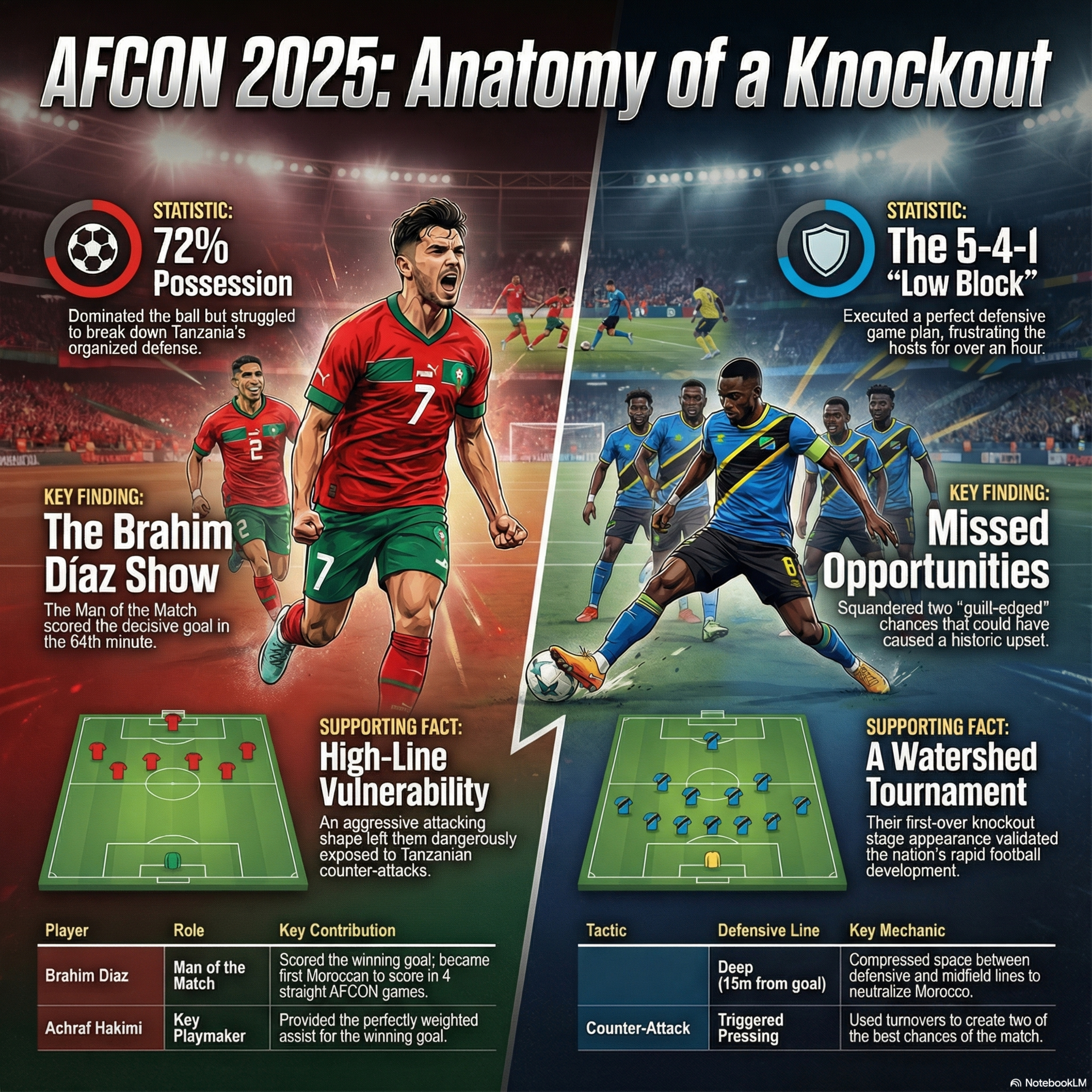
You got 68,000 expectant fans. You have history literally demanding a victory and the staggering disparity in talent. And yet, what do we get? A nervous, narrow one nil win for the favorite. And that's the paradox, isn't it? That's what we have to unpack. Our mission today is to pull out the strategic, the technical and the psychological lessons from that 90 minutes we saw the Atlas Lions with what was it, 72% of the possession, An absolutely overwhelming figure. 72% and they only only secured the win through one single moment of individual brilliance.
And even then, I mean, the ball just kind of squirmed over the line. Barely, barely. What we really witnessed was the most critical question in modern football, playing out right in front of us. How does an elite, super talented team dismantle a near perfect defensive structure? And maybe more importantly, what happens when the weight of history just suffocates a team that everyone expects to win comfortably? That is the core tension we are looking for those blueprints for success, for development across the entire continent.
So let's get into it. OK, let's unpack this defining deadlock. Because this really wasn't just a physical contest, was it? This was a pure a pure tactical confrontation, a battle of wills of different philosophies. Absolutely. On one side you've got Morocco, the World Cup semifinalists. They came into this playing with supreme confidence, total belief in their territorial dominance. Their defensive line was pushed way up the pitch. We're talking around 45 meters from their own goal. That's high.
That's a big risk. It's a huge risk. They trusted their technical quality. You know, they hit an 88% passing accuracy. They completely accepted the burden. They knew they had to be the ones to dictate the pace, the structure, everything. And on the other side, their opponent, Tanzania, coached by Miguel Angel Gamandi. And they accepted the, well, the exact opposite burden defense, first trip to the knockout. And they played like a team with absolutely nothing to lose and everything to gain. Their execution of the low block was, I mean, it was military grade, just so precise.
They settled immediately into this incredibly disciplined 541 formation, dropping their defensive line extremely deep. Sometimes they're sitting just 15 meters from their own goal line. 15 meters. That's incredibly compact. Unbelievably compact. The game plan was simple, it was robust, and it was relentless. Containment first, counterattack second. That was it. And right away, this tactical mismatch, it creates what you call the sterility problem. We hear this term sterile possession all the time, especially when Giants face underdogs.
But what does that actually look like on the field? And why was Morocco, with all that world class talent, so unable to puncture that defense? Well, sterile possession is. It's a visual signal. It tells you the attacking team is dominating all the metrics. The stats look amazing, but they're not actually generating any real threat. Right. So the numbers look good, 72% possession, high pass completion, but the one that matters. The crucial one? Yeah. Open play, expected goals or XG? That number stays stubbornly, frustratingly low for Morocco, Tanzania's compactness just completely denied.
They're attacking midfielders, any space between the lines. So if you're a developing African nation watching this, the key take away is that even the best talent in the world can be neutralized. It can be completely shut down by organization that just denies that crucial space. Precisely. If you're an attacking team, you live and die by operating in those vertical channels. You know, finding your playmakers between the opposition's midfield and their defense. When that space is gone, when it's just not there, you're forced to pass laterally sideways and this creates what analysts call EU shaped circulation pattern.
The dreaded U shape. I could see it happening in real time. You. Can almost trace on the screen. The ball goes wide to the full back, then it goes back to the center, back across to the other center, back up to the other full back, and then back again. It's like they're just circling the wagons. It circulates around that defensive block like water around a rock. So yeah, you show high passing accuracy on the stat sheet, but you have 0 direct threat to the goal. It becomes this visible footprint of of panic and just mounting frustration for the attacking side.
I have to ask about the psychological side of that. If you're a Moroccan player, you look up at the scoreboard at 00, you see you have 70 plus percent possession. Yeah. Does that U shape start to feel heavier? Does the pressure from those 68,000 people start to become a factor in that safe, sterile passing? It absolutely does. The passes become safer, the risks just disappear from your game. The central midfield pairing for Morocco, Illinawi and Sibari, they were excellent at recycling, possession and maintaining steel.
The But that very stability, you know, it was a symptom of the problem. Right, they needed to be unstable in a good way. They needed to find the needle, that one vertical pass that cuts to the lines. But that tiny 10 to 15 meter gap between Tanzania's midfield and defense was too small, is too compressed. So they opted for the reliable horizontal pass rather than the risky vertical one. And that, right there, is what defines sterile possession. So EU shape isn't just a tactical failure, it's a failure of nerve really, fueled by the weight of expectation.
It's the systemic outcome of psychological stress meeting tactical mastery. So to try and combat that rigidity at Morocco's coach will lead Rigragui. He did employ a pretty sophisticated blueprint. It was designed to stress the Tanzanian flanks. The 4141 they started with that was really just a disguise, wasn't it? Exactly when Morocco had the ball in the final third, they were incredibly aggressive, very fluid. The formation just morphed constantly. It would often shift into a A235 or sometimes A325 structure.
235 OK, so break that down for us, who are the five in that frontline sound like all out attack? It is. It's essentially throwing 5 specific attacking players at that back line. So you have your front three plus your two most advanced midfielders pushing right up alongside them. But the key is you keep 3 midfielders behind them to guard against the counter attack. So it's not just throwing bodies forward randomly, it's a structured way of creating very specific overloads in key areas. It's the nuance, exactly, and the objective was crystal clear.
Overload the wide areas, stretch that five man Tanzanian defense horizontally, and hope, just hope you can pull one of those center backs out of position or force a rotational mistake. The primary engine for this constant pressure, it was definitively the right flank. Spearheaded by a craft Hakimi and Brahim Diaz. This duo, they were tasked with finding the, I guess the high tech solution to this Tanzanian lock. Kimi's role is just fascinating to watch. He rarely operated like a traditional right back, He was more like a deep line playmaker running from the flank.
He held the width, yes, but what made the connection with Diaz so dangerous were the rotational interchanges, specifically their use of the underlap. OK, let's slow down on the underlap, because this is a really crucial piece of tactical terminology for our listeners. We all know an overlap, right? The fullback runs around the winger. What does an underlap achieve that's different? How does it confuse the defense? The underlap is when Hakimi, the fullback, makes his run inside of Diaz, the winger, into what we call the half space.
The half space that Channel between the sideline and the center of the. Pitch the prime real estate. That's where assists and shots come from. So when Akimi runs inside, it forces an immediate crisis for the defense. It creates a dilemma. Does the Tanzanian wingback Mohamed Hussein, does he stay wide to Mark Diaz? Or does the Y in center back, maybe Joel Bernando follow that inverted run of Akimi and in doing so create a huge gap in the central defense? So it's designed to create a communication failure.
It's so is chaos. The goal isn't just about getting to the goal line, it's about drawing defenders out of their disciplined vertical lines. It was Morocco's most potent, most palculated strategy, a constant threat. Every single attacking sequence felt like it was launched from this rotational engine room on the right side. Now let's contrast that high tech engine on the right with the tactical plan on the left flank, which was basically just isolation as Abdi was kind of out there on his own. That's exactly right.
Abdi was the traditional almost old school wide winger. His job was low tech, high aggression, hug the touchline and just beat the Tanzanian right wing back Haji Minoga one-on-one. And he was successful at creating pressure. To be fair, he drew a lot of fouls, won some yellow cards. I remember that reckless challenge from Dixon. Job on him. He did, he provided that necessary with and he was a danger just by running at people with pace. So he did his job in that sense. But the limitation, and this is where the predictability started to creep in.
It was the final delivery. Precisely while he was excellent at creating the initial space for himself, his final action, the cross, the cutback, that crucial pass, it was consistently either over hit or mistimed or just immediately cut out by the physicality and the height of those Tanzanian center backs who are just waiting for it in the middle. So it was an effective tool for maintaining width, but it lacked that razor sharp cutting edge that Diaz was providing on the other side. Yeah, and that contrast meant Tanzania could dedicate fewer defensive resources to that left side.
They knew, you know, that the final ball was just less likely to land cleanly over there. And this all links back to that sterility problem we talked about, the central midfield pairing LA Nali and Cybari. While they kept possession ticking over, the lack of any real vertical penetration from the core of the pitch meant that Tanzania's defensive midfield felt zero pressure. They never had to abandon Zone 14. They were comfortable, they were happy knowing the threats were constantly just circling wide.
It just reinforces the point, doesn't it? Possession for possession's sake is meaningless against a disciplined low block. You need a central midfielder to take a risk to break a line, or you need those rotations on the flank to be so good they pull the center backs wide enough to create a central passing lane. And Moranco only really achieved the ladder on the right side. Essentially, the midfielders just remained a little too conservative in their vertical movement. So we've seen how Morocco tried to unlock the defense.
Now we have to flip the board and really appreciate why Tanzania's lock, engineered by Coach Gamandi, was so incredibly effective. I mean, this was a master class in defensive resistance. It was a tactical triumph for a developing nation. That 541 low block wasn't just a number on a tactics board. It was a functioning philosophy. And it was all built around protecting Zone 14. OK, let's define zone 14 for our listeners. We mentioned it a lot in analysis, but why is that specific area of the pitch the absolute defensive priority?
Zone 14 is that central area, roughly, let's say 18 to 20 yards from the goal just outside the penalty box. Statistically, it's proven that most of the decisive actions that lead to goals through balls, sudden shots from distance, setting up cutbacks, they all originate from here. It's the Launchpad. It's the launchpad, so if you can deny the opposition easy access to zone 14, you fundamentally limit the quality of the chances they can create. By maintaining that rigid 541, Tanzania effectively made that area Fortress a no fly zone, especially for players like Diaz or Cybari trying to run centrally.
And they achieved this protection through intense, what you call space compression. Can you detail that mechanism? Because that proximity, that closeness between their lines, that seems to be what made the real difference. Think of it like a spring that's been tightly compressed. The vertical distance between their back five and their midfield 4 was maintained at a maximum of just 10 to 15 meters. It was incredibly, incredibly tight. So there's just no room to operate. No room at all. When the lines are that close together, there is simply no space for an opposition player to receive the ball in turn.
This compactness was absolutely crucial. Whenever a Moroccan player did try to receive a pass in what should have been a dangerous pocket, say say, Bari dropping a little deeper, they were immediately swarmed or tripled up, with two or three Tanzanian players converging on them instantly. So that rapid convergence, it essentially cancels out the technical advantage of the Moroccan players. It doesn't matter if you have world class ball control if you've got three guys on you the moment the ball arrives.
Exactly. They ensured there was number time to turn, no time to look up, and certainly no time to execute that final line breaking pass. That compression also directly addressed Morocco's central striking threat, IU Balacabi. The triple center back wall seemed specifically built to neutralize him. It was Hamad. Job and Nando were physical, they were tall, and they operated in perfect cohesion. They knew Morocco's game plan involved a lot of wide crosses and deep deliveries, so by having three specialist center backs, they were just able to absorb those crosses, neutralize El Camano, be in any aerial duels and simply muscle him out of the game.
He really struggled because he was just constantly outnumbered and out muscled against that physical trio. It's a classic example of an underdog identifying the opponent's primary strategy, wide play crosses, and then building a tailored defense specifically to absorb it. And critically, Tanzania didn't just sit back passively waiting to be shot at. That's a common misconception about low blocks. They can serve their energy through smart movement using what's called triggered pressing. OK, triggered pressing.
How does that differ from a normal high press? A high press expends an enormous amount of energy. You're chasing the ball deep into the opponent's half for 90 minutes. Tanzania couldn't sustain that. Triggered pressing is all about tactical patience. They waited for specific signals, specific triggers, like a bad first touch from a Moroccan midfielder or a backward pass from a full back to a center back. When those triggers occurred. Then they launched A coordinated high intensity press, but only in the mid third of the pitch.
So the goal wasn't to win possession high up, the goal was to force a turnover in a high leverage area to start their own attack. Right, They weren't looking to win the ball deep in Morocco's defense. They were looking to force a mistake in the middle 3rd to a immediately spark a counter attack, targeting those huge spaces that Morocco's advanced fullback Zucchini and Mesrouwi had left wide open. It's the difference between pressing everywhere and pressing smartly and selectively. And for 63 minutes that disciplined, smart resistance held firm against all odds.
And that brings us, of course, to the breakthrough. We spent all this time detailing the system, the structure of the psychological deadlock. But in tournament football, especially knockout football, we so often see what you could call the law of quality emerge. The deadlock wasn't broken by a systematic team move. It was breaking by a moment of, well, individual genius. This is where that one-on-one place gap in the rankings finally mattered. Brahim Diaz, 64th minute. For any coach out there studying how to break down a low block, this goal sequence is mandatory viewing.
It wasn't a fluke, it was the synthesis of persistence and elite talent. Let's narrate the sequence step by step. It was a beautiful narrative arc, really. Step 1, The initiation, the overload. The action begins exactly where Morocco had been focusing their energy, all at the right flank. A graphic Kimi gets the ball high up the pitch and crucially, he holds his whip. He keeps stretching the defense horizontally, which forces the Tanzanian wingback Hussein to commit out to the flank. OK, Step 2, the delivery half space entry.
This is the moment of real vision, isn't it? Instead of another cross, which hadn't worked all night, Hakimi drives a sharp, incisive path into the half space, that tight channel between the wide center back and the wing back. That one pass instantly eliminated Muhammad Hussein, who would step just a little too high to close Hakimi down. The lock was picked. And that leads to Step 3, the reception, spatial awareness. Brahim Diaz receives the ball inside the penalty area. His first touch, his body shape, it's just perfect.
He recedes it on 1/2 turn, immediately shielding it from the closing defender, setting his hips to the next action. There's zero panic, just instant spatial assessment under intense pressure. Step 4 The action 1V1 Isolation. This is where the real talent separates itself. Diaz, using his extremely low center of gravity, executes this rapid spin away from the defender. That quick rotation, it creates A vital micro gap, just a yard of separation. But that's all he needs. It gives him the time and space for the shot.
He had finally isolated himself from the swarm that had been consuming every Moroccan player in the box all night. And then Step 5, the strike. Technical execution from a really tight angle right side of the six yard box. The expected move is the cutback to a teammate or maybe a delicate dink over the keeper. Diaz makes the counterintuitive choice. He spots a fraction of space at the near post and just strikes the ball with pace. It wasn't a power or curve, it was about precision and surprise. He caught everyone, especially the keeper, flat footed.
Which brings us to step 6. The error, the goalkeeping mechanics. This is the absolute heartbreak for Tanzania and their keeper, Hussein Maslanga, who had been commanding up to this point. He made a critical technical error because he was anticipating the cross or the cutback. His weight shifted just slightly onto his back foot. A fatal shift and. When the shot came in, his barrier technique was compromised. He managed to get a glove to it, but the ball just squirmed beneath his torso and carried just enough momentum to trickle just agonizingly over the line.
A single momentary lapse costing the entire match. But the analytical take away here is that law of quality. Diaz became the first Moroccan ever to score in four consecutive Afghan matches. It just underlines his critical importance when the system failed to deliver. His sheer relentless technical quality provided the answer. So if organization and structure are the pillars for developing African nations, this goal proves that world class individual talent remains the crucial differentiator when the stakes are at their absolute highest.
It broke the blueprint. And while Morocco we're celebrating that breakthrough, the victory really came with some glaring warning signs. They survived, yes, but they looked vulnerable, specifically in defensive transition. That chaotic moment right after possession is lost. This is the curse of high possession football, isn't it? When you commit your fullbacks and your midfielders that high up the pitch, you create a huge tactical risk at the back. Correct. With Hakimi and Misrawi pushed up almost as wingers, the two center backs, Agourt and Messina, were just left isolated.
They were defending immense amounts of space against Tanzania's PC counterattackers. This is a failure of what is known as rest defense. Rest defense Explain that concept using a simple analogy for us. OK, imagine you're at home and you leave your front door wide open to talk to your neighbor on the street. Rest defense is making sure you still have the back door securely locked and bolted. It's the structural positioning of your non attacking players. Usually the center backs an offensive midfielder whose only job is to prepare for that immediate high speed counter attack.
If possession is lost, Morocco is leaving the back door wide open repeatedly. And we saw Tanzania almost score twice because of this failure. Let's analyze the Masuva warning in the 24th minute. How simple was the tactical exploitation here? It was shockingly simple. It wasn't some complex passing move. It was a long ball played right over the top. The Moroccan defense was caught completely flat footed Simon Misuva, the Tanzanian forward. He recognized the space vacated by new Sarah Mesrawi on the left flank and he just ran straight into it.
Because the defense failed to retreat quickly enough, Misuva found himself behind the highline with a completely free header. The miss was poor, but the simplicity of the attack that created it? That's got to be terrifying for a groggy. It is they failed to press the ball carrier which allowed him the time to pick out and execute that perfect long pass. It was a clear and present danger that a more clinical team will punish ruthlessly. And then came the chance that will haunt Faisal Saloom 55th minute.
This one was even more devastating because it originated deep inside Morocco's attacking territory, right after their own corner kick. This highlights the failure to counterpress. Explain that. What's the difference? Counterpressing is that immediate aggressive swarm that's supposed to happen the moment you lose possession. The aim is to win the ball back within say 5 to 7 seconds before the opposition can even launch their counter. Morocco took a corner, they lost the ball and their midfield completely failed to execute that swarm.
Tanzania cleared the danger and within 2 rapid passes they had bypassed the entire Moroccan midfield. They went from defending a corner to being one-on-one with the goalkeeper in about 5 seconds. That's the speed of the modern counter attack. Saloon got the ball inside the box after a dangerous Perry from Bono. He had the goal gaping. Statistically this was a big chance registering over .3 expected goals. That close range miss blasted over the bar. It wasn't just a physical failure for Morocco, it was a near psychological collapse.
Because if that goes in, the momentum shifts entirely and the host nation may have just disintegrated under that emotional stress. You could feel the entire stadium just deflate and then immediately tense up again. Those transition failures are critical warnings that Morocco has to address immediately heading into the next round. It's decided by systems, yes, but it's executed by people under enormous pressure. So let's move to the individual performances, assessing not just the talent but the mental fortitude.
We have to start with the man. Of the match Brian Diaz He earned a clear 9 point O out of 10 and his performance was without a doubt the critical difference, but his rating wasn't. Just about the goal was it. Plenty of players score a goal and then disappear. Diaz felt like a constant gravitational pull throughout the match. That's because he was the. Only player who consistently recently found the solution to the defensive puzzle. In a game where Morocco's other technical players looked a bit static, Diaz completed 4 successful dribbles, the highest on the pitch he constantly created that required chaos on the right flank, and what's more, his two way play was phenomenal, His work great, his tracking back, his pressing, it ensured he was carrying both the offensive and part of the defensive burden.
He is clearly the Talisman, the player carrying the entire offensive weight of expectation for this nation. Now let's talk about the. Contrast on the flanks we have Akrefikimi, who I'd call the unsung hero, an 8.5 out of 10 compared to Nuser Mazrawi, who scored a 6.5. His technical brilliance came at a significant tactical cost. Akimi was the team's. Engine He had the most touches in the match, operating as that playmaker from deep. His vision LED directly to the goal and his recovery pace was vital for snuffing out counters before they became truly dangerous.
He played with a near perfect blend of aggression and precision. Mazrawi though, he's. The definition of the modern tactical conundrum, isn't he? He's technically superb and he often inverts into midfield to help Morocco control possession centrally. So he achieves one goal but fails in another. He achieved the possession. Control, yes, but his inverted positioning was a tactical liability. It consistently left the left flank exposed, and as we detailed with that Zuva chance, that tactical cost nearly proved fatal.
Rogragi recognized this late in the game, substituting him for Salah Adeen to bring on some necessary defensive stability. His technical success in the middle directly contributed to the transition failure on the outside, then on the opposite end of the. Spectrum you have the isolated striker Ayubel Kabi with the tough 5.5 out of 10 and I almost feel for him because his failure was really a systemic success for Tanzania. That's a perfect assessment. It was a failure of the tactical plan to utilize his profile.
That 541 low block just starved him in service, reducing him to scraps and forcing him into aerial duels. He was never going to win against that physical three man center back wall. He fought hard, but his profile lacking that strong wink up play to drop deep and drag defenders out was ill sued to breaking down such a compact defense. The system bypassed him and the defense completely neutralized him. And finally, we have to. Talk about the tragic figures for the underdog. The difference between the two sides was clinical execution.
Feasel Saloom, 5.0 out of 10 will be defined by that unforgivable miss and the goalkeeper Hussein Masalanga, a 6.0 whose single technical lapse cost them the match. Saloon's moment was. Just a failure of composure under the ultimate pressure. It was the chance to eliminate the host nation and he squandered it. For Masalanga, it's the absolute cruelty of goalkeeping. For 63 minutes he was commanding, he was organizing his defense, making excellent saves. And yet that one technical flaw in the goal sequence, the weight shifting back the poorest barrier, it cost them everything.
It just underlines how fine the margins are at this level of football and the ultimate outcome. It's so often comes down to the strategy set by the coaches. Let's dissect the battle between Waleed Rograggi and Miguel Angle. Gamandi Regubre, the pragmatist under pressure, gets a 7 out of 10 from US Regrecki's primary. Success was psychological. He knew the emotional weight of this game. He prepared his team for a struggle, and he emphasized humility and patience before the match. That psychological steadiness was vital, and making sure they didn't panic when the first goal didn't arrive after 30 minutes of complete dominance, he guided them through an emotional minefield and his halftime adjustments.
Were spot on, they directly led to the breakthrough even if the team was slow to get going in the 1st place. His tactical. Adaptation was crucial. He recognized the stiffness of the attack, and he asked Akimi to play slightly narrower, forcing the Tanzanian wing back to commit earlier, and he asked Diaz to start wider before cutting in. That subtle rotation increased the frequency of those dangerous underlap movements, and it LED directly to the goal sequence. But he did admit. Didn't. He that they wasted 45 minutes due to technical errors and collective tension, that's the flaw.
The team lacked the necessary intensity from kickoff, which he acknowledged, and crucially, he failed to solve those defensive transition issues throughout the match. It was an effective win. He got the result he needed, but it was far from a fluent performance. Now to Ghomandi. The architect of resistance. We're giving him an 8 out of 10 for 60 minutes. He completely out coached Ribragi and designed a defensive structure that restricted one of the world's most talented attacks. His tactical plan?
Was elite. He restricted Morocco to minimal clear chances through sheer organization and that space compression. He instilled genuine belief in a squad Facing A1 on one place ranking disparity, Kamandi raised his stock significantly. He proved that organization can neutralize talent. But I have to push back. A little on that 8 out of 10. He designed a masterful defense, but wasn't his biggest flaw his hesitation, his in game management after they conceded? And eight for a coach who waited 10 critical minutes to make attacking Subs after his low block was broken.
Isn't that tactical timidity, not mastery? That is a fair criticism. And that hesitation was indeed critical. Once Diaz scored, the entire game shifted. Tanzania had to abandon their low block. They had to start pursuing an equalizer. And Gimondi waited until the 73rd minute, nearly 10 minutes later, to inject any fresh attacking impetus. That delay was crucial. Why was that delay so? Costly in your view, it allowed Morocco to. Consolidate their lead. They use those 10 minutes to settle into a controlled possession rhythm, just taking the pace out of the game.
Had Gimondi made aggressive attacking changes immediately, say within 3 minutes of the goal, it might have caught Morocco off balance while they were still celebrating before they could stabilize their midfield. That slow reaction prevented Tanzania from capitalizing on the emotional high of having held the Giants scoreless for so long. It was a failure of situational game management. All right, let's shift our focus. Entirely to the technology that underpinned this match. This AFCON saw the full implementation of some really advanced officiating technologies and it's fundamentally changing how decisions are made and how African fall is perceived globally.
Let's start with Semi automated off site technology, or SAOSAO. Is a massive technological leap for the continent. It ensures objective and importantly, rapid off site decision making. The system uses 12 dedicated tracking cameras installed across the stadium, and these cameras combined with AI algorithms, they track 29 specific data points on ETH Claire's body 50 times every single 2nd 29 data points. So what exactly is being tracked? Are we talking about tracking shoelace color? Help us understand what specific data points prove Cybari was marginally offside in that 15th minute, cutting the celebration short.
They're tracking anything. Relevant to the off sideline the tip of the nose, the shoulder, the ankle, the knee. The furthest forward point that a player can legally use to score a goal. By tracking these points 50 times a second, the AI can instantly determine the exact moment the ball leaves the passer's foot and compare the defenders position to the attackers forward most point. The impact here was accuracy and speed right before. Sao a marginal decision like the one on Cybari would have taken 4 or 5 minutes of VAR review drawing lines manually on a screen, and often it would still result in controversy and delay.
Exactly. The speed and the objectivity of the Sao decision are its greatest benefits. Cybari was marginally ahead. The decision was made in seconds. This maintains the flow of the game, it removes the subjectivity that used to plague these marginal calls, and it ensures the highest level of officiating accuracy. That is a huge leap forward for the African Games credibility on the global stage and beneath that. System is the connected ball technology. Can you briefly detail how that feeds into the system, the match ball itself?
Contains an internal measurement unit and IMU motion sensor. It sends hyper accurate data at 500 Hertz. While we didn't see an explicit goal line decision relying solely on it in this game, this technology is critical for so it provides that hyperaccurate confirmation of the exact moment the ball is played, which is essential for determining the start of the offside sequence. It also helps in confirming touch detection for handballs, which aids the VAR process immensely. And finally, we have to.
Discuss the subjectivity that still remains even with all this advanced technology, and that was exemplified by the 94th minute penalty controversy. The challenge from Messina on Nado this decision. Highlighted the persistent challenge of the clear and obvious threshold for VIER. Vier checked the incident thoroughly. There was certainly contact. Messina did appear to push Nutto. However, the decision on the field was not to award a penalty and VA determined that the incident did not meet the high threshold required to overturn that call.
Why is that threshold? So high, why didn't VAR intervene? If there was contact VAR isn't there. To re referee the game, it's there to correct clear errors in subjective judgement calls, like whether a player initiated the contact, whether the contact was sufficient to cause the fall, or whether or not it went down too easily. VAR rarely intervenes unless the referee has missed something fundamental. Because the referee on the field had a view and judge did a clean tackle or simulation, the VAR protocol backed the man on the field, concluding it wasn't a clear and obvious error and naturally in.
A high stakes host nation game that leads to claims of home advantage influencing the judgement. Regardless of all the technology, it's unavoidable. But the technical reality is that the protocol demands a near certainty to overturn a subjective call. While S eliminates those marginal offside controversies, the VAR threshold reserves the referee's autonomy in these tight, judgmentbased situations. And that's where subjectivity will always remain a factor in the game. OK, let's zoom out now. This single 90 minute match, it offers some profound lessons for the future trajectory of African football.
We have clear, distinct lessons for both the developing nations, like Tanzania and the established title contenders, like Morocco for the developing nations. Like Tanzania, there's stunning performance even in a narrow loss. It reveals 3 strategic pillars for sustained success. The first has to be institutional stability, and this is a massive. Challenge across the continent, isn't it? African football has this notorious tendency to fire coaches immediately after an elimination, regardless of the progress that's been made.
Exactly. The Tanzanian Football Federation has to resist this urge. Ghomandi has built an elite, cohesive tactical foundation. The evidence is right there restricting Morocco to one goal. He has to be retained to lead this team into the 2027 Afghan which Tanzania is Co hosting. Institutional stability ensures tactical continuity and maturity rather than just resetting the clock every two years and losing all that accumulated knowledge. Right, If they keep him. They build on that foundation. If they fire him, they start from scratch and they lose the entire tactical infrastructure.
He spent years creating the second tiller. This one directly addresses the painful outcome of this game clinical development. The core difference between the. Two teams was execution finishing. Gomondi created a system that works. The chances created from a Suva and Sloon prove that. But the execution failed disastrously. Tanzania needs clear, dedicated investment in Stryker development academies. We have to bridge the gap between effective system creation and execution at the elite level. You can import foreign tactical acumen, but you have to grow your clinical finishes domestically.
So the lesson for? African Leagues is stop relying solely on physical ability, start focusing on technical composure and decision making in the final third Yes and. That requires long term investment in specific high level coaching dedicated to that final action, the striking technique, the composure, the spatial awareness of a world class finisher, and the third. Lesson is to leverage experience. This match wasn't a loss for them. It was the ultimate education. This is their golden. Generation of experience playing a knockout game against the host nation in front of 68,000 hostile fans.
Maintaining composure and executing a near perfect tactical plan that is invaluable. This intense high pressure knowledge has to be kept together. They need to understand that they are no longer just participants, they are contenders. They have the capability to neutralize the biggest names and that feeling of competence is crucial for future tournaments. Now let's look at the title. Contenders Morocco. They're heading into a heavyweight quarterfinal. They survived, but they have to evolve. Lesson 1.
Intensity from kickoff for Groggy Self. Admission that they wasted 45 minutes cannot be repeated. A slow, tentative start against some more clinical opponents, say a Cameroon with a player like Brian and Boymo will be fatally punished. They need to start with the urgency and technical precision they showed right after that 64th minute goal. The emotional weight needs to fuel them, not paralyze them. Lesson 2 is tactical defensive restructure addressing that highline vulnerability against pace in transition.
They need more protection for Aguard and Messina strategically rig Ragwe has to consider adapting his midfield structure. The current single pivot allows for fluency, but it exposes the back to way too much. I think considering a double pivot, perhaps bringing in Sophie on Amrabat alongside LA now we would provide a vital defensive screen would fill the space Miss Raleigh vacays and dramatically shore up the central defense against those rapid counter attacks. It might sacrifice 1° of attacking fluency, but by his immense security and the final lesson?
For the Atlas Lions diversify the attack, the over reliance on the Hakimi and Diaz right flank made them predictable. Tanzania knew exactly where the threat was coming from. They cannot be a one. Sided team against the world's best. They need Bilal al Canoes to become more influential centrally to operate in those suffocated pockets of zone 14. They need secondary central threats like Ismail Sabari making more dynamic line breaking runs into the box. They have to create viable, consistent threats through the middle to force defenses to dedicate resources away from that right side.
If they remain predictable, the next low block they face will be even more difficult to breakdown. So the ultimate message. For Morocco is you have the quality now show the variation and the intensity that's required of a continental champion. So at the end of it all, we witnessed a high stakes drama. A host nation secured A resilient narrow victory based on a singular moment of individual quality and, you know, tremendous psychological fortitude. They survived the crushing weight of expectation and history, and meanwhile the underdog Tanzania delivered a near perfect systemic tactical performance, only to be undone by technical flaws and a tragic failure of clinical finishing.
The tactical lessons are. Crystal clear for every nation on the continent, organization and structure can neutralize immense talent disparity. But execution, execution remains the ultimate hurdle. And that leads us to. Our final provocative thought for you to Mull over as we look to the future of African football development. If organization and tactical discipline as displayed by Tanzania can neutralize A1 O1 place ranking disparity, what is the best strategy for continental success? Is sustained systemic structure and coaching stability a better long term bet for African football development?
Or does that momentary reliance on world class individual talent that Law of quality personified by Brahim Diaz remain the only reliable shortcut to winning tournaments? Finding that perfect. Balance. That's the challenge that defines the road to 2027. Thank you for joining. Us for this deep dive. We will catch you on the next one.
 Apple Podcasts
 Castbox
 Castro
 Goodpods
 Moon FM
 Overcast
 Pocket Casts
 Podbean
 Podcast Addict
 Podcast Republic
 Spotify