Morocco's Football Revolution and AFCON Burden
About this episode
Morocco's Football Revolution and AFCON Burden
Listen now on Spotify, Apple Podcasts, Amazon and other streaming services! Don’t forget to subscribe, share, and leave a ⭐⭐⭐⭐⭐ review to help more players and coaches discover the power of Techne Futbol and Data Technology in the beautiful game.
#TechneAfricaFutbol #TechneFutbol #TrainWithTechne #Playermaker #TraceFutbol #Hudl #FootballTech #FootballInnovation #PlayerDevelopment #CoachTools #SmartFootballTraining #AfricanFootball #CAFOnline #FIFA #FIFAYouth #CAFDevelopment #YouthFootballAfrica #NextGenFootball #FootballScouting #TalentIdentification #DigitalScouting #EliteYouthDevelopment #FootballJourney #FootballAnalytics #FIFAForward #FutebolAfricano #TrainTrackCompete #FootballExcellence #FootballAfrica #TheFutureOfFootball
Welcome back to the Deep Dive. You've given us a phenomenal stack of material this week and it's all centered on a moment in African sporting history that is well, it's just absolutely electric. It really is. We're talking about the kickoff of the 35th edition of the Africa Cup of Nations F Con 2025, hosted by the Kingdom of Morocco. And this deep dive, you know it isn't just about analyzing A tournament bracket or looking at the first few games. No, not at all. It's about dissecting a national statement.
That's what this is. We are looking at this, this convergence of massive ambition, cutting edge infrastructure and something that's been building for a long time. It's. A quiet revolution, really. A quiet, decades long football revolution that has fundamentally changed the calculus for for how African talent is developed. That is precisely our mission today. We really need to go past those initial results and understand the incredible weight of expectation that's been placed on the Atlas Lions. It's a story of paradox, isn't it?
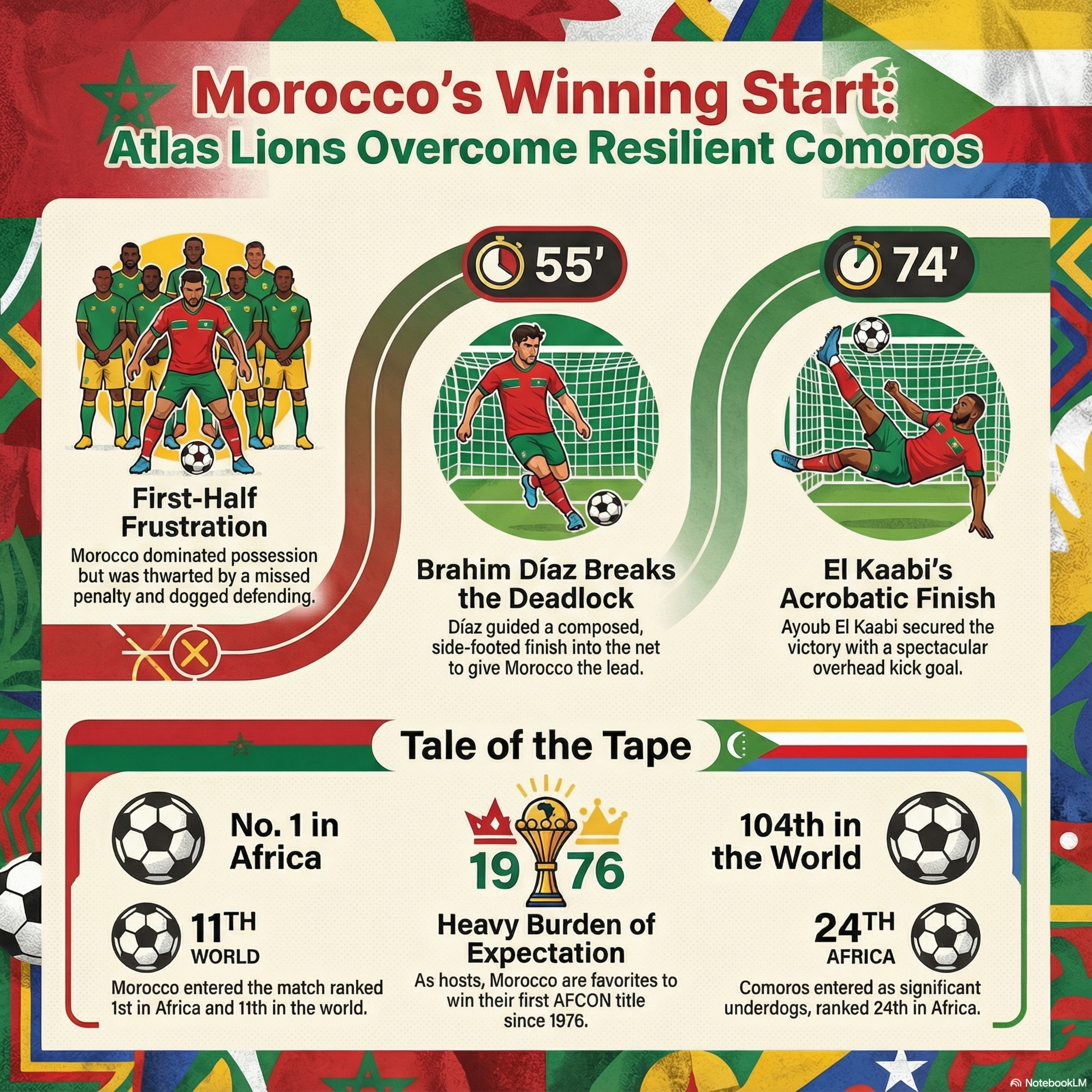
A huge one. I mean, you have Morocco, the continent's highest ranked team, sitting 11th globally. They're still basking in the glow of that legendary 2022 World Cup semifinal run. They're the giants, the hot favorites, no question. And that is exactly where the tension begins because despite being the current face of African football success on the global stage, they are chasing a title they've only won once. Once, and that was. Nearly half a century ago, back in 1976. So this current generation, this golden age of Moroccan football is under just immense pressure to end that 49 year drought and to do it on their own soil.
It's a historical and emotional burden that's, I mean, it's unlike any other. It really is. And we already have the opening night result, which is sort of the foundational game for this whole deep dive. Morocco got a 2 little victory over Comoros on Sunday, December 20, 1st in Robot. But the way the sources describe it, it wasn't a celebratory route, it wasn't a walk in the park. No, not at all. They describe a battling victory they had to overcome, real setbacks, a lot of frustration and a deeply, deeply organized opponent.
And I think we need to understand the struggle within that two nil win because it tells us everything about the challenges that lie ahead. Right. So let's start there. Let's unpack the context of this enormous expectation. OK, so the burden of being the favorite in any continental tournament, that's heavy. But for Morocco right now, it feels almost paralyzing. It does. The gap in perceived class in their recent global standing between Morocco and many of their African rivals has just grown so significantly.
They didn't just do well at the World Cup. No, they set a whole new benchmark for the entire continent. Exactly. And when you look at that squad, I mean it's just stacked with players who aren't just playing in Europe, they are starting for top clubs. Players like Akraf Akimi, Yasin Bunu, Sofian Amrabat, the list goes on. This isn't just a collection of talent. No, it's a concentration of high level, week in, week out European club experience and when you walk out onto the pitch with that kind of pedigree, the expectation, it just shifts from we hope they win to.
They must win. It's an obligation. It's an obligation, and that is just compounded by what some are calling the ghost of 1976. Morocco has only lifted that AFCON trophy one time. Which, for a nation with such a rich footballing tradition, and now with a centralized focus on development, that single title must feel like a deep psychological wound. It is, and it's important to understand, you know, this isn't a new phenomenon either. They've entered the last four editions of Afghan, so the last eight years heavily fancied.
Every single time. And every single time they've stumbled, they've failed to make it past the quarterfinals. That pattern of failure at the continental level, especially when you contrast it with their global success, that creates such a unique kind of pressure. It does. It suggests that maybe the problem isn't skill or talent, but something. Something psychological, a block, maybe an overtensed muscle when they face their immediate regional rivals. It's a kind of cognitive dissonance for the supporters, isn't it?
We can beat Belgium and Spain at the World Cup, but we can't get past the quarterfinals in Africa. It's a tough pill to swallow. So how does the team leadership handle that? How do they manage that pressure? Well, the coach Waleed Braggia, a man who knows Moroccan football inside and out. He's trying to mitigate this by being completely transparent. He's not letting his players or the media shy away from the central mandate. What was he saying? We see him stating it plainly, publicly. No messing around.
We have to win the Cup of Nations. Wow, that's a powerful move. He's taking the pressure off the players individual shoulders in a way, but just absorbing it himself as the head of the whole project. I think so. By confirming that the goal is the trophy, he removes any doubt, any ambiguity. Anything else is a failure and everyone knows it. And that clarity, ironically, might actually simplify the focus for the players. Just win the next game. Exactly. He also stressed the immediate advantage of course, playing at home.
He believes that the sheer support, coupled with the squad's progress since their last disappointment, that loss to South Africa, will make them tough to play against. He sees the familiar environment, the logistics, the crowd support. He sees all of that as a weapon. But the home advantage is a double edged sword, right? Morocco is a nation of nearly 40 million people, and the sources they speak of this palpable euphoria, sellout stadiums, fanatical, deafening crowds. That should be a huge lift.
It should be. But what happens if the team goes down a goal or if they miss a crucial chance early on like they did? That same intensity just flips on a dime. And the atmosphere can turn from supportive to intimidating in a heartbeat, compounding the pressure on the players. Absolutely. Think about the silence after that missed penalty, or the collective groan when a pass goes astray. When you are the undisputed favorite, the fans don't just ask for a win, they expect brilliance. And if that brilliance doesn't arrive immediately, that internal pressure, that fear of disappointing 68,000 people in the stadium and a nation of 38,000,000 watch teaching at home, that can cause overthinking.
It can cause rigidity. They've got to manage the constant scrutiny from the first whistle to the last. They need that maturity to just play their game, even if the crowd is demanding instant fireworks. And that ties into the bigger picture because this AFCON is so much more than just a football competition for Morocco, It is a global audition. Let's shift our focus there. Section 2. Hosting ambition and infrastructural transformation. Morocco wasn't just hosting an event, they're staging a declaration.
It is truly remarkable. I mean, they're pulling out all the stops to ensure this 35th edition of AFCON is remembered as flawless, as memorable for all 24 competing teams. And what's so critical to understand is the timeline here, right? AFCON 2025 is basically benefiting directly from these massive pre-existing preparations for something even bigger. The 2030 World Cup Co hosted with Portugal and Spain. Absolutely. This is, for all intents and purposes, a strategic dress rehearsal on a continental scale.
So that 2030 connection means the infrastructural demands are not just AFCON standard, they are World Cup standard. We're looking at a national infrastructural makeover designed to impress FIFA, designed to impress the entire global football community. The scale of it is just staggering. For the first time in the championship's history, Morocco is hosting across 9 stadiums spread throughout six different cities. 9 stadiums in six cities. Just think about the logistical effort required for that, to coordinate the facilities, the travel, the training grounds, the security for 24 international teams at the same time.
This level of dispersion and quality, it sets a monumental new bar for future African tournaments. It really does. And the venues themselves, they're like flagship statements. Yeah, let's start with the big one in Robot. The newly refurbished stayed Prince Moulay Abdullah, a capacity of 68,700. It hosted that spectacular opening ceremony, the crucial opening match, and it's where the final will be played. This stadium is absolutely central to the national identity of this tournament. It symbolizes their readiness.
But the effort, as you said, extends far beyond just the capital. City Oh yeah, consider the rebuild 75,000 Cedar Stadium in Tangier, a stunning venue that's going to be used right up to the semifinals. Plus you have new or renovated world class facilities in Agadir, Casablanca, Fez, Marekek. It's not local construction. It's a unified nationwide network. It's designed to meet the highest global standards for capacity, for media facilities, for the fan experience, everything. And you have to remember the history here.
For Morocco, it carries A heavyweight. This is only their second time hosting AFCON, the first being way back in 1988. But maybe more impactful is the memory of 2015. Absolutely. They were scheduled to host, but logistical and public health concerns related to the Ebola epidemic forced them to stand down. Equatorial Guinea had to take over. So that experience in 2015 must have instilled a really deep commitment to prove their capability now. Without a doubt, being denied that opportunity then and now being tied to this monumental 2030 World Cup bid, it transforms this AFCON from just a sporting event into a critical piece of foreign policy and national branding.
They're signaling to the world we are ready. We can handle the largest tournaments safely and spectacularly. And that opening ceremony was designed to send exactly that global signal, presided over by Crown Prince Mulay Al Hassan. It wasn't just a local affair. You had high level attendance from FIFA President Giovanni Infantino, CIA president Patrice Matsepe, the Comoros president was there. The messaging was deliberate. Very The ceremony focused on these powerful themes of African pride, of unity, respect for disparate cultures across generations.
It was broadcast live globally to millions. This was Morocco positioning itself not just as a host, but as a continental leader. Showing that African nations can and should host and manage events of this magnitude with world class organization. It was a massive projection of soft power. So the stage was set, the expectations were monumental, the infrastructure was gleaming. But all that grandeur it has to yield to the reality of 90 minutes of competitive football. And that's where things got complicated, right?
Let's dive into Section 3, the opening night battle, Morocco versus Kimura's. On paper, this match was billed as a formality. You have Morocco ranked 11th globally versus Kimoros ranked 104 globally and 24th in Africa. Statistically, it should have been a walkover. But tournament football rarely respects the rankings, does it? Especially not on opening night, when nerves, afraid and the underdog is incredibly motivated. Exactly. Morocco certainly dominated the ball territorially. They controlled over 80% of the possession that first half, just pinning Kimoros back into their own third.
But the Kimoros coach had clearly done his homework. They were described as well drilled. What does that actually mean on the pitch? It means they executed a very precise tactical player. They were defending deep, staying incredibly compact, denying any space between the lines of their defense and midfield, and essentially turning their defensive third into a chaotic traffic jam. Morocco could move the ball from side to side, but they couldn't penetrate. And the frustration started almost immediately.
Inside the 1st 7 minutes, they earned a penalty, one by Brahim Diaz. Sufian Rahimi steps up. And the Kimoro's keeper Yanic Pendor saves it. That missed penalty so early in the game, under that intense home crowd pressure, is just absolutely massive. It shifts the entire energy in the stadium from confidence to doubt instantly. The timing of that, it just amplified the pressure tenfold. It confirmed the worst fear for every fan in that stadium. Yeah, that this might just be one of those nights where nothing goes right.
And then to compound that early set back, you have the injury to the captain and center back Romaine Sais before halftime. So you lose your defensive leader when you're already struggling to score. It's a double psychological blow. The team goes into the interval level completely frustrated by this disciplined, dogged Komorian defense. And what's interesting is how Morocco reacted to that frustration. You know, they didn't panic. And and just throw men forward recklessly, which is often the knee jerk reaction when favorites are being stymied like that.
Right. They were restricted mainly to these long range shots that Pandora handled without too much trouble. It just showed that the Camaros organization was holding firm. Coach Rig Ragi later admitted he was not very satisfied at halftime, which is a massive understatement considering the possession stats. But he praised his team for applying certain adjustments very quickly after the restart. And this is where that maturity, or maybe tactical intelligence becomes the real differentiator. So what were those adjustments?
The sources suggest a change in the attacking pattern, maybe focusing on sharper lateral movement to try and pull those kimura defenders out of position. Create a tiny bit of space and 10 minutes into the second-half it worked. Tell me about the goal. It was a beautiful sweeping move. Manchester United defender Nuser Mazrawi using the space created by that adjustment, he drills a low cross into the box. This time Brahim Diaz makes the run and provides this composed side footed finish from close range.
Goal number one at 55 minutes. The sources say it finally ignited celebrations. You can only imagine the release of that tension for the players and for the crowd. It must have been almost physical. And crucially, that goal forced Komoros to change their tactics. They had to abandon their deep defensive shell and open up a bit in search of an equalizer. Which created the vulnerability Morocco had been looking for all night. Exactly, and Komoros almost delivered the punchback, Rafiki said dispossessed Sofiano Rabat charged forward and forced a goal bound effort that Yassine Bernew did really well to save.
If that goes in for one one, the entire narrative of the tournament changes on day one. So Morocco was living dangerously for a little while there. For a brief period, yes, but that vulnerability only last until the 73rd minute. When this decisive moment of just individual brilliance arrived, they brought on a substitute, Ayub El Kabi. And he delivered a showstopper. He met a delivery from Saleh Adaine with an absolutely sensational acrobatic overhead kick that beat a stranded pandor. That wasn't just a goal, that was a psychological sealer.
It confirmed the two new victory allowed Morocco to slow the tempo and just manage the remaining time with professional maturity. So in the end, it wasn't the flamboyant, dominant display that some expected, but it was efficient. It was clinically mature. It showed they could handle the pressure, adapt tactically at halftime and ultimately find that moment of quality needed to break down a very resilient defense. The post match comments really reinforce this Rogragui. Despite the win, he was focused on the need for adjustment, praising his team's quick application of those changes.
Meanwhile, the Comoros coach Stefano Kusen expressed immense pride. As he should. Right. He noted his team was solid defensively and argued the whole scenario could have flipped if C Wayne had scored for 1/1. So even in defeat, Comoros leaves Rabat encouraged by their organization, which is a reminder that no match in this tournament is going to be a comfortable ride. Unnecessary, difficult, victory secured. But now we have to ask the deeper question. Where did this maturity come from? Where did this ability to stay patient under such immense scrutiny even originate?
And that brings us to the real core of this deep dive. Sections 4:00 and 5:00 Inside Morocco's football revolution. The Mohammed the 6th Academy. This is where we ship from the immediate results to the long term structural success story. Because the achievements of this current generation World Cup semifinalists, AFCON favorites, they are emphatically not accidental. They are the calculated product of a nearly two decade long structural investment. The Mohammed, the 6th Football Academy, or AMF?
And it's so crucial to emphasize the origin here. This wasn't just a club initiative or a federation idea, sources stress. It was a state level strategy, a royal initiative of His Majesty King Muhammad the 6th. The goal was radical. It was to fundamentally modernize the entire football ecosystem and produce elite players consistently year after year, replacing that sporadic reliance on luck or, you know, finding diaspora talent. So this state mandate gave the Founders unparalleled scope. The monumental task of building this whole thing, this infrastructure and philosophy from scratch, was handed to the French Moroccan coach Nasser Largay.
He was the Academy's first technical director. And Largay's recollection of it is fantastic. He said he arrived between 2007 and 2010 with a blank sheet of paper and a royal mandate. He had to design everything. Everything. The physical architectural plan for the facilities, the entire sporting curriculum, the educational model, the ethical framework, the selection pathway, I mean everything. It required a huge foundation commitment to long term thinking, not quick wins. And that selection process says everything about the commitment to quality.
It was famously, almost brutally ruthless. It really was. Larga travelled the entire country observing over 15,000 children. From that vast pool of talent, only 37 were selected for the initial intake. 15,000 down to 37. That specific data point, it just underscores that they were looking for a very, very specific blend of technical ability, intelligence and character. Imagine the weight of those decisions. You are betting the future of an entire National Football project on 37 young boys. But within two years of that first intake, the validation started to come.
Academy players were already feeding into the U-17, the U20 and the Olympic national teams. The foundational quality was confirmed almost immediately. But the AMF is defined by its philosophy, isn't it? Not just its initial construction, the long term blueprint as defined by figures like the recruitment chief Tariq Al Qazari. It centers on developing a specific AMF brand identity. Right. And that brand, beyond his technical skills, it entails very specific characteristics. El Qazri details high technical precision, exceptional comfort under intense pressure, and tactical intelligence, particularly in tight spaces.
Which suggests a focus on cognitive speed, on decision making under duress, not just raw athleticism. But the truly defining component is the character requirement. El Qazri highlights humility in their work and a clear awareness that they represent something bigger than the individual. This is the anti star philosophy. And when we link this back to the pressure cooker of AFCON, this ingrained humility and sense of collective duty are absolutely essential. They are trained to carry the weight of national expectation without allowing it to destroy their focus.
And we see the living proof right there in the current squad. Five members of the AFCON squad are AMF graduates and they're occupying crucial roles all across the pitch. They are the engines of this team. Let's use them as case studies then, to understand the kind of talent the AMF cultivates. OK, let's start with Naif Aguard, the composed central defender. He embodies that structure and responsibility. He's the backbone of the defense. That calm under pressure is learned. It's not innate. Then you have Azadi Nunai, who provides the midfield artistry.
He's the one who controls the tempo, linking defense and attack with elegance. He's the cognitive element, the general on the field. Yousef and a series story is fascinating. He came to the Academy fast and raw, a pure athlete, but the AMF focus on developing his athletic intelligence. What does that mean? Athletic Intelligence. It means teaching him when to run, how to position himself, how to read the game and anticipate the play. They transformed him from just a raw athlete into a proven big game striker.
The AMF is turning raw potential into highly intelligent professionalism. And the other two. Usama Tarqualin offers that balance and structure in midfield, linking the complex movements that Unahi initiates. And finally, you have Abdel amid Ait Budlal, who represents the continuing line, the next generation coming through. He's proof that the pipeline is sustainable and adhering to those original, rigorous standards. But if we had to single out the most revolutionary aspect of the AMF, the one thing that really sets it apart from, say, traditional European or South American Academy models, what would be?
It is without a doubt the unwavering emphasis on comprehensive education, discipline and respect for collective living. Largas quote on this is definitive. When we spoke about education, we said everything. That inclusion of rigorous schoolwork, discipline, communal living, it's deeply strategic. It's about creating well-rounded individuals who can handle adversity, both in a difficult first half against Comoros and in life when the football career eventually ends. It suggests the product they're building is the man, not just the player.
And this ties directly into a fascinating and very transparent principle of the Academy preparing these boys for life after 35. Yes. Largay was always frank about the reality. Statistically, most boys would not become professional footballers, but even for the elite few who do make it, a career typically concludes around age 30 to 35. You have to anticipate what comes after that, this educational grounding. It's not just a backup plan. It instills a sense of security and proportion. And when players know they have options, they ironically play with less desperation and more freedom on the pitch.
This is maturity that's built right into the foundation of their entire existence. This transparency leads to the AMS really unique metric for success. El Kasri is adamant about this. He says success is not measured by a player's first professional debut or their first big transfer fee to Europe. He sees those as secondary and often volatile metric. So what is the metric? Because this is really insightful. The philosophy is that longevity is the triumphs, not detection. Exactly. The true success is realized when the player stabilizes his level with his club and the senior national team over time.
They are targeting a decade of elite football, not a flash in the pan debut. Think about that distinction. Any system can spot and launch a talent. The AMF aims to sustain it. They want players who can be leaders in high pressure environments for 10 continuous years. And the numbers, they just validate this patient, structured approach. Out of the 57 players under Largay's initial mandate, 47 became professionals and 15 moved to Europe. Several have already participated in World Cups and multiple Afghans.
These are staggering revolutionary numbers for an institution that was literally built from a blank sheet of paper just 15 years ago. It confirms that Morocco's development system has transitioned from a national experiment into a structured, respected pathway. It's become a blueprint that other African federations are now studying intensely. And this is the ultimate ambition, isn't it? It's far greater than just winning one trophy. The AMF positions the Academy as irrefutable proof due that African excellence can be produced and sustained on African soil.
It completely changes the equation for young Moroccan talent. They no longer need to rely solely on early departures to Europe to fulfill their potential. They can achieve world class development and success right there at home under their own flag. That institutional pride is palpable. We see the defender Nyef Aguerd acknowledging the vision, giving all thanks to His Majesty King Muhammad the 6th for his global vision of Moroccan and African football. For these AMF graduates, playing AFCON on home soil is more than just a tournament.
It's a duty. It's a duty to defend the Academy, the country and the values of the program that raised them. The dual ambition is thus formalized. The greatest objective for Morocco at this AFCON is confirming that the AMF project has created a new replicable blueprint for African success. Alongside ending that 49 year title drought, El Causri summed it up perfectly. He said they choose both a title and a founding chapter in the history of the Muhammad the 6th Academy. That ambition now faces the reality of the competition, so let's look at Section 6 setting the stage for the rest of the tournament.
Morocco takes the early control in Group A with that two nil win, and now they await the result of the match between Mali and Zambia. But regardless of their immediate group standing, we have to remember the sheer intensity and quality of the field they're up against. This is not a relaxed tournament. It's a formidable assembly of continental power. I mean, half of the 24 teams participating in this 35th edition are past AFCON champions. We're talking about pedigree and history everywhere you look.
And the quality extends globally to seven of the participants qualified for the last World Cup, which just cements AFCON status as a high level proving ground. The threat comes from every corner of the continent. The traditional powerhouses of West Africa are massive contenders. You've got the defending champions Ivory Coast, who has shown they know how to navigate the knockout stages. Plus Nigeria, Syria and Senegal, both routinely recognized as legitimate title favorites. They are always dangerous.
And of course, the North African challenge is always intense, primarily from Algeria and Egypt. Egypt, the undisputed historical powerhouse, holds the record with 7 Afghan titles. Though their last victory was way back in 2000 and their hunger for an eighth title is just immense. This tournament is also serving as a stage for intense individual scrutiny, particularly for global superstars who are chasing that elusive continental honor. The focus is perhaps strongest on Egypt's Muhammad Salah. Salah is under significant pressure to deliver his first national team honor since 2010, and the sources note that his recent controversial outburst at his club will only amplify the scrutiny he faces in Morocco.
The expectation is that he has to put aside club drama and deliver for his nation. It's a familiar pressure for any global star in a major national tournament. And it's a fascinating dynamic. You have Morocco, powered by this collective educational philosophy, facing Titans like Salah, who shoulder the hopes of their nation almost individually. And we can't discount the smaller teams. We saw the immediate challenge Comoros presented. Despite losing to Neo. They leave Rabat encouraged, having proven their capability to be giant killers in the 2021 finals when they famously eliminated Ghana.
Morocco's hard fought victory suggests that even the so-called minnows are capable of causing major upsets. No match, none, the rest of the group stage or beyond is going to be comfortable. This tournament, culminating in the final on January 18th, 2026, is going to demand absolute focus and tactical maturity until the very end. So what does this all mean? We started with the paradox. Global giants get continental underachievers. Carrying the weight of a 49 year drought. They secured a difficult first win, which reflected that necessary maturity of a tournament favorite.
But the true take away I think is the structural story. It is the blending of massive national expectation and gleaming World Cup ready infrastructure with a decade plus of patient, structured revolutionary development via the Muhammad the 6th Academy. This AFCON is far more than a soccer tournament for Morocco. It is the proving ground for a national blueprint for African football success. They're not just trying to win a trophy, they're trying to validate the idea that excellence can be cultivated on African soil and sustained at the highest levels.
It has been an incredibly deep dive into the expectations, the infrastructure, and the quiet revolution powering the Atlas Lions. The entire continent is watching to see if this project can finally pay off in the firm of gold. And the final provocative thought for you to explore is this. Given that the AMF model places education, character and collective humility ahead of pure professional metrics and celebrity status, which factor will ultimately be the deciding one in Morocco's ability to end that 49 year title drought?
Is it the glittering new infrastructure that impresses the world? The intense, sometimes fear inducing home crowd pressure? Or is it the ingrained humility and discipline taught at the Mahaba 6 Academy that will carry them over the finish line? That is the answer we will all be watching for.
 Apple Podcasts
 Castbox
 Castro
 Goodpods
 Moon FM
 Overcast
 Pocket Casts
 Podbean
 Podcast Addict
 Podcast Republic
 Spotify