Morocco AFCON 2025 Essential Travel Playbook
About this episode
Morocco AFCON 2025 Essential Travel Playbook
Listen now on Spotify, Apple Podcasts, Amazon and other streaming services! Don’t forget to subscribe, share, and leave a ⭐⭐⭐⭐⭐ review to help more players and coaches discover the power of Techne Futbol and Data Technology in the beautiful game.
#TechneAfricaFutbol #TechneFutbol #TrainWithTechne #Playermaker #TraceFutbol #Hudl #FootballTech #FootballInnovation #PlayerDevelopment #CoachTools #SmartFootballTraining #AfricanFootball #CAFOnline #FIFA #FIFAYouth #CAFDevelopment #YouthFootballAfrica #NextGenFootball #FootballScouting #TalentIdentification #DigitalScouting #EliteYouthDevelopment #FootballJourney #FootballAnalytics #FIFAForward #FutebolAfricano #TrainTrackCompete #FootballExcellence #FootballAfrica #TheFutureOfFootball
Welcome back to the Deep Dive. Today we are taking on, well, a pretty extraordinary mission. We are building the definitive, the systematic, the ultimate visitors playbook for Morocco ahead of the Confederation African of football AFCON 2025. So if you're getting ready to travel, maybe you're a die hard fan, a media professional and official, or even an investor looking at the incredible energy of this moment. This is your shortcut. This is absolutely, yeah. We've gone through a massive amount of information to get past the usual tourist talk and give you the tactical, real world knowledge you need for a smooth and honestly an unforgettable trip.
That's exactly right. And the scale of this, you know, it's just enormous. We're not just talking about a major football tournament, no, we're watching a nation that's really operating on 2 fronts at once. They're hosting AFCON 2025, yes, but at the same time they're getting all the infrastructure and logistics ready for their massive FIFA World Cup 2030 bit. So this is like a dry run in a way. It's more than that. It's a springboard, it's cultural, it's sporting, it's economic, all happening at the same time.
So our mission today is to follow a really clear path for you. We'll start with the digital essentials you need before you even leave home. Then we'll get into the on the ground logistics, you know, getting around money. And finally, we'll dive deep into the culture, the business, the lifestyle opportunities you really should tap into. We're giving you the practical intelligence to navigate this whole thing with confidence. All right, let's get into it then, starting with what we're calling the Digital Foundation.
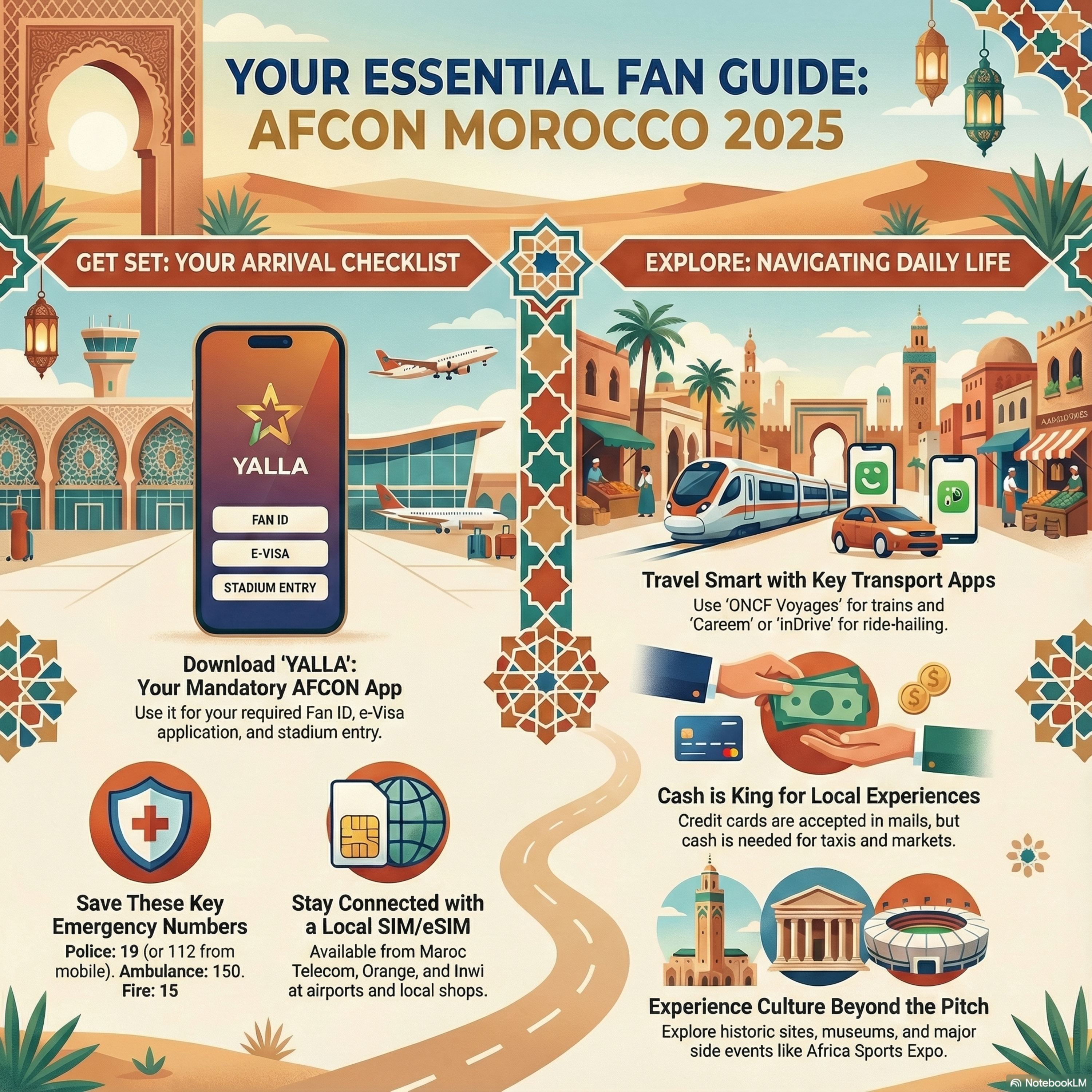
And honestly, if you only take one thing away from this entire deep dive, let it be this. These are the nonnegotiable must haves for anyone going to the matches, and the absolute centerpiece of this whole thing is one word, Yala. Yala, it's the modern key to AFCON 2025. And this isn't like just a digital brochure or a fun little app. This is the integrated platform for security, for your visa and for all access. It is absolutely mandatory for every single foreign visitor who's connected to the tournament.
Without it, your trip could stall before it even begins. OK, so let's break that down. You said it's multifunctional. It sounds like it's doing the job of three or four different apps. What exactly is the architecture of Yala? OK, so 1st and this is the most critical part, it's your gateway to creating your fan ID. Fan ID. And that fan ID is completely non negotiable for getting into any stadium. You can have a ticket in your hand, but if you don't have that digitally verified fan ID, you will not get in.
So it's a security layer. It's a security layer, exactly designed to streamline entry for huge crowds, manage flow, and insure control. Second, for a lot of nationalities, this app is how you get your AFCON evisa. Oh wow, so the visa is integrated too? Fully integrated Morocco has really streamlined the visa process for the turn in and the Yellow Platform is the official verified way to do it. It connects immigration and security clearance all in one place. That is a massive consolidation of power into a single app.
So what else does it handle? The tickets themselves. It does that too. It manages all your confirm match tickets. It's basically your digital wallet and your access token. And beyond that, it's also your security verification for getting into the official fan zones. OK, the fan zones. Right, which will be set up in all the host cities. The app proves you're an official attendee, ticket holder, media, whoever and get you seamless entry into those controlled areas. This is where we need to focus on a critical point, timing.
You said this has to be done before flying. What are the processing times we need to know about? What happens if someone leaves this to the last minute? This is the difference between a smooth trip and frankly, a missed flight. The fan ID creation process, which has a background check component, usually takes between 24 and 48 hours to get approved. A day or two at least. At least and for the E visa, which you do through the same app, you need to allow a minimum of 72 hours. So 3 full days for the visa.
Minimum. So our advice is urgent and simple. The second your flight and hotel are booked before you even pack, get on the Yalla app, upload your documents and get those fan ID and E visa applications started. That brings up a necessary question, though. If this one app is handling sensitive travel docs, visas, personal data, what's the story on data security? It's a very relevant question. The expectation, based on the requirements from CKF and the Moroccan government, is that the app meets international data protection standards, the kind you'd see with government E visa systems or, you know, other major sporting events.
But the responsibility is still on you, the user, to make sure your data is correct and protected. The technical reality though, is simple. No verified fan ID from Yala. No access to the core purpose of your trip. So once that digital foundation is set, the next practical step is immediate safety and communication right when you land. Let's talk emergency numbers. Sounds simple, but you want these saved before you even step off the plane. Absolutely saved in your favorites, pinned to your home screen, maybe even a screenshot in your photos.
It's crucial because Morocco has distinct services for different areas. OK, walk us through that. If I'm in Casablanca, a big city, who am I calling for police issues? For police inside city limits, local emergency staff, that sort of thing, the number is 19. You can also use the international standard 112 from a mobile and should get you to the right place, but 19 is the Direct Line for city police. But what if I'm on the highway driving between, say, Robot and Fez? Who's in charge there? That's the key distinction that falls under the Jendar Marie Royale.
They cover everything outside city line, so highways, rural roads and their number is 177. OK, so 19 for the city, 177 for the highway. Understanding that difference is crucial for a fast response, especially if you break down or have an accident between matches. And the universal services. Those are more straightforward. Ambulance and medical is 150, fire brigade is 15, and if you need it, directory inquiries is 160. Those few numbers are your first layer of physical security. Perfect, let's pivot to connectivity.
I've landed I'm through immigration with my fan ID now I need data right now for maps, for ride hailing, for that Yalla app. How do I get online instantly? PN activity in Morocco is thankfully very accessible and pretty reliable. You got three main players. Brock Telecom, the big historic one, often has the whitest coverage. Then there's Orange, which has great data speeds in the cities and in we, which is usually very competitive on price and data packages. So I see the kiosks at the airport. Is that the best place to start?
It's definitely the fastest way, but if you miss them, don't worry. You can find their dedicated shops in any mall or city center. But here's the real local secret. The thing you need to know how easy it is to top up? You can buy credits at supermarket counters, but the most convenient way is at the small local grocery shops. They're called a handout throughout every corner and they all sell top UPS. It's incredibly easy to stay connected. That's great, but what about E Sims? A lot of us don't want to be swapping physical SIM cards.
That's the modern solution. And yes, Morocco is fully compatible. All three main networks rock, Telecom, Orange and in we offer E Sims. You just need to pop into one of their official stores to get it activated. And international providers like Aralo, they work. Seamlessly for data, just set it up before you arrive. The key take away for everyone though, no matter which method you choose, is to ask for a high data prepaid package. You'll be burning through data with maps, right? Hailing WhatsApp and that Yala app?
Prioritize data capacity. All right, that nails down our digital foundation. So now we move from the digital world to the physical reality of getting around the tournament spread out. So efficient travel, both in the cities and between them, is paramount. Let's start with urban mobility. How do we get around inside Rabat or Mericac? Inside the big cities, you've got a great mix of public transport and apps. For places with a lot of traffic, like Robot and Casablanca, the tramways are a fantastic option.
They're efficient, reliable and cheap. So how does that work in practice? We'll take the Ribot Saleh Tramway. It connects two major zones and gets you to key areas easily. And there are official apps for both the robot and Casablanca trams. And the app lets you do what? Check roads, see arrival times and crucially, recharge your transport card digitally so you avoid the queues and any confusion. And for those of us who prefer the point to point convenience of a ride hailing app. The two essential apps you need to have installed are Kareem and in Drive they're the main players.
Kareem and in drive, what's the difference? Kareem is more like your standard service with set prices. In drive is interesting. It's more like a reverse auction where you propose A fare and drivers can accept it. Both are everywhere, they're trackable, and they're essential for getting around, especially after hours. Let's zoom out now to travel between cities a fan or a media career needs to get from Casablanca to Tangier. What are the best long distance options? Morocco has invested a huge amount in world class long distance travel.
The number one option is the train network which is run by ONCF. You absolutely must download their app ONCF Voyages or use the website for booking. OK, and why is the app so important? Because they run two different systems. You have the standard train network connecting most of the country and then you have the game changer, the high speed rail, the Elba rack, it's Baracos TGV. And the Al Barack, how much of an impact does it really have? A massive impact. It is totally revolutionized travel on that busy northern corridor.
Give me an example. OK, robot to Tangier, that used to be a really long tough drive. Now on the Al Barack is an incredible one hour and 20 minutes. Wow. Yeah, it's comfortable, it's state-of-the-art. And for any routes the train doesn't cover, the bus network is very reliable. The best tool for that is markhub dot MA. It's an aggregator site that lets you compare and book tickets for all major bus companies in one place. That's super useful. OK, let's talk driving. A lot of people, especially media, might rent a car for flexibility.
What are the key things to know before hitting the road? If you're driving, you need to be prepared first for navigation. Everyone uses Waze and it's not just for directions, it's crucial for real time traffic. It helps you avoid roadblocks and importantly, the community is great at flagging fixed and mobile police radar locations. Ah, so it helps you stay compliant. What about tolls? Toll booths can be a total nightmare with the wrong currency or a card that doesn't work. This is a major, major aha moment for anyone driving in Rocco.
You must get a Jowa's pass. A Jowa's pass, What is that? It's Morocco's electronic contactless toll system, and I cannot overstate how necessary it is. Why? Because foreign bank cards often, and I mean often, fail at the automated toll machines. Oh no. So you're just stuck. You're stuck. You're holding up a huge line of cars. You have to reverse out and find a cash lane. It's a massive, frustrating delay. So the JOZ pass just lets you bypass all that? Where do you get 1? It completely bypasses it, you just load it with credit and sail through the dedicated Jo Z lanes.
You can buy them really easily the big gas stations on the highways. And here's a pro tip, look for the mobile Jyo Z staff who walk around right before the big toll gates. They'll sell and activate a pass for you on the spot. That is a fantastic piece of advice, a true shortcut. Now what about speed limits and police checks? You have to be diligent. There are a lot of fixed speed cameras on the highways and mobile police radars are very common. The limits are typically 120 kilometers per hour on highways, 100 on national roads and then 60 or even 40 in cities.
And police. Checks. You'll see frequent checks, especially the entrances and exits of major cities. They're usually quick. The key is just to be ready. Have your passport, license and rental contract handy. Let's make this really concrete with the travel time matrix. This is so important for planning match days and media schedules. Absolutely. And this data really shows the impact of that infrastructure, like we said brought to Tangier on the AL Barack is just one hour, 20 minutes, The drive is closer to three hours.
So the train is the clear winner there. What about another popular route like Casablanca to Fez? That's another high volume on. It's about 3 hours whether you take the train or drive. Pretty comparable. OK, now for the long haul, what about going South Rabat all the way down to Agadir? That's the longest and most complex journey on the list. Over 500 kilometers by car. You need to budget a solid 5 hours and 45 minutes of driving. And public transport. You're looking at a mixed journey, train, then bus, and it'll take over six hours.
And here is the absolutely crucial planning note that people miss. What is it? There is currently no train service between Mera Cake and Agadir. None if. You're doing that 250 kilometer leg, it has to be a car, which takes about two hours, 45 minutes, or a bus booked through marcube dot MA. It's a huge detail to overlook in your planning. That's a massive insight. OK, we've got the digital setup. We've got movement covered. Let's get into our next logistics deep dive, starting with money. How do you handle financial transactions and more importantly, get cash quickly?
This is a critical duality. You have to understand. Major hotels, big malls, international chains, they all take credit cards. But the authentic Moroccan experience Taxis, souks, street food, the local handout that all runs on cash. You have to have it. So what's the Plan B if my international ATM card gets blocked or rejected, which you know, can happen? For large amounts or emergencies you always have Western Union and MoneyGram. But here's the real local aha moment for cash flow in Morocco. You need to know about the national cash networks which are look for science for cash plus whaf of cash and albeit cash which is usually part of the post office and.
What makes them better than an ATM? Speed, access and reliability. They offer instant cash pickup. Imagine your debit card stops working at 9 PMA friend can send you money and 5 minutes later you walk into a cash breed. Plus they're in every neighborhood and open late. Show your passport and you walk out with cash, no card needed. That is an incredible safety net. OK, Moving on to accommodation, AFCON will put a huge strain on hotels. What are the best platforms and what are the risks? For reliable hotels and verified ryads, your safest bet is booking.com.
For private apartments and villas, Airbnb is also excellent and widely used. These platforms give you security and a way to get help if things go wrong. What about people looking for something more local or maybe a longer term rental? That brings you to a veto dot MA. It's the big local platform for private rentals. You can find some amazing authentic places on there, however. There's a but. A very big, but it comes with a critical safety warning. It's not verified like the global platforms, so never ever make a full payment in advance.
Always verify the property, the host, everything you can. The risk of scams is just significantly higher for a short tournament trip. Stick to the verified sites. Got it. Let's talk food. Amazing cuisine but sometimes you just need delivery. What are the go to apps? Food and grocery delivery is very sophisticated in the big cities. The main apps are Glovo, Dunn, and Livery. Global is probably the most common and the most versatile. Versatile in what way? It's not just for restaurants, you can get groceries, pharmacy items, pretty much anything delivered.
It's the utility app you need for quick errands, so have that one installed for sure. And if you want to do your own grocery shopping? You'll see plenty of big modern supermarket chains. They're usually open seven days a week until about 10:00 PM. The big names are Marjane Carrefour, Aswak, Asalam and also discount chains like BIM and Kaizon. Right? But remember, for quick things the local handout is everywhere and for the best fresh produce you have to go to the local souks and markets. That balance is key.
OK, let's transition into our next big segment, lifestyle shopping and Cultural rules. This is where we get into the social landscape, starting with a topic that needs a lot of clarity, alcohol. Right, This is a nuanced area and you need to be very clear on the rules. The main fact is alcohol is legal for tourists in Morocco. However its consumption is very strictly controlled. Discretion is everything. OK, so where can a visitor legally have a drink? Only inside a licensed venue. That means major international hotels, dedicated bars, beach clubs and licensed restaurants.
Public drinking is absolutely forbidden on the street, in a park, on the beach. That can get you into serious trouble very quickly. And what if someone wants to buy a bottle to have back in their hotel room? It's restricted to specialized stores. You need to look for a store called Nicholas, which is a dedicated spirit shop or, and this is a key detail, certain large care for gourmet locations. They'll often have a separate cordoned off section for alcohol so. You can't just buy it at any supermarket.
Absolutely not. The big national chains, Marjane BIM Aswok Asalam, they do not sell alcohol at all. Are there any other rules for buying? Yes, the stores are usually only open from about 10:00 AM to 8:00 PM. And very importantly, they're often closed all day on Fridays. You will need your passport to buy anything. And of course there is 0 tolerance for drunk driving. You must use a ride hailing app. Understood. Let's move to something lighter. Retail and entertainment. If you need a break from the Medina or just want some modern convenience, where do you go?
Morocco's main cities have these incredible modern malls. In Casablanca, you have the famous Morocco Mall, the largest in Africa. It's huge. In Marrakech you have upscale places like M Ave. and all the other host cities have great options too like Ibn Batuta Mall in Tangier or Borge Face Mall in Fez. What about catching a movie? Very easy. The big cinema chain you'll see everywhere is Megarama. It's in Rabat, Casablanca, Merkek, all the main cities. They show all the international blockbusters. And beyond the official AFCON tickets from the Alla app, where do you look for tickets to other things like concerts or cultural shows?
For all non match events like the big after can concerts that are being planned, you need to check 2 main platforms, quiche.com and webook.com. They're the go to sources for local events, theater, festivals, you name it. Perfect. That sets us up for our next section, cultural immersion. The football is the reason to go, but the culture is what makes the trip unforgettable. Let's start with football heritage itself. Yes, to really dive into Moroccan football history, there are two key places. First is the Moroccan Football Museum at the Complex Mohammed the 6th near Rabat.
It's this amazing state-of-the-art facility. And 2nd for club history. You can find the Wide Ad Museum right in the Casablanca Medina, which is fascinating. And what if you're traveling with kids or just need a break from the football intensity? Morocco is very family friendly, the robot zoo is excellent especially for their work with the Atlas lions, and Casablanca has a brand new Casa zoo opening right before the tournament. Plus all those malls we mentioned have indoor amusement parks. Let's look at arts and culture for someone who wants to see some unique art.
What's on the list? The museum scene is really rich for modern art. The Muhammad the 6th museum in Rabat is the flagship for a broader African perspective. Mikhail in Merickek is a must see and in Merickek you have the iconic duo, the Yves St. Laurent Museum and the stunning major Ale Gardens right next door. What about deeper history? For that, I'd recommend the Jewish Museum of Casablanca, which gives incredible insight into the country's diverse heritage, and the amazing Heritage Museum in Agadir, which is all about the indigenous Berber culture.
OK, to round this out, let's list the absolute must see historical landmarks, the icons. These are the heavy hitters. Many are UNESCO sites. In Casablanca, the Hassan, the second mosque. It's an architectural marvel partly built out over the Atlantic Ocean. You have to see it incredible. In Robot you have the historic Cosbo Udayas, the Hassan Tower and the entire Robot Medina, which is a UNESCO site. And in the imperial cities. Merickek is defined by the energy of Jamaa al Finna Square, Qatubia Mosque and the beautiful Bahia Palace and Fez Fez has the incredible Fez El Bali Medina, one of the largest car free urban areas in the world.
And Al Querwin University, one of the oldest universities on the planet. Amazing depth and the coastal cities. In Tangier you have the natural beauty of Caps Bartell, where the Atlantic meets the Mediterranean and the Hercules Caves. And in Agadir, the historic Casma Ufela gives you these incredible panoramic views of the city. We've covered travel, survival and culture. Now for Section 6, Beyond football, this is about sports, leisure and business networking for visitors who are there to do more than just watch.
Exactly. This is all driven by the energy around AFCON and the 2030 World Cup prep. For people who want to play sports, there are two huge trends, the global boom of Fidel and world class golf. Fidel is exploding everywhere. Is it easy to find a court in Morocco? Extremely easy and very popular. The key thing you need to know is the booking platform, the Sportum app and website. It centralizes everything, lets you find and book courts easily and the cost is great, usually around €10 per player. And I hear that app is useful for more than just pedal.
That's right, you can also use Sportum to book 5A side football pitches, so it's your essential app for any kind of recreational team sport. And for the golfers? Morocco has a huge reputation for golf tourism. The courses are phenomenal and robot you have the famous Royal Golf Gar S Salam. Americac is a major hub with places like Royal Palm. The quality is world class and the value is excellent, with rounds typically between 60 and 150 euros. Let's switch to the business side. For investors and executives, AFCON 2025 is a massive networking opportunity.
Isn't. It it's a hugely concentrated period of sports business activity. If you're an investor or an executive, this is where you need to be. So what are the specific events to track? The calendar is packed around December and January. You have the Africa Sports Expo in Casablanca, which is a big industry event. In Robot, there's a transfer Room event which is all about the player trading business and the MIC Sports Forum. And why are those forums so important? Because that's where the strategic decisions for the 2030 World Cup are being shaped.
The MIC Sports Forum for example, is where they'll be discussing post AFCON, infrastructure, tech integration, all of that. I see. Then in January you have the Game Time Africa Summit in Rabat, a huge sports business gathering. And don't forget the 8 official C CAF fan zones. They're not just for fans, they're dynamic commercial hubs, great for business activation. And for media and fans who want to tune into the real local football conversation, where do we listen? You need to get into the sports radio scene.
Radio Mars is the number one sports station. Their morning show Mars Attack is essential listening. High energy, deep analysis. Also La Bamba Naire on Radio 2M. It's an influential show in a mix of French and Arabic. And digitally. The big digital platforms are where the debate happens in real time. Check out Elbow Tola which is hugely popular LA 360 Sport and a few others like Soccer 212. They're all over the intense AFCON developments and use all the modern data like the EPTS wearables data that's changing coaching.
OK, we are into our final section, wrapping this up with health and final practicalities. Health support is so important. What's the safety net like for a visitor who gets sick? The number one service to save in your phone is SOS Medicines. This service offers something incredible a Doctor Who makes house calls in the major cities and. Doctor comes to you, Yes. It's so convenient and reassuring if you feel unwell but don't want to deal with a foreign emergency room for something non critical. How fast is it and what's the cost?
They're impressively quick, usually arriving in 20 to 45 minutes in Casablanca or Rabat, and the fee is very reasonable, around 30 to €40. It's an essential service for Peace of Mind. And for more serious situations. Morocco has excellent private international hospitals, places like Cheek, Zaid Hospital in Rabat, Clinique International Americac. These are high standard facilities ready for international visitors with multilingual staff. And pharmacies if I need to find one late at night. To find an on duty pharmacy after hours, the best tool is the website guide Pharmacies dot MA.
It'll tell you exactly which pharmacy is open 24/7 in your area. Let's end with some final practical ground tips, the little things that prevent confusion. OK, first language and courtesy. While English is growing, French is still the main language for business and communication in the big cities. A little effort goes a long way. Dress code is relaxed, but be respectful, especially near religious sites. Tipping is appreciated but not mandatory. In the parking situation, this is a common point of confusion for drivers.
How does it work? This is a critical nuance. In most street parking spots you'll find self appointed parking guards. You're expected to pay them a small fee, usually 2 to 5 dirhams. Near stadiums it might be a bit more, maybe 10 to 20 drums. So it's an informal system, but what if it's a formal metered zone? Yes, and this is where it gets confusing. In the blue line zones you have to buy a ticket from the official machine first, but you will probably still be expected to pay the small fee to the guard who is watching your car.
So you have to be ready for that dual system. Exactly a few dirhams avoids any hassle and just makes the whole experience smoother. What an incredible amount of actionable information. We've covered the mandatory Yalla app, the speed of the Alborak train, the absolute necessity of the Jawazai Pass for drivers, the speed of local cash networks like Cash plus the critical rules around alcohol and even the tricky details of parking attendance. We've given you the playbook, from modern art museums to booking a padel court.
And this deep dive, as comprehensive as it is, is really just a snapshot of the infrastructure. Morocco is a place of vibrant, unexpected discovery. The best experiences are often the hidden gems you find just by exploring, but the bigger context here is the dynamic moment the country is in. So what does that mean for someone visiting? Well, given Morocco's ambitious role hosting AFCON and preparing for the World Cup at the same time, the true value for any visitor is not just watching the matches.
It's about witnessing a nation in an accelerated process of transformation. Culture and infrastructure are evolving side by side in real time. So the provocative thought to consider is this how can you leverage this unique confluence of sport, business and rapid development in 2025 to experience first hand the ambitious future of the African continent and maybe even play a small part in it? A truly powerful thought to end on. Thank you for diving deep with us. Enjoy the football, enjoy the culture, enjoy Morocco.
 Apple Podcasts
 Castbox
 Castro
 Goodpods
 Moon FM
 Overcast
 Pocket Casts
 Podbean
 Podcast Addict
 Podcast Republic
 Spotify