Modernizing African Football with Performance Data
About this episode
Modernizing African Football with Performance Data
Imagine, if you will, standing right on the touchline of a really vibrant, high stakes football match. Like, put yourself there right now. That's a great exercise. Right. Maybe you're in Nairobi and you can actually feel the altitude burning in your lungs every time you take a breath. Or you're an Accra and the humidity is just, you know, wrapping around you like a heavy, wet blanket. Yeah, that absolute wall of heat. Exactly. Or maybe Dakar, where the rhythm of the drums in the stands is so loud it literally syncs up with your own heartbeat and right in front of you on that pitch, the talent is just absolute raw, explosive brilliance.
It really is something you have to see to believe. It is the passion in these environments isn't just something you see, it's it's something that physically vibrates through the ground. But here's the beneath the roar of that crowd, and beneath the sheer beauty of the players doing what they do best, there is this invisible revolution happening. It's completely silent, isn't it? Completely silent. It's relentless, and it revolves entirely around one single terrifyingly powerful concept, which is data.
It really is the great unseen shift in the modern game. I mean, for a century we've lived in an era where talent was purely subjective. Yeah, entirely based on vibes. Exactly. It was the mythology of the game. A scout standing on the edge of a dusty pitch with a notepad, trusting their gut, saying things like that kid has a good engine or he looks a bit slow in the turn. Right, which is just completely unverifiable. Precisely. But we are ripping that up now. We are moving into an era where that exact same talent in those exact same environments can be quantified, mathematically verified and ultimately amplified to the rest of the world.
Which brings us to the core mission of this deep dive today, because we are taking a massive look at how we actually harness the game changing power of GPS and electronic performance and tracking system. PTS for the nerds out there. Right, EPTS and how we force these technologies to actually serve and benefit the African football ecosystem. And I want to be crystal clear right out of the gate here. We are not talking about strapping a bunch of expensive flashing gadgets to a teenager's back just so a coach can stare at a pretty pie chart on an iPad.
No, absolutely not. It's a waste of everyone's time. Exactly. We are talking about fundamentally altering the destiny of players. We are talking about uncovering hidden generational talent that the global market has historically overlooked just because of geographic bias. And we're talking about spotting the warning signs of a career ending hamstring terror like 3 weeks before the muscle actually snaps. Yes, building absolutely unstoppable, physically dominant teams on the continent. So if you are listening to this right now, whether you are an Academy coach, a federation visionary, a sports tech innovator, or just someone obsessed with the future of the beautiful game, consider yourself part of the silent audience.
You're right here in the room with us. You are, and we are about to hand you the ultimate unfiltered playbook for sports tech in emerging markets. And honestly, that playbook desperately needs a rewrite from page one, because The Dirty little secret of the sports technology industry is that the traditional standard European way of buying an implementing this gear, it is fundamentally broken the second you export it to the rest of the world. Oh, completely shattered. It is. It relies on a staggering amount of hidden privilege.
It assumes a level of, well, endless financial resources, perfect climate controlled infrastructure, and an army of specialized staff that simply does not exist in the vast majority of high potential global regions. Which is just wild when you think about. It right. So today we are just adjusting that old rule book we are throwing in the fire. We have to build a strategic framework from the ground up that is unapologetically designed for the harsh realities, the very real operational constraints and the immense untapped potential of African football.
I absolutely love that visual, throwing the old rulebook in the fire, but if we are going to revolutionize the African game, we really have to clear out the garbage first. Oh definitely, there's a lot of garbage. There really is. We have to tear down the biggest, most damaging lie that is being sold in sports science today. And it's a lie that starts the absolute second a vendor walks into a football club with a glossy brochure. I know exactly what you're going to say. It's this massive myth that when it comes to data, more is always better.
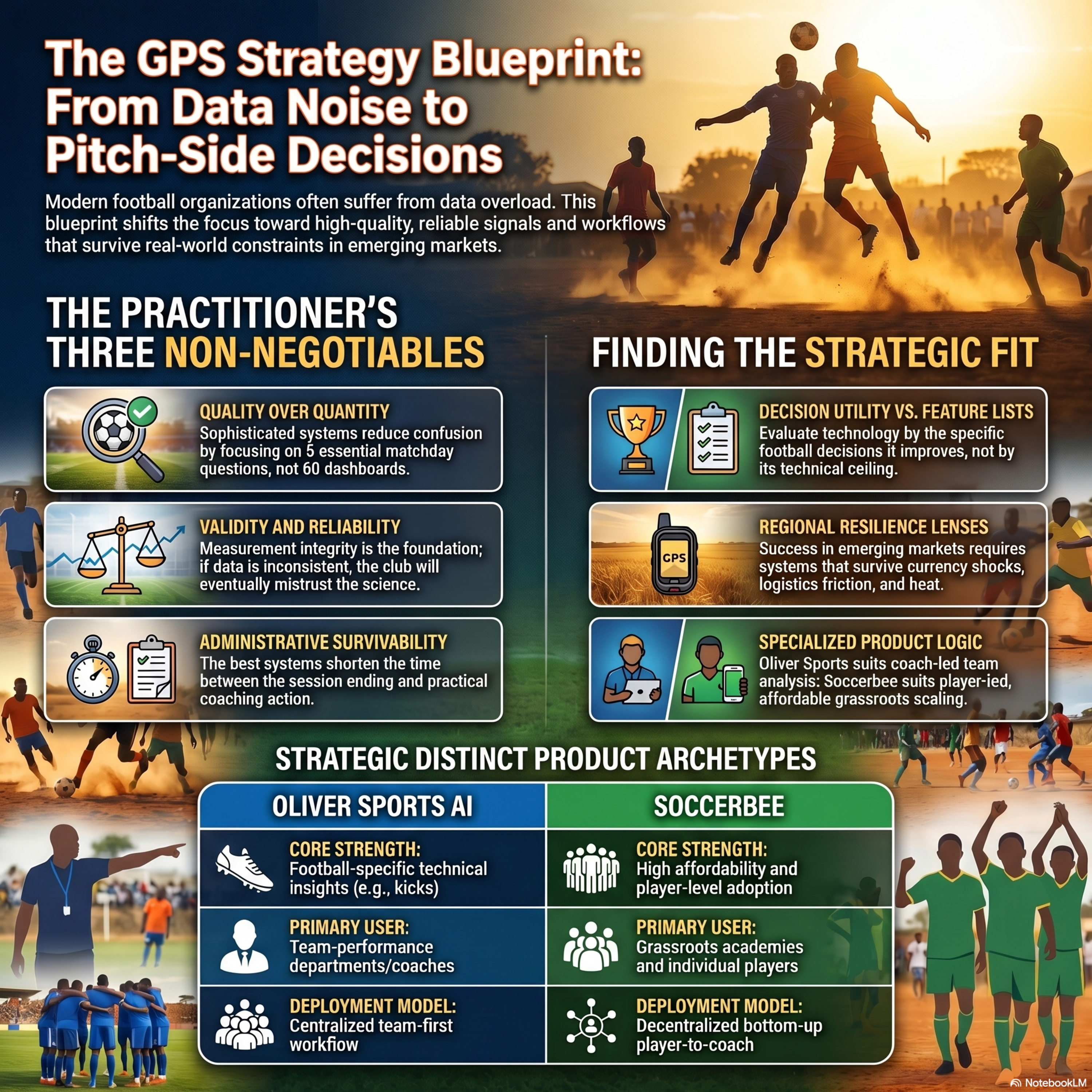
It is the most pervasive, dangerous trap in modern performance management. I mean, the entire traditional global market for sports technology has historically been built to reward metric expansion. Like an arms race. Exactly. It's an arms race of variables. We can call it the 60 dashboards problem. A technology vendor comes into a club, sets up their presentation, and their primary sales pitch is based on the sheer overwhelming volume of data their little black box collects. Right, they just overwhelm you with numbers.
Yeah, they stand there and boast that their tracker generates 1000 data points per second measuring 80 different proprietary variables. And the club executives who, you know, just want to feel like they're being cutting edge, they buy it. Because it sounds impressive in a boardroom. Exactly. But the practitioners on the ground then end up inheriting these massive, sprawling data environments that they never actually asked for. Right, it feels like a consumer tech pissing contest. Like my tracker measures 80 things.
Yeah well mine measures 120 things and tracks the players core temperature based on the wind speed. Which is just absurd. It sounds incredibly impressive until you actually have to use it on a Tuesday morning in the pouring rain. And that that is exactly where the illusion shatters. The reality on the pitch is that coaching Staffs and performance departments do not need more metrics. No, they don't. What they're desperate for are fewer, better, and significantly more trustworthy signals to actually drive a human decision.
Quality doesn't just beat quantity. Quantity actively destroys quality. OK, let's unpack this a little because we have to remember what these people are actually hired to do. Right. A head coach, a fitness lead, a medical director. They are not paid a salary to be data hoarders. They aren't archivists. Exactly. They are paid to reduce noise and win football matches. Let's really dig into the mechanics of that phrase. Reduce noise because you brought up this concept of cognitive load in these high pressure environments before and I think people really underestimate what a coach's brain is going through during a grueling season.
It's a biological bottleneck. Really. Think about how the human brain processes urgency in a high stakes environment like professional football. A head coach's attention is the single most scarce, highly contested resource in the entire organization. Oh for sure, everyone wants a piece of them. Every single day they have agents calling them, players complaining about playing time, board members demanding results, media scrutinizing their tactics. Their cognitive load is constantly maxed out. They must be exhausted before they even get to the pitch.
They are, so they have incredibly limited patience for any piece of information that does not directly, immediately connect to a decision they have to make right now. Which makes total sense. So when you flood that manager's office with 60 different dashboards showing complex algorithms about like symmetric running gate and micro accelerations, you are empowering them, you are paralyzing them. And this leads directly to a toxic organizational phenomenon called accountability diffusion. Now that sounds like the kind of corporate jargon someone uses right before they fire you.
It really does, doesn't it? Accountability. Diffusion. Break that down for us. What does that actually look like in the hallways of a football training center? It looks like institutional paralysis when the system spits out 80 different outputs. Nobody in the building knows which three actually matter enough to stake their reputation on, so human nature takes over. Everyone just passes the buck. Exactly. The head coach looks at the massive report and says, well, the physical data is too complex for me.
That's for the fitness team to handle. OK. And then what is the fitness coach do? The fitness coach looks at it and says well it's plug in an injury risk, so it depends on the medical staff's interpretation. And then the medical staff examines the player and says the player feels totally fine, it's just a tactical load issue. Oh man, so it just goes in a circle? A complete circle. Eventually everyone just points fingers at each other, no one makes a hard decision to rest the player or push the player, and the organization learns absolutely nothing.
That is so frustrating. It is if the tracking technology just becomes this incredibly expensive performative ritual that happens every morning, rather than a tool that actually changes behavior. It's the illusion of being beta driven. You think you are a sophisticated modern club because you've have these massive flat screens on the walls of the cafeteria showing player heat maps, but you're actually just drowning in numbers. Spot on. I was trying to picture what this feels like and it's basically like driving a high performance car where the dashboard spans the entire windshield.
Oh, that's a great analogy. Like the speedometer randomly switches between kilometers and mph every 3 minutes, the fuel gauge speaks in cryptic riddles, and the check engine light flickers perfectly to the beat of the radio. Sounds like a nightmare. It's not just useless to the driver, it's actively, terrifyingly dangerous because it forces you to take your eyes off the road just to figure out what's real. That is a phenomenal way to visualize it. And that danger leads directly into the second core truth that completely shatters this Moore's better myth.
Which is. Validity and reliability are absolute non negotiable prerequisites. It's the razor thin line between a genuine physiological signal and pure theater. Pure theater. Wow. Yeah, if the data is unstable, if the numbers jump around without a real world explanation, trust the roads in an instant. And in a football club, once trust is gone, it never comes back. And the false certainty that comes with bad data is what really keeps people up at night. Let's construct a scenario here because we know for a fact this kind of thing happens in the real world.
Oh, all the time. Let's hear it. OK? Imagine a manager is preparing for a massive cup final, like the biggest game of the decade. For this club, their star striker is their absolute best chance of winning. But the day before the match, the coach logs into this highly complex, expensive new tech platform and a flashing red proprietary algorithm flags the striker as a severe injury risk. Oh boy, right. The system says his mechanical load is asymmetric. The coach panics, trusts the machine over his own eyes and benches the star player.
And they lose the final. Devastating. But here's the kicker. What if nobody realized the player had Simply put the vest on slightly crooked? Oh, it happened so. Or what if the firmware on that specific device hadn't synced properly to the cloud? Or even worse, what if that complex injury algorithm was trained entirely on data from 30 year old European center backs and is now misinterpreting the natural explosive running mechanics of a 19 year old African winger? That is the exact blind spot of global algorithms.
The coach just made a career defining, potentially sackable decision based on a complete ghost in the machine. And think about the fallout of that moment. The second that Coach realizes the data was fundamentally flawed, that they benched their best player over a software glitch, the relationship between objective evidence and managerial authority inside that club is permanently severed. Yeah, they'll never look at a dashboard again. Never the very first time the numbers on the iPad completely contradict what a coach is seeing with their own highly experienced eyes.
Tension begins over the course of a few months. If those contradictions continue, it becomes fatal to adoption. The tech just ends up in a drawer. Exactly. The coax just stops looking at the reports. A mathematically reliable, painfully simple system protects that trust. Which brings us to the actual secret weapon of sports tech. Oh, I like the sound of a secret weapon. What is it? Effective post session data management. Everyone obsesses over the hardware, but honestly capturing the data is the easy part.
The actual competitive advantage lies in the velocity of action. Velocity of action. I like that. How quickly and how seamlessly can you get from the referee blowing the final whistle of a training session to a crystal clear, actionable insight physically in the head coach's hands? I hear that, but I want to push back on this a little bit. Sure, go for it. Let's look at this from the perspective of an ambitious owner. Say you have a newly promoted team, maybe in the South African Premier Division or the Egyptian Premier League.
They just secured a massive TV rights payday. OK. So they have some capital. Exactly. They are flush with cash for the first time in their history. Why wouldn't my instinct be to just Hoover up every single data point possible right now? I see where you're going with this. Even if my coaches don't understand it today, shouldn't I just buy the 120 metric system, store all that data in a massive server somewhere, and figure out what matters to us later when we hire smarter people? Isn't having the data and ignoring it better than needing it in three years and realizing we never tracked?
It is a very common argument, and honestly, it is the exact logic that vendors use to upsell premium packages. Yeah, but it is a trap. Trap. How so? Because it assumes A controlled laboratory environment. Yes. If you are a massive research university with a dedicated wing of data scientists who have six months to clean, scrub and run regressions on historical information, then absolutely collect everything. Right, but. Clubs aren't universities. Exactly. In the trenches of a professional football club.
A massive, indiscriminate data dump actively harms the daily workflow that creates serious friction. Because it just takes too long to load. Yes, it takes longer to download, it takes longer to process, and it clutters the interface. It is infinitely more effective to sit down and mandate 5 core decision metrics. Just 5. Start with absolute basics, things like training load control. Are we running them too hard today compared to yesterday? OK, that makes sense. Match to training comparisons? Did we simulate match intensity on Wednesday and return to play progression?
Is the injured player hitting their historical top speed yet? Keeping it hyper focused on the actual football. Yes. If an organization, no matter how much money they have, cannot sit down and clearly define the top ten specific football decisions they expect this new system to improve in the next 12 months, they have no business signing of the purchase order. They're simply not ready. Wow. OK so let's tie this all together. If this whole more is better philosophy, this toxic obsession with 60 dashboards and endless unverified metrics is actively failing and paralyzing even the most elite, heavily resourced multi $1,000,000 European clubs.
And it is failing them, believe me. What in the world happens when you take that exact same flawed logic, put it in a shipping container, and export it to the African continent? Spoiler alert, it's an absolute disaster. A complete catastrophe. The context changes everything, so let's look at the real operating environment. Let's talk about the reality of the African ecosystem. This is where we have to fundamentally and aggressively adjust our global lens, The standard conversation in sports tech boardrooms.
It treats Africa as if it is a single homogeneous market with one set of rules. Which is just Madden. It's. Insane. The realities of operating a football club in the highly developed urban centers of Morocco or Egypt are vastly fundamentally different from operating in South Africa, right, Which is entirely different from the logistical realities of Kenya, Nigeria, Ghana, Rwanda, Tanzania, Uganda, Senegal or Algeria. You're dealing with a massive continent. Huge You were dealing with wildly different baselines of physical infrastructure, massive variations in purchasing power, completely different models of football governance, and varying degrees of institutional stability.
You cannot take a beautifully bound, perfectly optimized playbook built for a massive club in London or Munich, drop it onto the desk of an Academy director in Lagos or Dar es Salaam and just expect the system to boot up and run. It's a completely different operating system. It really is, and the absolute biggest hurdle you hit on day one is what we call staffing asymmetry. Let's map this out for the list. Good idea, Let's compare them. In Europe a top tier club has entire departments dedicated to this stuff.
You have a head of sports science, a lead first team data analyst, a load management specialist, maybe even a dedicated sports technologist just to manage the hardware. An army of people in polo shirts. Exactly. But in many African clubs, highly ambitious academies or even national federations, the person buying the tech, charging the tech, distributing the tech and reading the data is often just the head coach. Or maybe it's the physical education lead at a local school. Or the guy who owns the Academy and also happens to drive the team bus.
They're incredibly smart football people, but they do not have pH DS in bio mechanics. And because of that massive staffing asymmetry, the value proposition of the technology completely shifts. In Europe, depth of data is valued. In emerging markets, ease of use and guidance, automated reporting become disproportionately overwhelmingly valuable. So it has to do the thinking for them basically. It has to. If a tracking system requires highly specialized, dedicated labor to sit there for two hours and write custom code just to derive a routine PDF output, any organization without a massive performance department will simply fail to use it.
It just becomes a paperweight. Exactly. The system will collapse under its own administrative way. But even beyond the staffing issue, the most brutal, unforgiving reality check for anyone operating in this space is understanding the true total cost of ownership. Ah, the TCO. Yes, because the device price you see listed on the vendor's shiny website. That is nothing but a mirage. That is just the starting line of your expenses. The TCO is an absolute silent killer for clubs. It destroys budgets overnight.
Let's walk through the math on this because it's actually shocking when you break it down. Let's do it. You go online, you see AGPS tracker for let's say 200 U.S. dollars. The Academy director looks at the budget and says great, I have $4000. I can afford 20 of them for the squad. We are going digital. Sounds perfect on paper. Right. But wait, that $200 is just the plastic and the silicon sitting in a warehouse in Ireland. First you have to calculate international shipping and because these devices contain lithium batteries, you are paying exorbitant specialized dangerous goods freight rates.
Which is not cheap. Not at all. Then the package finally arrives at customs. Now you are hit with massive import duties, which in some countries can be 30 to 50% of the declared value. Which is guts the budget. And then you add local value, value added tax on top of that. Suddenly, that $200 tracker cost the club $380 before it has even tracked a single Sprint. It's devastating. And then the ultimate terror, which is the replacement risk, because this is football, a player gets slide tackled, they land flat on their back and the device shatters.
It will happen. Oh, it's guaranteed to happen. When that device breaks, how much time and money does it cost to get a single replacement unit back through that exact same punishing customs process? This is exactly, exactly why the Eurocentric procurement assumption completely and utterly fails here. You really have to look at the psychological damage of that failure. The psychological damage say more about. That well, think about it, in a wealthy, insulated European ecosystem, a failed technology purchase is essentially just a line item inefficiency on a massive corporate balance sheet.
A drop in the bucket. Right. The club spent 50 grand on a system, the coach hated it. So they write it off as a loss, shrug their shoulders, and buy a completely different brand next season. Nobody loses their job. They just move on. But in a lower resource African environment, a failed technology purchase doesn't just waste money, it actively kills future innovation for a decade. Oh wow, a whole decade. Easily the club's leadership who took a massive financial risk to approve that budget in the 1st place, watches the expensive tech sit unused in a box.
They simply conclude, well sports deck doesn't work here, it's a European scam. It's a waste of money. That is so depressing. The downside of choosing the wrong system isn't just a bad season, it is an existential threat to the modernization of that entire performance department. It totally poisons the well for the next generation of coaches. And it's not just the hard financial costs, it's the human friction. The continuity of daily life and infrastructure can be incredibly fragile. Yes, the daily logistics.
We aren't just talking about money. We are talking about electricity. We are dealing with rolling power interruptions. We are talking about a reality where an entire coaching staff of four people might be sharing a single aging laptop. And trying to run heavy software on it. Exactly, we are talking about highly variable cellular based Internet connectivity. I really want you to picture the friction costs in real life. Paint the picture. Imagine an incredibly dedicated, brilliant Academy coach in Uganda.
They've just run a phenomenal, intense 2 hour tactical session in the heat. They are exhausted. Now, under the old European model, they have to collect 20 sweaty vests. Which is gross enough on its own, right? Then they have to plug them all into a massive docking station, pray the power grid stays up, and then spend 4 hours dealing with a slow software sync over a spotty 3G connection. Just brutal. They have to navigate complex raw data exports on a shared laptop that keeps freezing just to see how many kilometers their central midfielders ran.
What happens in human reality? They give up. That technology is going to end up shoved in the bottom of a desk drawer by week 3. It is absolutely guaranteed. Exactly. And this points to the absolute core requirement for this ecosystem. The real desperate need for these environments isn't the most advanced, mathematically complex academic technology in the world. What they actually need is the most survivable technology in the world. Survivable. I love that word for this. It needs to be administratively survivable under highly imperfect, chaotic conditions.
If the Wi-Fi drops, the system must still work. If the laptop dies, the data must be accessible on a phone. It has to be dillet proof. But you know, while we're spending all this time outlining these massive logistical constraints and the pain points, we cannot for one second lose sight of the profound world altering opportunity that sits on the other side of this problem. The opportunity is staggering. Honestly it gives me goosebumps. Africa has a massive, unmatched, undeniable density of football talent.
The sheer volume of gifted athletes is mind boggling. It's the deepest talent pool in the world. But historically, because of a lack of infrastructure, player assessment has relied almost entirely on subjective bias. A scout watches a game and writes down he looks really fast or she seems to have a great engine. It's entirely based on opinion and the eye test. Which is so easily dismissed by a skeptical buyer in. Europe, right? But if we can successfully navigate these hurdles and apply valid, reliable objective track in tech, we completely replace that subjective, easily dismissed bias with undeniable mathematical proof of talent.
And think about what that does to the global football economy. We are talking about the export of African talent to the major global leagues. Right now. A scout in Belgium or France looking at a player in Senegal has to trust the subjective opinion of a local contact. Or watch a grainy, poorly framed YouTube video of a match. Exactly. There is massive risk in that transfer. But what if objective data revolutionizes this entire supply chain? What if that local Academy in Senegal can suddenly provide standardized, globally recognized, perfectly accurate proof of a player's physiological capability?
That changes everything. They can literally e-mail a dossier that proves definitively that their 18 year old winger hits 34 kilometers per hour and recovers faster than a Champions League average. You can't argue with the math you. Can't It completely levels the playing field in the global transfer market. It allows African clubs and academies to negotiate transfer fees from a position of verified, undeniable strength. So we clearly know the massive stakes here. We need technology that survives power cuts, doesn't require an on site data scientist with a master's degree, and doesn't bankrupt the club on obscure import taxes.
A tall order, but possible. So let's get incredibly practical right now. Let's look at 2:00 Completely different hardware and software solutions that are actually built with these exact realities in mind. Because clearly the standard European vendors aren't the answer. So let's compare 2 fascinating models all over Sports AI versus Soccer B. These two systems are strategically fascinating to analyze side by side because they occupy very different spaces in the market, but they both directly address the neglected realities we just spent time discussing.
They come with the problem from opposite. Directions. They solve the problem from two different angles entirely. Let's start with all over sports AI. From a pure architectural and design standpoint, all of our positions itself around a concept I would call productive simplicity for team environments. And right away, the hardware design is completely wild. Oliver is worn on the. Cap Yeah, right in the sock. It's placed inside a specialized lower limb compression sleeve. It completely ditches the traditional slightly awkward sports bra style vest that goes on the upper back between the shoulder blades.
And that shift in form factor is highly, highly strategic. Traditional upper back GPS units are excellent for general locomotor tracking. Like they are great at telling you the total distance covered or the top sprinting speed. Which is good to know. Sure, but football is not track and field football. Organizations increasingly want direct, granular visibility into foot dominant behavior. Because Oliver is placed directly on the calf, it is right at the point of action. So it captures the actual kick.
Exactly. Utilizes highly sensitive inertial sensors, accelerometers, and gyroscopes to track actual ball interactions. Let's think about the mechanics of how that works. When a player sprints, the leg moves in a rhythmic oscillating pattern. The accelerometer reads that wave. OK, pretty standard. But when a player strikes a football, there is a massive, instantaneous violent spike in G force. As the foot connects with the mass of the ball. The sensor reads that specific spike. So now the algorithm can differentiate between a hard run and a hard kick.
Wait, really? It can tell the difference just from the G force. Yes, we are talking about capturing kicking intensity, measuring the volume of dribbling metrics, and quantifying actual kick power. And this aligns perfectly with FIFA's relatively recent progressive openness to approving lower limb tracking systems for official match. Play. It bridges that massive gap between just running around a field and actually playing the game of football. It speaks the language of the sport, not just the language of a marathon runner.
Exactly. And all of her layers on top of that Hardware. A heavy emphasis on AI enabled analysis, the software generates minute by minute metrics and narrative insights. The entire goal of their platform is to give that team level performance insight to tell a story about the match without needing that PhD data scientist would keep talking about. It provides A richer, much more football specific storytelling layer that an overwhelmed head coach can instantly digest. Now I want to contrast that entirely with Soccer B. Let's do it because Soccer B's architecture is fundamentally radically different.
It is not built around a centralized team purchase. It is built around a concept we can call productive simplicity for access. It is really the pioneer of the player first model. This blew my mind when I first saw how it works. So instead of an Academy director having to beg the club's board of directors to spend a massive centralized chump of their budget to buy a briefcase of 30 trackers. Which takes months of approval. The players themselves or their families by the individual tracker. It's highly affordable, like a tiny fraction of the cost of those massive enterprise systems.
Soccer B offers hardware like the Pro 2 or the Light 2. Very consumer friendly pricing. The player throws it on, goes to training, and captures their own personal data on their own smartphone app. They own it. Then the magic happens on the institutional side. The coach uses a piece of PC software called SCB Team to magically aggregate all those individual player owned data streams into one cohesive team dashboard. It's the ultimate democratization of sports data. It completely bypasses the traditional procurement blockade we talked about earlier.
Because the club isn't buying the hardware. Exactly, it overcomes those fragmented, non existent club budgets by building adoption from the bottom up rather than forcing it top down. This architecture is incredibly vital in emerging markets where institutional resources at the club level are dismally low, but individual and family aspiration, the desperate desire to prove a young players worth, is incredibly high. It taps into that personal ambition. So you have these two brilliant but entirely distinct pathways.
Let's apply these two models directly to the African continent. Let's map them to real environments. If I'm looking at Oliver with its calf worn metrics and AI team insights, to me this is the absolute perfect fit for an ambitious, well structured, heavily funded urban Academy in East Africa. Yeah, that's a great use. Case like maybe a premier set up in Nairobi or Dar es Salaam or maybe a National Federation technical hub where they have a dedicated coaching staff or, and I think this is a massive overlooked growth area, a highly structured women's pathway where they really want to tell a premium elite development story with rich football specific technical insights to go out and attract massive of corporate sponsors.
That is the exact right archetype for Oliver. They're targeting environments that want a centralized, coach LED, highly professionalized performance ecosystem. The club still owns the process, but if we pivot our focus to Soccer B, this is the ultimate perfect fit for the highly fragmented, chaotic grassroots scene. Think about vast parts of West Africa where thousands of players are constantly moving between different semi professional setups, Sunday leagues and pop up academies. Where there's no real institutional stability.
Exactly. Environments where families are actively scraping together money to invest in a young players individual development long before any local institution has the capital to officially sponsor them. In the Soccer B model, the player owns their physical history and they take it with them wherever they go. OK, I love the romance of that, but I have to interject here because the logistics sound genuinely terrifying to me. OK, let's hear the concern. Does Soccer B's decentralized model not create absolute, unmitigated chaos for a manager?
Put yourself in the shoes of a coach trying to run a cohesive Tuesday afternoon tactical session. I can see where this is going. If half my starting 11 bought their own soccer B device and wore it, but the other half couldn't afford one or they forgot at home, or their phone battery is dead and it won't sync, how does a coach actually make team wide decisions about physical load when the data is that fragmented? I have a puzzle with half the pieces missing. It is a highly valid critical concern, and frankly, it is the biggest systemic risk to the entire Soccer B model.
Fragmentation is the absolute enemy of data continuity. Because if you only have half the team's data, you don't really know how the session went. Exactly. If the coach's software solution depends entirely on athletes voluntarily opting into the ecosystem and maintaining their own hardware, adoption can become wildly uneven. It requires a very specific, highly charismatic type of leadership. The coach has to be a salesman, basically. They do. It requires a coach or an Academy director who can masterfully coordinate athlete onboarding, who can manage the friction of a hybrid environment, and who could build a cultural standard where bringing your tracker to training is viewed as being just as mandatory as bringing your football boots.
That's a huge culture shift. It's a massive administrative hurdle for the staff, but you have to remember the core trade off. They are accepting this administrative friction in exchange for entirely breaking down the financial cost barrier to entry. So understanding the strategic choice between the team first deep intelligence of Oliver and the player first highly accessible democratization of soccer B is a great starting point. You pick your hardware philosophy. Right, that's step one. But here is the terrifying reality of emerging markets.
Even if you pick the absolute perfect device, wrap it in a bow, fully train the staff, and hand it to the coach, there are invisible massive macroeconomic forces swirling around you that can destroy your entire program overnight. And the device itself has nothing to do with it. The dreaded unknown unknowns. We need to talk about the things that keep directors of football staring at the ceiling at 3:00 AM. Let's explore how you actually survive the unknown unknowns in emerging markets. This is the critical layer of strategy that almost all global procurement conversations completely ignore.
They focus on the spec sheet of the tracker and completely ignore the world it operates in. Because they assume a stable world. Exactly. The truth is, systemic risks entirely outside of the technology itself will ultimately determine the success or failure of a program in emerging markets. We're talking about massive macroeconomic shifts, extreme environmental realities, and geopolitical supply chain nightmares that can suddenly reprice an entire category of technology or disrupt a multi year implementation in a matter of days.
It's all the terrifying stuff that is definitely not printed on the vendors glossy brochure. I want to walk through these specifically because the mechanics of how this ruins a football club are wild. Let's start with a big one, currency instability. How does the foreign exchange market destroy a sports science department? It is brutal. The vast majority of the global sports technology industry prices its hardware and more importantly, it's recurring sauce. Software as a service. Subscriptions in U.S. dollars, EUR or British pounds.
OK. Standard international business. Right. But the academy's schools and federations operating in Africa are generating revenue and budgeting in their local currencies. The IRA, the CD, the Rand, the shilling. Which fluctuate. Massively so. Imagine a club signs a three-year software subscription based on their current budget, but in year 2 of that contract, a global macroeconomic event happens and their local currency devalues by 30% against the US dollar. The product didn't get 30% better, the club didn't get 30% more usage, but suddenly the exact same software became mathematically unaffordable.
Their entire innovation budget just vanished into thin air because of a 4X fluctuation. So they just have to cancel the contract. They have no choice. This punishing reality forces smart buyers to aggressively look for vendors who can either tolerate local market pricing logic or who offer highly resilient one time hardware purchase models without crippling recurring cloud fees. That is just heartbreaking losing your tech because of Wall Street. Then you have the physical nightmare, geopolitics and customs.
This is the supply chain reality. We touched on this earlier, but I want to go deep into the absolute misery of the battery carriage restriction issue because this sounds so mundane until you are actually living it. It sounds incredibly mundane until it actively ruins your season. Every single GPS tracker relies on high density lithium ion batteries, and the reality of global freight is that International Airlines, cargo carriers and Civil Aviation authorities have incredibly strict, constantly shifting, highly punitive regulations regarding the shipping of loose lithium batteries or devices containing them.
Because of the fire risk, right? Exactly. Under certain pressure and heat conditions, lithium batteries can enter thermal runaway and cause catastrophic cargo hold fires, so shipping them is highly restricted. Now imagine a remote Academy in Uganda or a club operating in an island market. Three of their twenty devices get smashed in a hard tackle. Which, like we said, is inevitable. The club is fully covered by warranty, the European vendor is happy to replace them, but the replacing units suddenly get flagged and stuck in an international port, or they get outright rejected by an air freight carrier due to new battery documentation restrictions.
So they just sit in a warehouse. What should have been a simple three day DHL replacement turns into 6 agonizing weeks of downtime. Wallpaper work is filed. Your longitudinal data continuity, the entire point of tracking player load over a season, is completely destroyed, not by a bad algorithm, but by a shipping regulation. I was trying to think of an analogy for this and it's basically like buying a state-of-the-art $1000 smartphone. It's the best phone on the market, but you live in a geographic area where the local cell towers just randomly shut down for three weeks at a time, right?
And if your dog chews up your charging cable, you have to import a new one through a notoriously slow, corrupt customs office that might hold the cable in a warehouse for a month. The phone's incredible internal specs. It's amazing camera, it's processor speed, none of that matters anymore if you physically cannot turn the screen on. Exactly. The environment defeats the spec sheet and this raises an absolutely vital question for anyone writing a check. Are you simply buying a technological product or are you buying a long term resilient supply chain?
You better be buying the supply. Chain. Because in these markets, if the supply chain is fragile, the product itself is effectively fragile. And Speaking of physical fragility, let's look at environmental volatility. I know the weather. A sleek new tracker might test absolutely perfectly inside a climate controlled 20° laboratory in Germany, but what physically happens to the chemistry of that battery and the integrity of the plastic casing when you expose it to the 40° midday heat of a pitch in the Gulf or North Africa?
It literally melts. What happens to the internal circuitry when it faces the sheer penetrating volume of micro dust in a sub-saharan training facility? What happens when extreme coastal humidity begins to corrode the exposed USB charging ports? I didn't even think about the charging ports. The industrial adhesives melt, the hardware overheats and auto shuts down. The charging ports get jammed. Resilience is not just a nice to have marketing bullet point. Extreme physical resilience is the absolute core feature.
Environmental ruggedness is the primary evaluation criterion. And we haven't even touched on capital scarcity or platform concentration risk, which are entirely different beasts. Capital scarcity is the harsh reality of cash flow. It means that when an unpredictable economic shock hits a football environment, say a sponsor pulls out or ticket sales drop, the innovation and technology budget is always the very first thing to get cut. It's seen as a luxury. Exactly. The senior men's first team might survive the cuts, but the youth Academy or the newly formed women's pathway tech budget is instantly slashed to 0.
Therefore, you cannot buy systems with long, slow adoption curves. Proving incredibly fast financial and performance payback and operating with extremely low ongoing costs is essential for survival. And what about this platform concentration risk? That is perhaps the most insidious threat of all, because you can't see it coming. Think about a product like Soccer B which relies heavily on the players using their own individual iOS or Android smartphones to pull data via Bluetooth. Right, everyone uses their own phone.
What happens if ALE or Google suddenly push an overnight software update that fundamentally changes their rivacy rules, or alters how background a Bluetooth ermissions function, or changes their integration standards? Oh wow, the app just breaks. The entire downstream sports product can instantly degrade or fail to sync, even though the physical wearable tracker hasn't changed at all. You were entirely at the mercy of Silicon Valley giants. OK, my head is spinning. We know the technology options.
We deeply understand the diverse, incredibly complex African ecosystem. And now we have stared into the abyss of the hidden traps, the shipping nightmares, the 4X collapses, the heat, the tech giants. It's a lot to navigate. The stakes are incredibly high. So how do we actually pull this off? If I am a director of football listening to this, how do I build something that doesn't just survive these threats but actually thrives and produces world class talent? It is time to build the ultimate step by step playbook for the African game.
This is where we stop theorizing and move directly into practical operational action. Implementing this level of technology in a volatile market requires a rigid, unyielding road map. We have developped A sixhase implementation roadma. Let's hear it. And the foundational mindset shift here is that Rocurement is not a one time event where you hand over a credit card procurement's capability design. You are building a new organ for your football club. Let's walk through this road map step by painstaking step.
Phase one strategic scoping. And this happens long before anyone even looks at a device. Yeah, long before in phase one, the club's leadership must lock themselves in a room and strictly define the top ten specific, measurable decisions. The system is expected to improve in the next 12 months. What kind of decisions are we talking about? Are we trying to reduce soft tissue injuries in the final third of the season? Are we trying to optimize our taper for a cup run? If you cannot list the exact decisions you want to change, do not buy the technology.
So no vanity metrics. Exactly. You must also define your reality. Who are the actual users? What is the technical literacy of the coaching staff? What are our real operational constraints regarding Internet and power? Which leads us to Phase 2, the controlled pilot. And I love this point because we aren't talking about a flashy showroom demo where the vendors sales Rep buys you an iced coffee and shows you a preloaded iPad. Absolutely not. A vendor demo is designed to hide flaws. A control pilot is a real grueling multi week block of actual training.
You are not testing the tracker, you are testing the workflow. You have to see if it actually survives your club. You stress test the administration. Can the assistant coach actually get the devices to sync on the club's notoriously terrible Wi-Fi? When the head coach is standing on the pitch at 1:00 PM with the sun beating down, can they actually read the contrast on the app interface to see the live data? Does the battery actually last for a double session day as advertised? You are looking for the points of failure in your specific environment.
Yes. And once you survive the pilot, you move to phase three KPI stabilization. This is where we take a massive axe to the 60 dashboards problem we talked about earlier. Oh good, time to chop down the noise. This is where you ruthlessly reduce the noise. You lock down the output to a maximum of maybe 5 core key performance indicators. You spend this phase establishing what a normal baseline looks like for your specific squad. Context matters. Exactly. You don't care what a normal Sprint load is for a Premier League player.
You care what is normal for your starting right back in your climate. And crucially, you decide as a staff exactly what physical action a metric will trigger. What do you mean by that? If the system says a player is carrying a 20% higher acute fatigue load than normal, what is the mandatory protocol? Do they sit out entirely? Do they act as a neutral player in possession drills? The data must trigger an automated workflow, not just a conversation. Which bleeds perfectly into Phase 4 governance design.
Now, I will admit, we talk about governance like it's a dry corporate buzzword meant for guys in suits on a board of directors. But what does data governance actually look like on the dirt on the ground for a youth Academy operating in Senegal? It is intensely, uncomfortably practical. Governance simply means answering the hardest, most legally complex questions before they turn into a full blown organizational crisis. Give me an example. For example, if your Academy is tracking 15 year old kids, who specifically is authorized to explain those physiological numbers to the players parents?
Are we legally and ethically protecting the biometric data of minors from being shared with third party scouts without consent? Exactly which server is that data stored on? Oh man, you don't think about that stuff until it's too late. And perhaps the most common disaster, if the head coach gets fired tomorrow morning, does all the club's historic multi year performance data walk out the door with him because it was saved locally on his personal laptop? Proper governance ensures that the institution owns the intelligence, not just the individual employee.
Think about the tragedy of that. If the data walks out the door when the coach gets sacked, you have spent three years and thousands of dollars paying for absolutely nothing. You are back to square 1. All right. Phase 5 scaled rollout. You only move to a scaled rollout after the pilot is Florida State stable and your governance rules are locked in. You do not expand before you are ready. And for the National Federation's listening, this is where you must adopt A tiered model. A tiered model? How does that?
Work you do not need and cannot afford the exact same premium system for every single level of your football pyramid. A smart federation will use a highly accessible player first system like 3 RP to blanket the broad fragmented grassroots talent pools and regional scouting camps. It casts a wide net. Then they will invest in a richer, highly centralized premium system like Oliver exclusively for their elite national technical hubs and the senior national squads. You match the complexity of the tool to the reality of the tier.
And finally, phase six, the annual review. This isn't just asking if the hardware turned on every day. It's a ruthless evaluation of whether the technology actually measurably improved your football decisions and win rate. But I want to pause here. We've built the structural playbook, but let's talk about the beating heart of the club, the human element. The most important part? Because the most perfectly designed, fully funded playbook in the world will crash and burn if the humans on the pitch actively reject it.
Let's talk about overcoming coach disengagement. It is paramount. The fastest way to lose a coach is through bad timing and bad translation. If a performance report arrives on the coach's desk 3 hours after training ends, it is completely useless because the coach has already planned tomorrow's session. It must be immediate. And the translation piece. Even more importantly, the reports must be translated into visceral football language, not sterile sports science abstraction. A veteran head coach does not care about a spreadsheet detailing raw biomechanical load variables, right?
I can just picture it. A young, eager sports scientist walks up to a grizzled head coach and says gaffer. Looking at the algorithm, Player X has an elevated deceleration load relative to their chronic 4 week baseline. The coach is going to walk away. The coach's eyes are going to glaze over. It sounds like math homework. The coach is going to ignore him. Instead, that analyst needs to translate the data into the language of the game. They need to walk up and say coach Player X absorbed way too much heavy braking demand in those defensive transition and high pressing drills we ran today.
His legs are going to be dead heavy tomorrow. We need to pull him out of the small sided games and let him recover or he won't be ready for Saturday. It's the exact same data point, but one is math and the other is football. That translation is precisely how you build true coach adoption. You make the data act as a trusted decision enhancer, a tool that supports their intuition, rather than presenting it as a rival mathematical authority structure that is trying to prove them wrong and. What about the players?
On the flip side of the staff, you desperately need player buy in. We are finally moving away from the archaic world where biometric data was secretly hoarded by the coaching staff to be used as a weapon to punish lazy players. I remember those days. We are moving toward athlete visible models. When you take the time to help athletes actually understand what the device on their back or their calf is measuring, it transforms from a surveillance device into a personal learning tool. They start competing with their own numbers.
And before we wrap up this massive playbook, I want to extrapolate on one incredibly important point here, because it is the most exciting trend on the continent, the explosive, undeniable rise of women's football across Africa. The growth curve is phenomenal. It truly is, and this technology plays a critical role in that specific ecosystem. Women's pathways, newly formed national federations and startup professional clubs are often in a position where they desperately need professionalization tools to establish credibility, standardize their training, and attract investment.
But they don't have the budgets yet. Right. They have to build this structure long before they have the revenue to justify hiring a massive multi tiered performance staff. Intuitive, coach friendly, highly automated technology acts as a massive accelerator for the women's game. It provides immediate objective progression, visibility and physical benchmarking without demanding the crushing staffing, depth and overhead of a men's Champions League environment. It is a literal fast track to professionalization.
It allows them to leapfrog years of structural development. So we have covered a truly tremendous continent spanning amount of ground today. What does this all ultimately mean for you, the listener who is out there in the trenches trying to build the future of football? It's a lot to process, I know. Let's take a breath and look at what we've unpacked. We've learned that the obsession with 60 dashboards is worse than useless if those metrics don't drive actual immediate football decisions. We learned that the human brain can only handle so much noise.
Quality over quantity, always. Quality and unshakeable reliability are the absolute bedrock of trust in a football club. We've seen that the African ecosystem is wildly diverse and brutally unforgiving, demanding absolute logistical resilience. You need technology that survives power grid collapses, agonizing customs delays, and 40° heat. It has to survive. It demands TCO affordability and dead simple workflows over pure academic metric volume. We deeply explored how systems like Oliver Sports AI and Soccer B offer entirely distinct, brilliant pathways to solve this.
Oliver for the team, Soccer B for the individual. Exactly, Oliver brings that rich lower limb football specific intelligence for structured team environments, while Soccer B radically democratizes access, building the data ecosystem from the individual player up. And finally, we built a rigorous 6 phase playbook to ensure that when you spend your budget, you are actually buying a strategic capability, not just a fragile gadget. And if there is one single overriding core principle I want people to take away from this entire discussion, it is that the value of any technology is entirely 100% contextual.
Context is everything. If you are sitting there making a highly stressful purchasing decision for an ambitious Academy in Ghana, a development school in South Africa, or a massive National Federation in Egypt, do not ever ask a vendor what system is best globally. Because it doesn't matter. It doesn't. The exact GPS system that the Champions League winner used last season might be an absolute, unmitigated administrative disaster for your specific facility. You must relentlessly ask what fits your financial budget resilience, what fits your coaching staff's actual daily reality, and what physically survives your climate.
Fit is everything. I absolutely love that fit is everything. Context is king. And as we close out this deep dive, I want to leave you, our listener with one final lingering, slightly provocative thought. Because as this technology inevitably becomes cheaper to manufacture, physically more rugged and heavily player focused, exactly the trajectory we're seeing with the Soccer B democratization model, we're rapidly hurtling toward a completely new paradigm in the sport. We really are. We are entering a world where the players themselves, not the institutional clubs, own their complete longitudinal physical history.
I want you to really imagine the power dynamic of this picture an unsigned, relatively unknown teenager in a remote village in West Africa, or training at altitude in the Rift Valley. OK, I see it. They finally get their golden opportunity. They arrive at a high stakes trial at a major European club or a massive urban center Academy. But they don't just arrive hoping to catch the scout's eye for 20 minutes during a scrimmage. They don't just hand over a highly edited, flattering highlight video of a few good goals.
No, they bring the receipts. They walk into that that office and hand over a smartphone containing 3 years of perfectly tracked, mathematically undeniable, highly granular physiological data. They have hard proof of their aerobic engine. They have proof of their explosive top speed. They have proof of their mechanical load tolerance and injury resilience over 100 matches. That completely flips the script. Suddenly, the entire power dynamic of global scouting shifts. It moves away from the massive institution validating the player and shifts entirely to the individual player, providing their own undeniable proof to the world.
The invisible revolution isn't coming. It is already here. The only question left is, are our clubs, our coaches and our federations actually ready for that? Thank you so much for joining us and being part of this massive deep dive into the future of the African game. Keep innovating, keep pushing the boundaries wherever you are, and we will catch you on the next one.
 Apple Podcasts
 Castbox
 Castro
 Goodpods
 Moon FM
 Overcast
 Pocket Casts
 Podbean
 Podcast Addict
 Podcast Republic
 Spotify