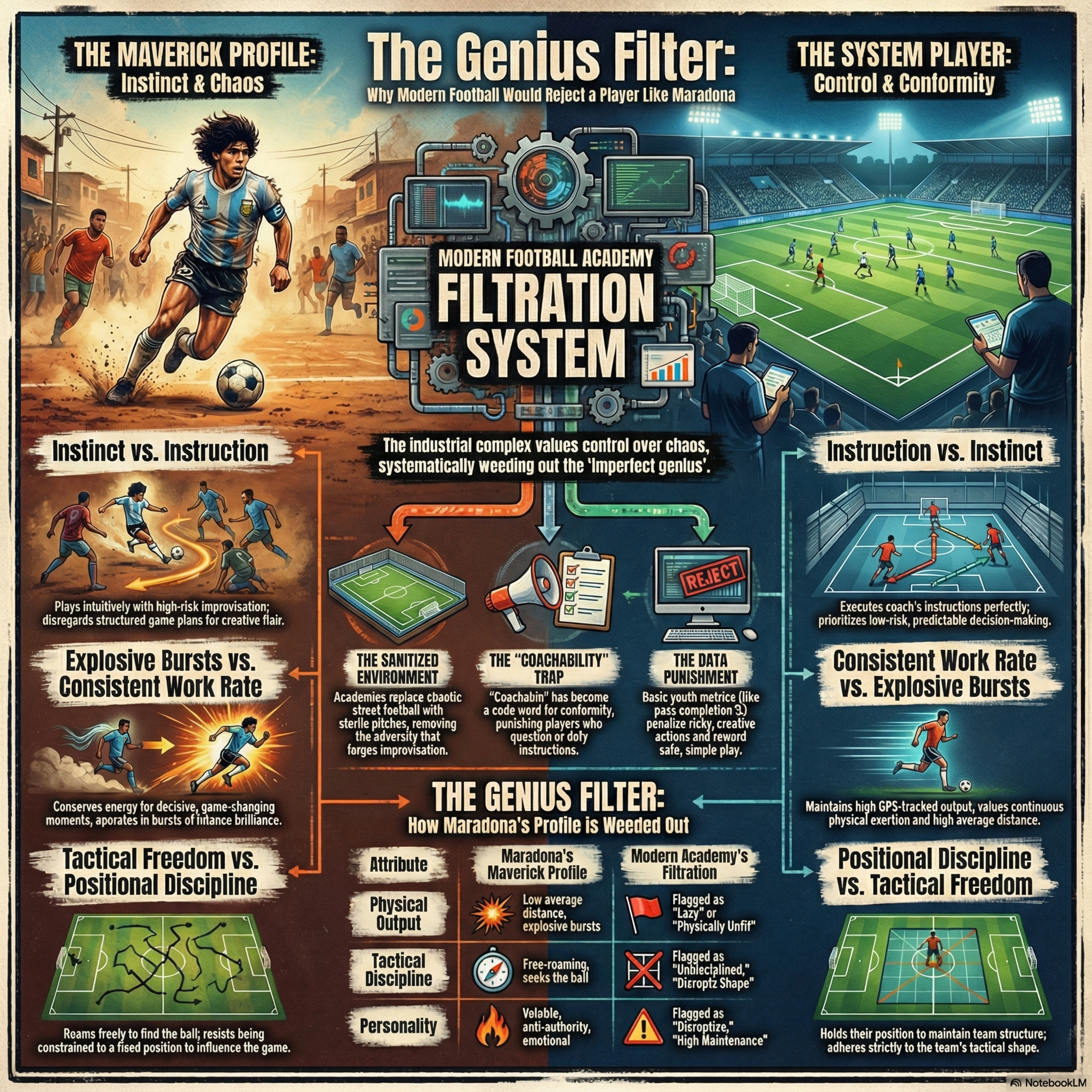
Modern Football Is Designed to Filter Out Maradona
About this episode
Modern Football Is Designed to Filter Out MaradonaListen now on Spotify, Apple Podcasts, Amazon and other streaming services! Don’t forget to subscribe, share, and leave a ⭐⭐⭐⭐⭐ review to help more players and coaches discover the power of Techne Futbol and Data Technology in the beautiful game.
#TechneAfricaFutbol #TechneFutbol #TrainWithTechne #Playermaker #TraceFutbol #Hudl #FootballTech #FootballInnovation #PlayerDevelopment #CoachTools #SmartFootballTraining #AfricanFootball #CAFOnline #FIFA #FIFAYouth #CAFDevelopment #YouthFootballAfrica #NextGenFootball #FootballScouting #TalentIdentification #DigitalScouting #EliteYouthDevelopment #FootballJourney #FootballAnalytics #FIFAForward #FutebolAfricano #TrainTrackCompete #FootballExcellence #FootballAfrica #TheFutureOfFootball
Welcome everyone to the deep dive where we don't just scratch the surface of complexity, we excavate. It, and today the excavation site, is the very soul of modern football. It really is. We are strapping on the gear today and digging into something that honestly it might sound like football heresy. We are putting forward a thesis that the global high tech industrialized football system. The one built for ultimate efficiency. Exactly. That system is actually designed to exclude, to filter out, and ultimately to prevent the rise of a player like Diego Maradona.
It's not a bug, it's a feature. And look, this isn't just some, you know, nostalgic games gone rant. This is a forensic indictment of a billion dollar global industry that is fundamentally redefined. What a successful athlete. Often at the expense of that, that chaotic genius. So that's the core conflict we are wrestling with today, this paradox of genius. Our intuition tells us that the more money, the more tech, more organization you pour in, well, the better the talent you produce, right it? Seems logical.
But what if that same system, with its relentless metrics and it's pervasive surveillance, is so hyper focused on eliminating risk, on eliminating volatility, that it inadvertently eliminates the greatest source of artistic risk there is, the maverick? And that's our mission. That is our mission today. It is laser focused. We need to unpack this entire filtration process to understand precisely what qualities are being lost in the pursuit of the quote reliable athlete. And crucially, how to translate that knowledge?
Yes, into strategic practical advantages for you, the listener, and for the future of African football development. We have to figure out how to nurture torture, this chaotic brilliance, not, you know, standardized out of existence. And we have to be clear about the stakes here. This isn't just about style, it's about the structural realities of the football industrial complex. Billions of dollars. Billions when club valuations are astronomical, when every single game, every transfer window has so much riding on it, then uncertainty.
High risk improvisation. Anything that disrupts the plan. It literally becomes the enemy. The modern system looks at the Maverick as a volatility factor that has to be controlled, or if that fails, just eliminated. So let's get precise. When we say Maverick, this chaotic genius, who are we talking about? How do we define that player? Well, it's a whole cluster of traits. First and foremost, high risk improvisation. This is the player who will attempt the pass or the dribble with a 5% chance of success because they know the payoff is a goal.
I said the 95% safe sideways pass. Exactly. Then there's often emotional volatility. It can be disruptive off the pitch, sure, but on it, it translates into this intense, almost frightening competitive fire. And their play is intuitive. Deeply intuitive, they often override tactical instruction in the heat of the moment because they feel the game differently. They are players who succeed in spite of the structure around them and not because of it. And Maradona is the archetype. He's the archetype rooted in the Argentine potrero, that street environment.
He was unpredictable to the opposition, yes, but he was also often unpredictable and, let's be honest, probably madding to his own coach. And that's the figure the modern system just cannot stomach. It can't compute it. So that sets up our initial question perfectly. If this analysis is right, if these structures are working exactly as they're intended, are we really heading for a homogenized, predictable, almost solved game? And if we are? And if we are, how do African Development strategies, which have, you know, historically relied on that raw, untapped St. talent, how do they act as the counterculture?
How do they become the necessary resistance to this global uniformity? We're starting now, and the 1st place we have to go is deep inside the architecture control that governs every single elite Academy. Let's do it. OK, let's unpack this. We have to go straight into the the core philosophical architecture of the modern Academy. It's described not just as a training ground, but as an institution of governmentality. And that is such a loaded, almost clinical phrase. But it is perfect. It's chilling.
It is because it forces us to see the Academy not primarily as a place of learning, but as a disciplinary apparatus. Its real function is to produce a specific type of human subject. One that is compliant. Compliant, rational and above all, optimized to minimize risk for the massive financial investment the club has made in them. And this immediately brings us to the work of Foucault and his idea of the Panopticon. For anyone listening, can you break down how that psychological structure applies to a modern training ground?
Sure. So the Panopticon, as Foucault imagined it, is a prison where every inmate can be watched at any time, but they never know when they're being watched. So they have to assume they're always being watched. Exactly, and the genius of it is that this creates a state of self correction. The subjects start policing their own behavior. The modern elite youth environment is a textbook digital panopticon. And we need to detail the technologies that make this so comprehensive. It's so much more than just a coach with a clipboard watching from the sidelines.
Oh, it's total. It's truly comprehensive. First you have the physical monitoring. The GPS vests that track every meter covered, every acceleration, every Sprint, every recovery time. And then it goes inside the body. Inside the body and inside the mind, players use Wellness apps to log sleep quality, their caloric intake, even their mood states. How do they feel about training? What are their energy levels? Are they emotionally stable? And then of course, the video. Endless video analysis. Every tactical decision, every pass, every single moment of hesitation is scrutinized, clipped, and presented back to you.
In this environment, every action, physical and mental, is visible. It's measurable and it's subject to immediate judgement. That constant, pervasive visibility, that's the cage. That is the cage. And this visibility is precisely what becomes a physical data-driven trap for the Maverick. We have to start with the first physical filter, the demand for what's called the docile body. Precisely. And to understand this, you have to hold up Maradona's actual physiological profile against this modern reality.
His game, if you watch the old tapes, was characterized by these long, almost lazy looking periods of low intensity walking or jogging. He looked like he was taking a break in the mid of the match. But he wasn't. He was conserving energy. He was scanning, reading the game, waiting for that perfect explosive moment. A quick burst. A powerful acceleration that would decide everything. And back in the 1980's, the only metric that mattered was the scoreboard. The only metric was the sublime brilliance he produced when it counted.
You couldn't measure The Walking, so it didn't matter. OK, now Fast forward 40 years. That exact same low intensity activity which was his tactical genius, it is now mathematically penalized. Oh, absolutely. Today, AU 14 player who replicates that exact profile. You know, the high skill, but the long periods of low movement? That player triggers an immediate, undeniable red flag on the performance dashboard. The GPS data just screams lazy. It screams lack of work. Great poor aerobic output, insufficient Sprint volume long before coach has even assessed the quality of their movement with the ball, the data totally isolated from tactical context and the players intelligent conservation of energy indicts them immediately.
Which highlights this core unstated assumption of the industrial system. Physical output is conflated with professional commitment. It's a profound confusion of metrics, a structural bias against intelligence, really. A player who runs 12 kilometers in a match, constantly busy, constantly moving, is almost always seen as more professional or more committed than a player who runs 8 kilometers. But creates 3 clear cut chances. Because of superior timing and vision, the system through this bio political management, it targets the body itself.
It demands that the body conform to standardize consistent norms of optimization. And Maradona's body was anything but standard. Physically idiosyncratic, defiantly low output for long stretches, he would inevitably resist this kind of internalized surveillance. And that would lead to immediate conflict with a coach who sees that GPS readout as objective, contextless truth. And here is the crucial relevance for African Development strategies. This is so important. If we just blindly adopt these standardized European physical metrics, we risk eliminating players whose inherent style.
A style forged on rougher or smaller pitches. Exactly. A style that relies on intelligent conservation of energy and explosive timing. We have to structurally question if running always equals playing. Or if smart movement is infinitely more valuable than maximum volume. It's a vital strategic question. It is, but let's follow the flow because this physical filtration feeds directly into the behavioral one if the data says low work rate. Then that data point is used by the coach to justify their assessment of a player's attitude, their compliance.
Which leads us perfectly to the coach ability trap. And this word coach ability, which should just mean eager to learn, has been twisted in the Academy environment to mean low maintenance compliance. It means conformity. That is the perfect summary. In the high pressure, high turnover audit culture of an elite club, coaches are structurally constrained. They're incentivized to produce players who just execute instructions without any deviation. And the maverick who by nature possesses an independent, sometimes rebellious personality.
They're immediately seen through the lens of risk management, not talent maximization. Because if a player improvises a high risk move, say an unexpected back heel or bona when the game model dictated a simple sideways pass to maintain the team's shape. They're not just making a technical choice in that moment, they were fundamentally challenging the coach's authority and the standardized game model, right? And you have to remember, youth coaches, especially in these big structured European programs, they're judged on how effectively they implement the standardized curriculum that's handed down from the technical director.
So the uncoachable genius is a threat to the coach's career. A profound liability. They disrupt the club's demand for evidence of control and predictability. Coaches will tell you they crave creativity, but the system they work in prioritizes the successful implementation of the system itself. The filtration mechanism will always then prioritize the controllable talent, which is almost never the most chaotic or the most unique talent. And that's a powerful connection. You see the pressure on the coach to conform makes them in turn and demand conformity from the player.
OK, so if we connect this structural pressure to the bigger picture, the critique is that true genius emerges in spite of structure, not because of it. So now we have to turn to the environmental filter that shapes the talent pool, specifically the shift away from the Potrero. Absolutely. The foundational assumption here is that an environment of chaos selects for the highest form of spontaneous creativity. And we're referencing the Potrero, the literal street football or rough, uneven field of Maradona's youth.
And this shift from what's called implicit learning, learning by doing in chaos, to explicit learning, which is learning by instruction in a controlled setting. That shift is one of the most significant factors that African Development models have to grapple with. So the Potrero was chaos, but it was a demanding, almost evolutionary form of chaos. Tell us what defined that environment and how it taught players. So the implicit learning model of the street is brutal, but it's hyper effective. First you have the surface.
Uneven, rocky, muddy pitches. They force players to develop a hypersensitive adaptive ball control. If you take a bad touch, the ball's gone. The ball's gone and you might get kicked for your trouble. Second, the opponents. You're playing against older, stronger, more aggressive opponents who do not care about your developmental needs. This forces the rapid development of shielding techniques, of cunning, of lightning fast decision making that's rooted in pure survival. And critically, there's no coach there to stop play.
No one's interrupting. Exactly. The feedback is immediate, It's environmental and it's often painful. You get kick, you lose the ball, you get mocked by your friends. There is no referee protection. This environment rigorously selects for resilience, for mental fortitude, and for a certain necessary low cutting, which the Argentines call Picardia. You learn to be sneaky. You learn to be sneaky, efficient and ruthlessly effective because you have to survive. And the Academy model is the complete inverse of this.
It's a sanitized environment of explicit control. It is sterility applied to development. The pitches are pristine like carpets. That removes the need for that adaptive, hypersensitive ball control, right? Referees and coaches protect the players, which removes the need for those physical survival skills. And critically, as you said, play is constantly interrupted. The moment a mistake is made, a coach blows a whistle, stops the session, gathers everyone around and gives explicit instruction on how to execute the game model correctly.
So what is the filtration effect of this sterility? Who does this system favor and who does it weed out? It filters out players who genuinely need that environment of chaos to learn. The Mavericks brain, which was forged in the demanding fire of adversity and high stimulation, may find the pristine, sterile stop start environment of an Academy so boring. We're just UN stimulating. UN stimulating. If the stakes aren't immediate survival or spontaneous problem solving, The Mavericks unique focus just disengages.
Meanwhile, the system player thrives. They absorb instructions perfectly. They execute drills Florida State, but they often lack the crucial St. craft needed to solve the truly novel chaotic problems they'll face in a first team match. And this environmental shift connects directly to a critical socio economic blind spot. We have to talk about the gentrification of talent. It's a huge demographic shift that we cannot ignore. The decline of casual street football globally, coupled with urbanization and the loss of public leisure space means that traditional talent pipeline is shrinking.
So the path to elite coaching is now, yeah. It's now increasingly a function of parental resources, their time, their ability to afford travel, and in many Western systems, the explicit pay to play model. Which means we are essentially pricing out the traditional chaotic genius. We are gentrifying the talent pool. We're pricing out talent from lower socioeconomic backgrounds, the very backgrounds that historically produced players with that intense hunger, that survival, that desperation that defined the game of Maradona or Garintia.
So there's a ghost Academy? The Ghost Academy of Missing Talents is very real. It's made-up of all those kids who decades ago would have been discovered on some rough field, but today just can't afford the fees, the travel or the geographic relocation required to get into one of these elite Academy hubs. And that is such a critical strategic insight for African football. This process of gentrification is both a threat and a massive opportunity. It underscores the urgent need for African clubs to invest heavily in smart scouting and alternative pathways.
You have to find them where they are. You have to actively prioritize discovering and sustaining talent outside the traditional expensive Academy structures. You have to capture this ghost Academy of Lost St. talent before it's gone. The resource constraint of St. play is what breeds the cunning in the fire. We cannot afford to lose that intensity now. We move deeper past the body, past the environment, and into the mind. And here's where it gets really, really interesting. We believe the system's most profound blind spot might be its inability to accommodate the way some creative brains are actually wired.
The issue of neurodiversity. This moves the discussion from structure into psychology, and when you look closely at the behavioral profile of the prototypical maverick, the player with high creativity, high impulsivity, intense hyper focus on specific tasks, and emotional volatility, those traits they light up, they strongly correlate with neurodiverting conditions, particularly ADHD. And this isn't some niche concept. You see this profile and high level creatives across so many fields. Yet, as we've established, football academies are almost universally designed for the neurotypical brain.
And that's the whole paradox of this ADHD creativity Nexus. The asset side of this brain profile is immense. The ADHD brain often excels in what's called divergent thinking, the ability to generate multiple non standard, rapid solutions to a single problem. Which on a football pitch is gold. It's pure gold. It translates directly to unpredictable flair, to seeing the past no one else sees, to making split second decisions in chaotic 1V ones or crowded penalty areas. The very impulsivity that might be a liability in a boardroom is a massive asset in a high pressure spontaneous match.
But the Academy environment, with its focus on routine and compliance, it immediately weaponizes the liability side of that same profile. Yes, because the Academy demands highly developed executive functions. Those are the cognitive processes that help us plan focus, remember instructions, and manage multiple tasks. The very things. The very functions often impaired in ADHD. Think about the standard Academy day. Sustained attention during long, repetitive tactical briefings. Strict adherence to identical routines every single day.
Emotional regulation after a mistake or criticism. All of these demands create systemic friction for that type of brain. And instead of providing tailored support, the filtration mechanism just kicks in. These players get labeled not just difficult, but disruptive, unfocused, or simply having a bad attitude. And they're managed out for poor compliance, not for a lack of talent. We saw this friction play out so publicly at the highest level, the conflict between a rigid, systemic coach like Eric Tenhag and a player like Jayden Sancho.
Right when Tenhag spoke about required mental and physical levels, it was the classic conflict. The coach demanding a highly standardized, predictable level of input, and the player whose creative output might rely on a more chaotic, confidence driven internal system. And the system chose sides. The system prioritized disciplinary equality. The rule must apply to everyone equally over individual nuance. The talent might be extraordinary, but the systemic disruption is just too much to bear. This brings us to the psychological characteristics of developing excellence, the PCDE problem.
It seems like academies are actively filtering for traits that guarantee consistency, even if those same traits preclude the possibility of transcended genius. They do. They prioritize traits like conscientiousness, emotional stability, and self regulation because those traits predict reliability. And crucially, they predict a smooth transition into the first team without management headaches. But those traits don't predict Maradona. No, they do not necessarily predict the kind of disruptive, world changing genius we see in a maverick.
The irony is just profound. It really is. By filtering for balance and stability, the system may be actively filtering out the obsessive, the unbalanced, or the volatile personalities that historically drove extreme high performance. Think about the documented personal struggles and the intensity of George Best or Paul Gascoyne or indeed Maradona. Their personal chaos fueled their competitive edge. Absolutely. The unstated assumption of the modern corporate Academy is that a professional footballer must be a balanced, well adjusted individual and the modern systems extensive Wellness protocols which are well-intentioned in supporting mental health, they have to be implemented with caution.
Also, we must be careful not to create a developmental environment that acts as a kind of sedative, smoothing out the very jagged edges that give a maverick their unique, unpredictable cutting edge. The strategic take away for African coaching gear is significant. We need neuro inclusive coaching models. This means providing different developmental track for highly creative players, tracks that minimize the low stimulation, repetitive tactical work. And maximize the high stimulation spontaneous problem solving work like small sided games.
It's about accommodating the brain's unique needs, not trying to fix the brain so it fits the system. And what's fascinating is how tactical ideologies then translate all of these psychological and physical demands into the most formidable structural barrier of all. We have to look directly at the dominant tactical model of the last decade, positional play or huego de position. Ositional play. It sounds beautiful and rational based on mathematical sueriority, but in practice it's the ultimate expression of control over chaotic individual action, the geometry of control.
It's entirely geometric. Positional play views the pitch as a rational grid to be occupied by 10 specific pieces. The whole system is built to create numerical and positional superiorities through highly structured, often pre planned movement patterns. The collective form is paramount, the individual is secondary. And this geometry imposes such severe constraints on the kind of free movement we associate with the maverick. Freedom in this system is entirely conditional. Players have to adhere to mandated distances between themselves and their teammates to ensure passing triangles are always available.
A winger, for example, must often rigidly hold width. Just stay on the touchline. Stay on the touchline to stretch the opponent's defensive line. Even if they don't touch the ball for 5-10 minutes, they are a cog in the machine. Their movement serves the collective structure by creating space for others deep inside. But the very essence of Meridana's game was ball dominance. It was roaming, going to where the ball was to dictate. The play. And that is the absolute fundamental structural conflict.
A player like Maradona constantly moving across the pitch, chasing the action, demanding the ball. He violently disrupts this carefully calculated geometry. If the number 10 in a strict positional play system drops into the left back position to pick up the ball, they immediately collapse the spacing and allow the opponent to compress their press in the midfield. The strict positional coach demands that the player trust the structure to bring the ball to them. They have to wait for the system to execute.
Which is completely antithetical to the Maverick score instinct, which is pure, immediate action. Exactly. The Mavic trusts only their own feet and their own timing to go and get the wall when they sense the moment. This waiting is a form of tactical discipline that the intuitive free spirit naturally rebels against. The tactical system is simply not built to incorporate that kind of spontaneous, structurally disruptive movement. And even if a system somehow manages to tolerate that structural disruption, there is the devastating and quantifiable issue of the pressing tax.
The concept of the luxury player who only attacks is functionally extinct in elite modern football. That is the commercial reality. Modern elite football is in effect A10 man defensive game. Even when you're attacking the metrics of defense, pressing, efficiency, recovery runs, defensive duels, counter pressing organization, they are non negotiable even for the most gifted attackers. This then becomes the final clanifiable filtration test even if a player somehow retains Meridana's offensive output if their defensive work rate, which is easily measured by GPS and video analysis, drops below the team threshold.
They compromise the entire team's defensive structure. They compromise its ability to initiate the high press. And coaches like Miguel Arteta and Pep Guardiola have made this stance brutally clear. Oh yes, talent is insufficient compensation if the work rate and the disciplines, specifically defensive discipline, are absent. We have seen world class attacking talent players worth 10s of millions moved on because they just didn't meet the defensive work rate requirements necessary to execute the system for 90 minutes.
OK, but let's play devil's advocate here. We have to address the massive blind spot, the messy exception. He survived for years without contributing fully to the press. Doesn't that prove the luxury player can still exist? It proves that one player, perhaps the greatest ever, could exist, but it required an entire team built to compensate for him. That team, particularly Barcelona under certain managers, allowed him to walk and just waited for his genius to solve the problem. And it's a luxury. That level of compensatory structuring, building a defense and a midfield purely to cover for one forward is a luxury that very few modern managers are allowed to grant.
For 99.9% of players in the world, the rule is simple. You press, you recover, or you sit on the bench. So applying this pressing tax to African teams, we face a critical strategic choice. Do we demand a 100% adherence to pressing metrics from all 10 outfield players? Or can we strategically tolerate lower work rates from, say, two or three key creative talents if they provide disproportionate offensive value that the structure otherwise cannot generate? And that trade off chaos for value is the difference between filtering out genius and harnessing it.
We often hear the lament that data kills imagination, right? It just rewards predictability and efficiency above all else. But this is where the analysis reveals A crucial blind spot in that assumption, the conflict between what we're calling old data and the emergent new data. And that initial criticism was absolutely justified. For a long time, data acted as an enemy of chaos, especially at the critical developmental age. The use of old data at youth levels is what built this filtration system.
Explain that mechanism. What happens when you know U-12 to U-16? Coaches rely on these basic counting stats. So at those foundational age groups, the data that's readily available is often simple, counting stats, past completion percentage, turnover rate, distance covered. If the academy's primary goal is retention and minimizing financial risk, those simple metrics create immediate, powerful risk aversion among the young players. And the Maverick, by definition, lives on risk. Exactly. Let's just visualize this for a second.
Player. A attempts 10 risky through balls into the penalty box. They only complete two of them, so that's a 20% success rate. Looks bad on paper. Looks terrible. Player B, however, makes 10 safe 5 yard sideways passes to the nearest teammate and completes 100%. Player B gets promoted for good decision making and consistency. Player A, the Maverick who is frequently losing the ball while trying to unlock defenses, gets flagged as wasteful and high risk. So this feedback loop just teaches kids to play it safe.
It teaches them to play the percentages just to survive the cut, actively filtering out the high risk inventive players who lose the ball frequently. But the new data, Advanced Analytics, has the potential to be the savior of that chaos. This is where concepts like Expected Threat or XT and VAEP come in. This is the revolutionary part of this whole deep dive. Advanced analytics has evolved specifically to value risk and to measure the impact of actions, not just the frequency. It moves beyond simply counting completions to measuring the true offensive impact.
Let's use a practical visualization for expected threat or XT. What is measure in simple terms? So XT measures how much a player's action increases the probability of their team scoring a goal. And crucially, it's measured regardless of whether the action succeeds or fails. OK, so let's go back to our scenario with player A and Player B, right? Player B completes a safe pass backward to the center back near the halfway line. The XT value of that is negligible. The probability of scoring hasn't changed much.
Player A attempts that wicked difficult through ball into the box, but it gets intercepted. That failed through ball might register a significantly higher XT value than Player B's completed backward pass because the fail through ball moved the attack into a highly dangerous high probability zone. XT explicitly rewards players who take steps to move the ball into danger, even if they miss the execution. That immediately changes the entire conversation for the Maverick and Vaep. Valuing actions by estimating probabilities takes this even further, right.
VAEP is an even more holistic model. It assesses every single action a player takes, dribbles, passes, tackles, carries for its probabilistic impact on both scoring and conceding. This model is perfectly designed to identify that high risk, high reward player. The one who kept getting filtered out. Exactly. They might have a high turnover rate, which looks bad in old data, but if those few successful high risk actions are generating massive disproportionate offensive value, which is a high VAEP score, the data empirically proves that their chaos is valuable and necessary.
So the critical disconnect is structural and temporal. Advanced Analytics is The Mavericks best friend, providing empirical evidence that chaos is valuable. But if youth coaches are still only using turnover rate and completion percentage as their primary KPIs, they're systematically filtering out the exact genius the first team data department is desperate looking for five years later. Which creates an absolute imperative for African Development. We have to strategically skip the outdated old data metrics.
In youth development, contextualizing data is vital. African clubs must move immediately to integrate the philosophy of XT and VAEP into youth scouting and coaching feedback. High value creativity. High value creativity, which inherently involves high risk, must buy a player a pass or a concession on simple defensive or high turnover metrics during that crucial developmental phase. The goal is to reward intent and threat over mere completion. This raises an important question, then. If the system is designed so effectively to eliminate the Maverick, how do we explain the filtration of some talents and the adaptation of others?
We need to look at the practical evidence of this filtration matrix in action. Let's start with the managed out. These are the residents of the Ghost Academy, players who possessed world class potential but were deemed structurally incompatible with the system's demands for consistency and control. Hotem Ben Arfa is the classic tragic modern example. Oh, he was an electric Maradona esque dribbler, pure magic, unstoppable on his day. But his career was just a constant series of conflicts with managers Who demanded defensive discipline and structural conformity.
So his genius wasn't enough. His genius was deemed insufficient compensation for his disruption of structure. He just bounced from club to club because the volatility became too high a risk for the collective. And Ravel Morrison, a name often cited by legends like Sir Alex Ferguson, who had seen everyone from Beckham to Ronaldo develop. Ferguson called Morrison the best 14 year old he'd ever seen, but Morrison's pure St. mentality and his off the pitch volatility clashed violently with the rigid discipline demanded by Manchester United.
He was managed out. He was managed out because the system demanded that he be a highly regulated professional before he was developmentally or psychologically ready to handle that compliance. The club's institutional support structure failed to contain his chaos, so the system just ejected him. And the modern high level example is that public fracture between Jayden Sancho and 10 Hack. That conflict was a perfect manifestation of the system prioritizing optics over output. Sancho style of play thrives on confidence.
Sometimes you hear it called vibes, traits common to the Maverick profile. 10 Hag, the ultimate system disciplinarian, demanded quantifiable training performance and adherence to non negotiable standards. And the system shows disciplinary equality. Right. The rule applies to everyone, regardless of talent, over individual nuance. Sancho wilted under that authoritarianism, proving that even at the very top, compliance can and often does trump extraordinary individual talent. Chaos isn't extinct. Some players survive, often adapting into what we're calling the hybrid model.
So how do we explain the survivors? These players survived either by finding systemic loopholes or by adapting their chaotic edge into controlled weapons. Look at Vinicius Junior at Real Madrid. How does he do it? He survives because he plays for a functional manager like Carlo Angelotti, who adapts his entire system to the player. Enchiladi allows Vinicius to cheat defensively, to stay high and wide and focus purely on one V1 isolation. But the tension is still there. Oh, the tension remains. We've all seen those viral clips of even Real Madrid coaches screaming pass at him.
It highlights that The Mavericks instinct is still often viewed as an error by those focused on the structural integrity of the team. Then you have Jeremy Doku, signed by Pep Guardiola, the high priest of the system. Doku is the perfect example of what you might call synthetic chaos. Guardiola assigned him specifically to inject unpredictability, a pure dribbler to break down the deep lying blocks that his system sometimes struggled against. But it's controlled chaos. It's strictly controlled chaos.
Docker is only allowed to use his chaotic skill in the final third. In his own half, he is mandated to be a strict system player, adhering to passing patterns and defensive pressing. The Maverick has been geofenced. His freedom is defined by his positional map and the club's tactical rules. And finally, Lamin Yamal emerging from Lamazia, the temple of structure, yet retaining incredible flair. Yamal is the ultimate hybrid success story. He retains significant creative flair and St. skills, which suggests that elite academies are starting to integrate the functional technique of the street into their development.
But critically, he is also tactically impeccable. He does work. He presses, he tracks back diligently, and he adheres to structural instruction. He is the maverick who learned to follow orders and more importantly, learned how to use his chaotic skills within a highly structured environment. So the conclusion of this filtration matrix is clear. The modern system demands hybridity. The next generation of African stars must possess the raw innate St. skills, the dribbling, the vision, the unpredictability.
But they must also be bio politically optimized to press for 90 minutes and regulate their emotions. The system will only accept chaos if it is manageable chaos. So what does this all mean for us? The great news, I think, is that this filtration mechanism is not an inevitable permanent state of the game. The strongest evidence that the Maverick is relocating, not extinct, is the rise of a specific tactical philosophy, relationism, also known as functional play. This is the counter reformation. This is the potential blueprint for African Development.
Relationism, championed by coaches like Fernando Denise in Brazil, explicitly rejects the rigid, grid based nature of positional play that we established earlier as the primary barrier to the maverick. It's the anti system system. It is but one that's built on connectivity rather than control. So instead of commanding players to occupy rational, distant space, what does relationism prioritize? It prioritizes approximate play. Players are actively encouraged to cluster together to form short, dynamic passing triangles in the space where the ball is, rather than rationally spreading out to occupy predefined zones on the pitch.
The entire system is built on intuition, connection, and the individual ability to combine with nearby teammates. This sounds like an immediate sanctuary for that free roaming ball dominant player. The exact maverick profile we've been describing. Let's look at the core tenets that this philosophy encourages. OK, the first core concept is Toko emevoi, which means touch and go. The primary instruction is deceptively simple. Pass the ball and then move immediately towards the ball, not away from it, to hold with or maintain structure.
So you follow the action. You follow the action. This encourages the rapid, short passing combinations and the intuitive clustered movement that define Maradona's street forged style, where combinations are born out of proximity and necessity. And the second key concept is escodinas, which means staircases help us visualize that dynamic movement. The staircase analogy is perfect. It describes dynamic player movement that forms diagonal lines, enabling continuous ball progression through constant wall passes and dribbling combinations.
Imagine a staircase running up the side of the pitch. Players are moving up and down in sequence, creating multiple passing options and numerical superiority in small localized areas. So you're not worried about the whole pitch? No, the focus is on finding a situational numerical superiority around the ball, enabling a series of quick one twos and dribbles, rather than maintaining structural superiority across the entire 100 pitch. So in a relation to system, the Maverick is no longer structurally disruptive.
They are the engine. The system relies entirely on their ability way to interpret space dynamically, their natural instinct for chaotic combination play, and their high risk taking. If African academies adopt this relationist model, which values proximity, instinct, and short passing, they can effectively dismantle the filtration mechanism we've analyzed. Because it fits. It's strongly aligns with the inherited cultural style of many African football traditions, rooted in the chaotic, intuitive nature of St. Play.
It allows him to nurture creative genius without demanding suffocating tactical rigidity. So to synthesize this entire deep dive, yeah, the critique we started with is fundamentally correct. A raw clone of Maradona, with his physical inconsistency, his tactical defiance and his emotional volatility, entering a top European Academy today would almost certainly be managed out by the U-14 level. For failing to meet GPS pressing targets, or for being deemed uncoachable, the system works, but it works too well.
We have traded the raw, illicit human unpredictability, the hand of God, for the algorithm of efficiency. And the reason for this trade off is the overwhelming commercial imperative, the billion dollar risk management that governs modern clubs. Absolutely. The financial obsession with control means clubs prefer the safe assets, the Jude Bellingham type who is elite technically, physically and crucially, mentally compliant. Predictable returns. They favor predictable, consistent returns over the Black Swan event of the uncontrolled genius.
Volatility is a dirty word for club owners driven by private equity or sovereign wealth funds. The moneyball of modern football favors the collective consistency and the predictable defensive structure over the individual spark. OK, so let's leave the listener with the three crucial actionable takeaways for the future of African talent development. These are strategic points built directly on this analysis number. One, we must fundamentally revalue character. Scouts and coaches need to develop the nuance to distinguish clearly between disruptive behavior, which harms the collective and team discipline, and divergent thinking, which is the source of all creativity.
We have to nurture the ladder. We have to nurture the ladder even when it is inconvenient or high maintenance. 2nd, the data issue. Contextualizing data is vital to avoiding that filtration trap. Youth coaches must move immediately beyond basic KP is like turnover rate and distance covered. GPS data regarding defensive work rate must be weighted against advanced metrics like expected threat or VAEP. High value creativity and the threat it generates must earn a player concessions on simple defensive consistency metrics during their youth development phase.
Their value isn't how far they run. It's in the danger they create. And finally, based on our look at the standardized brain, the desperate need for neuro inclusive coaching. African academies have to develop specific training tracks for ADHD or highly creative players. This means minimizing long repetitive tactical drilling which bores the neurodivergent brain and maximizing constraint LED chaos. Use small sighted games and spontaneous problem solving exercises to appeal directly to the brain that thrives on high stimulation and immediate feedback.
Build a system that supports their unique way of processing the game. Not a system that forces conformity. This has has been an incredible deep dive into the soul of the modern game and more importantly, what we can learn to protect the magic in ours. We've seen that the system works, but it works too well. It filtered out the very chaos and now desperately needs to buy back with synthetic talent. The ultimate synthesis from this deep dive suggests that the next Maradona won't be discovered on a street corner.
He will be engineered in a lab to look like it came from 1:00, but with the engine of a Ferrari in the discipline of a soldier. The challenge for African football and for you the listener, is this. Do we want to spend billions chasing the perfectly compliant hybrid that Europe has defined? Or can we intelligently adapt our existing systems right now through tactical blueprints like relationism, through neuro inclusive coaching, and through valuing XT over completion to let the true raw genius survive, thrive, and ultimately define the future of the beautiful game?
 Apple Podcasts
 Castbox
 Castro
 Goodpods
 Moon FM
 Overcast
 Pocket Casts
 Podbean
 Podcast Addict
 Podcast Republic
 Spotify