Measuring Arsenal vs Aston Villa Game Dec 6 2025, Chemistry With Brain Science
About this episode
Measuring Arsenal vs Aston Villa Game Dec 6 2025, Chemistry With Brain Science
Listen now on Spotify, Apple Podcasts, Amazon and other streaming services! Don’t forget to subscribe, share, and leave a ⭐⭐⭐⭐⭐ review to help more players and coaches discover the power of Techne Futbol and Data Technology in the beautiful game.
#TechneAfricaFutbol #TechneFutbol #TrainWithTechne #Playermaker #TraceFutbol #Hudl #FootballTech #FootballInnovation #PlayerDevelopment #CoachTools #SmartFootballTraining #AfricanFootball #CAFOnline #FIFA #FIFAYouth #CAFDevelopment #YouthFootballAfrica #NextGenFootball #FootballScouting #TalentIdentification #DigitalScouting #EliteYouthDevelopment #FootballJourney #FootballAnalytics #FIFAForward #FutebolAfricano #TrainTrackCompete #FootballExcellence #FootballAfrica #TheFutureOfFootball
If you were watching, if you were anywhere near a television or a radio for those final chaotic seconds of the Aston Villa versus Arsenal match, you felt it. Oh, you absolutely felt it. It stopped being just a football game, didn't it? It was just pure high stakes drama, that ball just ricocheting around the penalty box, flying off legs. Denied. Why? Denied again by just sheer instinct, and then finally it just explodes into the back of the. Neck and the Sound at Villa Park. I mean, you called it Pandemonium and that's exactly what it was.
It felt like more than just celebrating 3 points. It really did. It felt like it shifted the tectonic plates of the entire league race. It was an unbelievable finish, just a real crushing sucker punch delivered to the league leaders in the most dramatic way possible. But you know you're right. For us, this deep dive is about looking at more than just the two one score line. We're trying to get in a more fundamental question of, let's call IT system coherence. How do these elite teams function? Or, you know, in Arsenal's case, in those final moments, how do they spectacularly fail to function as a single unified entity when the pressure is at its absolute maximum?
Right. So we're going to be analyzing that specific game management failure that cost Arsenal 3 crucial points, but we want to take it a step further beyond the usual punditry. We're going to connect that tangible, you know, that heartbreaking moment of failure on the pitch to a really revolutionary scientific theory that, believe it or not, tries to quantify what team chemistry actually means. That's our mission today. We're trying to figure out if that shared intuition that that collective performance we call cohesion can actually be measured with math.
And if it can, does that measurement predict success so? We're taking this incredible 21 result, which was literally decided with the final kick of the game, and we're using it as our perfect high stakes case study. It's a perfect laboratory. OK, so let's unpack it. The big question we're tackling is this. Can the collective consciousness of a team actually be measured? And if it can, what does that number tell us about why Villa was able to find that little bit of clarity in all the chaos? And why Arsenal just fragmented at the worst possible time.
Well, to understand that, you first have to understand the stakes. Let's set the stage because the pressure on this fixture was immense. OK, you've got McKellar Tete's Arsenal and they're sitting pretty at the top of the Premier League table. They came into this match on an absolutely outstanding run. Yeah, they were flying. Ten wins, 3 draws and only that one single defeat early in the season away at Liverpool and you have to remember they're driven by this memory of being runners up in the last three seasons.
Always just falling short. Always. So the goal here was crystal clear for them. Win this match, extend their lead to eight points over Manchester City and a massive 9 points over Villa. It was their chance to really solidify their status as the title favorites. And the narrative around Villa, their opposition, just added this layer of, I don't know, historical tension that you just couldn't ignore. You're talking about Unai Emery? Exactly facing them was Unai Emery's Aston Villa. Emory, of course, was Arteta's predecessor at Arsenal.
It was a notoriously difficult stint for him there. What only about 18 months? Yeah, and he had the impossible job, right? He was the man who followed the manager who defined the club for 22 years. An impossible task. But what Emery did next, I think fundamentally changed his story. It absolutely did. After Arsenal he goes to Villarreal and immediately wins the Europa League. Just proves his caliber on the European stage and since he joined Villa just over three years ago, it's been nothing but progress.
So this managerial dual Arteta, the young successor against Emery, the proven master who's maybe determined to show his old club what they let go, that just added this delicious, almost personal spice to an already critical match. It did, but the real reason Villa was such a terrifying opponent in this moment was their form. I mean, they were sitting in a genuine third place in the league, looking to cut Arsenal's lead down to just three points. And their run has been, well, astonishing. It's been incredible.
Nine wins in their last ten Premier League games. If you look at where they were just a bit earlier in the season, this is a almost unbelievable resurgence. It points to something deeper than just tactics, doesn't it? For sure, it reflects a huge shift in the team's whole philosophy, mentally and physically. And the players themselves are the best source for this. You hear them talk constantly about the culture Emery has built. And it's always those two words. Always character and trusting the process.
It's not just about drills on a whiteboard, it's about building this unshakable mental fortitude. The fact that they had a difficult start to the season actually makes this run even more compelling. Because they learned from it. They learned those lessons early, and now they're playing with this immense, palpable confidence. They believe they can win against anyone, anywhere. So you take that history, the high stakes title race, Villa's phenomenal run. This was never going to be a simple routine win for the league leaders, was it?
Not a chance. It was set up perfectly for the kind of emotional, dramatic football that really tests A-Team score identity. And it didn't disappoint. The game kicked off with this intense, almost frantic energy that sort of foreshadowed the chaos we were going to see at the end. Oh yeah. The early exchanges showed both teams were fully prepared to just commit numbers forward, take risks. There was no sitting back. And we saw a danger for Villa early on. I remember Martin Edegard was right in the thick of it, showing Arsenal's intent to just dominate the middle of the park.
But Villa was quick to respond. There was that really fast, straight ball aimed for Morgan Rogers that bounced awkwardly off him. That was an early sign that Arsenal's high defensive line might be vulnerable. And then came the first big save. From David Raya, yeah, he had to be brilliant to deny Ollie Watkins, who is a striker in just prime form right now. Raya keeping that clean sheet early on was a crucial moment that just kept the tension simmering. Arsenal did have the ball in the back of the net relatively early on, but it was ruled out.
It was and it was a perfect example of their style, that patient, intricate football leading up to the finish. Bukay Osaka was again the architect down that right side. The flag went up for offside. It was a pretty comfortable decision after Trossard touched it in, but it was a clear warning shot to Villa. A warning. That said, this quality is persistent, it's dangerous, and it's coming for you. Exactly. But it was Villa who struck first and this gall, which we've been calling the cash jackpot, was just a master class in tactical exploitation.
It really was. It was a goal born from highly specific pre match planning. You could see Unai Emery's fingerprints all over it. So what was the plan? They had identified space down the right flank. The idea was to have John McGinn, who often operates. Why just sit a little bit inside? That would draw the Arsenal midfield centrally. And create the space for the overlap. Exactly. It allows Maddie Cash a massive overlap wide, exploiting Zinchenko's positioning. The ball goes wide, Cash gets it quickly.
And Zinchenko Arsenal's closest defender. He gambles on an interception but loses the tactical battle that gives Cash all the space he needs. And the execution from Cash was absolutely clinical. It wasn't just raw power, which he has plenty of. It was it was concentration intelligence it. Was he hit it hard, he hit it low and critically, he hit it down into the ground. That ensures it travels through that thicket of legs and ultimately right through David Reyes legs. A beautiful example of capitalizing on that small tactical space that Arsenal gifted him.
Villa leads one nil. That one nil lead holds through the first half, but the second-half dynamic, it's changed almost instantly. You could tell Arteta had some strong words at halftime. Arsenal came out with this renewed vigor. They immediately started the second-half strong and they had a period of true dominance that fell well. It felt overwhelming. And their response on the score sheet was swift and decisive. Leandra Troszard, coming off the bench, gets his name on the score sheet within 6 1/2 minutes.
And again, it's Bukay Osaka who's the architect driving that attack. But the key insight here, and this links back to our theme of cohesion, is the momentary lapse from Villa just before the goal. Yes, it was a sudden collective fragmentation in what is usually a rock solid Villa midfield. They conceded possession right on the halfway line under almost no pressure. And it turned what should have been stable possession into an immediate counterattack. Instantly, Arsenal didn't need 10 passes. They were right at the heart of the Villa defense.
Just like that. Trossard, who's known for his predatory finishing, makes a clever runoff soccer. And once that ball falls to him, it's a precise finish. Arsenal have their leveller and it just demonstrates how quickly a tiny lapse in collective focus can be punished at this level. And the rest of the second-half became this absolute white knuckle ride of tension. It was just punctuated by these near misses that kept ratcheting up the pressure. I'm thinking of Edegard's strike, a thunderous, powerful hit from distance that required a magnificent fingertip touch from Emmy Martinez to divert it onto the crossbar.
That was one of those moments where you just gasp, you know, you realize only the goalkeeper's sheer intuition and fingertips kept the game level. But Villa had their own massive chance to regain the lead, which showed that neither side was settling for a draw here. Not at all. Daniel Munoz was putting through on goal after a smart pass from Morgan Rogers, but RYA proving his worth again denied him from a tight angle. So these crucial saves, these near misses on both sides, they kept the score locked at 11, and it just built this pressure cooker environment that felt, well, it felt destined to explode in the final minute.
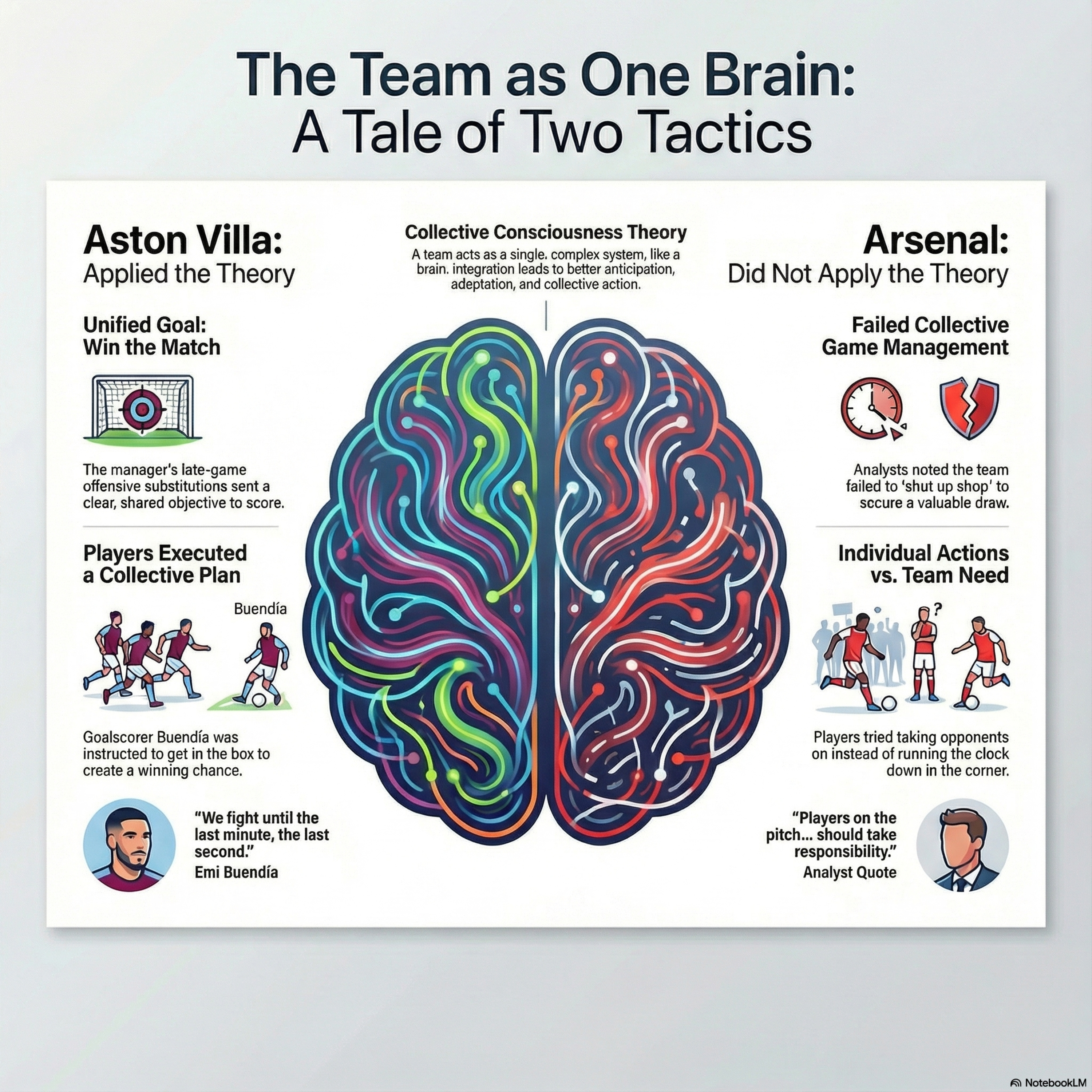
The stage was perfectly set for a systemic failure. OK, let's do this. Let's step away from the pitch for a moment and move into the truly abstract. We need to connect the chaos we saw in the field, that fragmentation of Arsenal's defense, that momentary lapse of collective focus, to a deep scientific diagnosis. We're moving to the idea that a football team 11 moving players can, or, you know, should function as a single unified consciousness. And this is where we introduced something called Integrated Information Theory, or IIT.
Right. It's a mathematical framework that's typically used to study consciousness in the brain. The profound philosophical question IIT tries to answer is what makes a physical system conscious? What makes it? One and the leap is can that same framework be applied to complex human systems like a sports team? Exactly. That sounds incredibly ambitious. I mean, taking a theory of consciousness and applying it to tracking players on a football pitch, how does the theory even define a system as conscious or integrated?
The core of IIT revolves around 2 concepts, integration and irreducibility. So a system has a high measure of integrated information, which is called A or V off if the system as a whole contains more information than the sum of its independent parts. OK, break that down for me. Think of it this way. If you try to divide a highly integrated system, let's say you split the two halves of a human brain, the total information content drops significantly. The whole is literally greater than the sum of its parts.
Feeling is a measure of that holistic connectivity. So if we model A-Team as a brain, what are the neurons? What's the communication between them? The mechanism is surprisingly robust. The entire team is model is a complex dynamic system. Each player acts as a neuron and the key is that these neurons are either activated or deactivated based on their actions, their positions and most importantly, their interactions with the players around them. And the data for this comes from. The data is crucial.
It's high resolution, positional and velocity data collected from the players across hundreds of matches. It comes from those electronic performance tracking systems, the EPTS wearables they all have. So it's not just where a player is, but how they're moving relative to their team mates. That is the critical difference. It's not about distance, it's about the coordination of movement. But how do we get from velocity data to this fine number? What does that number actually represent? OK, think of it was an analogy.
Imagine a Symphony Orchestra if every musician is a world class virtuoso, but they all play their part independently without listening to the conductor or each other. You'd have chaos. You'd have 12 units of individual information, individual skill, but a very low Phi value. The sound is fragmented. However, if they all anticipate the conductor, react instantly to the dynamic changes, and adjust their timing based on the players around them, the resulting music is much greater than the sum of their individual contributions.
That seamless, integrated, coordinated reaction, that's hi-fi, that's hi-fi. So a higher fi value means greater cohesion, greater integration. It means the team is acting with a kind of latent consciousness, anticipating and adapting as a single entity, not just 11 individuals running around. Precisely. It's the measurable level of collective understanding that emerges from the group dynamic. When Villa scores that goal in the 95th minute after multiple deflections, it suggests their system, their integrated consciousness, remained intact and functional.
It was still seeking opportunities, even in deep chaos. Whereas Arsenal's inability to clear the ball to effectively shut up shop. That suggests A momentary but catastrophic dip in their Phi, the system fragmented under stress. Exactly. And this is where the theory moves from fascinating philosophy to powerful prediction. You have to look at what the actual study found in elite football. OK, So what did it find? The core findings confirm the predictive power of this quantifiable cohesion. They found that top teams teams we already intuitively recognize as being consistently well drilled, like FC Barcelona, Real Madrid, Athletic, go to Madrid.
They all demonstrated consistently higher five values than other teams in the analysis. So it scientifically verifies that teams with great chemistry aren't just a subjective success story, they possess mathematically verifiable, highly integrated information systems. Yes, but the link that ties it directly to performance and winning. This is the core finding. The difference in five between two competing teams actually predicts the difference in shots on goal. That is the ultimate predictive metric.
Cohesion isn't just qualitative, it can be quantified, and that quantification directly correlates with offensive output. A team that integrates information better is superior at positioning, anticipating moves, adapting to defensive pressures in real time. And ultimately creating more scoring opportunities. They are truly thinking together in milliseconds, and that allows them to exploit gaps before the opposition's lo fi system can even react. This just fundamentally transforms how we look at team management.
We're moving this theory out of the abstract physics lab and putting it right onto the training ground. So for a modern elite football club, what are the tangible practical uses of a measurable indicator like Phi? The applications are genuinely transformative. I mean, sports technology consultants are so invested in this because it finally provides a metric that links raw movement data, complex modeling, and that critical human element of teamwork. Let's start with the most immediate application real time time monitoring during a match.
This is revolutionary for in game decision making. Imagine a coach sitting on the sideline with a live FI dashboard. If the team's integrated information value starts dropping significantly, let's say it dips by 15%, that's a clear objective signal that the system is fragmenting. The players are becoming individuals again, not a cohesive unit. Exactly, and that drop might necessitate an immediate intervention. Maybe it's a substitution to inject a known hi-fi integrator into the midfield. Maybe it's a quick tactical switch from a high press to a settled low block to simplify the system, or it could be as simple as a shouted instruction to regain structure and collective focus.
It turns game management from a gut feeling into a data-driven process. It drastically reduces the lag time between recognizing a problem and actually addressing it. It could prevent the kind of systematic breakdown we saw with Arsenal in those final 5 minutes. And I imagine it would drastically improve strategy design during the week on the training pitch. Oh for sure. Coaches could design offensive and defensive strategies based not just on player capability, but on quantifiable collective patterns.
They could run drills, simulate a high pressure environment and then measure the Phi generated by different formation. So you could identify which specific pressing traps or attacking movements lead to the highest integrated information flow for your team. Yes, and thereby maximize your success probability against a specific opponent. And this must be essential for personnel management as well. It moves beyond that subjective idea of chemistry. It allows for quantifiable key group identification.
We always talk about the importance of a central defensive pairing or a midfield trio. FEE lets you identify the most cohesive small groups within your squad that statistically Dr. that integrated information. So if your hi-fi Central defensive pairing breaks down due to injury. You don't have to guess who has the best chemistry with the remaining defender. You can proactively plug in the next best integrated group based on their measured dynamic history. It's a quantifiable assessment of those micro level dynamics.
It helps you manage squad rotation without sacrificing system performance. Beyond just groups, it could also evaluate the entire team's play style from a totally new perspective, right? Absolutely. You could measure if a high risk, high reward, high pressing style generates better integration, better fee for your specific squad than say a deep line defensive block. Maybe your current personnel are better suited to a less complex but higher cohesion strategy. It helps coaches tailor the style to the system.
It does. It offers a clear, measurable way to refine team performance away from just vague notions of playing well. And the ultimate take away here is that this model isn't just restricted to football. Any complex, high stakes environment where seamless, rapid and integrated action is required could benefit from knowing its current Phi status. Think about it. Disaster rescue operations, military units, even a high level corporate mergers and acquisitions team were instantaneous. Unified decision making is essential.
The principle is the same. A team that integrates information better doesn't just perform well. It anticipates, it adapts and it acts as a single coherent whole. And that is the Holy Grail of high performing groups. So now we take that theory, that power of measurable collective consciousness, and we apply it right back to the dramatic, messy reality of the 95th minute at Villa Park. The decisive goal is a textbook illustration of Villa's high Fi mentality prevailing over Arsenal system fragmentation.
It is. The sequence leading to that winning goal was absolute defensive chaos, yet Villa managed to find clarity and relentless persistence within it. Morgan Rogers delivers a deep cross into the box. And Arsenal manage a fantastic initial block on an attempt from Tielemans. Then another one of Buendia. The ball is just scrambling out. Arsenal has bodies behind the ball, they're putting in tremendous individual effort, but the system itself failed to achieve the necessary integrated action. Which in that moment was a simple, decisive clearance.
Right. Instead, the ball just kept coming back, which is a sure sign of low collective control. And the crucial moment belonged to Emmy Buendia, his persistence and remarkable composure. What stands fans out? As you said, he had a shot blocked initially, but he didn't check out of the play. He stayed involved, just waiting on the edge of the chaos for the scraps. And when the ball finally squirted out to him again, this is the high fi moment. A player with low collective consciousness panicked by the last minute would have likely just slashed at the ball.
Trying to hit it as hard as possible. Yeah, and potentially missing or hitting another Arsenal defender, Wendy awaited. He demonstrated calm, he found the small gap and he placed the ball past RYA, that final placement. That wasn't luck. It was composure born from relentless focus, which is the physical manifestation of high internal integration. And this links directly back to Villas defined character. Boendia is a fantastic story in himself. He had rejected opportunities to leave in the summer, insisting to Emory that he could still contribute.
He delivers the winning goal with the final kick of the game. That tenacity, that belief, that refusal to accept the draw, that is the character that results in high 5 moments when the game is at its most fragmented. So this brings us to. The managerial comparison? Unai Emery was rightly lauded for his proactive approach. Oh, for sure. His offensive substitutions, bringing on Boendi and Daniel Marone, that was a clear positive signal to the team to go and win the game. He injected energy and high intention players right up until the last second.
He was pushing the system to maintain Hi-fi offensively, Arteta on the other. Hand experienced real pain. He said later that the loss was so difficult because it stemmed from self-inflicted wounds. Right. Failure to. Manage the ball well in the second-half. Inability to win individual duels in the box, allowing open spaces. They gave the ball away in dangerous areas just before the goal. The exact symptom of a system that's breaking down a losing integration and we need to dedicate. Serious time to this analysis of Arsenal's failure to close out the draw.
Because this is the difference between a great team and a championship team. It is pundits. Universally observed that Arsenal should have been instructed to just shut up shop around the 85th minute, focus solely on taking the draw home, but the core issue is game. Management and who is responsible when that system fragments, The manager provides the strategy and structure. But in those final tight minutes, experienced players have to smell it. They have to manage the game on the pitch. The manager can shout.
Instructions, but the decision is out of his hands. It rests with the individual player on the ball, far down the pitch and the specific. Example that always comes up in these discussions is the player who should just run the ball into the corner flag to kill the clock. It's a fundamental. Non negotiable lesson in closing out a game. The management team encourages it, but the decision rests with the individual on the ball taking on that collective responsibility. Arsenal miss multiple opportunities for that kind of collective clock management and this is where.
That idea of feeling it connects right back to Phi. If a team has high collective consciousness, high fizzy, they inherently understand the high stakes of the moment without needing explicit instructions. They know a draw. Away from home against a top contender is a vital point at this stage of the season. Losing a match that late, especially after putting in tremendous effort to block those initial shots, is symptomatic of not feeling the moment collectively when the fight. Drops. You lose control precisely when the pressure is highest.
Conversely. Villas win was proof of their character, confirmed they kept the pressure alive, they refused to settle and they were rewarded. Their manager earned immense credit for those bold offensive substitutions at the death. They took the calculated risk because their integrated character, their high Fi mentality carried them over the line to secure those 3 crucial points. So given that. Dramatic victory. We have to address the big question is Aston Villa in the title race? I mean, they're now only three points behind the leaders.
They've won nine of their last ten league games. It's impossible to ignore them their current position. Makes them undeniable contenders, especially in what's been a highly unpredictable season where the margins are razor thin. They are absolutely capable of winning the title, but their path is fraught with a unique difficulty compared to rivals like Arsenal or Manchester City. OK, So what? Are the two crucial factors that will determine their staying power first. Player fitness, The need for their major players, their high FI integrators to stay fit is paramount, especially with the heavy congestion of fixtures coming up.
They just don't have the depth of resource that some of the traditional top four do. And the second factor. The management of. European football, it's critical Villa is a strong contender in the Europa League, which is a competition feel Emery is an expert at winning. They're capable of lifting that trophy, no question. But balancing? That European effort with the domestic league push that places immense demands on the squads energy levels and their capacity to maintain high integration across 2 competitions.
Exactly if you. Were to ask the manager, he would likely prioritize the Premier League title. But those Thursday night games, they take a toll. Now let's pivot. To the team that suffered that crushing blow this defeat ends Arsenals impressive 18 game unbeaten run and deals a massive mental hit, especially given the timing. How does Antenna make sure this loss doesn't derail their momentum? This is a. Huge test of their psychological resilience. He has to rely on the proven consistency levels the team has shown throughout the entire season.
He noted that while their overall effort was fine individually, they didn't raise their level in those critical closing moments. So the necessity. Now is to process that pain and use it as. Oxygen to drive them forward. It's about reinforcing their standards rather than letting doubt creep in. They have to focus internally, maintain discipline. So let's link this back. Explicitly to integrated information theory and that cohesion metric. Philly What does Arsenal need to do to address the cohesion gap that became so painfully apparent in those final minutes?
They need to understand. That structural deficiencies have to be compensated for with a heightened collective consciousness. Arteta's defense is currently fielding what was described as a patchwork defense. You have players like Timber playing center back instead of his natural position, and only one player, California, is in his recognized position. With foundational players like Gabriel and Seliba absent. That defensive base is constantly fresh and new, a fragmented. Foundation like that requires an exponential leap in collective understanding to stay organized, especially under extreme pressure.
Precisely. A patchwork defense inherently requires more integrated information, a higher five baseline to compensate for individual absences and miscommunications. If a player is slightly out of position because they're unfamiliar with the role, the collective system has to instantly adjust to cover that vulnerability, so Arsenal needs to. Raise individual levels, especially in winning duels in the box and critically. They have to prevent that recurring issue of losing dominance in periods of the second-half, which Arteta highlighted as a systemic problem.
They have to stop gifting open spaces in front of their goal this loss then. Despite the immense pain, it has to be framed as a massive learning moment for Arsenal's long term title aspirations. It has to be. It's the moment they learn how to manage the consequence of failing to prioritize system stability over chasing a high risk win. In the final 5 minutes. They've tasted the consequence of not having that collective smell for the draw. So to regain. Their strength, they have to rebuild that base at the back, reinforce the collective.
Belief that they can and will finish off tight games and ensure that their integrated system reigns. Functional, robust and capable of maintaining a high fight even under maximum pressure and with key personnel missing that integration. That's what wins titles when the going gets tough O we've. Dissected a football match that was decided by the slimmest of margins, but really it was driven by this profound difference in team behavior under pressure. On one side you have Aston Villa, a team that trusted the process, that harnessed its collective character to win in the most chaotic circumstances.
And on the other you have. Arsenal, a team that suffered from momentary individual and collective lapses in game management, costing them a valuable, valuable point. The lesson we learned? Today, is that the spirit, the character, the chemistry of a team? They aren't mystical concepts. No, they could be. Literally quantified and predicted mathematically using a metric like Phi which measures the system's integrated information. It really makes you wonder. We've seen that the measurable cohesion of a team can predict something as specific as the difference in shots on goal between 2 football teams.
So what else in high? Stakes. Human endeavor is governed by this same invisible, measurable force of collective consciousness. Whether it's the seamless action of a surgical team in a complex operation, the rapid response of an emergency services unit, or designing the perfect business strategy. How much closer are we to building the perfect, fully integrated team by measuring the very soul of the group dynamic? That's something to think about until the next deep dive.
 Apple Podcasts
 Castbox
 Castro
 Goodpods
 Moon FM
 Overcast
 Pocket Casts
 Podbean
 Podcast Addict
 Podcast Republic
 Spotify