Manchester United Reset Blueprint For African Football
About this episode
Manchester United Reset Blueprint For African Football
Imagine, imagine for a second spending £27 million right just to just to apologize for your own bad decision. It's it's unthinkable, really. It is, but that is exactly what we're looking at today. 27,000,000 lbs Completely up in smoke purely on termination fees to fire managers and executives who frankly never should have been hired in the first place. Exactly. I want you to really picture this scene. I want you to imagine that the three of us, you listening right now, me and our resident expert sitting right here across the table, that we are completely silent observers in the room A. Family on the wall?
Yes, exactly. We are sitting in the corner of this sprawling mahogany line boardroom belonging to, without a doubt, the world's most commercially recognized football brand. It's a massive institution. Massive. We're talking 1.1 billion followers globally. They have a trophy cabinet that literally requires its own post code. They are pulling in annual revenues, pushing a staggering 700,000,000 lbs. But you know, the air in this room right now is thick. The tension is incredibly palpable. Because despite all that unimaginable wealth, despite all that commercial power, the people sitting around this table are sweating.
But they're absolutely terrified. Right. They are currently architecting this total, tearing down this studs revolution in how they win football matches, and they're doing it because they have to. They are fighting for survival. It is. It's a phenomenal scene to reconstruct, isn't it? Because what you are witnessing in that boardroom is really one of the most profound contradictions in modern sports history. You have absolute empire of a club that not long ago had to publicly admit they were operating in the dark ages.
The Dark Ages, Those were the actual words used. Those were the actual terms being whispered internally. Yeah. I mean, they were relying on gut feelings. They were relying entirely on the old school human eye test, while their smartest competitors were just, you know, pulling away into the distance, using advanced mathematics and data science to buy much better players for significantly cheaper prices. And that contradiction is exactly our mission for this deep dive today. We are not sitting in this boardroom just to marvel at the sheer size of European mega budgets.
No, not at all. Or to, you know, gossip about Premier League boardroom drama. No, we are here as intellectual thieves. We are here to steal their blueprint. I love that. Because this Mecca club is currently scrambling, they are desperately trying to adopt Formula One level intelligence to basically save themselves from their own incompetence. Yeah, that's a great way to put it. And the incredibly hard learned literally multi £1,000,000 lessons they are stumbling through right now. That is exactly the road map that African clubs, African academies and federations can use to completely leapfrog the competition.
The paradigm shift we are looking at here is immense. I mean, it is about fundamentally moving away from treating football as this exercise in raw, unquantifiable romance. Right, the beautiful game. Exactly. Yes, the game is beautiful, but operating a football club cannot be romantic. It has to be treated as a rigorous decision making matrix. Oh, I like that decision making matrix. Yeah, but you know, I know exactly what an African club president or a federation technical director listening to this right now is thinking.
What's that? Their immediate reflex is going to be, well, look, we don't have £700 million a year in revenue, so none of this applies to our reality. Oh, totally. We hear that all the time. Right. But here is the fascinating take away from this boardroom we're sitting in. This mega club had the £700 million and they still failed spectacularly. They completely collapsed under their own weight because they lacked an intelligence architecture. A massive budget absolutely does not buy you out of bad decisions, right?
In fact, without data, a massive budget just allows you to make your bad decisions much, much more expensive. I want to pause on that because it's such a vital point. Before we can even begin to build the future of the African game, we really have to look at the sheer financial carnage of ignoring data. Yeah, the cost is staggering. We need to dissect the cost of blind intuition because we are talking about a lost decade for this club, an era stretching roughly from what, 2007 all the way to 2022?
Yeah, about 15 years. So what exactly went wrong during those 15 years? Well, what's incredible about that span of time is that internally they actually thought they were ahead of the curve. Really. Yeah, they brought in physical tracking. You know those GPS vests you see players wearing under their shirts? Oh yeah, the little black vests. Exactly. They had those as early as 2007. They were meticulously monitoring how far players ran, their top Sprint speeds, their recovery heart rates. OK, so they had data.
They had physical data, and because they had all these physical metrics perping up on screens everywhere, they created this false institutional impression of analytical sophistication. They patted themselves on the back, basically thinking, you know, we, we are a data-driven club. But hold on, physical data isn't football intelligence, right? Like, that just tells you if a player's hamstrings are about to snap. It doesn't tell you if they're actually making the right pass under pressure in the 89th minute.
Precisely the distinction. Physical data is about optimization, right? It optimizes training loads. It reduces soft tissue injuries. It dictates recovery protocols. But football intelligence? That is an entirely different universe. OK, unpack that for me. Football intelligence informs your recruitment strategy. It dictates your tactical preparation against a low block defense. It drives your actual match day decisions. So they were counting kilometers but missing the game. Exactly. They excelled at counting kilometers, but they completely neglected the intelligence layer for a decade and a half.
Just think about the landscape back then while their biggest domestic rivals were literally hiring astrophysicists. Wait, literally astrophysicists? Literally. And building rigorous, data-driven recruitment cultures back around, you know, 2012 this club went the complete opposite direction. They relied on a bloated, incredibly traditional network of over 100 scouts. Over 100. Over 100 just. Travel in the globe, watching games and writing down their opinions on a notepad. Exactly. It was an army of opinions, and when you have 100 scouts operating purely on the human eye test, you are relying entirely on subjective intuition.
You are subject to every single cognitive bias known to psychology. Like what? Well, recency bias for one. They remember the great goal a player scored yesterday, but completely forget the 10 sitters he missed last month, right? Or confirmation bias. They want a player to be good because he looks the part, so they only make a note of his successful dribbles and ignore every time he loses the ball. And the cost of that blind intuition, when it finally comes home to roost, is staggering. Let's look at the actual financial carnage on the balance sheet.
Let's do it. Because of this subjective scouting network, they spent £86 million on a single underperforming winger Anthony, 86 million. Just think about what that kind of money represents. If you don't have the data to tell you that his successful take on completion rate in the final third is actually, you know, below average for elite leagues, you just buy him because the scout said he had flair. Because he looked exciting. Yeah, exactly. But it gets so much worse than just one bad transfer fee.
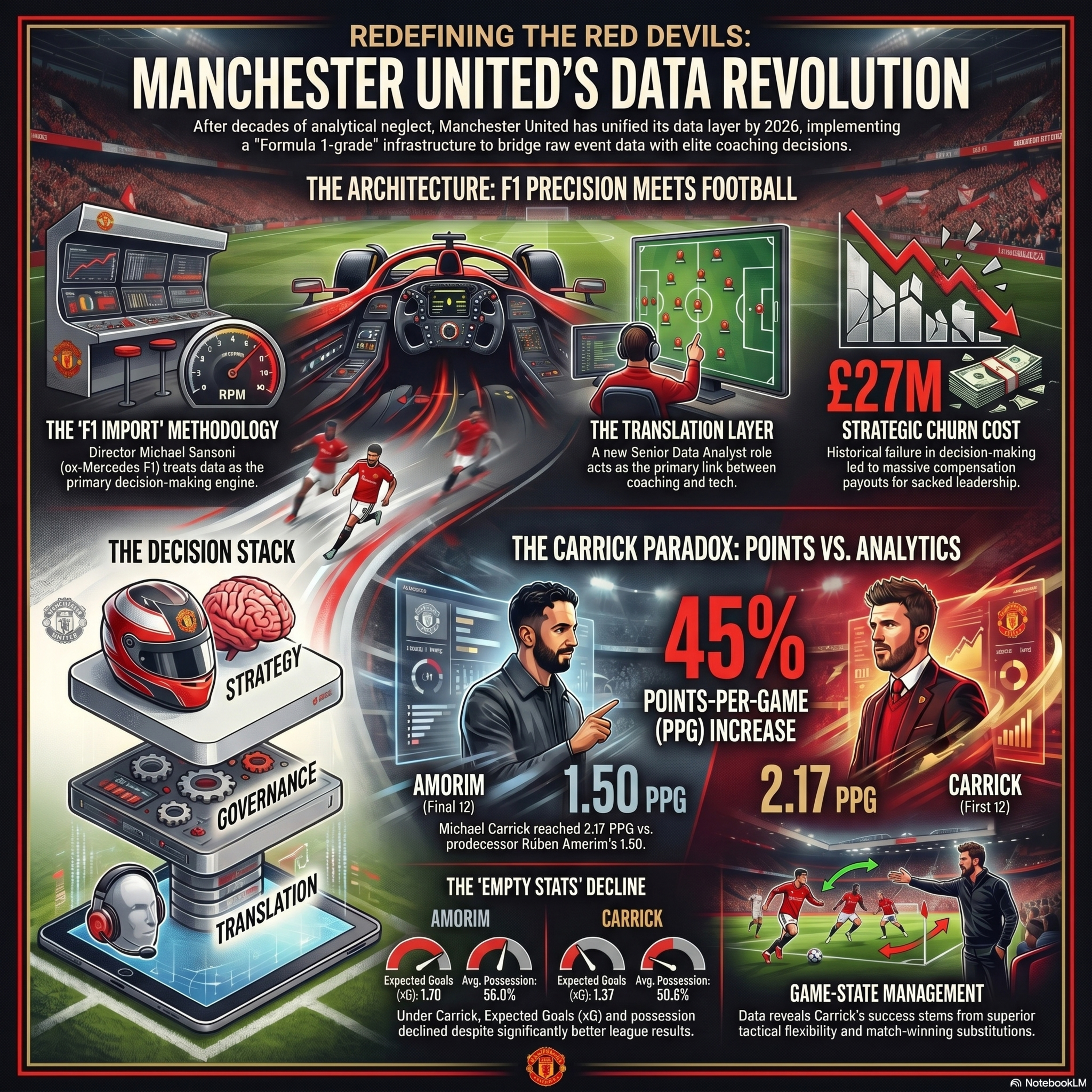
It's the churn. It's that 27,000,000 lbs lost purely on termination costs that we talked about. The severance packages. Right. They sacked managers like Eric Tenhag, they sacked Reuben Amaram, they sacked High level sporting executives like Dan Ashworth, £27 million just to look these men in the eye and say we made a catastrophic error in hiring you. Please take this massive check and go away. And we have to connect this to the broader structural damage too. That 27,000,000 lbs isn't just liquid cash up and smoke, it represents devastating lost tactical momentum.
Oh, interesting, How so? Think about the knock on effects. Every single time you fire a manager, you are also effectively discarding all the players you just bought specifically for that manager's unique system. Because the new guy doesn't want. Them exactly. You are abandoning all the Academy pathway adjustments you made to fit that game model. You are losing years of institutional continuity. You reset to 0, but you carry the financial baggage of the previous regime. OK, here's where this gets completely foundational for the African game.
The single biggest excuse you hear across the continent from Cairo to Cape Town is we don't have the budget for a data department. We are fighting to pay basic wages. We can't afford a room full of analysts. Right, it's the classic defense. Look at the reality in this boardroom. This European giant had literally all the budget in the world and they still fell into a competitive abyss because they lacked data governance. Absolutely. For an African club president listening right now, the cost of poor intelligence isn't necessarily a multi £1,000,000 severance package.
The cost is something much more insidious, isn't it? It is entirely insidious in the African context. The cost of poor intelligence is paid in devastating lost opportunity. It's the generational talent from your under 15 Academy who just walks away to a rival club for free because you didn't have a longitudinal record tracking his development. Oh, that hurts. It's the massive transfer fee you completely missed out on because you couldn't prove a player's high intensity Sprint metrics to a skeptical European buyer.
Right, because you didn't have the numbers to back it up. Precisely. Or it's the corporate sponsor who walks away from the negotiation table because the club's long term strategy just feels chaotic, emotionally driven and utterly unpredictable. It's like imagine buying an absolute top of the line ultra luxury rally car. You've got the incredible suspension, the massive engine, the bespoke tires, OK, But the driver throws away the pace notes and insists on driving it through a treacherous forest, completely blindfolded, just because he claims he knows the roads around here in his gut.
That's a perfect analogy. It's pure madness. You are going to crash that asset into a tree. So let me ask you the $1,000,000 question. Go ahead. How do we actually convince old school African club presidents, men who have built their entire careers on their trusted gut feeling and intuition for 20 years, that this intuition is actually their biggest financial liability? You don't attack their pride. That's rule number one. OK, You frame it entirely around the concept of decision risk. You never walk into an African club president's office and tell him his intuition is wrong.
You tell him his intuition deserves an insurance policy. Oh, an insurance policy. That's brilliant. Yeah, you have to demystify what a data department actually is. It doesn't have to be this perfect magical crystal ball that predicts the future. It simply has to act as a rigorous safeguard against catastrophic, repetitive, highly emotional mistakes. You explain to the president that he is buying an insurance policy against signing a striker who fundamentally doesn't fit the team style of play, or firing a coach who, underneath the bad results, is actually on the verge of a massive tactical breakthrough.
You are paying to reduce the massive financial risk of guessing. So how do you fix a blindfolded intuition heavy organization that has crashed the car tying and time again? You can't just hire a couple of guys with laptops. No, absolutely not. You have to completely structurally rebuild the architecture of how decisions are made in the building. And to do that, the people in this boardroom didn't just look at what other football teams are doing. No, they did. They looked outside this board. They borrowed from the fastest, most technologically advanced, most ruthlessly data reliant sport on planet.
Earth, they went straight to Formula One. Yes, they brought in a brand new director of data, Mike Sansoni. And this guy didn't come from a rival football club, he came directly from spending eleven years at the Mercedes Formula One team. Incredible hire. 11 years optimizing the cars, the aerodynamics, the race strategy for Lewis Hamilton. But I had to push back on this because it sounds crazy on the surface. How so? Well, an F1 car is a machine. It runs on a fixed, predictable track of asphalt. A football match is 22 highly emotional human beings running around on a chaotic grass pitch making hundreds of unpredictable micro decisions a minute.
How can you possibly apply telemetry from a machine to a human being? What is an F1 engineer actually bring to a muddy football pitch? It's a brilliant challenge, and it's the exact friction you face when introducing this concept to football people. But Sansoni isn't trying to turn human footballers into robots on a fixed track. Yeah, what he brings from Formula One is a complete radical paradigm shift in the timing of beta. The timing, the timing. Let's look at F1 in racing. Real time telemetry drives absolutely every single decision on the pit wall, right?
The exact degradation of the tire rubber, the aerodynamic load on the front wing, the microscopic temperature fluctuations of the brake, it is all streaming back to the engineers thousands of times a second. The analytical culture isn't just a fun supplement to the race director's human judgement. The data is the decision making process. And in football? Historically in football, data has been almost exclusively a post match review tool. It's an autopsy. An autopsy. Wow. Yeah. You play the game on a Saturday, you lose, and then on Tuesday morning the coaching staff sits down and looks at a static spreadsheet to figure out why they lost.
It is entirely, entirely reactive. OK, I see. Since Sony's mandate, his entire reason for being brought in from Mercedes is to move the club from reactive, backward looking reporting to highly predictive forward-looking decision making. OK, so it's not just staring into the rearview mirror to see what you just hit. It's building a highly advanced GPS to show you the traffic jam that's forming 3 miles ahead. To achieve this, they aren't just buying software, they're building what they call a decision stack.
And I want us to really take our time and walk through this layer by layer because this architecture is the exact blueprint African Federation's need to study it's 6 distinct sequential layers. And let me stress right here, the sequence of these layers is entirely non negotiable. You cannot skip steps. It is a structural architecture. If you build the top floor without pouring the foundation, the whole thing collapses. Right. So let's pour the foundation. The absolute ground level is data capture layer one.
This is your raw material. This is where you are gathering. The GPS vest outputs, the multi angle video feeds, the player medical records the biometric outputs. It's just the gathering phase. Then you move up to the second level, data engineering. This is crucial. This is the plumbing of the house. You need massive data pipelines and cloud architecture. This mega club actually brought in DXC technology to build a bespoke massive cloud platform. Why? So that all these completely isolated streams of data, the video, the medical, the physical, can actually talk to each other in one place.
Because I can assure you, without that data engineering layer, the data capture layer is just incredibly expensive noise. Expensive noise. Yeah, you end up with terabytes of match video sitting on one coach's laptop and years of GPS data sitting on a completely disconnected hard drive. In the sports science department, they never interact. Engineering connects the pipes. OK, pipes are connected. Then comes the third layer, modeling and science, right? This is where the heavy lifting happens. This is the realm of machine learning, artificial intelligence, and what they call Spadeio temporal models.
Yes, Spadeio. Temporal. Hold on, let me stop there. For those of us who aren't deep in data science, what on earth does Spadeio Temporal actually mean when we are looking at a football pitch? I know it sounds intimidating, but it's actually quite intuitive. Historically, football stats just told you what happened. You know player X completed the pass. Spadeiotemporal tracking looks at space and time. It tracks not just where a player is on the the space, but when they are there relative to the moving ball and the shifting defenders.
The time. It allows an AI model to analyze the exact probability of a passing lane opening up two seconds before the pass is actually made. They have data scientists calculating the mathematical probability of an opponent's tactical adjustment in real time. That is mindblowing, yeah. But here's the obvious problem. An artificial intelligence algorithm outcutting speiotemporal probabilities cannot talk to a grizzled old school football coach who is screaming from the touchline in the pouring rain.
No, he would throw you out of his office. Exactly which necessitates the fourth layer and arguably the most important one, the translation layer, the analysts. The bridge. Right, the bridge. We are going to dive incredibly deep into this specific layer in just a moment because it is the absolute beating heart of this entire revolution. But just to round out the stack, the fifth layer is program management. And I found this fascinating. They brought in a specialist named Gregor Nickel. He's not a football coach.
He's not a data scientist. His entire job as a business change expert is to manage the friction. Change management. Yeah, he ensures that these brilliant data projects actually get used by the coaches. He manages the delivery rhythm. And this is where most clubs fail. I have seen it time and time again. Really. Oh absolutely. A club builds a brilliant data department. The models are world class, but they completely lack program management. So what happens? The models sit on a server and they never ever make it into the Tuesday morning tactical meeting with the manager.
The manager just ignores it. It's too complicated. Or he just isn't forced to use it. Program management is the forcing function. It ensures adoption. It fundamentally changes the corporate behavior of the football club. And finally, you reach the top of the stack. Layer six, data leadership and strategy. This is Mike Sansoni at the top of the pyramid, setting the long term AI vision and reporting directly to the boardroom we are sitting in right now. Exactly. OK so we have this massive complex 6 layer multi £1,000,000 decision stack.
If I'm an African Federation technical director listening to this, I am looking at the six layer F1 blueprint and I am sweating bullets. Where do I even begin? How do I afford the cloud architecture and the machine learning? You begin by taking a deep breath and understanding why you absolutely must not start at the top layer. The most vital, actionable lesson for the African game today is this. Start with a decision map, not a data platform. A decision map I. Cannot stress this enough, do not go out and spend your limited budget on expensive AI software or hire a flashy director of data strategy if you don't even know what questions you were trying to answer.
I love culinary metaphors for this. Having all that raw data without a plan is like having a kitchen absolutely packed with raw, unpeeled vegetables, but you have no chef and no recipe. Right, you might have the ingredients for a Michelin star meal, but right now you're just sitting in the dark chewing on raw potatoes. That is exactly it for an African federation. The very first step before you spend a single dollar, before you sign a single software contract, is to sit down in a room and identify your top five highest stakes decisions.
Top five, OK. Where is the most risk in your organization? Is it the selection of the final 23 man tournament squad? Is it deciding exactly which youth players in the Academy get promoted to the senior team? Is it tactical preparation for an away opponent playing in a high altitude stadium? Oh, that's a good one. Once you identify those five specific high risk decisions, then you ask yourself what is the minimal amount of data we need to gather to reduce the uncertainty for those exact choices? So if an African team is pouring their foundation today looking for the minimal viable product, what exactly does their ground floor look like?
The ground floor has absolutely nothing to do with AI. It looks like relentless discipline, standardized data capture. It looks like assigning one properly trained analyst to film every single match from the correct elevated tactical angle, not ground level broadcast footage. Right, because you can't see the shape of the team from the ground. Exactly. It looks like creating a standardized post match coding template. Why is that so important? So that when a coach says, you know, we need a high press or watch out for their dangerous transition, those phrases mean the exact same measurable thing to the Under 15 Academy coach as they do to the senior national team manager.
Creating a shared tactical language across your entire organization that is your ground floor. Which brings us perfectly back to the most critical role in this entire revolution. Because, as we said, having a massive, beautifully structured database is completely useless if the coach standing on the touchline doesn't understand it, or worse, feels threatened by it and refuses to trust it. Yes, this bring us to that fourth layer we tabled a moment ago. The translation layer. The bridge between the rock code and the green grass.
This is what organizational psychologists call the boundary spanning role. Boundary standing. Yeah, and it is incredibly difficult to hire for and we can see exactly how this mega club is trying to solve this bottleneck right now by looking closely at their active job posting for a senior football data analyst. Yes, let's unpack this specific job spec, because reading between the lines here tells you everything about modern football. It really does. First off, this is not a junior video Clipper who sits in a dark room all night cutting highlight reels for YouTube.
No, not at. All this person needs hard, serious technical skills. The job requires mandatory proficiency in languages like SQL and Python. They are expected to query the raw event data directly, completely bypassing those slick prebuilt vendor dashboards that almost every other club uses. Why is that? Why bypass the easy vendor software? Because vendor dashboards are precooked meals. Oh, I like that. If you buy a standard dashboard, you are looking at the exact same visualizations, the exact same generic metrics as your opponents who bought the exact same software.
There is no competitive advantage in a precooked meal. This club doesn't want an analyst who just consumes finished products. They want someone who can get their hands dirty in the raw data lake. They want someone who can build custom proprietary metrics that fit their specific style of play. They want someone who can ask entirely new questions of the data that no other club is even thinking to ask. But, and this is the absolute kicker, they can't just be a spreadsheet nerd. They also have to be what you might call a bilingual diplomat.
The most revealing, fascinating line in the entire job specification, says this analyst, must be the quote primary analytical link between coaching staff and the wider data team. That sentence identifies the Grand Canyon that currently exists in modern football. The Grand Canyon. Yeah, on one side of the Canyon you have these brilliant data scientists who speak in Bayesian probabilities, Python scripts, and Spadeo temporal models. On the other side of the Canyon, you have the coaching staff, men who speak in pitch, geography, dressing room morale, grassroots intuition and the smell of the locker room.
Totally different languages. Exactly. The senior football data analyst has to stand on the bridge in the middle of that Canyon. They have to take a highly complex machine learning output regarding an opponent's defensive spatial vulnerabilities, strip away all the jargon and translate it into a simple three bullet point Monday morning tactical brief that the coach can immediately take out onto the training ground and execute. So for the African game, the application here is glaringly obvious. African clubs do not necessarily need a room full of 30 coders and expensive AI algorithms right now.
No, what they desperately need is this translation Layer. A single, highly effective, well trained analyst who could look at a match video, combine it with basic event stats, and then have the emotional intelligence to look the head coach in the eye, speak his language and say, boss, here's exactly why our midfield is getting completely overrun in the last 20 minutes of the game. Exactly. That one single human being is infinitely more valuable than $1,000,000 AI platform that nobody uses. Without question, if we dive into the human friction here, the psychology of coach adoption, it's a very delicate ecosystem.
You really have to empathize with the manager. Go for sure. Coaches are under immense job threatening pressure. Every single weekend. If an analyst walks into their office and hands them a 50 page spreadsheet full of numbers and complex heat maps, the coach's brain will experience cognitive overload. They'll just shut down. They will throw it in the bin and rely on their gut because their gut is comfortable. Insights are only valuable if they fit seamlessly, almost invisibly, into the coach's existing daily decision making workflow.
I see this friction everywhere across all industries, but especially in sports. You have these brilliant data nerds who speak cure code and these legendary old school coaches who speak grass. Yeah. So let me put you on the spot with a hypothetical. Let's hear it. If a cash strapped African federation has the budget for exactly 1 higher of just one high, do they go to a university, hire a brilliant data scientist and try to teach them the nuanced game of football? Or do they hire an experienced, tactically astute football coach and try to teach them data science?
Oh, it is the eternal $1,000,000 question of sports analytics. Historically, when the data revolution started, clubs went to universities. They hired pure data nerds and try to teach them about football and it almost always resulted in disaster. Really. Disaster. Yes, because it produced models that completely context. A purely mathematical model might tell a player you know always shoot from the specific coordinate. The XG is incredibly high, completely failing to understand that in the real world a massive center back is standing directly in the passing lane.
The math was right, but the football was wrong. The modern trend, and the one I would strongly, urgently advise for any African federation, is the opposite. OK, so the coach? Yes, you find a football native mind. You find a young coach or an ex player who deeply intuitively understands the rhythm, the tactics and the physical reality of the game and you upskill them in data literacy. Interesting. It is exponentially easier to sit a tactician down and teach them how to query a SQL database than it is to teach a computer programmer the complex emotional nuance of what happens in a locker room when a team goes down one NIL at halftime.
That makes so much sense, you. Absolutely must have the football credibility first or the manager will never respect you enough to listen. OK, I love that. Hire the football brain, teach them the tech. But what happens when that brilliant bilingual diplomat does everything right? OK, they query the database, they translate the insights, and they hand the coach a beautiful data-driven report that proves mathematically that the team is playing terribly, but the team actually just won the game three NIL.
This is where we hit a massive philosophical speed bump. We have to talk about the ultimate stress test of any data department, the statistical paradox. Yes, this is the moment where the eye test and the spreadsheet go to absolute war with each other. Let's dive really deep into this because this situation is mind blowing. Let's look at the incredible anomaly between the manager this mega club just sacked, Ruben Amaram, and the interim manager they brought in to try and salvage the season, Michael Carrick.
The contrast is fascinating. The statistical dissonance between these two men is crazy. Amaram was fired, right? Run out of town, But if you look objectively at his underlying stats in his final twelve matches, they were actually quite strong. His team was generating 1.7 arrow expected goals per game, right? Let me pause for the listener who might hear expected goals or XG thrown around on TV but doesn't quite get the mechanics. What exactly does that number mean? Expected goals, or XG is a predictive metric.
It assigns A probability to every single shot taken on the pitch based on historical data of thousands of similar shots. OK. So historical probability. Exactly. It looks at the angle, the distance from goal, the type of pass that led to it. If a shot has an XG of .5, history says a player should score that exact chance 50 percent of the time. It is a mathematical measure of the quality of chances a team is creating, regardless of whether the striker actually kicks the ball in the net or hits the post.
Perfect. So Amaram system is creating 1.7 O zero expected goals a game, a solid number. His team is getting almost 30 touches inside the opposition's penalty box every match. Very heavily. They're dominating the ball, holding 55% possession. Visually, on paper they're dominating, but his actual points per game? A completely dismal 1.50. The reality wasn't matching the math. He gets fired. And then Michael Carrick comes in as the interim. Right, Carrick takes over, and suddenly the underlying stats actually get worse.
Under Carrick, the expected goals drop down to 1.370. Wow. The touches inside the opposition box drop to 24. Their possession drops to just 50%. According to the pure unfeeling data, the team is performing worse. They're creating fewer chances and holding less of the ball. Yet Carrick boasts a massive 2.17 points per game, and he takes the team, rocketing up the league table from 6th place to 3rd. How is that physically possible? Well, if you take those two sets of numbers and feed them into a rigid, unfeeling algorithm, the algorithm will confidently spit out an answer that Michael Carrick is just getting lucky.
Just luck, huh? Yeah, it will tell you his team is drastically over performing their metrics. The strippers are just on a hot streak and a painful regression to the mean is inevitable. But is it? No, because a smart, mature, deeply embedded data department doesn't just throw their hands up and call it luck. They recognize this paradox as their most important research agenda. They ask what is our model missing? So what were Amaram stats? Were they just flat out lying? Amaram was generating what analysts referred to as empty statistics.
Empty statistics. He built a rigid dogmatic system that successfully created possession, yes, but it was possession completely devoid of danger. You mentioned the 30 touches in the box. Right, 30 touches. Yes, his team was getting touches in the penalty area, but they were heavily confested, low value touches with four defenders swarming the ball. A basic expected goals model struggles deeply with psychological context. Explain that. Well, it can't easily differentiate between a .35 XG chance taken by a striker who is brimming with confidence and flowing with the game and the exact same .35 XG chance taken by a striker who is terrified of the crowd, second guessing his managers rigid tactical instructions and physically exhausted.
I love this concept. This is the empty calories of data. Yes, Just because your plate is absolutely piled high with possession doesn't mean you were actually extracting any nutritional value out of it to win the game. Precisely. You can gorge on possession and star for points. Wow. What Carrick did when he took over was strip away the empty calories. He completely simplified the tactics. He restored psychological clarity and positional comfort to his key players. He happily gave up possession of the ball in order to gain control of the space on the pitch, making his team lethal on the counter attack.
But most importantly, and this is where the data really struggles to keep up, he mastered what we called game state management. Talk to me about game state management because the substitution statistics between these two managers are wild. This is the defining difference under Amerem. Over the course of 14 long, painful months, players coming on as substitutes scored a grand total of two goals. Just two. In 14. Months under Carrick in his first six games, substitutes came off the bench and scored four match winning goal.
In six games, That's insane. What does that tell you? That tells you? Carrick is brilliantly reading the momentum of the game. He is understanding the psychological ebb and flow of the 22 men on the pitch and he is making high leverage tactical interventions at the exact right moment, something that standard expected goals models currently struggle to quantify. When earlier we mentioned the data scientist dealing in Bayesian probabilities, this is exactly what they are trying to solve. Bayesian thinking is about constantly updating your mathematical probability based on near incoming evidence.
OK, so adapting on the fly. Exactly. If a team goes down a goal, the game state changes, the psychology shifts, and a Bayesian model tries to recapitulate the odds of a comeback based on how teams historically react in that specific emotional state. Carrick was acting as a human Bayesian model. This entire paradox is an absolute master class for African football because it proves that data does not replace coaching intuition it is supposed to interrogate. It yes, beautifully said. Think about managing a high stakes African Champions League game.
You're playing away from home, The heat is intense. You're in a wildly hostile environment in Cairo or Casablanca, dealing with complex dressing room dynamics. In that cauldron, empty stats will absolutely lie to you. They will completely mislead you. If your European built algorithm just tells you, hey good job we had 60% possession, that stat is worse than useless if that possession was entirely horizontal, passing in your own half while 60,000 opposing fans screamed at your terrified center backs.
The African game desperately needs context aware data. It needs models that account for grit, for psychological momentum, and for the chaotic control of transitions. It raises A profound question for any young data scientist working in African football right now. Are you actually measuring what matters to winning, or are you just measuring what is easy to count? Oh, that's good, measuring what's easy to count. It is easy to count passes. It is incredibly hard to count resilience. You cannot just import a clean European possession based algorithm, drop it into a chaotic, transition, heavy physically aggressive league in West Africa and expect it to perfectly map onto reality.
Data must respect the specific environment it operates in. So how do we actually do that? How do you build a mathematical model for African football that measures the seemingly unquantifiable? How on earth do you measure the emotional resilience of a squad playing, in a way, World Cup qualifier in a stadium where the crowd is actively pointing green lasers into your goalkeeper's eyes? You have to build probabilistic models, not deterministic ones. What's the difference? A deterministic model says if X happens, Y will definitively result.
A probabilistic model says if X happens under these specific conditions, there is a 60% chance of Yi. See. You have to expect that a football match is an open loop chaotic system. You start measuring game state momentum, for example, mathematically tracking exactly how aggressive A-Team becomes in the 5 minutes immediately after conceding a goal. You track dual aggression to see who wins the physical battles in those hostile environments. You have to stop retending that the data is a perfect high definition mirror of reality and start using it as a highly sophisticated flashlight in a dark room.
It shows you the obstacles, but you still have to navigate them yourself. That is a brilliant way to frame it, a sophisticated flashlight. And that need for context aware, highly specific data leads us seamlessly to our next revelation. Because if you want to talk about finding an edge in a dark room, we have to look at the two environments where data currently offers the absolute highest possible return on investment. The hidden edge. Exactly why? Because while everyone is fighting over men's first team algorithms, the rest of the market is still fast asleep on these two fronts.
I'm talking about the hidden edge, women's football and the youth Academy. This is where the true long term strategic brilliance of this mega club's massive rebuild actually comes to light. While the media focuses entirely on the men's team, the executives are not just building a data department for the Premier League squad, they are building a unified intelligence layer. Unified Intelligence Layer. They are creating one massive central data architecture that simultaneously serves the men's first team, the women's first team, and the Academy from the under fifteens all the way up.
Let's breakdown the economics of the women's game first, because it is an incredible case study in asymmetric warfare. It really. Is we have the actual numbers from the boardroom. This mega club's women's team is currently operating on a total wage bill of £5.88 million. Now look at their main domestic rival, Arsenal Women. Arsenal is operating on a wage bill of about £11.3 million. They are spending almost exactly double, so how on earth does a club expect to compete for trophies when they're being outspent 2 to one on player salaries?
This is the classic Moneyball scenario. Data is the great economic equalizer in a rapidly evolving market like women's football, which is growing explosively in popularity and revenue, but is still analytically underserved compared to the saturation of the men's game. The margins for exploitation are huge because Osenol might still be heavily relying on reputation based scouting, buying the famous names that cost a premium. This club can use their unified data layer to completely close the budget gap.
They can scour the globe to identify deeply undervalued players by looking at highly specific, overlooked metrics. Let's get specific. What exactly are they looking for that Arsenal isn't? They look for structural market inefficiencies such as. For instance, the manager might identify a specific tactical need for a holding midfielder. Instead of looking at who had the best highlight reel at the last World Cup, they filter the entire global database using a 75% weighted composite of primary underlying metrics.
They so hard numbers. Exactly. They will search specifically for players with exceptionally high possession, adjusted interceptions, high volume of progressive passes into the final third and positive standard deviations, and defensive dual win rates and the result. What happens is they end up finding a 22 year old player in the Swedish second division or maybe the US college system who costs an absolute fraction of the price but mathematically provides the exact specific tactical output required to neutralize Arsenal's 11,000,000 LB squad.
You beat money with math. You beat money with math? OK, Apply this directly to the African game. African women's football is an absolute goldmine of raw athletic and technical talent, but structurally it is currently analytically completely underserved. Wide open. If an African federation wakes up today and aggressively invests in women's football analytics, applying this exact same framework, they will absolutely dominate the Wolfcon, the Women's Africa Cup of Nations easily. More than that, they will completely corner the global export market as European and American clubs come looking for talent.
This is the ultimate first mover advantage. It is the textbook definition of a first mover advantage. If you apply structured scouting, standardized physical metrics, and performance tracking to the women's game in Africa before your rival federations do, you are creating proprietary analytical assets. Proprietary assets. And those assets will appreciate in value exponentially as global commercial investment continues to pour into the women's sport. You are buying the stock before it goes public.
And the second part of this hidden edge is the Academy, the youth pipeline. This mega club is creating what they explicitly call an Academy Data Passport for their category one youth system. This is vital for long term sustainability. They track every single player from the moment they enter the under fifteens all the way through their teenage years to the under 20 ones. It is a comprehensive longitudinal development record. So they're not just tracking goals and assists. No, not at all. They track physical growth spurts, tactical milestones, injury history, sleep patterns and behavioral trends.
So when a massive breakout star like a Kabhi Manu is suddenly promoted to the first team and shines on the biggest stage, that promotion wasn't a lucky guess. It was planned. It was based on multi year hard undeniable evidence. It's not just because the kid had three good days of training and caught the manager's eye. It is an evidence based de risked pathway. Now take that exact concept, the data passport, and bring it to a local underfunded Academy in Dakar or Accra or Johannesburg. This is where data transforms from a tactical tool into what I call economic defense.
Yes, explain this concept of economic defense to me, because I believe this is the single most important financial concept for African academies to understand in the modern era. It is a matter of absolute financial survival. Let's look at the harsh, deeply unfair reality of the global transfer market today. OK, right now, without data validation, African academies routinely produce generational world class talents, but they sell them to European clubs for an absolute pit and say $500,000. And then what happens 24 months later, after the player has been in Europe, that exact same player is sold between two European clubs for $25 million.
That's highway robbery. The European clubs are acting as middle men and keeping 90% of the value. Why does this keep happening? Because the European buyers are coming to the negotiation table armed with incredibly sophisticated expected transfer value models, they have algorithms that mathematically quantify positional scarcity in the global market, age-related performance curves, and future trajectory probabilities. Wow, so they know exactly what he's worth in five years? Exactly. The African Academy director, on the other hand, relying only on his eye test and his intuition of how good the boy is, is essentially bringing a knife to a quantitative gunfight.
A knife to a gunfight. The Academy Is negotiating based on feeling, while the European club is negotiating based on predictive mathematics. The Academy gets routed every single time. That phrase economic defense gives me literal goosebumps. We are leaving millions and millions of dollars on the table across the continent because we bring intuition to a quantitative negotiation. But imagine the paradigm shift if that local African Academy sets up a player passport. If they meticulously track the GPS data, the multi angle video metrics, the biometric growth over 4 years.
Then the entire power dynamic flips. They can counter negotiate with objective, undeniable evidence. When the European scout comes in low balling them, the Academy director can say we are asking for $500,000. Here is the longitudinal tracking data proving his high intensity Sprint capacity already matches a Champions League winger. Oh, that's so powerful. Here is the coded video evidence proving his complex decision making under pressure against senior professionals. The price is not 500,000. The price is 2.5 million.
Data protects your valuations. Data proves what your eyes see. But practically speaking, how quickly could a local African Academy realistically set up these player passports? Don't they need that massive DXC cloud architecture and millions of dollars to do it? Not at all, that's the absolute beauty of it. They can start tomorrow morning for almost 0 cost. Really. 0 cost a. Secure, highly structured spreadsheet. A dedicated cloud folder system for tactical video and a disciplined weekly reporting rhythm from the coaches.
That is all it takes. You do not need a multimillion dollar cloud platform to achieve 80% of the value of a player passport. You do not need AI to track a player's development. You just need organizational discipline and a refusal to rely solely on memory. Which brings us to the climax of this entire deep dive. We understand the value. We see the millions of dollars currently being left on the table. We understand the F1 decision stack in the translation layer. We have the. Now how do we actually execute this on the ground without Premier League money?
How do we build this? We have the exact blueprint, the African blueprint, A chronological journey to revolution. This is a step by step highly pragmatic implementation model and again, like the decision stack, you cannot skip steps. You must endure the friction of change management at each stage. Let's walk through the timeline. The very first zero to 90 days. What is the immediate action? The 1st 90 days are purely about establishing evidence discipline. No fancy tech. You create a standardized match coding template.
You ensure every single match, from the youth team to the seniors, is filmed from an elevated tactical angle. Right elevated. You assign one dedicated analyst lead and you institute a mandatory, unavoidable monthly review meeting with the coaches. And how do the coaches react to that? The friction here is immense. The coaches will hate the meetings. They will complain about being evaluated, but you push through it. The outcome is that the club finally begins making decisions from documented evidence rather than flawed emotional memory.
OK, you survived the 1st 90 days moving into months 3:00 to 6:00. Now you establish A standardized reporting rhythm. You build consistent pre match opponent profiles, objective post match reviews and injury availability templates. So making it a habit. The goal here is psychological. The coaching staff gets used to receiving consistent intelligence in a predictable rhythm. It becomes as normal as laying out the training cones. It becomes part of their weekly heartbeat. Months 6 to 12. Yeah, half a year in.
This is where the tech finally comes into play. Exactly. Now that the culture is ready, you introduce tracking data. This is where you bring in the GPS vests or EPTS units. Real quick EPTS. Electronic performance and tracking systems. It's the umbrella term for the wearables that track physical output. OK, but crucially, at this 6 to 12 month stage, you do not just hand the coach a spreadsheet of running stats, you link that physical data directly with the video you've been shooting since month one.
Good context. You don't just tell the manager he ran 10 kilometers today, that's useless. You say he ran 10 kilometers and here is the exact video clip of the tactical spaces he was covering when he hit his highest Sprint speeds. Context is everything. Months 12 to 18. This is the rollout of the Academy data passports we just discussed from the U15 S up to the seniors Academy progression finally becomes measurable, transparent and completely protected from the biases of individual youth coaches.
Months 18 to 24, we are nearing the two year mark. This is where you weaponize your intelligence for recruitment. You build out your scouting databases, you set highly specific data backed positional profiles for what kind of players you want to buy, and you establish that transfer valuation logic. The economic defense. This is where you build your economic defense to stop buying your own Antony's and start demanding millions for your own homegrown talent. And finally, 24 months and beyond the mature phase.
Federation wide scale. You take everything you've learned and you standardize these metrics across all national teams, domestic clubs and licensed academies. The entire country, from the grassroots to the World Cup squad, develops A unified National Football intelligence ecosystem. They speak the same language. OK, I have to stop you because there is a massive plot twist in all of this. The ultimate unknown unknown that is actually sitting right in front of our faces right now. It is shocking. Yes, we talk about the struggle for African federations to afford the technology in months 6 to 12, the GPS hardware, the Epps units, but there is a massive, shocking blind spot currently existing in African football.
A huge. One CAF, the Confederation of African Football, has already partnered with Catapult Sports. They've already distributed 2650 wearable GPS tracking units across 54 countries. The hardware is literally already sitting on the continent for free. This is the most crucial mind bending realization of this entire discussion. The entry point for physical performance data infrastructure already exists. It's already there. It is there at no direct cost to the member federations. The hardware barrier, the financial excuse, has been entirely removed.
Wait, over 2000 GPS units are already distributed? That is wild to me. It's exactly like discovering we already have the keys to a Ferrari parked in the garage, but no one bothered to learn how to turn the engine on. So what is the disconnect? Why isn't this technology revolutionizing the domestic leagues? Because of the golden rule of analytics, which we keep coming back to, governance before technology. The problem in African football right now isn't a lack of hardware, it's a profound lack of governance and translation training to actually convert that GPS output into a meaningful coaching decision.
So they had the vests, but they don't know what to do with them. You have federations where the units are literally gathering dust in a closet. Or worse, you have Teams is wearing the best just to look professional during warmups. But the data is never downloaded, never analyzed, and it never changes how the Tuesday afternoon training session is designed. It's performative tech. So if I'm an African Club executive listening to this and I've just realized I have a Ferrari sitting in my garage gathering dust, what is my Monday morning directive?
When I walk into my office tomorrow, what is the very first action I take? The Monday morning directive is to sit down and write things down before you even think about firing up those catapult units or charging the batteries. You document the governance. You write down exactly who owns the tactical decisions, when data is required to support those decisions, and who has the ultimate authority to override the data. You find your translator, your one program lead who speaks both grass and code. You establish that monthly review rhythm we talked about in phase one, right?
You demand that data deeply informs the five highest stakes decisions in your organization before you attempt to solve every other minor problem. You build the foundation. Then you turn on the Ferrari. OK, let's take a deep breath and recap the incredible journey we just went on in this boardroom. It's been quite a. We started by confronting the multi £1,000,000 mistakes of blind intuition, the 27 million in firing costs and the 86 million panic buys. We saw how the smartest minds are importing Formula One decision stacks to build predictive forward-looking future.
We wrestled with the Carrick Paradox, learning exactly how empty stats can lie and why game state momentum rules the real world. We uncovered the hidden edge of building a unified intelligence layer across women's football and the youth Academy, establishing the vital concept of economic defense. And we laid out the pragmatic 6 phase African blueprint, ending with the incredible realization that the GPS hardware is already waiting to be used. It's all right there for the taking. African football has the raw talent it has always had the deepest, most incredible well of raw talent on the planet.
Applying this intelligence layer is the key to absolute undeniable global dominance without a doubt. But I want to leave you our silent companion in this boardroom with one final completely mind expanding concept before we go, because the horizon of sports analytics is moving much faster than we think. Oh, it really is. We talked about unknown unknowns. We talked about how current XG models don't measure the psychology of the player. But what happens when the data scientists start looking beyond the grass?
You're talking about the biological dark variables. Exactly. Emerging physiological research is currently pointing to variables that standard event data can't even dream of capturing. We aren't just talking about heart rates anymore. No, much deeper. We are talking about a player's gut microbiome. We are talking about systemic inflammation markers in their blood. We are talking about quantifying the off pitch psychological stress of domestic disruption or the anxiety of contractual uncertainty. It's incredible.
None of these things are factored into the current expected goals models, yet they absolutely dictate the final microscopic margins of elite performance. They absolutely do. So here's the thought I want you to Mull over today. If the absolute future of analytics goes beyond the pitch, deep into the biological and emotional data of the human athlete, what happens when African football finally combines its unmatched raw genetic talent and its deep cultural resilience with true cutting edge biometric intelligence?
Could the ultimate unbeatable football algorithm actually be born in Africa? It's a profound, thrilling possibility when you pair an environment that historically produces such a sheer, chaotic athletic brilliance with rigorous, context aware intelligence. You don't just catch up to the European giants, you redefine the entire frontier of the sport. You change the game forever. And that, my friends, is the true revolution. Thank you for sitting with us in the boardroom today and for diving deep into the future of the beautiful game.
Keep questioning the gut feelings, keep building your economic defense, and until next time, keep looking for the edge.
 Apple Podcasts
 Castbox
 Castro
 Goodpods
 Moon FM
 Overcast
 Pocket Casts
 Podbean
 Podcast Addict
 Podcast Republic
 Spotify