Manchester United FC Data Revolution
About this episode
Manchester United FC Data Revolution
Imagine, just for a second, that you and I have been sitting as these completely silent, invisible observers in the back of like the most exclusive high stakes boardroom in global sports. Oh yeah, like a family. On the wall. Exactly. And we've just spent the last several hours absorbing this absolute master class in modern intelligence, strategy and, you know, survival. I mean, we are talking about the inner workings of Manchester United, but let me be entirely clear right at the top. We weren't looking at a tactical whiteboard here.
No, definitely not. We aren't debating inverted fullbacks or low blocks or pressing triggers on the grass. Right, we're looking at the invisible architecture, the stuff that dictates every single one of those decisions before a boot even touches the pitch. Exactly. We are diving into what is arguably the most consequential transformation in the entire 146 year history of this club. It really is. As of right now, May 2026, we are mapping a complete structural revolution in how a billion dollar sporting empire actually processes reality.
Like how it uses data, artificial intelligence and just raw computational power to make multi £1,000,000 choices. It's. Basically an expedition into the anatomy of change itself. Yeah, I mean, how does an institution of the sheer massive scale realize it is a full decade behind its fiercest rivals and then attempt this hyper accelerated Formula A1 style leap straight into the future? Well, it. Requires a pretty brutal dismantling of their own ego, honestly. Yeah, because to understand this transformation, you first have to confront the sheer magnitude of their previous failure.
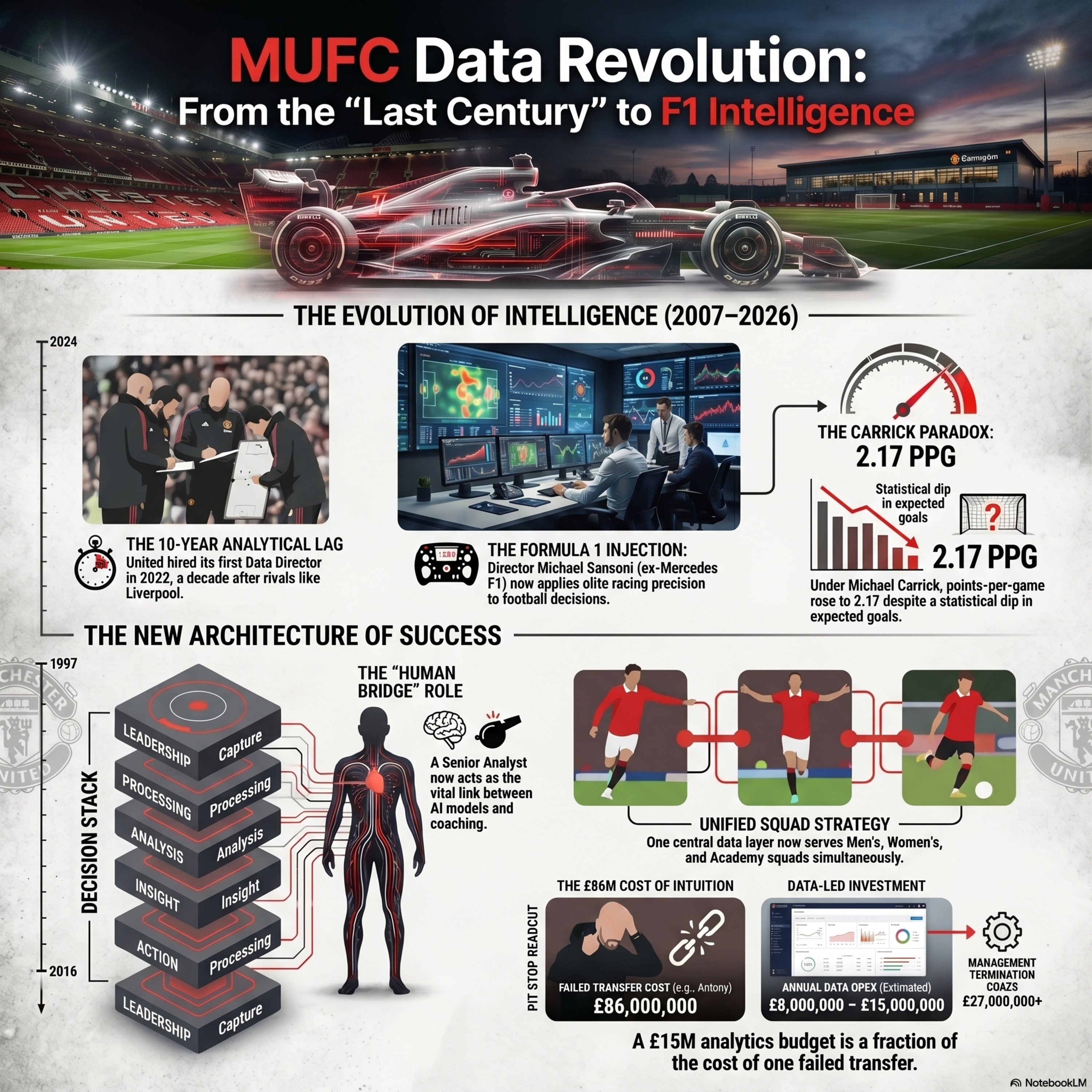
You know, we have to examine what we can basically call the baseline paradox of Manchester United. Let's unpack that. So if you look at their 2025 fiscal year, they generated over £666 million in revenue. It's a staggering number. It is. They boast roughly 1.1 billion followers globally. They have 68 major trophies. I mean, from a purely commercial standpoint, they are an absolute financial leviathan. Yet their own co-owner, Sir Jim Ratcliffe, stood up in public in December 2024 and delivered this diagnosis that should honestly send shivers down the spine of any executive.
Oh yeah, the last century quote. Right, he literally stated that the club was quote in the last century regarding data analysis, placing them in the very poor bracket of football intelligence. Which is just crazy to hear out loud. My immediate thought when I look at those two realities side by side is like, how does an entity generating over half a billion pounds just just forget to look at the numbers? It's the equivalent of a modern Fortune 500 logistics Titan trying to track intercontinental shipping crates using, I don't know, a physical paper rolodex in a landline.
Right. It sounds absurd, but the Rolodex analogy actually captures the mechanics of what happened during their last decade, which was roughly from 2007 to 2022. It wasn't that they ignored data entirely, it's that they measured the wrong things and completely thought they were innovators. Wait, really? How so? Well, Sir Alex Ferguson introduced GP tracking vests at the Carrington training ground very early in that timeline. Like they were pioneers in capturing physical performance metrics. Oh. OK, so they knew how far a player ran, their peak heart rate, their Sprint speed.
Yeah, it was entirely physiological. Exactly. And that early adoption created this really dangerous, almost catastrophic illusion of sophistication. They fundamentally confused physical data with tactical football intelligence. Oh, I see. Yeah, like physical data helps your medical staff optimize training loads so a player doesn't tear a hamstring. But tactical intelligence. Things like expected goals, opponent profiling, pitch control algorithms. Measuring the true probability of a past completion.
Right, that's what actually informs recruitment and match day strategy. And they spent 15 years obsessing over the Physiology while remaining entirely blind to the strategy. While they are looking at heart rates, their rivals are basically building Wall Street quantitative trading desks. Literally. I mean, Liverpool brings in Ian Graham as director of research back in 2012. Manchester City and Brighton, they were embedding hard analytics into their core operations as far back as 2009. Yeah, they were light years ahead.
Meanwhile, Manchester United like basic subscriptions to standard event theater providers like Opta or Stats Bomb. Until incredibly recently they didn't even have the raw feeds. Which forces a very specific, highly flawed workflow. I mean, when you lack quantitative validation, you have absolutely no choice but to rely on the human eye test, right? So Manchester United was operating this traditional network of over 100 human scouts scattered across the globe. And you know, human observation is inherently bias.
Oh totally, we fall victim to Regency bias. Visual flair confirmation bias. Exactly. And since 2017, they funneled over £1 billion into player recruitment based largely on this intuition heavy model. A billion pounds. Yeah, resulting in heavily, heavily diminishing returns. We have to unpack the mechanics of that failure because I don't think anything crystallizes the danger of intuition over evidence better than the £86 million acquisition of Anthony. Oh, that is the perfect example. Right, because if I'm a scout sitting in the stands in Amsterdam, I'm watching Anthony perform a brilliant spin move.
He beats the defender, whips the crowd into a frenzy. My human brain immediately codes that as like flare danger value. Of course it does. It looks amazing. But what is a rigorous algorithmic profile actually see? Well, an algorithm strips away the emotion of the crowd. It looks at the resulting action. It asks, did that spin move result in a progressive pass into the penalty area? Right. Did it actually increase the team's probability of scoring within the next 10 seconds? And when you run Anthony's data from that period through a modern predictive model, he performed in the absolute lowest percentiles for Premier League wingers regarding expected threat and ball retention in the final third.
Wow, so the human scout sees the trick, but the algorithm sees that he actually surrendered possession what, like 80% of the time after performing it? Precisely, and furthermore, A robust expected transfer value model and ETV model would look at positional scarcity. Like how rare that type of player. Is Yeah, exactly how many other left footed right wingers in global football are producing similar underlying metrics? If the algorithm finds 12 other players producing the exact same expected assists per 90 minutes, the market value.
Drops, obviously. You do not spend £86 million on a profile that isn't statistically scarce. The Anthony signing is like the ultimate monument to taking a nine figure financial risk without any algorithmic validation. Which means the bleeding just had to be stopped. I mean, the financial hemorrhage was just too great. And that naturally leads us to the first real attemt to fix this blind spot. The foundation phase. Yeah, in March 2022, they finally hired their first ever director of Data, Dominic Jordan.
And his background immediately stands out because they didn't poach him from Real Madrid or Bayern Munich. No, they didn't. They pulled him from the retail sector. He's at the N Brown Group. Right. Which sounds weird, but plucking a Cambridge educated mathematician from retail actually makes a great deal of structural sense. OK, walk me through that. In retail, your core challenge is supply chain logistics, inventory optimization and you know, predicting consumer behavior under shifting market conditions, right?
Well, in football, players are your most valuable inventory and you are trying to predict their performance output over a multi year contract under shifting tactical conditions. Oh, that makes perfect sense when you put it like that. Yeah, so Jordan's mandate was to build a data science apartment from Absolute 0. And he genuinely laid the necessary pipeline. Like he's systematically brought in data operations specialist, machine learning scientists, decision scientist. He really, he finally acquired those missing subscriptions to Opta and Stats Bomb.
Basically, he built the plumbing. He built exceptional plumbing. Jordan's team was producing highly rigorous predictive models. But, and this is a massive but, this era exposed what we call the trap of dado without governance. Dado without governance. OK, what does that look like in practice? Well, you can engineer a flawless dashboard that perfectly highlights a glaring weakness in the opponent's defensive structure, but if the club lacks A codified institutional mandate that physically forces the head coach or the sporting director to actually interact with that dashboard before a match?
And it doesn't matter. Exactly. The technology is essentially decorative. I can completely visualize this. You have a team of brilliant data scientists presenting A predictive model showing that a specific, say, £50 million target is statistically a poor fit for a high pressing system, right? And the traditional football manager just looks at the iPad, taps the table and says that's nice math. But my gut tells me he's got grit by him. That is exactly what happens in a governance vacuum. And you know, to compound the issue, the environment around the data team was violently unstable.
Oh, the turnover. Think about the sheer turnover. You had Eric 10 Haig, then Ruben Amarim. You had sporting directors and executives rotating in and out constantly. John Murtuff. Dan Ashworth. It was a revolving door. When leadership changes every 18 months, an analytics department has no permanent anchor. They spend all their time adapting to the whims of the new man rather than building a long term club philosophy. Financial friction of that chaos is just staggering. I mean the club spent over £27 million purely on compensation packages to fire 10, Hog, Amarim and Ashworth.
27,000,000 lbs They. Burned £27 million just to undo poor human decisions. Which perfectly illuminates A fundamental truth about organizational change. Building the technological infrastructure is only like 10% of the battle. And the other 90%? Modifying human behavior. Stripping power away from traditional decision makers. Dominic Jordan's tenure proved that simply hiring intelligent data scientists and purchasing software licenses will not save you, right? The institution required a top down, ruthless cultural shock to the system.
Kanias and Sir Jim Ratcliffe, when they take sporting control, they don't just, you know, tweet the department, they initiate a massive structural clearing of the desk. Well, it was a bloodbath, yeah. They execute widespread redundancies to clear budget, and they issue this hard mandate to RIP out the old psychological infrastructure and to lead this new era. In April 2025, they appoint Michael Sansoni as the new Director of Data. The Sansoni appointment is. It's the pivot point for this entire transformation because once again, they didn't hire a football insider.
Sensoni spent eleven years at the Mercedes AMG Patronus Formula One team. Yeah, he served directly as Lewis Hamilton's personal performance engineer on the track, and structurally, Ineos elevated his position. He does not report to a sporting director. He reports directly to the CEO, Omar Bharata. OK, that is a huge shift. So data now sits at the executive committee level. Precisely. Which means data can finally veto intuition. The results were pretty immediate. By the summer of 2025, San Sony's machine learning models are the driving force behind the signings of Matthias Cuna, Brian Abeyimo, Benjamin Sesco, and Sunny Lammons.
Right? But I have to stop and challenge this F1 methodology for a second. Sure, go for it. I understand why it sounds incredibly appealing in a boardroom, but Formula One is a closed deterministic system. It's literally physics. You have a car, a track, and sensors firing thousands of telemetry updates per second telling you the exact degradation of a tire compound. Very true. Well, a football match is a wildly open probabilistic system. Exactly. You have 22 highly emotional human beings, A referee making subjective decisions based on his own line of sight, sudden downpours affecting the friction of the grass and just pure tactical chaos.
Yeah, it's messy. You cannot apply deterministic F1 mathematics to human unpredictability, so how is this not just another expensive illusion? It's a brilliant distinction to draw, actually. If Sansoni were trying to like, copy and paste Mercedes exact tire degradation algorithms onto a football pitch, it would be a complete disaster. But he isn't importing the specific math, he is importing the F1. Culture of decision making in Formula One. Data is not a suggestion, it is the definitive basis for action.
You do not call a car into the pit lane because the team principal looks at the sky and has a gut feeling about the rain. No, you'd lose your job. Exactly. You pit because the telemetry and the weather radar dictate that you have a 78% probability of an optimal undercut. So he's introducing the discipline of treating uncertainty explicitly. Instead of a scout saying I think this striker will score goals, the model says based on his shot locations and our team's chance creation rate, there is an 82% probability he scores between 14 and 18 goals next season.
Precisely, it is about demanding evidence to quantify risk. It's a cultural shift where an imperfect probabilistic model is still trusted significantly more than an unaided human guess. But to execute that F1 style vision, to actually process reality in real time, the club had to build a digital infrastructure unlike anything previously seen in the sport. Let's open up the hood on this digital war chest then, because the sheer scale of the hardware and software they deployed is staggering. We are looking at an estimated annual analytics operating expense of between 8 million and 15,000,000 lbs and the foundation of that is tearing down the old data silos.
They partnered with DXC Technology to build a bespoke cloud architecture. Yeah, because in the past, medical data sat on one server, physical fitness data sat on a different server, and tactical event data was on 1/3. Completely disjointed. Completely. The DXC platform creates A unified, queryable space. A machine learning model can now look at a player's tactical drop off in the 80th minute and instantly correlate it against their sleep data and their historical hamstring load. That's incredible and the tracking mechanisms feeding that cloud are insane.
They abandoned the reliance on those old GPS vests and installed local positioning systems or LP's in conjunction with Stat Sports Apex 2 Point O. They physically wired 3 venues, Carrington, Old Trafford and the Lee Sports Village. Let's explain why LP's is such a massive upgrade over GPS. Well, GPS relies on satellites and low earth orbit, right? It can suffer from signal latency, cloud cover interference, and it generally has a margin of error of about 1m. A whole meter. Yeah, and if you are trying to measure the exact distance between a center back and a striker to determine if an offside trap works, 1m of error basically renders the data useless.
It's too blurry. Exactly. Local positioning systems use fixed beacons placed strategically around the stadium roof. They communicate directly with the players tags, providing centimeter level accuracy with 0 latency, and it's entirely unaffected by weather. Centimeter level accuracy. That's wild. And they didn't stop there. The £50 million redevelopment of Carrington includes high definition fixed camera arrays and tactical drones. Drones. Imagine being a coach and having drones buzzing over the training pitch, mapping your team's pressing shape from vertical perspective in real time.
It's like a video game. It is but the IECE of tech that absolutely blows my mind is what they did on the touchline. They armed the coaching staff with Qualcomm Snapdragon Copilot plus PCs. We're talking about 0 latency edge computing during a live match. This is a critical technological leap, like if an analyst on the bench wants to run a complex spatial query, say, analyzing every time the opponent's left winger receives the ball to see if their fullback overlaps or under laps. Sending that massive video file up to a cloud server in London and waiting for the calculation to come back takes several seconds.
In the Premier League, a three second delay means the phase of play is already over. So edge computing processes the data locally right there on the physical laptop chip. Exactly. The Snapdragon chips allow the artificial intelligence models to process the raw broadcast feeds and the LP's data locally on the machine. No cloud needed. None. The analyst receives instantaneous, actionable insights without ever relying on stadium, Wi-Fi or cloud latency. It is the closest football has ever come to an F1 pit wall strategy call.
That is just nuts. Add in external data feeds from stats, bombs, skill corner, broadcast tracking and why scout and you have like total digital omniscience. You really do. But I know what a traditional fan or even a skeptical board member might say to all this £15,000,000 a year in operating expenses just for computer stuff? That sounds like a massive bloated overhead. Right, and that skepticism stems from a fundamental misunderstanding of risk management. 15,000,000 lbs is not a cost in the traditional sense, it is a highly efficient insurance premium.
No, kid, explain that. Go back to Anthony, that was an 86,000,000 LB mistake plus wages, the financial damage of a single failed human intuition transfer. Worse, the entire operational cost of this world class analytics department for nearly a decade. Wow, when you frame it like that, it's a bargain. You don't spend on data because it looks futuristic. You spend on data to mathematically insulate the club against 9 figure human errors. OK, I see the financial logic. The infrastructure is flawless.
You have drones, centimeter accurate LP's, cloud lakes and edge computing. But there's still a massive human vulnerability here. I mean, you can have an AI that perfectly predicts the opponent's next substitution and precisely details how to counter it. But if the manager crosses his arms, refuses to look at the screen and yells at his players to just run harder, all that technology is absolutely useless. It is entirely useless. Which brings us to arguably the most important and honestly least understood structural role the club has created.
The boundary spanner. The translation layer. This is the role of Gregor Nichol, the Football data program manager. And what fascinated me the most about Gregor is his resume. He is not a football analyst, not all. He didn't play in the Football League. He doesn't have a background and expected goals. He is a project management office, a PMO and business change expert. Hiring a change management expert to oversee the football data department is an absolute masterstroke. Really. Why? Because it signals that Ineos finally diagnose the true nature of their problem.
Getting a traditional, highly stressed football coach to alter their tactical game plan based on an algorithm is not a technology problem. What is it then? It is a human psychology and change management problem. Because data scientists and football coaches speak completely different languages. A data scientist speaks Python, sequel and Bayesian inference. A coach speaks in pressing triggers, low blocks and dressing room mentality. Exactly. You can't just put them in a room and expect them to communicate.
They need a bilingual diplomat. They do, and we see this perfectly codified in the live vacancy of the club posted in May 2026 for a senior football data analyst. If you read the job description, it explicitly defines the role as the prime primary analytical link between coaching staff and the wider data team. It requires severe technical skills right? Like the ability to manipulate raw event data using SQL and Python from scratch, not just looking at prebuilt dashboard. Yes, very high level data wrangling.
But the core deliverable isn't a complex spreadsheet, it's communication. Think about the environment of a match day. A manager has maybe 5 minutes in the dressing room before warmups to absorb new tactical information. If an analyst walks in with a multi variable regression analysis proving why the opponent's midfield is vulnerable, the manager will tune them out immediately. Then throw them out of the room. Exactly. The senior analyst's job is to take the hyper complex math generated by Sansone's team and distill it into a single undeniable visual, like a simple heat map and say boss their left back pushes.
Just too high in transition. If we instruct our right winger to stay 5 yards wider, we will break their line 80% of the time. That is the translation layer. It's the art of making the math invisible, leaving only the actionable football insight. Precisely. And right now, as we sit here observing this in May 2026, that specific translation team has the most fascinating mind bending case study in world football sitting right in front of them, head coach Michael Carrick. Ah, the Carrick paradox. Yes, this is the exact moment where the billion dollar algorithmic infrastructure clashes violently.
The unmeasurable reality of the sport. Let's breakdown the numbers on this 'cause they genuinely hurt my brain. They are confusing, yeah. In January 2026, Ruben Amarum gets sacked, the team is in 6th place and his points per game or PPG is a miserable 1.50 right? But if you looked at the underlying algorithms under Amarum, the metrics were actually quite strong. The team was creating a high volume of chances on paper. They were. Then Michael Carrick takes over as Inter manager, and according to the raw data, the team's underlying performances actually get significantly worse.
It's so weird. Expected goals XG drops from 1.70 per match down to 1.37. Expected goals against goes up. Their average possession numbers plummet. Their touches inside the opponent's penalty box drop. Yeah, if a data scientist looked purely at the spreadsheet, they would conclude the team is in a tactical prefall. Absolutely. Yet Carrick's points per game skyrockets to 2.17. He pulls the team up from 6th to 3rd and secures Champions League qualification. How is a team that is mathematically playing worse winning so many more matches?
This cognitive dissonance is like the ultimate Crucible for Sansoni's department. To understand it, you have to dissect the flaws in current expected goals models. OK, what are the flaws? Well, XG models measure the historical probability of a shot going in based on location and angle, but they heavily struggle to filter out empty statistics. Empty statistics. Yeah, under Amarim the team dominated possession and had high touches in the box, but it was sterile. They were holding the ball in non threatening areas while the opponent had 10 men behind the ball.
So they were generating volume, but no actual velocity or threat. Exactly. More importantly, current machine learning models cannot measure psychological momentum, dressing room clarity, or tactical adaptability. Amarim ran a highly rigid, deterministic system that frustrated the players. Carrick came in and simplified their responsibilities. He restored psychological clarity and the most glaring proof of this is in his game state management. Oh, the substitutions. This stat blew my mind. It's crazy.
Under Amerem, substitutes scored a total of two goals in 14 months. Under Carrick, substitutes came off the bench to score 4 match winning goals in his first six games alone. Which statistically proves like Carrick is reading the context and the emotional flow of the match better than his predecessor. It allows him to intervene at the exact right moment, even if his team generates a lower overall volume of chances. Wait, if I'm a skeptic I'm looking at this insane. Checkmate. Doesn't the Carrick Paradox prove that the data is fundamentally flawed?
A lot of people would say that. Doesn't this prove that an old school manager relying on vibes man management and an intuitive reading of the game is actually superior to a £15,000,000 F 1 supercomputer? That is the easy reactionary conclusion. But to a true data scientist, Carrick isn't an enemy. He is a research mandate. Oh, I like that. The data isn't broken or wrong, it is simply incomplete. The Carrick paradox is exposing the exact frontier of what we cannot yet measure. The goal isn't to say Carrick's intuition beats the machine.
The goal is to ask how do we train the machine to recognize what Carrick is seeing? So the next evolution of this F1 grade analytics department is figuring out how to mathematically quantify tactical adaptability. Like how do you build an algorithm that measures the compounding effect of player confidence or the exact momentum shifts in a stadium? Exactly. They must evolve from raw volume based metrics to context sensitive models that can read the psychological temperature of a match. But it's crucial to understand that this transformation we're mapping out isn't just confined to the men's first team pitch.
The true ambition of Ioneus Architectural Blueprint is to cast a massive unified digital net across the entire institution. Right, the integration phase. The new data structure explicitly unifies 3 distinct environments under 1 central hub, the men's first team, the women's first team under Mark Skinner and the category one Academy. Yes, and we need to explore the women's team context here because the contrast in resources is staggering. It really is a study in achieving massive operational efficiency because the women's team has been highly successful on the pitch, you know, reaching the Champions League quarterfinals, but they are operating with a severe financial handicap.
Their wage bill is roughly £5.88 million compared to a rival like Arsenal who operates with an £11.3 million wage bill. And historically they faced massive institutional friction right over there. During the Carrington refurbishments, the women's squad was literally moved into portable buildings. That's just wild. So how does integrating them into this £15,000,000 data architecture solve that? Because data acts as the ultimate equalizer against financial disparity. If you cannot outspend your rivals, you have to outthink them in the recruitment market.
Money bowl. Exactly. United's data department uses composite profiles analyzing leagues like The American American and WSL or the Swedish Donald Venskin to find statistically undervalued players. They use this exact method to scout and acquire midfielders like Lisa Malesund. The algorithm identifies a player producing elite progressive passing metrics in a lower profile league, allowing United to correct tactical imbalances for a fraction of the cost Arsenal might pay. And their use of data extends way beyond just scouting, too.
The research they are funding regarding player Physiology is groundbreaking. They launched a massive partnership with Manchester Metropolitan University MMU, specifically focusing on ACL injuries in female athletes. Yeah, this touches on a massive blind spot in global sports science. Yeah, historically, elite athletic data has been heavily male centric. Female players suffer ACL injuries at disproportionately higher rates than men due to entirely different biomechanical factors. Like what? Things like the Q angle of the hips and hormonal fluctuations that affect joint laxity.
But because the baseline data didn't exist, clubs couldn't build predictive models. So United is basically building the baseline from scratch. Yes. By partnering with MMU to capture this specific biometric and hormonal data, United is building proprietary predictive injury models tailored exclusively for female athletes. That is huge. This isn't just about protecting their investments on the pitch, it's a pioneering medical intelligence initiative that gives them a distinct, massive advantage in WSL recruitment and retention.
Players want to sign with the club that has the science to keep them healthy. Yeah, that makes total sense. And the third pillar of this unified net is the Academy. They are tracking players from the under 15 squad all the way to the under 20 ones. They've instituted what they call longitudinal player data passports. I would actually argue that the data passport is the most valuable long term asset the club is currently building. Really. Why? Well, a passport is a seamless, unbroken chronological record of a player's physical growth, tactical comprehension, and psychological resilience over a six year period.
Oh wow. So when a manager like Michael Carrick is deciding whether to start an Academy graduate like Kabhi Minu in a high pressure Champions League match, he doesn't just ask an Academy coach for an opinion. Exactly. He pulls the data passport. He can see hard evidence that Mana's decision making speed under physical pressure matches the median of a seasoned Premier League veteran. The data validates the managers courage to play youth. Exactly. But looking at this structurally, I see a massive bottleneck.
We established that the translation layer, the boundary spanner like Gregor Nichol, the senior analyst, is the most fragile part of the system. It is if you have one senior analyst trying to distill insights for the men's team fighting for the Premier League, the women's team navigating the Champions League in the entire Academy structure. Isn't that person going to completely burnout? Oh, it is a severe, almost critical resource stream. The strategic ambition to unify the data program is correct.
But functionally, having one boundary spanning department cover all three incredibly demanding environments simultaneously is a massive structural risk. You cannot stretch one F1 pit wall team across three different race tracks on the same weekend. True institutional equality and true peak performance will eventually require the club to heavily duplicate this infrastructure, embedding dedicated, fully resourced analytics teams within each of those 3 pillars. That makes perfect sense. They've built the engine, now they need more drivers.
But the sheer existence of this massive structural blueprint doesn't just stop at the gates of Manchester. What fascinates me is how this acts as a glaring instructional mirror for the rest of the footballing world. It absolutely does. Specifically, I want to talk about the global implications for developing football economies. This is a vital pivot. The Manchester United narrative transitions from a specific club case study into a global cautionary tale and a road map, particularly when we look at the African football blueprint.
Because if you strip it down, if the richest, most commercially powerful club on the planet failed at modern intelligence for a straight decade simply because of stubbornness, bad governance and arrogant intuition. Then lack of resources is no longer a valid excuse for developing nations and federations to ignore data organizations like the Confederation of African Football CF or national federations like FKF in Kenya or FUFA in Uganda. They can look at United's lost decade and realize that the primary barrier to entry isn't a 15, £10 million budget, it's structural discipline.
African football has historically suffered from a lack of systemic infrastructure, but the intelligence community has mapped out a highly specific six phase African implementation model that scales this F1 philosophy down to developing economies. I really want to dive deep into this six phase model because taking an elite Silicon Valley style concept and applying it to a federation with limited funding is an incredible challenge. How does it actually work? It begins with phase one, the decision map.
Before a federation buys a single piece of software or a tracking vest, they must literally sit down and document their decision making process. They map out which choices, Recruitment, tactical setup, resource allocation are currently made purely on gut feeling and ask where data could improve those specific choices. It's an audit of their own intuition. So it's establishing the governess before buying the tech, avoiding the Dominic Jordan trap right from day one. Exactly. Then you move to phase two, which is remarkably simple.
Begin coding matches. You don't need drones. You need a standard video camera to record local Academy games and start systematically categorizing the events, passes, tackles, shots. That's basically free. Right Phase three introduces affordable physical tracking like basic GPS. Phase 4 involves building centralized databases, Phase 5 is integrating that data into scouting protocols, and Phase 6 is leveraging predictive modeling to value players. And what's incredible is that the physical technology for Phase 3 is already sitting on the continent.
It is see half partnered with Catapult Sports and has already distributed 2650 wearable tracking units across 54 African countries. The hardware is physically in the dressing rooms from Senegal to South Africa. But the hardware is useless without the governance. If a Ugandan Academy has the catapult vests but there is no institutional protocol requiring the coach to review a player's Sprint load data before sending him into a match, they are simply replicating Manchester United's failure, just with less money.
The tech is present. The culture of F1 decision making is what needs to be implemented. This is where it gets incredibly profound for me. We talk about analytics as a tool to win a match on a Saturday, but for African clubs, analytics is an economic shield. It is a defense mechanism against international exploitation. It is the ultimate leverage in a deeply unbalanced market. Historically, African academies have routinely sold generational talents to European buyers for absolute fractions of their true worth.
We see it all the time. An Academy might develop a phenomenal 17 year old midfielder and sell him to a Belgian club for $500,000 simply because they need the cash injection. 2 years later, that Belgian club sells the exact same player to the Premier League for $25 million. Because the European Club arrives at the negotiation table armed with an army of data scientists, and the African Academy arrives with a highlight reel, a handshake and hope. Exactly. The European buyer uses those expected transfer value ETV models we discussed earlier.
They quantify the players age, curve, physical benchmarks and positional scarcity. They know mathematically that the players were $5,000,000, but because the African club can't prove it, the European club dictates the price. So if an Academy in Senegal executes the sixth phase model, if they build their own longitudinal data passports and track their U15 through to their first team. It entirely shifts the power dynamic. When the European buyer offers $500,000, the Academy director can slide a data passport across the table and say no.
We have tracked his physical output, his past completion under pressure and his tactical progression for four years. Our ETV model shows his underlying metrics are statistically identical to Satya Manet at the same age. The price is $4 million. WOW data becomes the hard quantitative leverage to demand fair market value. It protects the entire developing football economy. That is absolutely brilliant. You use the data not just to validate the eye test, but to secure the bag and keep the wealth inside the developing infrastructure.
Precisely. But let's bring this all the way back to reality. No Grand LAN, no F1 supercomputer, an No 6 Hase blueprint survives contact with reality without exposing a few massive blind spots. What are the major risks threatening to completely derail this £15,000,000 operation at Manchester United right now? The single largest existential threat to this entire infrastructure is the identity of the next permanent manager. Because Michael Carrick is currently operating with the interim tech. Correct.
Eventually the sporting directors must hire a permanent manager if they hire a traditionalist, a manager who views data as a threat to his authority, who refuses to read the pre match analytical briefs provided by the boundary spanner, who overwrites recruitment algorithms because he knows a guy who played for him 10 years ago. Then the whole thing collapses. The entire £15,000,000 system is neutralized overnight. Years of meticulously building an F1 grade data culture can be dismantled in a single summer transfer window by a manager whose ego refuses to share authority with a database.
Wow, so the entire technological bridge really is that fragile. It all comes down to the willingness of 1 human being to look at an iPad. But what about the math itself? What is the data currently failing to see? The frontier they are currently battling is what we call the biological dark variables. Biological dark variables. It sounds like sci-fi. It refers to the Black Swan events that entirely evade current measurement parameters. Think of our algorithms right now like highly advanced weather satellites.
OK, we can track the massive storm systems, Sprint speeds, expected goals, passing networks with incredible precision, but the satellite cannot tell you if a specific player left his umbrella at home. Right, you can't see the micro events that derail the macro predictions. Precisely. The models are entirely blind to things like a player's gut microbiome and how it specifically effects their lactic acid clearance and muscle recovery rate on a Tuesday. Jeez. They are blind to off pitch psychological stressors, a domestic dispute, an illness in the family, contract anxiety, or a sudden loss of confidence.
These unmeasurable human variables often determine the final razor thin margins of elite performance, and right now the algorithms cannot process them. So we've built this flawless weather satellite, but it's fundamentally blind to human emotion and cellular biology. How on earth do you defend against that? The only defense is a structural concept called dynamic teaming. Wait, if the algorithm is blind to these dark variables, does that mean the club needs to employ staff whose explicit job is to argue with the computer like a dedicated professional contrarian?
That is exactly what dynamic teaming requires. The club must actively employ scouts, psychologists and traditional coaches whose sole mandate is to look at the algorithm's output, challenge its assumptions and point out the unmeasurable human elements. I see the data must always remain probabilistic, not deterministic. It must inform the human decision maker, but never completely replace them, because only a human can sense a biological dark variable. That is a wild, fascinating place to land. So to synthesize this massive, complex journey we've just been on, we have watched an absolute Titan of global sports, Manchester United, systematically drag itself out of the dark ages of visual bias and intuition.
We really have. We've seen them endure the catastrophic financial bleeding of a lost decade, survive the chaotic false dawn of Dominic Jordan, and finally submit to the brutal F1 style intelligence mandate of the I Neos era. We've seen them construct a £15,000,000 architectural wonder, a digital ecosystem of centimeter accurate tracking, edge computing on the touch line and unified data lakes, while crucially recognizing that none of that silicon matters without brilliant boundary spanning humans, the translation layer to turn math into actionable football.
And we've seen the ultimate paradox embodied in Michael Carrick proving that while algorithms can perfectly map the physical geometry of a pitch, they still haven't figured out how to mathematically map momentum, clarity, and belief exactly. It's a structural blueprint that echoes all the way from the high tech training complex in Carrington to the developing academies of Africa, offering an economic shield to those willing to embrace the numbers. The transformation is undeniably real, the technological integration is genuinely elite, but the bridge from a perfect mathematical insight to real world human action remains the ultimate, most fragile test of leadership.
Which leaves us with this final lingering thought. Imagine the future as artificial intelligence, drones and biometric tracking continue to perfectly map the human body, predicting every single tactical move on a pitch before it happens. Will the future of sports truly be won by the team with the most ruthlessly efficient algorithm? It's the big question. Or will it be won by the team that figures out how to measure the one thing data still cannot see, the human heart, the psychology, the dressing room and the sheer will to win.
Think about that in the context of your own life, your own career. Think about how much of your daily intuition, your stubborn gut feelings, and your routine decisions could be drastically enhanced or completely overturned by the right data. If only you had the structural discipline and the courage to actually look at the numbers. Absolutely. That's all for this deep dive. Stay curious and we'll catch you next time.
 Apple Podcasts
 Castbox
 Castro
 Goodpods
 Moon FM
 Overcast
 Pocket Casts
 Podbean
 Podcast Addict
 Podcast Republic
 Spotify